Premises and facilities management
PAT testing in Ireland: what Regulation 81 requires, how often, and what to keep
PAT testing (portable appliance testing) is the inspection and testing of plug-in electrical equipment, and in Ireland Regulation 81 of the Safety, Health and Welfare at Work (General Application) Regulations 2007 requires every employer to keep portable equipment fit for safe use and, for equipment exposed to wear and supplied above 125 volts AC, to have it checked by the user before use, periodically inspected by a competent person and, where appropriate, tested and certified.

The Regulations never use the words “PAT testing”, and they set no fixed interval: how often depends on the equipment, where it is used and how hard it is worked. That leaves a building with three jobs rather than one annual visit: the user's look before use, the competent person's inspection, and the test with its certificate. This guide covers what the law says, which equipment it reaches, who does each part, how often, and what to keep.
01
What Irish law requires: Regulation 81
The duty behind PAT testing in Ireland is Regulation 81 of the Safety, Health and Welfare at Work (General Application) Regulations 2007 (S.I. No. 299 of 2007), in Part 3, which deals with electricity. It places four duties on the employer that bear on plug-in equipment:
- Regulation 81(1)(b): “portable equipment is maintained in a manner fit for safe use”. This applies to all portable equipment, whatever its voltage.
- Regulation 81(1)(c): portable equipment which is “exposed to conditions causing deterioration liable to result in danger” and “supplied at a voltage exceeding 125 volts alternating current” is “visually checked by the user before use” and “periodically inspected by a competent person, appropriate to the nature location and use of the equipment”.
- Regulation 81(2): the employer shall ensure, “where appropriate”, that a competent person tests that equipment and “certifies whether or not the portable equipment (including any cables and plugs) was, on the day of test, as far as could reasonably be ascertained, safe”.
- Regulation 81(3): if the certificate says the equipment was not safe, the employer shall ensure it “is not used until it is made safe and certified as such”.
Regulation 81(1)(a) adds the protection behind the plug: a circuit or socket intended to supply portable equipment above 125 volts and up to 1,000 volts AC must be protected by a residual current device (RCD) tripping at no more than 30 milliamperes. Regulation 81(4), substituted by the General Application (Amendment) Regulations 2007 (S.I. No. 732 of 2007), covers reduced voltage on construction sites and in damp or confined locations.
Two things set Irish law apart from much of what is online, which is often written for Great Britain: the duty to inspect and test is in the Regulations themselves, and the test ends in a certificate. Neither “PAT testing” nor “portable appliance testing” appears in the Regulations, and Part 3 has no exemption by size of business: the requirements in Regulation 81 are written as duties of “an employer”. What the Regulations do not do is name a frequency. That decision sits with the employer's risk assessment under section 19 of the Safety, Health and Welfare at Work Act 2005, which must be in writing and reviewed where there has been a significant change or reason to believe it is no longer valid.
The Health and Safety Authority's Guide to the General Application Regulations 2007, Part 3: Electricity (December 2007) explains why portable equipment gets this attention: it is “more susceptible to damage than fixed electrical equipment”, it is “more likely to be used in different environments” and it “is often directly in contact with the user”.
02
What counts as portable equipment
Regulation 74 defines “portable equipment” as equipment, including hand-held portable equipment, which requires to be moved while it is working, is designed so that it can be moved while it is working, or “is moved from time to time between the periods during which it is working”. The HSA's Part 3 guide says this includes not only tools such as drills and grinders but “transportable electrical equipment which is moved about on wheels or a trolley, such as electric arc welders, floor-cleaning equipment and steam/water pressure cleaners”.
In an ordinary office, school, hotel, shop or apartment block, that usually means:
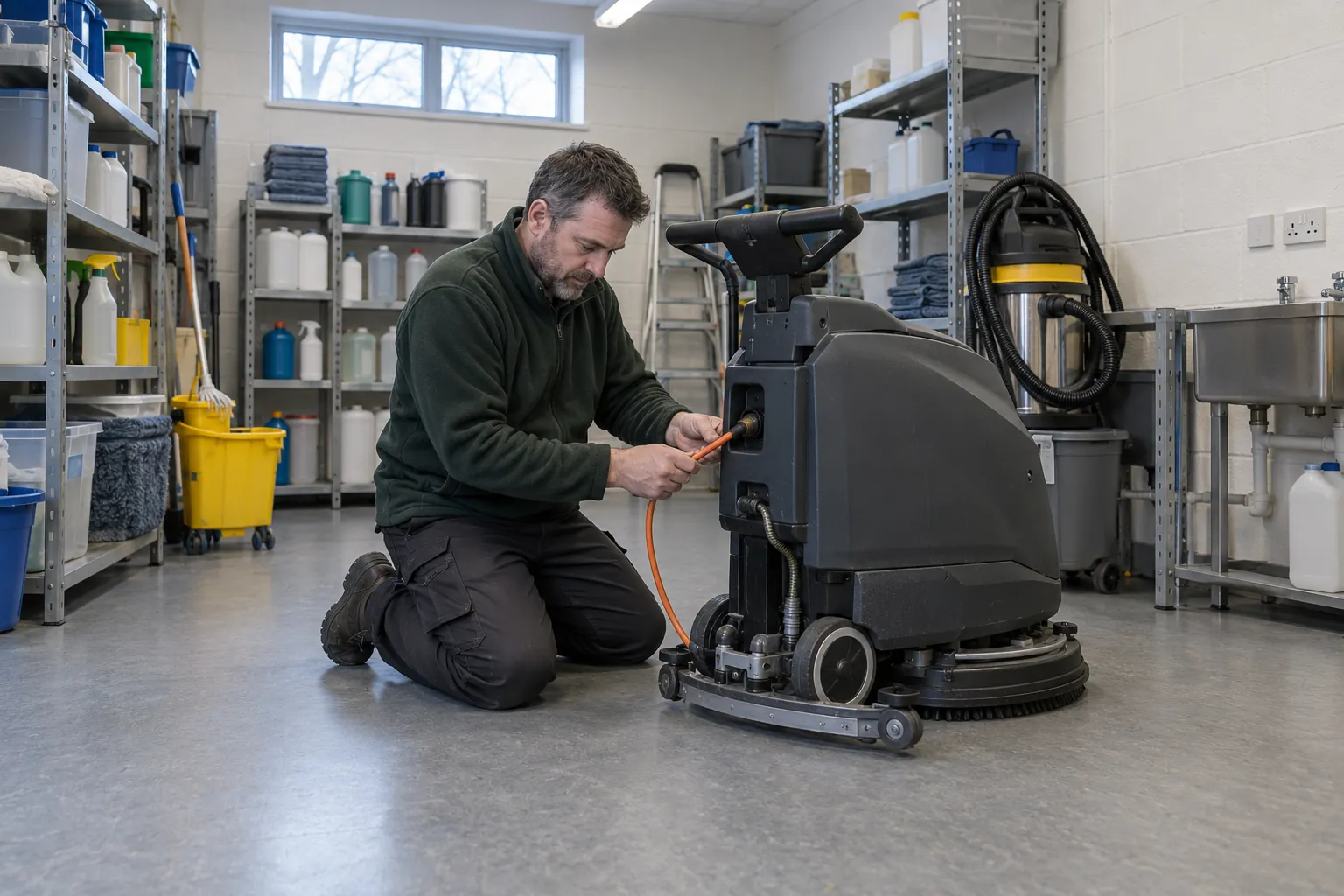
- cleaning equipment: vacuum cleaners, floor scrubbers and polishers, carpet cleaners and pressure washers, which are moved constantly and dragged by their leads;
- kitchen and canteen equipment: kettles, toasters, mixers and meat slicers, the examples the HSA gives in its safety alert on electrical hazards in restaurants and kitchens, and microwaves;
- caretaker and maintenance tools: drills, grinders, heat guns, work lights and portable heaters;
- extension leads and multi-way adaptors, which take the same wear as the equipment plugged into them;
- office equipment that is plugged in and out, such as projectors, fans and desk lamps, and equipment that rarely moves, such as photocopiers and desktop computers.
Not everything needs the same treatment. Regulation 81(1)(c) and 81(2) apply to equipment that is both exposed to conditions causing deterioration and supplied above 125 volts AC. The HSA's guide says that equipment below 125 volts AC “is not specifically included in Regulations 81(1)(c), 81(2) and 81(3) but must be maintained in a manner fit for safe use”, and “should be subject to an appropriate inspection regime”. It also says that equipment “located in environments where it is safe from accidental damage or environmental degradation and that is rarely moved should not need to be tested unless a risk assessment shows otherwise”.
The fixed installation is separate. The wiring, distribution boards and sockets fall under Regulation 89, which since S.I. No. 732 of 2007 requires an existing installation to be tested by a competent person “from time to time where required having regard to the nature, location and use of the installation”, with a report of the test. The HSA's Guidance-Note on Periodic Inspection and Testing of Electrical Installations (November 2014) covers that regime and says it “is not aimed at appliances, which take their supply via the electrical installation”.
Medical electrical equipment is outside Part 3 under Regulation 75(2)(b), though it must still be maintained and used so as to prevent danger; in a nursing home or GP surgery, Regulation 81 still reaches the kettle and the floor scrubber.
03
The three parts: the user's check, the inspection and the test
Regulation 81 describes three levels of attention: the user's check, and the inspection and test by a competent person.
- The user's visual check, before use. The HSA's Part 3 guide says employees should visually check portable equipment before they use it for “obvious damage on the equipment enclosures and insulation”, “obvious damage to the cable or lead supplying the equipment or evidence of any temporary repairs such as taped connections”, “loose connections or loose cabling”, “damage to the plug tops or sockets being used” and “scorch or burn marks on the equipment, leads or plug tops”. Employees “should be instructed in the carrying out of these checks”.
- The periodic inspection by a competent person. A more systematic look, by someone “competent to establish the ongoing safety of the electrical equipment”, in the guide's words. The HSA's risk assessment template for portable electrical appliances in schools lists the visual checks to make: the switch working, no damage to the casing, no loose parts or missing screws, the cable securely anchored to the plug with no cuts, frays, taped joints or signs of overheating, the plug with no cracked casing or loose or bent pins and a correctly rated fuse, and the socket outlet with no cracks or sign of overheating.
- The test and certificate, where appropriate. The combined inspection and electrical test that most people mean by a PAT test, carried out by a competent person with a test instrument, ending with the certification in Regulation 81(2)(b). Neither Regulation 81 nor the HSA's Part 3 guide lists which electrical tests make up a PAT test: Regulation 81(2) leaves the testing, and the judgement whether the equipment was safe, to the competent person. The HSA's guide says that “where required by manufacturers or where it is subject to heavy wear and tear, equipment will need to be tested”.
A fault found at any level has the same outcome. The guide says that employees discovering a defect “should not use the equipment and should report the defect to their supervisor”, and the schools template asks that defective equipment is “clearly identified, labelled as ‘out of use’ and stored separately to prevent accidental use”. Reporting is also a legal duty on the employee: section 13(1)(h) of the 2005 Act requires an employee to report, as soon as practicable, any defect in “any article or substance which might endanger” anyone's safety.
The RCD that protects the socket needs checking too. The HSA's Part 3 guide says an RCD “must be tested by regular operation of the test trip button, as stipulated by the device manufacturer”, with a competent person's functional test as part of the installation tests; its 2014 guidance note recommends a push-button test “at least twice per year”.
04
How often PAT testing should be done
There is no fixed interval in Irish law, for the inspection or for the test. Regulation 81(1)(c) asks for periodic inspection “appropriate to the nature location and use of the equipment”, and the HSA's Part 3 guide says that “the nature and frequency of these inspections will vary dependent on the use and location of the equipment” and that “the frequency of inspections should be related to the likelihood of equipment damage”. An annual test of every item is a habit, not a legal requirement, and for some equipment it is not frequent enough.
The questions that set a sensible interval come from the Regulations' own words:
- How hard is it used, and how often is it moved? A floor scrubber that goes round a school every evening, dragged by its lead and stored wet, wears faster than a desk lamp that never moves.
- Where is it used? Kitchens, plant rooms, workshops, outdoor areas and anywhere wet or dusty are a harder environment for equipment than a carpeted office.
- Who uses it? Equipment shared by many people, or by contractors or students, is less likely to be looked at before use.
- What does the manufacturer say? The guide makes testing necessary where the manufacturer requires it.
- What have previous inspections found? Repeated faults mean the interval is too long; years with none may justify a longer one, and the risk assessment should say why.
Some events call for a check outside the cycle. The general rule on inspecting work equipment, Regulation 30 of the same Regulations, which the HSA's guide describes as “closely related” to the Regulation 81 duty to keep portable equipment fit for safe use, requires “special inspections” when exceptional circumstances arise that are liable to make work equipment unsafe, “including modification work, accidents, natural phenomena or prolonged inactivity”. In practice that means inspecting and, where appropriate, testing equipment after a repair, after it has been dropped or got wet, and before equipment that has been in store for a long time goes back into use. The same applies to equipment brought in from home, such as a personal heater: the risk assessment should say whether it is allowed and how it is brought into the regime.
05
Certificates, records and what good evidence looks like
Regulation 81 makes the certificate the formal output of a test: the competent person certifies whether each item, including its cables and plugs, was safe on the day of the test, and an item certified unsafe stays out of use until it is made safe and certified again. Regulation 30(d), on inspections of work equipment exposed to conditions causing deterioration, requires the results to be “recorded and kept available for 5 years from the date of inspection” for an inspector, with access for users on request. The HSA's schools template, for its part, lists among its control measures that equipment subject to heavy wear and tear “is tested periodically by a competent person and records of the test kept”.
A record that lets you manage the risk, rather than only answer an inspector, holds:
- a register of portable equipment by area, with what it is, whether it is supplied above 125 volts AC, and the interval decided for inspection and for testing;
- periodic inspection results: the date, the inspector, each item inspected and what was found, passes included;
- test certificates and results from the competent person, filed against the register so that a missing item shows;
- faults and their outcome: who reported it, when it was taken out of use, and whether it was repaired, retested and certified, or disposed of;
- RCD checks: the push-button test of each device, and the competent person's functional tests;
- reviews of the intervals, with the reason for each change, linked to the risk assessment.
What makes the record believable: entries made at the time, faults recorded by item rather than “all OK”, every fault matched by an outcome, and gaps explained. Keeping the register and certificates with the documents behind the safety statement puts the risk assessment, the intervals and the evidence together.
06
Where the record fails, and what SiteClara does about it
The test visit is the visible part of Regulation 81: a contractor arrives, labels go on, certificates follow. The rest leaves little trace. The user's check before use is done, or not, by whoever picks up the scrubber. The periodic inspection of the staff kitchen or the cleaners' store slips because nobody asks for it. A scorched plug or a taped lead is mentioned to whoever is passing, and the item is back in use the next morning. When the next test comes round, nobody can say what was looked at in between, or what happened to the faulty kettle.
SiteClara puts a printed QR poster, with an optional NFC tag behind it, at each location where checks happen, such as a staff kitchen, a cleaners' store, a caretaker's workshop or a plant room corridor. The person doing the check scans the code or taps the tag on their own phone, with no app to install, sees the checks due at that location, such as the periodic visual inspection of that kitchen's appliances or the RCD push-button test on that floor's board, and marks each one done or says what stopped them, with a photo when one is asked for. The named person and the time are recorded as it happens. A damaged lead or a scorched plug reported at the location, with a photo, goes onto the team's list of jobs and stays open until someone closes it.
The supervisor sees what is due, done and missed, and records the reason a check was missed. Each day they review and approve a report that goes to nominated management or client contacts the next morning, showing what was reported, completed and still open, and how the scheduled checks went. That gives the inspections between tests a record made at the time, and a reported fault an owner and an outcome.
07
Questions people ask
What is PAT testing and what is its purpose?
PAT testing (portable appliance testing) is the inspection and electrical testing of portable equipment by a competent person, to establish whether it is safe. Under Regulation 81(2) of the General Application Regulations 2007 the competent person certifies whether the equipment, “including any cables and plugs”, was “on the day of test, as far as could reasonably be ascertained, safe and without risk” to anyone coming into direct or indirect contact with a live part. The HSA's Part 3: Electricity guide gives the reason it matters: portable equipment is “more susceptible to damage than fixed electrical equipment” and “is often directly in contact with the user”.
Is PAT testing mandatory in Ireland?
In effect, yes, for portable equipment exposed to conditions causing deterioration and supplied above 125 volts AC. Regulation 81 of the General Application Regulations 2007 requires that equipment to be checked by the user before use, periodically inspected by a competent person and, “where appropriate”, tested and certified, though it never uses the term “PAT testing” and sets no fixed interval.
How often should PAT testing be done?
As often as the equipment's use and location require: Irish law sets no fixed interval. The HSA's Part 3: Electricity guide says the frequency of inspections “should be related to the likelihood of equipment damage”, and the interval belongs in the employer's written risk assessment, reviewed in the light of what inspections find.
Do small appliances need PAT testing?
Not because they are small: a kettle, toaster or extension lead is portable equipment, and what decides testing is whether it is exposed to conditions causing deterioration and supplied above 125 volts AC. The HSA's Part 3: Electricity guide says equipment safe from accidental damage and rarely moved “should not need to be tested unless a risk assessment shows otherwise”, while equipment supplied below 125 volts AC must still be “maintained in a manner fit for safe use”.
08
Where to read more, and a list to take away
Start with Regulations 74, 81 and 88 of the General Application Regulations 2007, read with S.I. No. 732 of 2007, and the HSA's Guide to Part 3: Electricity. For the wiring and sockets, see the HSA's Guidance-Note on Periodic Inspection and Testing of Electrical Installations; schools can use its risk assessment template for portable electrical appliances. For the wider round of checks, see the health and safety inspection checklist.
To keep portable equipment safe and show that it is:
- list the portable equipment in each area, noting what is supplied above 125 volts AC and what is exposed to wear, damp or heavy use;
- set a schedule of intervals for inspection and testing in the written risk assessment;
- instruct every user in the check before use, and make reporting a fault easy;
- have a competent person inspect periodically, and record it, passes included;
- have a competent person test and certify, and file each certificate against the register;
- take faulty equipment out of use at once, label it, and record its repair or disposal;
- press the test button on each RCD regularly, and record it;
- review the intervals against what the inspections find.
Sources
Every document this guide quotes or links to, in the order it first cites them.
- Safety, Health and Welfare at Work (General Application) Regulations 2007 (S.I. No. 299 of 2007) irishstatutebook.ie
- General Application (Amendment) Regulations 2007 (S.I. No. 732 of 2007) irishstatutebook.ie
- Risk assessment under section 19 of the Safety, Health and Welfare at Work Act 2005 irishstatutebook.ie
- Guide to the General Application Regulations 2007, Part 3: Electricity hsa.ie
- Safety alert on electrical hazards in restaurants and kitchens hsa.ie
- Guidance-Note on Periodic Inspection and Testing of Electrical Installations hsa.ie
- Risk assessment template for portable electrical appliances in schools hsa.ie
- Section 13(1)(h) of the 2005 Act irishstatutebook.ie
- Section 2(2) of the 2005 Act irishstatutebook.ie
Related guides
 Premises and facilities managementHealth and safety inspection checklist: what to walk, what to record, and what the HSA looks forA workplace health and safety inspection in Ireland: the 2005 Act and 2007 Regulations, what to walk, how often, recording actions, and what an HSA inspector asks.
 Premises and facilities managementSafety statement: what the 2005 Act requires, and how to show it is followedWhat a safety statement must contain under section 20 of the Safety, Health and Welfare at Work Act 2005, who needs one, when to review it and how to show it works.
 Premises and facilities managementBuilding maintenance checklist: what to check in an Irish building, how often, and who byA building maintenance checklist for non-domestic buildings in Ireland: daily to annual checks under the 2005 Act, the 2007 Regulations and the Fire Services Acts.
 Premises and facilities managementPlanned preventative maintenance: how to plan it in an Irish building and prove it was donePlanned preventative maintenance (PPM) in Ireland: the duty behind it, building a PPM schedule, the statutory tasks and the records that prove it was done.