Premises and facilities management
Welfare facilities at work: what the law requires, and how to keep them right
Welfare facilities are the toilets, washbasins, drinking water, places to eat and rest, changing rooms and lockers that every employer in Ireland must provide, maintain and keep clean for employees, under section 8 of the Safety, Health and Welfare at Work Act 2005 and Regulations 18 to 25 of the General Application Regulations 2007, with separate rules for construction sites in Part 14 of the Construction Regulations 2013.
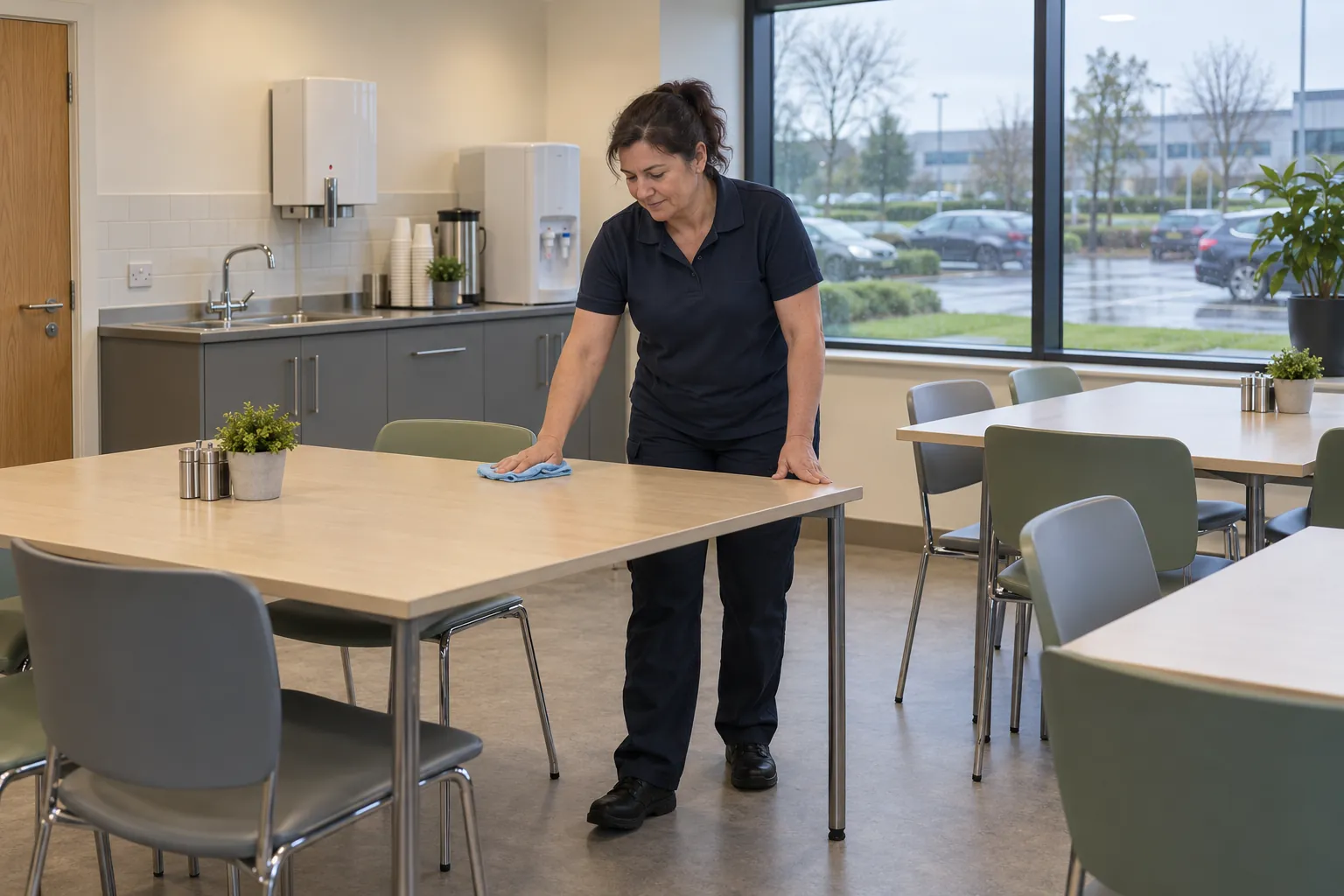
The law says what must be there and leaves the employer to decide how often to check it. This guide covers what each facility involves, what changes on a building site, who is responsible in a shared building, and how to keep a record that shows the facilities are kept right.
01
The duty: what Irish law means by welfare facilities
The general duty is in the Safety, Health and Welfare at Work Act 2005, section 8. Section 8(2)(f) makes part of every employer's duty "providing and maintaining facilities and arrangements for the welfare of his or her employees at work". Note both verbs: a canteen with a broken kettle and no clean table has been provided, but not maintained.
The detail is in Chapter 1 of Part 2 of the Safety, Health and Welfare at Work (General Application) Regulations 2007 (S.I. No. 299 of 2007):
- Regulation 18: a clean place of work, seating where the work allows it, "an adequate supply of potable drinking water" at points "conveniently accessible to all employees", facilities for boiling water and taking meals (or reasonable access to others), and no eating where there is a risk to safety, health or welfare.
- Regulation 19: rest rooms or rest areas where the work or the number of employees requires them.
- Regulation 20: sanitary and washing facilities, which the employer must "provide and maintain and keep in a clean state", with an adequate number of lavatories and washbasins with hot and cold running water, and showers where the work requires them.
- Regulation 21: changing rooms where special work clothes are worn, and otherwise a place for everyone to store their clothes and personal effects.
- Regulations 22 to 25: fixed living accommodation, outdoor workstations, a place where pregnant, postnatal and breastfeeding employees are "able to lie down to rest in appropriate conditions", and facilities organised for people with disabilities.
Regulation 4's definition of a place of work for Chapter 1 leaves out some places, among them temporary or mobile work sites, "including construction sites". Those have their own rules in Part 14 of the Safety, Health and Welfare at Work (Construction) Regulations 2013 (S.I. No. 291 of 2013).
The Health and Safety Authority's Guide to the Safety, Health and Welfare at Work (General Application) Regulations 2007, Chapter 1 of Part 2: Workplace (December 2007) explains each regulation. The quotations here are from the Regulations as made and the HSA's guidance; check the current text on the Irish Statute Book if an amendment matters to your case.
02
What welfare facilities a workplace needs
The Regulations say "adequate" and "suitable" more often than they give a number. For an office, shop, school, hotel, warehouse or factory, the HSA's workplace guide fills in what those words mean:
- Toilets. For numbers, the guide reproduces tables from BS 6465-1:2006, the British Standard on sanitary facilities, counted on the most people likely to be at work at one time; the full standard is a paid publication from the British Standards Institution. Staff toilets should be separate from toilets for other users, on the same floor or one floor above or below unless a lift serves the others, and separate for men and women unless each is a single room lockable from inside.
- Washing. Running hot and cold, or warm, water, soap and clean towels or another means of drying, near the toilets. The guide discourages "the single towel for use by many" and says hot water must be controlled to prevent scalding. Showers are needed for heavy work or harmful substances.
- Drinking water at points employees can reach, more of them where the workplace is large or people must stay at a workstation. Drinking fountains should have a shielded nozzle.
- Somewhere to eat and make a hot drink, provided by the employer or shared with other employers at the same location. It must have a means of boiling water; tables should be easy to clean, seats should have backs, the area should be lit and heated, and damaged tables or chairs replaced without delay. Meals must not be taken where substances, vehicle fumes or other hazards present a risk.
- Somewhere to rest, where the work is arduous or done in dust, fumes, noise, heat or cold; offices where people can relax during breaks are excepted. A canteen may serve as a rest area if nobody has to buy food to use it.
- Changing and storing clothes: changing rooms with seating where special work clothes are worn, and a way to dry damp work clothes. In offices, separate pegs or hooks at least 31 cm apart, with somewhere for personal effects, can be enough.
- Somewhere to lie down for pregnant women and nursing mothers, when possible near the toilets and washing facilities, with adequate space, heating and lighting.
For accessible toilets the guide refers to the Building Regulations Technical Guidance Document M.
03
Welfare facilities on construction sites
Part 14 applies on every construction site, meaning any site where construction work is carried out for a project. The 2013 Regulations define construction work as "any building, civil engineering or engineering construction work", so it covers road works and other civil engineering projects as well as new buildings, extensions and fit-outs.
On a building site the duty falls on the contractor responsible for the construction site, under regulations 98 to 105 of the Construction Regulations 2013, and unlike the 2007 Regulations, Part 14 gives numbers:
- Shelter, meals and drinks (regulation 98): enclosed shelter for bad weather and clothing, with means to warm up and dry wet clothes where more than 5 people are at work; tables with impermeable surfaces and seats with backs for meals; facilities for boiling water, and for heating food where more than 5 are at work and hot food is not otherwise available; and potable drinking water at a convenient point. All of it must be ventilated, lit, "kept in a clean, hygienic and orderly condition", and not used to store building materials or plant.
- Lockers (regulation 99): changing rooms where special work clothes are worn, otherwise a place for everyone to lock away their clothes and personal effects.
- Washing (regulation 100): for work expected to last more than 30 working days, basins, soap and towels, and hot and cold or warm running water. Over 100 people for more than 12 months: 6 washbasins plus one for every further 20 or part of 20. Where a dangerous substance is used: nail brushes and one basin for every 5 people.
- Toilets (regulation 101): at least one, not just a urinal, for every 20 people, private, with a proper door and fastening, accessible at all times and "maintained in a clean and hygienic condition". Under regulation 101(2) fewer than 20 people count as 20 and other numbers round down to a multiple of 20, so 45 people need at least two. Over 100 people, with enough urinals, the scale is one per 25 up to 100 and one per 35 after.
- Regulations 102 to 105: living accommodation, safe access to every facility, pregnant women and nursing mothers, and people with disabilities.
The project supervisor for the construction stage (PSCS) must, under regulation 17(3), co-ordinate arrangements for "the provision and maintenance, in an appropriate condition, of site welfare facilities" and monitor them. On a site with several contractors, that duty stops each one assuming somebody else is cleaning the canteen cabin.
The HSA's construction Welfare Facilities frequently asked questions set the rules out plainly. The leaflet Requirements for Construction Site Welfare Facilities, from the Construction Safety Partnership Advisory Committee and published by the HSA, says "a core aspect of the provision of welfare facilities is an adequate maintenance plan" and that "Site Rules for monitoring the provision, upkeep and use of welfare facilities should be prepared".
04
Who is responsible in a shared or contracted building
- The employer keeps the duty to its own employees even when a contractor does the cleaning and a landlord owns the canteen. The contract is how the duty is carried out, not a way of handing it over.
- The person in control of the building, such as a landlord or managing agent in a multi-let office block, business park or shopping centre, must under section 15 of the 2005 Act ensure, so far as is reasonably practicable, that a non-domestic place of work made available to others, its access and egress, and anything provided for use there are safe and without risk to health. Anyone obliged by contract or tenancy to maintain or repair it has that duty to the extent of the obligation. Who cleans and stocks common toilets and shared tea stations is then a matter for the lease and service contract, which is why it should be written down.
- Employers who share a place of work must co-operate and co-ordinate under section 21 of the 2005 Act. The HSA notes that employers may provide facilities jointly.
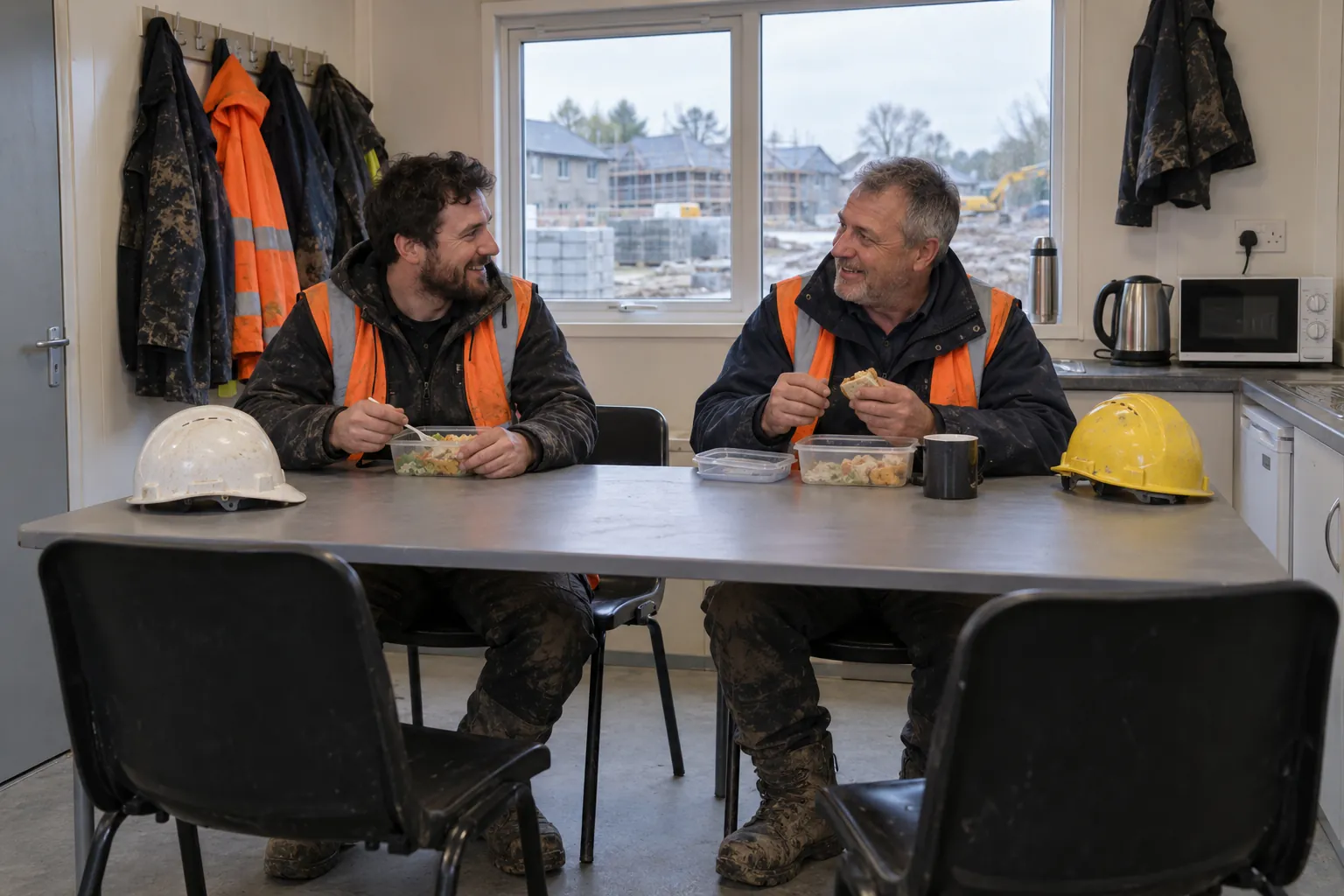
- The cleaning, security or catering contractor is an employer too. Its staff need somewhere to change, eat and wash; a cleaner whose only rest area is the cleaning store is a welfare problem in its own right.
Whatever the arrangement, the safety statement and the service contract should say which facilities each employer's staff use, who cleans and restocks each one and how often, and who a fault goes to. Someone should own each fault until it is fixed.
05
How often to check welfare facilities, and what to look for
No Irish law sets a frequency. Regulation 18 asks for cleaning "as frequently as necessary to maintain an appropriate level of safety and health". A starting point of our own, not a rule:
- Toilets and washrooms: several times a day in busy buildings; the toilet cleaning checklist guide covers each check.
- Canteen or tea station: after each main break, with a full clean daily: tables, sink, kettle and microwave working, fridge cleared, bins emptied.
- Drinking water points, rest rooms, changing rooms and showers: daily, that they work, are clean and are stocked.
- The room for nursing mothers: weekly, and always that it is available and not used as a store.
- Site welfare cabins: daily, including heating, drying, water and toilets, and kept clear of materials and plant.
The same failures turn up everywhere: the canteen turned into a store room, the water point "out of order" for a month, the shower that runs cold, the accessible toilet with its alarm cord tied up, and the night shift that finds the canteen locked. So a useful check asks whether each facility is there, works, is stocked, and can be used by the people it is for at the hours they work.
Safety representatives look at the same things: the HSA's General Inspection Checklist for Safety Representatives (July 2022) asks "Are welfare facilities, e.g. toilets and canteen, clean and tidy?", and a health and safety inspection checklist usually does too.
06
Where the welfare record fails, and what SiteClara does about it
In most buildings the welfare record is a sheet on the back of the toilet door, a weekly line reading "welfare facilities: satisfactory", or nothing. The sheet covers the toilets but not the canteen, the changing room or the drinking water. The weekly line is ticked from the office. Faults are mentioned to whoever is passing, and the cold shower is still cold a fortnight later because nobody owned it. On a site with several contractors, the welfare cabin belongs to everyone and so to no one.
SiteClara puts a tag at each welfare facility: the toilets, the canteen, the changing room, the water point, the site welfare cabin. It is a printed QR code, with an NFC tag behind it if staff should tap rather than scan. A member of the team scans or taps it on their own phone, with no app to install, and completes the check; the time and the person are recorded as it happens. If something is wrong, they report it there, with a photo if it helps, and it goes onto the team's list of jobs until someone closes it.
Scheduled checks are set per location, so the busy toilets can be due every two hours and the room for nursing mothers weekly. Staff see what is due and mark it done, or say what stopped them; the supervisor sees what was missed and records why. At the end of the day the supervisor reviews the checks and photos and approves a report that goes to nominated management or client contacts the next morning, showing what was completed, what was reported and what is still open.
07
Questions people ask
What is a welfare facility?
A welfare facility is something an employer provides for the basic needs of people at work: toilets, washing facilities, drinking water, somewhere to eat and rest, somewhere to change or keep clothes, and somewhere for pregnant and breastfeeding employees to lie down. Section 8(2)(f) of the Safety, Health and Welfare at Work Act 2005 requires employers to provide and maintain them.
How many toilets does a workplace need in Ireland?
In an ordinary workplace the 2007 Regulations ask for an "adequate number", and the HSA's workplace guide uses the tables in BS 6465-1:2006. On a construction site, regulation 101 of the 2013 Regulations requires at least one toilet that is not just a urinal for every 20 people at work.
Does an office need a separate rest room?
Usually not. Regulation 19 of the General Application Regulations 2007 requires a rest room or rest area where the work or the number of employees makes it necessary, but excepts people employed "in offices or similar workrooms providing relaxation during breaks".
08
Where to read the official guidance, and a list to take away
Read section 8(2)(f) of the Safety, Health and Welfare at Work Act 2005 with sections 15 and 21; Regulations 18 to 25 of the General Application Regulations 2007 with the HSA's Guide to the General Application Regulations 2007, Chapter 1 of Part 2: Workplace; and, for building sites, Part 14 of the Construction Regulations 2013 with the leaflet Requirements for Construction Site Welfare Facilities. Food businesses have food hygiene law to meet as well, which is outside this guide.
Before the next inspection, check that:
- everyone, including cleaning, security and night staff, has toilets, washing, drinking water and somewhere to eat, at the hours they work;
- the number of toilets and washbasins has been checked against the HSA guide, or regulation 101 on a building site;
- there is a rest area where the work calls for one, and a room where pregnant women and nursing mothers can lie down that is not used as a store;
- the safety statement and service contracts say who cleans, restocks and repairs each facility, and how often;
- on a construction site, site rules for monitoring the provision, upkeep and use of welfare facilities have been prepared, and the PSCS is co-ordinating and monitoring the welfare arrangements;
- checks are recorded with the actual time and a person's name, and faults are owned until fixed;
- a supervisor walks the facilities unannounced and signs the record.
Sources
Every document this guide quotes or links to, in the order it first cites them.
- Safety, Health and Welfare at Work Act 2005, section 8 irishstatutebook.ie
- Safety, Health and Welfare at Work (General Application) Regulations 2007 irishstatutebook.ie
- Safety, Health and Welfare at Work (Construction) Regulations 2013 irishstatutebook.ie
- Guide to the Safety, Health and Welfare at Work (General Application) Regulations 2007, Chapter 1 of Part 2: Workplace hsa.ie
- Welfare Facilities frequently asked questions hsa.ie
- Requirements for Construction Site Welfare Facilities hsa.ie
- Section 15 of the 2005 Act irishstatutebook.ie
- Section 21 of the 2005 Act irishstatutebook.ie
- General Inspection Checklist for Safety Representatives hsa.ie
Related guides
 CleaningToilet cleaning checklist: what to check, how often, and a record that stands upWhat a toilet cleaning checklist should cover in an Irish workplace, how often to check, the duty in Regulation 20 of the 2007 Regulations, and a credible record.
 Premises and facilities managementSafety statement: what the 2005 Act requires, and how to show it is followedWhat a safety statement must contain under section 20 of the Safety, Health and Welfare at Work Act 2005, who needs one, when to review it and how to show it works.
 Premises and facilities managementHealth and safety inspection checklist: what to walk, what to record, and what the HSA looks forA workplace health and safety inspection in Ireland: the 2005 Act and 2007 Regulations, what to walk, how often, recording actions, and what an HSA inspector asks.
 Premises and facilities managementFacilities manager responsibilities in Ireland: what the role covers, and how to show it is doneWhat a facilities manager in Ireland is responsible for: 2005 Act and Fire Services Acts duties, maintenance, contractors, budgets, the compliance year and records.