Premises and facilities management
Facilities manager responsibilities in Ireland: what the role covers, and how to show it is done
A facilities manager is responsible for keeping an organisation's buildings safe, compliant and working for the people in them: in Ireland that means carrying out the employer's and the person in control's duties under the Safety, Health and Welfare at Work Act 2005 and the Fire Services Acts 1981 and 2003, running planned and reactive maintenance, managing cleaning, security and other services and the contractors who deliver them, holding the budget, and reporting to senior management.
Also written for United Kingdom · United States · Canada · Australia · New Zealand · South Africa
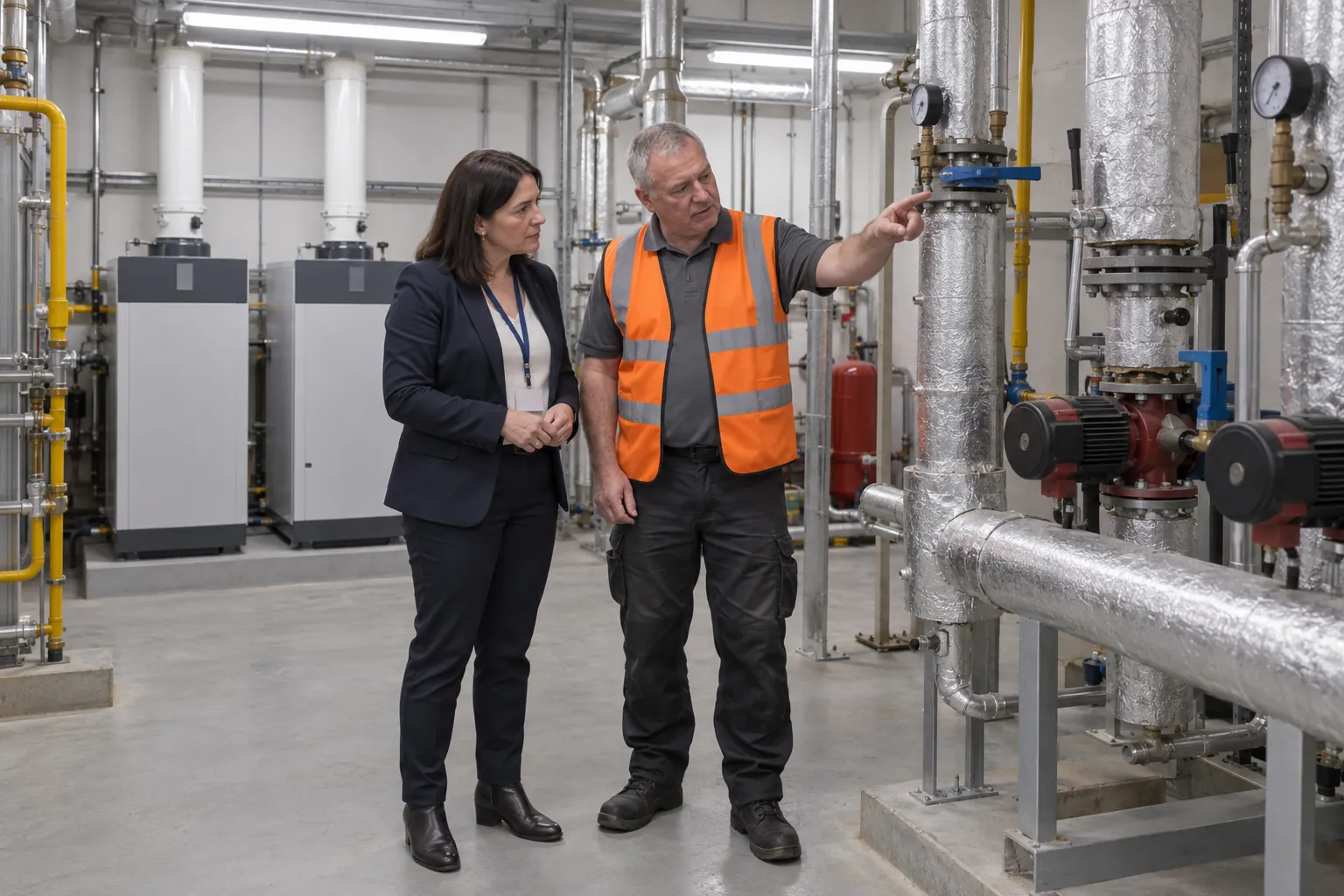
Most of the work is done through other people's hands, often across several buildings. This guide sets out the Irish law behind the role, the responsibilities job descriptions share, who holds each duty when work is outsourced, the compliance year, and what a good record looks like.
01
What a facilities manager is, and the Irish law behind the role
Facilities management is the work of keeping an organisation's buildings, and the services people rely on in them, fit for the organisation's purpose. A facilities manager, also called a facility manager or estates manager, leads that work, usually for a set of services across multiple buildings or a campus rather than one building. The international standard for the discipline is ISO 41001:2018, Facility management – Management systems – Requirements with guidance for use, which describes a management system for facilities management rather than listing tasks.
Most of the legal duties a facilities manager carries out belong in Irish law to the employer, or to whoever controls the premises. The facilities manager is how the organisation meets them. The main ones are:
- Section 8 of the Safety, Health and Welfare at Work Act 2005 requires every employer to ensure, so far as is reasonably practicable, the safety, health and welfare at work of employees, including maintaining the place of work "in a condition that is safe and without risk to health", safe access and egress, emergency plans, reporting accidents to the Health and Safety Authority (HSA), and obtaining "where necessary, the services of a competent person".
- Section 15 of the 2005 Act applies to anyone who has control to any extent of a non-domestic place of work used by people other than their own employees, or who has, "by virtue of any contract, tenancy, licence or other interest", an obligation to maintain or repair it. They must ensure, so far as is reasonably practicable, that it and its means of access and egress are "safe and without risk to health".
- Section 19 requires a written risk assessment, reviewed after a significant change, and section 20 the safety statement built on it, naming each person responsible for tasks assigned under it.
- Section 18 of the Fire Services Act 1981, as amended by section 29 of the Licensing of Indoor Events Act 2003, covers premises used for sleeping accommodation, care, teaching, assembly or public access, and any workplace. Every person having control over them must guard against the outbreak of fire, provide reasonable fire safety measures and procedures, and "ensure that the fire safety measures and procedures ... are applied at all times".
- The Safety, Health and Welfare at Work (General Application) Regulations 2007 (S.I. No. 299 of 2007, as amended), covering the workplace, work equipment and lifts, electricity, work at height and manual handling, and the Safety, Health and Welfare at Work (Construction) Regulations 2013 (S.I. No. 291 of 2013) whenever building or maintenance work counts as construction work.
Ireland is not the UK: there is no Regulatory Reform (Fire Safety) Order here. The HSA enforces safety and health at work, and the local fire authority fire safety. The Department of Housing, Local Government and Heritage's Fire Safety Guide for Building Owners and Operators (August 2023) names the facilities manager and the estates manager among the parties who "may hold or share in section 18(2) responsibilities", alongside owners, landlords, tenants and owners' management companies.
02
Key responsibilities of a facilities manager
Facilities manager job descriptions vary with the organisation, but the same duties appear in nearly all of them:
- Statutory and safety compliance: knowing which inspections, tests and risk assessments each building needs, making sure they happen on time, and holding the certificates, reports and the fire safety register. A building compliance checklist is the usual starting point.
- Health and safety: safe premises and safe work in them, the parts of the safety statement that concern the buildings, contractor control and permits to work, and accident reporting to the HSA.
- Building maintenance: planned preventative maintenance of heating, ventilation and air conditioning, electrical installations, plumbing, lifts, fire systems and the building management system, and reactive repairs when something fails. This is often called hard FM.
- Soft services: cleaning, security, reception, post, catering, waste and recycling, pest control and grounds, often called soft FM.
- Contractors and suppliers: specifying services, running tenders, choosing vendors, managing contracts and holding providers to agreed service levels.
- Budgets: setting and managing the operating budget, planning capital spend on plant and building fabric, and explaining variances.
- Space, workplace and projects: allocating space, planning moves and changes, running minor works and refurbishment projects, and keeping the workplace fit for the people in it.
- Critical incidents, energy and keys: what happens when power, water, heating or access fails and who attends out of hours, energy and utilities, and the master key record.
- Reporting to the business: telling senior management whether the estate is safe, compliant and on budget, and what it needs next, often in a monthly facilities management report.
A real Irish example shows the mix. Dublin City University's Facilities Manager job description (Estates Office) asks the post holder to oversee the day-to-day work of the Estates Office so that campus facilities are fit for purpose across "Grounds, Cleaning & Waste, Maintenance, Security (CCTV, Access Control, Intruder Alarms etc.), Campus Infrastructure, life safety systems, Utilities and Space management", and adds the helpdesk, a master keying record, and making sure contractors comply with Estates Office procedures, including the submission of "job specific method statements, RAMS and insurance details", as well as issuing work permits and supervising the work. It also makes out of hours Estates management presence on campus for critical incidents "an essential requirement of the role".
03
In-house, outsourced, and who holds the duty
How the work divides depends on the delivery model:
- In-house: the organisation employs its own caretakers, cleaners or maintenance staff, and the facilities manager manages that team directly.
- Single services outsourced: separate contracts for cleaning, security, mechanical and electrical maintenance and so on, each managed by the facilities manager.
- Bundled or total FM: one provider delivers most services under a single contract, and the facilities manager becomes an intelligent client, setting the specification and checking performance.
- Multi-unit developments: the common areas of an apartment development belong to the owners' management company, which usually engages a licensed managing agent; the Property Services Regulatory Authority's page on property management services publishes the agreement a licensee uses when engaged by one.
Outsourcing moves the work, not the duty. The organisation remains the employer under section 8 and, where it controls the premises, the person in control under sections 15 and 18. Section 15 also reaches a facilities company whose contract obliges it to maintain or repair a place of work, "to the extent of his or her obligation". The gov.ie fire safety guide says that where section 18(2) responsibilities are shared, the allocation of responsibility for maintenance, fire alarm and emergency lighting systems and evacuation procedures "should be clear to all parties involved", and that the person having control "may delegate specific fire safety duties" but keeps overall responsibility for making sure they are done.
The HSA's page on legionellosis makes the same point for water: employers sharing a place of work, and where applicable landlords, will need to liaise so that it is clear who does the overall risk assessment and who does "the relevant checks identified in the control plan, for example, the flushing of showers or temperature checks".
Write down, for each building and service, who does the work, who checks it and where the record is kept. Gaps in that table, most often between two contractors' teams, are where compliance failures come from.
04
The working week and the compliance year
Behind the day-to-day work of faults, complaints, contractors and quotes sits the compliance calendar. The gov.ie fire safety guide's recommended routine maintenance schedules say many of the daily, weekly and monthly activities "can be carried out without expert knowledge", while the quarterly, six-monthly and yearly work should be done by people competent in the system who can certify it to the relevant standard. A typical Irish calendar includes:
- Daily: escape routes unobstructed and final exit doors readily openable, the fire alarm panel showing normal operation or any fault logged and acted on, and the indicator on each emergency light working.
- Weekly: the fire alarm test, recording which trigger device was used, in line with I.S. 3218; a visual check of at least 25% of the emergency lighting so that all of it is seen every four weeks, under I.S. 3217; and the water checks the Legionella control plan gives each building.
- Monthly: every point where a fire extinguisher or hose reel is kept, and the monthly emergency lighting inspection.
- Periodic, by a competent person: servicing of the fire alarm, emergency lighting, extinguishers and sprinklers to their standards; testing of electrical installations, which the HSA's page on inspection and testing explains under Regulation 89 of the 2007 Regulations, with defects "rectified promptly"; and thorough examination of lifts and lifting equipment under Regulation 52 and Schedule 1 of the 2007 Regulations, every six months for a hoist or lift.
- Reviews: the risk assessments, safety statement and Legionella risk assessment when something significant changes, with each check, drill and service entered in the fire safety register, which the gov.ie guide calls "a living document" to be kept on the premises for the fire authority.
Two Irish duties catch facilities managers when work starts. The HSA's asbestos legislation page lists the Exposure to Asbestos Regulations 2006 to 2025 and the 2025 Code of Practice, and its page on asbestos surveys says a refurbishment or demolition survey "is required where the premises, or part of it, needs upgrading, refurbishment or demolition". And under Regulation 6 of the Construction Regulations 2013 the client must appoint, in writing, competent project supervisors for the design process and the construction stage where the work involves a particular risk, more than one contractor, or is notifiable (planned to last more than 30 working days or exceed 500 person days).
Accidents have their own clock. The HSA's page on accident and dangerous occurrence reporting says an injury that keeps an employee from their normal work for more than three consecutive days, excluding the day of the accident, must be reported to the HSA within ten working days, and a fatal accident immediately to the HSA or Gardaí, followed by the formal report to the HSA within five working days of the death.
Many teams keep this calendar in a CAFM system, smaller ones in a spreadsheet. Either way, each check needs an owner, a date and a record someone else can find and trust.

05
Qualifications, skills, and what good evidence looks like
There is no licence to practise as a facilities manager in Ireland and no single route in. Facilities professionals arrive from building services engineering, the trades, hospitality, property and office management, and work up from supervisor or assistant posts. Large estates set a high bar: the DCU job description asks for at least eight years' relevant experience in the operations and management of complex facilities, at least three of them as a manager, a primary degree or equivalent in a construction or engineering field, and "working knowledge of CAFM and BMS Systems". Smaller organisations often value practical experience over a degree.
The skills that matter most are organisation, contract and budget management, a working knowledge of building services and Irish regulation, and the ability to explain risk plainly to the business. A facilities manager who can say what is compliant, what is not, and what it will cost to fix is more useful to a board than one who reports everything as green.
Good evidence of the role being done well is not a thick folder. It is being able to answer, quickly and with a record behind each answer:
- Which statutory inspections and services are due in the next three months, and which are overdue?
- Were last week's routine checks done, in every building, and by whom?
- Which faults are open, how old are they, and who owns each one?
- Are the contractors delivering what the contract says, measured the same way each month?
- Where is the money going against budget, and what is coming?
06
Where the record fails, and what SiteClara does about it
Facilities managers usually have good records of what contractors certify and weak records of what happens every day. The weekly fire alarm test is in the register on site, the cleaning contractor's sheets stay in its store, and a fault mentioned at reception may never reach anyone. When the board asks whether last month's routine checks were done in every building, the honest answer is often an assurance rather than a record.
SiteClara records that routine work at the place it happens. A printed QR poster at each location, such as a toilet block, plant room, fire exit or bin store, with an optional NFC tag behind it, lets cleaning, security or caretaking staff scan the code or tap the tag on their own phone, with no app to install. They see the scheduled checks due there and mark each one done, or say what stopped them, with a photo when it helps. An issue reported there goes onto the team's list of open jobs until someone closes it, and the supervisor's queue groups open jobs by building and floor.
Each day the supervisor reviews the day's checks and photos and approves a short report, which goes to the facilities manager and other nominated contacts the next morning, showing what was reported, what was completed, what is still open and how the scheduled checks went. Where a cleaning provider and a security provider work in the same building, each can run its own staff, forms and approval.
07
Questions people ask
What are the 11 core competencies of a facility manager?
They are the International Facility Management Association's list, set out on IFMA's 11 Core FM Competencies page: finance and business; operations and maintenance; leadership and strategy; project management; real estate; sustainability; facility information and technology management; communications; risk management; occupancy and human factors; and performance and quality. IFMA says it established these areas through a Global Job Task Analysis, a survey of facility managers across the world that it calls the most comprehensive conducted for the FM industry.
What are the key skills of a facility manager?
Budget and contract management, a working knowledge of building services and the regulations that apply to them, and clear communication. Dublin City University's Facilities Manager job description (Estates Office) asks for experience of developing and managing a facilities and maintenance budget with cost control, of managing output specification contracts and in-house staff, and of maintenance and fault finding on plant such as boilers, HVAC, generators and switchgear. It also asks for a comprehensive knowledge of the regulatory environment, "working knowledge of CAFM and BMS Systems" and "excellent financial, verbal and written Communication skills".
08
Further reading, and a list to take away
The Irish Statute Book holds the Acts and regulations named above; the HSA and the gov.ie Fire Safety Guide for Building Owners and Operators explain them in practice.
If you are writing a facilities manager job description in Ireland, or starting in the role, check that you know:
- who the employer and the person in control are for each building, and which of their duties you carry out;
- the compliance calendar for each building, and who owns each line of it;
- where the fire safety register, the safety statement, the Legionella control plan and the asbestos survey for each building are kept;
- where each routine check is recorded, and how you would see that it was missed;
- how faults and accidents are reported, and how you know each one is closed;
- the budget, the capital plan, and what senior management expect to see from you and how often.
Sources
Every document this guide quotes or links to, in the order it first cites them.
- ISO 41001:2018, Facility management – Management systems – Requirements with guidance for use committee.iso.org
- Section 8 of the Safety, Health and Welfare at Work Act 2005 irishstatutebook.ie
- Section 15 of the 2005 Act irishstatutebook.ie
- Section 19 irishstatutebook.ie
- Section 20 irishstatutebook.ie
- Section 18 of the Fire Services Act 1981 irishstatutebook.ie
- Section 29 of the Licensing of Indoor Events Act 2003 irishstatutebook.ie
- Safety, Health and Welfare at Work (General Application) Regulations 2007 irishstatutebook.ie
- Safety, Health and Welfare at Work (Construction) Regulations 2013 irishstatutebook.ie
- Fire Safety Guide for Building Owners and Operators gov.ie
- Facilities Manager job description (Estates Office) dcu.ie
- Page on property management services psr.ie
- Legionellosis hsa.ie
- The HSA's page on inspection and testing hsa.ie
- Asbestos legislation page hsa.ie
- Asbestos surveys hsa.ie
- Accident and dangerous occurrence reporting hsa.ie
- IFMA's 11 Core FM Competencies page ifma.org
Related guides
 Premises and facilities managementBuilding compliance checklist: the statutory picture for a building in IrelandBuilding compliance checklist for non-domestic buildings in Ireland: fire, electrical, gas, water, asbestos, lifts, energy and access, who holds each duty and when.
 Premises and facilities managementFacilities management report: what to include, and what makes it believableWhat a facilities management report in Ireland should contain: the duties behind it, the fire safety register, statutory checks, OMC reporting and believable KPIs.
 Premises and facilities managementSafety statement: what the 2005 Act requires, and how to show it is followedWhat a safety statement must contain under section 20 of the Safety, Health and Welfare at Work Act 2005, who needs one, when to review it and how to show it works.
 Premises and facilities managementCAFM system: what it does, the Irish records it holds, and how to choose oneWhat a CAFM system does, the Irish maintenance and fire safety records it is asked to hold, and how to choose, implement and keep one honest on the ground.