Cleaning
Toilet cleaning checklist: what to check, how often, and a record that stands up
A toilet cleaning checklist records when each toilet was checked or cleaned, who did it, and whether the floors, toilets, basins, water, soap, toilet paper, towels and bins were in order, with any fault and who it was reported to.
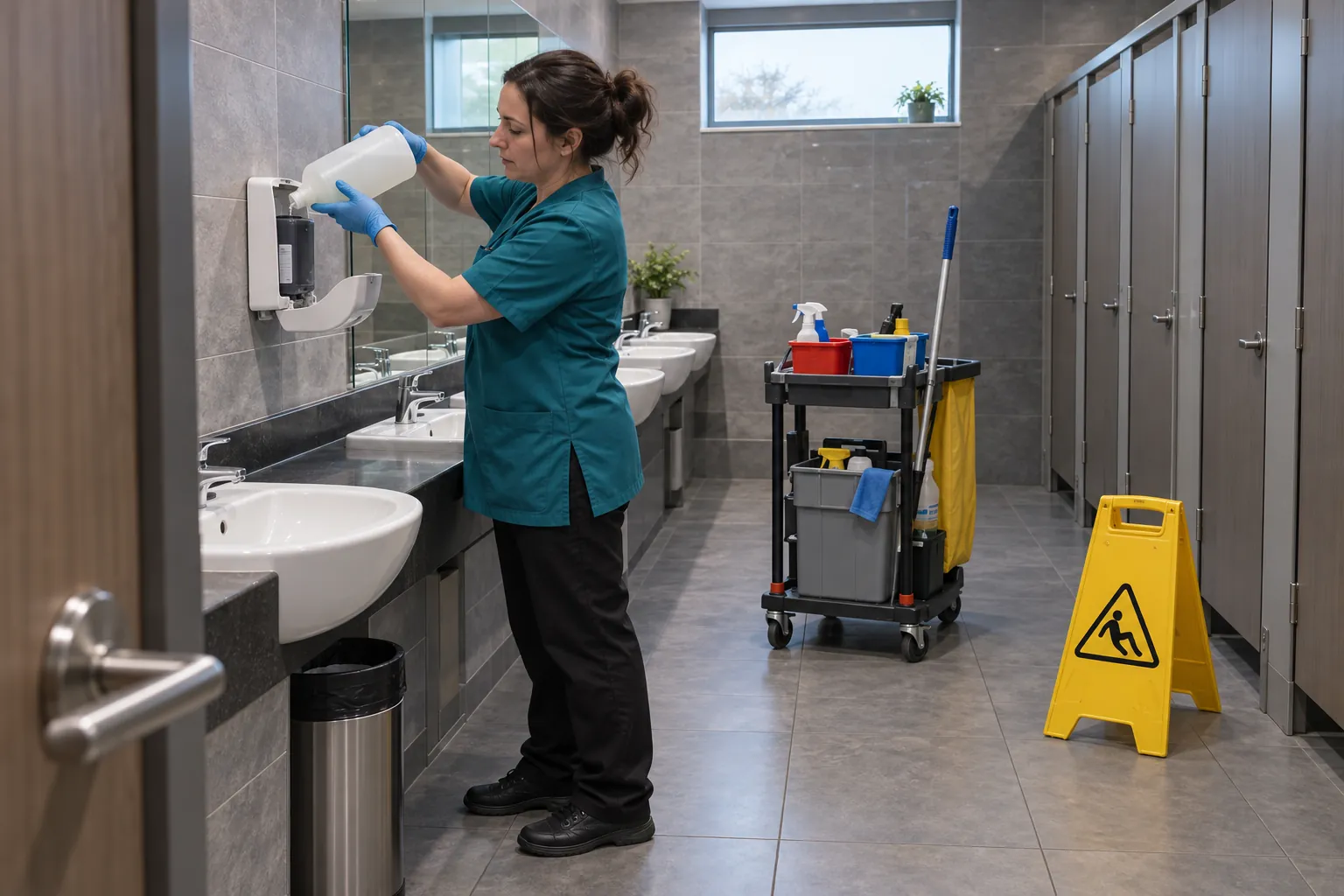
In many Irish workplaces it is the sheet on the back of the toilet door: the most visible cleaning record in the building, and often the least believed. This guide covers the legal duty behind it in the General Application Regulations 2007, what the checklist should cover, how often toilets should be checked and cleaned, who is responsible when the building is shared or the cleaning is contracted out, and what makes the record stand up when a client, a staff member or an HSA inspector asks about it.
01
The duty behind the checklist
No law in Ireland says you must pin a cleaning checklist to a toilet door. What the law requires is the outcome the checklist is meant to show: toilets and washbasins that are adequate, maintained and clean. The duty is in two places.
The first is the Safety, Health and Welfare at Work Act 2005, section 8. Every employer must ensure, so far as is reasonably practicable, the safety, health and welfare at work of their employees, and section 8(2)(f) names "providing and maintaining facilities and arrangements for the welfare of his or her employees at work" as part of that duty.
The second, and the specific one, is Chapter 1 of Part 2 of the Safety, Health and Welfare at Work (General Application) Regulations 2007 (S.I. No. 299 of 2007), which covers the workplace itself. Three of its regulations bear on toilets and cleaning:
- Regulation 20 says an employer "shall provide and maintain and keep in a clean state" adequate and suitable sanitary and washing facilities for employees, and "an adequate number of lavatories and washbasins, with hot and cold running water" in the vicinity of workstations, rest rooms, changing rooms and rooms housing showers. It also requires separate use of lavatories or washbasins for men and women when so required for reasons of propriety, and showers where the work or health requires them.
- Regulation 18 requires every place of work to be kept in a clean state, with accumulations of dirt, refuse and waste removed "by a suitable method as frequently as necessary to maintain an appropriate level of safety and health", and the floor of every workroom cleaned in the same way.
- Regulation 25 requires places of work, where necessary, to be organised to take account of persons at work with disabilities, naming washbasins and lavatories among the things to consider.
The words "keep in a clean state" are the reason the checklist exists. The Regulations set no frequency and ask for no particular record. They leave it to the employer to decide how often is often enough, and a checklist is how most employers, and most cleaning contractors working for them, show that the decision was made and carried out.
The Health and Safety Authority's Guide to the Safety, Health and Welfare at Work (General Application) Regulations 2007, Chapter 1 of Part 2: Workplace explains what the workplace regulations mean in practice. The quotations here are from the Regulations as made and from that guide, published by the HSA in December 2007; check the current text if an amendment matters to your case.
02
What a toilet cleaning checklist should cover
The HSA's workplace guide gives a practical picture of what adequate and suitable toilets and washing facilities look like. It says washing facilities should have running hot and cold, or warm, water, soap and clean towels or another suitable means of drying, and that the single towel used by many should be discouraged. WC compartments should be supplied with toilet paper and hooks, female toilet compartments with a suitable sanitary disposal unit, and cubicle doors should have locks that are easy to use and can be released from outside in an emergency. Washing facilities should be adequately lit, sufficiently ventilated, appropriately maintained and kept clean. The guide adds that hot water temperatures must be controlled to prevent scalding, and that a loose WC bowl should be secured before it falls over.
Those points turn directly into the lines of a checklist. A useful one records two things: that someone looked, and what they found. Each entry should carry:
- The date and the actual time of the check, written when it happened, not when it was due.
- Who checked: a name or initials that identify one person, not the name of the cleaning company.
- Floors: dry, swept, free of paper and litter, with a wet floor sign out while a floor is wet.
- Toilets and urinals: clean inside and out, flushing, seats secure, cubicle locks working.
- Washbasins and taps: clean, draining, with hot and cold, or warm, water running.
- Supplies: toilet paper, soap, and paper towels or a working hand dryer, restocked if low. Hand washing is the first thing to fail when the soap runs out.
- Bins: waste bins and sanitary disposal units emptied or within capacity.
- Ventilation and smell: extract fans running, no lingering odour.
- Lights, mirrors, hooks and fittings: working and intact.
- Faults found: a leak, a blocked toilet, a broken lock or light, and who it was reported to.
- Supervisor check: a separate column, completed less often, by someone who did not do the clean.
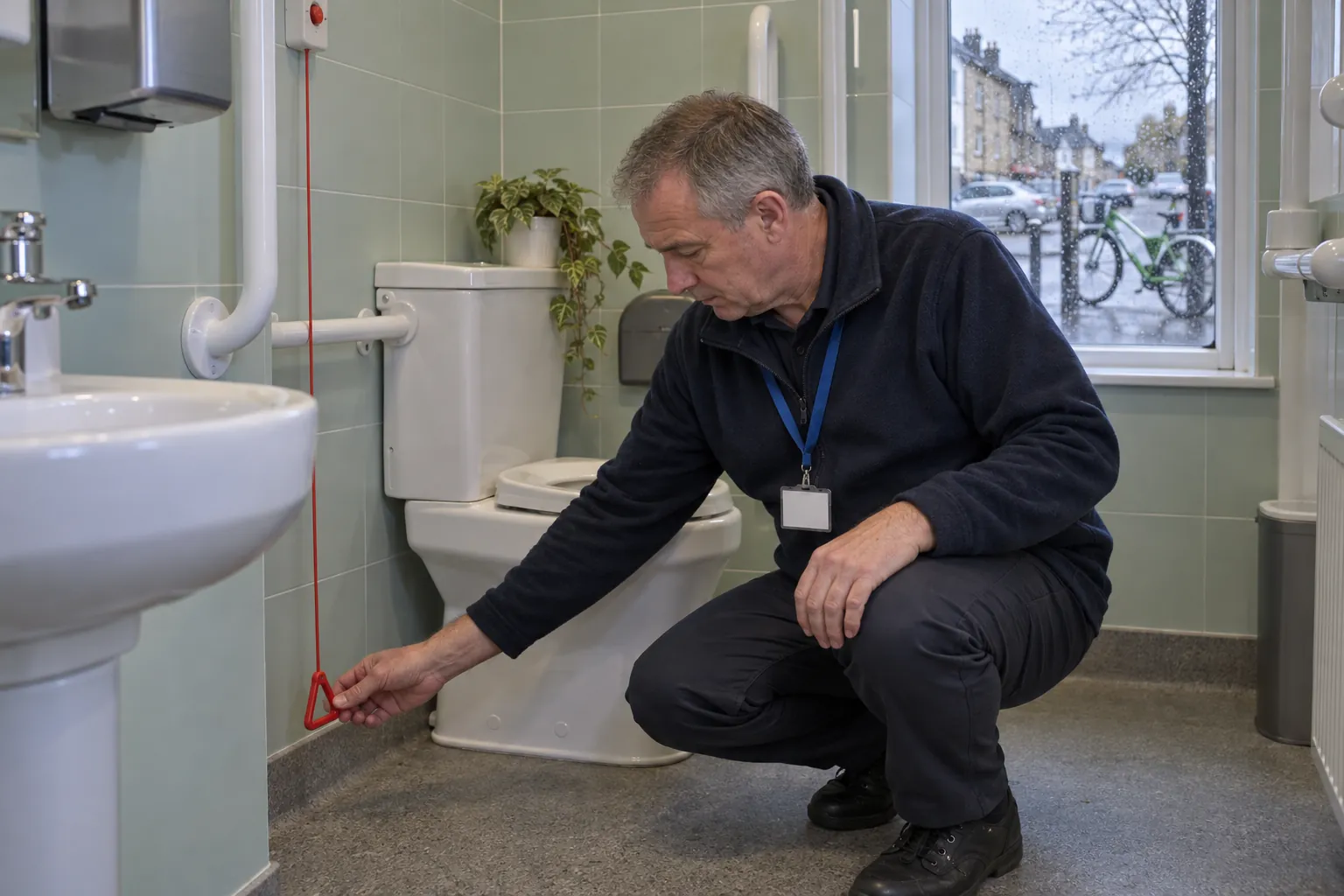
For an accessible toilet, add the things that matter to the person who depends on it: the alarm cord hanging free to the floor and not tied up out of the way, the grab rails secure, and the room not used as a store for cleaning equipment or boxes. Regulation 25 is the reason these belong on the list.
Keep the checklist short enough to complete honestly in the time available. A form with twenty boxes an hour gets ticked in one stroke at the end of the shift. Put it where the person checking will see it and fill it in on the spot: inside the door at eye height, in a clear holder, with a pen. In a shop, a hotel or a GP surgery, customers and patients read it too.
03
How often toilets should be checked and cleaned
There is no statutory frequency. Regulation 18 asks for cleaning "as frequently as necessary to maintain an appropriate level of safety and health", and the right interval follows how many people use the room and what the building is for. It should be written into the cleaning contract or specification, not left to whoever is on shift; the commercial cleaning checklist guide covers what goes into one.
As a starting point of our own, not a rule or a standard, which each building should adjust to its own pattern of use:
- Every 30 to 60 minutes: shopping centres, train and bus stations, stadiums and event venues at peak times.
- Every one to two hours: busy offices, schools and colleges during the day, hospital and GP waiting areas, gyms and leisure centres.
- Two or three times a day: quieter offices and staff-only toilets.
- At least once a day: every toilet in use, with a full clean.
Checks should follow use, not the clock alone: straight after the morning arrival, after lunch, after the school break, at half time. An hourly check through a quiet afternoon and none during the lunchtime rush produces a tidy sheet and a dirty room.
Evenings and weekends need the same thought. If the building is used for evening classes, weekend retail or a Saturday match, the checklist should show who covers those hours. Gaps at those times are the first thing a complaint will point to.
04
Who is responsible when the toilets are shared or contracted out
In a single-occupier building with its own cleaner, the answer is simple: the employer provides the toilets and keeps them clean. Most buildings are not that simple, and the checklist is often where the confusion shows.
- The employer keeps the duty under Regulation 20 for its own employees, even when it pays a cleaning company to do the work. The contract is how it discharges the duty; the checklist is how it can show that the contract is being delivered.
- The cleaning contractor is an employer too, with its own duties to its own staff, and under section 12 of the 2005 Act every employer must manage and conduct its undertaking so as to ensure, so far as is reasonably practicable, that people at the place of work who are not its employees are not exposed to risks to their safety, health or welfare. A wet floor with no sign is the contractor's problem as much as the client's.
- The person in control of the building, such as a landlord or a managing agent in a multi-let office block or shopping centre, has duties under section 15 of the 2005 Act where they have control of a non-domestic place of work made available to others, including anyone who has, by contract or tenancy, an obligation to maintain or repair it. Common-area toilets cleaned under the service charge fall here.
- Employers who share a place of work must co-operate and co-ordinate under section 21 of the 2005 Act. The HSA's workplace guide notes that employers may arrange among themselves to provide facilities jointly, and gives the sharing of facilities in shopping centres as an example.
Whatever the arrangement, three questions should have written answers: who cleans each toilet, how often, and who a fault goes to. A tenant's staff reporting a blocked toilet to the reception desk, the reception desk telling the cleaner, and the cleaner writing "blocked" on the sheet does not get it fixed. The checklist should say who the fault was reported to and when, and someone should own the job until it is closed.
The employer's safety statement is the natural place to record how welfare facilities are kept clean and who does it. In a shared building, section 21 requires employers who share the place of work to co-operate, co-ordinate and inform each other of risks, including by exchanging safety statements or relevant extracts. It is good practice for each tenant's statement and the landlord's arrangements to describe the same toilets in the same way.
05
What makes a toilet cleaning record believable
Anyone who has managed a cleaning contract has seen a checklist completed in advance, or every hour of the day ticked in the same pen at the same angle. Staff and clients know it too, so an unconvincing checklist can do more harm than none. The things that make a record believable are simple:
- It is written at the time. The time recorded is the time the check happened, not the time it was due.
- It names a person. Initials that identify one person carry weight; a company name does not.
- It shows exceptions. A record where nothing ever ran out and nothing ever broke is not believed. Notes such as "soap refilled" or "blocked toilet reported to facilities 14:20" show that someone looked.
- Someone else checks it. A cleaning supervisor who walks the toilets unannounced and signs the record a few times a week gives it independence.
- It is kept. Sheets thrown away each Monday cannot answer a complaint about last week. Keep them for as long as your contract or your insurer requires.
- Gaps are explained. A missed check with a reason, such as "room closed for plumber" or "covering spill in canteen", is more credible than a record with no gaps at all.
If a client, a staff member or an inspector asks, the question will be when the toilets were last checked, by whom, and what was done about the problem they saw. A good record answers all three without anyone having to reconstruct it, and it protects the operative too: a timed, named entry shows the room was right at the time.
06
Where the paper checklist fails, and what SiteClara does about it
Paper works well enough in one building with a steady team. It struggles when a contractor looks after many sites, when staff change often, or when a client wants the record rather than an assurance. The sheet stays on the door, so the client sees it only if they visit. Nobody notices a missed check until the next complaint, and nobody can tell from a tick whether it was written at 10:00 or at 17:00. A fault written on the sheet stays on the sheet.
SiteClara replaces the sheet with a tag at the toilet door: a printed QR code, with an NFC tag behind it if staff should tap rather than scan. A member of the team scans or taps it on their own phone, with no app to install, and completes the check. The time and the person are recorded as it happens. If something is wrong, such as a leak or a broken lock, they report it there, with a photo if it helps, and it goes onto the team's list of jobs until someone closes it.
Scheduled checks are set per location, so the busy ground-floor toilets can be due every hour and the staff toilets upstairs twice a day. Staff see what is due and mark it done, or explain what stopped them, and the supervisor sees what was done and what was missed and records why. At the end of the day the supervisor reviews the checks and photos and approves a report that goes to nominated management or client contacts the next morning, showing what was completed, what was reported and what is still open.
07
Questions people ask
What should I include on a checklist for toilet cleaning?
The date and actual time of each check, the name or initials of the person who did it, and a line each for floors, toilets and urinals, washbasins and water, toilet paper, soap and towels or a hand dryer, bins and sanitary disposal units, ventilation, and any fault with who it was reported to. The HSA's Guide to the General Application Regulations 2007, Chapter 1 of Part 2: Workplace says washing facilities should have running hot and cold, or warm, water, soap and clean towels or another suitable means of drying, and that WC compartments should have toilet paper, hooks and locks that can be released from outside in an emergency, with a suitable sanitary disposal unit in female compartments.
How often should a workplace toilet be cleaned?
As often as its use requires: no Irish law sets a number. Regulation 18, reproduced in the HSA's Guide to the General Application Regulations 2007, Chapter 1 of Part 2: Workplace, requires a place of work to be kept in a clean state, with dirt, refuse and waste removed "as frequently as necessary to maintain an appropriate level of safety and health", and the guide says surfaces must be cleaned at suitable intervals that "will depend on the type and level of work activity and the frequency of use". Write the interval for each toilet into the cleaning contract or specification, and check more often at the times the room is busiest.
08
Further reading, and a list to take away
The law is Regulations 18, 20 and 25 of the Safety, Health and Welfare at Work (General Application) Regulations 2007, read with sections 8, 12, 15 and 21 of the Safety, Health and Welfare at Work Act 2005, all on the Irish Statute Book. The HSA's Guide to the General Application Regulations 2007, Chapter 1 of Part 2: Workplace explains each workplace regulation, and for the number of toilets and washbasins it points to BS 6465-1:2006, the British Standard code of practice on the scale of provision of sanitary appliances, with tables for offices, shops, factories and other non-domestic premises. Food businesses have food hygiene law to meet as well, which is outside this guide.
Before you print the next batch of checklists, check that:
- the check frequency for each toilet is written into the cleaning contract or specification and follows how the room is used;
- the checklist covers floors, toilets and urinals, basins and water, supplies, bins, ventilation and faults;
- accessible toilets have their own lines: alarm cord free, grab rails secure, room clear;
- the checklist separates checks from full cleans and deep cleans;
- each entry has the actual time and a name or initials that identify one person;
- there is room to record faults and who they were reported to, and someone owns each fault until it is fixed;
- in a shared building, it is agreed in writing who cleans which toilets and who takes the faults;
- a supervisor signs the record on unannounced visits;
- completed records are kept, and you know for how long;
- evenings and weekends are covered if the building is used then.
Sources
Every document this guide quotes or links to, in the order it first cites them.
- Safety, Health and Welfare at Work Act 2005, section 8 irishstatutebook.ie
- Safety, Health and Welfare at Work (General Application) Regulations 2007 irishstatutebook.ie
- Guide to the Safety, Health and Welfare at Work (General Application) Regulations 2007, Chapter 1 of Part 2: Workplace hsa.ie
- Section 12 of the 2005 Act irishstatutebook.ie
- Section 15 of the 2005 Act irishstatutebook.ie
- Section 21 of the 2005 Act irishstatutebook.ie
Related guides
 CleaningCommercial cleaning checklist: area by area, for Irish workplacesA commercial cleaning checklist for Irish offices and shared premises, area by area: the 2007 Regulations behind it, using it on shift and checking it is followed.
 CleaningOffice cleaning checklist: what to clean, how often, and a record that shows it was doneWhat an office cleaning checklist should cover in an Irish workplace, how often each task is done, the duty in Regulation 18 of the 2007 Regulations, and the record.
 CleaningCleaning supervisor duties: what the role involves in Ireland, and what good looks likeWhat a cleaning supervisor does in Ireland: the duties, a typical shift, the 2005 Act and 2007 Regulations, the contract cleaning ERO, checking work and reporting.
 Premises and facilities managementSafety statement: what the 2005 Act requires, and how to show it is followedWhat a safety statement must contain under section 20 of the Safety, Health and Welfare at Work Act 2005, who needs one, when to review it and how to show it works.