Premises and facilities management
Asbestos management plan: what it must say, and how to keep it true
An asbestos management plan is the written plan that a New Zealand person conducting a business or undertaking (PCBU) with management or control of a workplace must have under the Health and Safety at Work (Asbestos) Regulations 2016 wherever asbestos is identified or likely to be present, setting out where the asbestos is, how its risks are managed and why, what happens in an incident or emergency, and the workers who work on or near it, and it must be reviewed at least every five years.

WorkSafe New Zealand says buildings built before 1 January 2000 are likely to contain asbestos material, so most older workplaces, from offices, schools and shops to halls and blocks of units, need one. The plan is usually built on an asbestos register: the list of every identified or assumed asbestos material, with its location and condition. This guide explains what the plan must contain, who prepares it in a shared building, how asbestos is identified first, and how to keep the plan current between reviews.
01
What an asbestos management plan is, and what the law requires
WorkSafe's good practice guidelines Managing asbestos in your building or workplace – for PCBUs define it simply: "An asbestos management plan is a document that sets out where any identified asbestos material is present and how it will be managed." It is the working document for a building that contains asbestos, not a one-off survey report.
The legal requirements sit in the Health and Safety at Work (Asbestos) Regulations 2016, made under the Health and Safety at Work Act 2015 (HSWA). WorkSafe's Interpretive guidelines – The Health and Safety at Work (Asbestos) Regulations 2016 (April 2026) explain it regulation by regulation. Under regulation 13, the duty to prepare an asbestos management plan, the PCBU with management or control of the workplace must ensure a plan is prepared if:
- asbestos or asbestos-containing material (ACM) is identified at the workplace, whether assumed to be present or found by an asbestos management survey; or
- asbestos or ACM is likely to be present, for example because the workplace contains buildings or plant constructed when asbestos was likely used as a building product.
Why 1 January 2000 matters. The interpretive guidelines say: "Buildings built before 1 January 2000 are likely to contain asbestos/ACM. For buildings built after 1 January 2000, it is possible asbestos/ACM is present, but is less likely." The date is a guide to likelihood, not a legal cut-off for the plan.
Who has the duty. The PCBU (person conducting a business or undertaking) with management or control of a workplace is one that can control whether, what and how work is carried out there. WorkSafe's PCBU guidelines are written for commercial property owners, property managers, commercial tenants, residential landlords, project managers and bodies corporate, not for homeowner-occupiers or residential tenants.
The plan sits alongside the PCBU's other asbestos duties: to eliminate or minimise exposure to airborne asbestos (regulation 9), to ensure asbestos is identified (regulation 10) and samples analysed by an accredited laboratory (regulation 11), and to indicate where it is (regulation 12). WorkSafe's April 2026 announcement of its updated asbestos guidance calls asbestos "the number one cause of work-related death in New Zealand, with approximately 220 people dying from asbestos-related disease each year."
02
What the plan must contain, and the asbestos register beside it
The PCBU guidelines say the plan "must be in writing, but it can be electronic or a paper hardcopy." It must include information about:
- the identification and location of asbestos material, for example where any signs and labels are located;
- decisions about how asbestos risks are managed and the reasons for these decisions, such as safe work procedures and control measures;
- procedures for recording incidents or emergencies involving asbestos;
- the workers who may carry out work on or near asbestos, including their training, roles and responsibilities, and health monitoring.
WorkSafe suggests adding where asbestos documents are kept and who updates them, key dates such as scheduled reviews and inspections, and contact details for the people involved.
Emergencies belong in it. The PCBU guidelines say the procedure to reduce the risk of asbestos exposure in an emergency "must be recorded in your asbestos management plan." Fire, flood and earthquake damage are the obvious cases, and if a structure containing asbestos has to be demolished in an emergency, WorkSafe must be notified before demolition starts.
The asbestos register. The guidelines say the aim of an inspection is to produce an asbestos register, "a document that lists all identified or assumed asbestos in a building or workplace." A register should include:
- the date asbestos material was identified or assumed;
- the location, type and condition of the asbestos;
- an estimate of the area or quantity;
- details of inaccessible areas;
- any results from sample analysis;
- details of any past asbestos removal work.
WorkSafe adds that "It can be useful to include photos or drawings in your asbestos register to show the location of any asbestos material." In short, the register says what and where; the management plan says what we are doing about it, and why. The asbestos survey report feeds both: WorkSafe says its information can be used to record asbestos in the register and "will also be helpful when you prepare your asbestos management plan", so keep the survey report and register with the plan.
WorkSafe publishes an asbestos management plan template, a worked example plan and an example asbestos register, the appendices to its PCBU guidelines.
03
Who prepares the plan, and who must be able to see it
The PCBU with management or control of the workplace is responsible for making sure the plan is prepared. In a shared building that is rarely one business alone: an owner, a property manager, a body corporate, commercial tenants and the contractors on site may all have duties about the same asbestos.
The PCBU guidelines say each PCBU must, so far as reasonably practicable, consult, cooperate and coordinate with the others "to determine what each is responsible for. This includes who will prepare the asbestos management plan." They also say plainly: "You cannot contract out of your duty to prepare an asbestos management plan." You can, though, "make reasonable agreements with other PCBUs to meet your duties", so write down the arrangements for who prepares, holds and updates the plan. The more influence and control a business has over the building, the more of the duty is likely to be its own. See WorkSafe's Overlapping duties – quick guide and our guide to overlapping duties.
Who must be able to see it. An up-to-date copy must be readily accessible to workers and their representatives, to businesses working or having work done at the workplace, and to any health and safety inspector who asks, and WorkSafe says to keep a copy on site. The interpretive guidelines say an inspector should usually have it "within 20 minutes of being requested unless there are exceptional circumstances". A plan that lives only in a consultant's inbox fails that test.
04
Identifying asbestos first: surveys, assumptions and labels
A plan is only as good as the identification behind it. The interpretive guidelines say that a PCBU that knows or ought reasonably to know there is a risk of exposure to respirable asbestos fibres must ensure, so far as is reasonably practicable, that the asbestos giving rise to it is identified, and that in WorkSafe's view this needs "an asbestos management survey" by a "competent person".
WorkSafe's PCBU guidelines describe two kinds of survey:
- An asbestos management survey, recommended during normal occupation and use. It may involve minor intrusive work, such as looking behind panels, and records the location, amount, type, condition and accessibility of asbestos material. Any areas that are not accessible must be assumed to contain asbestos.
- A refurbishment or demolition survey, needed before refurbishment or demolition. It is intrusive, such as breaking through walls, lifting carpets or removing tiles, so that all the asbestos the work could disturb is found before it starts.
Assume, then confirm. The guidelines are direct: "Always assume asbestos is present in your building or workplace until you are certain it is not." Material that could be asbestos and cannot be identified must be assumed to be, and the assumption recorded in the plan. So must enclosed cavities, riser shafts, air conditioning ducts and other areas that cannot be inspected.
Where to look. The PCBU guidelines note that "Asbestos cement (for example, Fibrolite) was commonly used in wet areas like kitchens, bathrooms, toilets, and laundry areas." Existing paperwork helps too: "Records of routine, preventative, or reactive maintenance work may contain information about identified asbestos materials or materials used."
Sampling. Only a competent person should take samples, because sampling can release fibres, and analysis must be done at an accredited laboratory. Where suspected material is stable, non-friable and will not be disturbed, WorkSafe says it may be more practicable to assume it is asbestos than to test it.
Showing where it is. Under regulation 12 the presence and location of identified asbestos must be clearly indicated, for example with labels on or next to the material where that is safe, site plans or the register, and weatherproof signs at entrances. The interpretive guidelines warn that a removable sticker "may not be appropriate at a location such as a school as children could remove the sticker."
05
Keeping the plan current: condition checks, contractors and the five-year review
Most buildings manage asbestos in place rather than removing it: WorkSafe says "Asbestos is not dangerous if it is in good condition, and is left alone and managed correctly". That makes the routine checks, not the document, the heart of the plan.
Condition checks. The PCBU guidelines say control measures "must be regularly monitored and checked" on an ongoing basis, and that you should regularly inspect areas that contain or are assumed to contain asbestos. Those inspections should assess:
- the condition of the asbestos material;
- any signs of deterioration;
- the effectiveness of encapsulation, sealing or enclosure.
Sealed and encapsulated material "needs to be checked regularly for signs of deterioration or damage". A plan should say who checks what, where and how often, in words a caretaker can follow.
Contractors and trades. WorkSafe says "Carpenters, plumbers, electricians, painters, roofers, flooring installers, and other tradespeople that work on or in older buildings might encounter asbestos material as they work." WorkSafe's guidelines for trades, Working with or near asbestos, tell them to "Ask the PCBU to view the AMP" before starting and check whether asbestos has been identified or presumed where they will work. The building's side of that is having the plan and register to hand, and showing them before the work begins.
When to review. Regulation 14 sets the triggers for reviewing the plan. The interpretive guidelines list them: the plan must be reviewed and, if necessary, revised when:
- there is a review of a control measure;
- asbestos is removed from, or disturbed, sealed or enclosed at the workplace;
- the plan is no longer adequate for managing the risk, for example because the use of the workplace changes;
- a health and safety representative requests a review, reasonably believing the health or safety of their work group may be affected and that the plan has not been adequately reviewed;
- 5 years have passed since the plan was last reviewed.
The plan must also be kept up to date in between: if you change your control measures, the PCBU guidelines say "you must update your asbestos management plan".
Removal. Asbestos removal may need a WorkSafe-licensed contractor (Class A can remove friable and non-friable asbestos, Class B non-friable only), and the licence holder register lets you check one. Removal is also a review trigger, so the plan and register follow it.
06
Where the plan fails, and what SiteClara does about it
Asbestos management plans rarely fail on paper. They fail between reviews: the sealed ceiling in the plant room nobody has looked at since the survey, the switchboard label that came off during a repaint, the electrician who started drilling before anyone showed him the register. Five years on, the plan still describes the building as it was, and nobody can say how the known asbestos has been watched since.
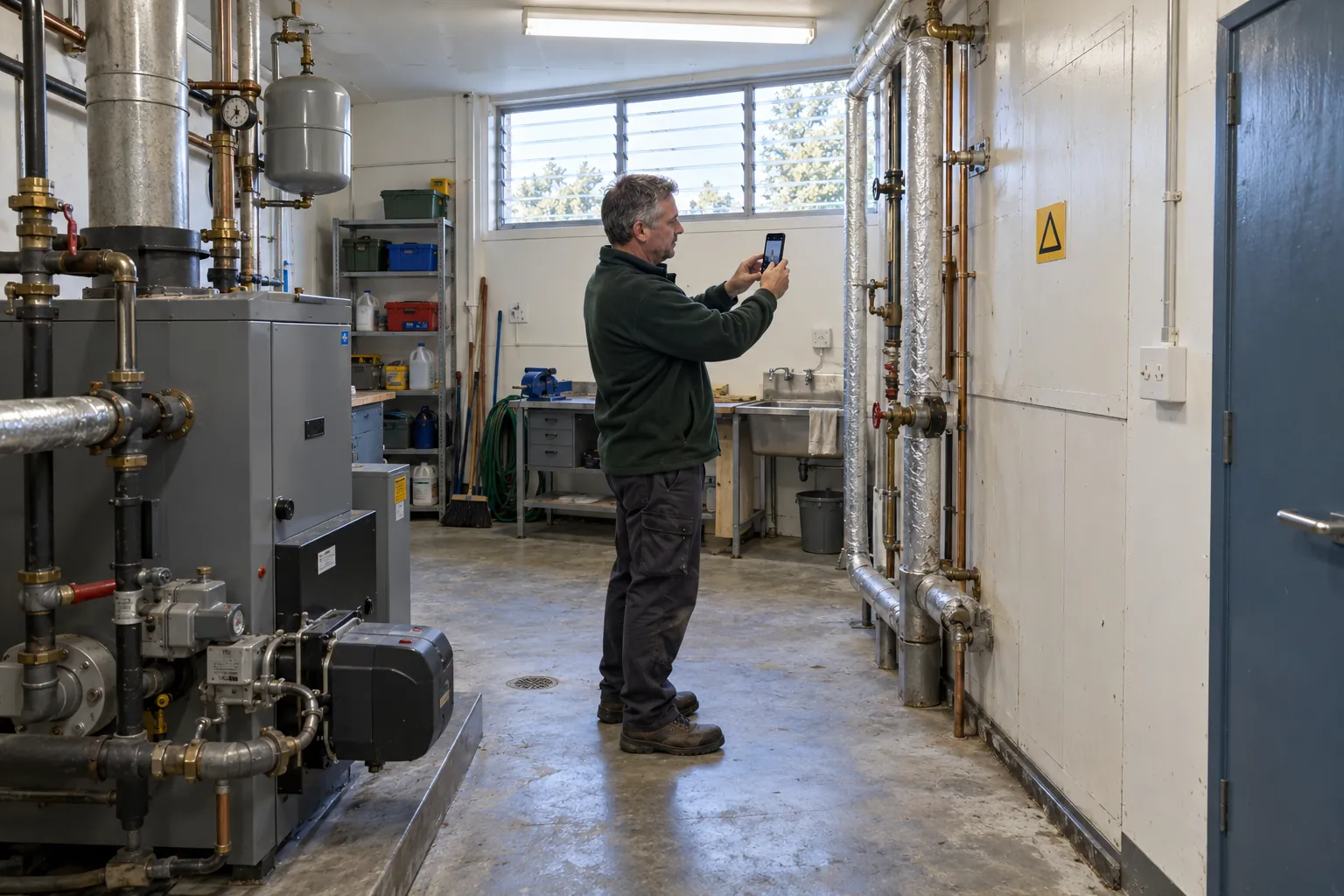
SiteClara records the routine checks that keep the plan matched to the building. A printed QR poster, with an optional NFC tag behind it, sits at each place where a check is scheduled, such as the plant room, the riser cupboard on each floor, or the site office where the plan and register are kept. Staff scan or tap with their own phone, with no app to install, see the checks due there, for example "sealed ceiling in good condition", "asbestos labels in place and legible" or "register shown to today's contractors before work", and mark each one done or say what stopped them. The time and the named person are recorded as it happens, with a photo when one is asked for, so a condition check can carry a picture of the material on the day. Damage found goes onto the team's list of open jobs until someone closes it.
A supervisor sees what is due, done and missed, records the reason a check was missed, and each day reviews and approves a short report for nominated managers or the client, sent the next morning. When the plan is next reviewed, whoever reviews it has a dated trail of what was checked, what changed and what was put right.
07
Questions people ask
How often should an asbestos management plan be updated?
At least every five years, and sooner when something changes. WorkSafe's guidelines Managing asbestos in your building or workplace – for PCBUs say "You must review your asbestos management plan every five years", or when asbestos control measures are reviewed, when asbestos is removed, disturbed, sealed or enclosed, or when the plan is no longer suitable to manage the risks. A health and safety representative can also request a review, and "If you need to make changes to your control measures to manage risks, you must update your asbestos management plan."
Who is responsible for managing asbestos in a building?
The PCBU with management or control of the workplace, which is usually the owner, the property manager, the body corporate or the business running the building, and often several of them together. WorkSafe's guidelines Managing asbestos in your building or workplace – for PCBUs say businesses with overlapping duties must consult, cooperate and coordinate, including on who prepares the plan, and that "You cannot contract out of your duty to prepare an asbestos management plan."
Who can write an asbestos management plan?
The PCBU can prepare it, with help from a competent person if it chooses. WorkSafe's Managing asbestos in your building or workplace – for PCBUs lists a work health and safety professional, a qualified occupational hygienist or an asbestos contractor such as an asbestos surveyor, and says "Even if you choose to hire someone to help you, you are still responsible for preparing your asbestos management plan."
Is there an example asbestos management plan or a WorkSafe template?
Yes. WorkSafe's Asbestos templates and examples page has an asbestos management plan template in Word, a completed asbestos management plan example and an asbestos register example, both as PDFs.
08
Further reading, and a list to take away
Start with WorkSafe's Managing asbestos in your building or workplace – for PCBUs, which walks through the whole process from collecting information to monitoring controls, then the Interpretive guidelines for each legal duty. The template, example plan and example register are on the asbestos templates page.
WorkSafe's Approved Code of Practice: Management and removal of asbestos (2016) is being kept until the coming HSWA reforms are enacted, and both its own page and WorkSafe's page We have updated our asbestos guidance summarise where the newer guidance differs from it; check that summary before relying on the code. Our building compliance checklist shows where the plan sits among a building's other duties, and the hazard register guide covers the wider risk management it feeds into.
Before you sign off an asbestos management plan, check that:
- a competent person has surveyed the building, and areas that could not be inspected are recorded as assumed to contain asbestos;
- the register lists every identified or assumed asbestos material, with its date, location, type, condition, quantity, sample results and any past removal;
- the plan records the decisions and reasons for each material, the emergency procedure, and the workers who work on or near asbestos, with their training, roles and health monitoring;
- the businesses sharing the building have agreed who prepares, holds and updates the plan, and a current copy is on site;
- contractors are shown the plan and register before work that could disturb the building's fabric;
- condition checks of known asbestos are scheduled, done by a named person and recorded, with photos where useful;
- the next review date is no more than five years away, and removal, damage, refurbishment or a change of use triggers an earlier one.
Sources
Every document this guide quotes or links to, in the order it first cites them.
- Managing asbestos in your building or workplace – for PCBUs worksafe.govt.nz
- Interpretive guidelines – The Health and Safety at Work (Asbestos) Regulations 2016 worksafe.govt.nz
- Announcement of its updated asbestos guidance worksafe.govt.nz
- Asbestos management plan template, a worked example plan and an example asbestos register worksafe.govt.nz
- Overlapping duties – quick guide worksafe.govt.nz
- Working with or near asbestos worksafe.govt.nz
- Licence holder register worksafe.govt.nz
- Approved Code of Practice: Management and removal of asbestos worksafe.govt.nz
- We have updated our asbestos guidance worksafe.govt.nz
Related guides
 Premises and facilities managementBuilding compliance checklist: what a New Zealand building owner and PCBU must keep in orderA building compliance checklist for New Zealand non-residential buildings: the compliance schedule and BWoF, evacuation schemes, HSWA duties, asbestos and records.
 Premises and facilities managementHazard register: what HSWA expects, and how to keep one that is usedWhat a hazard register is under New Zealand's HSWA, what goes in it, how to assess and control risks, when to review it, and what changes on 1 April 2027.
 Premises and facilities managementOverlapping duties: sharing health and safety when several PCBUs work in one buildingOverlapping duties under HSWA 2015: when PCBUs share a building or a contracting chain, how to consult, co-operate and co-ordinate, and how to show it works.
 Premises and facilities managementBuilding manager duties: the law, the daily work and the record, in New ZealandWhat a building manager does in New Zealand: HSWA duties, the compliance schedule and BWoF, unit title buildings, daily work and the records that show it was done.