Premises and facilities management
Overlapping duties: sharing health and safety when several PCBUs work in one building
Overlapping duties are the health and safety duties that two or more businesses share for the same matter under the Health and Safety at Work Act 2015, such as the same workplace, the same workers or the same risk.
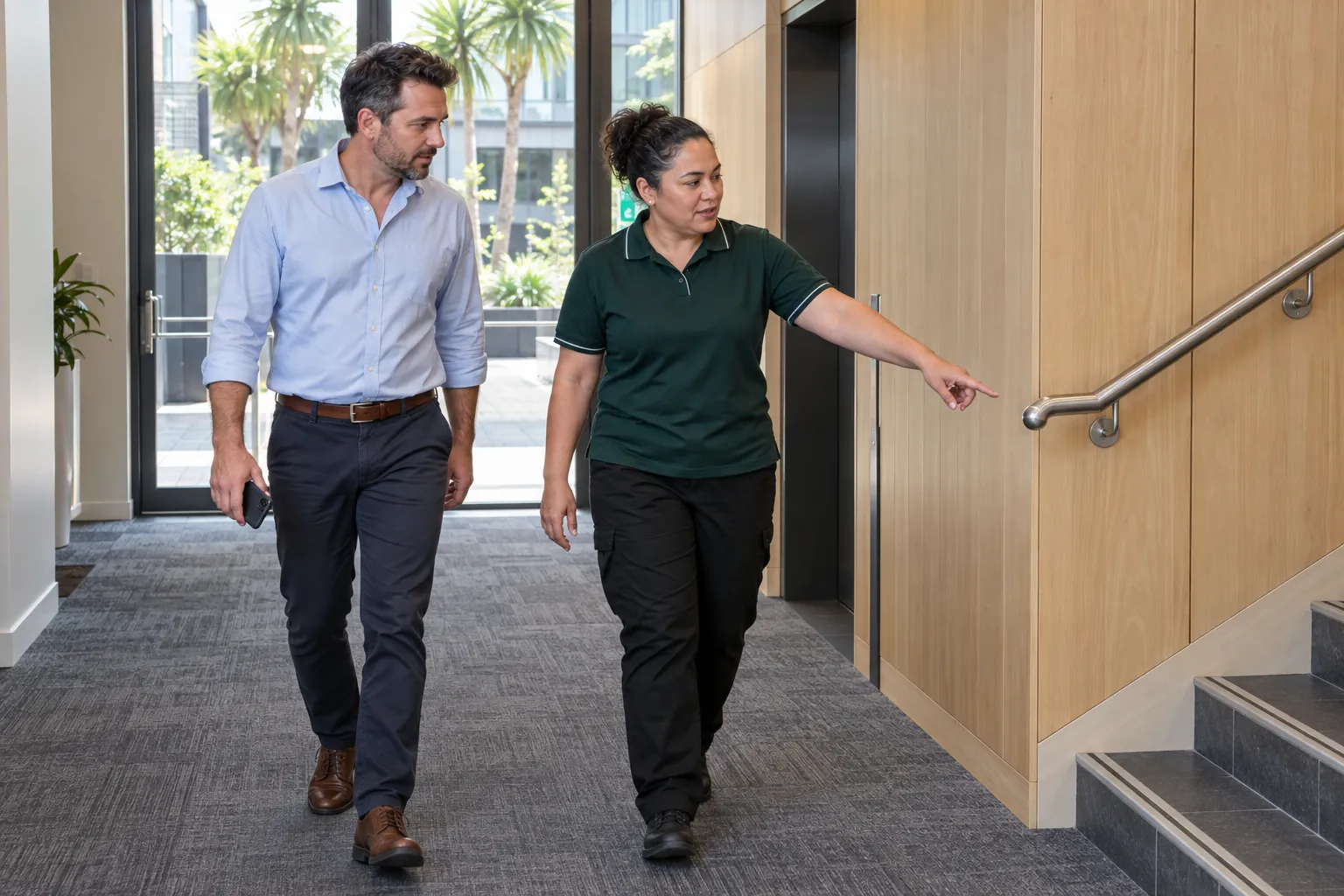
Few commercial buildings in New Zealand have one business in charge of health and safety. The owner, the property manager, the body corporate, each tenant, the contract cleaners, the security company and the lift technician all carry duties, and many of those duties concern the same stairwell, the same car park and the same emergency plan. This guide explains what the law asks of each PCBU, how to decide who manages which risk, what WorkSafe expects to see, and how to show that the arrangement is actually working.
01
What overlapping duties are under the Health and Safety at Work Act 2015
The Health and Safety at Work Act 2015 (HSWA) puts its main duties on the person conducting a business or undertaking, the PCBU. It does not assume one PCBU per workplace. WorkSafe New Zealand's Overlapping duties quick guide opens with the idea in one sentence: "Businesses that work together will likely share health and safety duties in relation to the same matter. These are known as overlapping duties."
WorkSafe's Introduction to the Health and Safety at Work Act 2015 special guide sets out the principles that sit behind it:
- "More than one person may have the same duty (eg different PCBUs may have the same duty towards the same worker)."
- "A person may have more than one duty (eg a person can be a PCBU and a worker)."
- "Duties are not transferable or able to be contracted out of, but reasonable arrangements can be entered to ensure duties are met."
The working duty is section 34 of the Act. In the special guide's words, PCBUs must, so far as is reasonably practicable, "consult, co-operate and co-ordinate activities with all other PCBUs who have health and safety duties in relation to the same matter (overlapping duties)". It is a duty in its own right. A PCBU that has managed its own risks well can still fall short if it never talked to the other businesses whose work affects the same people.
The quick guide describes two ways duties come to overlap:
- A shared workplace, such as a shopping centre or a port, "where more than one business and its workers control and influence the work on site". An office block, a school, a hospital campus, a building with a construction contractor on site for a refurbishment and an apartment building with a body corporate are all shared workplaces in this sense.
- A contracting chain, where contractors and subcontractors provide services to a head contractor or client and "don't necessarily share the same workplace". A facilities management company that subcontracts the cleaning, which in turn uses a specialist for high-level windows, is a chain.
03
Deciding who manages what: influence and control
Sharing a duty does not mean sharing every task equally. The quick guide is direct: "The more influence and control a business has over a health and safety matter, the more responsibility it is likely to have." It names three kinds of control:
- Control over the work activity: the business doing the work may be best placed to control its risks. The cleaning company controls how its cleaners mop, dilute chemicals and use a scrubber drier.
- Control of the workplace, including its plant and structures. The owner or property manager controls the lighting, the lifts, the handrails and the car park barrier.
- Control over workers: a business has more influence over its own workers and contractors than over another business's.
Size is not the test. WorkSafe says "the business with the most financial resources does not automatically have most of the responsibilities", and a business with less influence and control "may fulfil their responsibilities by making arrangements with the business with more influence and control".
The quick guide's case study is a council and a contractor maintaining a walking track in a council park. The contractor controls the track work, so it manages that work's risks and leaves the site safe each evening. The council controls the rest of the park, so it manages risks from other businesses working in the same area, signs the park entrances, makes sure the work site is not interfered with overnight, and does not set timeframes so short that they encourage cutting corners. The two hold scheduled catch-ups.
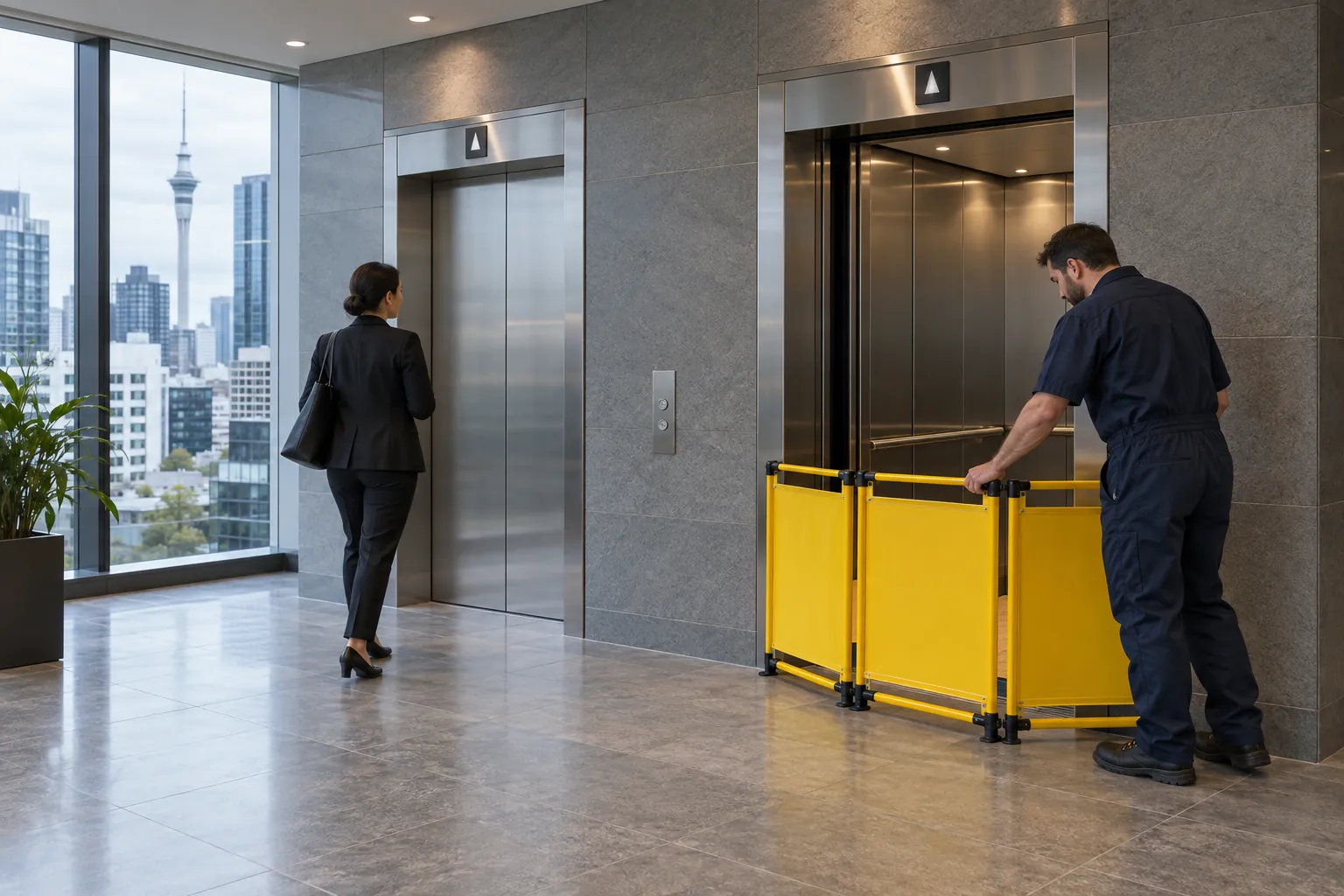
The same reasoning reads straight across to a building. WorkSafe's special guide uses a multi-storey office block: a finance company leases it, the building owner manages and controls it, and a contractor maintains the lifts. Before lift work starts, the owner consults both the contractor and the tenant so that timing, barricading and communication with staff and clients are agreed. During the work the tenant reports its concerns to the others; when a faulty barricade is not fixed after it was reported, the tenant moves its client meetings to the ground floor and sends its staff to other lifts. Each PCBU acts within its own control, and none waits for the others.
04
Consulting, co-operating and co-ordinating in practice
WorkSafe says consultation "can be as simple as getting the right people from each business together to exchange important health and safety information". The quick guide says a business is more likely to meet the duty if it:
- plans ahead, thinking through every stage of the work and how it could affect other businesses and the public;
- identifies the health and safety risks that need managing;
- consults the other businesses to agree how to control each risk, and which business, or businesses, are best placed to control it;
- clearly defines roles, responsibilities and actions, and explains them so everyone knows what to expect.
Its table of questions is a ready-made agenda for a first meeting between a property manager and a new cleaning or security contractor: what each business will do, how, when and where; what plant and substances will be used; which workers are involved and who else may be affected; how each business's work could add to the others' risks; how workers will raise concerns; how emergency procedures will be co-ordinated; who will notify the regulator if a notifiable event occurs; and what facilities, such as first aid, could be shared.
Agreements are allowed and encouraged. WorkSafe says businesses "can enter into reasonable agreements with each other to ensure risks are collectively managed", reflected in contracts. Its examples include a housekeeping agency whose staff use a hotel's first aid facilities: the agency still has to be satisfied the hotel can provide adequate first aid for them. In a shared building, one PCBU is often agreed as the one that notifies WorkSafe of a notifiable event, with the others checking that it was done.
The contracting guide adds a warning about substances that fits commercial cleaning closely. A venue owner told a cleaning contractor to use chemicals stored on site but gave no instructions for their use; a worker was burned by a cleaner diluted wrongly. Both businesses shared the duty. WorkSafe says the owner should have checked the workers' training before awarding the contract, confirmed PPE and first aid access, provided the safety data sheets and checked the containers were properly labelled.
05
Monitoring each other, and what WorkSafe expects to see
An agreement is where the duty starts, not where it ends. The quick guide says that entering into one "does not mean they no longer hold any responsibility for their workers. They must still monitor the other business to ensure they follow through on what was agreed." It asks all businesses to discuss the work, agree each one's influence and control, agree who will manage what and how, and "monitor and check how things are going on an ongoing basis".
WorkSafe's approach is set out in the same guide. It "expects businesses to be able to explain the steps they have taken to consult, cooperate and coordinate with each other about their overlapping duties, and their arrangements to control risks", and "may then check to see that these arrangements are working well". It expects monitoring to be "sensible and proportionate", expects sound contractor management (choosing competent contractors, exchanging information, planning and monitoring carefully, and reviewing after the contract), and says "A business at the top of a contracting chain should not push risk down the chain."
The contracting guide describes monitoring as part of the overlapping duty itself. Its list of what monitoring may include reads like a property manager's diary:
- making sure everyone understands their roles and responsibilities;
- regular health and safety performance meetings;
- regular inspections as appropriate;
- raising issues that need the contractor's attention;
- investigating and responding to accidents and incidents;
- reporting regularly on contractor performance;
- recording health and safety progress for future contracting, and a review when the contract ends.
It also warns against choosing on price alone: "Cost may be a factor that you consider, but you should never prioritise this over health and safety." A cleaning contract priced for fewer hours than the agreed checks need creates a risk the client has helped to cause.
06
Where the record fails, and what SiteClara does about it
The agreement between PCBUs is usually the easy part. The cleaners will check the stairwells and the washrooms, the security company will lock up and patrol the car park, the property manager will fix lights and handrails, and the tenant will report hazards it sees in the common areas. What is hard to show later is that any of it happened. The stairwell sheet is signed for the week on Monday; the patrol is walked with nothing to show for it; the loose nosing is mentioned to whoever was passing, and each business assumes another has it in hand. That is exactly the gap WorkSafe names, and it leaves the property manager nothing to monitor and nothing to explain.
SiteClara records the agreed checks at the place they are done. A printed QR poster, with an optional NFC tag behind it, sits at each location a check is scheduled, such as a stairwell, a washroom, a bin room or a car park level. Staff scan or tap on their own phone, with no app to install, see the checks due there, and mark each one done or say what stopped them. The time and the named person are recorded as it happens, with a photo when one is asked for, and a hazard reported at the location goes onto the team's list of open jobs until someone closes it.
The contractor's supervisor sees what is due, done and missed, gives the reason a check was missed, and approves a daily report that goes to nominated contacts the next morning, showing what was reported, completed and still open. Where a cleaning or security company works in a building that a property manager or body corporate controls, both can read the same record of the agreed checks, which is the kind of shared, ongoing information the monitoring duty asks for.
07
Questions people ask
What does overlapping duties mean?
It means that more than one business holds a health and safety duty for the same matter, and each must meet it. WorkSafe's Overlapping duties quick guide puts it this way: "Businesses that work together will likely share health and safety duties in relation to the same matter. These are known as overlapping duties." They arise in a shared workplace, such as a shopping centre or a port, and in a contracting chain, where contractors and subcontractors provide services to a head contractor or client and "don't necessarily share the same workplace".
What does WorkSafe expect of PCBUs working together?
That they can show how they share the work of managing the risk. The Overlapping duties quick guide says "WorkSafe expects businesses to be able to explain the steps they have taken to consult, cooperate and coordinate with each other about their overlapping duties, and their arrangements to control risks." An agreement does not end a business's responsibility: it "must still monitor the other business to ensure they follow through on what was agreed", and "A business at the top of a contracting chain should not push risk down the chain."
How do you manage contractors in the workplace?
Stage by stage, from scoping the work to reviewing it afterwards. WorkSafe's PCBUs working together: Advice when contracting says "You need to be satisfied that the contractors you choose are able to carry out the work in a safe and healthy manner." It describes pre-qualification to shortlist contractors on their general ability and competence, choosing one that has complied with the project's health and safety requirements and is competent, monitoring the contract for its duration, including the health and safety performance of contractors and subcontractors, and a review of the work and the contractors' performance once it is complete.
What are a worker's responsibilities under HSWA?
Four duties, set out in section 45 of the Act. WorkSafe's Introduction to the Health and Safety at Work Act 2015 special guide says a worker must "take reasonable care for their own health and safety", "take reasonable care that what they do or do not do does not adversely affect the health and safety of other persons", "cooperate with any reasonable workplace health and safety policy or procedure that has been notified to workers", and "comply, so far as reasonably able, with any reasonable instruction given by the PCBU, so the PCBU can comply with HSWA and regulations".
08
Further reading, and a list to take away
Start with WorkSafe's Overlapping duties quick guide, which includes the table of consultation questions, and PCBUs working together: Advice when contracting, with example pre-qualification, tender and job registration forms. The Introduction to the Health and Safety at Work Act 2015 special guide covers the Act as a whole, and the Property management FAQs cover landlords, property managers, tenants and bodies corporate. For who a PCBU is in the first place, see our guide to PCBU duties.
For a building with more than one PCBU, check that:
- every PCBU with a duty in the building is known, including each contractor and subcontractor;
- the shared matters are listed: common areas, chemicals, lighting, access, lone work, first aid, the emergency plan;
- each has an agreed owner, chosen by influence and control rather than by size, and the agreement is written into the contract;
- there is an agreed PCBU to notify WorkSafe, and a way for the others to check it was done;
- workers of every business, including night-shift cleaners and patrol officers, can report a hazard where they find it;
- reported hazards are tracked until they are closed, not just passed on;
- the agreed checks leave a record of when they were done and by whom, which the other PCBUs can see;
- the arrangement is reviewed at scheduled meetings and whenever the work, the tenants or the contractors change.
Sources
Every document this guide quotes or links to, in the order it first cites them.
- Health and Safety at Work Act 2015 legislation.govt.nz
- Overlapping duties quick guide worksafe.govt.nz
- Introduction to the Health and Safety at Work Act 2015 special guide worksafe.govt.nz
- Property management FAQs worksafe.govt.nz
- PCBUs working together: Advice when contracting worksafe.govt.nz
- Understanding the changes to the health and safety law worksafe.govt.nz
Related guides
 Premises and facilities managementPCBU duties: what a PCBU is, and what the law expects of one in a buildingWhat a PCBU is under the Health and Safety at Work Act 2015, the primary duty of care, shared duties in one building, and what changes on 1 April 2027.
 Premises and facilities managementBuilding manager duties: the law, the daily work and the record, in New ZealandWhat a building manager does in New Zealand: HSWA duties, the compliance schedule and BWoF, unit title buildings, daily work and the records that show it was done.
 Premises and facilities managementNotifiable events: what WorkSafe must be told, and what to do in the first hourWhat a notifiable event is under HSWA 2015, what to do when one happens in a building, who tells WorkSafe when PCBUs overlap, and the records to keep.
 Premises and facilities managementHealth and safety representatives: electing an HSR, and engaging workers in a buildingWhat a PCBU must do under Part 3 of HSWA: engaging workers, electing a health and safety representative, the HSR's powers, and health and safety committees.