Fire and water checks
Backflow testing: which devices, how often, and what the records should show
Backflow testing is the check, usually at least once a year, that a backflow prevention device still stops water used in a building from flowing back into the drinking water supply, carried out by an independent qualified person (IQP) or, for some boundary devices, by the water supplier.
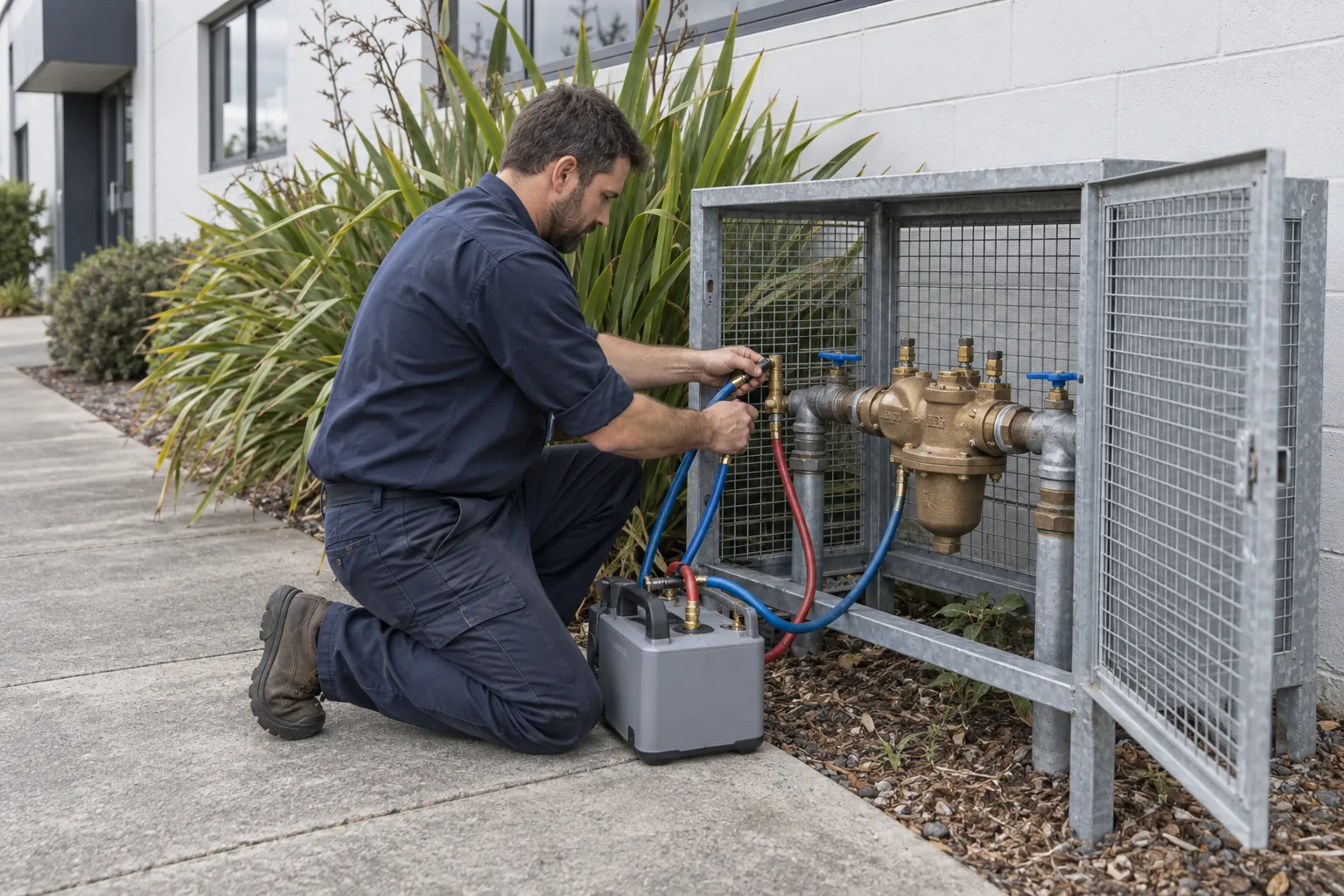
In New Zealand many commercial and public buildings have at least one device: at the boundary to protect the council's network, inside the building to protect the people using it, or both. This guide explains where the requirements come from, which devices a building is likely to have, who tests what, what happens when a device fails, and the records that should sit behind every test.
01
What backflow is, and where the testing duty comes from
MBIE's Acceptable Solution G12/AS1 (third edition, amendment 14) defines backflow as the unplanned reversal of flow of water, or mixtures of water and contaminants, into the water supply system. It happens in two ways. Back-siphonage is caused by the supply pressure becoming less than the downstream pressure. Back-pressure is caused by the downstream pressure becoming greater than the supply pressure. In practice, back-siphonage can follow a burst main or heavy draw-off nearby, and back-pressure can come from a pump, a boiler or a pumped private bore. Both need a cross connection: any actual or potential connection between a potable water supply and a source of contamination.
Three sets of rules meet at a backflow prevention device, and a building owner in New Zealand is likely to deal with all three.
- The Building Code. Clause G12, set out on MBIE's page on G12 water supplies, requires potable water for drinking and food preparation to be protected from contamination. G12/AS1 says backflow protection must be provided wherever water or contaminants could flow back into the potable supply, and that every backflow prevention device must be testable in service to verify that it works.
- The Building Act 2004. Automatic backflow preventers connected to a potable water supply are SS 7 in the list of specified systems on MBIE's page Specified systems and compliance schedules. A building that contains one needs a compliance schedule, and the device is then covered by the annual building warrant of fitness (BWoF). G12/AS1 says as much: testing automatic devices is required under the Building Act through the schedule and the BWoF.
- The water supplier and its bylaw. Under the Drinking Water Quality Assurance Rules 2022 (revised 29 November 2024), set by Taumata Arowai, drinking water suppliers must run a backflow prevention programme to protect their network, and water bylaws put duties on property owners. Auckland's Water Supply and Wastewater Network Bylaw 2015, for example, says at clause 11(2) that every owner must prevent backflow either by providing an adequate air gap or by using a backflow prevention device.
The practical result is that one building may have two kinds of device with two lines of accountability: a boundary device the water supplier cares about, and devices inside the building that the council tracks through the compliance schedule. The results go to different places.
02
Hazard ratings, and the devices a building is likely to have
G12/AS1 grades every cross connection by what backflow from it could do. The grading decides which device is acceptable.
- High hazard: anything with the potential to cause death. G12/AS1's examples include boiler, chiller and cooling tower make-up water, chemical dispensers, laboratories, sluice sinks and WC trigger sprays.
- Medium hazard: anything with the potential to injure or endanger health. The examples include fire sprinkler and building hydrant systems, irrigation without chemicals, untreated water storage tanks, drink dispensers with carbonators, and swimming pools and spas.
- Low hazard: a nuisance by colour, odour or taste, without injuring or endangering health. The examples are drink dispensers without carbonators, drinking fountains and bottle fillers, and ordinary hose taps.
Table 2 of G12/AS1 matches the hazard to the protection. The devices a facilities team is likely to meet are these:
- Air gap: an unobstructed vertical distance between the water outlet and the highest level the water can reach, at least the greater of 25 mm or twice the supply pipe diameter. It is the simplest protection, but G12/AS1 says it must not be used in a toxic environment.
- Reduced pressure zone device (RPZD): the device G12/AS1 names, with the air gap, for high-hazard premises, and the one Watercare lists for high-risk properties such as hospitals and chemical plants.
- Double check valve assembly (DCV): named, with the air gap, for medium-hazard premises, including premises with fire-fighting water services; G12/AS1 notes it can be installed in a medium and low hazard toxic environment.
- Pressure type vacuum breaker (PVB): G12/AS1 notes it vents at 7 kPa or less but needs a significantly higher pressure to reseat, so it suits only systems with enough pressure to close it fully.
- Atmospheric vacuum breaker (AVB) and hose connection vacuum breaker: simple devices on individual outlets. A hose tap on a potable supply needs at least a permanently attached hose connection vacuum breaker.
G12/AS1 also separates containment (or boundary) protection, installed as near as practicable to the water supplier's point of supply to protect the network from the whole premises, from individual protection at each hazard inside the building. Containment protection is in addition to individual protection, not a substitute for it. Table 2A lists premises that need containment protection where the supplier has not provided it: an air gap or RPZD for high-hazard premises such as hospitals and secondary and tertiary education facilities with laboratories; an air gap or DCV for medium-hazard premises such as public swimming pools and premises with fire-fighting water services.
03
Boundary devices and internal devices: who is responsible for which
The boundary device protects the public network, and the water supplier sets the rules for it. The Drinking Water Quality Assurance Rules require the supplier to survey its network for medium and high-risk sites at least every five years (rule D3.2), to have every testable boundary device tested at least annually (D3.4), and to keep a register of each one's location, type, risk and test results (D3.5). A footnote to D3.4 says it does not include devices downstream of the point of supply, or within buildings, whose primary purpose is protecting the building's users.
Watercare's page on backflow says Watercare installs all boundary backflow devices in Auckland except those on fire supplies, and that the property owner is responsible for maintaining and annually testing the correct device at the boundary. The owner can ask Watercare to test it or engage an IQP from Auckland Council's register, and the test certificate goes to Watercare. Other councils and water suppliers set their own backflow policies, so read your own supplier's rules rather than assume Auckland's.
Internal devices protect the people in the building and belong to the Building Act side. MBIE's Compliance Schedule Handbook (amendment 3, 2014) says a backflow preventer must be listed on the compliance schedule where it is connected to a potable water supply and is entirely within the property boundary of the building it serves, or partly within it and not owned by the network utility operator. Its examples include reduced pressure zone devices, double check valve assemblies, pressure type vacuum breakers and atmospheric vacuum breakers.
Around the devices, the roles divide like this:
- The building owner is responsible for having every procedure on the compliance schedule carried out, for keeping the reports and for the annual BWoF. The owner usually delegates the arranging to a property or facilities manager, or in a unit title development to the body corporate and its manager, but the duty stays with the owner.
- The IQP inspects and tests the SS 7 devices as the compliance schedule requires and signs the Form 12A that the owner needs for the BWoF. MBIE's page on inspection and maintenance of specified systems says the first step is to ask the council for its IQP register, which shows which systems each IQP may inspect. See the guide to specified systems and IQPs.
- The plumber handles the installation and repair of devices inside the building; in Auckland, Watercare installs the boundary device unless it is on a fire supply. Water New Zealand's page on the NZ Backflow Testing Standard says repairs to devices covered by the Building Act should be carried out only by people licensed or authorised under the Plumbers, Gasfitters, and Drainlayers Act.
- Everyone else in the building, cleaners, caretakers and security included, tests nothing but is often first to see a device leaking or a cage damaged.
04
The annual test: frequency, method and what good evidence looks like
The compliance schedule sets the frequency and method for each internal device, and the handbook suggests what they should be. For reduced pressure zone devices, double check valve assemblies and pressure vacuum breakers it points to three documents that could be used: AS 2845.3, the United States Environmental Protection Agency's Cross-Connection Control Manual, and the NZ Backflow Testing Standard. G12/AS1 references the NZ Backflow Testing Standard 2019, Field testing of backflow prevention devices and verification of air gaps, published by Water New Zealand with Master Plumbers, Gasfitters and Drainlayers NZ. Water New Zealand describes it as a replacement for parts 2 and 3 of AS 2845.
For devices that are harder to test, the handbook gives the minimum:
- Atmospheric vacuum breakers should be tested annually: with the fixture turned on, the poppet or float must close; turned off, it must open.
- Non-testable automatic backflow preventers should be inspected annually, and replaced or repaired if leaking or showing any other fault.
- Every automatic backflow preventer should be inspected and tested after repair or replacement.
- Maintenance, planned and responsive, should follow the nominated standard.
On the boundary side, rule D3.4 and Watercare's guidance both come to the same answer: every testable boundary device is tested at least once a year, whatever its hazard rating.
The handbook recommends a reference number and a precise description for each system; its example is a 15 mm double check valve assembly on the boiler feed supply in the level 9 plant room, cross-referenced to the consent drawing. A useful test record shows:
- the device's reference, type, size and location, and what it protects;
- the hazard it is protecting against, and whether it is a boundary or an internal device;
- the date of the test, the tester's name and their IQP registration;
- the result, including readings where the method calls for them, and pass or fail;
- any fault found, the repair made, by whom, and the retest after it;
- where the certificate went: to the water supplier for a boundary device, into the building's compliance records for an internal one.
05
Failed devices, the Form 12A and keeping the file straight
A device that fails its test is not protecting anything until it is repaired and retested, so the gap between the failure and the retest is what matters. Watercare's guidance gives Auckland owners two weeks to repair a failed boundary device, after which Watercare will do the repair and invoice the owner. For internal devices the compliance schedule and the IQP set the expectation, and the Form 12A certifies that the schedule's procedures were carried out, so a failure needs putting right, and recording, well before the anniversary.
MBIE's inspection and maintenance page sets out how the records hang together. The owner needs a Form 12A from each IQP, certifying that the inspection, maintenance and reporting procedures of the compliance schedule have been carried out for the previous 12 months, before signing the BWoF. The owner must also obtain and keep reports of the inspections, maintenance and repairs from the people who did the work, for at least two years after they were issued.
Backflow files go wrong in a few recurring ways:
- A new hazard, no new device: a chemical dispenser or replacement boiler fitted without anyone asking about backflow, and the schedule left describing the building as it was.
- A device nobody can find, boxed in during a fit-out.
- A certificate in the wrong file: the boundary test filed with the BWoF and never sent to the water supplier.
- A fault seen and not reported: a leak mentioned at reception that the IQP hears about at the next test.
- No access: the plant room locked or the tenants not warned of the shutdown, and the test slips past the anniversary.
06
Where the record fails, and what SiteClara does about it
The annual test is well documented; the other 364 days are not. The plant room walk is ticked off on a sheet taped inside the door, a leak at the boundary cage is told to whoever was passing, and when the IQP arrives nobody can say what happened since the last visit.
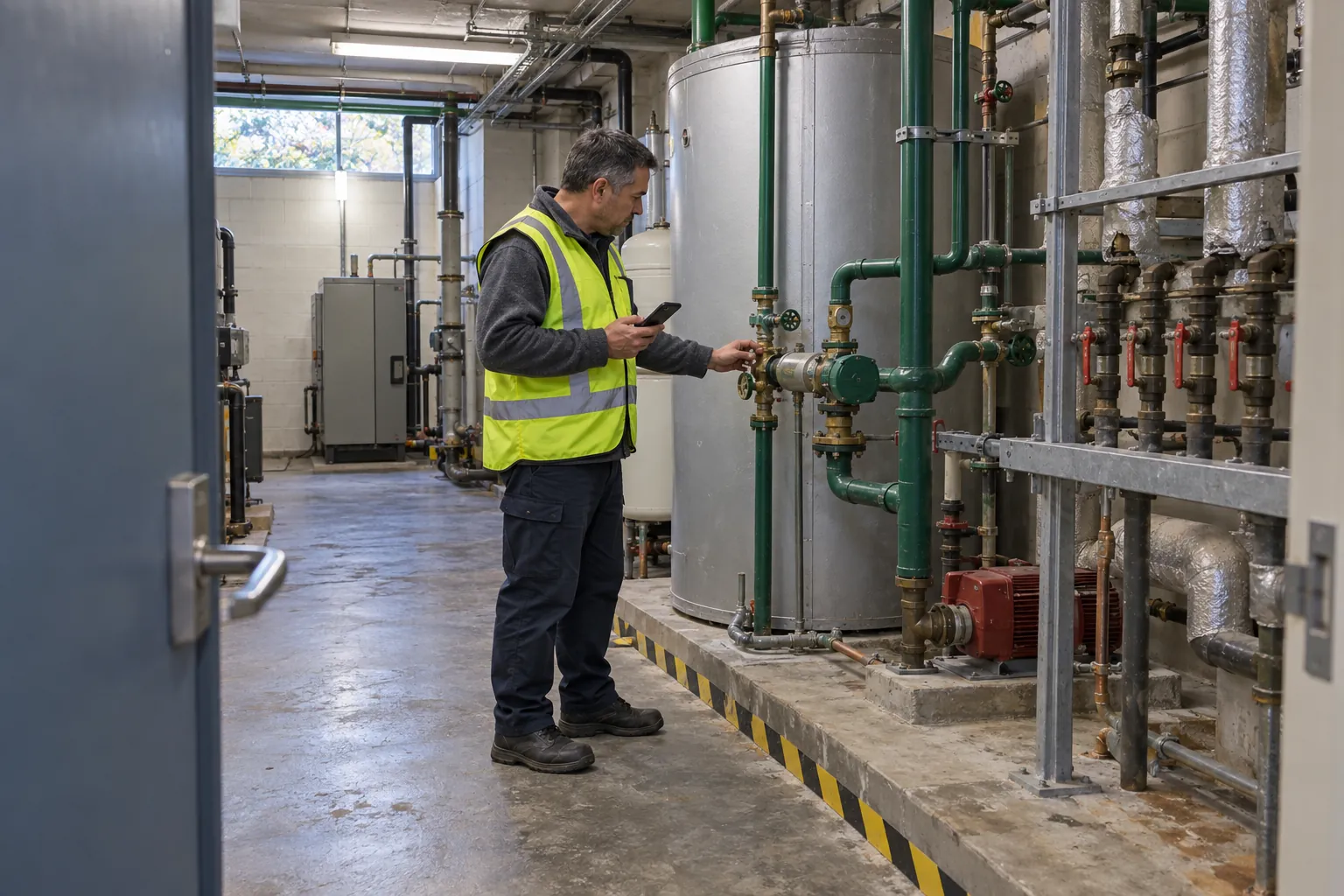
SiteClara is built for that everyday part of the work. A tag at each point that needs looking at, such as the plant room, the boundary cage or the sprinkler valve set, lets the person doing the walk scan it with their own phone and mark the check done, with a photograph when one is asked for. The record shows which point was checked, by whom and when, as it happened, and a check that was due and not done shows as not done rather than disappearing. A fault reported at the tag, such as a dripping relief valve or a damaged cage, goes onto the list of jobs for the team responsible until someone closes it. A daily report, reviewed by a supervisor, tells the building or facilities manager what was checked, what was missed and why, and what is still open.
07
Questions people ask
What is a backflow test?
A field test that shows a testable backflow prevention device is still working, carried out at least once a year, usually by an IQP, and after any repair or replacement. Water New Zealand's page on the NZ Backflow Testing Standard says the standard covers the testing of backflow prevention devices and the verification of air gaps, for uniformity of practice and reliability of testing. Watercare's page on backflow says that when a device passes, the tester issues a certificate.
Can I do backflow testing myself?
Not the annual test. Watercare's page on backflow gives Auckland property owners two options for a boundary device: ask Watercare to test it, or engage an IQP. For internal devices on the compliance schedule, MBIE's page on inspection and maintenance of specified systems says the owner must obtain a Form 12A from their IQPs before providing the BWoF. An owner's staff can still look at a device between tests and report a leak or damage.
Where can I get backflow tested in New Zealand?
From an IQP on your council's register. MBIE's page on inspection and maintenance of specified systems says the first step in engaging an IQP should be to ask the council for its IQP register, usually on the council's website, which also shows which specified systems each IQP is competent to inspect; look for SS 7. In Auckland, Watercare's page on backflow points owners to the Auckland Council list of IQPs, or Watercare will test a boundary device itself.
Can a plumber install a backflow device?
Inside the building, installing or repairing a device is a job for a plumber, and Water New Zealand's page on the NZ Backflow Testing Standard says repairs to devices covered by the Building Act should be carried out only by people licensed or authorised under the Plumbers, Gasfitters, and Drainlayers Act. At the boundary, check your water supplier's rules first: Watercare's page on backflow says Watercare installs all boundary backflow devices in Auckland except those on fire supplies.
08
Where to read more, and a list to take away
For the Building Code side, start with MBIE's page on G12 water supplies, which links the current Acceptable Solution G12/AS1. The Compliance Schedule Handbook has the SS 7 guidelines. For the network side, read your water supplier's backflow policy and bylaw; in Auckland that is Watercare's page on backflow. The NZ Backflow Testing Standard 2019 is available from Water New Zealand.
To keep a building's backflow protection in order, check that:
- you have a list of every backflow device in the building and at the boundary, with its reference, type, location and the hazard it protects;
- every internal device is on the current compliance schedule, and the schedule is amended when a device is added, moved or removed;
- you know your water supplier's rules for the boundary device, and who holds its test certificate;
- an IQP registered with your council for SS 7 tests every testable device at least annually, and after every repair or replacement;
- failed devices are repaired by someone licensed or authorised under the Plumbers, Gasfitters, and Drainlayers Act, and retested quickly, and the retest is recorded;
- new fittings such as chemical dispensers, boilers, carbonators and irrigation are checked for backflow protection before they are connected;
- the plant room and boundary cage are looked at between tests, and leaks and damage reach someone who will act;
- test reports and Form 12As are kept for at least two years, and the BWoF is signed and displayed on time.
Sources
Every document this guide quotes or links to, in the order it first cites them.
- Acceptable Solution G12/AS1 (third edition, amendment 14) building.govt.nz
- G12 water supplies building.govt.nz
- Specified systems and compliance schedules building.govt.nz
- Drinking Water Quality Assurance Rules 2022 taumataarowai.govt.nz
- Water Supply and Wastewater Network Bylaw 2015 assets.watercare.co.nz
- Backflow watercare.co.nz
- Compliance Schedule Handbook building.govt.nz
- Inspection and maintenance of specified systems building.govt.nz
- NZ Backflow Testing Standard waternz.org.nz
Related guides
 Fire and water checksIQPs and specified systems: who inspects what, and what the owner must keepWhat an IQP is, the specified systems SS 1 to SS 16, how to engage IQPs, what they inspect and what is left to the owner, and how the Form 12A works in New Zealand.
 Fire and water checksThe compliance schedule: what it lists, and how to keep a building to itWhat a New Zealand compliance schedule lists, which buildings need one, how it is issued and amended, who does the checks and the records behind every BWoF.
 Fire and water checksThe building warrant of fitness: what a New Zealand owner signs each year, and how to make it trueWhat a New Zealand building warrant of fitness declares, who signs it, the Form 12 and Form 12A cycle, the records behind it, and the checks that keep it true.
 Fire and water checksLegionella control in New Zealand buildings: the routine checks, and the record that shows themLegionella control in New Zealand buildings: the Health NZ guidelines, G12, cooling towers on the compliance schedule, flushing, temperatures and the record.