Fire and water checks
Legionella control in New Zealand buildings: the routine checks, and the record that shows them
In New Zealand, legionella in a building's water is controlled by storing hot water at 60°C or more and cold water below 20°C, and by flushing little-used outlets every week, as Health New Zealand's guidelines recommend.
No single regulation sets this out. The duty comes from four places at once: the building owner's compliance schedule, the Building Code's hot water rules, a PCBU's duties under the Health and Safety at Work Act 2015, and the guidelines Health New Zealand publishes. Most of the day-to-day work is plain routine: flushing the shower nobody uses, checking the tempering valve in the rest home bathroom, reading the cooling tower's monthly results. This guide sets out that routine, who does it, and what the record should show.
01
Who is responsible for legionella control in New Zealand
Legionella bacteria live naturally in New Zealand water and soil. In a building they can multiply in warm, stagnant water, and people are infected by breathing in fine droplets that carry them. The illness, legionellosis, ranges from a flu-like illness to Legionnaires' disease, a severe pneumonia. WorkSafe's page Legionnaires' disease and legionellosis notes that it is "more common in people who are older, smoke or drink heavily, have chronic lung disease or other long-term medical conditions".
Health New Zealand's The Prevention of Legionellosis in New Zealand: Guidelines for the Control of Legionella Bacteria (published October 2024, revised April 2025) reports that of the laboratory-identified cases between 2000 and 2020, 51% were attributed to L. longbeachae, linked with compost and potting mix, and 31.2% to L. pneumophila, the species of water systems. Warm water systems in buildings remain a recognised source.
There is no single legionella regulation. The duty to control the risk in a building runs through four strands:
- The Health and Safety at Work Act 2015 (HSWA). WorkSafe's guidance on Preventing Legionnaires' disease from cooling towers and evaporative condensers applies that directly: PCBUs whose buildings operate cooling towers or evaporative condensers "must eliminate the risks from Legionella colonisation and dissemination so far as is reasonably practicable." WorkSafe also states that Legionnaires' disease is a notifiable illness under HSWA: "You must notify us if someone has developed Legionnaires' disease as a result of work."
- The Building Act 2004 and the New Zealand Building Code. Clause G12.3.9 of the Code requires that "A hot water system must be capable of being controlled to prevent the growth of legionella bacteria." Mechanical ventilation or air conditioning, which can include an air conditioning cooling tower, is a specified system, so it sits on the building's compliance schedule and is covered by the annual building warrant of fitness.
- The Health Act 1956. Legionellosis is a notifiable disease. Health New Zealand's Communicable Disease Control Manual chapter on legionellosis says attending medical practitioners or laboratories must immediately notify the local medical officer of health. The local office of the National Public Health Service investigates each notified case, looking for common exposures such as cooling towers, spa pools or a shared water system.
- The Health New Zealand guidelines and the standards. The guidelines are written for "building owners, managers and contractors of buildings" as well as public health officers, and set out the routines described below. For cooling towers they rest on AS/NZS 3666, Air-handling and water systems of buildings – Microbial control, Parts 1 to 4, sold by Standards New Zealand.
This guide covers the routine checks. The risk assessment, water treatment and system design belong to a plumber, a water treatment specialist or an engineer.
02
Which parts of a building legionella control covers
The guidelines list the conditions that raise the risk in any water system: no biocide in the incoming water, low or no flow so that water stagnates, stored water, temperatures anywhere between 20°C and 50°C, recirculated water, and "the presence of rust, scale, sludge or matter that supports microbial growth." In an ordinary non-domestic building that points at:
- Hot water storage: hot water cylinders and storage water heaters, including systems that circulate hot water round a large building.
- Cold water storage tanks, particularly in a roof space or next to a boiler.
- Showers, taps and hoses, above all the rarely used ones: the accessible shower on a quiet floor, the outlets in a wing closed for the holidays.
- Thermostatic mixing valves (TMVs) and tempering valves, which prevent scalding and leave a short run of warm water behind them.
- Sensor taps, which the guidelines say "can be colonised by Legionella bacteria" through biofilm on the seals inside the solenoid valve.
- Cooling towers and evaporative condensers, which release fine water droplets from their exhaust fans and are among the first places public health officers look when there is a cluster of cases.
- Evaporative air coolers and spa pools, each with its own chapter in the guidelines.
- Grounds: compost and potting mix, a risk for grounds staff rather than the water system.
Cooling towers, spa pools and hospital warm water systems need a specialist programme. Most offices, schools, halls of residence and apartment buildings depend on temperature control and keeping water moving, and that is where most of the checks sit.
03
Hot and cold water: temperatures, flushing and how often
The guidelines summarise temperature control in two lines: "Store and circulate cold water below 20°C. Store and circulate hot water above 60°C." Where hot water circulates round a building from a central heater, it should leave the heater at 60°C or more and return at no less than 55°C.
The Building Code's Acceptable Solution G12/AS1 (third edition, amendment 14) sets the other side of the balance. Paragraph 6.14.3 requires the storage water heater's thermostat to be set at "not less than 60°C to prevent the growth of Legionella bacteria", and paragraph 6.14.1 caps the hot water delivered to fixtures used for personal hygiene at 45°C in early childhood education and care centres, schools, old people's homes, hospitals and similar institutions, and 50°C in all other buildings. A tempering valve or TMV close to the outlet closes the gap.
The routine the guidelines recommend for hot and cold water systems in buildings is:
- Daily: flush sensor taps, and void the first 500 mL to waste before each use.
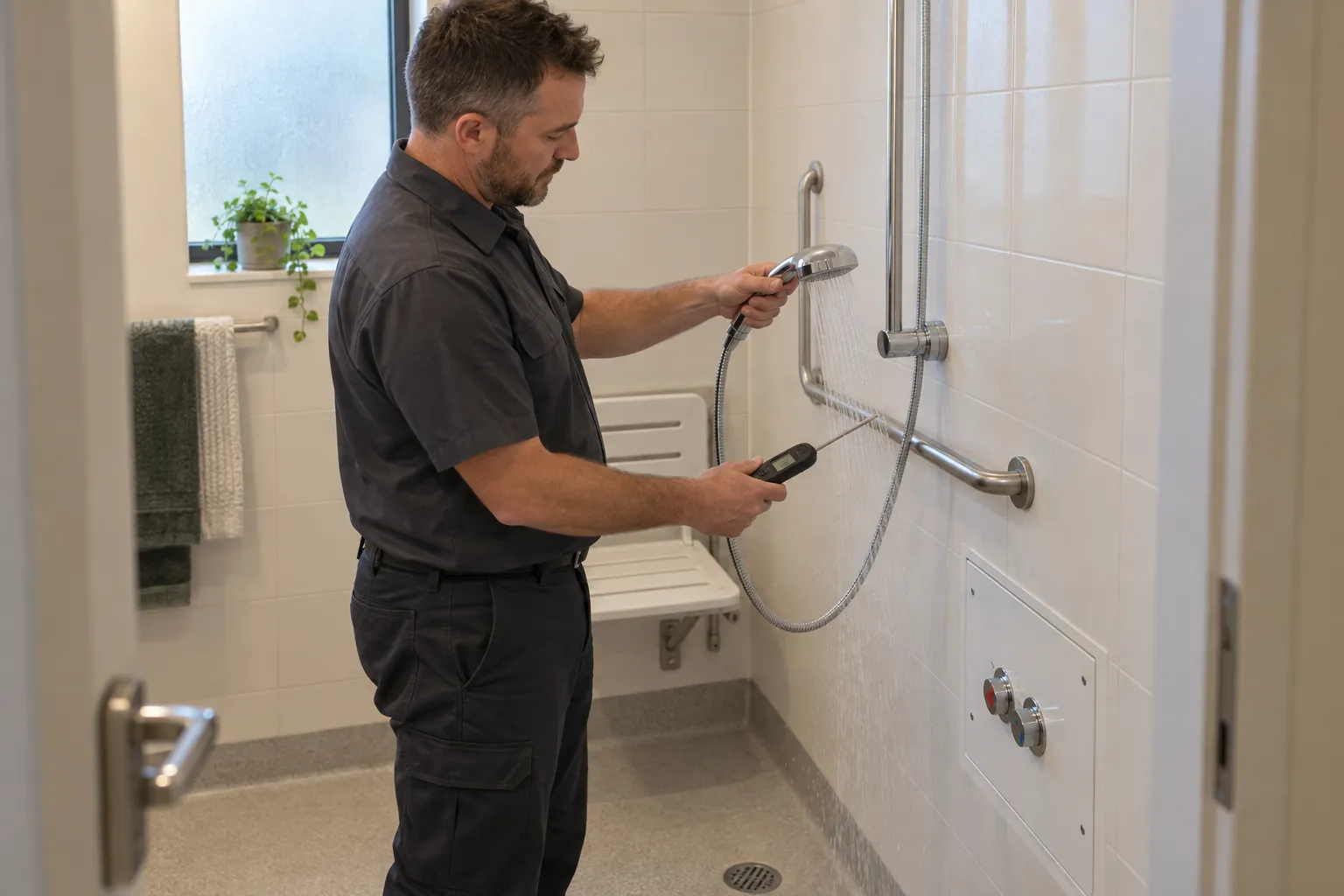
- Weekly: flush any pipework whose water lies idle for more than a week, at full flow for at least three minutes, timed for hot water from when it reaches delivery temperature. Showers and mixer taps are flushed once fully cold and once fully hot; outlets behind a TMV until the water reaches the valve's preset temperature.
- Fortnightly: check the outlet temperature of each TMV with an accurate thermometer, to catch drift from its setting.
- Monthly: check any anti-scald valve by running the hot water and making sure it shuts down before it reaches a scalding temperature.
- At least every three months: remove, descale and sanitise showerheads, shower hoses, tap aerators and strainers, and more often in high-risk areas.
- Every six months: check the temperature of the stored hot water, to make sure it does not fall below 60°C.
- Every twelve months: a full service of each TMV, with a fail-safe test in which flow from the outlet should stop within four seconds of the cold supply being isolated; cold water storage tanks inspected and cleaned, initially once a year; hot water cylinders drained, cleaned and flushed where sediment is a problem.
- Every three years: a new thermostatic capsule in each TMV, and a new cartridge in each anti-scald valve.
An outlet that is rarely used or sits at the end of a long dead leg may be better removed with its pipework, which removes the check too. A hot water system idle for more than two weeks should be thermally disinfected before it is used again.
A temperature outside the limits is not a pass with a comment beside it. Control has failed at that point, perhaps a thermostat turned down or a tank warming in the roof, and the record should show who was told and what was done.
04
Cooling towers, the compliance schedule and the BWoF
Mechanical ventilation and air conditioning is specified system 9 in the list on MBIE's page Buildings with compliance schedules for specified systems. A building with a cooling tower serving its air conditioning therefore has the tower on its compliance schedule, with the inspection, maintenance and reporting procedures the council has set. MBIE's older page on Legionellosis in buildings (last updated March 2016) states that building owners must ensure these systems get the inspection, testing and maintenance the schedule sets out.
The Health New Zealand guidelines describe what that usually means in practice:
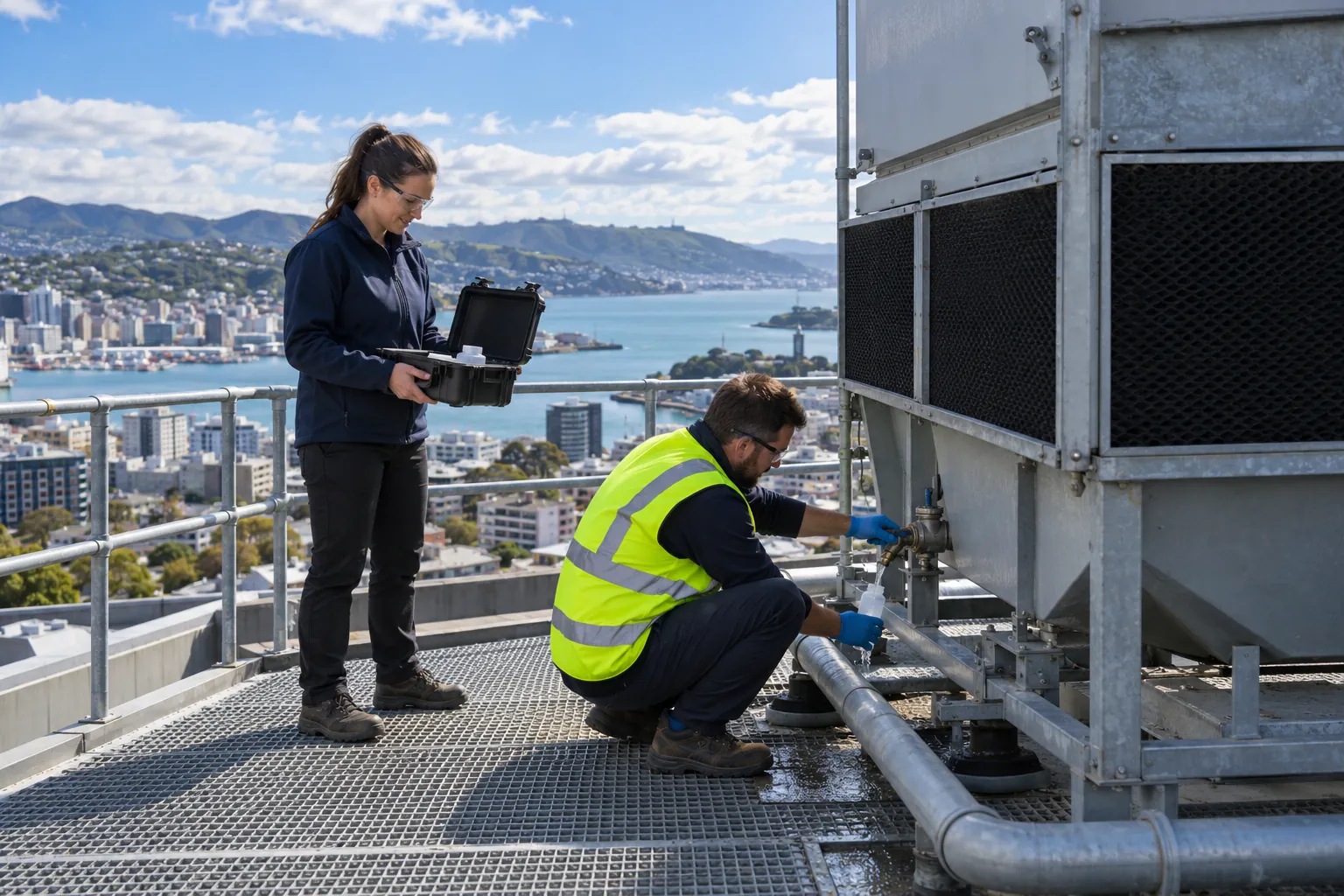
- Monthly visual inspection for microbial growth, algae, leaks, blocked air inlets and working dosing equipment, and inside for corrosion, scale and fouling.
- Monthly testing for Legionella and for heterotrophic bacteria, in an IANZ-accredited laboratory.
- Immediate remedial action under AS/NZS 3666.3 after any positive Legionella result, and notification of results of 1,000 cfu/mL or more "within 48 hours to the local Medical Officer of Health".
- An annual inspection with the plant fully shut down, and a water treatment programme whose records are kept and reviewed.
- Records kept on site: procedures, cleaning and disinfection, water treatment, test results and who is responsible.
The guidelines put the value of that last item bluntly: "a lack of accurate and up-to-date records is a common feature of systems associated with disease outbreaks."
The independent qualified person (IQP) for this specified system inspects it as the compliance schedule requires. MBIE's page on Inspection and maintenance of specified systems explains that the IQP's Form 12A "certifies the inspection, maintenance and reporting procedures of the compliance schedule have been carried out for the previous 12 months", and the owner supplies it to the council with the building warrant of fitness. None of that is optional, and none of it is replaced by anything the building's own staff record.
Cooling towers serving an industrial process sit outside the BWoF system; the guidelines say they are covered by HSWA and expected to comply with AS/NZS 3666 as a minimum, and that Auckland Council's Property Maintenance and Nuisance Bylaw 2015 requires industrial wet cooling towers in Auckland to be registered each year and their Legionella results sent to the council.
WorkSafe's guidance expects the PCBU that manages or controls the workplace to "keep written records to demonstrate ongoing compliance", including the actions taken when results show increased microbial growth, and suggests tenants confirm a maintenance schedule and monthly water quality testing programme are in place.
05
Who does the checks, and what a good record shows
The building owner carries the Building Act duties. Under HSWA, WorkSafe's cooling tower guidance gives duties to several PCBUs at once: the one that manages or controls the workplace, the maintenance and service providers, and, in a smaller way, the tenants. In practice the checks are shared out:
- The facilities manager, property manager or body corporate manager keeps the list of outlets and plant, arranges contractors, and makes sure the routine is done and recorded.
- Caretakers, site staff and cleaners often do the weekly flushing, since they are in those rooms anyway, once they know which outlets and for how long.
- A registered plumber or TMV service contractor does the TMV servicing, fail-safe tests and capsule changes, and the cylinder and tank work.
- A water treatment specialist runs the cooling tower's treatment programme and sampling, and reports on each visit.
- The IQP inspects the specified system and signs the Form 12A.
The guidelines add that people doing this work should keep aerosols to a minimum, that respirators should be worn where aerosols may be breathed in at a cooling tower, and that under HSWA it is the employer's responsibility to provide protective equipment and train staff to use it.
A useful record carries:
- The outlet or item, named the same way every time, so that "level 2 accessible shower" means one shower.
- The date and time the check was done, written when it was done.
- The name of the person who did it.
- The reading in degrees, not a tick. A column of ticks hides a cylinder drifting from 62°C to 56°C over a winter.
- For flushing, which outlets were run and for how long.
- What happened when a check failed: who was told, what was done, and the reading after the fix.
- Missed checks, with the reason: a locked room, a floor under refurbishment, a caretaker on leave.
The guidelines include sample log sheets in their appendices: a service log sheet for warm water systems, and commissioning, routine and twelve-monthly log sheets for each TMV. Their TMV routine ends with the instruction to "Record all service details and fortnightly operating checks on a log sheet for future reference in the event of valve failure." The owner needs these, the contractors' reports and the compliance schedule paperwork to tell the same story.
06
Where the record fails, and what SiteClara does about it
Most failures in the routine are not failures of knowledge. They are the weekly flush that stopped when the caretaker changed, the TMV check skipped over the school holidays, the reading of 48°C written down and never passed on. A sheet showing every shower flushed every Monday for a year, in the same pen, is not easily believed.
SiteClara puts a printed QR poster, with an NFC tag behind it if staff are to tap, at the locations in the routine: the little-used shower, the TMV cupboard, the plant room door. Staff scan or tap with their own phone, with no app to install, and see the checks due at that location. They mark each one done, or say what stopped them, with a photo when one is asked for, such as the thermometer in the stream. The time and the person are recorded as it happens.
The supervisor sees which checks are due, done and missed, and can give the reason one was missed. A problem found on a check, such as a tap that will not run hot, is reported there and goes onto the team's list of jobs until someone closes it, and can be escalated to the building manager. Each day the supervisor approves a report that goes to nominated management or client contacts the next morning, showing how the scheduled checks went.
07
Questions people ask
What are the symptoms of Legionnaires' disease?
WorkSafe's page Legionnaires' disease and legionellosis gives the usual first symptoms as headache, muscle aches, feeling generally unwell and fever, followed by the second or third day by a cough, sometimes with blood-streaked phlegm, shortness of breath, chest pain, nausea, vomiting and diarrhoea, and confusion. Health New Zealand's The Prevention of Legionellosis in New Zealand describes the milder form, Pontiac fever, as a self-limiting, flu-like illness with fever that lasts two to six days.
Is Legionella in tap water?
It can be. Health New Zealand's The Prevention of Legionellosis in New Zealand says that "any water can potentially be a source", with the risk rising as the water warms from 20°C to 50°C and as disinfectant falls to ineffectual levels, and links L. pneumophila infection with domestic drinking water supplies that are usually unchlorinated. In a building the concern is what happens after the mains: if stored cold water is kept free of sediment and no warmer than 20°C, the guidelines say "any Legionella present in the incoming mains water will not be able to proliferate."
Is Legionnaires' disease contagious?
No. WorkSafe's page Legionnaires' disease and legionellosis says it is not contagious and you cannot catch it from another person, and Health New Zealand's Communicable Disease Control Manual chapter on legionellosis states: "Person-to-person transmission has not been demonstrated." People are infected by breathing in fine droplets of water or dust that carry the bacteria.
What is the most common way to get Legionella in New Zealand?
Through compost and potting mix, most likely by breathing in dust while gardening or handling the bags. Of the laboratory-identified cases between 2000 and 2020, Health New Zealand's The Prevention of Legionellosis in New Zealand attributes 51% to L. longbeachae, the species linked with those products, and 31.2% to L. pneumophila from water systems. WorkSafe's page Legionnaires' disease and legionellosis advises anyone handling garden soil, compost, mulch or potting mix to wear gloves, open bags slowly with the opening away from the face, dampen the mix to reduce dust and wash their hands well afterwards, even if gloves were worn. The warning label the guidelines recommend for bagged products ends: "See your doctor if you develop high fever, chill, breathlessness or cough."
How long should you run a shower to avoid Legionella?
Three minutes at full flow, once a week, for a shower that is not used regularly. Health New Zealand's The Prevention of Legionellosis in New Zealand says pipework whose water lies idle for more than one week "should be flushed at full flow for a minimum period of three minutes after the water has reached its normal hot delivery temperature", and that infrequently used showers and mixer taps are flushed on both the cold and the hot side.
08
Further reading, and a list to take away
The main document is Health New Zealand's The Prevention of Legionellosis in New Zealand, free to download, with its log sheets in the appendices. WorkSafe's two Legionnaires' disease pages cover cooling towers and the risk from potting mix. MBIE's G12 Water supplies page holds the Acceptable Solutions, and your council administers the compliance schedule and the BWoF. AS/NZS 3666 is available from Standards New Zealand.
For the routine in your building, make sure that:
- you know which systems the building has, and which are on the compliance schedule;
- a named person owns the routine;
- every little-used outlet is listed, and someone owns its weekly flush;
- stored hot water is checked at 60°C or more, and TMV outlet temperatures are recorded as readings, not ticks;
- showerheads and aerators are descaled at least every three months;
- a reading out of range has a written next step and a named person to tell;
- missed checks are recorded with a reason, not left blank;
- the cooling tower's monthly results are seen by the owner, not just filed by the contractor;
- the routine is reviewed when the building, its use or its occupants change.
Sources
Every document this guide quotes or links to, in the order it first cites them.
- Legionnaires' disease and legionellosis worksafe.govt.nz
- The Prevention of Legionellosis in New Zealand: Guidelines for the Control of Legionella Bacteria static.info.content.health.nz
- Preventing Legionnaires' disease from cooling towers and evaporative condensers worksafe.govt.nz
- Communicable Disease Control Manual chapter on legionellosis healthnz.govt.nz
- G12/AS1 (third edition, amendment 14) building.govt.nz
- Buildings with compliance schedules for specified systems building.govt.nz
- Legionellosis in buildings building.govt.nz
- Inspection and maintenance of specified systems building.govt.nz
- G12 Water supplies building.govt.nz
Related guides
 Fire and water checksIQPs and specified systems: who inspects what, and what the owner must keepWhat an IQP is, the specified systems SS 1 to SS 16, how to engage IQPs, what they inspect and what is left to the owner, and how the Form 12A works in New Zealand.
 Fire and water checksThe compliance schedule: what it lists, and how to keep a building to itWhat a New Zealand compliance schedule lists, which buildings need one, how it is issued and amended, who does the checks and the records behind every BWoF.
 Fire and water checksThe building warrant of fitness: what a New Zealand owner signs each year, and how to make it trueWhat a New Zealand building warrant of fitness declares, who signs it, the Form 12 and Form 12A cycle, the records behind it, and the checks that keep it true.
 Premises and facilities managementPreventative maintenance: how to plan it and show it was donePreventative maintenance for New Zealand buildings: the HSWA and Building Act duties, the compliance schedule, building a programme, and the records behind it.