Premises and facilities management
Health and safety representatives: electing an HSR, and engaging workers in a building
A health and safety representative (HSR) is a worker elected by the members of their work group to represent them on health and safety matters, under Part 3 of New Zealand's Health and Safety at Work Act 2015.
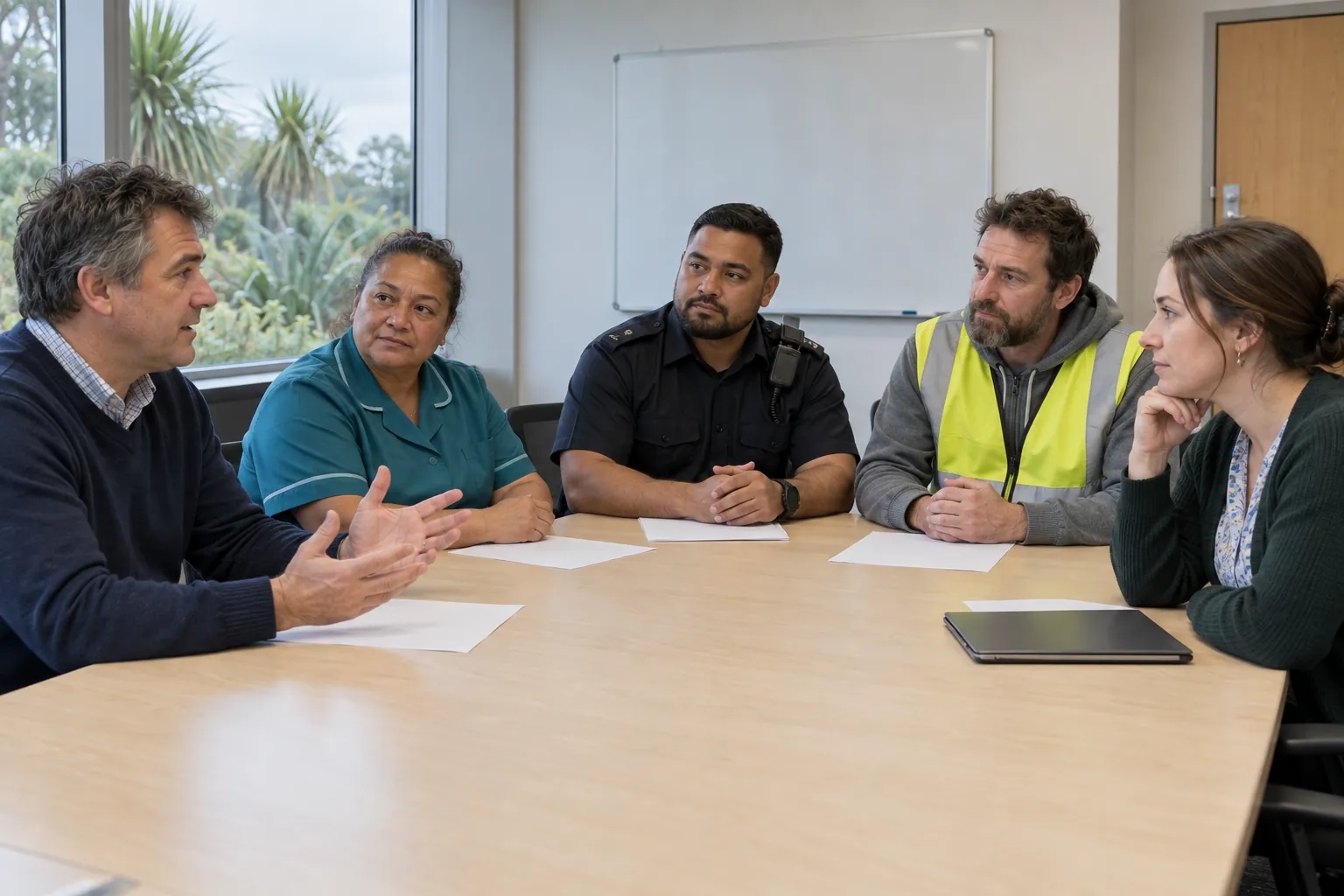
Part 3 also says every PCBU, whatever its size, must engage with its workers on health and safety and give them real ways to take part, and HSRs and health and safety committees are two well-established ways of doing it. This guide explains what the law requires, how an HSR is elected, what an HSR can do, how committees work, and what it looks like in a building where cleaners, security officers, caretakers and tenants all work for different PCBUs.
01
What Part 3 of HSWA requires: engagement, participation and representation
Part 3 of the Health and Safety at Work Act 2015 (HSWA) covers worker engagement, participation and representation. The Health and Safety at Work (Worker Engagement, Participation, and Representation) Regulations 2016 add the detail on work groups, elections, training and committees. WorkSafe New Zealand explains both in two documents published in September 2023: the good practice guidelines Worker engagement, participation and representation, and the interpretive guidelines Health and Safety Representatives and Committees: guidance on the legislative requirements.
In WorkSafe's words, a PCBU (person conducting a business or undertaking) must "engage with its workers on issues which will or are likely to affect health and safety", and "have practices that provide reasonable opportunities for its workers to participate effectively in improving health and safety". The good practice guidelines add that this applies "regardless of their size, level of risk or the type of work they carry out".
Engagement (section 59) has a specific meaning: give workers relevant information in good time, give them a reasonable opportunity to express views, raise issues and contribute to the decision, take their views into account, and tell them promptly what was decided. A notice in the tearoom announcing a decision already made is information, not engagement.
Participation practices (section 61) are the ongoing ways workers raise concerns, share information, suggest improvements and contribute to decisions. WorkSafe stresses that workers "can raise health and safety concerns at any time"; they do not need to wait for a meeting.
Representation is one form of participation. Any PCBU can choose to have HSRs or a health and safety committee (HSC), but it must initiate the election of one or more HSRs if a worker asks, and must establish an HSC if an HSR or five or more workers ask. Part 3 does not apply to volunteer workers or to prisoners working inside a prison.
02
What it covers in a building with several PCBUs
Section 58 says a PCBU must engage with the workers who carry out work for it and who are, or are likely to be, directly affected by a health and safety matter. A worker includes employees, contractors and subcontractors and their employees, labour hire staff, apprentices and people on work trials. Managers are workers too.
In a commercial building, each PCBU engages its own people. The cleaning contractor engages its cleaners, including the night crew and relief staff; the security company its officers on static posts and mobile patrols; the facilities company its technicians and caretakers; each tenant its own staff. WorkSafe's example is a construction company on a Canterbury rebuild that need not engage the electricians or plumbers working for other businesses on site, because "these businesses have their own duty to engage with their workers".
Section 60 lists when a PCBU must engage. Read for a building:
- Identifying hazards and assessing risks: the cleaner who mops the atrium stairs knows where the floor stays wet; the guard who locks the car park knows which lights are out.
- Proposing changes that may affect health or safety: a new cleaning chemical, new night shift hours, a lone-worker arrangement for patrols, a refurbishment.
- Decisions about controlling risks, resolving issues, whether welfare facilities such as tearooms and toilets are adequate, monitoring workers' health and workplace conditions, and information and training.
- Developing participation practices, including deciding work groups for HSR elections.
Engagement has to reach the people who are hard to reach. The good practice guidelines ask how shift workers and workers on rotating rosters will be reached, and name groups a PCBU should have processes for, including young, migrant and temporary workers, workers who speak languages other than English or have difficulty reading and writing, and Māori and Pacific workers. Cleaning and security workforces often include many of them, working after the building's managers have gone home.
Where several PCBUs have workers at one workplace, the guidelines describe good practice as participation that spans them: "All workers have opportunities to be equally involved in health and safety at this workplace, no matter which PCBU they work for." That links to the separate duty on overlapping duties to consult, co-operate and co-ordinate.
03
Electing a health and safety representative
WorkSafe's Health and Safety Representatives page says an HSR must be "a worker who has been formally elected by the members of your work group". A person the business has simply appointed and called its HSR does not have the powers the Act gives. The steps, as the interpretive guidelines set them out:
- A request. Any worker can ask for an HSR, in person, by email or by phone (section 62). WorkSafe suggests recording the date. A PCBU can also decide to hold an election without one.
- Start within two months of receiving the request, for that worker's work group (regulation 12).
- Decide the work groups, after engaging with workers (section 64). The default is one group for everyone. Smaller groups by site, occupation, floor or shift are allowed if they give effective representation and easy access to HSRs; the PCBU must consider, among other things, how many places people work at, how far apart they are, how much workers move between them, and shift patterns.
- Decide the number. For one group of all workers the minimum is one HSR for every 19 workers, rounded up, so 33 workers need two (regulation 6).
- Call for nominations. A candidate must belong to the work group, be willing, and work regularly and long enough to be effective. Anyone but a candidate can run the election; the PCBU pays for it and provides reasonable resources.
- Elect. If candidates do not outnumber vacancies, each is treated as elected. Otherwise a vote is held by any method, but by secret ballot if a work group member, a candidate or the PCBU asks.
- Publish the list. Regulation 20 requires a list of HSRs' names and contact details for each work group, easy for workers to find, kept up to date and given to the regulator on request.
Work groups can cross PCBU boundaries. Two or more PCBUs can agree a multiple PCBU work group arrangement, so that, say, everyone on one floor of an office building or all the night staff on a campus elect HSRs together. WorkSafe's example is a hospital where food workers from several businesses form one group.
An HSR serves three years, or a shorter agreed term, and can be re-elected. They stop being an HSR if they leave the work group or a simple majority of its members decide so. Regulation 17 makes it an offence to unreasonably delay an election or to interfere with or influence a voter; WorkSafe gives the maximum fines as $6,000 for an individual and $30,000 for anyone else.
04
What an HSR does, and what the PCBU owes them
WorkSafe summarises the functions in Schedule 2 of the Act as representing workers in the work group, investigating complaints, monitoring health and safety measures, inquiring into risks, making recommendations, telling the PCBU whether the law is being complied with, and promoting the interests of workers who have been harmed, including return to work. Any elected HSR may:
- enter and inspect any area of the workplace at a reasonable time after reasonable notice, or without notice after an incident or where there is a serious risk from an immediate or imminent exposure to a hazard;
- request information about hazards and risks affecting the work group, though not personal information about a worker without consent unless it cannot identify them;
- attend an interview about health and safety between a worker and an inspector or the PCBU, with the worker's consent, and accompany an inspector;
- consult WorkSafe or an inspector on any health and safety issue.
Two powers need training, assessed against NZQA unit standard 29315 (or, for an HSR trained under the old Health and Safety in Employment Act 1992, transition training). A trained HSR may issue a provisional improvement notice (section 69) to someone they reasonably believe is contravening, or likely to contravene, the Act or regulations, after first consulting them; and may direct unsafe work to cease (section 84) where there is a serious risk from an immediate or imminent exposure to a hazard, after first trying to resolve it with the PCBU unless there is no time.
The PCBU must:
- consult the HSR, so far as is reasonably practicable, on health and safety matters for the work group;
- allow reasonable time for the role, paid as normal work;
- provide the information, resources and facilities reasonably needed;
- on a recommendation, within a reasonable time, adopt it or write to the HSR giving reasons;
- allow two days' paid training leave a year, pay the fees and reasonable expenses, and decide on a training request within three months.
Regulation 26 caps the total paid training leave by the number of workers on 1 April: 2 days for 1 to 5 workers, 6 days for 6 to 50, one day for every 8 workers (or part) from 51 to 280, and 35 days plus 5 for every 100 (or part) above that.

05
Health and safety committees, and what good evidence looks like
An HSC lets the PCBU and workers meet regularly and work together on health and safety: helping them co-operate, developing standards, rules, policies and procedures, and making recommendations.
- When: as soon as practicable after a request from an HSR, or from five or more workers (section 66).
- Membership: agreed between the PCBU and workers. At least half must be workers representing workers and not nominated by the PCBU, and one PCBU member must be authorised to make decisions for it (regulation 28).
- Meetings: at least every three months, or sooner if more than half the members ask (regulation 29).
- Recommendations: adopted, or the PCBU writes explaining why not, within a reasonable time.
The good practice guidelines say a committee can work well where several PCBUs share a workplace, such as a construction site or a university campus, with members drawn from each. In a shared commercial building, a joint committee of the property manager, the cleaning and security contractors and the larger tenants is one practical way to co-ordinate.
WorkSafe's position statement Our approach to worker engagement, participation and representation says inspectors assess these practices, and that WorkSafe considers enforcement where the processes are not in place or participation is not working and nothing has been done about it.
Written records of engagement are not required by law, the guidelines say, but notes are good practice, covering when a discussion took place, who took part, what was discussed and found, what was decided and why, who will act and by when, and when the action was completed. In a building the test is simple: when a cleaner or a guard reports something, can anyone show what happened to it?
06
Where the record fails, and what SiteClara does about it
The formal parts are usually done: the election is held, the HSR list goes on the noticeboard, the committee minutes are filed. What fails is the loop Part 3 is built on, from a worker raising something to hearing what was done. The night cleaner tells the day supervisor about a loose stair nosing, the supervisor mentions it to someone in the property manager's office, and nobody writes it down. The HSR's walk-round notes sit in a notebook until the next committee meeting.
SiteClara records checks and reports at the location. A printed QR poster, with an optional NFC tag behind it, sits at each place a check is scheduled, such as a stairwell, a plant room door or a car park level. Staff scan or tap on their own phone, with no app to install, see the checks due there, and mark each one done or explain what stopped them. The time and the named person are recorded as it happens, with a photo when one is asked for, and a hazard reported at the location goes onto the team's list of open jobs until someone closes it.
The supervisor sees what is due, done and missed, records the reason a check was missed, and approves a daily report that goes to nominated management or client contacts the next morning, showing what was reported, completed and still open. For an HSR or a committee, that is a record to start from: the hazards workers raised, where and when, and whether they were closed. Where a cleaning or security company works in a building the property manager controls, both can read the same record.
07
Questions people ask
What is a health and safety representative?
A worker elected to speak for their work group on health and safety. WorkSafe's page Health and Safety Representatives says an HSR is "a worker who has been formally elected by the members of your work group to represent them on health and safety matters", and calls HSRs a well-established example of worker participation. It gives workers a voice through someone they chose; a person the business simply appoints is not an HSR under the Act.
What are the responsibilities of a health and safety representative?
The HSR's functions include representing the work group, investigating complaints, monitoring health and safety measures, inquiring into risks and making recommendations, but WorkSafe's interpretive guidelines Health and Safety Representatives and Committees say HSRs "do not have to use them". An HSR "is not expected to know everything about workplace health and safety issues, or to have overall responsibility for health and safety in their workplace"; their obligations are those of any worker, and the PCBU keeps its own duties. The guidelines add that the Act protects HSRs from civil and criminal liability for what they do, or do not do, in good faith in the role.
What HSR training is needed in New Zealand?
WorkSafe's page HSR training says initial training means achieving NZQA unit standard 29315, taught only by providers NZQA has approved. The PCBU must allow each HSR up to two days' paid leave a year for health and safety representative training, and pay the fees and reasonable costs such as travel. An HSR who has not been trained can still carry out the functions of the role, but only a trained HSR can issue a provisional improvement notice or direct unsafe work to cease.
Does every business have to have a health and safety representative?
No, but it must hold an election if asked. The interpretive guidelines Health and Safety Representatives and Committees say any PCBU can choose to have HSRs or a committee, but must initiate the election of one or more HSRs if a worker requests it, and establish a committee if an HSR or five or more workers request one. Engaging with workers on health and safety is required either way, whether the business is small or large.
08
Further reading, and a list to take away
Start with WorkSafe's two September 2023 documents, the good practice guidelines Worker engagement, participation and representation and the interpretive guidelines Health and Safety Representatives and Committees, which cite the section or regulation beside each requirement. WorkSafe's page Requirements for Health and Safety Representatives and Health and Safety Committees links both. The Act and the 2016 Regulations are on legislation.govt.nz.
Changes to health and safety law take effect on 1 April 2027. WorkSafe's summary Understanding the changes to the health and safety law (updated July 2026) does not list changes to these duties; check it again after that date. For how the other duties fit together in one building, see PCBU duties.
For a building, or a cleaning or security contract, check that:
- each PCBU engages its own workers, including night, relief and mobile staff, whatever its size;
- workers know they can ask for an HSR or a committee, and an election starts within two months of a request;
- work groups suit how the work is done, and PCBUs sharing a site have considered a joint group or committee;
- the list of HSRs and their contact details is easy to find and current;
- HSRs have paid time for the role and their training leave;
- a committee meets at least every three months and gets written reasons when a recommendation is not adopted;
- a worker can report a hazard at the place they find it, and hears what was done;
- engagement on section 60 matters is noted: when, with whom, what was decided and what happens next.
Sources
Every document this guide quotes or links to, in the order it first cites them.
- Worker engagement, participation and representation worksafe.govt.nz
- Health and Safety Representatives and Committees: guidance on the legislative requirements worksafe.govt.nz
- Health and Safety Representatives worksafe.govt.nz
- Our approach to worker engagement, participation and representation worksafe.govt.nz
- HSR training worksafe.govt.nz
- Requirements for Health and Safety Representatives and Health and Safety Committees worksafe.govt.nz
- Understanding the changes to the health and safety law worksafe.govt.nz
Related guides
 Premises and facilities managementPCBU duties: what a PCBU is, and what the law expects of one in a buildingWhat a PCBU is under the Health and Safety at Work Act 2015, the primary duty of care, shared duties in one building, and what changes on 1 April 2027.
 Premises and facilities managementOverlapping duties: sharing health and safety when several PCBUs work in one buildingOverlapping duties under HSWA 2015: when PCBUs share a building or a contracting chain, how to consult, co-operate and co-ordinate, and how to show it works.
 Premises and facilities managementHazard register: what HSWA expects, and how to keep one that is usedWhat a hazard register is under New Zealand's HSWA, what goes in it, how to assess and control risks, when to review it, and what changes on 1 April 2027.
 Premises and facilities managementNear miss reporting: learning from the harm that nearly happenedWhat a near miss is under New Zealand's HSWA, when one must be notified to WorkSafe, what a good near miss report records, and how to get near misses reported.