Premises and facilities management
PCBU duties: what a PCBU is, and what the law expects of one in a building
PCBU stands for person conducting a business or undertaking, the term New Zealand's Health and Safety at Work Act 2015 uses for the business or organisation that carries the main health and safety duties.
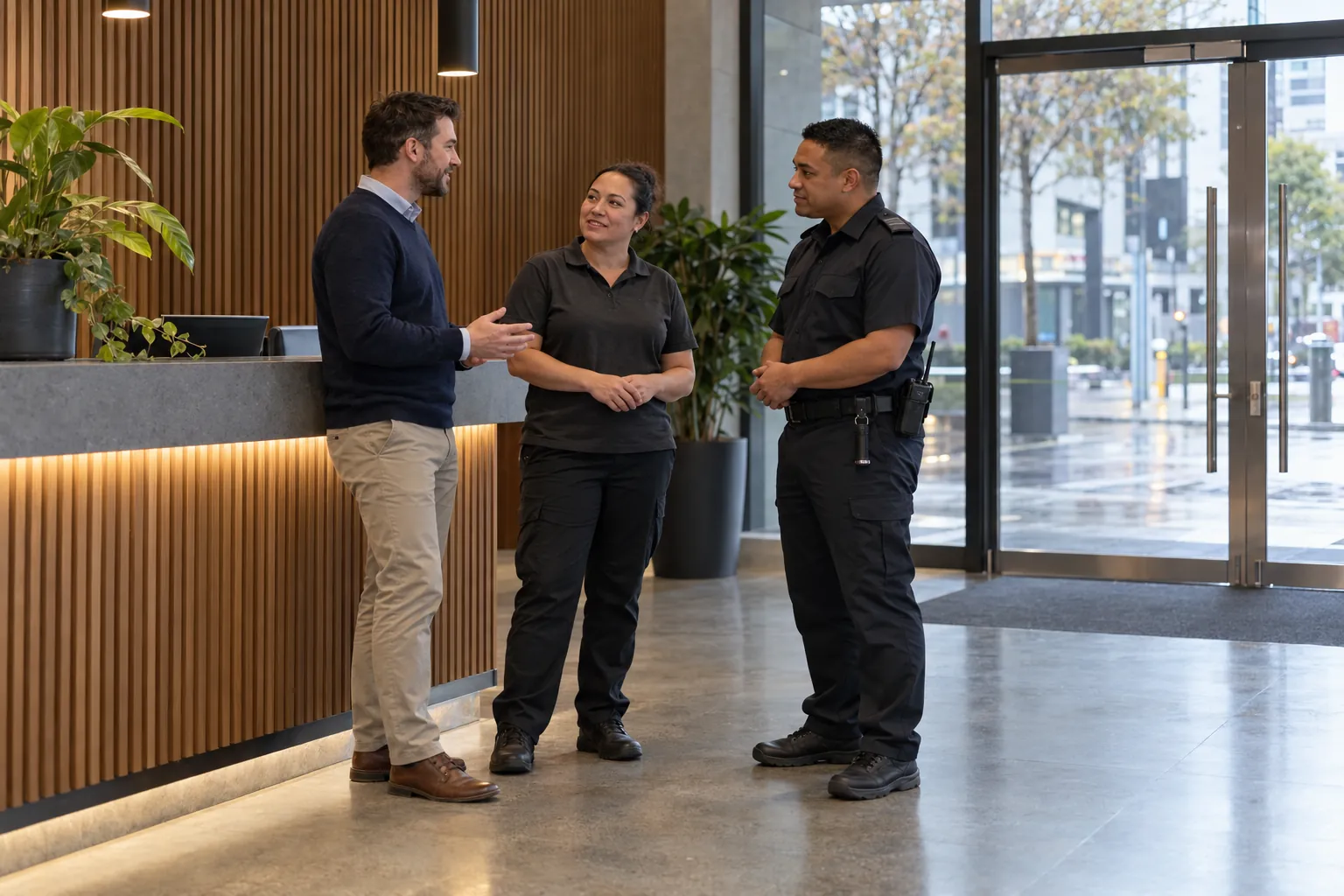
In one ordinary commercial building there can be half a dozen of them: the owner, the property manager, each tenant, the body corporate, the contract cleaners and the security company. This guide explains what a PCBU is, what the primary duty of care involves and the obligations it places on each, how the duties overlap in a shared building, and what changes when the 2026 amendments take effect on 1 April 2027.
01
What a PCBU is, and the primary duty of care
PCBU stands for person conducting a business or undertaking. It is the central idea of the Health and Safety at Work Act 2015 (HSWA), New Zealand's main work health and safety law, and it replaced the older focus on the employer. WorkSafe New Zealand describes it on its page Who or what is a PCBU? as "a broad concept used throughout HSWA to describe all types of modern working arrangements which we commonly refer to as businesses".
The Act does not define business or undertaking. WorkSafe's Introduction to the Health and Safety at Work Act 2015 special guide (second edition, February 2019) gives the usual meanings: a business usually aims at profit or gain, and an undertaking is non-commercial. So a PCBU can be a company, a sole trader, a council, a school or a charity that employs staff.
Some people are not PCBUs, even though they have duties of their own:
- Workers and officers, to the extent they are solely a worker or an officer. Officers carry the separate due diligence duty described below.
- Volunteer associations that employ nobody, even if they engage contractors; the contractors are PCBUs.
- Home occupiers who engage someone only for residential work on their own home.
The core duty is in section 36 of the Act, the primary duty of care. WorkSafe's page What is the primary duty of care? summarises it: a business must ensure, so far as is reasonably practicable, the health and safety of its own workers, of other workers whose work it influences or directs, and of anyone else put at risk by its work, such as visitors, customers and the public.
So far as is reasonably practicable is defined in section 22. WorkSafe's guide explains it as what can reasonably be done, weighing how likely and how severe the harm is, what the PCBU knows or ought to know about the risk and its controls, and whether those controls are available and suitable; cost counts against a control only if it is grossly disproportionate to the risk.
02
What the duty covers in a building
The primary duty of care is broad, and the Act lists what it includes without limiting it. Read for a commercial building, a school or an apartment block, each item has an everyday meaning:
- A work environment without risks to health and safety: lighting in stairwells and car parks, ventilation, noise, and the psychological side WorkSafe's special guide names, including overcrowding, deadlines, shift arrangements, work-related stress and fatigue.
- Safe plant and structures, kept in good condition: the building itself, lifts, roof access, ladders, cleaning machines and tools.
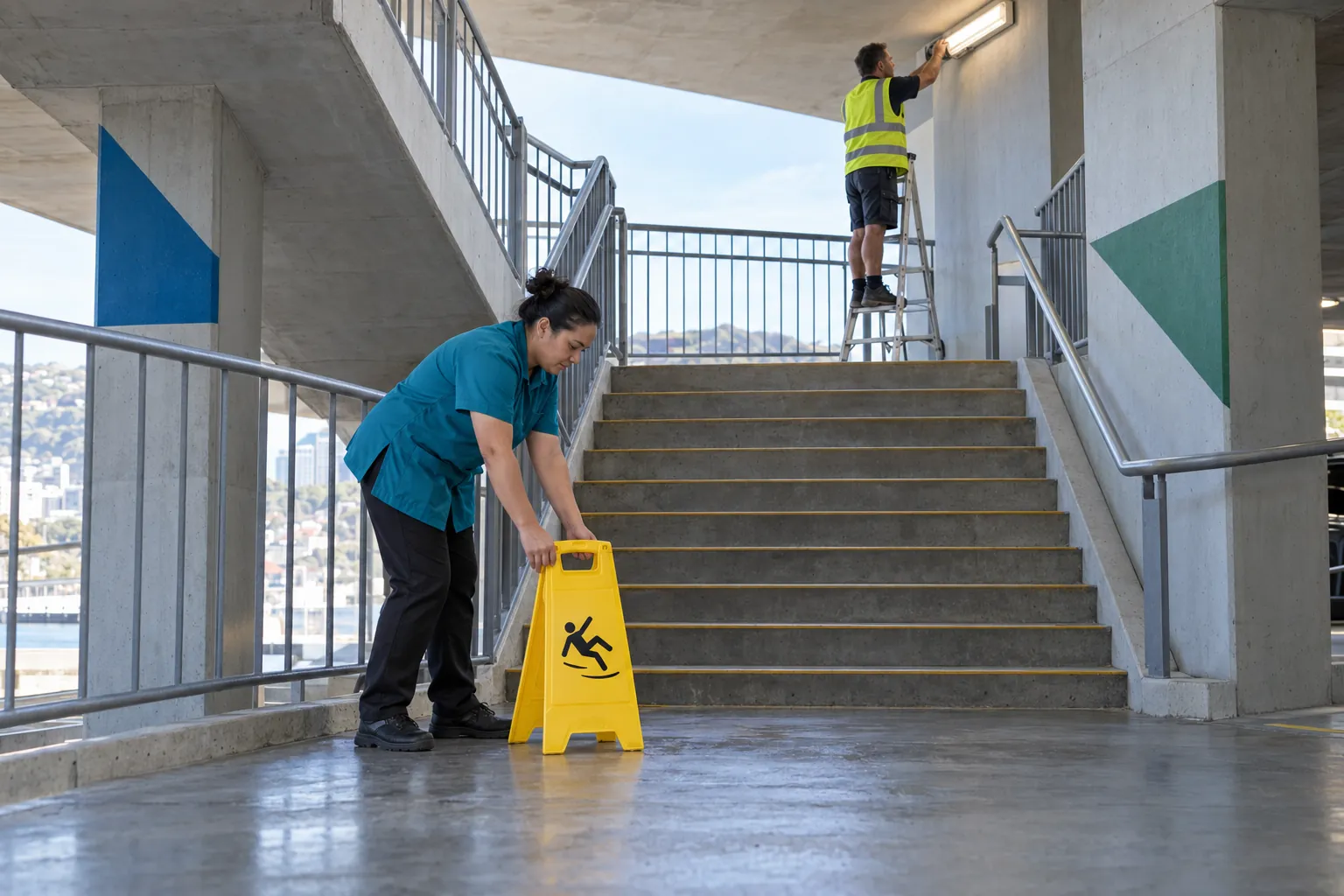
- Safe systems of work: how a task is done, such as wet floor cleaning in a busy lobby, lone night patrols or work in a plant room.
- Safe use, handling and storage of plant, structures and substances: the cleaners' chemical store, fuel, pool chemicals.
- Adequate facilities for the welfare of workers, and access to them: toilets, drinking water, hand washing, somewhere to eat and rest.
- Information, training, instruction and supervision needed to protect people from the work.
- Monitoring of workers' health and of conditions at the workplace, to prevent injury or illness.
Two further duties sit on top of the primary duty and matter most to whoever runs the building. Section 37 applies to a PCBU who manages or controls a workplace. In the words of WorkSafe's page Duties for specific businesses, that PCBU "must ensure, so far as is reasonably practicable, that the workplace, how people enter and exit the workplace, and anything else that may arise from the workplace are without health and safety risks to people". Section 38 does the same for a PCBU who manages or controls fixtures, fittings or plant at a workplace.
A workplace, for these purposes, is "any place where a worker goes or is likely to be while at work, or where work is being carried out or is customarily carried out". A lobby, a car park, a bin room and a stairwell are all workplaces.
The Health and Safety at Work (General Risk and Workplace Management) Regulations 2016, summarised in WorkSafe's General risk and workplace management – part 1, add welfare facilities, first aid, and an emergency plan covering evacuation, notifying emergency services and medical treatment, which should be tested at least once a year.
03
One building, several PCBUs: overlapping duties
Few buildings have a single PCBU. WorkSafe's Property management FAQs are direct about who counts:
- a commercial property owner or landlord "is a Person Conducting a Business or Undertaking (PCBU)" with a duty of care to everyone involved with or affected by work at the property;
- a property manager "is also a PCBU" for the property it is responsible for;
- commercial tenants "are also PCBUs", with the same duty for their own workers and others;
- a body corporate "is considered to be a PCBU", which in a unit title development means the body corporate under the Unit Titles Act 2010.
Add the contract cleaners, the security provider and the lift and fire protection contractors, each a PCBU in its own right, and one stairwell can involve five or six duty holders. Under section 34, PCBUs who share a duty in relation to the same matter must, so far as is reasonably practicable, consult, co-operate and co-ordinate activities with each other. WorkSafe's Introduction to the Health and Safety at Work Act 2015 special guide is plain: "A PCBU cannot contract out of its duties". Its Overlapping duties quick guide adds that "A business is not only responsible to the people they employ or contract."
What a PCBU can do is make reasonable agreements about who manages which risk. The landlord may agree to maintain stair lighting and handrails; the cleaning company may agree to control wet floors and its own chemicals; the tenant may agree to report hazards it sees in the common areas. Each still keeps its own duty, and WorkSafe's special guide says the PCBUs "should also monitor each other to ensure everyone is doing what they agreed".
The share of the work follows influence and control over the work, the workplace and the workers, not size. A property manager controls the building; the cleaning company controls how its cleaners work. WorkSafe's special guide says PCBUs sharing a site should:
- discuss what work activities are being carried out;
- agree on the degree of influence and control each has;
- agree on who will manage what and how;
- agree on the use of shared facilities;
- monitor and check how things are going on an ongoing basis.
04
Managing risk, and the duties of officers and workers
Section 30 of HSWA sets the order for managing any risk: eliminate it so far as is reasonably practicable, and if it cannot be eliminated, minimise it so far as is reasonably practicable, to the extent the PCBU can influence and control the matter. Removing a trip hazard beats a cone beside it; a cone beats a note in the induction pack.
Every PCBU must also, so far as is reasonably practicable, engage with its workers on health and safety matters that directly affect them, and give them reasonable opportunities to help improve health and safety (Part 3 of the Act), directly or through health and safety representatives and committees. The night-shift cleaner is usually the first to know that a stair light is out.
Workers have their own duty (section 45): to take reasonable care for their own health and safety and that of others, to co-operate with any reasonable health and safety policy or procedure they have been told about, and to comply, so far as they reasonably can, with reasonable instructions. Other persons at a workplace, such as visitors, have a similar duty under section 46.
When something serious happens, the PCBU has further duties under sections 55 to 57. The PCBU that manages or controls the workplace must preserve the site of a notifiable event, the regulator must be notified as soon as possible, and, as WorkSafe's guide puts it, the PCBU "must keep records of notifiable events for at least five years from the date the regulator was notified about the event". Where several PCBUs are involved, one should be nominated to notify, but all are responsible for making sure it is done.
A building owner has duties under other law too. Where a building has specified systems such as sprinklers or fire alarms, MBIE's guidance on managing your building warrant of fitness explains that the owner engages independent qualified persons (IQPs) for the compliance schedule's inspections, supplies the BWoF to the council each year, displays it, and keeps inspection, maintenance and repair records for at least two years.
05
What changes on 1 April 2027
The Health and Safety at Work Amendment Act 2026 received the Royal assent on 9 July 2026, according to MBIE's page on health and safety reform, and WorkSafe's page Understanding the changes to the health and safety law says the changes take effect on 1 April 2027. Until then, the Act applies as described above. From that date:
- Critical risk becomes the focus. WorkSafe's page What is critical risk? defines it as a risk likely to result in death, a notifiable injury, illness or incident, or a notifiable occupational disease, or one managed by regulations under HSWA. A new Schedule 1A of the Act lists categories that are critical risks in any case, among them asbestos work, hazardous substances and work at height.
- Small and large PCBUs are treated differently. A small PCBU has fewer than 20 workers for at least nine months of a financial year. WorkSafe's guidance on managing critical risks for small PCBUs says they must manage critical risks and are not required to manage risks that are not critical, though they may, and must still provide welfare facilities including toilets, drinking water, hand washing, first aid and emergency planning.
- Large PCBUs, with 20 or more workers or expecting to have them for more than three months of the financial year, must manage all risks while, in the words of WorkSafe's page on prioritising critical risks for large PCBUs, prioritising critical risks: managing them first, reviewing their controls more often and giving them a larger share of resources.
- Officer duties focus on governance. WorkSafe says officers' duties are clarified to focus on governance: understanding the risks, making sure resources and processes exist, and verifying that the business uses them.
- Overlap with other laws. A PCBU that complies with a requirement in another Act that manages the same risk, such as the Building Act, will be treated as complying with HSWA for that risk.
- Approved codes of practice become a safe harbour: a PCBU that follows the relevant actions in an approved code is treated as meeting its duty.
Some duties carry on. WorkSafe's small PCBU page says a small PCBU must still provide adequate welfare facilities and must still consult, co-operate and co-ordinate with any PCBU it shares a duty with, and that its officers must still exercise due diligence; MBIE says the amendments clarify the types of serious injury, illness or event that must be notified to the regulator. A slip on a wet stair or a lone guard assaulted at night can each be a critical risk, so the everyday checks that control them matter more under the new focus, not less.
06
Where the record fails, and what SiteClara does about it
Overlapping duties are usually written down well: the cleaners check the stairwells, the security company locks up and patrols the car park, the property manager fixes lights and handrails. What is rarely written down is whether any of it happened. The check sheet on the plant room door is signed for the week in advance; the patrol is walked with nothing to show for it; the broken stair nosing is mentioned to whoever was passing. WorkSafe's special guide expects PCBUs that share duties to monitor each other, and says officers of large PCBUs cannot rely on a health and safety system simply existing: they "should understand how it works, and take steps to make sure it is working". Without a record of what was done, neither is possible.
SiteClara records the checks at the location. A printed QR poster, with an optional NFC tag behind it, sits at each place a check is scheduled, such as a stairwell, a bin room or a car park level. Staff scan or tap on their own phone, with no app to install, see the checks due there, and mark each one done or explain what stopped them. The time and the named person are recorded as it happens, with a photo when one is asked for, and a hazard reported at the location goes onto the team's list of open jobs until someone closes it.
The supervisor sees what is due, done and missed, records the reason a check was missed, and approves a daily report that goes to nominated management or client contacts the next morning, showing what was reported, completed and still open. Where a cleaning or security company works in a building the property manager controls, both can read the same record of the agreed checks.
07
Questions people ask
What does PCBU stand for, and what does it mean in New Zealand?
WorkSafe's page Who or what is a PCBU? says "A PCBU means a Person Conducting a Business or Undertaking", "a broad concept used throughout HSWA to describe all types of modern working arrangements which we commonly refer to as businesses". In practice it is whoever carries the primary duty of care under the Health and Safety at Work Act 2015.
How do you identify a PCBU?
Start from the work being done and who is conducting it. WorkSafe's page Who or what is a PCBU? says "Most New Zealand businesses, whether large corporates, sole traders, or self-employed, are classed as PCBUs", and that an undertaking such as a government department, a local council, a school or a charity can be one too. It names three groups that are not: volunteer associations, home occupiers and workers.
What are three responsibilities of a PCBU?
WorkSafe's page What is the primary duty of care? lists eight things a PCBU must ensure, so far as is reasonably practicable. Three that matter in any building are providing and maintaining a work environment "without risks to health and safety", providing and maintaining safe plant and structures, and providing safe systems of work. The others cover safe use, handling and storage of plant, structures and substances, adequate welfare facilities, information and training, monitoring, and any worker accommodation provided.
Who is legally responsible for safety in the workplace?
The PCBU carries the main duty. In the words of WorkSafe's page What is the primary duty of care?, "a business has the primary responsibility for the health and safety of workers and others influenced by its work", which covers its own workers, other workers it influences or directs, and customers, visitors and the public put at risk by the work. Officers and workers have duties of their own, described above, and where several PCBUs share a building each keeps its own duty.
08
Further reading, and a list to take away
The Health and Safety at Work Act 2015 is on legislation.govt.nz. WorkSafe's Introduction to the Health and Safety at Work Act 2015 special guide explains the duties with worked examples, and its Property management FAQs suit a shared building. For the 2027 changes, start with Understanding the changes to the health and safety law.
For a building with more than one PCBU, check that:
- every PCBU with a duty in the building is known: owner, property manager, body corporate, tenants and each contractor;
- each has agreed in writing who manages which risk, from stair lighting to chemical storage to lock-up;
- shared facilities, first aid and the emergency plan have an owner, and the plan has been tested this year;
- workers, including contractors' night staff, have a simple way to report a hazard at the place they find it;
- reported hazards are tracked until they are closed, not just passed on;
- the agreed checks leave a record of when they were done and by whom, that the other PCBUs can see;
- officers see enough of that record to verify, not assume, that the arrangements work;
- critical risks have been identified ahead of 1 April 2027, and whether each PCBU is small or large.
Sources
Every document this guide quotes or links to, in the order it first cites them.
- Health and Safety at Work Act 2015 legislation.govt.nz
- Who or what is a PCBU? worksafe.govt.nz
- Introduction to the Health and Safety at Work Act 2015 special guide worksafe.govt.nz
- Section 36 of the Act, the primary duty of care legislation.govt.nz
- What is the primary duty of care? worksafe.govt.nz
- Duties for specific businesses worksafe.govt.nz
- General risk and workplace management – part 1 worksafe.govt.nz
- Property management FAQs worksafe.govt.nz
- Overlapping duties quick guide worksafe.govt.nz
- Managing your building warrant of fitness building.govt.nz
- Health and safety reform mbie.govt.nz
- Understanding the changes to the health and safety law worksafe.govt.nz
- What is critical risk? worksafe.govt.nz
- Managing critical risks for small PCBUs worksafe.govt.nz
- Prioritising critical risks for large PCBUs worksafe.govt.nz
Related guides
 Premises and facilities managementOverlapping duties: sharing health and safety when several PCBUs work in one buildingOverlapping duties under HSWA 2015: when PCBUs share a building or a contracting chain, how to consult, co-operate and co-ordinate, and how to show it works.
 Premises and facilities managementNotifiable events: what WorkSafe must be told, and what to do in the first hourWhat a notifiable event is under HSWA 2015, what to do when one happens in a building, who tells WorkSafe when PCBUs overlap, and the records to keep.
 Premises and facilities managementHazard register: what HSWA expects, and how to keep one that is usedWhat a hazard register is under New Zealand's HSWA, what goes in it, how to assess and control risks, when to review it, and what changes on 1 April 2027.
 Premises and facilities managementHealth and safety representatives: electing an HSR, and engaging workers in a buildingWhat a PCBU must do under Part 3 of HSWA: engaging workers, electing a health and safety representative, the HSR's powers, and health and safety committees.