Fire and water checks
Weekly fire alarm test: how to do it, and what to record
A weekly fire alarm test is a short routine test in which someone on site operates a different manual call point each week to check that the fire alarm system works, as government fire safety guidance recommends, pointing to the British Standard BS 5839-1 for further guidance on testing and maintenance.
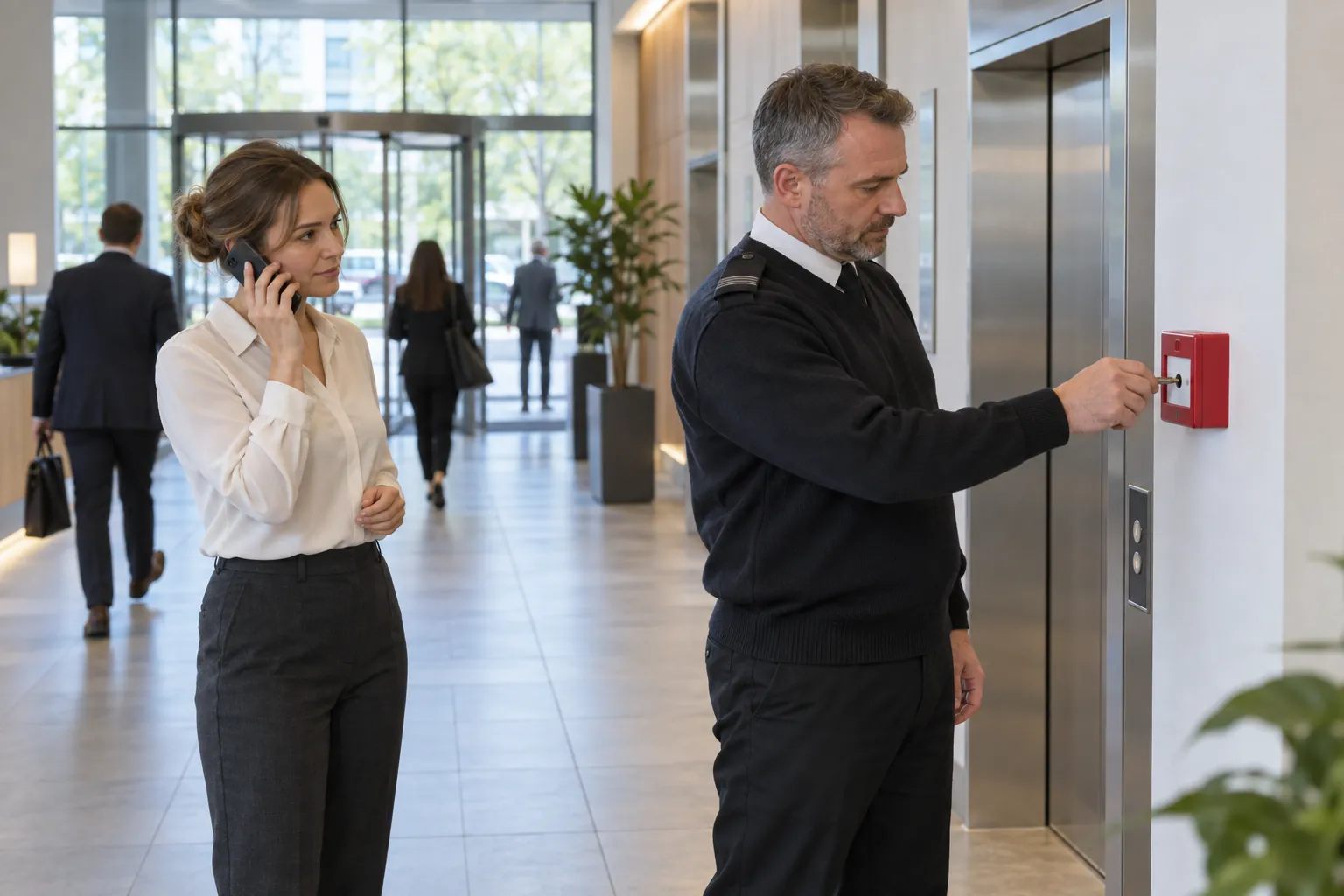
It is the most familiar fire safety check in any workplace, and one of the easiest to do badly: the same call point every week, nobody checking the far end of the building, nothing written down. This guide covers what the test is for, how to do it properly, and what the record should show.
01
Where the weekly test comes from
In England and Wales, article 17 of the Regulatory Reform (Fire Safety) Order 2005 requires the responsible person to make sure fire safety equipment, including fire detection and fire alarm systems, is subject to a suitable system of maintenance and kept in efficient working order. Scotland and Northern Ireland have equivalent duties under the Fire (Scotland) Act 2005 and the Fire Safety Regulations (Northern Ireland) 2010. None of these laws says "test the alarm weekly", but regular testing is how a responsible person shows that the fire alarms in a commercial building actually work.
The weekly test comes from BS 5839-1, the British Standard code of practice for fire detection and fire alarm systems in non-domestic premises. It is the standard fire risk assessors, insurers and fire and rescue authorities expect a workplace system to be designed, installed and maintained to, and it divides the routine into two parts:
- Checks by the user, which BS 5839-1 calls the premises management: a weekly user test of the system, operating one manual call point, and keeping a log book.
- Periodic inspection and servicing by a competent person, at intervals the standard sets at no more than six months, so at least twice a year.
Government guidance sets out the same routine. In England, the Home Office's A guide to making your small non-domestic premises safe from fire lists as a weekly check that fire alarm systems should be tested using a different manual call point each week, to make sure the system is operating and that the alarm is audible throughout the premises, and as a six-monthly check that fire alarm systems should be inspected and tested by a competent contractor.
Following BS 5839-1 is not a legal requirement in itself, but it is the recognised way to show that the legal duty to maintain the system is met, and a fire risk assessment will normally expect it. Systems in homes and in some residential buildings are covered by a different part of the standard, BS 5839-6, with its own routine.
02
What the weekly test does and does not show
The weekly test is a user test: short, simple and done by a member of staff on site. It is designed to confirm the alarm sounds when it should, and to show that:
- a manual call point sends a signal to the control panel;
- the control and indicating equipment receives it and shows the right zone or device;
- the sounders and any visual alarm devices operate;
- where the system is monitored, the signal reaches the alarm receiving centre;
- where fire doors are held open on devices linked to the alarm, they release.
Because a different call point is used each week, over time every call point in the building is proved to work. The test also keeps occupants familiar with the sound of the alarm, so that they recognise it when it matters.
It does not test every detector, the battery standby, or the cause and effect programmed into the panel, such as lifts returning to the ground floor or ventilation shutting down. Those belong to the competent person's periodic inspection. A weekly test that passes tells you the system is working in the way the test exercises, which is valuable, but it is not a service.
03
How to carry out the weekly fire alarm test
The test takes a few minutes. BS 5839-1 recommends it is done during normal working hours, at roughly the same time each week, so that occupants know a short alarm at that time is a test. A sensible routine:
- Choose the call point next on the rotation list, not the one by the office door that was used last week.
- Tell whoever needs to know: the alarm receiving centre if the system is monitored, reception, and any areas where a sudden alarm could cause a problem.
- Operate the call point with its test key, rather than breaking the glass or pressing the element.
- Check the panel shows the correct zone or device. A panel that reports the wrong location will send people the wrong way in a real alarm.
- Confirm the sounders work throughout, including in plant rooms, toilets, stairwells and noisy areas, by having someone listen or by asking a colleague elsewhere. Keep the alarm brief, about a minute, so it is not mistaken for a real alarm.
- Silence and reset the system, reset the call point, and check the panel returns to normal with no faults showing.
- Confirm with the alarm receiving centre that it received the signal, and put the system back on line.
- Record the test in the log book, including anything that did not work.
If anything fails, such as a sounder that did not operate, a wrong zone on the panel or no signal at the receiving centre, record it and report it to the fire alarm maintenance company straight away. A fault left until the next service visit could be a fault for months.
04
The call point rotation and the log book
A testing schedule is what turns weekly fire alarm testing into evidence that every part of the system has been exercised. Number every manual call point on a list or a plan, and work through them in order. In a building with forty call points, each is tested roughly once every forty weeks. Mark on the list the date each was last tested, so that a call point hidden behind a door or in a rarely used plant room does not quietly drop out of the rotation.
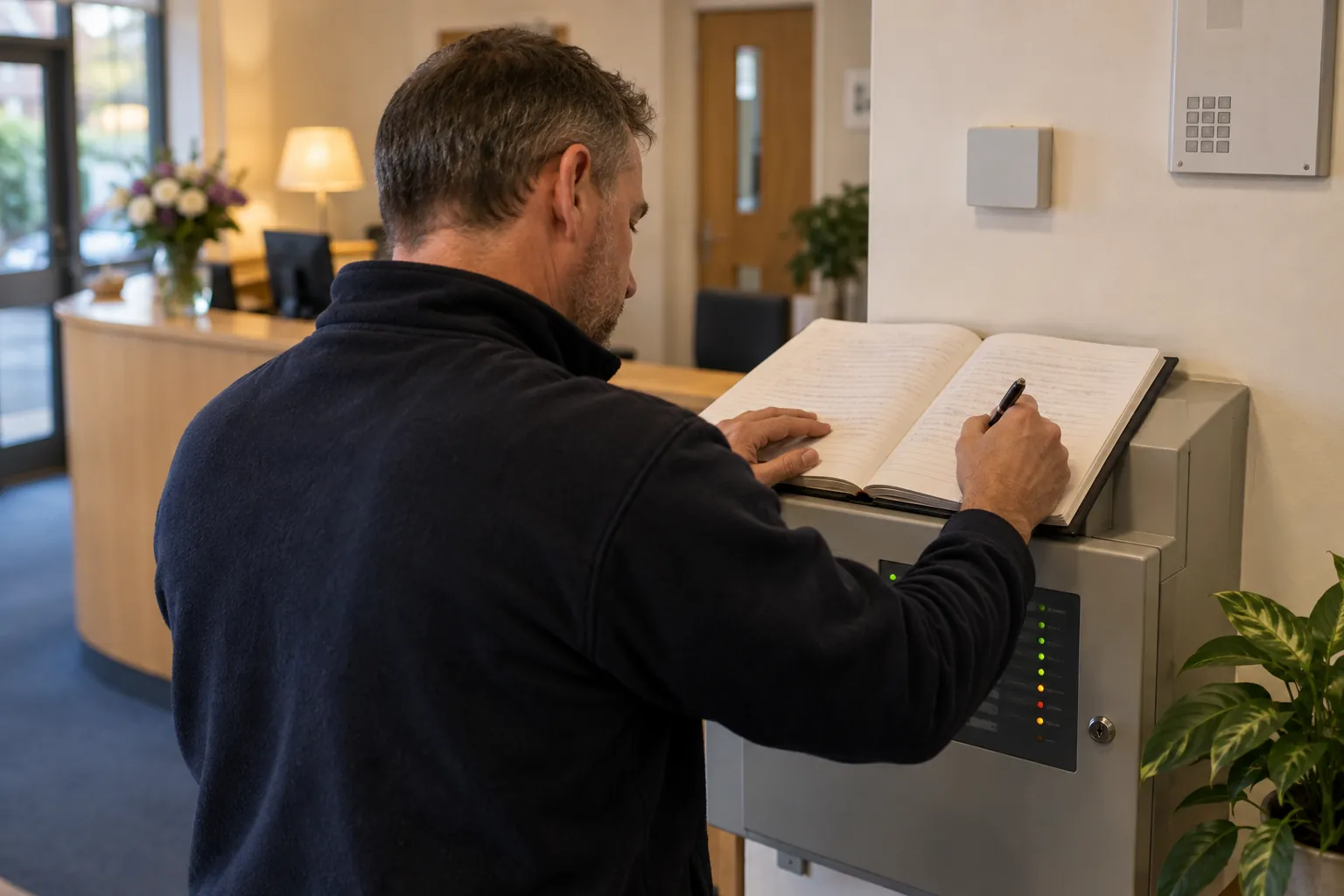
BS 5839-1 recommends that a log book is kept for the system, usually beside the panel, and includes a model. For the weekly test, each entry should show:
- the date and time of the test;
- the call point used, by its number or location;
- the result: panel indication correct, sounders heard throughout, signal received by the receiving centre;
- any fault found, who it was reported to and when;
- the name of the person who did the test.
The log book also records false alarms and their causes, faults, disablements, and visits by the maintenance company. False alarms are worth watching: a pattern of them from one detector or one area is something the competent person needs to know about, and fire and rescue authorities take an interest in premises that call them out repeatedly.
BS 5839-1 also recommends a quick daily check that the panel shows normal operation, with any fault indication recorded and reported. On many sites this is part of the opening routine or the security officer's first patrol.
05
Servicing by a competent person
The periodic inspection and servicing recommended by BS 5839-1 is carried out by a competent person, usually a fire alarm maintenance company, at intervals of no more than six months. This fire alarm inspection covers the parts of the fire detection system that the weekly test does not reach: detectors tested in turn, batteries and chargers checked, sounder audibility, the panel's functions and programmed cause and effect, and a review of false alarm records and the log book.
Third-party certification, such as the BAFE SP203-1 scheme or the LPCB's LPS 1014, is one way to show a fire alarm company is competent, and many insurers and fire risk assessors look for it. After each visit the company should issue a servicing certificate and note anything that needs attention; keep it with the log book.
Some things always need the competent person rather than site staff: faults on the panel that do not clear, disabling or isolating zones for building work, changes to the system after a refit or a change of layout, and anything to do with the cause and effect. A weekly test that keeps finding the same fault is a reason to call them, not to keep recording it.
Can building staff carry out fire alarm testing themselves? For the weekly test, yes: it is designed for the premises management to do, once someone has been shown how. For servicing, no.
06
Where the weekly test fails, and what SiteClara does about it
Weekly alarm tests go wrong in predictable ways. The same call point gets tested every week because it is nearest the panel. The person who does it is on holiday and nobody else knows the routine. The log book is filled in on a Friday for a test that happened on Tuesday, or did not happen at all. And in an estate of many buildings, a regional manager has no way of knowing which sites tested this week without phoning round.
SiteClara puts a printed QR poster at each call point or at the panel, with an optional NFC tag behind it. The person doing the test scans the code or taps the tag on their own phone, with no app to install; they are enrolled by text and sign in with a link. They see the check due at that location, such as this week's call point test, and mark it done, or explain what stopped them. A fault, such as a sounder that did not operate, is reported there with a photo and goes onto the team's list of jobs until someone closes it.
The supervisor sees what is due, done and missed across the building or estate and can record why a test was missed; a job that needs the building manager can be escalated to them to answer. Each day the supervisor reviews and approves a report that goes to nominated management or client contacts at 8am the next morning, showing what was reported, completed and still open, and how the scheduled checks went, for example 12 of 12 completed. It is priced per building, with no per-person fees.
07
Questions people ask
Is weekly fire alarm testing a legal requirement?
No law says in so many words that a fire alarm must be tested every week, but the law requires the system to be maintained in efficient working order, and government fire safety guidance recommends a weekly test. In England, the Home Office's Fire safety risk assessment: offices and shops says all types of fire warning systems should be tested once a week, using a different call point for each successive test, and points to BS 5839-1 for further guidance on testing and maintenance, and its shorter guide to making small non-domestic premises safe from fire says the same.
What is the legal requirement for fire alarm testing in the UK?
In every part of the UK the legal requirement is to keep fire safety equipment, including the fire alarm, subject to a suitable system of maintenance and maintained in an efficient state, in efficient working order and in good repair, without a testing interval written into the law. The duty is in article 17 of the Regulatory Reform (Fire Safety) Order 2005 in England and Wales, regulation 16 of the Fire Safety (Scotland) Regulations 2006 in Scotland, and regulation 16 of the Fire Safety Regulations (Northern Ireland) 2010 in Northern Ireland. Government fire safety guidance recommends a weekly test and six-monthly servicing by a competent person as the routine that keeps the system in that state.
08
Further reading, and a list to take away
BS 5839-1, the code of practice for fire detection and fire alarm systems in non-domestic premises, is published by BSI and includes the model log book. The Fire Industry Association publishes free guidance on fire alarm maintenance and false alarms. BAFE and LPCB publish registers of certificated companies. GOV.UK publishes the Fire safety risk assessment guides for different types of premises, and your local fire and rescue service can advise on false alarm reduction in your area.
Before next week's test, check that:
- every call point is numbered and on a rotation list, with the date it was last tested;
- the test happens at about the same time each week, and a named deputy can do it;
- the alarm receiving centre is told before the test and confirms receipt after it;
- someone confirms the sounders can be heard across the building, not just by the panel;
- each test, fault and false alarm is recorded in the log book;
- faults go to the maintenance company the same day;
- the six-monthly service is booked and its certificate is kept with the log book.
Sources
Every document this guide quotes or links to, in the order it first cites them.
- Article 17 of the Regulatory Reform (Fire Safety) Order 2005 legislation.gov.uk
- Fire (Scotland) Act 2005 legislation.gov.uk
- A guide to making your small non-domestic premises safe from fire gov.uk
- Fire safety risk assessment: offices and shops gov.uk
- Regulation 16 of the Fire Safety (Scotland) Regulations 2006 legislation.gov.uk
- Regulation 16 of the Fire Safety Regulations (Northern Ireland) 2010 legislation.gov.uk
- BS 5839-1 knowledge.bsigroup.com
- Fire safety risk assessment gov.uk
Related guides
 Fire and water checksEmergency lighting log book: what to record, and how oftenWhat an emergency lighting log book should record, the monthly and annual tests BS 5266-1 recommends, who does each, and how to keep the record credible.
 Fire and water checksFire safety checks in the workplace: what to check, how often, and who does itThe routine fire safety checks a UK workplace needs, from daily escape routes to the weekly alarm test, who does each one, and what the record should show.
 Fire and water checksFire marshal checklist: the daily and weekly checks, and the job in an evacuationWhat a fire marshal or fire warden checks each day and week, their role in an evacuation, the law behind the role, and how to keep a record that stands up.
 Security patrolsSecurity officer duties and responsibilities: what the role involves, and how it is checkedSecurity officer duties in the UK: licensing, patrols, access control, incidents and reporting, what officers cannot do, and how duties are set and checked.