Fire and water checks
Personal emergency evacuation plans: who needs one, what goes in it, and keeping it true
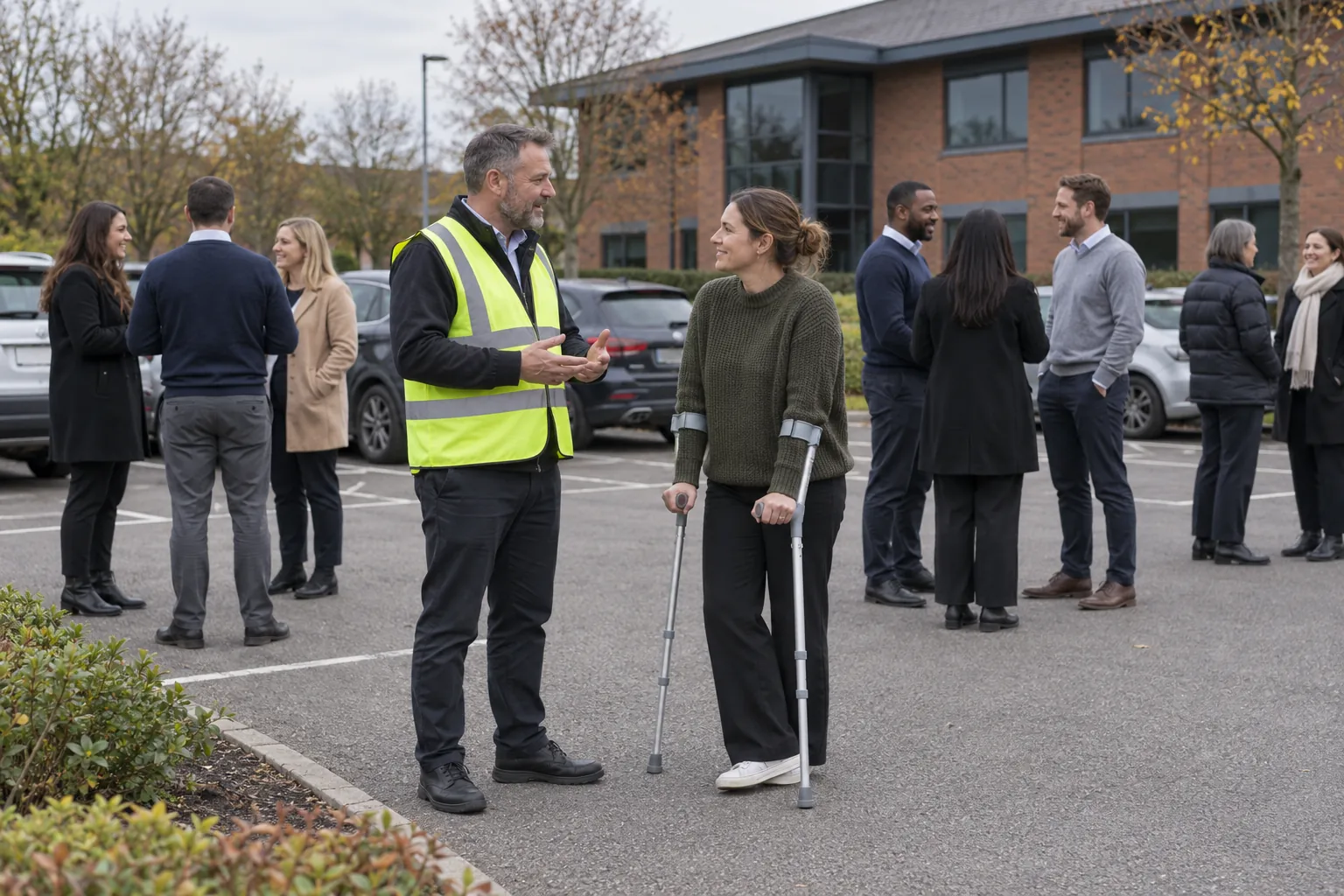
A personal emergency evacuation plan (PEEP) is a written plan, agreed with one person who may not be able to leave a building unaided in a fire, that sets out how they will be alerted, which route they will take and who or what will help them get out without waiting for the fire and rescue service.
Also written for Ireland

In workplaces and other non-domestic premises in England and Wales, PEEPs follow from the Regulatory Reform (Fire Safety) Order 2005, which requires the responsible person to plan an evacuation that works for everyone, disabled people included. Since 6 April 2026, residents of high-rise blocks of flats in England have their own version, residential PEEPs, under the Fire Safety (Residential Evacuation Plans) (England) Regulations 2025. This guide covers both, the generic and standard plans for visitors, how to write a plan, and how to keep it true once it is filed.
01
What a PEEP is, and the law behind it
A PEEP is a plan for one person, written with them, not about them, alongside the building's general fire procedures.
No law in England and Wales uses the words "personal emergency evacuation plan" for workplaces; the duty is to the outcome. Under the Regulatory Reform (Fire Safety) Order 2005, the responsible person (usually the employer, or the owner, landlord, occupier or managing agent in control of the premises) must make a suitable and sufficient assessment of the fire risks under article 9 of the Fire Safety Order and record it, and the record must include any group of persons identified as especially at risk. Article 14 requires that, in the event of danger, people can evacuate the premises as quickly and as safely as possible, and article 15 requires the responsible person to "establish and, where necessary, give effect to appropriate procedures, including safety drills" and to nominate enough competent persons to carry out the evacuation.
The government's supplementary guide, Fire safety risk assessment: means of escape for disabled people (Home Office, first published in 2007 and updated in September 2023, applying to England), turns that duty into practice. Section 1.1 says the fire safety risk assessment must include "an emergency evacuation plan for all people likely to be in the premises, including disabled people, and how that plan will be implemented", and that "such an evacuation plan should not rely upon the intervention of the Fire and Rescue Service to make it work." A PEEP is how that is done for a named person.
The duty to make reasonable adjustments in section 20 of the Equality Act 2010 includes providing an auxiliary aid, such as a vibrating pager, where a disabled person would otherwise be at a substantial disadvantage. Scotland and Northern Ireland have their own fire safety law with similar duties: the Fire (Scotland) Act 2005 and the Fire Safety Regulations (Northern Ireland) 2010.
02
PEEPs, standard plans and generic plans: who needs which
The government guide describes three kinds of plan, chosen by how well the building knows the person:
- A personal emergency evacuation plan (PEEP) for staff and regular visitors. Section 1.4 says they "can be provided with an individual plan through the human resources department or building manager", tailored to their needs and likely to give detailed information on their movements during an escape. Section 4.1 adds: "All staff should be given the opportunity to have a PEEP at induction."
- A standard evacuation plan for occasional visitors. Section 1.5 says it is used "where there are visitors or casual users of the building who may be present infrequently or on only one occasion": written procedures held at reception, offered as options for people to choose from as part of signing in.
- A generic plan for buildings where people come and go without passing a reception, such as a shopping centre, library or theatre. The guide says generic plans "should be provided in a discreet manner", so that people with conditions such as asthma, heart disease or epilepsy feel able to ask for help.
The people who may need a plan are not only wheelchair users. The guide covers mobility impairments, people who are deaf or hard of hearing and may not hear an audible alarm, people with sight loss, and cognitive disabilities, and notes that some people have difficulties only in conditions they would not normally meet, such as smoke or the stress of evacuating in an emergency. Its options cover people with mental health problems too, and its sample letter to staff asks anyone with a temporary condition that may impede their evacuation, such as pregnancy, to say if they need help.
Section 3.1 starts from the person, not an assumption: "It should not be automatically assumed that a disabled person cannot leave the building independently." Many people can make their own way out once suitable aids and adaptations are in place; others need a refuge, an evacuation lift or an evacuation chair with trained operators.
In a shared building each occupier writes plans for its own people, but section 3.5 says each plan should be passed to the building's responsible person so they can be co-ordinated, so that two companies are not relying on the same refuge or lift.
03
How to write a PEEP, and what goes in it
The guide describes a conversation, not a form-filling exercise. Section 3.1 says an interview should be organised with the person, that disabled people should be consulted about their plan, given information about the building's systems, and that their opinions and experience "should be both sought and respected." A suitable plan is negotiated, "taking into consideration what the building, management and disabled person can offer."
A practical sequence for a workplace PEEP:
- Offer it at induction, when circumstances change, and to anyone who asks.
- Meet the person and walk the evacuation routes together where possible.
- Agree how they will be alerted in the event of a fire: the alarm, a visual beacon, a vibrating pager or a named colleague.
- Agree the way out to a final exit and a safe place outside: the stair, horizontal escape into another fire compartment, an evacuation lift, or a refuge followed by assisted escape.
- Name the help: buddies or fire marshals, by role, with deputies for every shift, and any equipment, such as an evacuation chair, and its location.
- Practise it, then complete the form: record the date agreed, who has a copy and when it is next reviewed.
Keep the plan to what an evacuation needs. It holds health information, special category data under data protection law, so share it only with the people who have a part in it.
A refuge is not an end point. The guide says: "People should never be left in a refuge point to wait for the Fire and Rescue Service." A PEEP that ends "wait in the refuge" is unfinished until it says who comes, how the person tells them they are there, and how they get down.
Article 21 of the Fire Safety Order requires employers to give employees adequate safety training, and the guide says helpers' training should include disability awareness, disability evacuation etiquette and moving, lifting and handling techniques. Where a plan relies on a chair, see the guide to evacuation chairs.
04
Residential PEEPs in high-rise flats in England
The Fire Safety (Residential Evacuation Plans) (England) Regulations 2025 (SI 2025/797) came into force on 6 April 2026. They apply to a "specified residential building", which regulation 3 defines as a building in England with two or more sets of domestic premises that is at least 18 metres high, has at least seven storeys, or is more than 11 metres high and has a simultaneous evacuation strategy, where everyone leaves at once when there is a fire. Lower residential buildings are outside these regulations, though the Fire Safety Order still applies to their common parts.
A relevant resident is someone whose flat is their only or principal residence and whose ability to evacuate without assistance is compromised by a cognitive or physical impairment or condition. For those residents, the responsible person must:
- Identify them with "reasonable endeavours" (regulation 5). The government guidance suggests asking when a new resident moves in, reminding all residents every twelve months, and acting when someone makes an approach.
- Offer a person-centred fire risk assessment (regulation 6), and carry one out for each resident who asks. No specialist is required; the guidance says it is usually a conversation with the resident.
- Put in place mitigating measures that are reasonable and proportionate, after discussion with the resident (regulation 7), paid for by the responsible person, by all residents where most benefit, or by the resident, who may decline.
- Agree an emergency evacuation statement (regulation 8): use reasonable endeavours to agree the approach to the resident's evacuation, record it in writing and give the resident a copy.
- Review it all within 12 months of the statement being recorded and before the end of every 12 months after that, and sooner if it needs amending or the resident reasonably asks (regulation 9).
- Tell the fire and rescue authority, with the resident's explicit consent, the flat number, floor, degree of assistance needed and whether there is a statement, by whichever means the fire and rescue authority chooses: electronically, or as a hard copy in a secure information box, which the responsible person must install if the building does not already have one (regulation 10).
- Prepare a building emergency evacuation plan (regulation 13), give it to the fire and rescue authority, keep a copy in the secure information box where there is one, and review it at least every 12 months.
The guidance, Residential PEEPs: guidance for responsible persons (Ministry of Housing, Communities and Local Government, first published in December 2025 and updated in April 2026), says a resident cannot be compelled to take part, and that the assessment "is not intended to duplicate or repeat the building's fire risk assessment required under Article 9 of the Fire Safety Order". It recommends recording the decisions made and keeping only the minimal and necessary information.
05
Practice, review and the checks a plan depends on
Practice. Section 3.4 of the government guide says: "Generally, escape plans should be practised on a regular basis and at least every six months", adding that some systems, such as paging systems, need testing more often and that carry-down may be simulated. For visitors, section 3.2 advises against drills involving disabled members of the public, which may put them at risk of injury unnecessarily, and recommends regular simulated practice alongside moving, handling and disability evacuation etiquette training. Record each practice in the same place as your fire drills: the date, the plan, who took part and what did not work.
Review. Section 3.5 says the responsible person must ensure all emergency plans are updated as necessary and whenever the fire risk in the building changes, and that disabled people should be advised to report any change in their circumstances. Review a workplace PEEP when the person's needs, hours or floor change, when a named helper leaves or changes shift, when the building changes (a refurbishment, a closed stair, a lift out of service), when a practice shows a problem, and on a fixed date such as once a year.
The equipment and places the plan relies on. Each needs checking on a regular round, at the frequency the fire risk assessment and the maker's instructions set:
- Refuges: clear of stored items, with the communication point, where fitted, working and answered.
- Evacuation chairs: in place and ready, with trained operators on every shift.
- Escape routes: clear, with emergency lighting tested.
- Alerting aids: pagers charged and issued, visual beacons working after the weekly fire alarm test.
- Evacuation lifts: in service, with any fault reported at once and a stop-gap agreed with the person who relies on the lift.
Keep the records of practices, reviews and checks with the fire safety log book, where a fire risk assessor or an inspecting officer will look for them.
06
Where the record fails, and what SiteClara does about it
PEEPs rarely fail on paper. They fail in the gap between the plan and the building: the refuge that has become a store for chairs, the evacuation chair moved to the basement during decorating, the communication point that rings at a desk nobody staffs on Saturdays. The plan is reviewed once a year; what it depends on changes every week, and those checks are the easiest to tick at a desk.
SiteClara puts a printed QR poster, with an NFC tag behind it if staff prefer to tap, at each place a plan relies on: a refuge, an evacuation chair's position, an evacuation lift lobby. Whoever does the round scans or taps with their own phone, with no app to install, sees the checks due at that point and marks each one done, or explains what stopped them. The time and the named person are recorded as it happens, with a photo when one is asked for.
A fault found on the round, such as a refuge blocked by furniture, a chair missing or a communication point not answered, is reported there with a photo and goes onto the team's list of jobs until someone closes it. The supervisor sees which checks are due, done and missed, records why one was missed, and can escalate a job to the building manager. Each day the supervisor approves a report that goes to nominated management or client contacts the next morning, so the person who keeps the PEEPs sees what has changed in the building since they were written.
07
Questions people ask
Who is responsible for writing a PEEP?
The responsible person, defined in article 3 of the Regulatory Reform (Fire Safety) Order 2005: in a workplace, the employer, who often has a manager, HR or whoever runs the fire procedures write it with the person. In a shared building, section 3.5 of Fire safety risk assessment: means of escape for disabled people says each plan should be passed to the building's responsible person so that the plans for every occupier can be co-ordinated.
Who pays for a person-centred fire risk assessment?
In a high-rise block of flats in England, regulation 6 of the Fire Safety (Residential Evacuation Plans) (England) Regulations 2025 puts the duty to offer the assessment, and to carry one out for each resident who asks, on the responsible person, and section 7.16 of Residential PEEPs: guidance for responsible persons says no specialist is required: many responsible persons have their own staff do it, as a conversation with the resident. The measures it identifies are paid for under regulation 7 by the responsible person, shared by all residents where a measure would benefit most of them, or by the resident, who may decline to pay.
Is there a free PEEP template?
Yes. Appendices 2 to 7 of Fire safety risk assessment: means of escape for disabled people, free on GOV.UK, are a pro-forma letter offering staff a PEEP, a new starter evacuation questionnaire, a personnel record sheet, two example PEEP forms (the second a simple record sheet suited to standard plans) and a reception sign. For high-rise flats in England, the Responsible Persons Toolkit collects examples of approaches responsible persons have already put in place.
How often should a PEEP be reviewed?
A residential PEEP in England must be reviewed no later than 12 months after the emergency evacuation statement is first recorded and before the end of every 12 months after that, and sooner if it needs amending or the resident reasonably asks, under regulation 9 of the Fire Safety (Residential Evacuation Plans) (England) Regulations 2025. For a workplace PEEP no fixed interval is set: section 3.5 of Fire safety risk assessment: means of escape for disabled people says plans should be updated whenever the fire risk in the building changes, and section 3.4 says escape plans should be practised at least every six months.
Do visitors need a PEEP?
Not usually. Section 1.5 of Fire safety risk assessment: means of escape for disabled people suggests standard plans for visitors or casual users who may be present infrequently, held at reception and offered when people sign in, and discreet generic plans where people do not pass a reception. A regular visitor can have a PEEP of their own.
08
Further reading, and a list to take away
For workplaces and other non-domestic premises, the main reference is the government's Fire safety risk assessment: means of escape for disabled people. GOV.UK's fire safety and evacuation plans page says to make special arrangements for people with mobility needs. For high-rise flats in England, read the Residential PEEPs collection, which holds the guidance, the factsheet and the responsible persons toolkit. Your local fire and rescue service can give advice; in Scotland and Northern Ireland, read the guidance for your own law.
For PEEPs in your building, make sure that:
- every member of staff is offered a PEEP at induction, and anyone can ask for one;
- each plan is agreed with the person: how they are alerted, the route and who helps;
- no plan ends with someone waiting in a refuge for the fire and rescue service;
- visitors are offered a standard plan at reception, or a discreet generic plan;
- helpers are named with deputies for every shift, and trained;
- plans are practised at least every six months and reviewed when anything changes;
- the refuges, chairs, lifts and alerting aids they rely on are checked on a regular round;
- in a high-rise block in England, residents are asked on moving in and every year.
Sources
Every document this guide quotes or links to, in the order it first cites them.
- Article 9 of the Fire Safety Order legislation.gov.uk
- Article 14 legislation.gov.uk
- Article 15 legislation.gov.uk
- Fire safety risk assessment: means of escape for disabled people gov.uk
- Section 20 of the Equality Act 2010 legislation.gov.uk
- Fire (Scotland) Act 2005 legislation.gov.uk
- Fire Safety Regulations (Northern Ireland) 2010 legislation.gov.uk
- Article 21 of the Fire Safety Order legislation.gov.uk
- Fire Safety (Residential Evacuation Plans) (England) Regulations 2025 legislation.gov.uk
- Residential PEEPs: guidance for responsible persons gov.uk
- Article 3 of the Regulatory Reform (Fire Safety) Order 2005 legislation.gov.uk
- Regulation 6 of the Fire Safety (Residential Evacuation Plans) (England) Regulations 2025 legislation.gov.uk
- Regulation 7 legislation.gov.uk
- Responsible Persons Toolkit gov.uk
- Regulation 9 of the Fire Safety (Residential Evacuation Plans) (England) Regulations 2025 legislation.gov.uk
- Fire safety and evacuation plans gov.uk
- Residential PEEPs collection gov.uk
Related guides
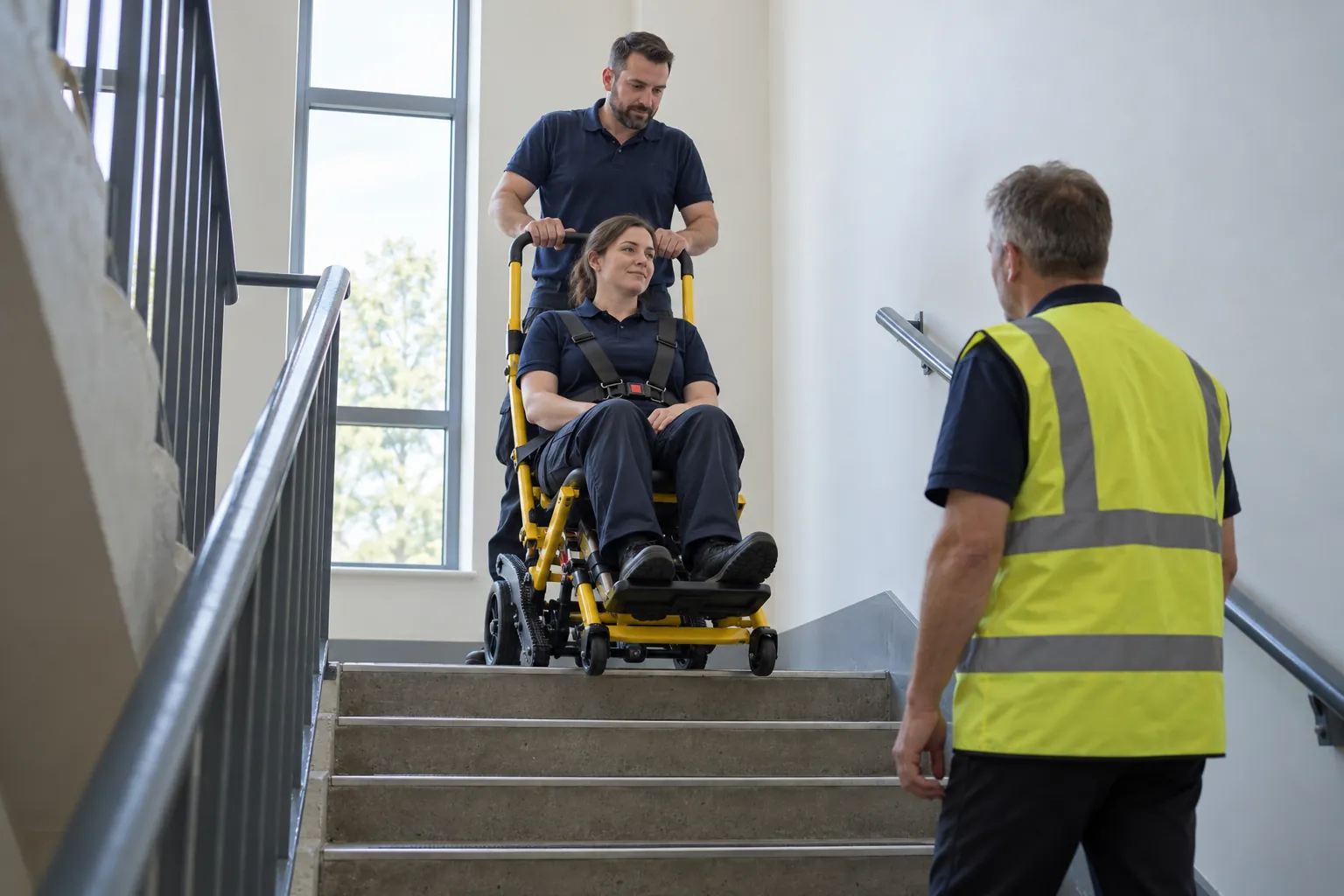 Fire and water checksEvacuation chairs: the duty behind them, the checks, servicing and trainingWhen a building needs an evacuation chair, what the law says, the routine check, servicing and training, and how to keep a record that shows the chair is ready.
 Fire and water checksFire drill procedure: planning, running and recording a fire drillHow to plan and run a fire drill in a UK workplace, how often the guidance says to hold one, what the law requires, and what the fire drill record should show.
 Fire and water checksFire marshal checklist: the daily and weekly checks, and the job in an evacuationWhat a fire marshal or fire warden checks each day and week, their role in an evacuation, the law behind the role, and how to keep a record that stands up.
 Fire and water checksFire safety log book: what to record, who keeps it and for how longWhat a fire safety log book should contain, from alarm tests to drills and servicing, who keeps it, how long for, and whether paper or digital is better.