Fire and water checks
TR19 kitchen extract cleaning: the intervals, the report and the daily filters
TR19 Grease is the Building Engineering Services Association's specification for managing the fire risk of grease in commercial kitchen extract systems, and its minimum cleaning intervals go by hours of use: every 3 months for a kitchen cooking 12 to 16 hours a day, every 6 months for 6 to 12 hours, and every 12 months for 2 to 6 hours.
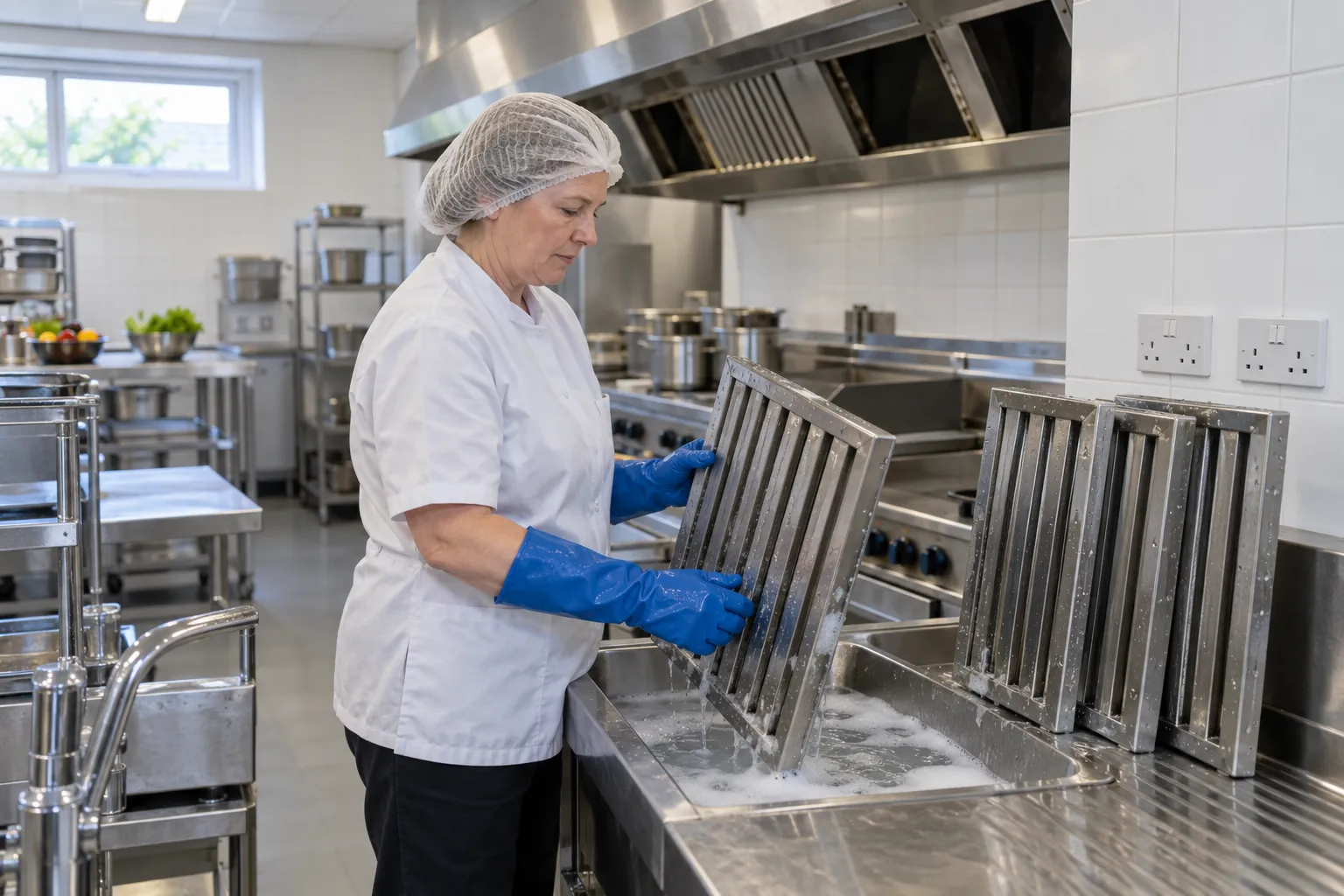
No law names TR19, but fire safety law requires the responsible person to assess and control the fire risk, and fire and rescue services and insurers use TR19 Grease as the measure of whether that has been done. This guide covers what the specification asks for, how often an extract is cleaned, what the post-clean report must show, and the daily canopy and filter cleaning that the kitchen team does in between.
01
What TR19 is, and the legal duty behind it
TR19 is a technical specification published by BESA, the Building Engineering Services Association. It comes in two parts. TR19 Air covers the internal cleanliness of general ventilation systems. TR19 Grease: Specification for fire risk management of grease accumulation within kitchen extraction systems covers commercial kitchen extracts. BESA's own guidance explains that TR19 Grease was produced as a standalone specification in 2019, replacing what had been section 7 of the second edition of TR19; its publications page dates the current document August 2020. In a kitchen, "TR19" usually means TR19 Grease, and TR19 compliance means a kitchen extraction system cleaned often enough that grease stays within the deposit limits the specification sets, by a method that meets its standard for post-clean verification.
TR19 Grease is an industry specification, not a law. The legal duty comes from fire safety legislation. In England and Wales, the Regulatory Reform (Fire Safety) Order 2005 places the duties on the responsible person, the employer or whoever controls the premises. Three articles matter for a kitchen extract:
- Article 4 defines the general fire precautions, starting with "measures to reduce the risk of fire on the premises and the risk of the spread of fire on the premises".
- Article 9 requires a "suitable and sufficient assessment of the risks", reviewed regularly, and, since 1 October 2023, a record of it in every case, not only where five or more people are employed.
- Article 17 requires the premises, and facilities, equipment and devices provided under the Order, to be "subject to a suitable system of maintenance" and "maintained in an efficient state, in efficient working order and in good repair". Where premises form part of a larger building, the responsible person may make arrangements with the other occupiers, who must co-operate.
The London Fire Brigade's Fire Safety Guidance Note GN86, Catering Kitchen Extract Systems (revision 3, May 2022) puts the extract under article 4(1)(a) and says a detailed assessment of it "should be contained in the fire risk assessment for the premises in accordance with Article 9". Its fire investigation team states that "by far the most common problem and cause of ducting fires is the lack of proper cleaning and maintenance".
Scotland has the same maintenance duty in regulation 16 of the Fire Safety (Scotland) Regulations 2006, and Northern Ireland in regulation 16 of the Fire Safety Regulations (Northern Ireland) 2010.
A health and safety duty and a food hygiene duty apply to the same equipment. Regulation 5 of the Workplace (Health, Safety and Welfare) Regulations 1992 requires mechanical ventilation systems provided for the workplace to be "maintained (including cleaned as appropriate) in an efficient state, in efficient working order and in good repair". And food hygiene law, in Annex II of Regulation (EC) No 852/2004, says food premises "are to be kept clean and maintained in good repair and condition" and that ventilation systems are to be built so that "filters and other parts requiring cleaning or replacement" are "readily accessible". None of these names TR19 or a cleaning interval: that detail comes from the industry standards.
02
The parts of a kitchen extract, and who cleans which
GN86 lists the parts of a typical catering kitchen extract system, from the cooking line to the outside air:
- the canopy, also called the hood, which houses the grease filters;
- the canopy grease filters, which reduce the amount of grease passing into the ductwork;
- the canopy or extract plenum, the space immediately behind the filters and below where the ducting starts;
- the ductwork, including any flexible sections, sound attenuators and turning vanes at changes of direction;
- the extract fan, connected to the ductwork to draw the air from the canopy; and
- the discharge duct, which takes the air out of the building.
No filter catches everything. GN86 says "all the internal surfaces of the kitchen extract systems are affected by grease and oil deposits and no filter is 100% effective", and that grease, once alight, can spread fire rapidly along the ductwork and into the fabric and voids of the building. The grease is the fire hazard, wherever it sits. That is why TR19 Grease covers the whole route, canopy to atmosphere, and why a kitchen whose filters are spotless can still have a duct full of grease.
The work divides into two kinds:
- Daily or weekly cleaning by the kitchen team. GN86 says periodic specialist cleaning "should be accompanied by daily or weekly cleaning of canopies and filters", typically carried out by the kitchen operator. Bedfordshire Fire and Rescue Service's guidance on fire hazards in kitchen extract systems says extract hoods and filters "should be cleaned and degreased daily or in accordance with manufacturers recommendations".
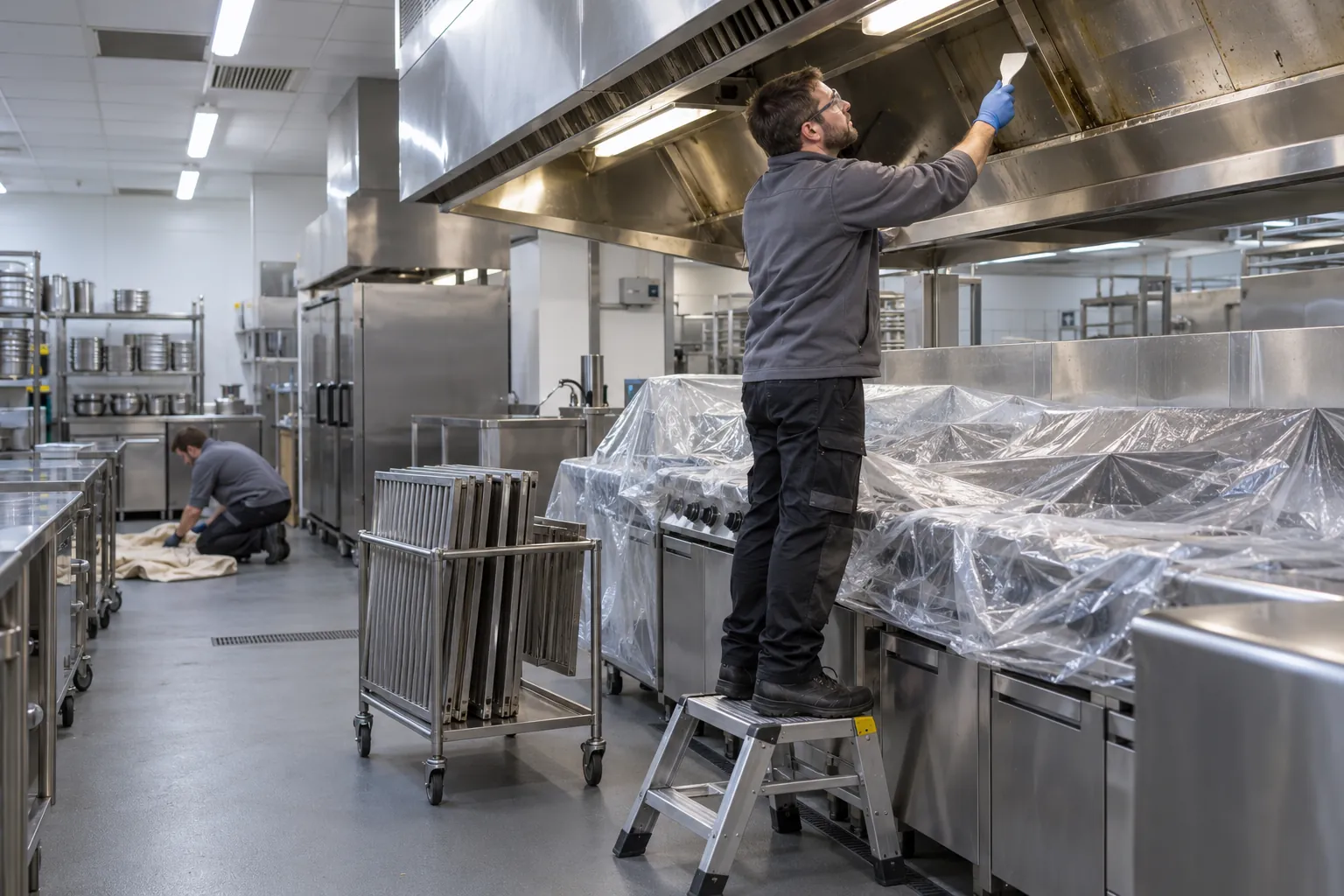
- The specialist clean, a deep clean of the plenum, ductwork, fan and discharge, at the intervals in the next section, by a contractor working to TR19 Grease. This is the clean that produces a post-clean report and a certificate.
Access is essential. Ducts cannot be cleaned where nobody can safely reach inside them. GN86 says access panels "should be of sufficient number, quality and size to enable unrestricted access" to every interior surface for cleaning and inspection, to BESA's DW172 specification for kitchen ventilation systems, with the same fire rating as the duct, and that access holes should not be cut into the ductwork, nor sheet metal fixed to it with screws and duct tape. BESA's guidance says TR19 Grease expects panels typically every 2 to 3 metres wherever possible. Bedfordshire Fire and Rescue Service warns that if no access panels have been installed, "it is very likely that it has never been cleaned".
The HSE's catering information sheet CAIS10, Ventilation in catering kitchens, makes the same point from the design side: canopies and ductwork should be non-combustible and made to discourage grease build-up, there "should be suitable access to the ductwork to allow regular cleaning to prevent accumulation of fat", and grease filters "need to be easy to remove for cleaning/replacement".
03
How often a kitchen extract is cleaned under TR19 Grease
TR19 Grease sets minimum intervals for the specialist clean by daily hours of cooking. BESA's guidance on kitchen extract system cleaning gives them as:
- Heavy use, 12 to 16 hours a day: clean every 3 months.
- Moderate use, 6 to 12 hours a day: clean every 6 months.
- Light use, 2 to 6 hours a day: clean every 12 months.
BESA calls these "minimum recommendations" and says more frequent cleaning may be needed depending on the type of cooking, the condition of the system, and the results of insurance and fire risk assessments. The actual interval, it says, should be set by a competent person after a cleanliness risk assessment that looks at the cooking, seasonal menu changes, how fast grease builds up and the deposit test results, and should be reviewed regularly.
The real test is the grease, not the calendar. GN86 says "the frequency of cleaning should be such that grease deposit limits are not exceeded", measured in microns by the test methods in TR19 Grease. BESA's guidance gives the limit: grease "must be controlled so as not to exceed a mean average of 200 microns between scheduled cleans", with deposits of 500 microns or more needing immediate spot cleaning. The contractor measures this with a wet film thickness test or a deposit thickness test at points along the system.
Some kitchens need more. GN86 notes that kitchens producing high levels of fried or chargrilled food make far higher grease levels than those that mostly bake or boil, and that many systems need more frequent cleaning because of the type of cooking as well as the hours of use. It also says the canopy and plenum are areas of higher fire risk where more frequent cleaning should be considered "in accordance with insurers' requirements".
Insurers of commercial kitchens set their own conditions. GN86 refers to the insurers' document RC44, Recommendations for fire risk assessment of catering extract ventilation, as a method for assessing extract systems, and says that no cleaning, or an ineffective regime, "could also invalidate commercial liability/property insurance policies". Read the policy wording: it may name TR19 Grease, a shorter interval, or a contractor in a certification scheme.
04
The specialist clean, the post-clean report and the certificate
A TR19 clean is judged by its evidence. GN86 says that after cleaning the extraction system, the cleaning contractor "should provide the client with a Post-Clean Verification of Cleanliness report" that includes:
- the system or systems cleaned;
- pre and post clean measurements;
- pre and post clean photographs;
- COSHH data on any chemicals used;
- recommendations for future cleaning;
- a certificate summarising the cleaning works completed; and
- a sketch or schematic of the system showing the access panels and test locations, "clearly highlighting any un-cleaned/inaccessible areas" with an explanation of why.
BESA's guidance adds that the before and after photographs should be taken from matching positions, and that the hygiene certificate should state the date of the clean, the system location and the name of the technician. It says TR19 Grease introduces minimum competency for technicians, the BESA Grease Hygiene Technician qualification, and describes BESCA's certification scheme for kitchen extract cleaning, under which each clean is registered and a certificate generated as evidence of compliant cleaning. BESA's news report on the growth in vent hygiene compliance says the scheme has been renamed: it is now the Ventilation Hygiene Register (VHR, formerly the BESCA Ventilation Hygiene Elite scheme), whose members notify each compliant clean and give the client a VHR Post Clean Completion Certificate.
Read the report, not just the certificate. Bedfordshire Fire and Rescue Service warns that "certificates of cleaning may be issued by less reputable contractors when only a partial clean has been undertaken". The schematic is where a partial clean shows: a riser marked inaccessible, a fan not reached, a section behind a ceiling with no panel. GN86 says that after a fire, fire safety staff "will determine if any highlighted uncleaned/inaccessible areas contained in the report were dealt with". An access panel that the last three reports asked for, and nobody fitted, is the finding that matters.
Shared ductwork needs one date. In a shopping centre, an office building with a staff restaurant or a mixed-use block, the duct often leaves the tenant's kitchen and runs through space the landlord or managing agent controls. GN86 says the responsible persons must co-operate "to ensure that all interior surfaces of the ductwork are cleaned at the same time, and not on different days/dates".
Where the record lives. GN86 says a fire safety officer on an audit "will ask to see post-clean verification of cleanliness records". Keep each report with the fire risk assessment and the other fire records, in the fire safety log book or wherever the building keeps them, and record what was done about each recommendation, by whom and when. A good extract record shows:
- the extract system or systems, with the usage band and the agreed interval;
- the date of each specialist clean, the contractor, and the post-clean report;
- each recommendation and inaccessible area, and when it was closed;
- the daily or weekly canopy and filter cleaning, with who did it and when;
- any fault found in between, such as grease running from the filters, a missing filter, or a fan running poorly with weak airflow at the canopy, and what was done.
05
Where the record fails, and what SiteClara does about it
The specialist clean is the easy part to prove: it leaves a report with photographs. The gap is in between. The canopy wipe-down and the filter degrease happen at the end of a long shift, if they happen, and the kitchen cleaning schedule on the wall can be initialled for the week in one go. A filter that went back greasy, a filter missing from its slot, or grease weeping from the canopy edge is mentioned to whoever is on the pass and forgotten. When the contractor's report says a section was inaccessible, the recommendation sits in an inbox until the next visit says the same thing.
SiteClara puts a printed QR poster at each place a check is due, such as the cooking line canopy, the filter wash area or the access to the fan, with an optional NFC tag behind it. Staff scan the code or tap the tag on their own phone, with no app to install, see the checks due there, such as the daily filter degrease or the weekly canopy clean, and mark each one done or explain what stopped them. The time and the named person are recorded as it happens, with a photo when one is asked for, so a photograph of clean filters back in the canopy can sit beside the tick. A problem, such as grease running from the filters or a missing filter, is reported there with a photo and goes onto the team's list of jobs until someone closes it.
The supervisor sees what is due, done and missed, and can record why a check was missed; a job that needs the building manager, such as an access panel the contractor's report asked for, can be escalated to them to answer. Each day the supervisor reviews and approves a report that goes to nominated management or client contacts at 8am the next morning, showing what was reported, completed and still open, and how the scheduled checks went. That gives the responsible person a working record of the cleaning between specialist visits, kept as it happens.
06
Questions people ask
Is a TR19 certificate a legal requirement?
No law requires a TR19 certificate as such, but the law does require the fire risk from grease in a kitchen extract to be assessed and controlled. In England and Wales that comes from article 9 of the Regulatory Reform (Fire Safety) Order 2005 and article 17 of the same Order, and the London Fire Brigade's GN86, Catering Kitchen Extract Systems says a fire safety officer on an audit will ask to see post-clean verification of cleanliness records. A report and certificate from a clean to TR19 Grease is the usual way to show TR19 compliance, and BESA's guidance on kitchen extract system cleaning notes that many insurers now require proof that the ductwork is regularly cleaned and inspected.
How often should TR19 cleaning be performed?
Under TR19 Grease, a kitchen extract used 12 to 16 hours a day is cleaned at least every 3 months, one used 6 to 12 hours every 6 months, and one used 2 to 6 hours every 12 months, according to BESA's guidance on kitchen extract system cleaning. These are minimums: the interval should keep grease below the specification's limit, and heavy frying or chargrilling, the fire risk assessment or the insurer can require more.
How do I get a TR19 certificate?
A TR19 certificate is issued by the cleaning contractor after a specialist clean of the whole extract system to TR19 Grease, as part of a post-clean verification report with before and after measurements and photographs. BESA's guidance on kitchen extract system cleaning advises checking that the contractor's technicians hold the BESA Grease Hygiene Technician qualification and that the firm is registered with the Ventilation Hygiene Register (formerly BESCA's Ventilation Hygiene Elite scheme), which records each clean and issues a certificate.
Who is responsible for kitchen extract cleaning?
The responsible person under fire safety law, usually the employer or whoever controls the premises, is responsible for kitchen extract cleaning, and where a duct runs through space controlled by someone else, such as a landlord, they must co-operate. The London Fire Brigade's GN86, Catering Kitchen Extract Systems says the kitchen operator typically does the daily or weekly canopy and filter cleaning, and that responsible persons sharing a duct should arrange for all of it to be cleaned at the same time.
07
Further reading, and a list to take away
Start with the London Fire Brigade's GN86, Catering Kitchen Extract Systems, which is short and written for the people who run kitchens and buildings, then BESA's guidance on kitchen extract system cleaning. The specification itself, TR19 Grease, is sold by BESA. The government's page on fire safety in the workplace explains who the responsible person is and what they must do, and your local fire and rescue service can advise on your own premises.
Before the next specialist visit, check that:
- every kitchen extract system is named in the fire risk assessment, with its usage band and agreed cleaning interval;
- the interval is at least what TR19 Grease gives for the hours of cooking, and at least what the insurance policy requires;
- the last post-clean report has before and after measurements and photographs, and a schematic showing any area not cleaned;
- every recommendation and inaccessible area in that report has an owner and a date, including any access panel still to be fitted;
- where the duct runs through a landlord's or another tenant's space, the whole route is booked for the same visit;
- the canopy and filters are cleaned daily or weekly, and each clean is recorded by the person who did it when they did it;
- the reports are kept with the fire risk assessment and the fire safety log book, ready for a fire safety officer or an insurer.
Sources
Every document this guide quotes or links to, in the order it first cites them.
- TR19 Grease: Specification for fire risk management of grease accumulation within kitchen extraction systems publications.thebesa.com
- Article 4 legislation.gov.uk
- Article 9 legislation.gov.uk
- Article 17 legislation.gov.uk
- London Fire Brigade's Fire Safety Guidance Note GN86, Catering Kitchen Extract Systems london-fire.gov.uk
- Regulation 16 of the Fire Safety (Scotland) Regulations 2006 legislation.gov.uk
- Regulation 16 of the Fire Safety Regulations (Northern Ireland) 2010 legislation.gov.uk
- Regulation 5 of the Workplace (Health, Safety and Welfare) Regulations 1992 legislation.gov.uk
- Annex II of Regulation (EC) No 852/2004 legislation.gov.uk
- Bedfordshire Fire and Rescue Service's guidance on fire hazards in kitchen extract systems bedsfire.gov.uk
- HSE's catering information sheet CAIS10, Ventilation in catering kitchens hse.gov.uk
- BESA's guidance on kitchen extract system cleaning thebesa.com
- News report on the growth in vent hygiene compliance thebesa.com
- Fire safety in the workplace gov.uk
Related guides
 Fire and water checksFire risk assessment: what the law requires, the five steps, and what the record must showWho must have a fire risk assessment, the five steps, what the written record must hold since October 2023, who can carry one out and when it must be reviewed.
 CleaningRestaurant cleaning checklist: daily work and a useful recordA UK restaurant cleaning checklist for kitchen and front of house, with daily, weekly and periodic tasks, safe cleaning methods and a worked cleaning record.
 Fire and water checksFire safety log book: what to record, who keeps it and for how longWhat a fire safety log book should contain, from alarm tests to drills and servicing, who keeps it, how long for, and whether paper or digital is better.
 Fire and water checksHot work permits: the permit, the checklist and the fire watchWhat a hot work permit is, the UK law and guidance behind it, what the permit and checklist cover, how long the fire watch lasts, and how to show it was kept.