Fire and water checks
Fire safety log book: what to record, who keeps it and for how long
A fire safety log book is the record a building keeps of its fire alarm tests, emergency lighting tests, extinguisher checks, fire drills, training, servicing, faults and false alarms, to show that its fire precautions are maintained.
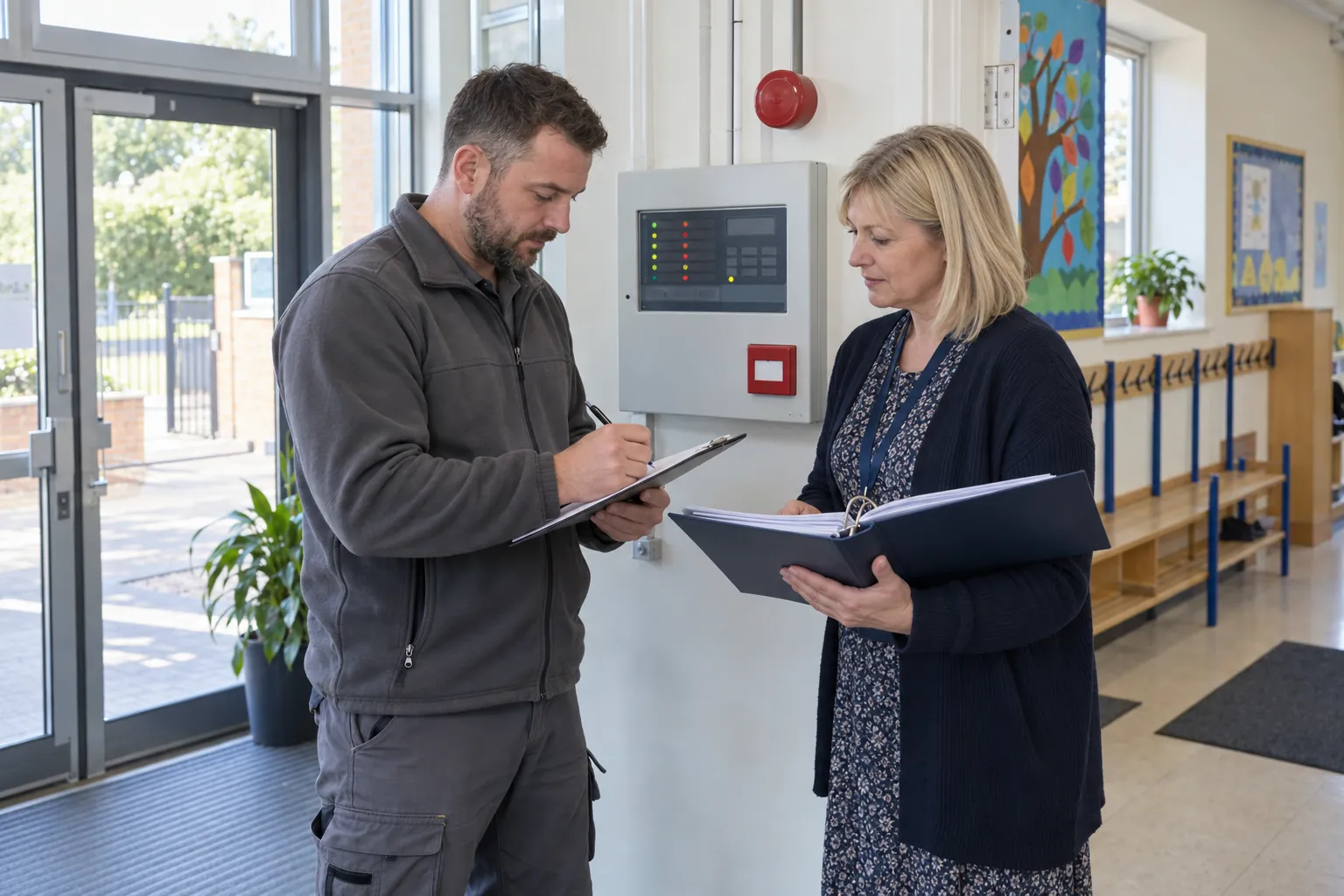
The Home Office's guidance for small non-domestic premises in England says a suitable record of testing and maintenance should be kept in the form of a logbook or an electronic record. This guide covers what belongs in it, who fills in each part, how long to keep it, and whether a paper book or a digital record serves you better.
01
What a fire safety log book is, and the duty behind it
A fire safety log book is the running record of how a building's fire precautions are tested, maintained and used, and the document people ask to see when they want to know whether the premises comply with fire regulations. It holds the routine tests of the fire alarm and emergency lighting, the servicing of fire safety equipment, fire drills, staff training, faults found and fixed, and false alarms, together with any action taken.
No law uses the words "fire log book". The duty to keep records comes from what the law requires to be done. In England and Wales, the Regulatory Reform (Fire Safety) Order 2005 places fire safety duties on the responsible person: usually the employer, or whoever has control of the premises, such as the owner, landlord or managing agent. Among other things, the Order requires them to:
- carry out a fire risk assessment and keep it under review;
- maintain fire safety facilities, equipment and devices in an efficient state, in efficient working order and in good repair;
- give each employee adequate fire safety training and instruction, and repeat it periodically where appropriate;
- put in place, and record, the arrangements and fire safety procedures for managing fire safety, including evacuation.
Since October 2023, changes made to the Order by the Building Safety Act 2022 require every responsible person to record their fire risk assessment in full and to record their fire safety arrangements, whatever the size of the business. There is still no requirement for a particular book, but a log book is the practical way to record fire safety testing and maintenance week by week and show those arrangements are carried out. The British Standards for fire detection and alarm systems (BS 5839-1) and emergency lighting (BS 5266-1) also recommend a log book for each system, and a fire risk assessor, an insurer or an inspecting fire officer from the fire and rescue service may ask to see it.
Is it a legal requirement to have a fire log book?
Not by that name: in England and Wales, the Fire Safety Order requires fire safety equipment to be maintained in efficient working order and good repair (article 17) and the responsible person's fire safety arrangements to be recorded (article 11), but it does not prescribe a book. The Home Office's guide for small non-domestic premises in England says a suitable record of testing and maintenance should be kept in the form of a logbook or an electronic record.
02
What a fire safety log book should contain
Commercial log books, such as the A4 books sold by fire safety suppliers for commercial premises and residential blocks, and the free templates some fire and rescue services publish, follow a similar pattern. A comprehensive fire log book, or a set of records that together do the same job, covers:
- Premises details: the address, the responsible person and their contact details, the people with fire safety duties, and the date of the current fire risk assessment and its next review.
- Fire alarms: each weekly test, with the date, time, the call point or device used, the result and who did it.
- Fire alarm servicing: each periodic inspection and service by the maintenance engineer, with the contractor's report or certificate.
- Faults and false alarms: each fault or unwanted alarm, its cause, the action taken and when it was put right.
- Emergency lighting: the monthly functional tests and the annual full-duration test, with any failed fittings and their repair.
- Fire extinguishers and other equipment: routine visual checks and the annual service, and where the building has them, sprinkler systems, dry or wet risers, smoke ventilation, fire curtains and fire dampers.
- Fire doors and escape routes: routine checks of fire doors, exits and escape routes, and any obstruction found.
- Fire drills and evacuation drills: the date, the time taken to evacuate, any problems, and what was done about them.
- Training: who received fire safety training, the people you designate as fire marshals or wardens and their training, and when it is due again.
- Visits and changes: visits by the fire and rescue service or insurer, changes to the building or its use, and changes to the fire safety arrangements.
Keep it in sections, so that each system's history can be read on its own. An inspector who wants to see the last six months of fire alarm servicing should not have to leaf through fire drills and extinguisher checks to find it.
03
The routine entries, and how often each is due
The fire risk assessment and the relevant British Standards set the frequency of each check for each premises, and a suitable log book has space for all of them. For most non-domestic buildings the rhythm looks like this:
- Daily or each time the building opens: escape routes and exits clear, final exit doors openable, the fire alarm panel showing normal. These are often recorded as a daily check rather than in the log book itself.
- Weekly: the fire alarm test, from a different call point each week in rotation.
- Monthly: the emergency lighting functional test, covered in our guide to the emergency lighting log book, and a visual check of fire extinguishers.
- Periodically, by a competent person: fire alarm servicing, usually every six months under BS 5839-1; the annual emergency lighting full-duration test; the annual extinguisher service; and the servicing of any other systems, each at the interval its standard or the manufacturer recommends.
- At least once a year: a fire drill, and more often where the fire risk assessment or the type of premises calls for it, such as where there is shift work or a high turnover of staff.
- On induction and periodically: fire safety training for staff, with refresher training at the interval the assessment sets.
The log book is also where anything unplanned is recorded: a false alarm at 10:14 on a Tuesday, a call point smashed by accident, an extinguisher discharged and replaced, a fire door found damaged. Those unplanned entries are often the most useful to a fire risk assessor, because they show how the building is actually used.
For a fuller calendar of routine checks, from daily to annual, see our guide to fire safety checks in the workplace.
04
Who keeps it, where, and for how long
The responsible person owns the log book, but rarely fills in all of it. In practice the entries come from several people:
- the premises, site or building manager, who usually keeps the book and makes sure the routine tests happen;
- staff, caretakers or security officers who carry out the weekly and monthly tests;
- fire marshals or wardens, who record drills and their findings;
- contractors and engineers, who record servicing and leave their reports and certificates;
- the fire risk assessor, who reads the book at each review and records their visit.
Where more than one responsible person shares a building, such as a landlord for the common parts and tenants for their own floors, the Order requires them to co-operate and co-ordinate. Agree who keeps which records, and make sure each can see the ones that affect their part of the building.
Keep the log book on the premises, where it can be produced when the fire and rescue service visits, and where engineers can complete it. Many buildings keep it beside the fire alarm panel. It should be kept on the premises at all times and available to those who need it, not locked in an office that is empty when the inspector calls; secure storage matters for completed books and old certificates too.
There is no single statutory retention period for a fire log book. Keep completed books and the service reports that go with them, rather than discarding them when a new book is started: they show the history of each system, which the fire risk assessor, an insurer or, after an incident, an investigator may need. Your insurer or your organisation's records policy may set a minimum period, and many organisations keep them for several years.

05
Paper or digital, and what makes the record credible
A paper fire safety logbook and a digital record can both be compliant: the Home Office's guide to making small non-domestic premises safe from fire says a suitable record of testing and maintenance should be kept in the form of a logbook or an electronic record. Neither format is required by law, and neither shows compliance on its own. What matters is that the record is complete, can be produced on request, and can be believed. A credible log book:
- is written at the time, with the date and actual time of each test, not filled in from memory at the end of the month;
- names the person who did each test or check, and the company and engineer for each service;
- is specific: which call point, which emergency light, which extinguisher, not "all OK";
- records failures and what happened next: a fault noted with no repair recorded suggests the fault is still there;
- has no unexplained gaps: a missed weekly test with a reason, such as the building being closed, is better than a blank;
- keeps the supporting documents: service reports, certificates and the fire risk assessment, filed with or referenced from the book.
Paper is simple, needs no training and is what most inspectors expect to see. Its weaknesses are that it exists in one place, can be lost or damaged, and cannot tell anyone that a test was missed. Digital records can be seen from anywhere and can show gaps as they happen, but only if everyone uses them, and only if the responsible person can show them on the day, including to an inspector who has no login. Many buildings use both: a paper log at the panel for engineers, and a digital record of the routine checks. Either way, a logbook helps only if it is read regularly by someone with the authority to ensure faults are fixed.
06
Where the log book fails, and what SiteClara does about it
Most log books fail in the same few ways. Weekly tests are recorded in batches, several weeks in the same pen. The book sits at the panel in one building while the manager responsible for five others never sees it. A fault is written down and never closed, and nobody notices until the fire risk assessor reads the book months later.
SiteClara can record the routine checks that feed the log book as they happen. A printed QR poster, with an optional NFC tag behind it, goes at a location such as the fire alarm panel, a call point or a floor's emergency lighting. Staff scan the code or tap the tag on their own phone, with no app to install; they are enrolled by text and sign in with a link. They see the scheduled checks due there, such as the weekly alarm test or the monthly extinguisher check, and mark them done, or explain what stopped them. A fault is reported there with a photo and goes onto the team's list of jobs until someone closes it, and the supervisor can escalate it to the building manager, who can answer it.
The supervisor sees what is due, done and missed across the building, and can record the reason a check was missed. Each day the supervisor reviews and approves a report that goes to nominated management or client contacts at 8am the next morning, showing what was reported, completed and still open, and how the scheduled checks went, for example 12 of 12 completed. It is priced per building, with no per-person fees.
07
Further reading, and a list to take away
GOV.UK publishes the government's fire safety risk assessment guides for different types of premises, and a short guide to fire safety in the workplace, both of which describe the records a responsible person should keep. The Health and Safety Executive covers wider health and safety duties, while fire safety in most workplaces is enforced by the fire and rescue service. Many fire and rescue services publish advice for businesses, and some offer free log book templates. The Scottish Government publishes practical fire safety guidance for Scotland, and the Northern Ireland Fire and Rescue Service does the same for Northern Ireland. BS 5839-1 and BS 5266-1 are available from the British Standards Institution.
Check that your log book:
- names the responsible person and the date of the current fire risk assessment;
- has a section for each system: alarm, emergency lighting, extinguishers and any others;
- records every weekly and monthly test, with the device, time, result and name;
- records servicing, with the contractor's report or certificate kept with it;
- records every fault and false alarm, with the action taken and the date it was fixed;
- records fire drills and training, with the next due dates;
- is kept on the premises and can be produced on request;
- is kept, with its supporting documents, when a new book is started.
Sources
Every document this guide quotes or links to, in the order it first cites them.
- Regulatory Reform (Fire Safety) Order 2005 legislation.gov.uk
- Building Safety Act 2022 legislation.gov.uk
- Fire Safety Regulations (Northern Ireland) 2010 legislation.gov.uk
- Article 17 legislation.gov.uk
- Article 11 legislation.gov.uk
- Guide for small non-domestic premises in England gov.uk
- Fire safety risk assessment guides gov.uk
- Fire safety in the workplace gov.uk
Related guides
 Fire and water checksFire safety checks in the workplace: what to check, how often, and who does itThe routine fire safety checks a UK workplace needs, from daily escape routes to the weekly alarm test, who does each one, and what the record should show.
 Fire and water checksWeekly fire alarm test: how to do it, and what to recordWeekly fire alarm test: how to carry out the test BS 5839-1 recommends, rotating call points, what to record, and what only a competent person can do.
 Fire and water checksEmergency lighting log book: what to record, and how oftenWhat an emergency lighting log book should record, the monthly and annual tests BS 5266-1 recommends, who does each, and how to keep the record credible.
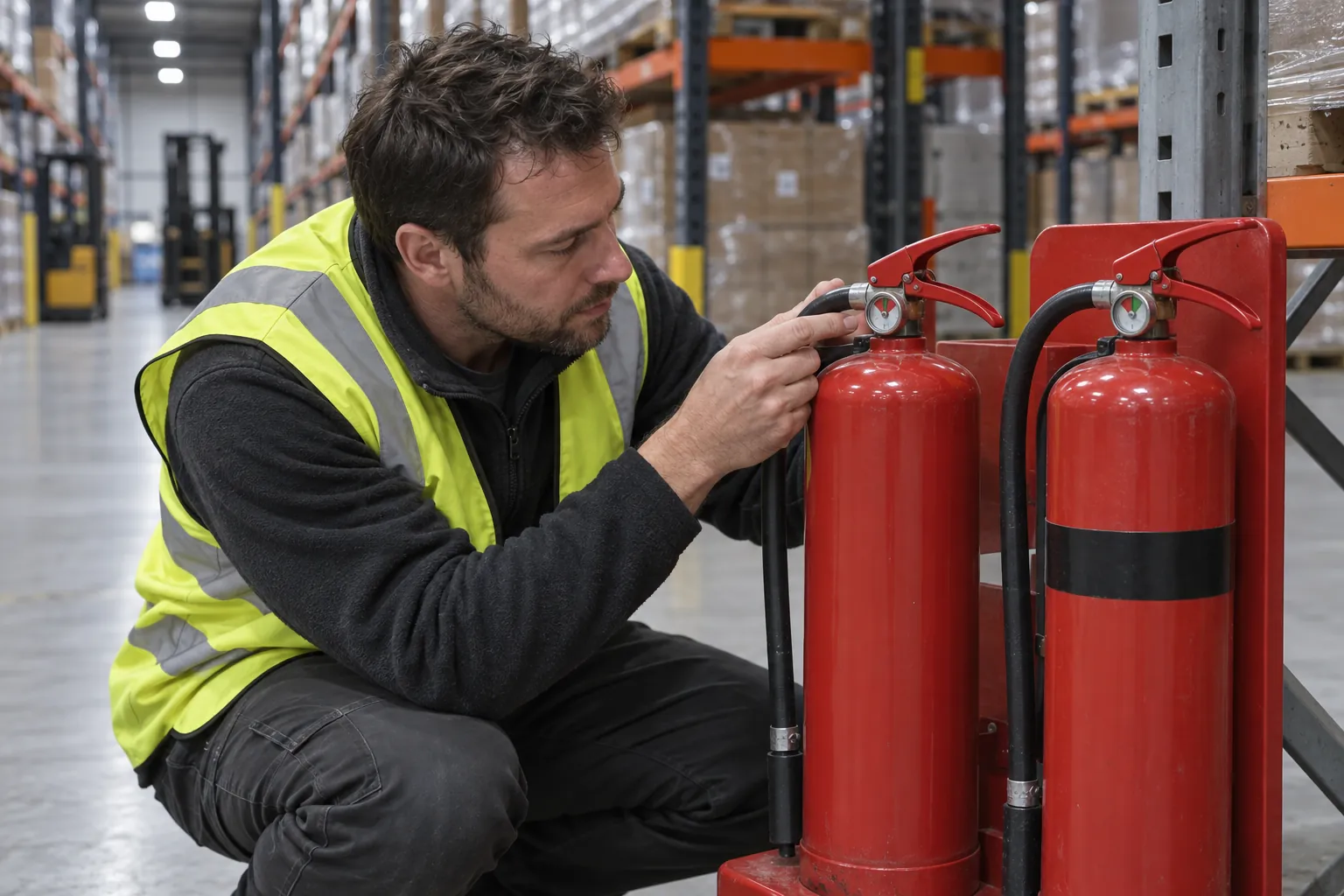 Fire and water checksFire extinguisher checks: the monthly check and the annual serviceWhat a monthly fire extinguisher check looks at, what the annual service by a competent person covers under BS 5306-3, and how to keep a record that stands up.