Fire and water checks
Hot work permits: the permit, the checklist and the fire watch
A hot work permit is a written authorisation, issued by a nominated person before any welding, cutting, grinding, soldering, torch-on roofing or other work that produces flames, sparks or heat begins, that fixes where and when the work may happen, the precautions to be taken, and the fire watch to be kept once it stops.
Also written for Ireland · United States · Canada · Australia · New Zealand · South Africa
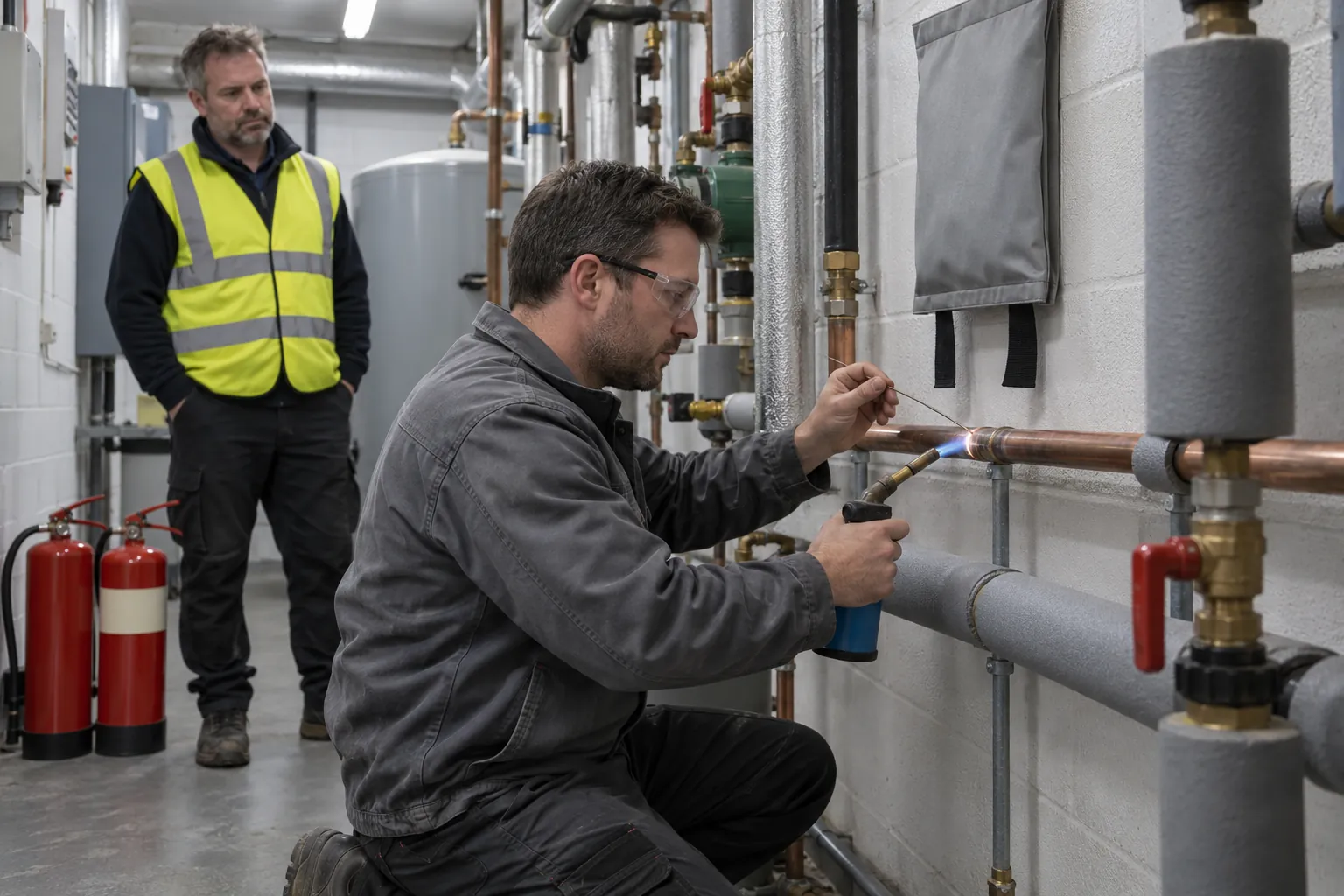
No UK statute names it, but the Regulatory Reform (Fire Safety) Order 2005, the CDM Regulations 2015 and DSEAR 2002 all lead to one, and HSE's construction guidance and the insurers' codes ask for a continuous fire watch of at least an hour after the work ends. This guide covers what counts as hot work, what the permit and its checklist contain, how long a permit and its fire watch last, who does what, and how a building shows the watch was kept.
01
What a hot work permit is, and the law behind it
HSE's guidance Fire safety in construction (HSG168, third edition, 2022) defines hot work as "any process that generates flame, sparks or heat", and says that where hot works cannot be avoided, formal systems of management such as a permit-to-work system should be used. A hot work permit is that system written down for one job: the work, the place, how long it is valid, the precautions before, during and after, and who authorises, carries out and closes it. HSG168 calls permit-to-work systems formal management documents: the permit turns the hazards at that work location into precautions that the person doing the work and the issuer both sign before the work can start.
No UK statute uses the phrase. The duty comes from several directions:
- Fire safety law. In England and Wales, article 9 of the Regulatory Reform (Fire Safety) Order 2005 requires a suitable and sufficient fire risk assessment, and article 11 requires the responsible person to make, give effect to and record arrangements for the effective planning, organisation, control, monitoring and review of the preventive and protective measures. Under article 5, a contractor with an obligation for maintenance or repair shares those duties for matters within its control.
- Construction work, including maintenance. Regulation 29 of the Construction (Design and Management) Regulations 2015 requires suitable and sufficient steps to prevent, so far as is reasonably practicable, injury from fire or explosion during construction work, which regulation 2 defines to include repair, upkeep and maintenance of a structure and of its fixed services. A plumber soldering a pipe in a plant room is doing construction work.
- Flammable substances. Schedule 1 to the Dangerous Substances and Explosive Atmospheres Regulations 2002 (DSEAR) requires a system of permits to work, issued before the work starts by a person responsible for the function, where work is done in hazardous places or involves hazardous activities.
Insurers add their own. The Fire Protection Association's Fire Prevention on Construction Sites: the Joint Code of Practice (tenth edition, 2022, with amendments in 2023 and 2025) states at clause 16.4 that all hot work must be subject to a hot work permit once fitting out has begun and in all buildings being refurbished; it applies to projects with an original contract value of £2.5m or more, and to smaller contracts within a large project, and serves as best practice where the construction or insurance contract does not require it. For existing buildings, the FPA's RC7: Risk control for hot work (version 9, 2023) recommends a separate permit on every occasion hot work of any type is done in or on an established building, structure or plant. RC7 concentrates on protecting property when hot work is carried out, and says a fire risk assessment for the protection of personnel is still needed alongside it.
02
What counts as hot work, and avoiding it first
The Joint Code defines hot work as operations using open flames, grinding, welding, the local application of heat or the generation of sparks. In an ordinary building the jobs that need a hot works permit are often small and routine:
- welding and cutting, such as repairing a handrail or a steel bracket;
- blowlamps, including soldering and brazing pipework in a plant room or riser;
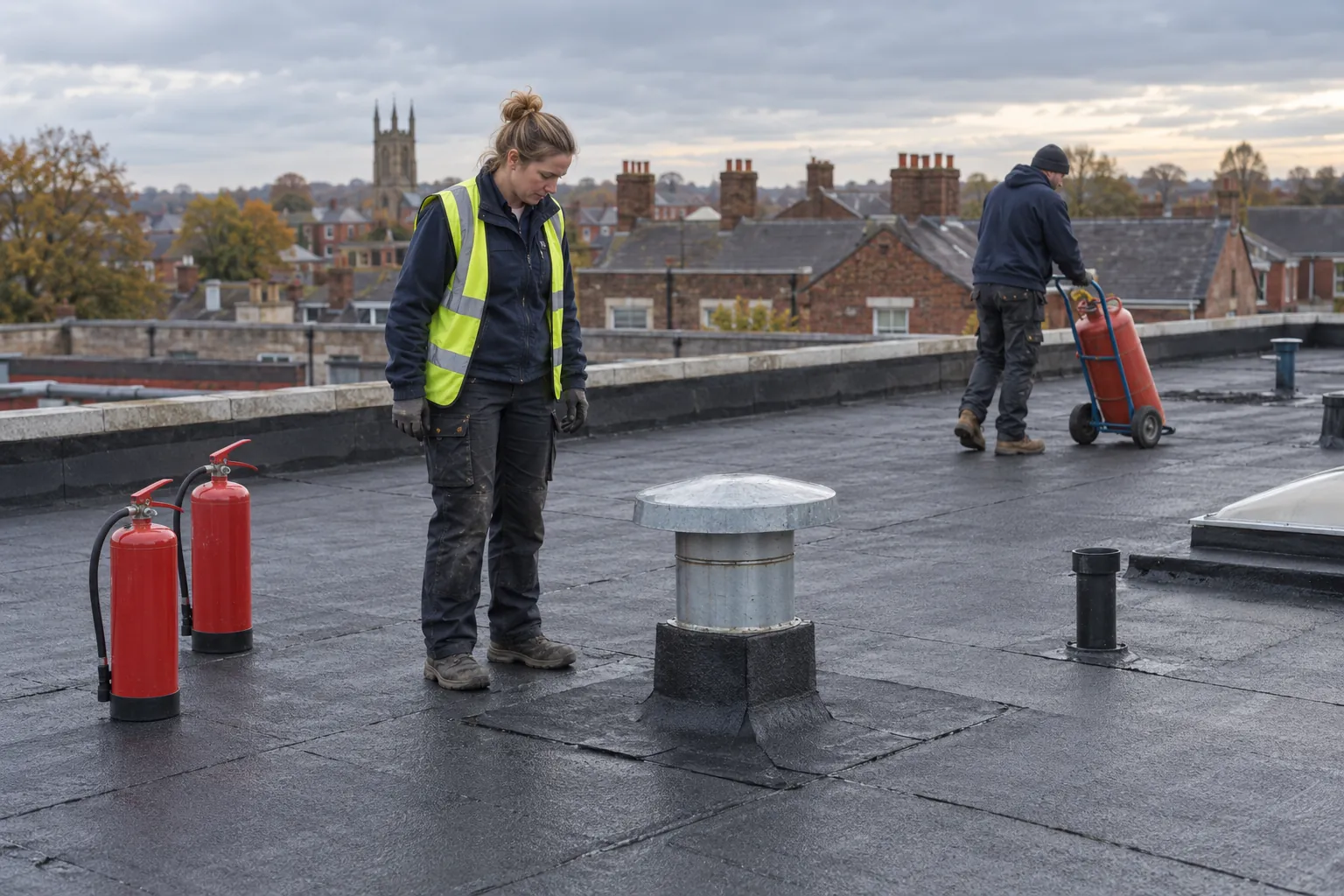
- torch-on roofing felt and bitumen boilers on a flat roof;
- angle grinders and disc cutters;
- hot air guns used to strip paint;
- cutting drums or containers that have held a flammable liquid.
The last is the most dangerous: HSE's safety bulletin Deadly explosions during cutting of drums and containers warns that a container that looks empty can hold enough residue in its seams and folds to give an explosive vapour.
The first question on any permit is whether hot work is needed at all. HSG168 says hot works should be designed out where practicable and replaced with cold methods, and RC7 says hot work should only be authorised where a safer method is not available: compression or push-fit joints instead of soldered ones, bolted instead of welded connections, cold cutting instead of a disc cutter, or the item taken to a workshop.
03
What a hot work permit and its checklist contain
HSG168 (paragraph 129) says a hot work permit should normally record the location and nature of the work, its proposed time and duration, the time limits of the permit, the precautions before, during and after, the procedure for raising the alarm, the person in direct control of the work, and the person authorising and closing it.
The sample permit in the Joint Code's Annex A, and the near-identical one in RC7, which RC7 says may be freely copied, has four parts: the proposal, by the person doing the work; the agreement, by the issuer, with the times of issue and expiry, the earliest time for the final check, any extra conditions, and confirmation that there is no reasonably practicable alternative to hot work; the completion, signed by whoever was responsible for the work; and the issuer's sign-off, confirming any isolated fire detectors or zones are reinstated.
The hot work permit checklist is completed at the work site before work starts. It confirms that:
- sprinklers, where fitted, are working, and fire detection stays on, with only the zone being worked in isolated;
- a dedicated, trained person not directly involved in the work will keep the fire watch;
- at least two suitable extinguishers are at hand, including at least one water or foam unit of 13A or more, and the people there are trained to use them;
- everyone involved knows the escape routes and how to raise the alarm;
- within at least 10 metres, combustibles are removed or covered with non-combustible blankets or screens, flammable liquids taken away, floors swept and openings covered;
- when welding, cutting or grinding, the work area is screened with non-combustible welding screens or blankets wherever practicable;
- the far side of walls and partitions has been checked for combustibles that conducted heat could reach;
- tanks, containers and dust collectors have been emptied and tested, or are known to be free of flammable vapour or dust.
Both versions say plainly that if these points cannot be complied with, the hot work should not go ahead.
04
The fire watch, and how long a permit should last
Fires from hot work often start after the work has stopped, when a spark has lodged in a void or heat has travelled along a pipe into a space nobody is watching; HSG168 notes that some materials can smoulder for a significant period before they ignite. The UK guidance sets these minimum fire watch periods:
- HSE, construction: HSG168 calls for a continuous fire watch of the hot work area for at least an hour after the end of hot work, followed by at least one more check two hours after the end, and a watch during breaks.
- The Joint Code and RC7: a continuous fire watch for at least one hour after work is completed, then checks at intervals of no more than 20 minutes for a further hour, or up to three hours or more where a risk assessment shows the need, before the permit is signed off. The checks include the far side of any wall, partition or ceiling within 10 metres, and floors below.
- HSE, welding: HSE's page on safety risks from welding says that where hot work cannot be done in a safe area, a fire watch should be kept during and after it for at least 30 minutes, extended to 60 where an ignition may be hard to detect or slow to develop.
Where the insurer or contract requires the Joint Code or RC7, its longer periods apply. Both say the watch must continue through lunch and tea breaks, and ideally that photographs of the area, adjacent voids and vulnerable spaces are taken to show it was kept and attached to the permit for sign-off. The Joint Code expects thermal imaging on construction sites, and longer watches around timber frames and hidden voids.
A hot work permit should last for one task in one place, and not long. Clause 16.5 of the Joint Code says permits must cover only specific activities and locations, be signed off at the end of each work period and not be issued for protracted periods: a fresh permit is needed where work runs from morning to afternoon, and blanket permits covering several days are not allowed. HSG168 says hot works should finish two hours before the end of the working day so the fire checks can be done, and RC7 says work must not start if trained people will not be there for the final check.
The Joint Code also requires a fire check at the end of each working day or shift, particularly where hot work has been done, and HSG168 says security staff should be told to check former hot work areas.
05
Who issues the permit, who watches, who closes it
- The issuer authorises the work. HSG168 says only people with clearly assigned authority should issue or close a permit, and RC7 says the nominated person, normally the company fire or safety officer, must have experience or training in hot work and be senior enough to enforce the procedure. In many managed buildings the facilities manager or building engineer holds the role; on a construction site, HSG168 says the principal contractor controls the system.
- The person doing the work, often a contractor, completes the proposal and checklist with the issuer, and should be trained in hot work, for example through the FPA's Hot Work Passport, which RC7 names. Clause 16.3 of the Joint Code says hot work should only be done by trained personnel, with frequent training for everyone involved on its risks.
- The fire watcher is a trained person not doing the work, with extinguishers to hand, watching during the work, through breaks and for the full period after.
- The person closing the permit confirms the area and adjacent areas are free of smouldering material, hot waste and equipment are removed, and any isolated detector zone is back on, before the issuer signs off.
RC7 says contractors must be told the site's hazards and fire procedures, including the permit system, and should give a written undertaking to follow the precautions before work starts. In a multi-let building, the floor below or the far side of a wall may belong to another occupier, so access for the fire watch needs agreeing first; article 22 of the Fire Safety Order requires responsible persons who share premises to co-operate and co-ordinate.
Fire alarms cause two common problems: isolating more than needed (RC7 says only the local detectors or zone) and forgetting to put them back (HSG168 asks for robust procedures to reactivate the alarm when work stops for a break or the day).
Completed permits are records. RC7 recommends one copy with the person doing the work and one with the issuer, the completed form returned and kept, and the Joint Code requires a senior member of staff to inspect completed permits at least monthly and record it. HSE's page on permit to work systems lists the failures to look for, including the wrong type of permit used, the wrong information about the work, and the terms of the permit not adhered to.
06
Where the fire watch record fails, and what SiteClara does about it
The permit is usually filled in carefully at the start. The weak point is what follows: the fire watch times written up together at the end, the final check "not before 16:30" signed at 15:45 because the contractor needed to leave, the floor below assumed rather than checked, and the copy that should have come back to the issuer still in a van. Asked how the watch was kept, the permit shows a signature and a time, not the checks.
SiteClara records checks at the place they are done. A printed QR poster, with an optional NFC tag behind it, goes at each location where checks happen, such as a plant room, a roof access, a riser or a floor. Staff scan the code or tap the tag on their own phone, with no app to install, see the checks due there, and mark each done or explain what stopped them. Each scan records the named person and the time, with a photo when one is asked for, so a fire watcher checking the work area, the floor below and the far side of a wall leaves timed, photographed entries rather than one signature at the end. A problem found, such as a scorched surface or a detector zone still isolated, is reported there with a photo and stays on the team's list of jobs until someone closes it.
The supervisor sees what is due, done and missed and records why a check was missed. Each day they approve a report that goes to nominated management or client contacts at 8am the next morning, showing what was reported, completed and still open, and how scheduled checks went, such as the end-of-day fire checks.
07
Questions people ask
When would I need a hot work permit?
Whenever hot work cannot be avoided: HSE's Fire safety in construction (HSG168) says to use a formal system such as a permit to work where you cannot avoid hot works, and the FPA's RC7: Risk control for hot work recommends a separate permit on every occasion hot work of any type is carried out within or upon an established building, structure or plant. HSG168 adds that a fully documented permit system may not be needed where the risks are low, for example in a designated hot work area.
Why would you need a hot work permit?
To control a fire risk that small jobs carry too: HSE's Fire safety in construction (HSG168) warns that minor hot works in areas containing combustible materials could have catastrophic consequences if they are not properly controlled. The permit sets out the control measures to take before, during and after the work for a clearly defined job and time period, and names who authorises and closes it.
Is a hot work permit a legal requirement in the UK?
Often, though not by name for every job: Schedule 1 to the Dangerous Substances and Explosive Atmospheres Regulations 2002 require a system of permits to work, issued by a person with responsibility, for work in hazardous places or involving hazardous activities, and HSE's Fire safety in construction (HSG168) says formal systems such as a permit to work should be used where hot works cannot be avoided. On construction sites once fitting out has begun, and in all buildings being refurbished, the FPA's Fire Prevention on Construction Sites: the Joint Code of Practice says all hot work must be subject to a hot work permit.
How long should a hot work permit last?
No longer than one work period: clause 16.5 of the FPA's Fire Prevention on Construction Sites: the Joint Code of Practice says permits must cover only specific activities and locations, be signed off at the end of each work period and not be issued for protracted periods, with a fresh permit where work extends from morning to afternoon. Blanket permits covering several days must not be allowed.
Do you need a hot work permit for soldering?
Yes, under the FPA's RC7: Risk control for hot work, which lists brazing and soldering among the hot work it covers and recommends a separate permit on every occasion hot work of any type is done in an established building. It also suggests avoiding the hot work altogether where pipe jointing is possible without soldered fittings.
Can hot work be done when the sprinklers are off?
No: the FPA's RC7: Risk control for hot work says that in sprinklered premises hot work should not be carried out when the water supply to the sprinkler system is shut off, and the checklist in the Joint Code says the same.
08
Further reading, and a hot work permit checklist to take away
HSE publishes Fire safety in construction (HSG168), with hot works and permits at paragraphs 118 to 132, Guidance on permit-to-work systems (HSG250) and the Approved Code of Practice Dangerous substances and explosive atmospheres (L138). The Fire Protection Association publishes the Joint Code and RC7, each with a sample permit and checklist. GOV.UK's Fire safety risk assessment: offices and shops says to check all areas where hot work has been done to make sure no ignition has taken place and no smouldering materials remain. See also our guides to fire safety checks in the workplace and the fire safety log book.
Before any hot work in your building, check that:
- someone has asked whether a cold method would do the job;
- the issuer is named, trained and senior enough to stop the work;
- the permit covers one task, one location and one work period, with an expiry time;
- the checklist was completed at the work site, within 10 metres and beyond walls;
- two suitable extinguishers are at hand and the fire watcher is not doing the work;
- only the zone being worked in is isolated, and someone is named to reinstate it;
- the fire watch runs for at least an hour after the work, through breaks, with checks after that for as long as the permit requires;
- the work finishes early enough for the watch to be completed;
- completed permits come back to the issuer and are reviewed at least monthly.
Sources
Every document this guide quotes or links to, in the order it first cites them.
- Fire safety in construction hse.gov.uk
- Article 9 of the Regulatory Reform (Fire Safety) Order 2005 legislation.gov.uk
- Article 11 legislation.gov.uk
- Article 5 legislation.gov.uk
- Regulation 29 of the Construction (Design and Management) Regulations 2015 legislation.gov.uk
- Regulation 2 legislation.gov.uk
- Schedule 1 to the Dangerous Substances and Explosive Atmospheres Regulations 2002 legislation.gov.uk
- Fire Prevention on Construction Sites: the Joint Code of Practice thefpa.co.uk
- RC7: Risk control for hot work thefpa.co.uk
- Deadly explosions during cutting of drums and containers hse.gov.uk
- Safety risks from welding hse.gov.uk
- Article 22 of the Fire Safety Order legislation.gov.uk
- Permit to work systems hse.gov.uk
- RC7: Risk control for hot work thefpa.co.uk
- Guidance on permit-to-work systems hse.gov.uk
- Dangerous substances and explosive atmospheres hse.gov.uk
- Fire safety risk assessment: offices and shops gov.uk
Related guides
 Fire and water checksFire safety checks in the workplace: what to check, how often, and who does itThe routine fire safety checks a UK workplace needs, from daily escape routes to the weekly alarm test, who does each one, and what the record should show.
 Fire and water checksFire safety log book: what to record, who keeps it and for how longWhat a fire safety log book should contain, from alarm tests to drills and servicing, who keeps it, how long for, and whether paper or digital is better.
 Fire and water checksFire marshal checklist: the daily and weekly checks, and the job in an evacuationWhat a fire marshal or fire warden checks each day and week, their role in an evacuation, the law behind the role, and how to keep a record that stands up.
 Premises and facilities managementBuilding compliance checklist: the statutory picture for a UK buildingBuilding compliance checklist for UK non-domestic buildings: fire, electrical, gas, water, asbestos, lifts, access and energy, who is responsible, how often.