Premises and facilities management
The Workplace Regulations 1992: what they require of a building, and how to show it
The Workplace (Health, Safety and Welfare) Regulations 1992 are the Great Britain regulations that set the basic standards almost every non-domestic workplace must meet, from maintenance, cleanliness, floors, temperature and lighting to toilets, washing facilities, drinking water and somewhere to rest and eat.
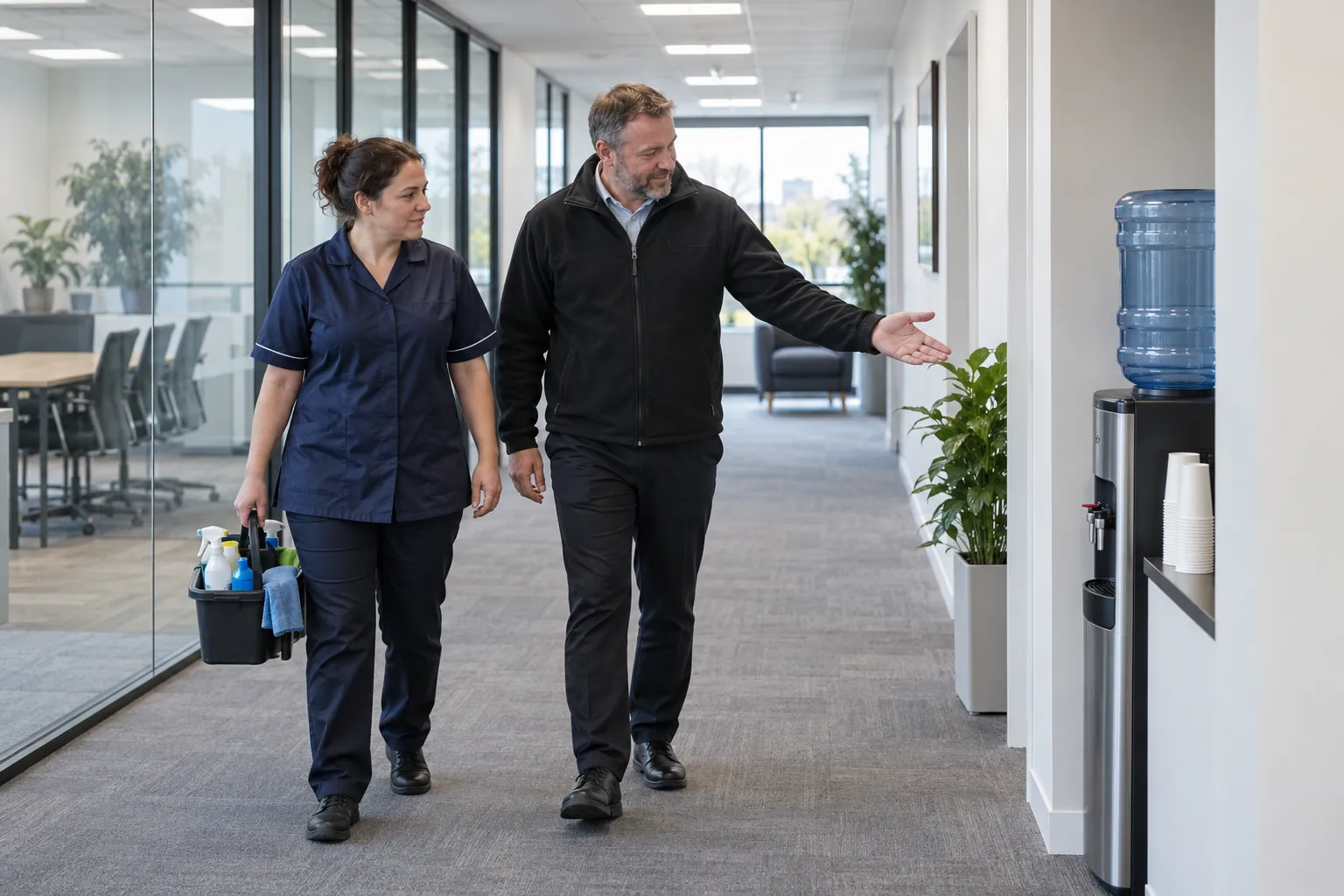
Usually called simply the Workplace Regulations, they apply to offices, shops, schools, factories, warehouses and most other places people work, and they bind employers and anyone who controls a building to any extent, including landlords and managing agents. This guide sets out what the Regulations ask of the building, how many toilets and washbasins the Health and Safety Executive's Approved Code of Practice expects for the number of people at work, and how a premises team shows, day to day, that the duties are being met.
01
What the Workplace Regulations 1992 are, and who they bind
The full title is the Workplace (Health, Safety and Welfare) Regulations 1992 (SI 1992/3004). They apply in England, Wales and Scotland. Northern Ireland has its own, the Workplace (Health, Safety and Welfare) Regulations (Northern Ireland) 1993. Regulation 2 defines a workplace as "any premises or part of premises which are not domestic premises and are made available to any person as a place of work", and the definition takes in the rooms, lobbies, corridors, staircases and roads used to get to and from that place of work, and the places where facilities are provided for it.
Regulation 4 places the duties on two kinds of person:
- every employer, for a workplace under its control where any of its employees works;
- every person who has, to any extent, control of a workplace in connection with a trade, business or other undertaking, for the matters within that person's control.
In a multi-let building that splits the work. The Health and Safety Executive's Approved Code of Practice says owners, landlords or managing agents should ensure that the common parts, facilities, services and means of access within their control comply, such as the lobby, the stairs, toilets shared by tenants and the ventilation plant, while each tenant employer answers for the workplace it controls. The owner is not responsible for a spillage caused by a tenant, or for the day-to-day cleaning of toilets where that is the tenants' job, and tenants are expected to co-operate with each other and with the landlord. The Regulations sit alongside section 4 of the Health and Safety at Work etc. Act 1974, the duty of anyone in control of non-domestic premises towards people who use them but are not their employees.
Regulation 3 leaves out, apart from a few named regulations, ships, work below ground at a mine and construction sites where only construction work is going on. It applies only some of the Regulations to aircraft, trains and road vehicles and to farm or forestry land away from the main buildings, and at temporary work sites the welfare requirements of regulations 20 to 25 apply so far as is reasonably practicable. Beyond that, the only exemption is a certificate the Secretary of State for Defence may grant to the armed forces in the interests of national security (regulation 26).
Regulation 1 brought the Regulations into force on 1 January 1993. For workplaces already in use then, regulations 5 to 27 took effect on 1 January 1996, so every workplace has had to meet the same requirements since.
02
What the Regulations cover
The Regulations run from regulation 4A to regulation 25A. Grouped by what they ask of a building, they are:
- The building itself: stability and solidity (4A) and maintenance of the workplace and of certain equipment, devices and systems (5).
- The working environment: ventilation (6); a reasonable temperature indoors (7); suitable and sufficient lighting, with emergency lighting where people would be specially exposed to danger if the lights failed (8); cleanliness and waste materials (9); room space (10), at least 11 cubic metres per person in most workplaces under the ACOP; and workstations and seating (11).
- Safety in and around the building: floors and traffic routes (12); falls and falling objects (13); windows, glazing and safe window cleaning (14 to 16); traffic routes organised so that pedestrians and vehicles can circulate safely (17); doors and gates (18); escalators and moving walkways (19).
- Welfare facilities: toilets (20), washing facilities (21), drinking water (22), somewhere to keep clothing (23) and to change (24), facilities to rest and eat meals (25), and arrangements for disabled people (25A).
Most are settled when the building is designed or fitted out. Four are daily work for whoever runs the premises, because they are met only if somebody keeps meeting them: maintenance (regulation 5), cleanliness (9), floors and traffic routes (12), and toilets and washing facilities kept clean and in order (20 and 21). The rest of this guide is about those four.
03
Regulation 5: maintenance, and a system for it
Regulation 5 says the workplace, and the equipment, devices and systems it covers, "shall be maintained (including cleaned as appropriate) in an efficient state, in efficient working order and in good repair", and that where appropriate they "shall be subject to a suitable system of maintenance". The equipment covered is anything whose fault is liable to cause a breach of the Regulations, mechanical ventilation, and equipment and devices intended to prevent or reduce hazards.
The ACOP and its guidance (paragraphs 41 to 46) explain what that means in practice:
- An efficient state means free of faults likely to affect the health, safety or welfare of workers, and an adequate level of hygiene.
- A potentially dangerous defect should be put right immediately, or steps taken to protect anyone who might be put at risk.
- Equipment that could fail and put workers at serious risk should be checked at regular intervals, as appropriate, by inspection, testing, adjustment, lubrication, repair and cleaning.
- Other faults should be put right as soon as possible. A broken toilet, the ACOP's own example, may be taken out of service until it is repaired, unless that leaves fewer toilets than the minimum in its tables, in which case it should be repaired without delay.
- How often, and by whom, depends on the equipment: the guidance points to HSE's publications and manufacturers' instructions, and its examples include emergency lighting, window restrictors, powered doors and escalators.
A suitable system usually comes down to a list of what is covered, how often each item is checked or serviced and by whom, a way for anyone in the building to report a defect, and a way to see that each defect was made safe and then fixed. Larger buildings run it as planned preventative maintenance; a small office may need little more than a calendar and a named person. Some items have their own regimes on top, such as the tests kept in an emergency lighting log book.
04
Regulations 9 and 12: a clean workplace and safe floors
Regulation 9 requires that "every workplace and the furniture, furnishings and fittings therein shall be kept sufficiently clean", and that, so far as is reasonably practicable, "waste materials shall not be allowed to accumulate in a workplace except in suitable receptacles". The surfaces of floors, walls and ceilings inside buildings must be capable of being kept sufficiently clean. The ACOP (paragraph 90) says sufficiently clean means regular cleaning, so that dirt or refuse does not accumulate and spillages are cleaned up as soon as possible, at a frequency and standard that depend on the nature of the business. Cleaning must not itself expose anyone to a health or safety risk, which brings in the Control of Substances Hazardous to Health Regulations 2002 for the cleaning products used.
There is no national cleaning frequency for an ordinary workplace. The frequency is set by the building's use and written into the cleaning specification, and regulation 9 is the outcome it has to deliver.
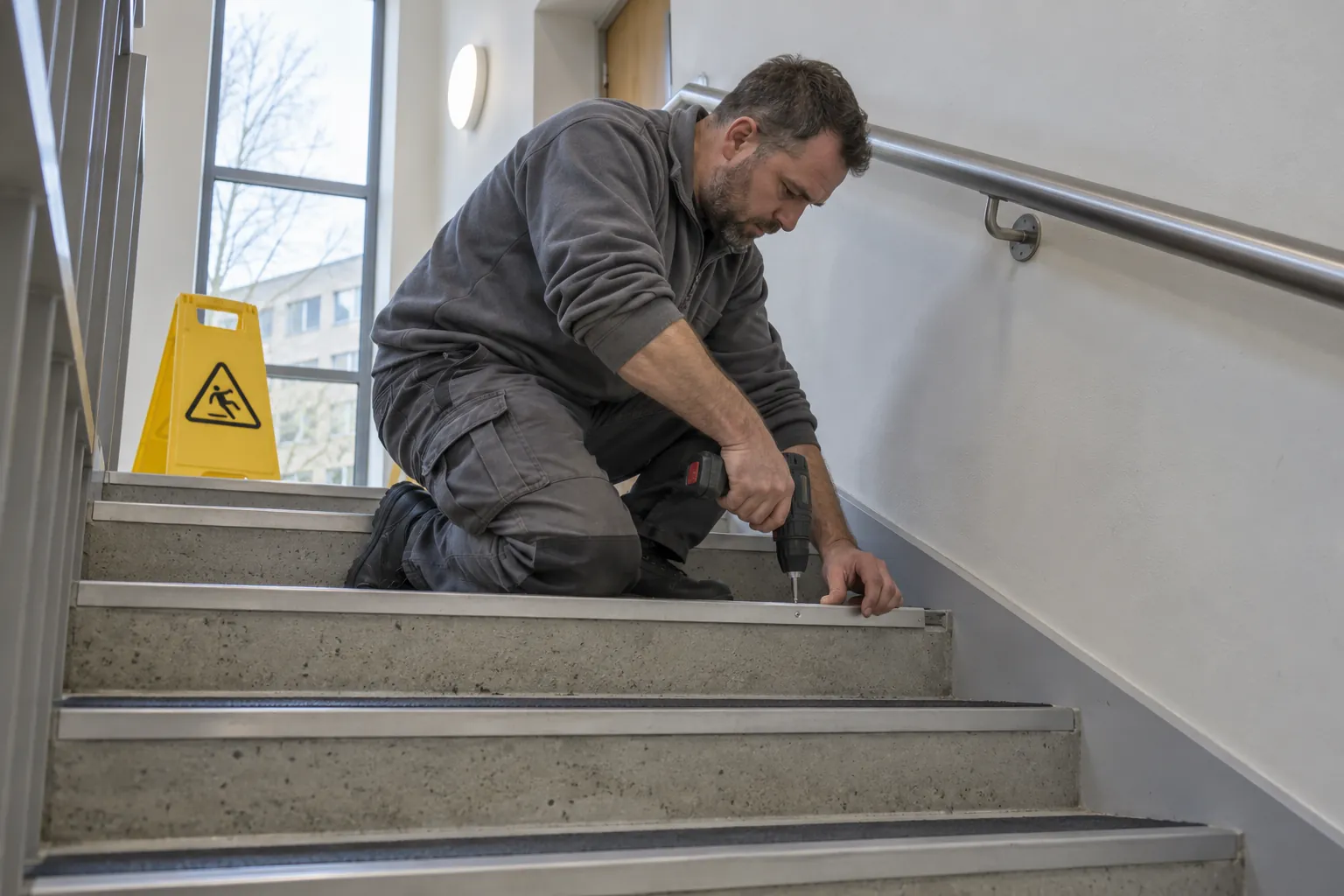
Regulation 12 covers floors and traffic routes: corridors, stairs, ramps, doorways, loading bays and the like. Floors must be suitable for their use, with no hole or slope, and not uneven or slippery so as to expose anyone to risk, with drainage where necessary, and, so far as is reasonably practicable, kept free of obstructions and of "any article or substance which may cause a person to slip, trip or fall". Staircases need suitable and sufficient handrails. Regulation 17 adds that traffic routes must be suitable for the persons or vehicles using them, that pedestrians and vehicles must be able to use them without endangering persons at work nearby, and that there must be sufficient separation where they share a route. The ACOP adds the routine:
- damaged surfaces that could cause a trip or fall should be made good, and conspicuously marked or protected until they are (paragraph 110);
- a spillage likely to be a slipping hazard calls for immediate steps to fence it off, clean it up or cover it (paragraph 113);
- the risks from snow and ice should be minimised, for example by gritting (paragraph 116);
- obstructions matter most near emergency routes, stairs, corners and junctions (paragraph 117).
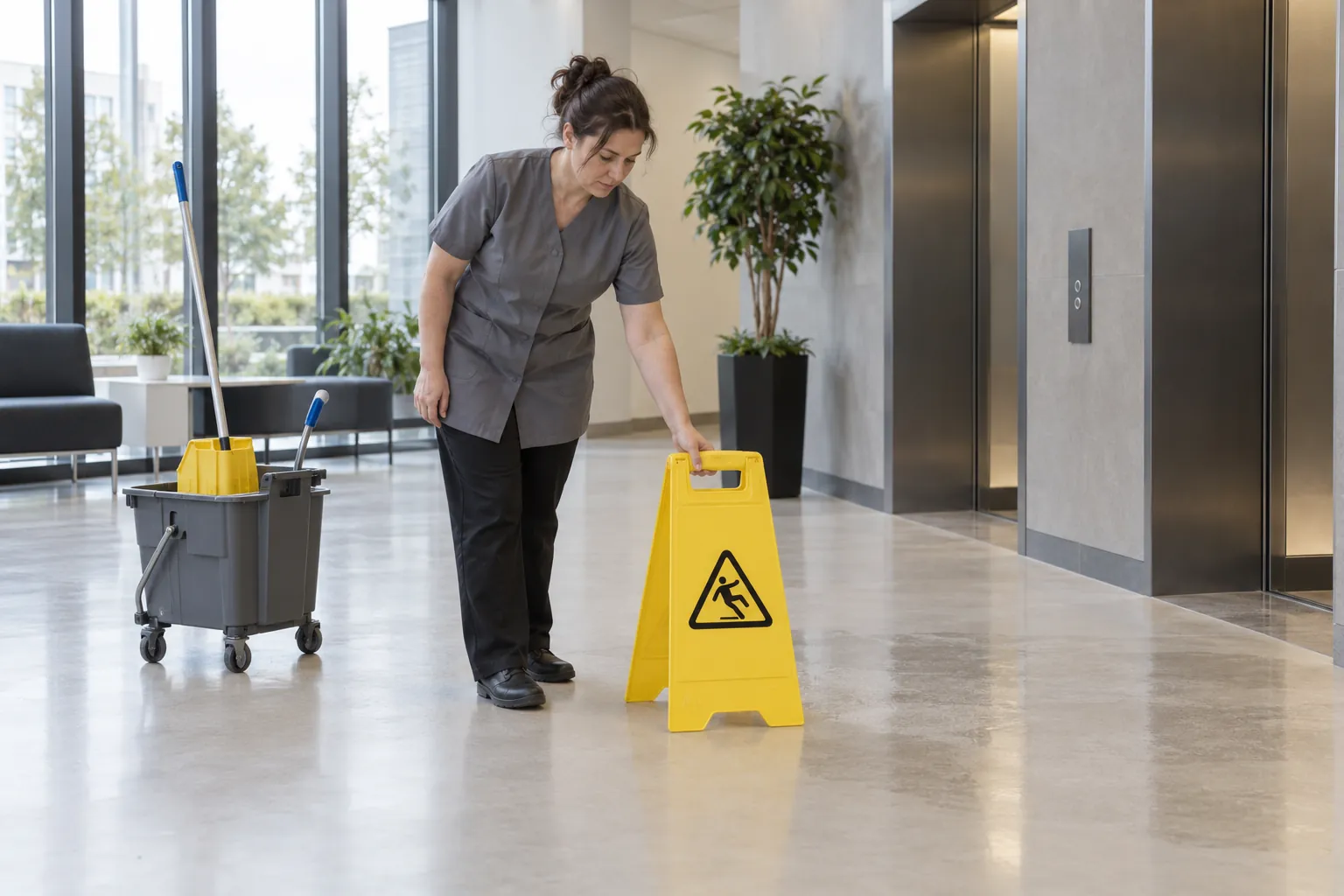
In practice regulation 12 is met by the people who walk the building: the cleaner who signs and mops a spill, the caretaker who notices the lifted tile, the security officer who finds the stairwell stacked with boxes. It is met only if what they see is made safe and reported to someone who fixes it.
05
Regulations 20 and 21: toilets, washbasins and how many
Regulation 20 requires "suitable and sufficient sanitary conveniences" at readily accessible places, in rooms that are adequately ventilated and lit and, with the toilets themselves, "kept in a clean and orderly condition", with separate rooms for men and women unless each toilet is in its own room with a door that can be secured from inside. Regulation 21 requires suitable and sufficient washing facilities next to every toilet and near any changing rooms, with clean hot and cold, or warm, running water so far as practicable, soap or another suitable means of cleaning, towels or another suitable means of drying, and the same standard of ventilation, light and cleanliness.
How many toilets per employee? The ACOP's Table 1 (paragraph 197) gives the minimum where men and women both work, counted on the largest number of people likely to be at work at any one time:
- 1 to 5 people: 1 toilet and 1 washbasin;
- 6 to 25 people: 2 toilets and 2 washbasins;
- 26 to 50 people: 3 toilets and 3 washbasins;
- 51 to 75 people: 4 toilets and 4 washbasins;
- 76 to 100 people: 5 toilets and 5 washbasins;
- above 100: one more toilet and washbasin for every 25 people, or part of 25 (paragraph 200).
Where toilets are used only by men, Table 2 may replace the toilet column with cubicles and urinals: 1 cubicle and 1 urinal for 1 to 15 men, 2 and 1 for 16 to 30, 2 and 2 for 31 to 45, 3 and 2 for 46 to 60, 3 and 3 for 61 to 75, 4 and 3 for 76 to 90, and 4 and 4 for 91 to 100. Above 100, one more cubicle for every 50 men (or part of 50) is enough, provided at least as many urinals are added.
These are minimums. The ACOP says to calculate separately for each group with its own facilities, to provide more where breaks are taken at set times or everyone finishes together, and to add facilities where the public uses the same toilets, so that workers can use them without unreasonable delay.
HSE's own page on toilets and washing facilities adds a supply of toilet paper, somewhere for female workers to dispose of sanitary dressings, a way of drying hands such as paper towels or a hot-air dryer, and agreed reasonable adjustments for workers with disabilities. Paragraph 206 of the ACOP says the frequency and thoroughness of cleaning should be adequate to keep these rooms clean, and that responsibility for cleaning should be clearly established, particularly where facilities are shared by more than one workplace.
The other welfare duties are simpler. Regulation 22 requires an adequate supply of wholesome drinking water, readily accessible, with cups unless it comes from a drinking fountain. Regulation 25 requires suitable and sufficient rest facilities, somewhere to eat meals where meals are regularly eaten at work, and somewhere for a pregnant woman or nursing mother to rest.
06
Where the record fails, and what SiteClara does about it
The Workplace Regulations ask for outcomes: kept clean, kept in repair, kept free of slipping hazards. When something goes wrong, the questions are when the washroom was last checked, who reported the broken toilet or the lifted tile, and how long it took to put right. The evidence is usually thin: a sheet on the washroom door filled in at the end of the shift, a defect mentioned to whoever was passing, and in a shared building a landlord and a tenant who each thought the other was cleaning the second-floor toilets.
SiteClara records the routine checks and the faults at the places they happen. A printed QR poster, with an optional NFC tag behind it, sits at each washroom, stairwell, entrance or plant room where a check is scheduled. Staff scan or tap on their own phone, with no app to install, see the checks due there, and mark each one done or explain what stopped them. The time and the named person are recorded as it happens, with a photo when one is asked for. A fault, such as a blocked toilet or a leak at the foot of the stairs, is reported from the same tag and goes onto the team's list of jobs until someone closes it.
The supervisor sees what is due, done and missed, and records the reason a check was missed. Each day they approve a report that goes to nominated management or client contacts at 08:00 the next morning, showing what was reported, completed and still open: a working record, made at the time, of the cleaning and defect reporting the Regulations depend on.
07
Questions people ask
What are the legal requirements for toilets in the UK?
In Great Britain, regulation 20 of the Workplace (Health, Safety and Welfare) Regulations 1992 requires "suitable and sufficient sanitary conveniences" at readily accessible places, in rooms that are adequately ventilated and lit and kept in a clean and orderly condition, with separate rooms for men and women unless each toilet is in its own room with a door that can be secured from inside. Regulation 21 requires washing facilities beside them, with clean hot and cold, or warm, water, soap and a means of drying. Northern Ireland sets the same duties in its own 1993 Regulations.
How many toilets are needed for a 100-person office?
Five toilets and five washbasins where men and women both use them, according to the table on HSE's page How many toilets should a workplace have?, taken from the Approved Code of Practice. The count is the largest number of people likely to be at work at one time, and above 100 the Workplace health, safety and welfare ACOP (L24) adds one toilet and one washbasin for every further 25 people or part of 25.
Is it illegal for a workplace to not have toilets?
Yes, in Great Britain. Regulation 20 of the Workplace Regulations 1992 requires toilets at readily accessible places in almost every workplace the Regulations cover, and section 33(1)(c) of the Health and Safety at Work etc. Act 1974 makes it an offence to contravene any health and safety regulations. Construction sites where only construction work is going on are largely left out of these Regulations and have their own welfare rules.
What is the new toilet law in the UK?
The most recent change is to building rules, not to workplace law: Part T of the Building Regulations in England, explained in Toilet accommodation: Approved Document T, first published on 15 May 2024. It applies to new buildings other than dwellings and to buildings undergoing a material change of use, and covers the design of universal toilets, ambulant toilets and toilet cubicles. The Workplace Regulations and the ACOP's toilet numbers are unchanged.
08
Where to read the official guidance, and a list to take away
The Regulations themselves are on legislation.gov.uk as the Workplace (Health, Safety and Welfare) Regulations 1992, with each regulation on its own page. HSE publishes the Approved Code of Practice and guidance, Workplace health, safety and welfare (L24), free, which is where the tables of toilet and washbasin numbers are, and a short leaflet for employers, Welfare at work (INDG293). Its simple health and safety pages set out Workplace facilities: what you must provide and what it expects of toilets and washing facilities.
Before the next walk round the building, check that:
- it is written down who controls each part of the building, and who cleans and maintains the shared toilets, stairs and lobbies;
- the equipment covered by regulation 5 is listed, with how often it is checked and by whom;
- cleaning frequencies are set by each area's use and written into the cleaning specification;
- spills, damaged floors and obstructions on traffic routes are made safe at once;
- toilet and washbasin numbers meet the ACOP tables for the most people on site at one time;
- toilet paper, soap, a means of drying hands, sanitary disposal and drinking water are always available;
- the record of checks and repairs shows times and names, and is kept.
Sources
Every document this guide quotes or links to, in the order it first cites them.
- Workplace (Health, Safety and Welfare) Regulations 1992 legislation.gov.uk
- Workplace (Health, Safety and Welfare) Regulations (Northern Ireland) 1993 legislation.gov.uk
- Regulation 4 legislation.gov.uk
- Section 4 of the Health and Safety at Work etc. Act 1974 legislation.gov.uk
- Regulation 3 legislation.gov.uk
- Regulation 26 legislation.gov.uk
- Regulation 1 legislation.gov.uk
- Workplace health, safety and welfare hse.gov.uk
- Regulation 5 legislation.gov.uk
- Regulation 9 legislation.gov.uk
- Control of Substances Hazardous to Health Regulations 2002 legislation.gov.uk
- Regulation 12 legislation.gov.uk
- Regulation 17 legislation.gov.uk
- Regulation 20 legislation.gov.uk
- Regulation 21 legislation.gov.uk
- Toilets and washing facilities hse.gov.uk
- How many toilets should a workplace have? hse.gov.uk
- Section 33(1)(c) of the Health and Safety at Work etc. Act 1974 legislation.gov.uk
- Toilet accommodation: Approved Document T gov.uk
- Welfare at work hse.gov.uk
- Workplace facilities: what you must provide hse.gov.uk
Related guides
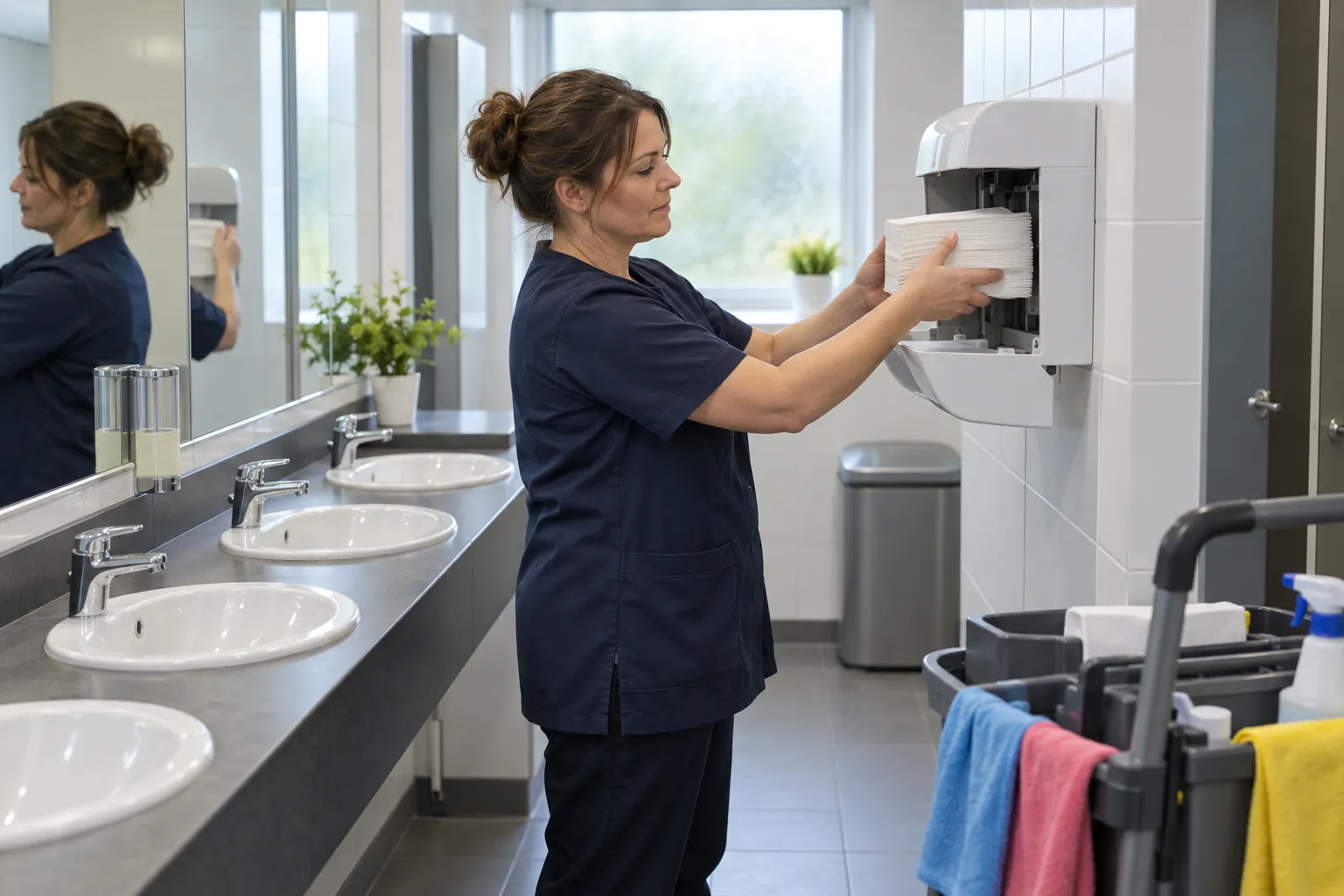 CleaningToilet check sheet: what to record and how to make it credibleWhat a washroom check sheet should record, how often to check, the legal duty behind it, and how to keep a record a client or inspector will believe.
 Premises and facilities managementBuilding maintenance checklist: what to check, how often, and who byA building maintenance checklist for UK non-domestic buildings: daily to annual tasks for fabric, services, safety systems and grounds, and who does each.
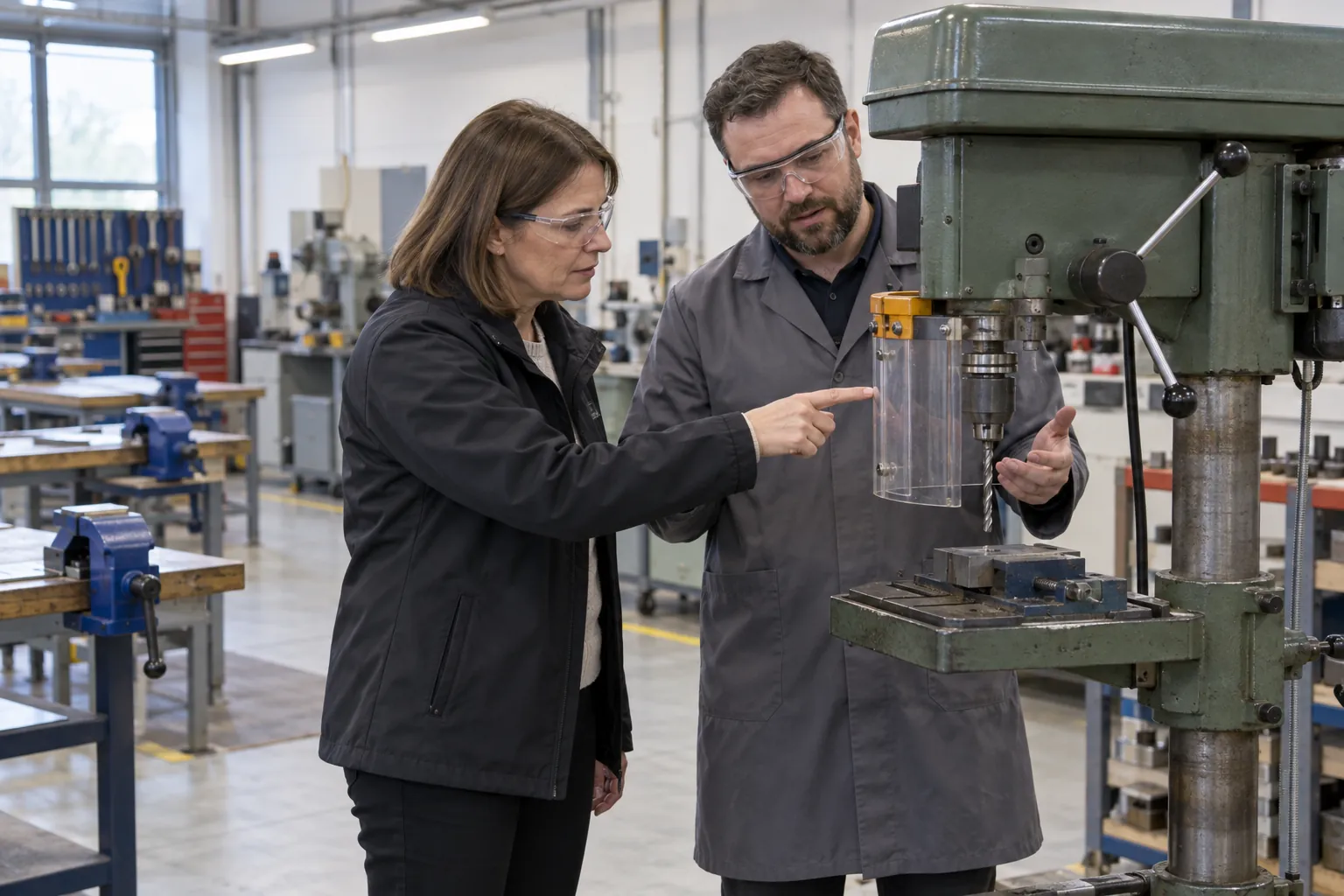 Premises and facilities managementHealth and safety inspection checklist: what to look at, and what to do nextHow to run a workplace health and safety inspection: the legal basis, what to walk and look at, how often, recording findings and actions, and involving staff.
 CleaningSlips and trips: the law, the causes, and the record that shows the floor was safeSlips and trips at work in the UK: the law on floors and spills, the causes, the risk assessment, wet floor signs, and the cleaning record a slip claim turns on.