Fire and water checks
Emergency lighting log book: what to record, and how often
An emergency lighting log book is the written record of a building's emergency lighting tests, the monthly function test of every emergency light and the annual full-duration test that BS 5266-1 and the government's fire safety guidance recommend, and of each fault, repair and change to the system.
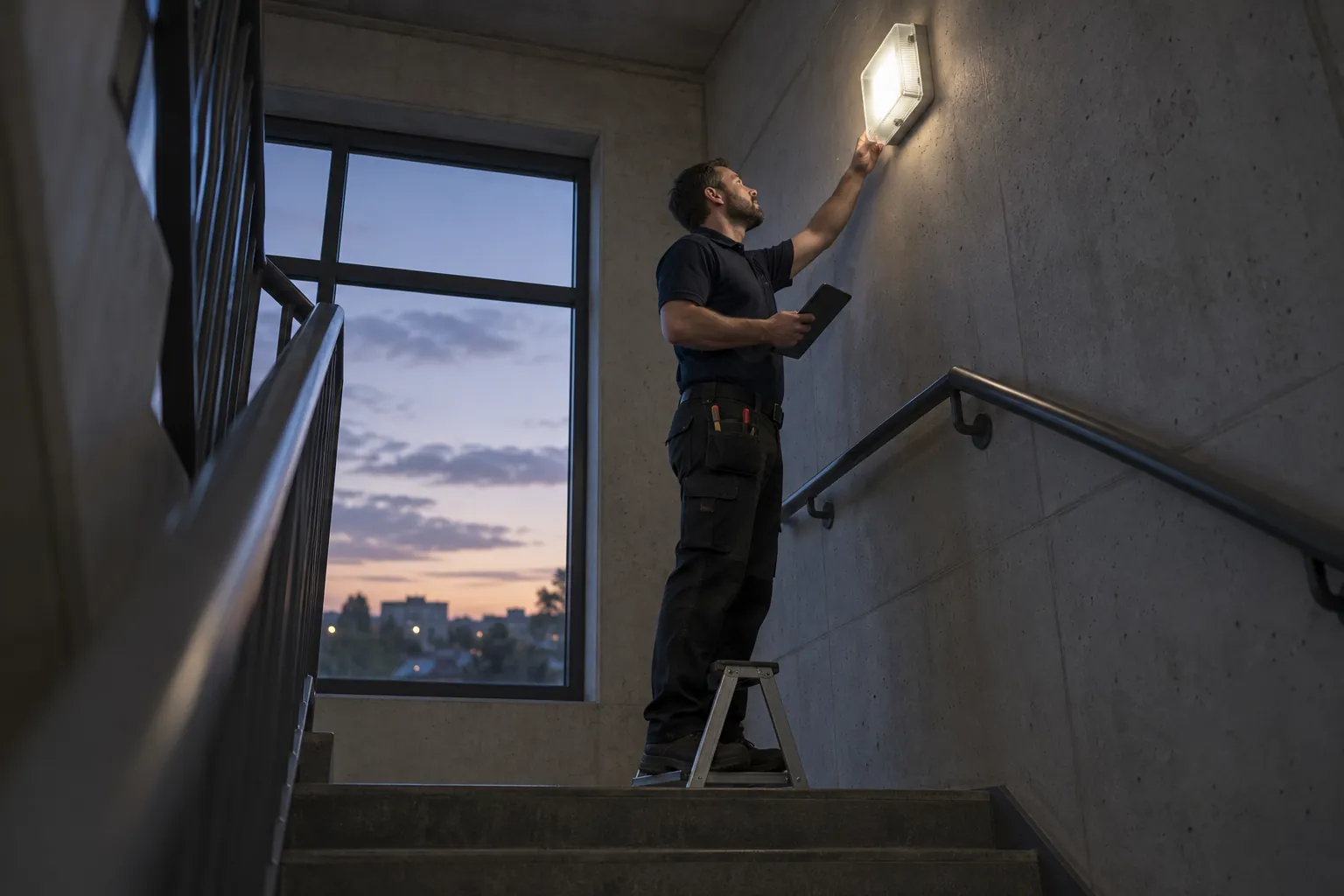
Emergency lighting only proves itself when the power fails, so the log book is the evidence, in the meantime, that it would work. This guide covers what an emergency lighting log book should contain, the monthly and annual tests behind the entries, who can do each, and what makes the record believable.
01
The duty, and the standard behind the log book
In England and Wales, the Regulatory Reform (Fire Safety) Order 2005 requires the responsible person to make sure that emergency routes and exits which need lighting have emergency lighting of adequate intensity in case the normal lighting fails, and that it is subject to a suitable system of maintenance and kept in efficient working order. Scotland has equivalent duties under the Fire (Scotland) Act 2005 and Northern Ireland under the Fire Safety Regulations (Northern Ireland) 2010. The fire risk assessment decides where emergency lighting is needed.
The detail comes from BS 5266-1, the British Standard code of practice for the emergency lighting of premises, which works alongside the European standard for testing and recording emergency escape lighting systems, published in the UK as BS EN 50172. Between them they recommend:
- a monthly functional test of every emergency luminaire and exit sign;
- an annual full-duration test of the whole system, for its full rated duration;
- a log book kept on the premises, recording the tests, faults and remedial work, and any changes to the system.
Emergency escape lighting gives enough illumination for people to find their way out during an evacuation, to see hazards on the route, and to find firefighting equipment and call points. The log book has no statutory format: the law does not require a particular book. It requires the system to be maintained, and a responsible person who is asked by a fire safety inspector or fire risk assessor how they know it works will be expected to show the log book. Insurers commonly ask for it too.
02
What an emergency lighting log book should contain
Printed emergency lighting log books, with record sheets for each type of test, follow broadly the same shape, and a digital log book should record the same things as a paper-based one. The book should hold:
- Details of the system: whether it uses self-contained luminaires with their own batteries or a central battery system, its rated duration, and where the drawings are kept.
- The completion or commissioning certificate issued when the system was installed or last altered, and any periodic inspection certificates since.
- A schedule of luminaires: each emergency light and exit sign, by a reference and location, so that a test can be recorded light by light.
- The monthly test records: date, who tested, which luminaires, the result, and any faults.
- The annual test records: date, start time, duration, result for each luminaire, and the competent person who carried it out.
- Faults and remedial action: what failed, who it was reported to, what was done, and when.
- Alterations: lights added, moved or removed during a refit or a change of layout.
Emergency lighting testing records are part of the building's wider fire safety and health and safety records. Some buildings keep a single fire safety log book with sections for the fire alarm, emergency lighting, extinguishers, fire doors and drills; others keep a separate emergency lighting logbook. Either works, as long as the record is complete, current and can be produced when it is asked for.
03
The monthly functional test
The monthly function test is a short one, sometimes called a flick test. Its purpose is to prove each emergency light comes on when the normal supply fails, not to run the batteries down. A trained member of staff can do it:
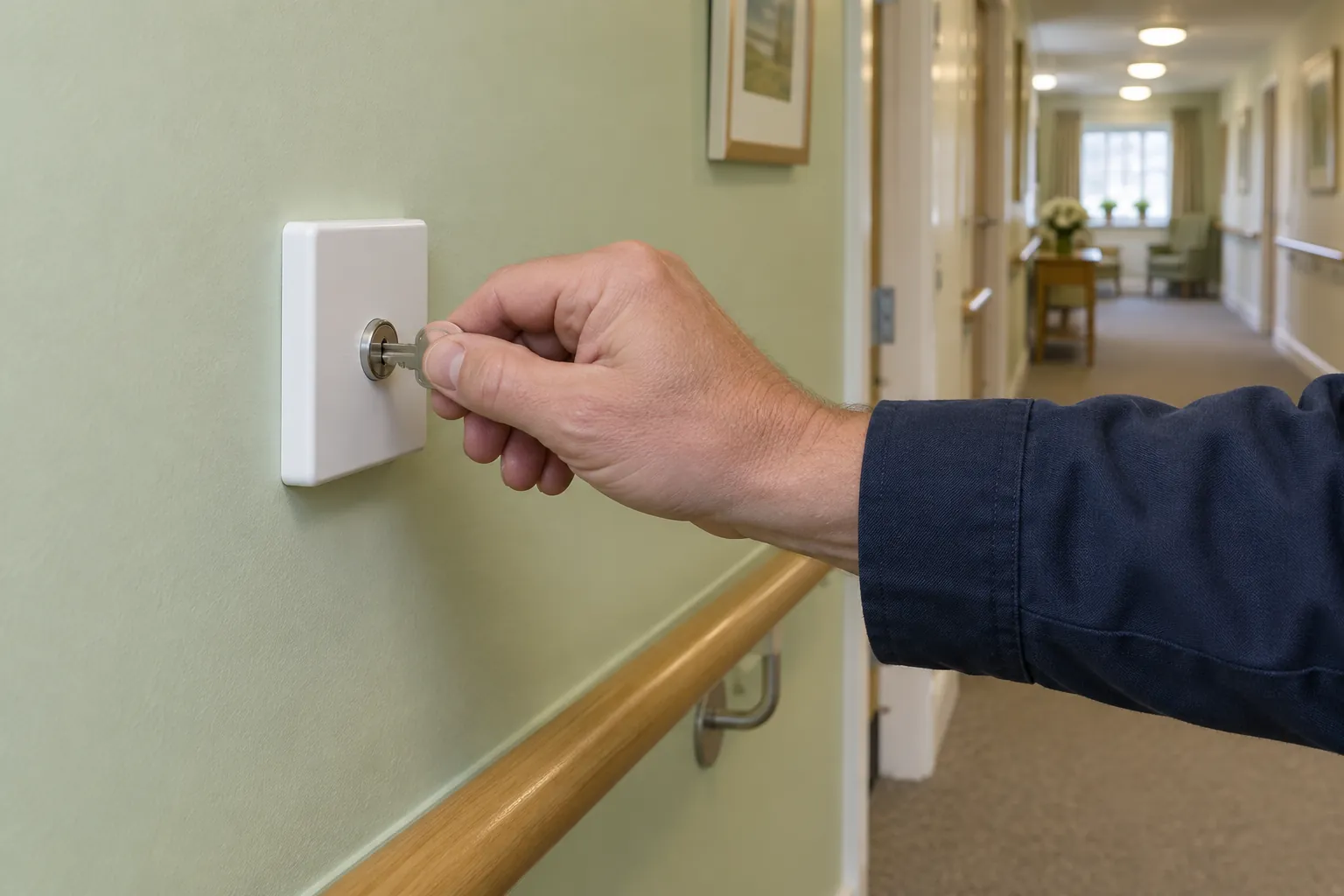
- Simulate a failure of the normal lighting supply, usually with a test key switch fitted beside the lighting circuit, or by switching off the local circuit. Never by removing fuses from a board that serves anything else.
- Walk the building and check that every emergency luminaire and illuminated exit sign has lit, including in stairwells, plant rooms, toilets and outside final exits.
- Keep it short: long enough to see each light working, but not so long that the batteries are drained with the building occupied.
- Restore the supply and check that each luminaire's charging indicator, where it has one, shows it is charging again.
- Record the result: the date, who tested, the luminaires tested, and each one that failed, flickered or was dim.
In a large building, the monthly test can be done floor by floor or circuit by circuit across the month, as long as the record shows every luminaire was tested.
Where the building has a central battery system, its indicators are usually checked more often, and the manufacturer's instructions and the installer's recommendations say how. Where luminaires have automatic self-testing, they run their own tests and report faults, but someone still needs to check the results regularly, record them and act on them. An automatic test that nobody reads is not a test.
04
The annual full-duration test
Once a year, the whole emergency lighting system is tested for its full rated duration, usually three hours, and one hour in some premises. The test proves the batteries can still hold every light on for as long as the system was designed for. It is normally carried out by a competent person, such as an electrical contractor or an emergency lighting specialist, who also inspects the system and issues a periodic inspection certificate.
Can you conduct the annual full-duration test yourself? In principle the test is simple, but it needs someone competent to judge the results, deal with failures and certify the system, and most responsible persons use a contractor for it.
Two practical points matter:
- Timing. After a full-duration test the batteries can take up to 24 hours to recharge, during which the system may not protect the building for its full duration. Test when the building will be empty or lightly used afterwards, or test alternate luminaires on different days so that every area keeps some emergency lighting.
- Failures. A luminaire that fails before the end of the rated duration needs a new battery or a replacement fitting. What happens if the lighting fails during the annual test? The failure is recorded, the fault is put right, and the affected luminaires are retested, with the remedial work written in the log book.
Between annual tests, anything that changes the building, such as a refit, new partitions or a change of use, can leave areas without the emergency lighting the fire risk assessment expects. The competent person should look at the system after such changes, not only at the next annual visit.
05
What makes the log book credible
Good record-keeping is what makes a system look compliant to someone who was not there. A fire safety inspector or fire risk assessor reading an emergency lighting log book is looking for signs that the tests really happened. The records that stand up share a few features:
- Entries are made at the time, with the actual date and time of the test and the name of the person who did it.
- They are specific: which luminaires were tested and which failed, by reference, not "all OK".
- Faults have outcomes: every recorded failure has a matching entry for its repair, with a date.
- Gaps are explained: a missed month with a reason is more believable than twelve identical entries.
- The annual certificate is there, signed by the competent person, with any recommendations and what was done about them.
- Someone reviews it: a manager who reads the log book every few months will see the fault that has been recorded three times and never fixed.
The records that do not stand up are just as recognisable: a year of monthly tests written in the same pen on the same day, no faults ever, or a log book that stops when the person who kept it left. Emergency lights do fail, batteries wear out, and a log book with no remedial entries at all suggests nobody is looking closely.
06
Where the record fails, and what SiteClara does about it
The monthly emergency lighting test is easy to postpone. It needs someone to walk the whole building, it has to be fitted around occupied hours, and the log book sits in a cupboard by the fire alarm panel where nobody else sees it. In a portfolio of buildings, the person accountable often has no way to know which buildings did their test this month until the fire risk assessor finds a gap.
SiteClara puts a printed QR poster at each location a check happens, such as a test key switch, a floor or a stairwell, with an optional NFC tag behind it. The person doing the test scans the code or taps the tag on their own phone, with no app to install; they are enrolled by text and sign in with a link. They see the checks due at that location, such as the monthly emergency lighting test for that floor, and mark each one done, or explain what stopped them. A failed or damaged light is reported there with a photo and goes onto the team's list of jobs until someone closes it.
The supervisor sees what is due, done and missed and can record why a check was missed; a job that needs the building manager can be escalated to them to answer. Each day the supervisor reviews and approves a report that goes to nominated management or client contacts at 8am the next morning, showing what was reported, completed and still open, and how the scheduled checks went, for example 12 of 12 completed. It is priced per building, with no per-person fees.
07
Questions people ask
What are the legal requirements for emergency lighting?
In England and Wales, article 14(2)(h) of the Regulatory Reform (Fire Safety) Order 2005 requires emergency routes and exits that need illumination to be provided with emergency lighting of adequate intensity in case their normal lighting fails, where that is necessary to keep people safe. Article 17 then requires the responsible person to keep it subject to a suitable system of maintenance and in efficient working order and good repair; the fire risk assessment decides where emergency lighting is needed.
What qualifications do I need to test emergency lighting?
No particular qualification is required by law in England and Wales to test emergency lighting: the Home Office's Fire safety risk assessment: offices and shops guidance for England says that, depending on the installation, you should be able to carry out most of the routine tests yourself, and should contact your supplier or another competent person if you are not sure how. The same guidance says the annual testing and maintenance of emergency lighting should be done by a competent person. The Fire Safety Order's own definition of competence, in article 18(5) for the people appointed to assist with fire safety measures, is sufficient training and experience or knowledge and other qualities, not a particular certificate.
08
Further reading, and a list to take away
BS 5266-1, the code of practice for the emergency lighting of premises, is published by BSI and includes model certificates and guidance on the log book. The Industry Committee for Emergency Lighting (ICEL) publishes guidance on emergency lighting design and maintenance. GOV.UK publishes the Fire safety risk assessment guides for different types of premises, which explain when emergency lighting is needed, and your local fire and rescue service can advise on your own building.
Before next month's test, check that:
- every emergency luminaire and exit sign has a reference and is on a schedule;
- the monthly test has a named person, a deputy, and a way to test without draining the batteries;
- each monthly test records which lights were tested and which failed;
- every fault has a matching repair entry, with a date;
- the annual full-duration test is booked, at a time that allows recharge before the building is occupied;
- the completion certificate and the latest periodic inspection certificate are with the log book;
- automatic self-test results, if you have them, are read and recorded.
Sources
Every document this guide quotes or links to, in the order it first cites them.
- Regulatory Reform (Fire Safety) Order 2005 legislation.gov.uk
- BS 5266-1 knowledge.bsigroup.com
- BS EN 50172 knowledge.bsigroup.com
- Article 17 legislation.gov.uk
- Fire safety risk assessment: offices and shops gov.uk
- Article 18(5) legislation.gov.uk
- Fire safety risk assessment gov.uk
Related guides
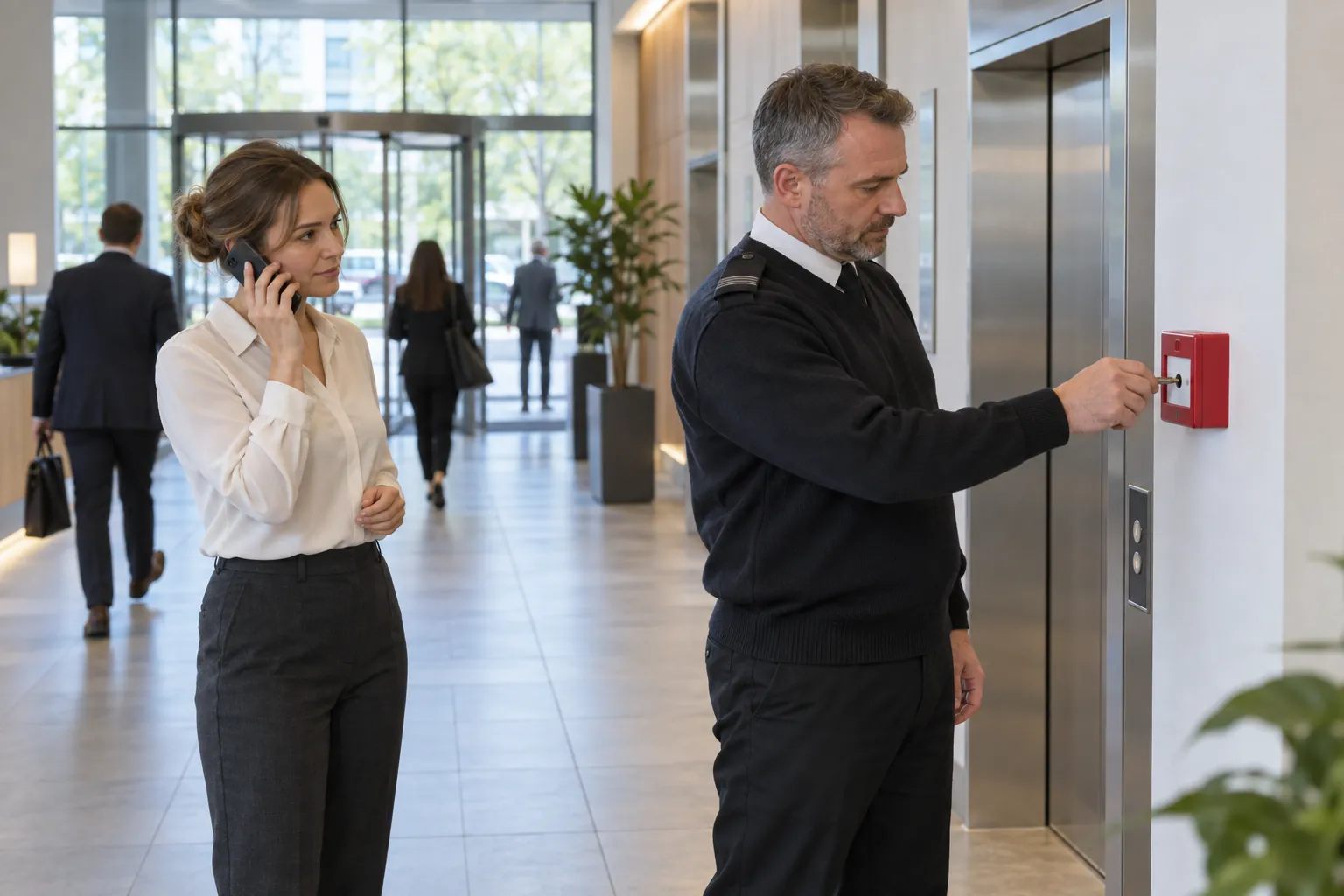 Fire and water checksWeekly fire alarm test: how to do it, and what to recordWeekly fire alarm test: how to carry out the test BS 5839-1 recommends, rotating call points, what to record, and what only a competent person can do.
 Fire and water checksFire safety checks in the workplace: what to check, how often, and who does itThe routine fire safety checks a UK workplace needs, from daily escape routes to the weekly alarm test, who does each one, and what the record should show.
 Fire and water checksFire extinguisher checks: the monthly check and the annual serviceWhat a monthly fire extinguisher check looks at, what the annual service by a competent person covers under BS 5306-3, and how to keep a record that stands up.
 Premises and facilities managementBuilding manager responsibilities: the duties, the daily work and the recordWhat a building manager is responsible for in UK commercial and residential buildings: legal duties, daily work, contractors and the records that prove it.