Premises and facilities management
Accident investigation: finding out why it happened, not who to blame
An accident investigation is a structured look at a work-related event that hurt someone, or could have, to find out what happened, why it happened and what has to change so that it does not happen again.
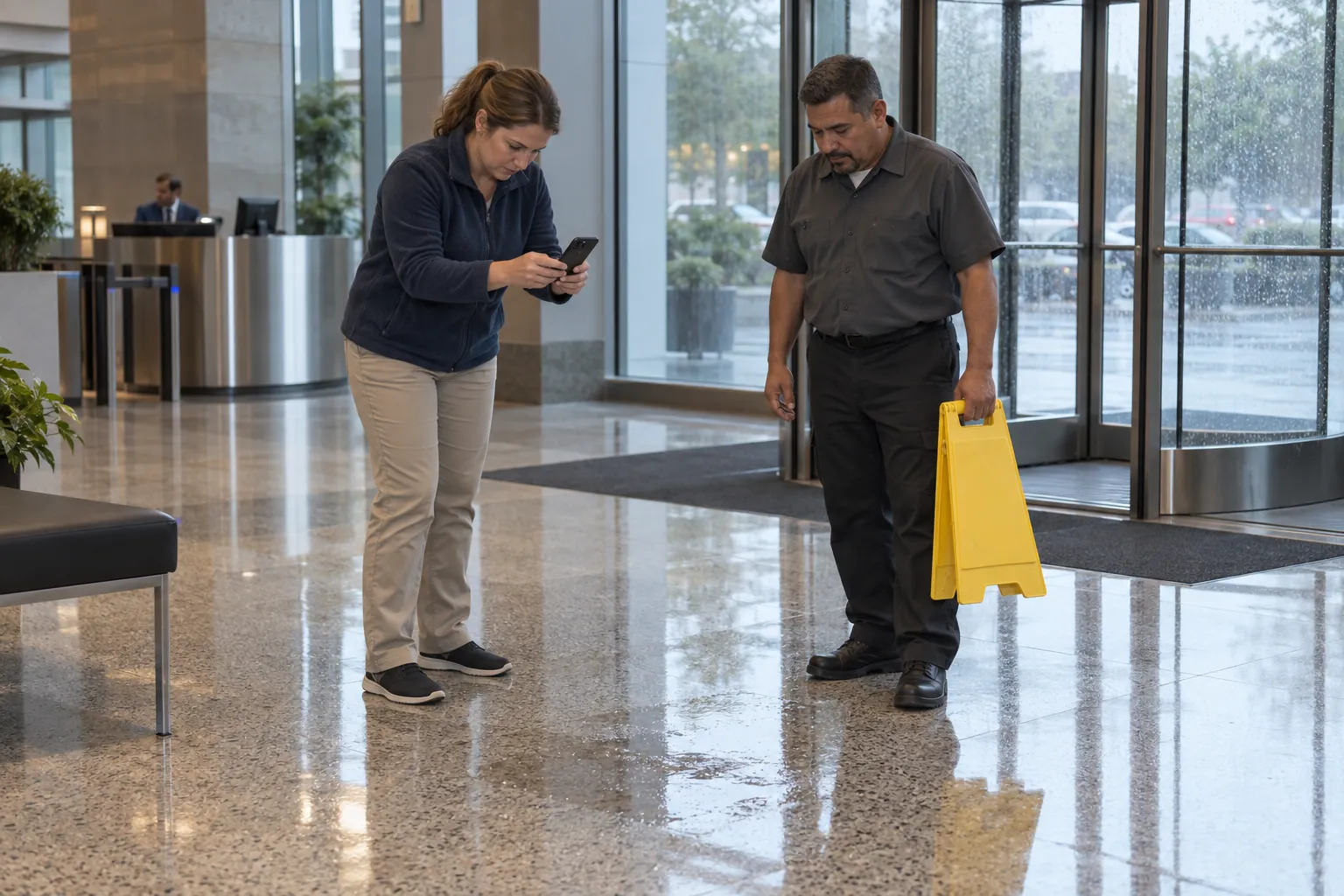
It starts once the injured person has been cared for and the area is safe, and it ends only when that change has been made. OSHA calls it an incident investigation, and its guidance for employers sets out four steps: preserve and document the scene, collect information, determine the root causes, and implement corrective actions. This guide walks through each step as it plays out in an office, a school, a hospital or a parking garage, with the few places where federal or state rules make part of it mandatory.
01
What an accident investigation is, and what the rules require
An accident investigation is a structured look at a work-related event that hurt someone, or could have, to find out how and why it happened and what has to change. OSHA's guide for employers, Incident [Accident] Investigations: A Guide for Employers (December 2015), deliberately uses the word incident, because "accident" suggests an event that "just happened" and could not have been prevented, while "the vast majority of harmful workplace events do not 'just happen.'" It defines an incident as "a work-related event in which an injury or ill-health (regardless of severity) or fatality occurred, or could have occurred." Most facility teams still say accident investigation; here the two mean the same.
OSHA's incident investigation page puts the purpose plainly: investigating "a fatality, injury, illness, or close call" gives employers and workers "the opportunity to identify hazards in their operations and shortcomings in their safety and health programs." It adds that investigations "that focus on identifying and correcting root causes, not on finding fault or blame, also improve workplace morale and increase productivity."
For an ordinary commercial building, no federal OSHA standard requires every accident to be investigated. The guide is advisory; it says it "does not create any new legal obligations." What the law does require sits around the investigation:
- Reporting to OSHA. Under 29 CFR 1904.39, a work-related fatality must be reported within eight hours, and an in-patient hospitalization, amputation or loss of an eye within 24 hours. The workplace incident report guide covers the clock in detail.
- Recording. Employers covered by Part 1904 must enter each recordable case on the OSHA 300 log and the 301 incident report within seven calendar days, under 29 CFR 1904.29. The 301 records what happened; it is not an investigation of why.
- Process safety. Sites under OSHA's Process Safety Management standard must investigate incidents that caused, or could reasonably have caused, a catastrophic release of highly hazardous chemicals, as the OSHA and EPA fact sheet The Importance of Root Cause Analysis During Incident Investigation (2016) notes. Few offices or schools are covered.
Some states go further, and it matters which state you are in. There are currently 22 OSHA-approved State Plans covering private and public sector workers, and seven covering only state and local government workers. In California, 8 CCR 3203, the Injury and Illness Prevention Program rule, requires every employer's written program to "include a procedure to investigate occupational injury or occupational illness" and methods for correcting unsafe conditions "in a timely manner based on the severity of the hazard." In Washington, WAC 296-800-320 requires a preliminary investigation of all serious injuries, with the findings documented for use at any formal investigation. Check your own state plan before relying on the federal position.
02
What to investigate in a building
OSHA "strongly encourages employers to investigate all incidents in which a worker was hurt, as well as close calls (sometimes called 'near misses'), in which a worker might have been hurt if the circumstances had been slightly different." Its Recommended Practices: Hazard Identification and Assessment make the same point, treating "injuries, illnesses, close calls/near misses, and reports of other concerns" as clear signs of where hazards exist, with an action item to conduct incident investigations.
In a building run by janitorial, security and engineering teams, the events that most often call for an investigation are ordinary ones:
- a slip on a freshly mopped restroom floor or a wet lobby during a rainstorm;
- a fall on a stairwell with a loose tread nosing or a light out;
- a strain from lifting trash, moving furniture or pulling a heavy floor machine;
- a cut or needlestick from a trash bag or a restroom sharps container that was overfull;
- a chemical splash while diluting a floor stripper or disinfectant;
- a security officer struck by a vehicle in a parking garage or at a loading dock, or hurt in a confrontation;
- a close call: the ceiling tile that fell into an empty hallway, the door closer that failed on a fire door, the cart that rolled down a ramp.
Not every event needs the same depth. Scale the investigation to what could have happened rather than to what did: a spill that caused a bruise and one that nearly sent someone down a flight of stairs share a root cause, and the second deserves the fuller look. The near miss reporting guide covers how to get close calls reported in the first place.
03
Steps 1 and 2: make it safe, preserve the scene, and collect information
OSHA's guide is clear on the order: "Before investigating, all emergency response needs must be completed and the incident site must be safe and secure for entry and investigation." Care for the injured person comes first, then isolating the hazard so nobody else is hurt, then the investigation.
Preserve the scene. The guide says to preserve it "to prevent material evidence from being removed or altered," using cones, tape or guards. In a building that means leaving the wet floor sign where it was (or noting that there was none), keeping the ladder, the broken cord or the loose handrail aside rather than throwing it out, and asking whoever cleans up the spill to wait for a photo. Washington goes further: under WAC 296-800-32010, equipment involved in an accident that results in a death, an in-patient hospitalization, an amputation or the loss of an eye must not be moved until the Department of Labor and Industries has investigated and released it, except to remove victims or prevent further injuries.
Document the scene. Record the date of the investigation and who is investigating, the injured person's name and injury, and the date and location of the incident. OSHA's photo tips are worth following: distance shots first, then closer; several angles; the date, time, place and photographer noted for each; and an object of known size in the frame for scale.
Collect information. The guide's Step 2 lists sources beyond interviews that are easy to forget in a building:
- equipment manuals and industry guidance documents;
- company policies and records, including the post orders or the janitorial scope of work for that area;
- maintenance schedules, records and logs: the last check of that stairwell light, the last service of that door closer, the open work order for that leak;
- training records, audit and follow-up reports, and previous corrective action recommendations.
That list is where many building investigations stall. If the restroom check sheet was initialed for the whole day in advance, or the leak was mentioned to whoever was passing, the records cannot say whether the hazard was known, or what was done about it.
04
Interviewing the injured person and witnesses
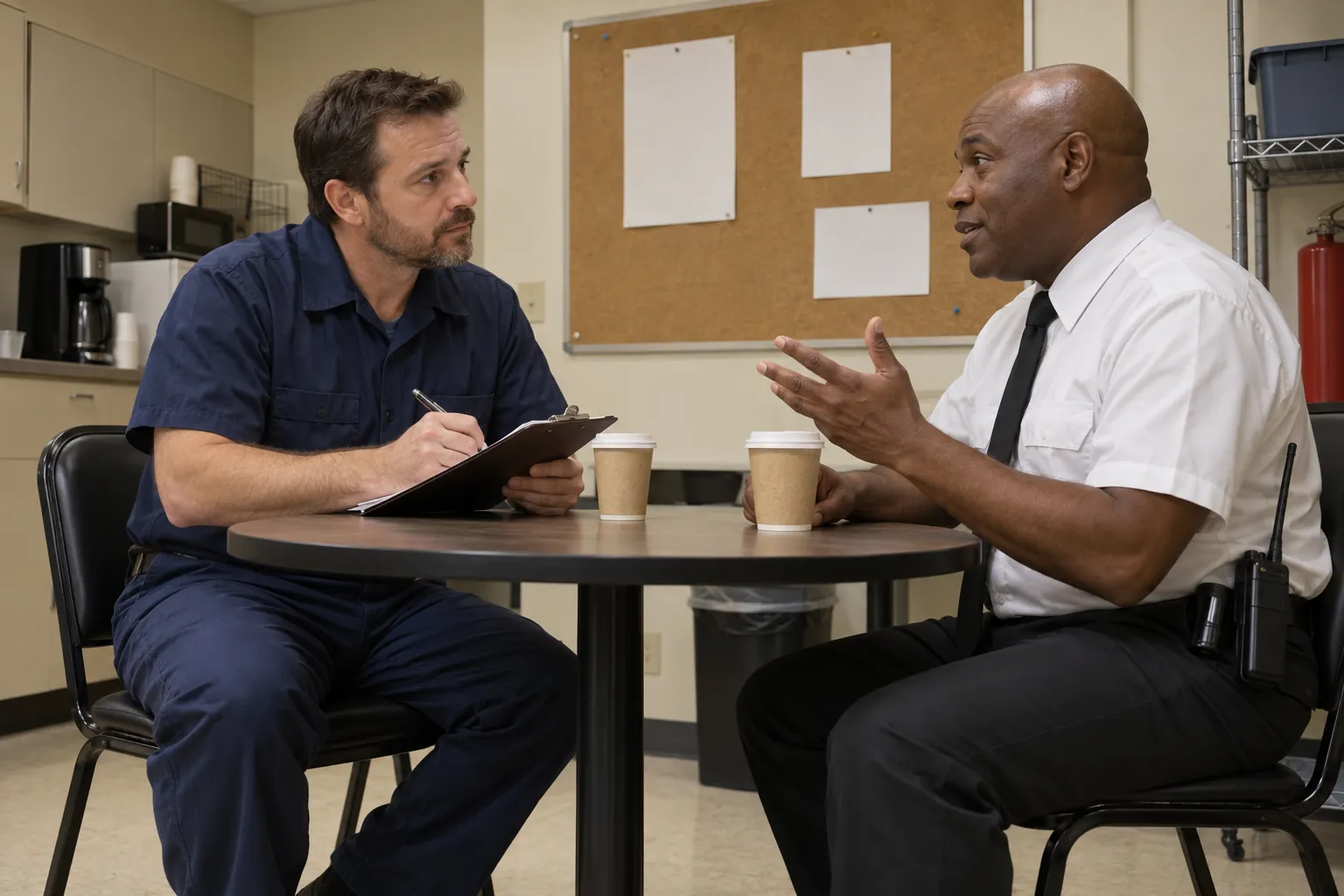
Memories fade, so interviews should be done as soon as the site is safe and things have settled. OSHA's guide says "the sooner a witness is interviewed, the more accurate and candid his/her statement will be," and that an investigation may mean re-interviewing people as more is learned, "up to and including the highest levels of management." Its advice for the interview itself fits a custodian, an officer or a building engineer equally well:
- conduct the interview in the person's own language, with a translator if needed;
- state clearly that the purpose is fact-finding, not fault-finding;
- let the employee know they can have an employee representative, such as a labor representative, where available;
- ask them to tell it their way, and do not interrupt;
- reflect the facts back, and ask what they think could have prevented it.
The guide's checklist of questions is built on who, what, when, where, why and how. For building work, a few of them carry most of the weight: When were the hazards pointed out to the employee? When did the employee first sense something was wrong? Why didn't the employee check with the supervisor when the employee noted things weren't as they should be? The last one often reveals that there was no easy way to report a problem, or that reports went nowhere.
Blame undermines all of this. The guide warns that if an investigation is seen as "a search for 'someone to blame,'" both management and labor "will be reluctant to participate in an open and forthright manner." There is also a legal floor. Under 29 CFR 1904.35, employers must have "a reasonable procedure for employees to report work-related injuries and illnesses promptly and accurately," one that would not "deter or discourage a reasonable employee" from reporting, and must not discharge or in any manner discriminate against an employee for reporting. Disciplining the person who reported is the fastest way to stop the next report.
05
Steps 3 and 4: root causes and corrective actions
A root cause, in the words of OSHA and EPA's fact sheet, "is a fundamental, underlying, system-related reason why an incident occurred that identifies one or more correctable system failures." The fact sheet's own example could have come from any building. A worker slips on oil on the floor. A traditional investigation finds the cause to be "oil spilled on the floor," cleans it up and tells the worker to be more careful. A root cause analysis asks instead: why was the oil on the floor? What was its source? Why did it remain there, and how long had it been there? Was the spill reported? In the example, the answer was that there was no program to prevent, detect and correct leaks, so cleaning up one spill would not have prevented the next.
OSHA's guide says the way to get there is "persistently asking 'why'." Conclusions such as "worker was careless" or "employee did not follow safety procedures" are where the questions start, not where they stop. The guide adds that the factors behind an incident "nearly always involve equipment, procedural, training, and other safety and health program deficiencies," so it is common to find causes in several places at once.
Implement corrective actions. The guide says the investigation "is not complete until corrective actions are implemented that address the root causes." It names the weak ones to avoid: "Bob should have used common sense" and "Employees must remember to wear PPE." Strong ones follow the hierarchy of controls in OSHA's Recommended Practices: Hazard Prevention and Control, from elimination and substitution through engineering and administrative controls to personal protective equipment, and are specific: move the floor-care routine to after hours, replace the stair treads, add a light to the garage ramp, change the route so the loading dock is covered at delivery time.
Give each action an owner and a date, then check it: OSHA's recommended practice is to "follow up to confirm that controls are effective." A fix ordered but never completed leaves the investigation open by the guide's own measure. Communicate the results "to managers, supervisors, and workers to prevent recurrence," including contractors working in the same space, and review the program at least once a year for trends.
06
Where the record fails, and what SiteClara does about it
Investigations in buildings usually fail on the questions about before. Had anyone reported the leak? When was the stairwell last checked, and by whom? Was the restroom floor mopped at 2 p.m., or was the sheet on the back of the door initialed for the whole shift at 7 a.m.? Did the night officer's word about the loose handrail reach anyone who could fix it? The records OSHA tells investigators to read are often the weakest documents in the building.
SiteClara records the routine checks and the problems reported in the building, where they happen. A printed QR poster goes at each location, such as a restroom, a stairwell, a garage level or a loading dock, with an optional NFC tag behind it. Staff scan the code or tap the tag on their own phone, with no app to install, and sign in with a link. They see the checks due at that location and mark each one done, or say what stopped them. A hazard, such as a spill, a loose tread or a light out, is reported at the location with a photo, time-stamped and tied to the place, and goes onto the team's list of jobs until someone closes it.
The supervisor sees what is due, done and missed, and records why a check was missed; a job that needs the building manager can be escalated to them to answer. Each day the supervisor reviews and approves a report that goes to nominated management or client contacts at 8 a.m. the next morning, showing what was reported, what was completed, what is still open, and how the scheduled checks went. After an accident, that record helps answer the investigation's questions about before: whether the hazard had been reported, when, by whom, and what was done about it.
07
Questions people ask
What are the steps of an accident investigation?
OSHA's Incident [Accident] Investigations: A Guide for Employers sets out four: preserve and document the scene, collect information, determine the root causes, and implement corrective actions. A list with five steps may count making the area safe as a step of its own; OSHA treats it as the precondition, saying that before investigating, "all emergency response needs must be completed and the incident site must be safe and secure."
What are the 5 whys in accident investigation?
The five whys is the habit of asking "why?" again after each answer until the questions reach a cause that can be fixed. OSHA's Incident [Accident] Investigations: A Guide for Employers does not use the name, but it describes the method: finding root causes "requires persistent 'digging', typically by asking 'Why' repeatedly," and "the more and deeper 'why?' questions asked, the more contributing factors are discovered." There is nothing special about the number five; stop when the answer points to something in the system that can be changed, not to a person to blame.
Who should be on an accident investigation team?
Managers and workers together. OSHA's Incident [Accident] Investigations: A Guide for Employers says that although a supervisor sometimes conducts investigations, "to be most effective investigations should be conducted by a team in which managers and employees work together, since each brings different knowledge, understanding, and perspectives." Where a staffing agency supplied the worker, both the agency and the host employer should investigate. The guide also says the written investigation plan should set out who will conduct investigations and what training they should have received.
Is there an OSHA accident investigation training course?
Yes. The OSHA Training Institute Education Centers run course 7505, Introduction to Incident (Accident) Investigation, listed in the OTI Education Centers course descriptions. It covers the reasons for conducting investigations, employer responsibilities and a four-step procedure, is aimed at employers, managers, employees and their representatives who investigate accidents and near misses, and has a minimum of 7.5 student contact hours.
What techniques are used to find the root cause of an accident?
The OSHA and EPA fact sheet The Importance of Root Cause Analysis During Incident Investigation lists six tools: brainstorming, checklists, logic or event trees, timelines, sequence diagrams and causal factor determination. It says that for simpler incidents brainstorming and checklists may be enough, that logic or event trees should be considered for more complicated ones, and that whichever tools are used should answer four questions: what happened, how it happened, why it happened and what needs to be corrected.
08
Where to read more, and a list to take away
OSHA's Incident [Accident] Investigations: A Guide for Employers is the most useful single document, with a blank incident investigation form, an investigator's kit list, photo and sketch tips, and a set of root cause questions in its appendices. The OSHA and EPA fact sheet The Importance of Root Cause Analysis During Incident Investigation is two pages. OSHA's Recommended Practices for Safety and Health Programs place investigation inside a wider program. In California read 8 CCR 3203, in Washington WAC 296-800-320, and elsewhere check whether an OSHA-approved State Plan applies.
Before the next accident, check that:
- there is a short written procedure saying who is told, who investigates, and how quickly;
- everyone knows the OSHA reporting deadlines of eight hours for a fatality and 24 hours for a hospitalization, amputation or loss of an eye;
- investigations include a manager and a worker, and on a shared site every employer whose people were involved;
- interviews happen as promptly as possible once the site is safe, in the person's own language, as fact-finding not fault-finding;
- every corrective action has an owner, a date and a follow-up check;
- the check records and hazard reports for each area show who did what, and when, as it happened;
- close calls are investigated too, and results are shared with the people who work there.
Sources
Every document this guide quotes or links to, in the order it first cites them.
- Incident [Accident] Investigations: A Guide for Employers osha.gov
- Incident investigation page osha.gov
- 29 CFR 1904.39 osha.gov
- 29 CFR 1904.29 osha.gov
- The Importance of Root Cause Analysis During Incident Investigation osha.gov
- OSHA-approved State Plans osha.gov
- 8 CCR 3203 dir.ca.gov
- WAC 296-800-320 app.leg.wa.gov
- Recommended Practices: Hazard Identification and Assessment osha.gov
- WAC 296-800-32010 app.leg.wa.gov
- 29 CFR 1904.35 osha.gov
- Recommended Practices: Hazard Prevention and Control osha.gov
- OTI Education Centers course descriptions osha.gov
- Recommended Practices for Safety and Health Programs osha.gov
Related guides
 Premises and facilities managementThe workplace incident report: what to write, when, and who needs to see itHow to write a workplace incident report: what to include, the OSHA 301 and its seven-day rule, the 8- and 24-hour calls to OSHA, and what happens next.
 Premises and facilities managementNear miss reporting: catching the close calls before they become injuriesWhat counts as a near miss, what OSHA recommends, what a near miss report should capture, and how to follow it up so people keep reporting in your buildings.
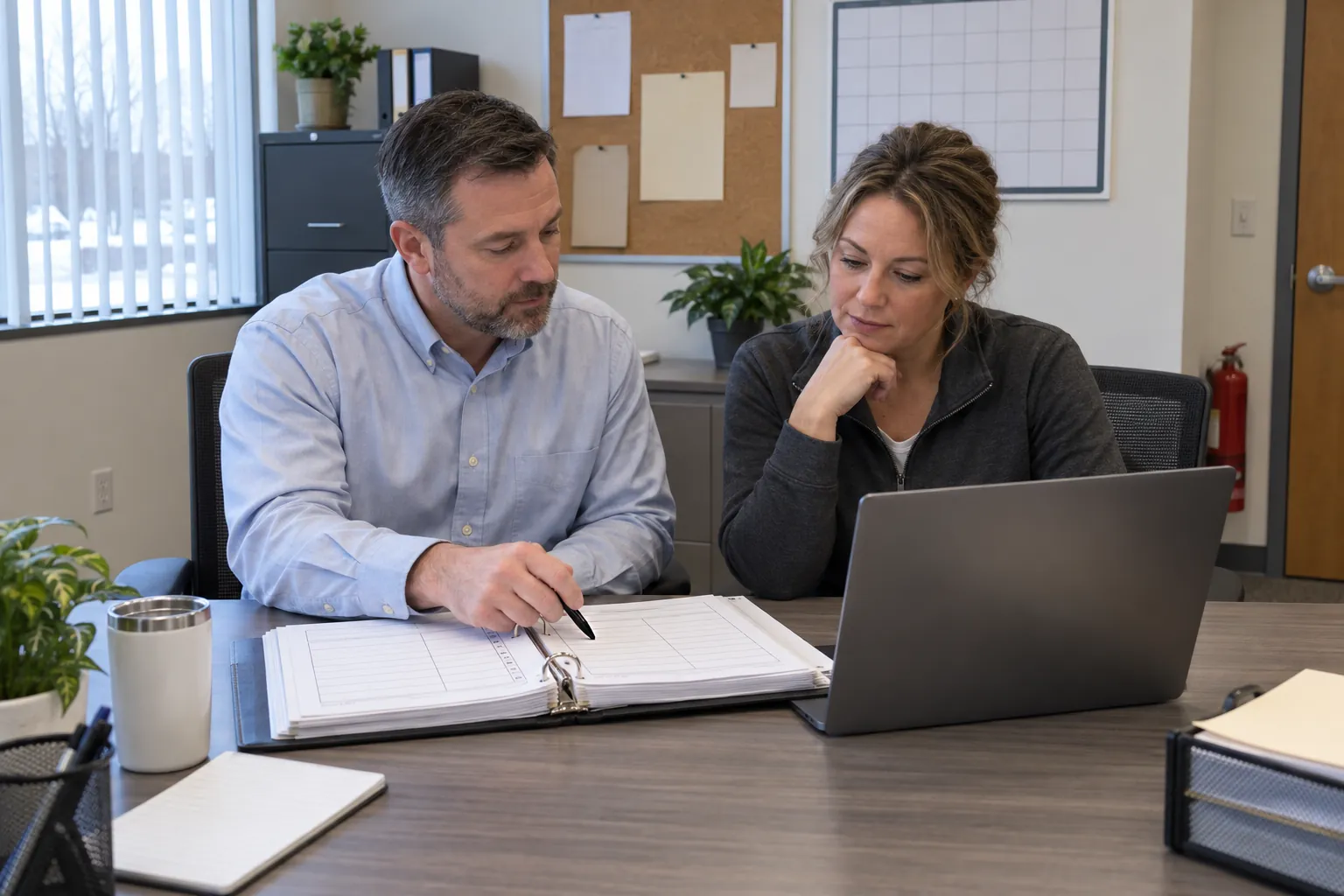 Premises and facilities managementThe OSHA 300 log: what to record, when, and how to keep it honestWho must keep the OSHA 300 log, which injuries are recordable under 29 CFR 1904, the seven-day rule, the 300A posting and what the working record needs.
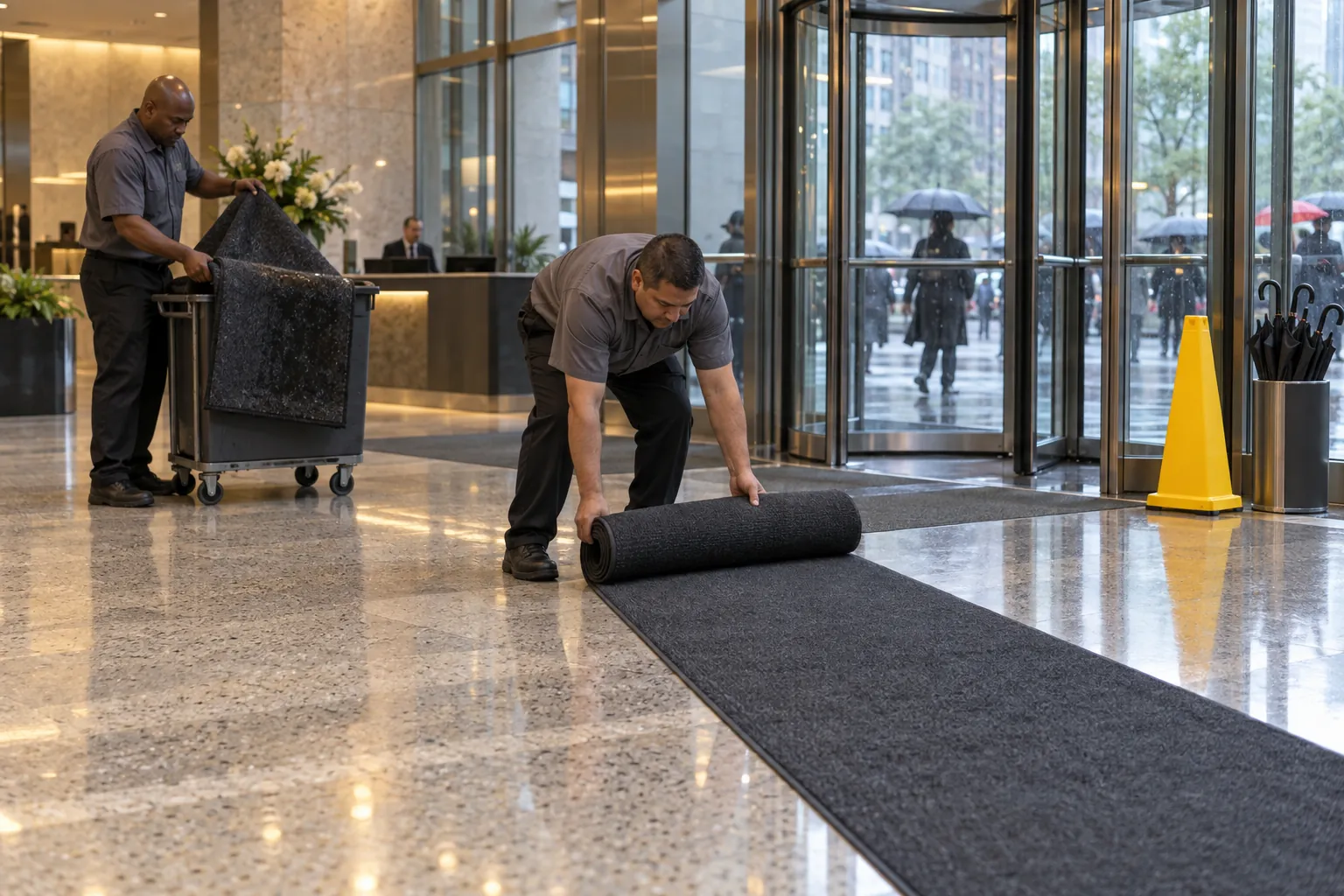 Premises and facilities managementSlip, trip, and fall prevention: keeping floors, stairs, and walkways safe every daySlip, trip, and fall prevention in a commercial building: what OSHA 1910.22 requires, where people fall, the controls that work, and how to check and record them.