Premises and facilities management
AED inspection checklist: keeping a defibrillator ready to use
An AED inspection checklist is a routine visual check, made at the interval the manufacturer and state law set, that confirms each automated external defibrillator is ready to use: the readiness indicator shows ready, the pads and battery are present and within their expiration dates, and the cabinet is accessible and undamaged.
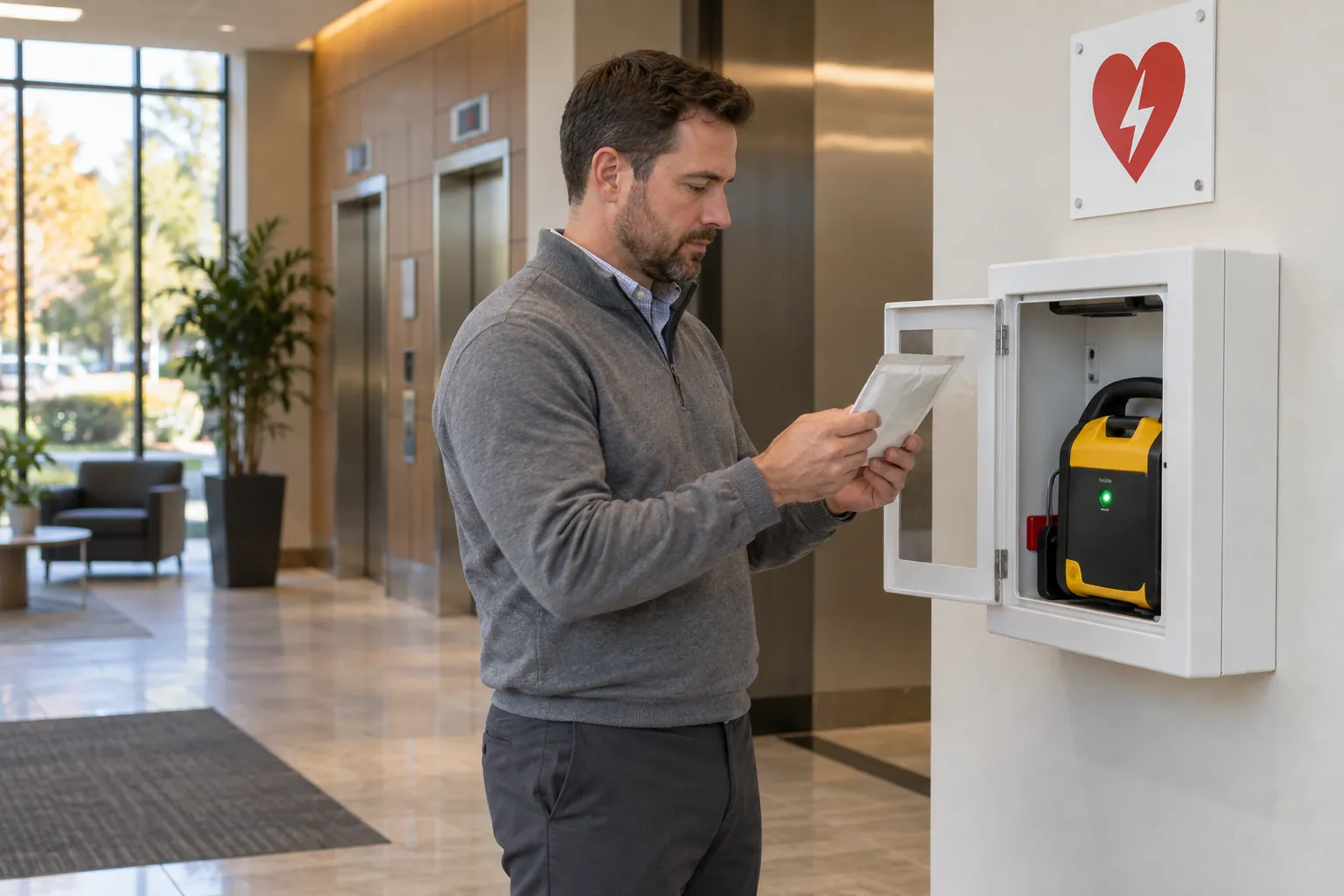
A defibrillator on the wall is only useful if it works the moment someone opens the cabinet. The AED checks itself, but it cannot tell anyone that its pads expired last spring, that the cabinet is behind a stack of chairs, or that its warning light has been flashing for a week. This guide covers who sets the rules in the United States, what an AED inspection checklist should cover, how often to check, and what the record should show.
01
Who sets the rules: the FDA, OSHA, your state and the manufacturer
There is no single federal AED inspection rule for workplaces in the United States. The duty to check an AED comes from four places, and a facility manager needs to know which of them apply to the building.
The manufacturer. Every AED comes with an owner's manual that sets out its self-tests, what its status indicator means, how long its pads and battery last, and what the owner should check and how often. State laws such as California's and New York's point back to these instructions, so the manual for each model on site is the first document your checklist is built from.
The FDA. The Food and Drug Administration regulates AEDs as medical devices. Its page on Automated External Defibrillators (AEDs) explains that "The FDA published a final order in February 2015 requiring premarket approval (PMA) applications for new and existing AEDs and necessary AED accessories." The FDA does not inspect your AED, but it tells owners to check whether their AED system and accessories are FDA-approved, and warns that for an AED that is not, compatible pads and batteries "may no longer be available to support your AED after February 3, 2022."
OSHA. Federal OSHA's Automated External Defibrillators (AEDs) overview says plainly that "OSHA standards do not specifically address automated external defibrillators (AEDs)." OSHA encourages them instead. Its first aid standard, 29 CFR 1910.151, Medical services and first aid, requires that where there is no infirmary, clinic or hospital in near proximity, "a person or persons shall be adequately trained to render first aid," but it does not require an AED.
Your state. States have their own AED laws, and they differ on registration, training, notifying emergency medical services (EMS), maintenance and which buildings must have a device at all. Two examples show the range:
- California: Health and Safety Code section 1797.196 requires a person or entity that acquires an AED to "Ensure that an inspection is made of all AEDs on the premises at least every 90 days for potential issues related to operability of the device, including a blinking light or other obvious defect that may suggest tampering or that another problem has arisen with the functionality of the AED," to make sure it is "tested at least biannually and after each use," and to make sure "records of the maintenance and testing required pursuant to this paragraph are maintained." Health and Safety Code section 19300 requires an AED in certain larger buildings (for example, business buildings with an occupancy of 200 or more) that are constructed on or after January 1, 2017, or that are older but have $100,000 of tenant improvements or renovations in one calendar year on or after January 1, 2020.
- New York: Public Health Law section 3000-b requires a public access defibrillation provider to have the device "maintained and tested according to applicable standards of the manufacturer and any appropriate government agency," to designate at least one person to be trained and "familiar with the operation and routine maintenance of the automated external defibrillator," and to report every use immediately to the local EMS system.
02
What an AED inspection checklist covers
The routine inspection is a visual and functional check that a trained layperson can do in a few minutes per device. It does not replace the manufacturer's maintenance, and it does not involve opening the device. The manual for each model is the authority, but most checklists cover the same items:
- Status indicator. The readiness light, symbol or screen shows the device is ready. On many models a flashing or red light, a warning symbol, or a chirp or beep means the device has found a fault in its own self-test; the manual says which. California's statute names "a blinking light" as exactly the kind of problem the inspection is meant to catch.
- Location and access. The AED is where the site map says it is, the cabinet or bracket is not blocked by furniture, deliveries or a locked door, and the AED sign above it can be seen from the corridor.
- Cabinet. The door opens, the cabinet alarm sounds if one is installed and has not been silenced, and the cabinet is clean and in good condition.
- Electrode pads. Pads are present, sealed in their package, connected where the model keeps them pre-connected, and within their expiration date. Adult pads are in place, with pediatric pads or a child key where the site serves children and the model supports them. A spare set is kept with the device.
- Battery. The battery is installed and within its install-by or expiration date, and a spare is on hand where the model uses disposable batteries and the manufacturer recommends one.
- The device itself. The case is intact, with no cracks, fluid, corrosion or other damage, and the cable and connector are undamaged.
- The response kit. Many programs keep a small kit with the AED: gloves, a CPR barrier mask, trauma shears, a razor and a towel or wipes. Check it is complete and sealed.
- Instructions and notices. Any instructions your state requires are posted next to the AED. In California, when an AED is placed in a building, the building owner must "post instructions, in no less than 14-point type, on how to use the AED" next to it.
- Accessories and approval. Replacement pads and batteries are the ones the manufacturer specifies and, following the FDA's advice, bought from authorized sellers and FDA-approved for that device.
Write the pad and battery expiration dates on the checklist, not just a check mark: the date lets whoever orders supplies plan ahead.
03
How often: the daily glance, the monthly check and after every use
Frequency comes first from the manufacturer's instructions and second from state law. Where neither sets a shorter interval, a sensible pattern for a workplace or public building looks like this:
- Every day or every shift, a glance: whoever opens the building, a custodian or the security officer on the first round looks at the status indicator on the way past and reports anything other than ready. It takes seconds and can catch a fault the day it appears.
- Every month, the full checklist: the status indicator, access, cabinet, pads, battery, kit and signage, with the expiration dates written down. Monthly is more often than California's 90-day minimum, and it fits alongside other monthly checks such as the fire extinguisher inspection, so it is harder to forget.
- Every 90 days at the least in California, and at whatever interval your state or manufacturer sets.
- After every use: the device is taken out of service until the pads are replaced, the battery is checked, the device is tested as the manufacturer and state law require (California requires a test "after each use"), and the kit is restocked.
- When the manufacturer or the FDA issues a notice: a recall, a safety alert or a software update is acted on for the affected devices, whatever the calendar says.
Tie pad and battery replacement to their dates, not to the inspection. If the pads expire in March, order them in January. A monthly check that finds expired pads has done its job, but a program that plans replacements from the recorded dates rarely finds them.
AEDs placed outdoors, in parking garages or in unheated vestibules need more attention: the manual gives an operating temperature range, and heated cabinets have their own checks.
04
Who does the check, and what the record should show
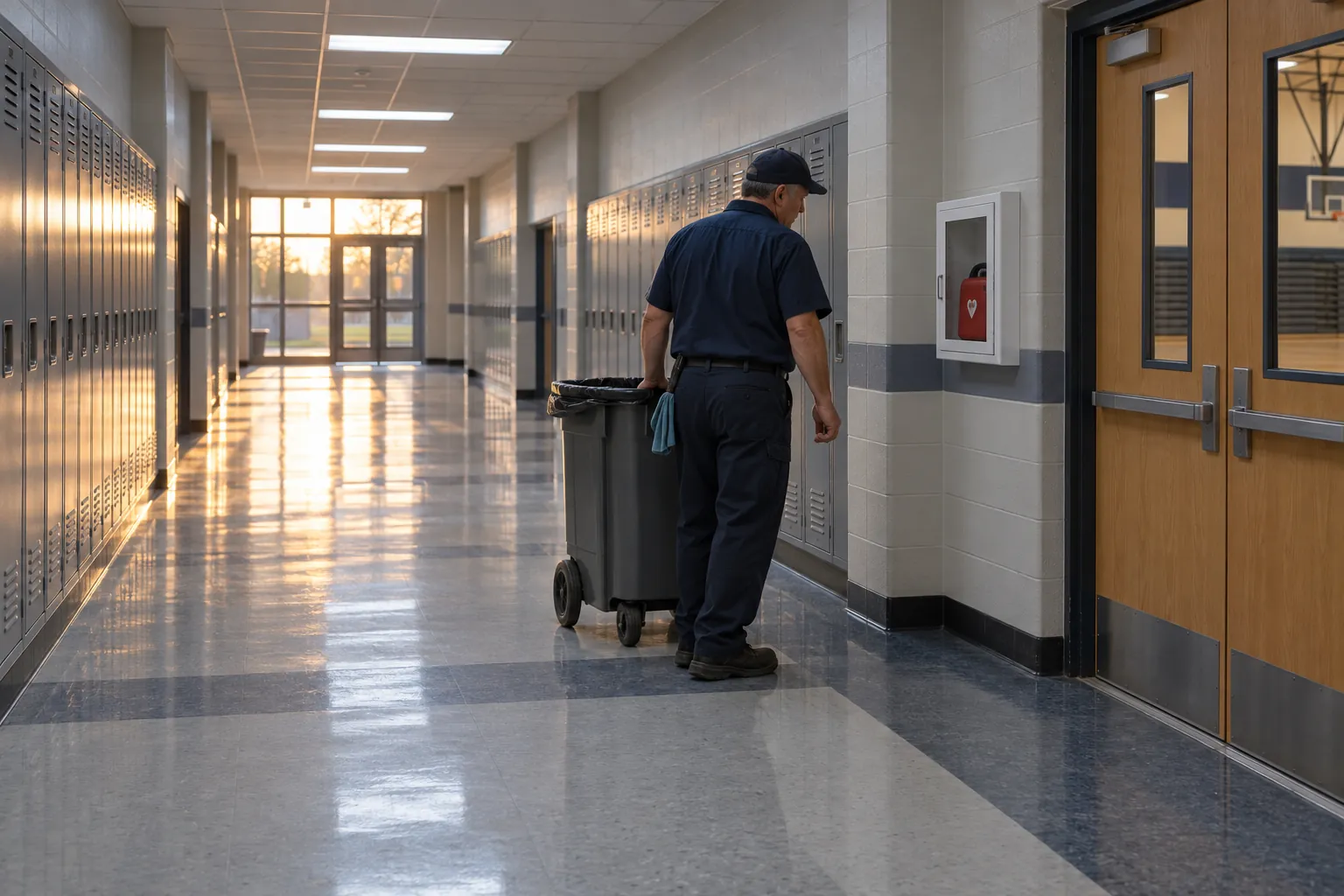
Name a person, and a backup, for every device. New York's statute makes this explicit: at least one person associated with the provider must be designated for training and be familiar with the device's operation and routine maintenance. In practice the AED coordinator is often the facility manager, the building engineer, the safety coordinator or the security supervisor, with the monthly walk delegated to a custodian, a janitor or an officer on patrol.
Whoever does it needs to know what "ready" looks like on each model on site, which faults to report, and whom to call. They need not be a medical professional, but someone who knows the device should show it to them.
The record is what shows the program works. California requires records of maintenance and testing to be kept; New York requires the device to be maintained and tested to applicable standards. Neither sets a form, so every inspection should be documented in a record that answers these questions without anyone having to remember:
- Which device: its location, model and serial number or asset ID.
- When: the date and time of each inspection.
- Who: the name of the person who checked it, not initials on a tag.
- What was found: the status indicator reading, and the expiration dates of the pads and battery.
- What was wrong, and what was done: the fault, who was told, when it was fixed, and whether a loaner or a nearby device covered the gap.
- Maintenance and events: manufacturer or vendor service, software updates, recalls and the action taken, and every use with the date the device went back into service.
Training records belong alongside. OSHA's publication Saving Sudden Cardiac Arrest Victims in the Workplace: Automated External Defibrillators (OSHA 3185) lists what workers can be trained to do: recognize sudden cardiac arrest and notify EMS, perform CPR, provide early defibrillation with an AED, and care for the victim until EMS arrives. Your state may add its own training or notification rules.
05
Placement, what happens after a use, and recalls
An inspection checks the device, but it is also the regular moment to ask whether the device is in the right place. OSHA 3185 advises that "AEDs should be conveniently installed to ensure response within 3-5 minutes." The FDA notes in How AEDs in Public Places Can Restart Hearts that "The probability of survival decreases by 7% to 10% for every minute that a victim stays in a life-threatening arrhythmia." If the building has changed since the AED was installed, with a new floor plan, a new tenant, a locked-down stairwell or a new fitness room, the walk from the farthest point should be timed again.
After an AED is used, the checklist becomes a return-to-service procedure:
- Report the use as your state requires. New York requires every use on a patient to be "immediately reported to the appropriate local emergency medical services system." Your medical director or EMS agency may also ask for the device's event data.
- Replace the pads, which are single use, and restock the response kit.
- Check the battery and run the test the manufacturer and state law call for.
- Record the use, the replacement parts, the test and the time the device went back on the wall.
- Tell staff where the nearest other AED is until it returns, if it is out of service for any time.
Recalls and safety notices need an owner too. The FDA advises AED owners to check whether their AED and accessories are FDA-approved, to contact the manufacturer if they are unsure or have had no letter, to locate the unique device identifier (UDI) on the label, and to "Report problems with AEDs and AED accessories to the FDA by submitting a voluntary report online at MedWatch." Make sure the manufacturer has a current contact for each device, because a recall letter sent to a former facility manager or a closed mailbox helps nobody. The FDA also advises owners to keep an AED that is not FDA-approved "available for use" until they obtain an approved one, rather than taking it off the wall.
06
Where the record fails, and what SiteClara does about it
AED checks fail quietly. The tag inside the cabinet shows a neat column of initials, some of them filled in on the same afternoon before an audit. The status light has been flashing since a long weekend, and everyone who walked past assumed someone else had called it in. The pads expired in the spring because the dates were never written down, and one device was moved in a renovation and is not where the map says.
SiteClara puts a printed QR poster at each AED location, with an optional NFC tag behind it. Staff scan the code or tap the tag on their own phone, with no app to install, and sign in with a link. They see the checks due at that location, such as the monthly AED inspection, and mark each one done, or say what stopped them, such as a locked room. A problem, such as a flashing status light, a missing pad set or a blocked cabinet, is reported there with a photo and goes onto the team's list of jobs until someone closes it.
The supervisor sees what is due, done and missed, and can record why a check was missed; a job that needs the building manager can be escalated to them to answer. Each day the supervisor reviews and approves a report that goes to nominated management or client contacts at 8 a.m. the next morning, showing what was reported, completed and still open, and how the scheduled checks went, for example 6 of 6 completed.
07
Questions people ask
How often are AEDs required to be inspected?
It depends on your state and on the manufacturer, because there is no single federal interval. California sets a minimum: Health and Safety Code section 1797.196 requires an owner to "Ensure that an inspection is made of all AEDs on the premises at least every 90 days" and to ensure that the AED "is tested at least biannually and after each use." A monthly inspection meets that minimum with room to spare.
What are the OSHA inspection requirements for AEDs?
There are none specific to AEDs. OSHA's Automated External Defibrillators (AEDs) overview says that "OSHA standards do not specifically address automated external defibrillators (AEDs)." The inspection requirements come instead from your state's AED law and from the manufacturer's instructions for each model.
What are AED maintenance requirements?
State laws such as California's and New York's point to the manufacturer. California's Health and Safety Code section 1797.196 requires an owner to "Ensure that the AED is maintained and tested according to the operation and maintenance guidelines set forth by the manufacturer" and to ensure "that records of the maintenance and testing required pursuant to this paragraph are maintained." New York's Public Health Law section 3000-b requires the device to be "maintained and tested according to applicable standards of the manufacturer and any appropriate government agency."
What is the 3-minute rule for AED?
It is not an OSHA rule, since OSHA standards do not specifically address AEDs. The closest federal guidance on placement is OSHA's publication Saving Sudden Cardiac Arrest Victims in the Workplace: Automated External Defibrillators (OSHA 3185), which advises that "AEDs should be conveniently installed to ensure response within 3-5 minutes."
08
Where to read more, and a list to take away
Start with the owner's manual for each AED model on site: it sets the self-test behavior, the checks and the replacement intervals. The FDA's Automated External Defibrillators (AEDs) page lists FDA-approved AED systems and explains what the 2015 final order means for owners. OSHA's AED overview and OSHA 3185 cover why and where to place AEDs at work. Then read your own state's AED statute; in California, Health and Safety Code 1797.196, and in New York, Public Health Law 3000-b.
A short AED inspection checklist to take away:
- keep a list of every AED by location, model, serial number and responsible person;
- glance at each status indicator daily or every shift, and report anything but ready;
- complete the full checklist monthly, or at the interval your manufacturer and state set if that is shorter;
- record the pad and battery expiration dates, and order replacements before they lapse;
- check that each cabinet is accessible, has a visible AED sign, is alarmed where an alarm is installed and is stocked with a response kit;
- take the device out of service after a use, report the use as your state requires, and record its return;
- act on recalls and safety notices, and keep the manufacturer's contact details current;
- keep training records with the inspection records, and re-time the walk to each AED when the building changes.
Sources
Every document this guide quotes or links to, in the order it first cites them.
- Automated External Defibrillators (AEDs) fda.gov
- Automated External Defibrillators (AEDs) overview osha.gov
- 29 CFR 1910.151, Medical services and first aid osha.gov
- Health and Safety Code section 1797.196 leginfo.legislature.ca.gov
- Health and Safety Code section 19300 leginfo.legislature.ca.gov
- Public Health Law section 3000-b nysenate.gov
- Saving Sudden Cardiac Arrest Victims in the Workplace: Automated External Defibrillators (OSHA 3185) osha.gov
- How AEDs in Public Places Can Restart Hearts fda.gov
Related guides
 Fire and water checksEmergency action plan: what OSHA requires, and how to keep the plan workingWhat an emergency action plan must contain under OSHA 1910.38, who needs one, how alarms, wardens, drills and reviews fit in, and what the record should show.
 Premises and facilities managementSafety walkthroughs: how to walk a building, talk to the crew and fix what you findWhat a safety walk is under OSHA's Recommended Practices, what to look at in a commercial building, how often to walk, how to record findings and close them out.
 Premises and facilities managementBuilding compliance checklist: OSHA, the fire code and the ADA in one US buildingBuilding compliance checklist for US commercial buildings: OSHA, the fire code, elevators, water, asbestos and the ADA, who holds each duty and how often it is due.
 Premises and facilities managementPreventive maintenance checklist: what to check in a commercial building, how often, and how to prove itA preventive maintenance checklist for commercial buildings: HVAC, electrical, fire and life safety, plumbing, how often, and what the record should show.