Premises and facilities management
Safety walkthroughs: how to walk a building, talk to the crew and fix what you find
A safety walk is a planned walk through a workplace by a manager or supervisor to spot hazards, see how the work is really done, talk to the people doing it and make sure what they find gets fixed.
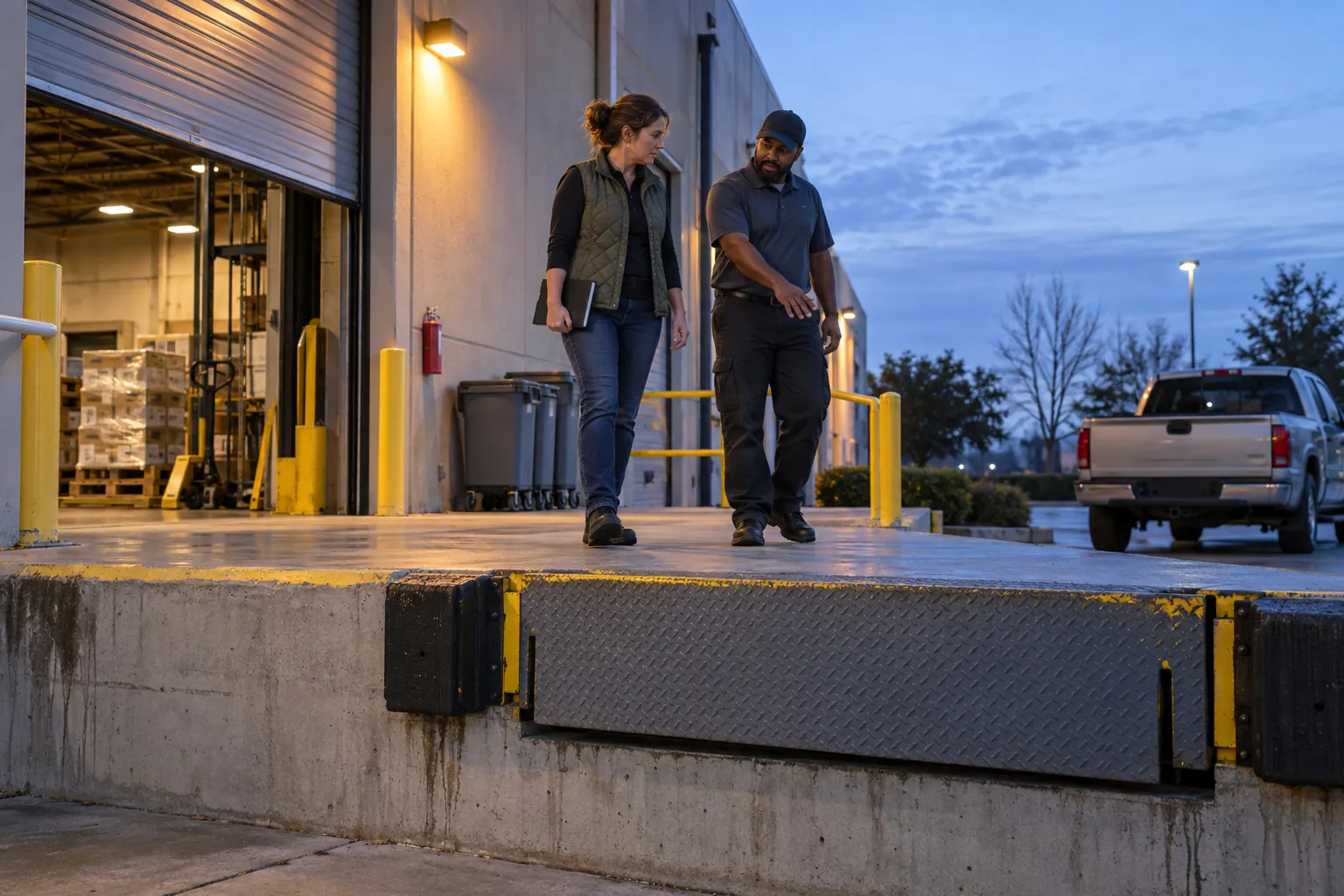
Done well, it catches the blocked exit and the frayed cord before anyone is hurt and shows the crew that safety is more than a poster. Done badly, it is a stroll with a clipboard and a list nobody closes. This guide covers where the practice comes from, what to look at in a commercial building, how often to walk, and how to record and close out what you find.
01
What a safety walk is, and the duty behind it
A safety walk, also called a safety walkthrough, a leadership safety walk or a management walkaround, is a planned visit to the places where work happens, to find hazards, see how the work is really done and hear from the people doing it. An inspection works through a checklist of conditions; a walk puts as much weight on conversation and on the manager being seen on the floor. Most good programs do both.
No federal OSHA standard requires a safety walk by that name. The practice comes from OSHA's Recommended Practices for Safety and Health Programs (OSHA 3885, October 2016), which asks employers to "conduct regular inspections of all operations, equipment, work areas, and facilities", to "have workers participate on the inspection team, and talk to them about hazards that they see or report", and, under management leadership, to "be visible in operations and set an example by following the same safety procedures you expect workers to follow". The document is explicit that it is advisory: its practices "are recommendations only", and employers "will not be cited for failing to have a safety and health program that complies with this document."
The legal duty sits underneath. Section 5(a)(1) of the Occupational Safety and Health Act, Section 5, the General Duty Clause, requires each employer to furnish "a place of employment which [is] free from recognized hazards that are causing or are likely to cause death or serious physical harm", and Section 5(a)(2) requires compliance with OSHA's standards. Several of those standards assume someone is looking: the walking-working surfaces standard, 29 CFR 1910.22, says surfaces "are inspected, regularly and as necessary, and maintained in a safe condition." A regular walk is the ordinary way to meet that expectation and to find recognized hazards before they become an injury.
One point of vocabulary. In an OSHA enforcement inspection, the "walkaround" is the physical inspection by the Compliance Safety and Health Officer, and 29 CFR 1903.8, Representatives of employers and employees, gives a representative of the employer and one authorized by employees the opportunity to accompany the officer. That is a different event from the walks this guide is about, which are the employer's own.
02
What to look at on a safety walk in a commercial building
The Recommended Practices list the categories typical hazards fall into: general housekeeping, slip, trip and fall hazards, electrical hazards, equipment operation and maintenance, fire protection, work organization and process flow (including staffing and scheduling), work practices, workplace violence, ergonomic problems and lack of emergency procedures. They add that inspections should include "the activities of on-site contractors, subcontractors, and temporary employees", which in most office buildings, schools and campuses means the janitorial crew, the security officers and the maintenance contractors. In a commercial building a walk usually covers:
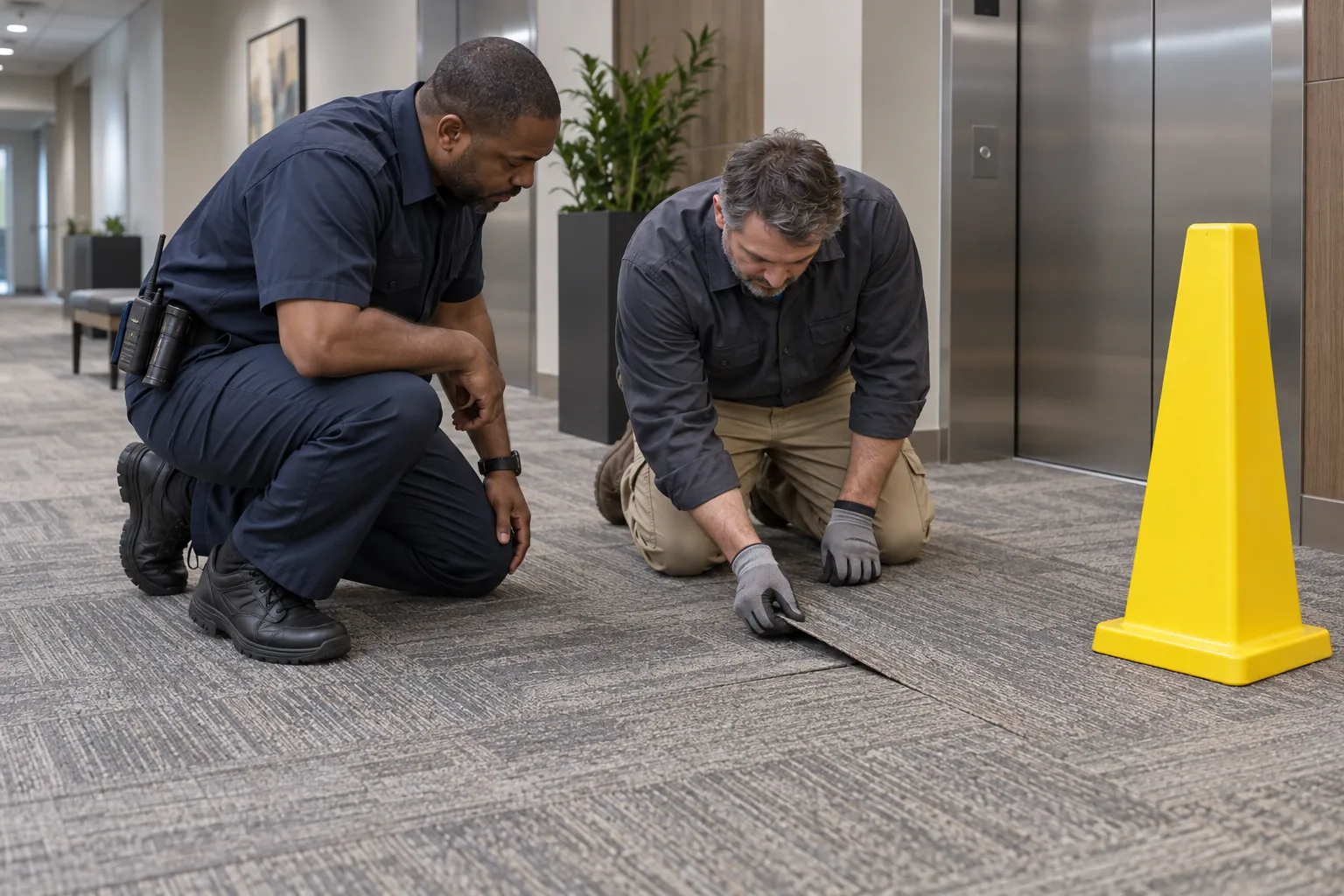
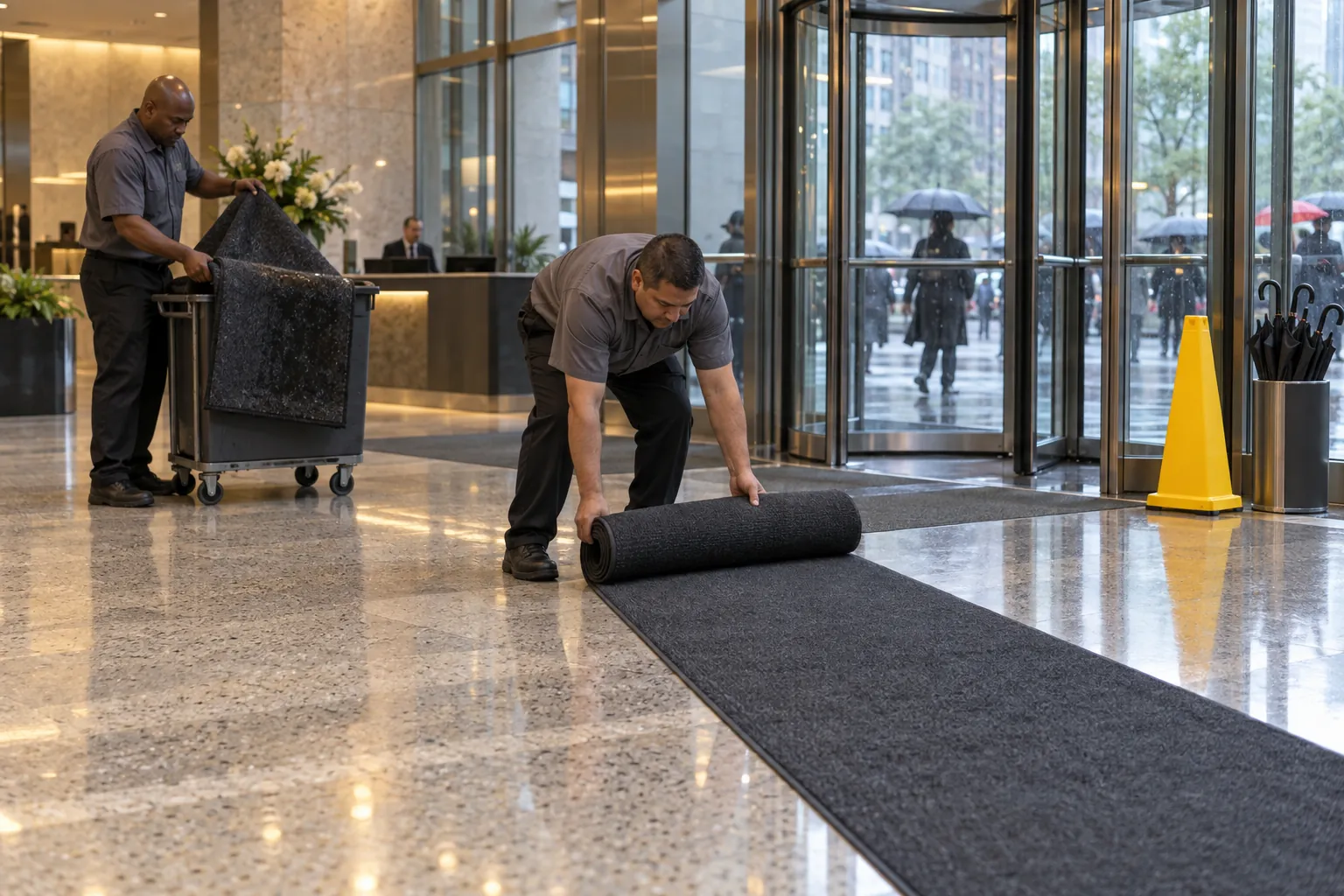
- Floors, stairs and walkways: spills, wet floors without a sign, torn carpet, loose stair treads and nosings, missing handrails, ice and snow at entrances. Under 29 CFR 1910.22(d)(2) a hazardous condition must be corrected before the surface is used again or, if that cannot be done immediately, guarded. In practice, a worn or slippery stair tread or ramp may need repair, or slip-resistant treads or tape.
- Exit routes: the exit route standard, 29 CFR 1910.37, says "exit routes must be free and unobstructed", adequately lighted and marked by a sign reading "Exit". Look for stock in stairwells, locked or chained doors, dead exit signs and furniture parked in corridors. See the guide to exit route requirements.
- Electrical: blocked panels, missing breaker covers, daisy-chained power strips, damaged cords on vacuums and floor machines. See electrical panel clearance.
- Fire protection: extinguishers in place and not blocked, sprinkler heads with clear space beneath, fire doors that close and latch, alarm pull stations visible.
- Custodial closets and chemical storage: containers labeled, secondary bottles labeled, eyewash where it is needed and unobstructed, no mixing of incompatible products.
- Equipment in use: ladders in good condition and used the right way, carts and floor machines maintained, loading dock plates and edges protected.
- Work practices and ergonomics: overloaded trash carts, lifting heavy bags alone, reaching over rails, working alone at night without a way to call for help.
- Security and violence: propped doors, broken locks on back-of-house areas, lighting in parking lots and loading areas, whether staff know how to raise an alarm.
The list is a prompt, not a script. The value of a walk is often in what no checklist asks: the new tenant's boxes in the service corridor, or the cleaner who says the restroom floor is always wet by the third sink.
03
Who walks, how often, and how to run one
OSHA does not set a frequency. It asks for regular inspections and inspections when things change, and the Recommended Practices list "number and frequency of management walkthroughs" among the leading indicators an employer might track. California's section 3203 names three triggers on top of scheduled periodic inspections: when the program is first established, when new substances, processes, procedures or equipment bring a new hazard, and when the employer learns of a new or previously unrecognized hazard. A pattern that works in many buildings is:
- Daily or each shift: the supervisor's own walk of their area at the start of the shift, short and focused on the day's work.
- Weekly or biweekly: the site or facility manager's walk, with a worker or crew lead alongside, covering one or two zones in depth.
- Monthly or quarterly: a senior manager's leadership walk, and a joint walk with the client or the contractors in a shared building.
- On change: after a renovation, a new tenant, a new cleaning product or machine, an injury or a near miss.
Walk every shift, not only days. A building at 2 a.m. has different hazards, different people and often thinner supervision. Vary the route and the time so the walk sees the building as it is, not as it is prepared for a visit. And walk with the people who do the work: the Recommended Practices ask employers to "inspect the workplace with workers and ask them to identify any activity, piece of equipment, or material that concerns them."
A simple structure keeps a walk from becoming a tour:
- Before: read the open items from the last walk and any recent reports, near misses or injuries in the area. Decide the zone and one or two things to look at closely.
- On the floor: look first, then ask. Ask open questions: what slows you down, what worries you, what would you fix first? Thank people for what they point out. Follow the same rules you expect of them, in the PPE the area needs.
- Fix what can be fixed now: move the cart out of the exit, put out the wet floor sign, take the damaged cord out of service.
- Record the rest while it is fresh, with a location, a photo and a name for who will fix it.
- Afterwards: tell the crew what happens next, and come back to check.
A walk supports, and does not replace, the inspections that codes and standards assign to a competent or qualified person, such as fire protection system testing, or a structural repair, which 29 CFR 1910.22(d)(3) says a qualified person must perform or supervise.
04
Recording what you find, and who owns the fix
OSHA's Hazard Identification and Assessment guidance says: "Be sure to document inspections so you can later verify that hazardous conditions are corrected. Take photos or video of problem areas." A useful record of a walk holds, for each finding:
- where it is, precise enough that someone else can find it: building, floor, room or area;
- what was seen, in plain words, with a photo;
- how serious it is, and whether anything was done on the spot;
- who will fix it, and by when;
- any interim measure until it is fixed, such as a cone, a barrier or a closed area;
- when it was closed, by whom, and how that was checked.
That matches OSHA's Hazard Prevention and Control guidance, which asks employers to list hazards needing controls in order of priority, "assign responsibility for installing or implementing the controls to a specific person or persons", "establish a target completion date" and "plan how you will track progress toward completion." In California, section 3203(b)(1) requires records of the scheduled and periodic inspections, including the person conducting the inspection, the unsafe conditions and work practices identified and the action taken to correct them, kept for at least one year, with exceptions for smaller employers.
In a building with more than one employer, the owner of a finding is often not the person who found it. A janitorial supervisor may find a loose stair nosing that only the property manager can fix, or a security officer may find a propped fire door the tenant keeps opening. The Recommended Practices call these multiemployer worksites, naming "long-term contractors providing building cleaning and maintenance" as an example, and ask host employers and contractors to exchange information about hazards and to agree who implements which parts of the program. For a walk, that means agreeing in advance where findings go when they belong to someone else, and who confirms they were fixed.
05
Closing the loop, and keeping walks honest
A walk earns its keep only when what it finds gets fixed and the people who raised it hear about it. OSHA's Worker Participation guidance asks employers to encourage workers to report concerns and to ensure "no worker will experience retaliation for bringing such information to management's attention". Section 11(c) of the OSH Act prohibits retaliation against employees for raising safety concerns. Workers keep telling managers about hazards only if they see something happen.
Walks go wrong in predictable ways:
- The walk becomes policing. If every walk ends in someone being written up, workers stop talking. Keep the focus on conditions and systems, and handle discipline separately.
- The same route at the same time. The lobby is spotless at 10 a.m.; the loading dock at 5 a.m. is another story.
- Findings with no owner. A list of twenty items with nobody's name against them is a list of twenty items that will be found again next month.
- Closed but not fixed. An item marked done because a work order was raised, not because the stair was repaired. Close an item only when it has been checked.
- Counting walks instead of results. A leading indicator such as walks completed is useful only alongside what the walks found and how quickly it was put right. The Recommended Practices pair walkthroughs with "number and severity of hazards identified during inspections" and "amount of time taken to respond to reports."
- Walks that miss the contractors. The night janitorial crew and the overnight security officer see the building when nobody else does. Walk with them sometimes, and give them a way to report between walks.
Between walks, the same people see hazards every day. A simple way to report a hazard where it is found, at any hour, with a photo, catches what no walk schedule can; see the guide to near miss reporting.
06
Where the record fails, and what SiteClara does about it
Safety walk records fail in familiar ways. The walk is logged on a form completed back at the desk, so it cannot show which areas were actually walked or when. The findings go into an email or a spreadsheet, and three months later the same propped door is found again. And what the night custodian noticed between walks, the dead exit sign or the cart in the stairwell, was mentioned to whoever was passing and never written down.
SiteClara works on those gaps for the routine checks that sit alongside a safety walk. A printed QR poster at each location, with an optional NFC tag behind it, lets staff scan or tap with their own phone, with no app to install, and sign in with a link. They see the checks due there, such as a weekly walk of a stairwell or the daily look at a loading dock, and mark each one done or say what stopped them. A hazard they find is reported there with a photo and goes onto the team's list of jobs until someone closes it, and the supervisor's queue groups open jobs by building and floor.
The supervisor sees what was due, done and missed, and can record why a check was missed. A job the team cannot fix, such as a loose stair nosing or a tenant's storage in an exit route, can be escalated to the building manager to answer. Each day the supervisor reviews and approves a report that goes to nominated management or client contacts at 8 a.m. the next morning, showing what was reported, what was completed and what is still open.
07
Questions people ask
What does "Gemba safety walk" mean?
Gemba is the Japanese term for "actual place", the place where the work is done. The Lean Enterprise Institute's lexicon entry Gemba defines a gemba walk as "a management practice for grasping the current situation through direct observation and inquiry before taking action." A Gemba safety walk applies that idea to safety: leaders go to where the work happens, look and ask, rather than judging conditions from reports at a desk.
What should be included in a safety walk around checklist?
OSHA's Hazard Identification and Assessment guidance says to "use checklists that highlight things to look for", noting that "each workplace will have its own list". It names the typical categories: general housekeeping, slip, trip and fall hazards, electrical hazards, equipment operation and maintenance, fire protection, work organization and process flow, work practices, workplace violence, ergonomic problems and lack of emergency procedures. It also says to include "all areas and activities", including the activities of on-site contractors, subcontractors and temporary employees. Add a column for where each finding is, who owns the fix and by when.
08
Where to read more, and a list to take away
OSHA's Recommended Practices for Safety and Health Programs is the starting point, with each core element on its own page, including Management Leadership. OSHA and NIOSH's Small Business Safety and Health Handbook (OSHA 2209-01R 2024) carries self-inspection checklists by topic, though it says it should not be used to assess compliance with the OSH Act or OSHA standards. OSHA's Using Leading Indicators to Improve Safety and Health Outcomes explains how to measure a program before injuries happen. In a State Plan state, read the state's own rules, such as California's section 3203.
Before you start, or restart, a safety walk program, check that:
- each area of the building has an owner and a walk frequency, including nights and weekends;
- walks include workers, and the contractors who clean, secure and maintain the building;
- each finding is recorded with a location, a photo, an owner and a target date;
- findings that belong to another employer have an agreed route and a confirmation back;
- items are closed only when the fix has been checked;
- workers hear what happened to what they raised, and can report hazards between walks without fear of retaliation;
- the walk records are reviewed at least once a year for repeat findings and slow fixes.
Sources
Every document this guide quotes or links to, in the order it first cites them.
- Recommended Practices for Safety and Health Programs osha.gov
- Occupational Safety and Health Act, Section 5 osha.gov
- Walking-working surfaces standard, 29 CFR 1910.22 osha.gov
- State Plans osha.gov
- Title 8, California Code of Regulations, section 3203 dir.ca.gov
- 29 CFR 1903.8, Representatives of employers and employees osha.gov
- Exit route standard, 29 CFR 1910.37 osha.gov
- Hazard Identification and Assessment osha.gov
- Hazard Prevention and Control osha.gov
- Worker Participation osha.gov
- Gemba lean.org
- Management Leadership osha.gov
- Small Business Safety and Health Handbook osha.gov
- Using Leading Indicators to Improve Safety and Health Outcomes osha.gov
Related guides
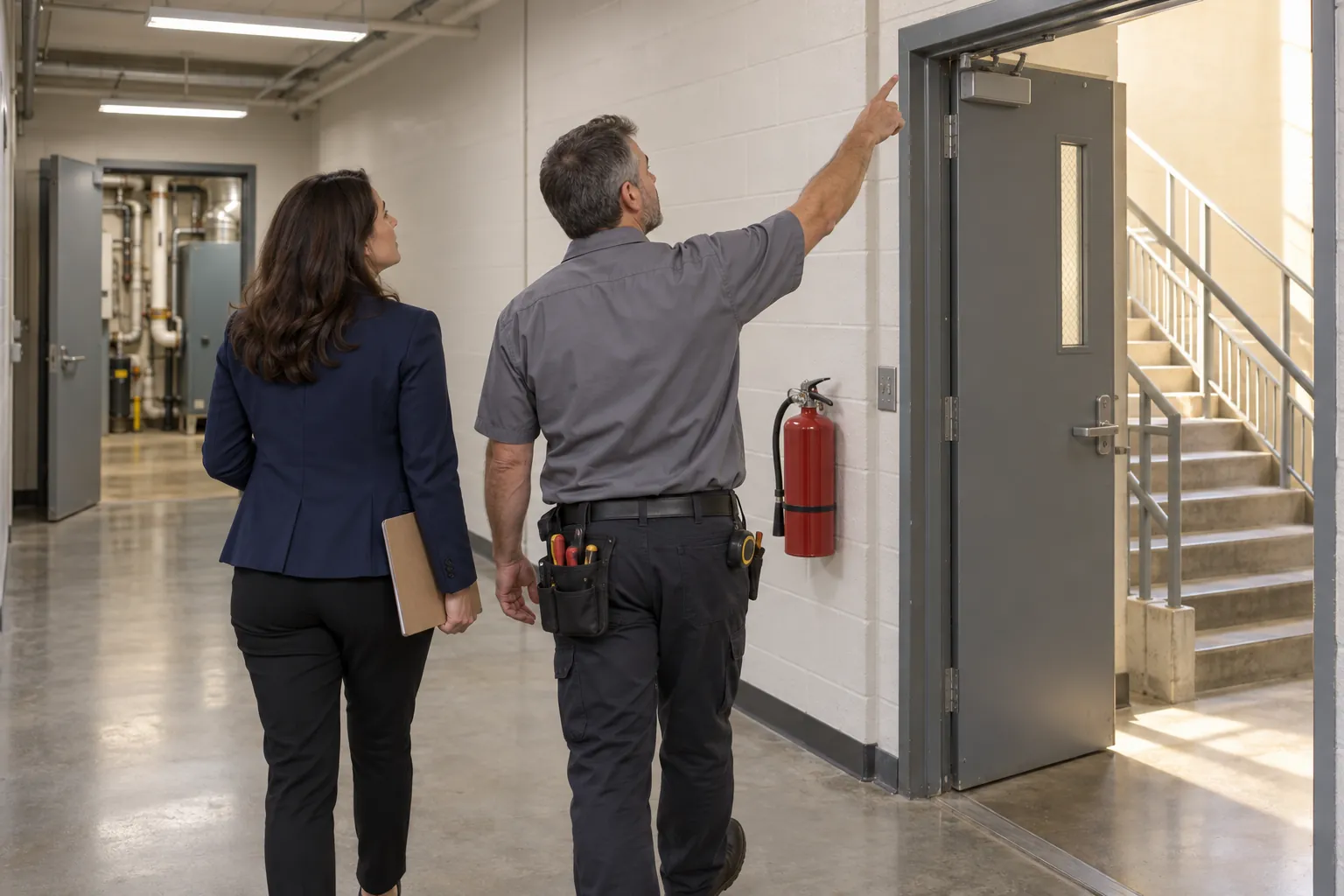 Premises and facilities managementOSHA inspection checklist: what to check before OSHA doesAn OSHA self-inspection checklist for a building: the duty behind it, what to check under each standard, how often, and how to record hazards through to correction.
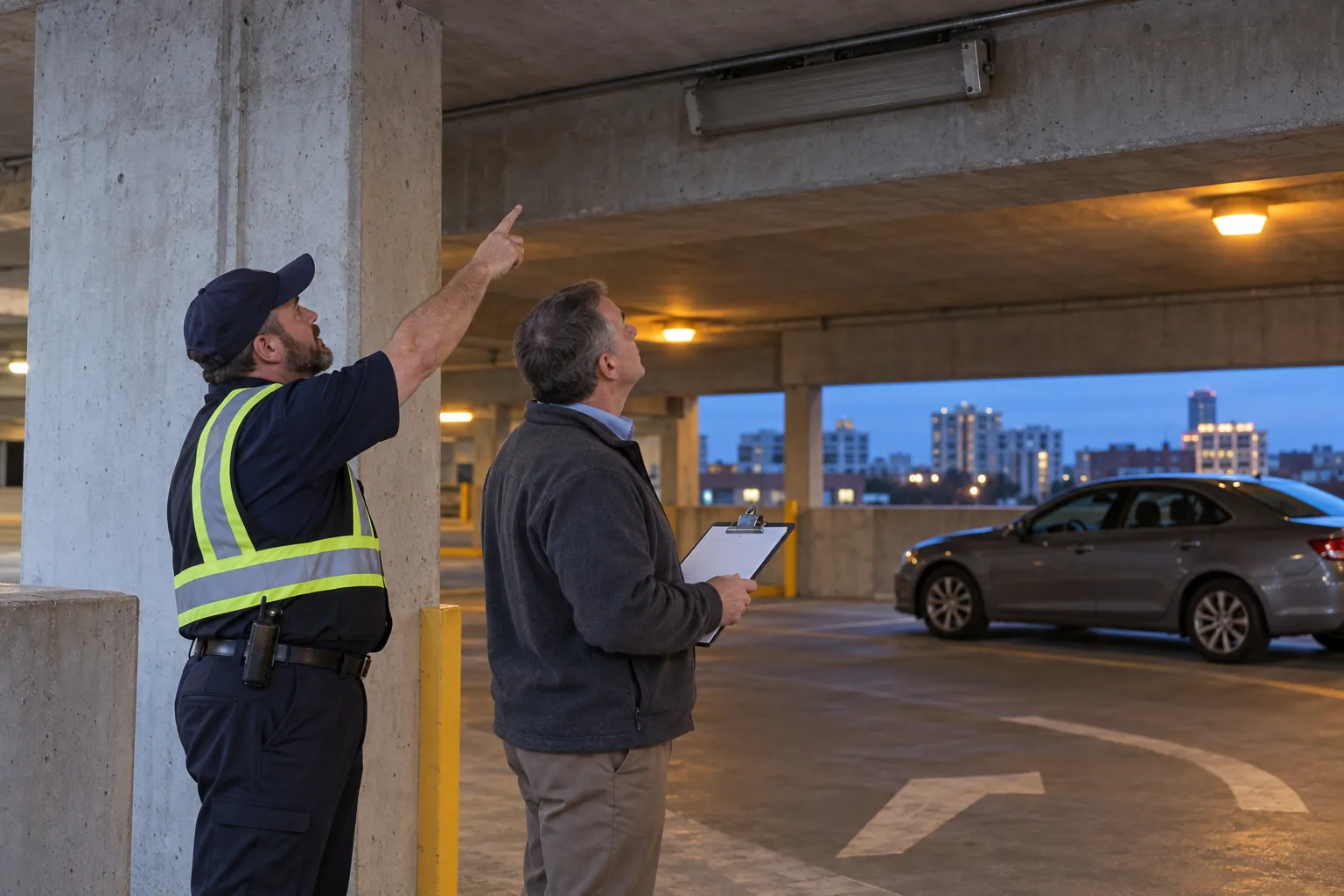 Premises and facilities managementNear miss reporting: catching the close calls before they become injuriesWhat counts as a near miss, what OSHA recommends, what a near miss report should capture, and how to follow it up so people keep reporting in your buildings.
 Premises and facilities managementEngineering rounds: how to walk the plant, and how to show it was walkedEngineering rounds in a commercial building: what to walk, the readings to take, how often, the rules behind them, and a round log that shows the plant was checked.
 Premises and facilities managementSlip, trip, and fall prevention: keeping floors, stairs, and walkways safe every daySlip, trip, and fall prevention in a commercial building: what OSHA 1910.22 requires, where people fall, the controls that work, and how to check and record them.