Premises and facilities management
Building compliance checklist: OSHA, the fire code and the ADA in one US building
A building compliance checklist is a list of the safety regulations, building codes and inspections a US commercial property must keep up with, and the record each one should leave behind.
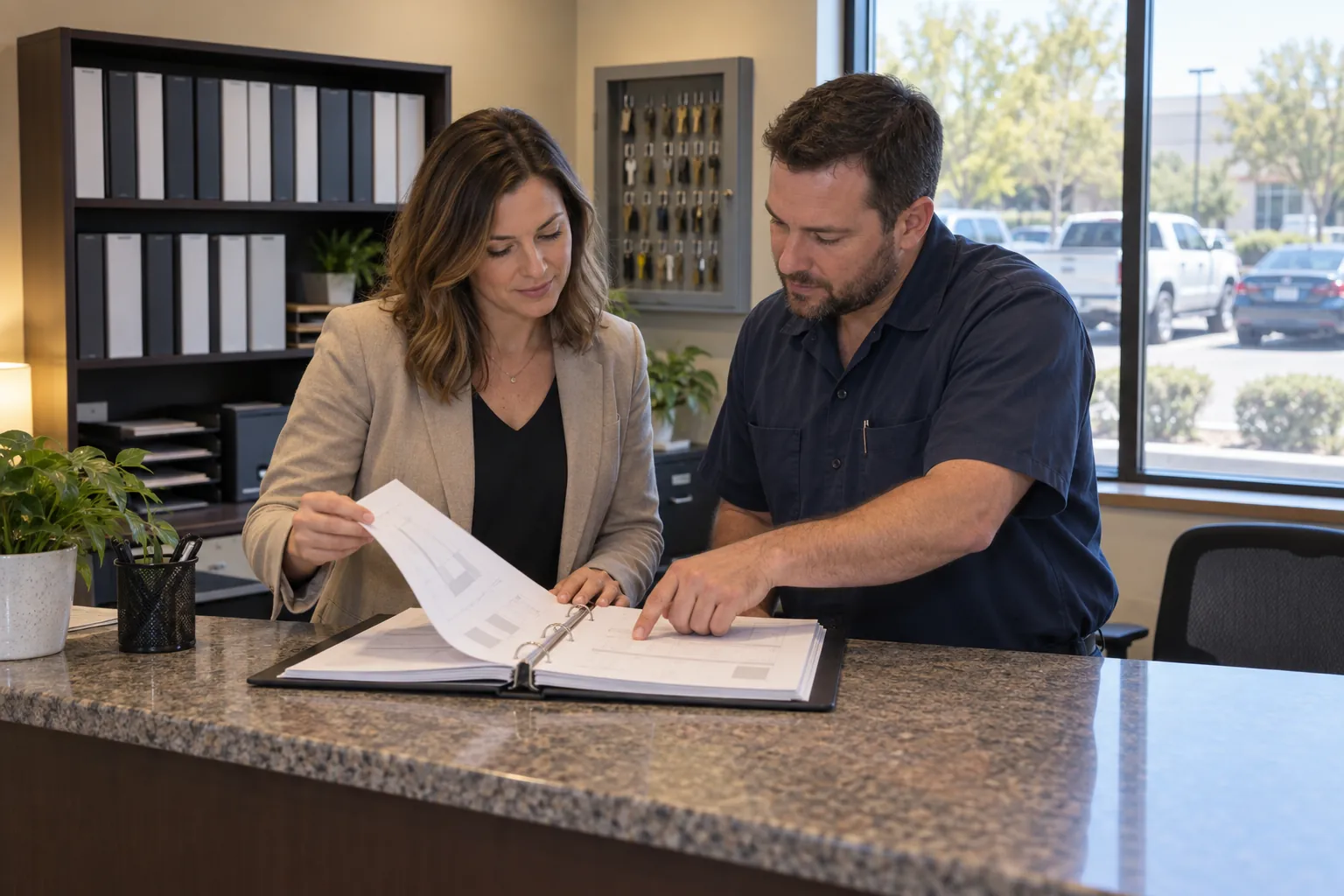
Building compliance in the United States is not one law but a stack of them: OSHA standards wherever people work, the fire and property maintenance codes your city or county has adopted, state rules for elevators, boilers and backflow, federal asbestos rules and the Americans with Disabilities Act. This checklist sets out each duty, who usually holds it, how often the work is done, which items need a licensed contractor and what record should come out of each.
01
Who is responsible for building compliance in the US
There is no single building compliance law in the United States. Each requirement has its own source, its own enforcer and its own duty holder, which is why the gaps usually sit between people rather than inside one job description. The main duty holders are:
- The employer, under the Occupational Safety and Health Act and the general industry standards in 29 CFR 1910, for its own employees. OSHA's State Plans page notes that "There are currently 22 State Plans covering both private sector and state and local government workers, and seven State Plans covering only state and local government workers." In a state plan state, such as California, check the state's own standard.
- The building owner, under the fire code and property maintenance code the state, county or city has adopted, most often an edition of the International Fire Code (IFC) or NFPA 1, enforced by the fire marshal or code official, the authority having jurisdiction (AHJ).
- A business open to the public, a public accommodation under Title III of the Americans with Disabilities Act; state and local government buildings fall under Title II.
- Building and facility owners for asbestos, under OSHA and the EPA.
- State and local programs for elevators, boilers and backflow prevention, each with its own intervals and certificates.
In a multi-tenant office or retail center, the lease decides who maintains what: typically the owner, through the property manager, keeps the structure, common areas, roof and central plant, and each tenant keeps its own suite. A lease can move the work but not a legal duty, and the janitorial, security and maintenance vendors who do much of the routine work carry their own duties to their own employees.
A building compliance checklist is most useful when it names, for every item, who holds the duty, who does the work, who holds the report and when the item is next due.
02
The building compliance checklist at a glance
For a typical US commercial building, such as an office, a school, a church, a retail store or a mixed-use property, the compliance checklist covers:
- Workplace safety under OSHA: walking surfaces, exit routes, emergency and fire prevention plans, extinguishers, alarms, electrical working space, restrooms, first aid and eyewash, injury records.
- Fire and life safety under the fire code: egress, fire doors, fire alarm and sprinkler systems, emergency lighting, kitchen hood suppression, generators, permits and the fire marshal's inspection.
- Elevators and escalators: maintenance to ASME A17.1 and the state or city inspection certificate.
- Boilers and pressure vessels: servicing, and a state certificate where required.
- Water: backflow testing and, where the building needs one, a Legionella water management program.
- Asbestos: knowing where it is in older buildings, and inspecting before renovation.
- Accessibility: accessible features kept working, barriers removed where readily achievable.
- Local rules: the certificate of occupancy, energy benchmarking where required, stormwater and grease traps, and your insurer's requirements.
Use this as the skeleton of your own register. A hospital adds CMS and The Joint Commission, a school adds the EPA's AHERA rules, and a kitchen, pool or garage adds its own items. The code edition your jurisdiction adopted, your AHJ, your insurer and the manufacturers set the actual frequencies. For day-to-day upkeep, see our building maintenance checklist.
03
The OSHA items: routine checks the employer owns
OSHA's general industry standards hold most of the frequent checks, and they apply wherever people are employed, whoever owns the building:
- Walking surfaces. 29 CFR 1910.22 requires that "Walking-working surfaces are inspected, regularly and as necessary, and maintained in a safe condition," and that hazards are "corrected or repaired before an employee uses the walking-working surface again." In practice, a daily walk of entrances, corridors and stairs.
- Exit routes. 29 CFR 1910.36: "Employees must be able to open an exit route door from the inside at all times without keys, tools, or special knowledge." 29 CFR 1910.37: "Exit routes must be free and unobstructed." Check routes, doors and exit signs daily; see exit route requirements.
- Emergency action and fire prevention plans. Where a standard requires one, 29 CFR 1910.38 says "An emergency action plan must be in writing, kept in the workplace, and available to employees for review" (an employer with 10 or fewer employees may communicate it orally), and 29 CFR 1910.39 treats the fire prevention plan the same way. See the emergency action plan.
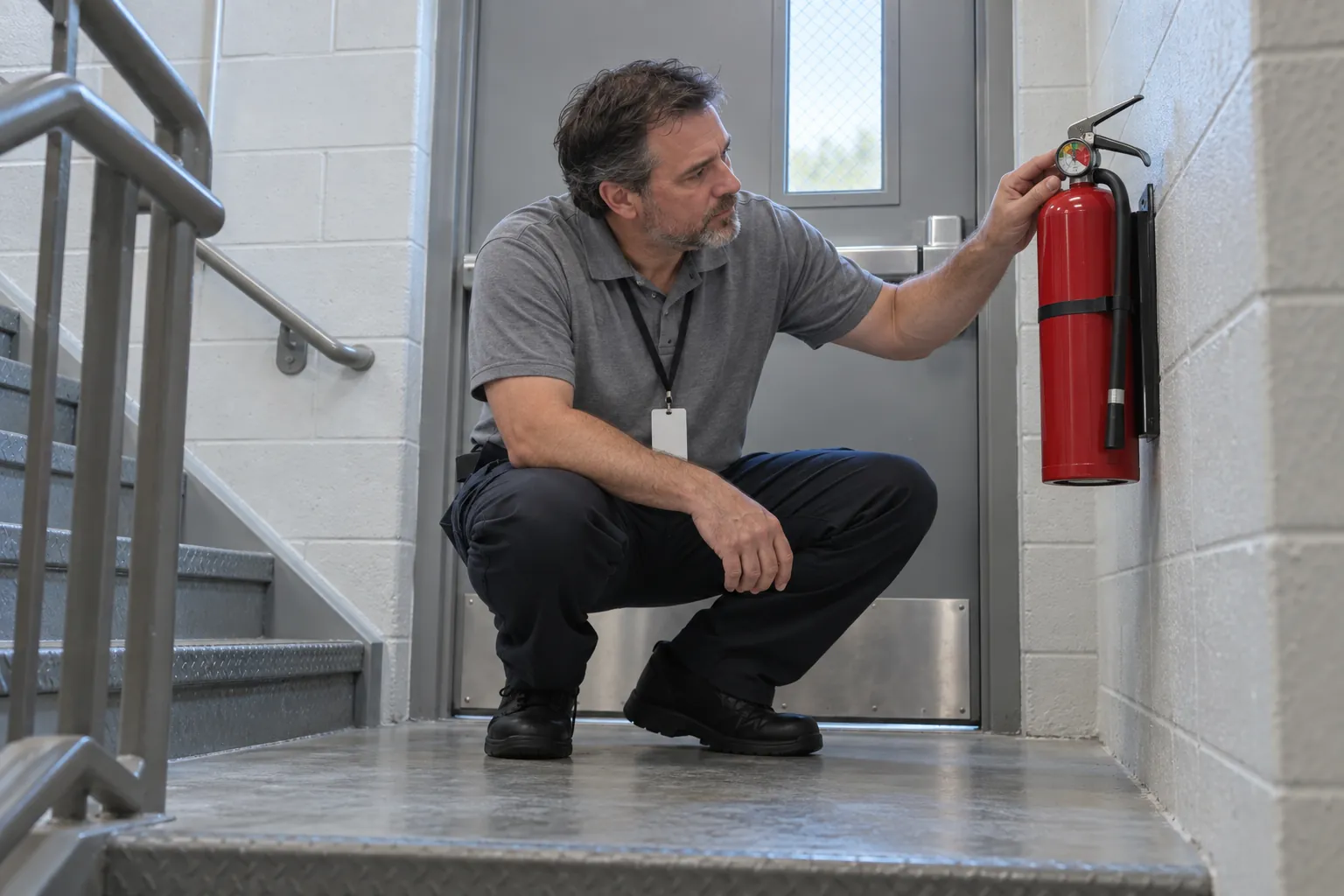
- Portable fire extinguishers. 29 CFR 1910.157: they "shall be visually inspected monthly," with an annual maintenance check whose date the employer records and keeps "for one year after the last entry or the life of the shell, whichever is less." See the monthly fire extinguisher inspection.
- Alarms and sprinklers. 29 CFR 1910.165 requires non-supervised employee alarm systems to be tested "every two months." Where a sprinkler system is installed to meet OSHA's standard, 29 CFR 1910.159 requires "a main drain flow test" annually, and "The minimum vertical clearance between sprinklers and material below shall be 18 inches."
- Electrical working space. 29 CFR 1910.303: "Working space required by this standard may not be used for storage." The electrical room turned storeroom is a common finding; see electrical panel clearance.
- Restrooms, first aid and eyewash. 29 CFR 1910.141 requires toilet facilities and lavatories with running water, hand soap and towels. 29 CFR 1910.151 says "Adequate first aid supplies shall be readily available," and requires eye and body flushing facilities where anyone may be exposed to injurious corrosive materials, as in many janitor closets.
- Injury records. Under 29 CFR 1904.1, a company that "had 10 or fewer employees at all times during the last calendar year" need not keep them unless told to, and some low-hazard industries are partially exempt. Others keep the OSHA 300 log and, under 29 CFR 1904.32, post the annual summary from February 1 until April 30.
04
Fire code, fire protection systems and the other licensed items
Fire codes are adopted locally: the IFC in one city, NFPA 1 in the next, often an older edition and always with local amendments. The NFPA standards they point to, such as NFPA 10 for extinguishers, NFPA 25 for sprinklers and standpipes, NFPA 72 for fire alarms, NFPA 80 for fire doors and NFPA 110 for generators, are standards until a jurisdiction adopts them. Ask your fire marshal which code and edition they enforce, and whether they inspect your occupancy periodically.
Most of this is licensed work. The site team books it, lets the contractor in and makes sure every deficiency is closed out:
- Fire alarm: inspected and tested at the NFPA 72 intervals your AHJ enforces, with trouble signals answered in between; see fire alarm testing.
- Sprinklers, standpipes and fire pumps: the weekly to annual inspections in NFPA 25; see fire sprinkler inspection.
- Emergency and exit lighting: tested at the frequency your fire code sets; see emergency lighting testing.
- Fire doors: an annual NFPA 80 inspection where your code requires it, and routine checks that doors close, latch and are not wedged open.
- Kitchen hoods: suppression serviced at the intervals your fire code sets, and cleaning as often as the cooking demands; see kitchen hood cleaning.
- Generator: exercised and tested to NFPA 110 where it serves life safety loads; see generator testing.
- Elevators, boilers and backflow: elevator maintenance to ASME A17.1 with the state or city inspection and certificate; boilers serviced and, where the state requires, certified; backflow preventers tested by a certified tester, usually yearly, with results filed with the utility (see backflow testing).
- Legionella: the CDC's Toolkit: Developing a Legionella Water Management Program says "Many buildings need a WMP to reduce the risk for Legionella growing and spreading within their water system and devices." See the water management program.
- Asbestos: OSHA's asbestos standard, 29 CFR 1910.1001, requires building owners to "determine the presence, location, and quantity of ACM and/or PACM at the work site," tell those who work near it, and keep the records for the next owner; presumed material means thermal system insulation and surfacing in buildings built no later than 1980. Before renovation or demolition, the EPA's asbestos NESHAP (40 CFR Part 61, Subpart M) requires "a thorough inspection where the demolition or renovation operation will occur."
A report listing deficiencies is not evidence of compliance until each one is corrected and the correction recorded. Our fire inspection checklist covers what a fire marshal typically looks at.
05
Accessibility, local rules, and where the records live
Accessibility. The ADA Title III regulations, 28 CFR Part 36, give a public accommodation two continuing duties. Under Section 36.211 it "shall maintain in operable working condition those features of facilities and equipment that are required to be readily accessible to and usable by persons with disabilities," though this "does not prohibit isolated or temporary interruptions in service or access due to maintenance or repairs." Under Section 36.304 it "shall remove architectural barriers in existing facilities" where that is readily achievable, meaning "easily accomplishable and able to be carried out without much difficulty or expense." For a building team the first duty is the routine one: the failed automatic door operator, the accessible restroom used for storage, the ramp blocked by a delivery.
Local rules. Your city or county may add a certificate of occupancy that matches the building's use, energy benchmarking, stormwater and grease trap inspections, and in some large cities facade or cooling tower rules. Construction, alterations and structural or plumbing work usually need their own permits and inspections under the building and plumbing codes your jurisdiction has adopted. Check with the building department and the fire marshal.
Where the records live. Every item produces evidence: a written plan, a report, a tag, a certificate, a test result. The problem is rarely that it was never made, but that nobody can find it when the fire marshal, an OSHA compliance officer or an insurer asks. A good arrangement has:
- a compliance register: each item, the code behind it, the duty holder, the frequency, the date last done and next due;
- reports, tags and certificates filed against the building and the system, with the contractor's license number;
- records a code requires on site kept where the AHJ expects them;
- deficiencies tracked to completion, with evidence of the fix;
- the daily, weekly and monthly checks recorded as they happen.
06
Where the record fails, and what SiteClara does about it
The annual items usually have good paperwork, because a contractor leaves a report or a tag. The weak point is everything in between: the daily walk of the exit routes, the monthly look at every extinguisher, the electrical room kept clear, the eyewash in the janitor closet, the fire door wedged open for a delivery. These are the items an inspector asks about, and the ones most often recorded after the fact on a clipboard sheet initialed for the whole month, if at all. A problem found on those walks is often mentioned to whoever was passing and never becomes a work order.
SiteClara records those routine checks where they happen. A printed QR poster goes at each location, such as an exit stairwell, an electrical room, a janitor closet or a loading dock, with an NFC tag behind it if staff would rather tap. Custodial, security or engineering staff scan or tap on their own phone, with no app to install, see the checks due there, and mark each done or say what stopped them, with a photo when one is asked for. A problem is reported on the spot and goes onto the team's list of jobs until someone closes it.
The supervisor sees what was due, done and missed, and can record why a check was missed. Each day the supervisor reviews and approves a report that goes to nominated management, owner or client contacts at 8 a.m. the next morning, showing what was reported, what was completed, what is still open and how the scheduled checks went.
07
Questions people ask
What is the checklist for building inspection?
It depends on who is inspecting: the fire marshal inspects against the fire code your jurisdiction has adopted, the building official against the building code, and an OSHA compliance officer against the workplace safety standards. For your own routine inspections, OSHA's Small Business Safety and Health Handbook includes self-inspection checklists for general industry workplaces, covering housekeeping, electrical safety, exit routes and emergency planning, and fire protection among others. OSHA calls them "a starting point for identifying workplace hazards" and warns: "Do not use the checklists to assess your compliance with the OSH Act or OSHA standards."
How do you make a compliance checklist?
Start from the items that apply to your building, then name the duty holder and the frequency for each. OSHA's Hazard Identification and Assessment guidance says to "Conduct regular inspections of all operations, equipment, work areas and facilities" and to "Use checklists that highlight things to look for," noting that "each workplace will have its own list." It also says to "Be sure to document inspections so you can later verify that hazardous conditions are corrected." The Small Business Safety and Health Handbook suggests "selecting the checklists that apply to areas that are most critical to your business, then expanding your checklists over time to cover all areas that pertain to your business."
What is a building compliance certificate?
In the United States the nearest equivalent is the certificate of occupancy, issued by the local building department. New York City's Certificate of Occupancy page explains that "A Certificate of Occupancy (CO) states a legal use and/or type of permitted occupancy of a building," and that "existing buildings must have a current or amended CO when there is a change in use, egress or type of occupancy." Other jurisdictions set their own rules, and the elevator, boiler and backflow certificates on this checklist are separate documents.
08
Further reading, and a list to take away
OSHA publishes 29 CFR 1910 on its own site, including 1910.22 on walking-working surfaces, and its State Plans page says whether your state runs its own program. ADA.gov publishes the Title III regulations, the CDC the Legionella water management toolkit, and the EPA its page on the asbestos NESHAP. Your fire marshal can tell you which fire code edition applies. Our OSHA inspection checklist covers what a compliance officer looks at.
To check your building compliance is in order:
- you know whether your state runs an OSHA State Plan, and which fire code edition your AHJ enforces;
- every item has a named duty holder, and the lease is clear on who maintains what;
- the emergency action and fire prevention plans are written and current;
- each licensed inspection has a date last done and next due;
- reports and certificates can be found within minutes;
- deficiencies are tracked to completion;
- you know where any asbestos is, and so do the people who work near it;
- the routine checks are recorded as they happen, and someone reviews the register quarterly.
Sources
Every document this guide quotes or links to, in the order it first cites them.
- State Plans page osha.gov
- 29 CFR 1910.22 osha.gov
- 29 CFR 1910.36 osha.gov
- 29 CFR 1910.37 osha.gov
- 29 CFR 1910.38 osha.gov
- 29 CFR 1910.39 osha.gov
- 29 CFR 1910.157 osha.gov
- 29 CFR 1910.165 osha.gov
- 29 CFR 1910.159 osha.gov
- 29 CFR 1910.303 osha.gov
- 29 CFR 1910.141 osha.gov
- 29 CFR 1910.151 osha.gov
- 29 CFR 1904.1 osha.gov
- 29 CFR 1904.32 osha.gov
- Toolkit: Developing a Legionella Water Management Program cdc.gov
- Asbestos standard, 29 CFR 1910.1001 osha.gov
- Asbestos NESHAP epa.gov
- ADA Title III regulations, 28 CFR Part 36 ada.gov
- Small Business Safety and Health Handbook osha.gov
- Hazard Identification and Assessment osha.gov
- Certificate of Occupancy page nyc.gov
Related guides
 Premises and facilities managementBuilding maintenance checklist: what the code expects, how often to check, and who does itA building maintenance checklist for US commercial buildings, built on the International Property Maintenance Code: daily to annual tasks, who does each, the record.
 Fire and water checksFire inspection checklist: what the fire marshal looks at, and how to be readyA fire inspection checklist for US businesses: what the fire marshal checks, the records to have ready, who prepares what, and how to stay ready between visits.
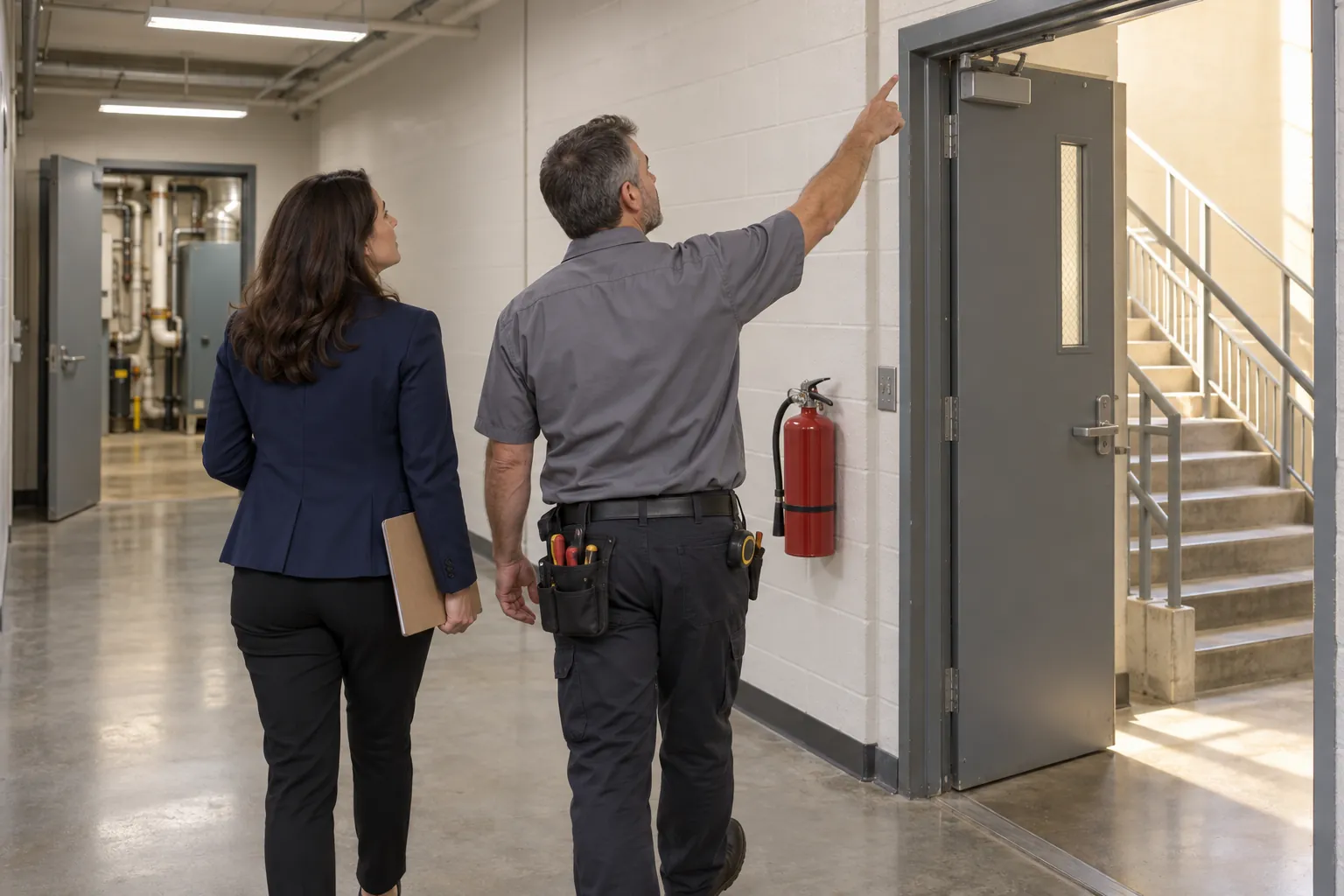 Premises and facilities managementOSHA inspection checklist: what to check before OSHA doesAn OSHA self-inspection checklist for a building: the duty behind it, what to check under each standard, how often, and how to record hazards through to correction.
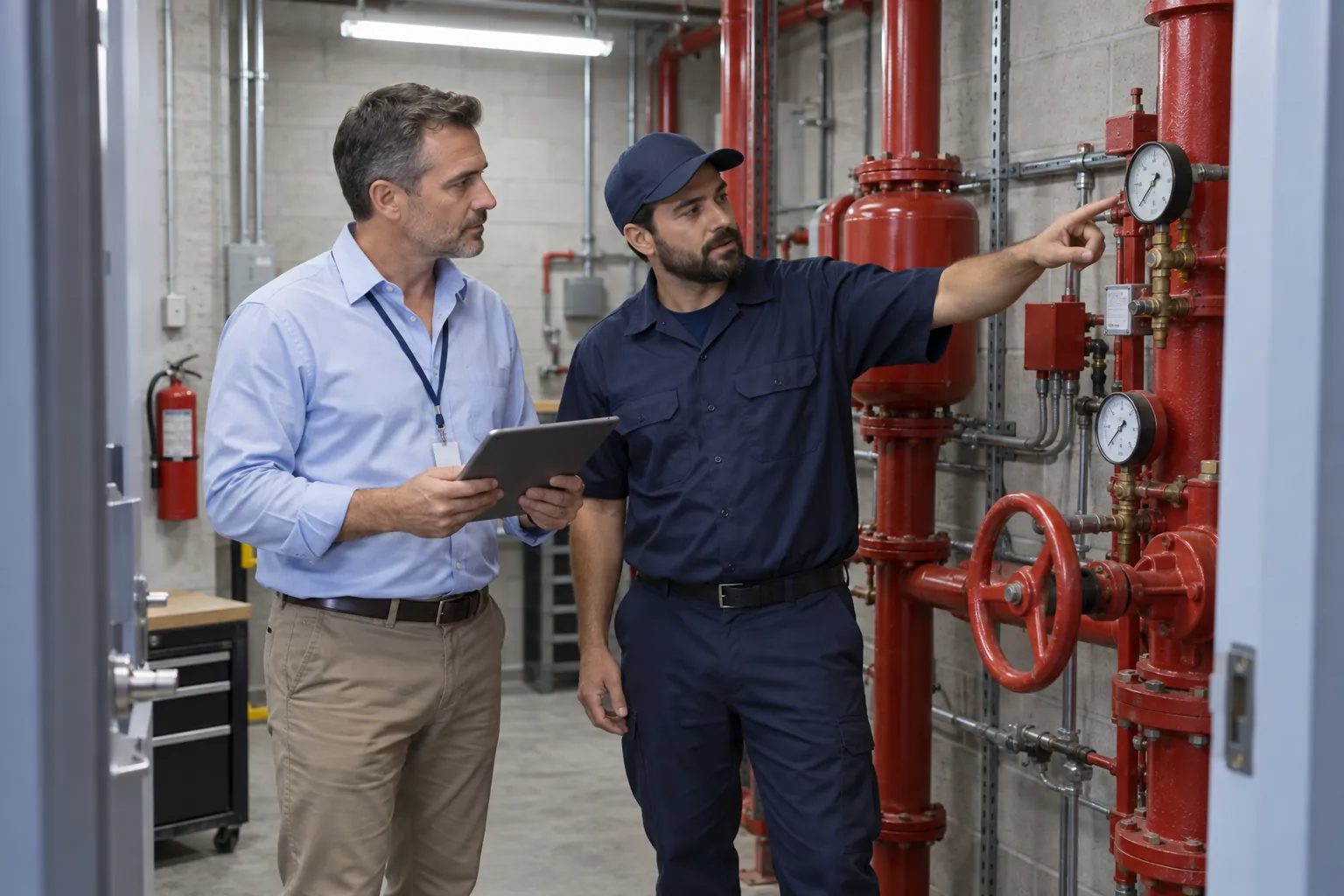 Premises and facilities managementFacility manager duties: what the job covers, and how to show it is doneFacility manager duties across buildings and vendors: OSHA's General Duty Clause, exits, lockout, contractors, the inspection calendar and a record you can show.