Premises and facilities management
AHERA periodic surveillance: the six-month asbestos check, done and recorded
AHERA, the Asbestos Hazard Emergency Response Act of 1986, is the federal law that requires public school districts and nonprofit private schools to inspect their buildings for asbestos, keep an asbestos management plan and check known or assumed asbestos-containing building material at least once every six months.
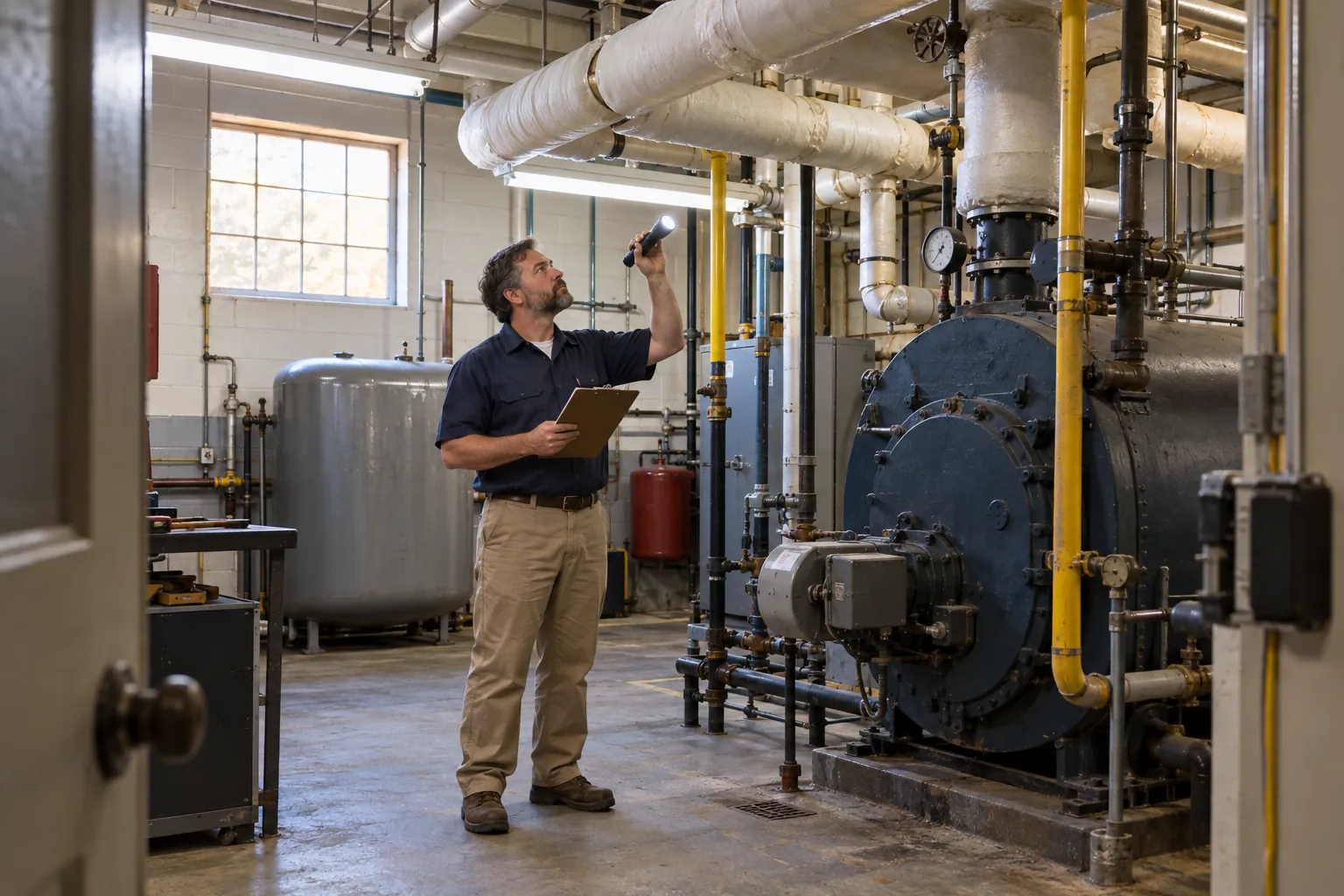
That six-month check, periodic surveillance, needs no accredited inspector, which makes it the easiest duty in the asbestos rules to let slide between three-year reinspections. This guide covers what the rule says, which buildings and materials it reaches, how to walk the check, who can do it, what the record must hold, and how to keep that record honest.
01
What AHERA periodic surveillance is, and where the rule comes from
AHERA is the Asbestos Hazard Emergency Response Act of 1986, which added a title on asbestos to the Toxic Substances Control Act. The Environmental Protection Agency (EPA) carries it out through the Asbestos-Containing Materials in Schools rule, 40 CFR part 763, subpart E. EPA's own summary, Asbestos and School Buildings, says it applies to "public school districts and non-profit schools including charter schools and schools affiliated with religious institutions", and lists the core duties: inspect for asbestos-containing building material, reinspect every three years, keep an asbestos management plan at the school, notify parent, teacher and employee organizations every year, designate a contact person, and perform periodic surveillance.
Periodic surveillance is set out in 40 CFR 763.92, Training and periodic surveillance. Paragraph (b)(1) reads: "At least once every 6 months after a management plan is in effect, each local education agency shall conduct periodic surveillance in each building that it leases, owns, or otherwise uses as a school building that contains ACBM or is assumed to contain ACBM."
Paragraph (b)(2) then says what each person performing the surveillance must do, in three steps:
- "Visually inspect all areas that are identified in the management plan as ACBM or assumed ACBM."
- "Record the date of the surveillance, his or her name, and any changes in the condition of the materials."
- "Submit to the person designated to carry out general local education agency responsibilities under § 763.84 a copy of such record for inclusion in the management plan."
That is the whole of it: look, write down the date, your name and what has changed, and hand the record to the designated person. It fills the gap between the accredited reinspections required at least once every three years under 40 CFR 763.85, Inspection and reinspections, in a building where ceilings leak, ladders knock pipe insulation and floor tiles lift.
02
Which buildings and which materials it covers
The duty falls on the local education agency, which the definitions in 40 CFR 763.83, Definitions give a wide meaning: a local educational agency under the Elementary and Secondary Education Act, "the owner of any nonpublic, nonprofit elementary, or secondary school building", and the governing authority of a Defense Dependents' school. In practice that is a school district, a charter school, a parochial or other private nonprofit school, and whoever owns the building a nonprofit school uses.
A school building is wider than the classrooms: the same section includes labs, libraries, cafeterias, gymnasiums, facilities for housing students or administration, the maintenance, storage and utility facilities essential to them, and covered exterior walkways.
Surveillance covers every area the management plan identifies as asbestos-containing building material (ACBM) or assumed ACBM, whether friable or not. The plan will usually group materials into homogeneous areas, defined as an area of surfacing material, thermal system insulation or miscellaneous material "that is uniform in color and texture". Typical entries in an older school are:
- Thermal system insulation (TSI): pipe insulation, fittings, boiler and tank insulation.
- Surfacing material: sprayed or troweled-on ceiling texture and fireproofing.
- Miscellaneous material: floor and ceiling tiles, and similar interior materials.
- Materials in routine maintenance areas, such as boiler rooms, which must carry a warning label under 40 CFR 763.95, Warning labels, reading "CAUTION: ASBESTOS. HAZARDOUS. DO NOT DISTURB WITHOUT PROPER TRAINING AND EQUIPMENT."
Two points often missed. First, 763.85(c) says that thermal system insulation which has kept its structural integrity and has an undamaged protective jacket or wrap "shall be treated as nonfriable and therefore is subject only to periodic surveillance and preventive measures as necessary". A torn jacket is exactly what the walk exists to catch. Second, assumed material counts the same as confirmed material: if the inspector assumed a homogeneous area was asbestos rather than sampling it, it is on the surveillance list until the plan says otherwise.
03
How to walk a six-month surveillance check
EPA's Learn About Asbestos page explains why the walk matters: "exposure may occur only when the asbestos-containing material is disturbed or damaged in some way to release particles and fibers into the air." The rule asks for a visual inspection of every listed area. It does not ask the person walking it to touch, sample or assess the material; touching material to judge whether it has become friable, and reassessing its condition, is part of the accredited reinspection under 763.85(b). A good surveillance routine keeps to looking, and reports what it sees.
- Start from the plan. Take the current inventory of homogeneous areas with the condition last recorded. Surveillance is about changes, so the walker needs the last known condition in hand.
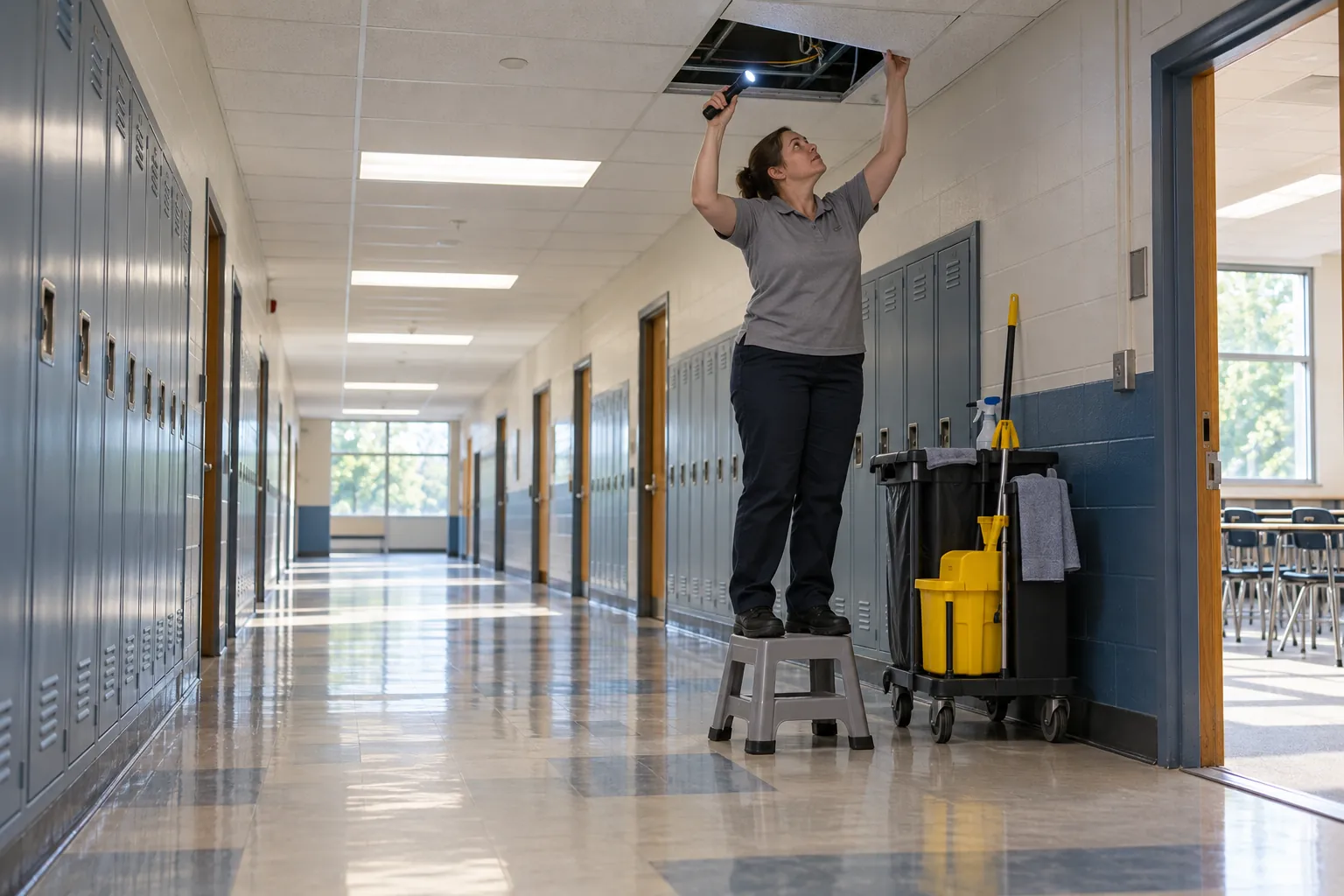
- Turn the inventory into a route, in walking order, including crawl spaces, pipe chases, above-ceiling areas, portable classrooms and storage rooms.
- Look at each area and compare. Signs of change include water staining or a new leak, flaking or delamination of ceiling texture, debris on floors, desks or pipe runs below, torn or missing jacketing on pipe insulation, damaged or cut insulation, cracked, broken or lifting floor tiles, gouges from furniture, carts or ladders, and new penetrations where cable or pipe has been run through a surface.
- Check the labels in routine maintenance areas are still posted and readable.
- Record every area: "no change" shows it was looked at; a blank does not.
- Report debris or new damage the same day to the designated person, follow the district's O&M procedures, and do not sweep or vacuum it with ordinary equipment.
Fix two windows in the school year, for example fall and spring break, so the walks cannot drift more than six months apart, and put the date each walk is due on the calendar, not only the date of the last one. The six-month walk is the minimum: a custodian who sees a stained ceiling tile on a Tuesday should have a clear way to report it that day.
04
Who performs surveillance, and the training behind it
Section 763.92(b) does not require the person performing surveillance to be accredited, unlike 763.85, where inspections and reinspections "shall be made by an accredited inspector". Districts use their own trained maintenance or custodial staff, or contract the walk to an asbestos consultant.
Training for in-house staff is set in 763.92(a). Every member of the maintenance and custodial staff ("custodians, electricians, heating/air conditioning engineers, plumbers, etc.") who may work in a building containing ACBM must receive awareness training of at least 2 hours, whether or not they work with the material, and new staff must be trained within 60 days of starting. The course includes the locations of ACBM in each building where they work and "recognition of damage, deterioration, and delamination of ACBM", which is exactly what a surveillance walk needs. Staff whose work will disturb ACBM need that course and 14 hours of additional training. Paragraph (a)(3) treats staff who have attended EPA-approved asbestos training or equivalent training for O&M and periodic surveillance as trained.
OSHA's rules apply alongside EPA's. Section 763.91(b) requires schools to comply with the OSHA Asbestos Construction Standard, 29 CFR 1926.1101, or EPA's Asbestos Worker Protection Rule, whichever applies. Under 1926.1101, custodial work that contacts but does not disturb asbestos is Class IV work, and its training must be consistent with 763.92(a)(1) and last at least 2 hours. OSHA's general industry standard, 29 CFR 1910.1001, Asbestos, requires an awareness course for employees who perform housekeeping in areas containing asbestos-containing or presumed asbestos-containing material, repeated at least yearly. Federal OSHA covers private employers, such as a nonprofit school or a janitorial contractor; public school employees are covered by OSHA-style rules only where a State Plan covers state and local government workers, under the state's own standard, and otherwise by EPA's Asbestos Worker Protection Rule, 40 CFR part 763, subpart G, which applies the two OSHA asbestos standards to state and local government employees OSHA does not protect. Check which applies in your state.
The designated person carries the program. 40 CFR 763.84, General local education agency responsibilities, requires the agency to designate a person to ensure the requirements are implemented and to make sure that person is adequately trained. The agency must also tell short-term workers, such as telephone repair workers, utility workers or exterminators, where the ACBM is, and inform workers and building occupants, or their legal guardians, at least once each school year about inspections, response actions and surveillance planned or in progress.
05
The record, the plan, and what happens when something has changed
40 CFR 763.94, Recordkeeping sets the minimum. Paragraph (d) reads: "For each time that periodic surveillance under § 763.92(b) is performed, the local education agency shall record the name of each person performing the surveillance, the date of the surveillance, and any changes in the conditions of the materials." Paragraph (a) requires records to be kept "in a centralized location in the administrative office of both the school and the local education agency as part of the management plan."
The management plan itself is set out in 40 CFR 763.93, Management plans. It must include a plan for periodic surveillance under 763.92, alongside plans for reinspection and for operations and maintenance, and paragraph (d) requires the agency to "maintain and update its management plan to keep it current with ongoing operations and maintenance, periodic surveillance, inspection, reinspection, and response action activities." Each school keeps a complete, updated copy in its administrative office, open to workers before work begins and to parents, teachers, EPA and the state within five working days of a request. A surveillance record that never reaches the plan has not done its job.
A useful surveillance record, for each building and walk, shows:
- the building, the date, and the name of each person who walked it;
- every homogeneous area on the inventory, with its location and material type;
- against each area, "no change" or a plain description of the change, where it is and how large;
- a dated photograph of any change, from the same viewpoint each time;
- what was reported, to whom, and when the record reached the designated person.
When the walk finds a change, the O&M rules take over. 40 CFR 763.91, Operations and maintenance, defines a minor fiber release episode as the falling or dislodging of 3 square or linear feet or less of friable ACBM, and a major one as more than that. A minor episode is handled with wet methods, cleaning, sealed leak-tight containers and repair; a major one means restricting entry, posting signs, shutting off or modifying the air handling, and a response designed and carried out by accredited people. Paragraph (h) of 763.94 requires a record of each episode: date, location, method of repair, response action and who did the work.
Custodial routines matter here too. OSHA's 1910.1001(k) forbids cleaning asbestos-contaminated surfaces with compressed air, allows dry sweeping of asbestos only where vacuuming or wet cleaning is not feasible, and requires HEPA-filtered vacuums for asbestos-containing waste. On asbestos-containing floors, sanding is prohibited, stripping must use wet methods and low abrasion pads at speeds lower than 300 rpm, and burnishing or dry buffing is allowed only where the finish is thick enough that the pad cannot contact the asbestos material.
06
Where the record fails, and what SiteClara does about it
Surveillance records fail quietly. The form is photocopied from the last one, with "no change" in every row and a new date at the top. The custodian who did the walk retired, and nobody notices until the reinspection finds two walks missing. A crumbling pipe elbow is mentioned to whoever was nearby. The record exists, but cannot show anyone stood in front of the material.
SiteClara works on the routine part of this: checks and reports at a place in the building. A printed QR poster goes at each location, such as a mechanical room, a corridor, a crawl space access or a classroom wing, with an optional NFC tag behind it. Staff scan the code or tap the tag with their own phone, with no app to install, and sign in with a link. They see the checks due at that location and mark each one done, or say what stopped them, with a photo when the check asks for one. A problem, such as a stained ceiling, torn pipe jacketing or debris on the floor, is reported on the spot with a photo and goes onto the team's list of jobs until someone closes it.
The supervisor sees what is due, done and missed, and can record why a check was missed; a job that needs the building manager can be escalated to them to answer. Each day the supervisor reviews and approves a report that goes to nominated management or client contacts at 8 a.m. the next morning, showing what was reported, completed and still open, and how the scheduled checks went. The designated person gets a dated record of who looked at what, and of changes reported between walks.
07
Questions people ask
What does AHERA do?
AHERA sets the asbestos duties of schools. EPA's Asbestos and School Buildings says the Act and its regulations require public school districts and nonprofit schools, including charter schools and schools affiliated with religious institutions, to "Inspect their schools for asbestos-containing building material" and to "Prepare management plans and to take action to prevent or reduce asbestos hazards". The same page lists an original inspection with reinspection every three years, and yearly notification to parent, teacher and employee organizations on the availability of the management plan.
What are the criteria for passing the AHERA TEM clearance test?
Under 40 CFR 763.90, Response actions, paragraph (i)(3), a removal, encapsulation or enclosure is complete when the average asbestos concentration of five air samples taken inside the affected functional space and analyzed by transmission electron microscopy (TEM) is not statistically significantly different, by the Z-test in appendix A to subpart E, from the average of five samples taken at the same time outside it, and the average of the three field blanks is below the filter background level of 70 structures per square millimeter. Paragraph (i)(4) also allows completion where each of the five inside samples draws at least 1,199 L of air on a 25 mm filter, or 2,799 L on a 37 mm filter, and their average does not exceed 70 structures per square millimeter. For a project larger than small-scale, short-duration work but no more than 160 square feet or 260 linear feet, paragraph (i)(5) allows the samples to be analyzed by phase contrast microscopy (PCM) instead, and the action is complete when each of the five samples is at or below 0.01 fibers per cubic centimeter.
Did the EPA ban asbestos?
EPA's Risk Management for Asbestos, Part 1: Chrysotile Asbestos says that "In March 2024, EPA announced a ban of ongoing uses of chrysotile asbestos", the only known form of asbestos imported, processed or distributed for use in the United States, with phase-outs for the chlor-alkali industry, sheet gaskets, brakes and other friction products. That ban deals with ongoing uses; the AHERA duties for asbestos-containing material already in school buildings remain in 40 CFR part 763, subpart E.
08
Where to read more, and a list to take away
Start with the regulation itself: 40 CFR 763.92 for training and surveillance, 40 CFR 763.94 for the records and 40 CFR 763.93 for the management plan. EPA publishes How to Manage Asbestos in School Buildings: The AHERA Designated Person's Self Study Guide, the Model AHERA Asbestos Management Plan for Local Education Agencies and the AHERA Asbestos Management Plan Self-Audit Checklist for Designated Persons, which is the quickest way to find what is missing. Under 763.93, management plans go to the agency the governor of your state has designated, and states may set their own procedures for reviewing them; read your state agency's guidance as well as EPA's.
Before the next surveillance window, check that:
- every school building the district or school leases, owns or uses is listed in the management plan, with its ACBM and assumed ACBM;
- the plan includes a written surveillance plan, and the next two walk dates for each building are on the calendar;
- all custodial and maintenance staff have had at least two hours of awareness training, new hires within 60 days, and the dates and hours are recorded;
- every area on the inventory gets an entry on each walk, with "no change" or a description and photo of the change;
- warning labels in boiler rooms and other routine maintenance areas are in place and readable;
- damage found between walks has a clear, same-day route to the designated person;
- each surveillance record reaches the designated person and is filed in the management plan at the school and at the district office;
- short-term contractors are told where the ACBM is before they start, and the annual notice to parent, teacher and employee organizations has gone out.
Sources
Every document this guide quotes or links to, in the order it first cites them.
- Asbestos and School Buildings epa.gov
- 40 CFR 763.92, Training and periodic surveillance ecfr.gov
- 40 CFR 763.85, Inspection and reinspections ecfr.gov
- 40 CFR 763.83, Definitions ecfr.gov
- 40 CFR 763.95, Warning labels ecfr.gov
- Learn About Asbestos epa.gov
- OSHA Asbestos Construction Standard, 29 CFR 1926.1101 osha.gov
- 29 CFR 1910.1001, Asbestos osha.gov
- Asbestos Worker Protection Rule, 40 CFR part 763, subpart G ecfr.gov
- 40 CFR 763.84, General local education agency responsibilities ecfr.gov
- 40 CFR 763.94, Recordkeeping ecfr.gov
- 40 CFR 763.93, Management plans ecfr.gov
- 40 CFR 763.91, Operations and maintenance ecfr.gov
- 40 CFR 763.90, Response actions ecfr.gov
- Risk Management for Asbestos, Part 1: Chrysotile Asbestos epa.gov
- 40 CFR part 763, subpart E ecfr.gov
- How to Manage Asbestos in School Buildings: The AHERA Designated Person's Self Study Guide epa.gov
- Model AHERA Asbestos Management Plan for Local Education Agencies epa.gov
- AHERA Asbestos Management Plan Self-Audit Checklist for Designated Persons epa.gov
Related guides
 Premises and facilities managementCustodian duties: what the job involves, and how to show it was doneCustodian duties in schools, offices, churches and public buildings: cleaning, restrooms, opening and locking, safety checks, OSHA rules and a record of the work.
 CleaningSchool cleaning checklist: what custodians clean, how often, and how to show it was doneA school cleaning checklist for classrooms, restrooms, hallways, the cafeteria, gym and nurse's office: daily, weekly and summer tasks, the rules and the record.
 Premises and facilities managementBuilding compliance checklist: OSHA, the fire code and the ADA in one US buildingBuilding compliance checklist for US commercial buildings: OSHA, the fire code, elevators, water, asbestos and the ADA, who holds each duty and how often it is due.
 Premises and facilities managementIndoor air quality checks in schools and other buildings: what to check, how often, and what to recordIndoor air quality checks for schools and other buildings: what to check, how often, who does it, and what EPA, OSHA and state rules expect of the record.