Premises and facilities management
Indoor air quality checks in schools and other buildings: what to check, how often, and what to record
Indoor air quality in schools affects students' health and performance: the EPA notes that children breathe more air in proportion to their body weight than adults, and that asthma, which nearly 1 in 13 school-age children has, is the leading cause of school absenteeism due to chronic illness.
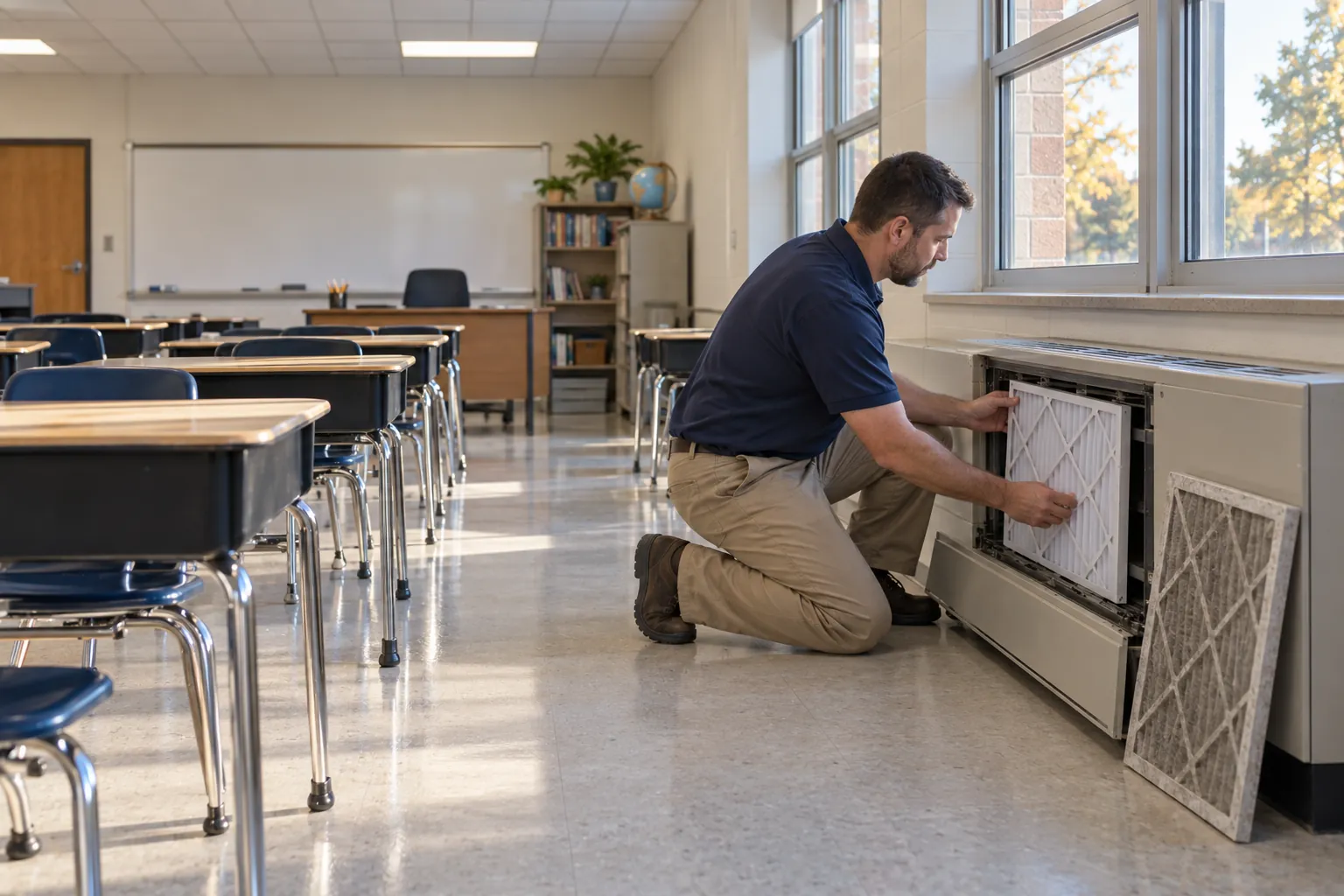
In classrooms, offices and other buildings, indoor air quality is mostly decided by routine work nobody sees: filters changed on time, drain pans kept clean, outdoor air dampers that actually open, a leak dried before mold takes hold. Federal law sets no general indoor air quality standard, but the EPA's IAQ Tools for Schools program, OSHA's guidance and a few state rules describe what a sound program looks like. This guide covers what to check, how often, who does it, and what a record worth trusting looks like.
01
What indoor air quality checks are, and which rules ask for them
Indoor air quality (IAQ) checks are the scheduled inspections, readings and small maintenance tasks that keep the air in an occupied building healthy and comfortable: ventilation working as designed, temperature and humidity in range, and moisture, mold and pollutant sources kept out.
There is no federal indoor air quality standard for ordinary buildings. OSHA says so plainly on its Indoor Air Quality page: "Although OSHA does not have IAQ standards, it does have standards about ventilation and standards on some of the air contaminants that can be involved in IAQ problems." What does apply to private employers everywhere is the General Duty Clause, Section 5(a)(1) of the Occupational Safety and Health Act of 1970, under which each employer "shall furnish to each of his employees employment and a place of employment which are free from recognized hazards that are causing or are likely to cause death or serious physical harm to his employees."
Public schools need a second look. According to OSHA's State Plans page, "State and local government workers are not covered by federal OSHA." Teachers, custodians and other school district staff are covered only where a state plan covers public employees: 22 state plans cover both private and public sector workers, and seven cover only state and local government workers. So before relying on any rule, check which one applies to your building and your employer.
Some states write indoor air quality duties into law or regulation. Connecticut, for example, requires school districts to carry out an annual inspection and evaluation of indoor air quality in each school building using the EPA's IAQ Tools for Schools checklists, under CGS 10-220(d), as set out in Connecticut's IAQ Requirements for School Districts. Two state rules are worth reading wherever you are:
- California. Title 8, California Code of Regulations, section 5142, Mechanically Driven Heating, Ventilating and Air Conditioning (HVAC) Systems to Provide Minimum Building Ventilation, requires the HVAC system to be "maintained and operated to provide at least the quantity of outdoor air required by the State Building Standards Code", operated continuously during working hours with narrow exceptions, and "inspected at least annually", with records kept for at least five years.
- New Jersey. The PEOSH Indoor Air Quality Standard, N.J.A.C. 12:100-13, applies to "buildings occupied by public employees during regular work hours", which takes in the state's public schools. It requires a designated person, a written compliance plan reviewed at least annually, a preventive maintenance schedule for the HVAC system, and records kept for at least three years.
For schools everywhere, the reference point is the EPA's Indoor Air Quality Tools for Schools program. It is voluntary guidance, not a regulation, but it is the most complete free description of what a school IAQ program should do. Its Framework for Effective School IAQ Management sets out six key drivers: organize, communicate, assess, plan, act and evaluate.
02
What an indoor air quality check covers
The EPA's IAQ Tools for Schools Action Kit breaks the work down by who does it, with separate walkthrough checklists for classrooms, ventilation, building and grounds maintenance, food service, waste management, renovation and repairs, the school nurse and administrative staff. Between them, a building's IAQ checks usually cover:
- Outdoor air intakes: clear of leaves, snow, debris and covers, and away from pollutant sources. The EPA's Ventilation Checklist names dumpsters, loading docks and bus-idling areas at ground level, and plumbing vents, exhaust fans, puddles and cooling tower mist on the roof.
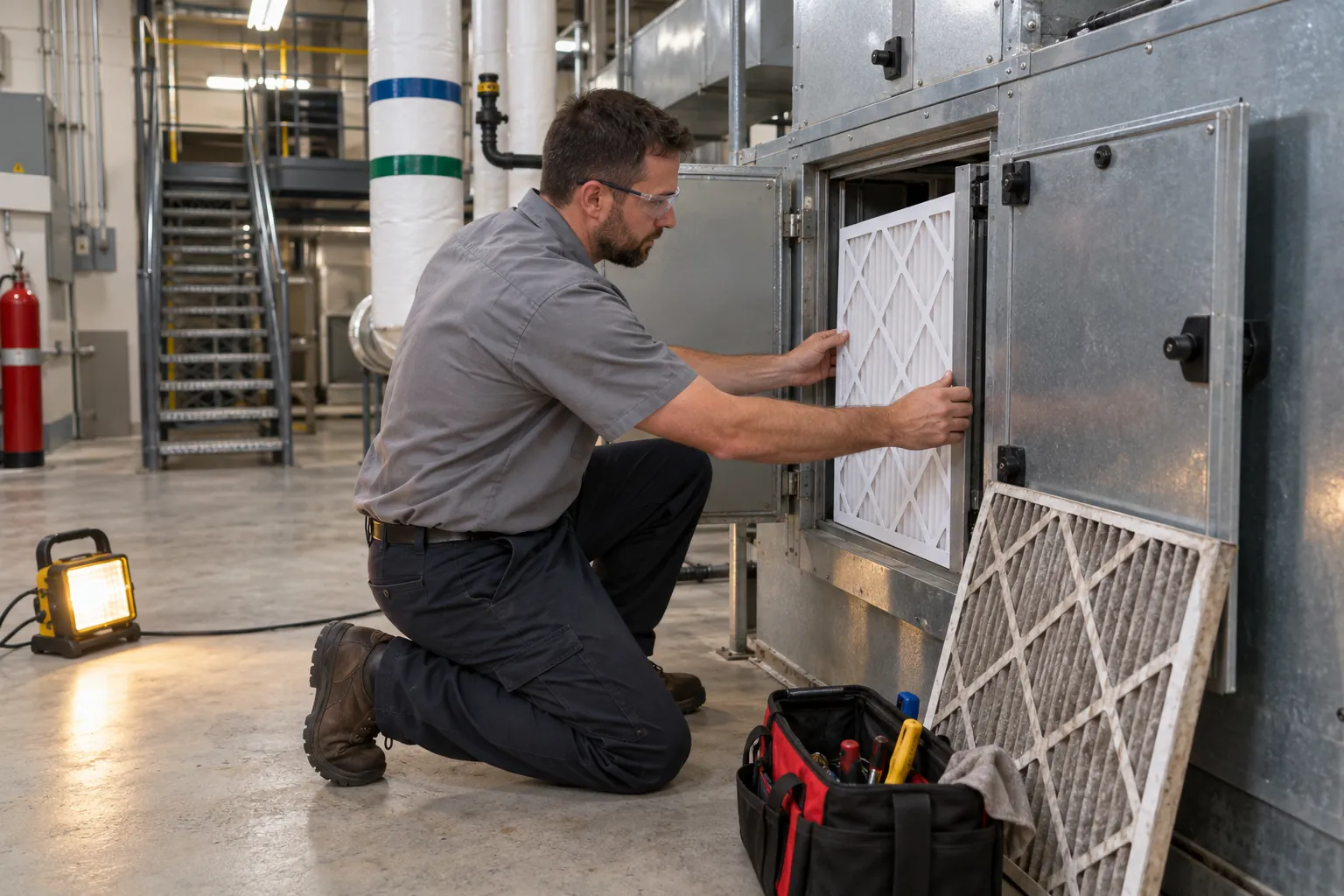
- Filters: replaced on schedule, with the fans off while they are changed, a proper fit so air cannot bypass them, and the arrow on the frame pointing in the direction of airflow.
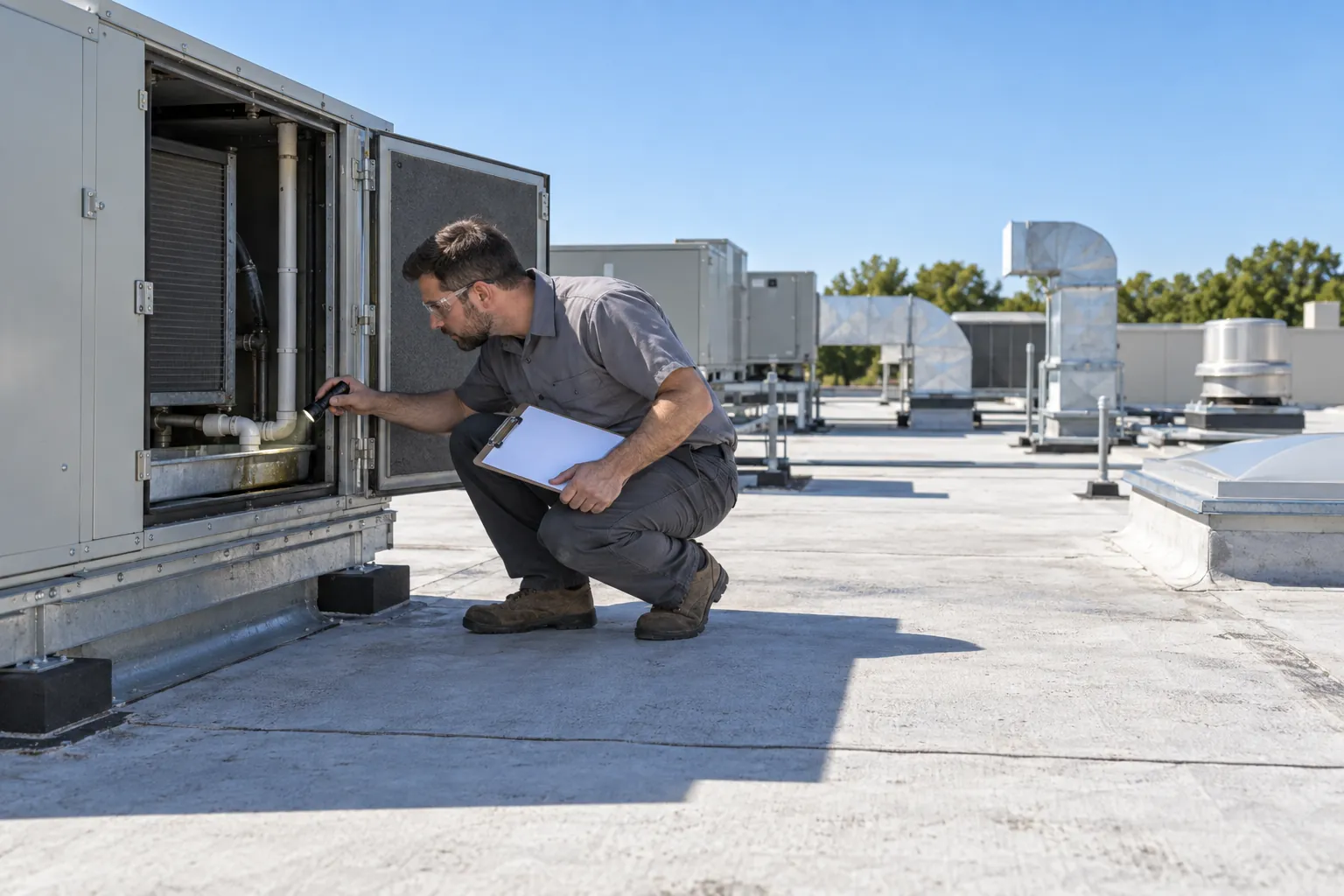
- Drain pans and coils: pans that slope to the drain with no mold or standing water, and clean coils.
- Air handlers and unit ventilators: clean inside, with nothing stored in the unit or the mechanical room.
- Outdoor air controls: dampers open at least to minimum position when the system runs, and time clocks matching how the building is actually used, including evenings and weekends.
- Moisture: leaks, stained ceiling tiles, condensation on windows and cold water pipes, and damp carpet.
- Thermal comfort: temperature and relative humidity in each occupied space.
- Airflow in the room: air coming from the supply vent, grilles not blocked by furniture or displays, and restroom, kitchen and lab exhaust fans that run.
- Sources inside: cleaning products and air fresheners, art and science supplies, classroom animals, food left overnight, pests, and odors.
- Dry drain traps: floor drains, sinks and seldom-used restrooms kept full of water so sewer gas cannot come back into the room.
Radon, lead in drinking water, asbestos and carbon monoxide belong in the same program, but each has its own guidance and they are not covered here.
03
How often: daily, weekly, monthly and yearly
No federal rule sets the frequencies; they come from the manufacturer, the building's design and the few state rules that set a floor. A workable schedule for a school or office looks like this:
- Daily, on custodial rounds: trash removed, spills cleaned, leaks, wet ceiling tiles and odors reported, and systems running in occupied mode before people arrive.
- Weekly: floor drains and seldom-used sinks and restrooms run to keep the traps full (the EPA's Teacher's Classroom Checklist suggests about a quart of water down each floor drain once a week), humidifiers inspected while in use, and a walk past the outdoor air intakes.
- Monthly, or as the manufacturer requires: filters checked and changed on schedule, drain pans and cooling coils inspected and cleaned, outdoor air dampers seen moving, and cooling towers inspected. OSHA's publication Indoor Air Quality in Commercial and Institutional Buildings (OSHA 3430, 2011) suggests monthly inspection of drain pans and cooling coils, or as required, and weekly inspection of humidifiers during operation.
- Seasonally: controls switched between heating and cooling, time clocks reset for the school calendar, and freeze protection tested before winter.
- At least once a year: a full inspection of the HVAC system. In California this is the legal minimum under section 5142, which also says "problems found during these inspections shall be corrected within a reasonable time." Ductwork and plenums are typically inspected for debris and microbial growth on a routine basis, which OSHA 3430 gives as, for example, semi-annually.
- Whenever something changes: after a leak or a flood, during and after renovation, when a room changes use, and whenever occupants complain.
Moisture is the one clock that is not negotiable. The EPA's Mold Remediation in Schools and Commercial Buildings Guide says to "clean and dry wet or damp spots within 48 hours" and to "maintain low indoor humidity, below 60% relative humidity (RH), ideally 30-50%, if possible." New Jersey makes it a rule for public buildings: damp or wet materials are to be remediated "within 48 hours of discovery". A leak that sits over a weekend in a closed school is how that window is missed.
04
Who does what: the IAQ coordinator, custodians, engineers and teachers
Indoor air quality fails when it belongs to everybody and nobody. Both the EPA and the New Jersey standard start with one named person. The EPA's framework asks a school or district to "develop a systematic approach" and designate an IAQ coordinator; New Jersey requires the employer to "identify a designated person who is given the responsibility to assure compliance". The job is coordination, not doing every check: knowing what is scheduled, who does it, what was found and what is still open.
- The IAQ coordinator, often the facilities director, a district environmental health and safety manager or, in a single school, a trusted assistant principal: keeps the plan, collects the checklists, takes complaints, and makes sure findings turn into work orders.
- The building engineer or HVAC technician: filters, belts, coils, drain pans, dampers, controls and the annual inspection. New Jersey's minimum for scheduled HVAC maintenance includes filters, belts, lubrication and motors, with standing water "checked visually for microbial growth".
- Custodians and day porters: the daily picture. They are in every room, see the stained tile and the wet carpet first, manage cleaning chemicals and run the drain traps.
- Teachers and office staff: keep vents clear and report odors, drafts and stuffy rooms. The EPA's classroom checklist is written for them.
- The school nurse: notices patterns, such as headaches clustered in one wing, that point to a building problem.
- Contractors: HVAC service firms and renovation crews, whose visits and findings belong in the same record as the in-house checks.
Where a building is leased, OSHA 3430 advises employers to know "the building management's program and methods for mitigating or resolving indoor air quality problems". A tenant who reports a stuffy floor needs to know who will answer, and the property manager needs a record that shows the report was acted on.
05
Readings, complaints, and what good evidence looks like
Some checks are yes or no; some need a reading. The ranges most often used come from ASHRAE's consensus standards. These are sold, but ASHRAE offers free read-only versions of ASHRAE standards, including Standard 55 and Standard 62.1. OSHA 3430 suggests checking that temperature and humidity sit in a comfort range of 68 to 78 degrees Fahrenheit and 30% to 60% relative humidity, citing ASHRAE Standard 55. New Jersey requires a check of the HVAC system when temperatures in office buildings are outside 68 to 79 degrees Fahrenheit.
Carbon dioxide is the reading people most often misread. OSHA 3430 describes CO2 levels as "a rough indicator of the effectiveness of ventilation" and of crowding: it rises with the number of people in a room and falls with the outdoor air brought in. It is not a pollutant measure at ordinary indoor levels; the OSHA permissible exposure limit of 5,000 ppm as an eight-hour average is a worker exposure limit, not a ventilation target. New Jersey uses 1,000 ppm as a trigger: above it, the employer must check that the HVAC system "is operating as it should".
Outdoor air rates are set in design by ANSI/ASHRAE Standard 62.1, Ventilation and Acceptable Indoor Air Quality, now in its 2025 edition. They reach your building through your state or local mechanical code, and most adopted codes, such as the International Mechanical Code, carry their own ventilation tables drawn from an earlier edition, so check which one your code follows. Measuring them is a job for a test and balance contractor, not a walkthrough.
Complaints are part of the evidence. New Jersey requires employers to promptly investigate "all employee complaints of signs or symptoms that may be associated with building-related illness or sick building syndrome". OSHA 3430 suggests looking at where symptoms occur, the time of day, the season and what was going on nearby, because the pattern often points to the cause. A good complaint record shows the room, the time, what was found and what was done.
For every scheduled check, good evidence answers the same questions:
- What was checked: the unit, the room or the location, identified the same way every time.
- When: the date and time, recorded when the check was done, not later.
- Who: the named person, or the contractor and technician. California requires "the name of the individual(s) inspecting and/or maintaining the system, the date of the inspection and/or maintenance, and the specific findings and actions taken."
- What was found, including the readings where there are any, and a photo when it helps, such as a clogged filter or a stained tile.
- What was done, or the work order it became and when it was closed.
- What was missed, and why: a locked room, a unit down for repair.
Keep the records for at least as long as your state requires, and longer if your district's own retention schedule says so: five years for the HVAC inspection records in California, three years for the maintenance records in New Jersey.
06
Where the record fails, and what SiteClara does about it
Indoor air quality records fail quietly. The sticker on the air handler says the filter was changed in March, but nobody can say which of the thirty unit ventilators got new filters. The monthly drain pan check is initialed for the quarter in one sitting. A teacher mentions a musty smell to the custodian in the hallway, it never becomes a work order, and three weeks later the ceiling tile comes down. When a parent asks what has been done about a classroom, the answer is a binder that proves very little.
SiteClara records the checks at the location. A printed QR poster, with an optional NFC tag behind it, sits at each place a check is scheduled, such as a mechanical room door, a rooftop unit access hatch or a classroom corridor. Staff scan the code or tap the tag on their own phone, with no app to install, see the checks due there, and mark each one done or say what stopped them, such as a locked mechanical room or a unit waiting on parts. The time and the named person are recorded as it happens, with a photo when one is asked for, for example of a new filter in place or a clean drain pan. A problem, such as a leak, a stained ceiling tile or a stuffy room, is reported there with a photo and goes onto the team's list of jobs until someone closes it.
The supervisor sees what is due, done and missed, and can record the reason a check was missed. A job that needs the building manager can be escalated to them to answer. Each day the supervisor reviews and approves a report that goes to nominated management or client contacts at 8 a.m. the next morning, showing what was reported, completed and still open, and how the scheduled checks went, for example 11 of 12 unit ventilator checks completed.
07
Questions people ask
How do you improve indoor air quality in schools?
The EPA's Why Indoor Air Quality is Important to Schools names three measures: control of airborne pollutants, introduction and distribution of adequate outdoor air, and maintenance of acceptable temperature and relative humidity. The same page notes that indoor levels of some pollutants may be two to five times, and occasionally more than 100 times, higher than outdoor levels, so removing sources matters as much as ventilation. The EPA's Indoor Air Quality Tools for Schools program says a healthy learning environment can reduce absenteeism, improve test scores and enhance student and staff productivity.
What are signs of poor indoor air quality?
OSHA's Indoor Air Quality page says poor indoor air quality has been tied to symptoms like headaches, fatigue, trouble concentrating, and irritation of the eyes, nose, throat and lungs, and links asthma with damp indoor environments. The EPA's Why Indoor Air Quality is Important to Schools adds coughing, allergic reactions and aggravated asthma and other respiratory illnesses among students and staff. In the building itself, look for the things the checks above cover: stuffy or musty rooms, stained ceiling tiles, condensation and damp carpet.
What is a safe level of CO2 in a classroom?
No federal rule sets one. OSHA's Indoor Air Quality in Commercial and Institutional Buildings (OSHA 3430) gives the OSHA permissible exposure limit as 5,000 ppm as an eight-hour average, a worker exposure limit rather than a ventilation target, and notes, citing ASHRAE, that CO2 concentrations in acceptable outdoor air typically range from 300 to 500 ppm. It treats indoor CO2 as a rough indicator of the effectiveness of ventilation: high levels may indicate overcrowding or too little outdoor air. New Jersey's PEOSH Indoor Air Quality Standard, N.J.A.C. 12:100-13, which covers the state's public schools, requires the employer to check the HVAC system whenever carbon dioxide exceeds 1,000 parts per million.
Is poor air quality an OSHA violation?
Not in itself. OSHA's Indoor Air Quality page says that although OSHA does not have IAQ standards, it does have standards about ventilation and on some of the air contaminants involved in IAQ problems, and that the General Duty Clause requires employers to provide a workplace free of known hazards that cause or are likely to cause death or serious injury. Federal OSHA does not cover public school staff, so for a public school the question is whether a state plan or a state IAQ rule, such as New Jersey's, applies.
What are the acceptable limits for indoor air quality?
There is no single federal set. OSHA's Indoor Air Quality in Commercial and Institutional Buildings (OSHA 3430) suggests a comfort range of 68 to 78 degrees Fahrenheit and 30% to 60% relative humidity, citing ASHRAE Standard 55, and lists ASHRAE Standard 62.1 for outdoor air ventilation rates as a national consensus standard, not an OSHA regulation. New Jersey's PEOSH Indoor Air Quality Standard, N.J.A.C. 12:100-13 sets action points for buildings occupied by public employees: a check of the HVAC system when carbon dioxide exceeds 1,000 ppm or when office building temperatures fall outside 68 to 79 degrees Fahrenheit.
08
Further reading, and a list to take away
For schools, start with the EPA's Indoor Air Quality Tools for Schools and its IAQ Tools for Schools resources, which include the Action Kit, the walkthrough checklists and preventive maintenance guidance. For offices and other commercial buildings, OSHA's Indoor Air Quality in Commercial and Institutional Buildings includes an HVAC maintenance checklist and a guide to investigating complaints. For mold, read the EPA's Mold Remediation in Schools and Commercial Buildings Guide. In California or a New Jersey public building, read 8 CCR 5142 or N.J.A.C. 12:100-13 in full; elsewhere, check your state plan and district policy.
Before the school year, or the next heating or cooling season, check that:
- one person is named as IAQ coordinator, and staff know how to reach them;
- you know which rules apply to your building: federal OSHA, a state plan, a state IAQ rule, or your district's own policy;
- every air handler, unit ventilator and rooftop unit is on a list, with its filter size and change interval;
- outdoor air intakes are clear and away from dumpsters and idling buses;
- drain pans, coils and humidifiers are on a monthly or manufacturer's schedule;
- leaks and wet materials are dried or removed within 48 hours, and weekends and breaks are covered;
- floor drains and seldom-used restrooms are run weekly;
- complaints go into a record with the room, the time, what was found and what was done;
- the annual HVAC inspection is booked, and its findings become work orders that are closed;
- each check is recorded when it is done, by the person who did it, and someone reads the record every week.
Sources
Every document this guide quotes or links to, in the order it first cites them.
- Indoor Air Quality osha.gov
- Section 5(a)(1) of the Occupational Safety and Health Act of 1970 osha.gov
- State Plans osha.gov
- Connecticut's IAQ Requirements for School Districts portal.ct.gov
- Title 8, California Code of Regulations, section 5142, Mechanically Driven Heating, Ventilating and Air Conditioning (HVAC) Systems to Provide Minimum Building Ventilation dir.ca.gov
- PEOSH Indoor Air Quality Standard, N.J.A.C. 12:100-13 nj.gov
- Indoor Air Quality Tools for Schools epa.gov
- Framework for Effective School IAQ Management epa.gov
- IAQ Tools for Schools Action Kit epa.gov
- Ventilation Checklist epa.gov
- Teacher's Classroom Checklist epa.gov
- Indoor Air Quality in Commercial and Institutional Buildings (OSHA 3430, 2011) osha.gov
- Mold Remediation in Schools and Commercial Buildings Guide epa.gov
- Free read-only versions of ASHRAE standards ashrae.org
- ANSI/ASHRAE Standard 62.1, Ventilation and Acceptable Indoor Air Quality ashrae.org
- Why Indoor Air Quality is Important to Schools epa.gov
- IAQ Tools for Schools resources epa.gov
Related guides
 Premises and facilities managementHVAC filter change log: what to record, how often, and who signs itWhat an HVAC filter change log should record, how often to check and change filters, which ASHRAE standards and state rules apply, and where filter logs go wrong.
 Premises and facilities managementBuilding engineer duties: what the job covers, and how to show it is doneBuilding engineer duties in a commercial building: running the plant, rounds and logs, lockout, refrigerant and boiler rules, vendors, and a record that holds up.
 Premises and facilities managementPreventive maintenance checklist: what to check in a commercial building, how often, and how to prove itA preventive maintenance checklist for commercial buildings: HVAC, electrical, fire and life safety, plumbing, how often, and what the record should show.
 Premises and facilities managementEngineering rounds: how to walk the plant, and how to show it was walkedEngineering rounds in a commercial building: what to walk, the readings to take, how often, the rules behind them, and a round log that shows the plant was checked.