Cleaning
Blood spill cleanup: doing it safely, and showing it was done
Blood spill cleanup at work means keeping people back, putting on gloves, picking up any sharps with tongs or a brush and dustpan, soaking up the blood, cleaning and then disinfecting the surface, and bagging the waste for disposal.
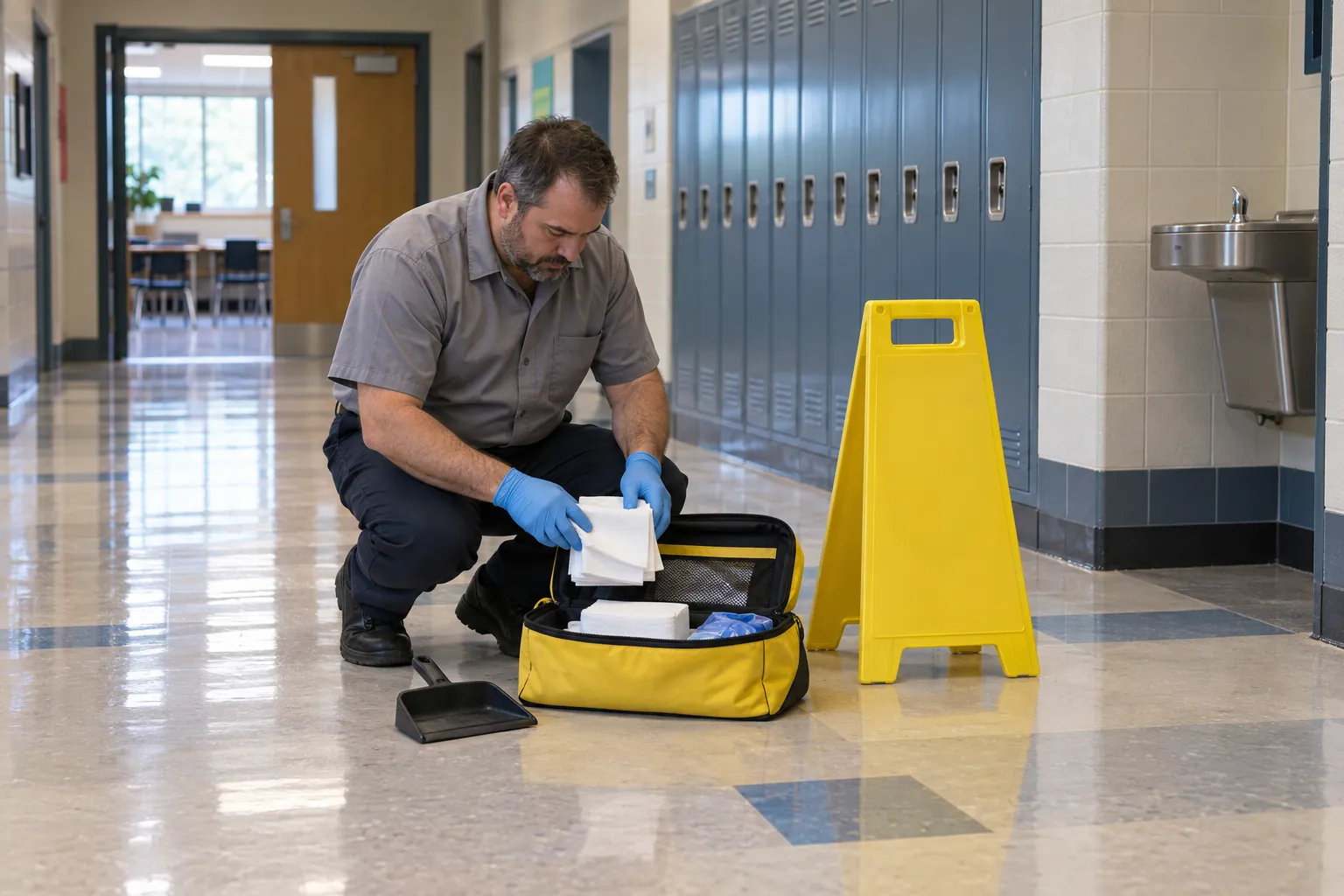
A nosebleed in a school hallway, a cut hand in a restroom, broken glass after a fall in a store: sooner or later a custodian or day porter is asked to clean up blood. OSHA's bloodborne pathogens standard sets how an employer prepares for that, from the written cleaning schedule and the disinfectant to the gloves, the sharps and the training. This guide covers the rule, the steps, who does what, and what a good record of each cleanup shows.
01
The rule behind blood spill cleanup
In the United States, cleaning up blood at work is governed by OSHA's Bloodborne Pathogens standard, 29 CFR 1910.1030. It "applies to all occupational exposure to blood or other potentially infectious materials," and occupational exposure means "reasonably anticipated skin, eye, mucous membrane, or parenteral contact with blood or other potentially infectious materials that may result from the performance of an employee's duties." The standard is not limited to hospitals. OSHA's topic page, Bloodborne Pathogens and Needlestick Prevention, names "housekeeping personnel in some industries" among the workers who may be at risk.
Coverage depends on the job, not the title. OSHA's enforcement directive, OSHA Instruction CPL 02-02-069, Enforcement Procedures for the Occupational Exposure to Bloodborne Pathogens (2001, updated 2017), lists among the jobs that may be covered "custodial workers required to clean up contaminated sharps or spills of blood or OPIM."
Three paragraphs do most of the work:
- The written schedule. Paragraph (d)(4)(i) says the worksite must be "maintained in a clean and sanitary condition" and that the employer "shall determine and implement an appropriate written schedule for cleaning and method of decontamination based upon the location within the facility, type of surface to be cleaned, type of soil present, and tasks or procedures being performed in the area."
- The spill itself. Paragraph (d)(4)(ii)(A) says contaminated work surfaces "shall be decontaminated with an appropriate disinfectant" after procedures, "immediately or as soon as feasible when surfaces are overtly contaminated or after any spill of blood or other potentially infectious materials," and at the end of the shift if the surface may have become contaminated since the last cleaning.
- Broken glass. Paragraph (d)(4)(ii)(D) says broken glassware that may be contaminated "shall not be picked up directly with the hands. It shall be cleaned up using mechanical means, such as a brush and dust pan, tongs, or forceps."
A "Good Samaritan" act, voluntarily helping a coworker or a member of the public, is not occupational exposure, though the directive says OSHA "strongly encourages" employers to offer the same follow-up. The spill that is left afterward is still somebody's job.
02
What counts as a blood spill, and where custodians meet one
The standard covers blood and "other potentially infectious materials" (OPIM). For a cleaning team the part of that definition that matters is "any body fluid that is visibly contaminated with blood, and all body fluids in situations where it is difficult or impossible to differentiate between body fluids." Vomit with visible blood in it is treated as blood, and so is a spill nobody can identify. That is universal precautions, which the standard describes as treating blood and certain body fluids "as if known to be infectious." A spill with no visible blood is covered in the guide on vomit cleanup.
In an ordinary non-medical building, blood turns up in predictable places:
- Restrooms: nosebleeds, cuts, needles left in stalls, sanitary product bins.
- Schools: playground and gym injuries, nosebleeds, the nurse's office.
- Retail and hospitality: broken glass on the sales floor, kitchen cuts, falls at the entrance.
- Offices, lobbies and stairwells: falls, break room cuts, incidents a security officer has dealt with.
- Locker rooms and fitness areas: mats, benches and equipment.
Size changes the method, not the duty. A few drops on a sink ledge and a pool on a hallway floor both call for gloves and an appropriate disinfectant; the large spill also needs absorbent material and a closed-off area. Carpet and upholstery are harder, because a disinfectant cannot be relied on to reach blood that has soaked in, so decide in advance when a porous item is cleaned and when it is replaced. A large or traumatic scene, such as an assault or an unattended death, is beyond what a custodial spill kit is for; decide in advance which specialist biohazard cleanup company is called for it.
The waste depends on how much blood there is. The standard defines regulated waste to include "liquid or semi-liquid blood," "contaminated items that would release blood or other potentially infectious materials in a liquid or semi-liquid state if compressed," items "caked with dried blood" that can release it when handled, and contaminated sharps. The procedure needs to say how that waste is bagged, labeled and collected.
03
Blood spill cleanup, step by step
OSHA sets the requirements; the CDC's Guidelines for Environmental Infection Control in Health-Care Facilities (2003, updated 2024) give the method most programs follow. It says "prompt removal and surface disinfection of an area contaminated by either blood or body substances are sound infection-control practices." A workable routine for a custodian:
- Make the area safe. Keep people away with a barrier or wet floor sign, and look for sharps and broken glass first.
- Put on gloves. Paragraph (d)(3)(ix) says gloves "shall be worn when it can be reasonably anticipated that the employee may have hand contact with blood" and "when handling or touching contaminated items or surfaces." Add eye protection where splashing is possible.
- Pick up sharps and glass without hands. Use tongs or a brush and dustpan, straight into a sharps container. The directive adds that the tools "must be properly decontaminated or discarded after use" and that "vacuum cleaners are not appropriate for cleanup of contaminated broken glass."
- Remove the bulk of the spill. For larger spills the CDC says to "first remove visible organic matter with absorbent material" and "then clean and decontaminate the area."
- Clean, then disinfect. The CDC notes that label claims "are based on use on a pre-cleaned surface," and the directive says gross contamination "must be cleaned up first with a soap and water solution." Then keep the surface wet with disinfectant for the label's full contact time.
- Bag the waste. Regulated waste goes into a closable, leakproof container labeled with the biohazard symbol or color-coded, closed before it is moved, and disposal follows state and local rules under (d)(4)(iii)(C).
- Clean the tools and the bucket. Under (d)(4)(ii)(C), reusable "bins, pails, cans, and similar receptacles" are cleaned "immediately or as soon as feasible upon visible contamination."
- Take off the gloves and wash hands, which (d)(2)(v) requires "immediately or as soon as feasible" after removing them.
- Report it. Record the cleanup, restock the kit, and report at once any skin, eye or mouth contact, cut or needlestick.
04
Who does what: the plan, the training and the vaccine
Most failures happen before the spill: nobody was trained, the kit was empty, or nobody knew whose job it was. The standard puts the preparation on the employer.
- A written Exposure Control Plan. Paragraph (c)(1)(i) requires one "designed to eliminate or minimize employee exposure" from any employer with an employee who has occupational exposure. Its exposure determination lists the tasks where exposure occurs, so spill cleanup should appear by name. The plan "shall be reviewed and updated at least annually" and whenever tasks change.
- Training. Paragraph (g)(2)(ii) requires training "at the time of initial assignment to tasks where occupational exposure may take place" and "at least annually thereafter," including "the procedure to follow if an exposure incident occurs." Paragraph (h)(2) keeps training records for three years.
- The hepatitis B vaccine. Paragraph (f)(1)(i) says the employer "shall make available the hepatitis B vaccine and vaccination series to all employees who have occupational exposure," and (f)(2)(i) says after training and within 10 working days of initial assignment.
- Equipment at no cost. Paragraph (d)(3)(i) requires protective equipment "at no cost to the employee": in practice, a stocked spill kit within reach.
Designated first aid providers need a decision too. The directive lets an employer defer the vaccine for someone whose first aid is only "a collateral duty," provided every first aid incident involving blood is reported "before the end of the work shift during which the incident occurred" and the full vaccine series is offered "as soon as possible, but in no event later than 24 hours" to any unvaccinated first aid provider who helped.
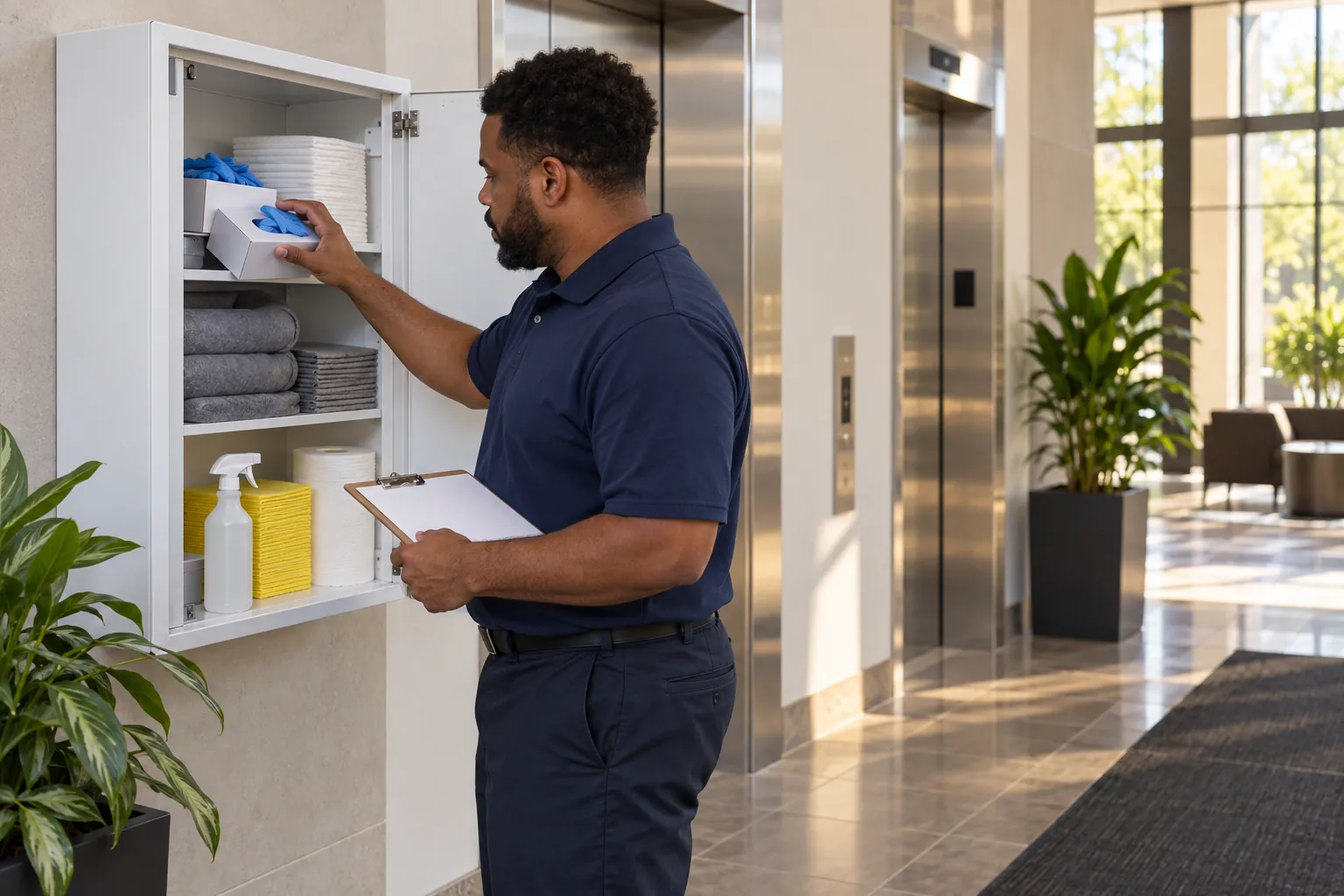
Janitorial contracts add a second employer. The directive says that for companies providing a service such as housekeeping, both they "and the host employers are responsible for complying with all provisions of the standard" under OSHA's multi-employer policy. The contractor trains its people, provides the vaccine and equipment, and runs follow-up after an exposure; the facility controls the building and often supplies the sharps containers. The contract and post orders should say who provides and restocks the spill kits, and who is called when a spill is found.
05
What a good blood spill cleanup record shows
The standard requires training, sharps injury and medical records, but no log of individual spill cleanups. Most facilities keep one anyway, because the questions after an incident are always the same: was it cleaned, when, by whom, and with what? The directive also tells compliance officers to "interview employees to ensure that the disinfectants are being used according to the manufacturer's instructions."
A good record of each cleanup shows:
- where the spill was, and when it was reported;
- who cleaned it up, and when they finished;
- the disinfectant used, and whether sharps or broken glass were found;
- how the waste was bagged and where it went;
- anything that could not be done, such as carpet that needs replacing, and who was told;
- whether an exposure incident happened, recorded as yes or no, with the details kept in the confidential incident and medical records, not on the cleaning log.
Around the individual spills sit the routine checks that make a cleanup possible:
- Spill kits checked on a schedule and restocked after every use.
- Sharps containers in restrooms and first aid rooms. Paragraph (d)(4)(iii)(A)(2) says they must be "maintained upright throughout use" and "replaced routinely and not be allowed to overfill."
- Restrooms checked often enough that a spill is found quickly; see the restroom cleaning log.
Two things keep the record honest: the person who did the cleanup records it at the time, not at the end of the shift, and a spill reported but not yet cleaned stays visible as open.
06
Where the blood spill record fails, and what SiteClara does about it
In most buildings the blood spill record is a radio call and a memory. The custodian cleans up and goes back to the round, nothing is written down unless there was an injury report, and the used spill kit is not restocked because nobody knew it had been opened. Asked the next week who cleaned the stairwell and with what, a manager can only guess, and a spill reported to whoever was passing may appear nowhere at all.
SiteClara records checks and reports at the place they happen. A printed QR code poster, with an optional NFC tag behind it, goes at each location where a check is scheduled, such as a restroom or the spill kit cabinet. Staff scan or tap on their own phone, with no app to install, see the checks set for that place, and mark each one done or say what stopped them. The facility writes the checks, so a spill kit check can ask whether gloves, absorbent and disinfectant are in stock, with a photo when one is asked for. The time and the named person are recorded as it happens.
Staff can also report a spill from the poster at that location; it goes onto the team's list of jobs and stays open until someone closes it. The supervisor sees what is due, done and missed, records the reason a check was missed, and each day approves a report that goes the next morning to nominated managers, showing what was reported, completed and still open.
07
Questions people ask
What are the OSHA guidelines for cleanup of blood spills?
OSHA's Bloodborne Pathogens standard, 29 CFR 1910.1030 requires contaminated surfaces to be decontaminated with an appropriate disinfectant "immediately or as soon as feasible" after any spill of blood, gloves wherever hand contact with blood can be reasonably anticipated, broken glass picked up by mechanical means and never by hand, and regulated waste in closable, leakproof, labeled containers. The employer must also have a written cleaning schedule, an Exposure Control Plan, annual training and the offer of the hepatitis B vaccine for employees with occupational exposure.
Is spilled blood a biohazard?
Spilled blood is always treated as potentially infectious, and the waste from cleaning it up is regulated biohazard waste when there is enough of it. 29 CFR 1910.1030 defines regulated waste to include "liquid or semi-liquid blood," items that would release blood if compressed, and items "caked with dried blood" that can release it during handling. That waste goes into a closable container that prevents leakage, labeled with the biohazard symbol and the word "BIOHAZARD" or color-coded, and its disposal follows federal, state and local regulations. An item with a little dried blood that would not release it during handling falls outside that definition.
How do I disinfect a blood spill?
Remove the visible blood with absorbent material first, clean the surface, then apply a disinfectant and keep the surface wet for the product's contact time. The CDC's Recommendations for Environmental Infection Control in Health-Care Facilities give a 1:100 bleach dilution to decontaminate nonporous surfaces after a spill has been cleaned up and 1:10 for the first application, before cleaning, where a spill involves large amounts of blood; EPA-registered products with label claims against HBV and HIV are accepted too.
How long is dried blood infectious?
Long enough that dried blood should be treated as infectious. The CDC's Clinical Overview of Hepatitis B says the hepatitis B virus "is infectious for at least 7 days on surfaces," so a spill found days later is cleaned and disinfected in the same way as a fresh one.
08
Where to read more, and a blood spill cleanup checklist to take away
Start with 29 CFR 1910.1030 and OSHA's Bloodborne Pathogens and Needlestick Prevention page; CPL 02-02-069 explains enforcement, the CDC guideline gives the spill method, and EPA's List S names the products. All are linked above. In a State Plan state, read your state's own standard too.
Before the next spill, check that:
- the Exposure Control Plan names blood spill cleanup as a task and has been reviewed in the last year;
- everyone who may clean up blood has been trained in the last year and offered the hepatitis B vaccine;
- the written cleaning schedule covers blood by location and surface, including carpet;
- every spill kit has gloves, eye protection, absorbent, tongs or a scoop, a disinfectant and biohazard bags, and is checked on a schedule;
- the disinfectant's EPA registration number is on List S or another OSHA-accepted list, and staff know its contact time;
- sharps containers are upright, reachable and never allowed to overfill;
- regulated waste goes into labeled, leakproof bags and leaves the building under the state's rules;
- a janitorial contract or post orders say who cleans up blood, who supplies the kits and who is told;
- each cleanup is recorded by the person who did it, at the time, and an exposure incident is reported at once.
Sources
Every document this guide quotes or links to, in the order it first cites them.
- Bloodborne Pathogens standard, 29 CFR 1910.1030 osha.gov
- Bloodborne Pathogens and Needlestick Prevention osha.gov
- OSHA Instruction CPL 02-02-069, Enforcement Procedures for the Occupational Exposure to Bloodborne Pathogens osha.gov
- State Plans osha.gov
- Guidelines for Environmental Infection Control in Health-Care Facilities cdc.gov
- Retired Lists C, D, E and F epa.gov
- EPA's Registered Antimicrobial Products Effective Against Bloodborne Pathogens (List S) epa.gov
- Selected EPA-Registered Disinfectants epa.gov
- Recommendations for Environmental Infection Control in Health-Care Facilities cdc.gov
- 29 CFR 1904.8 osha.gov
- Clinical Overview of Hepatitis B cdc.gov
Related guides
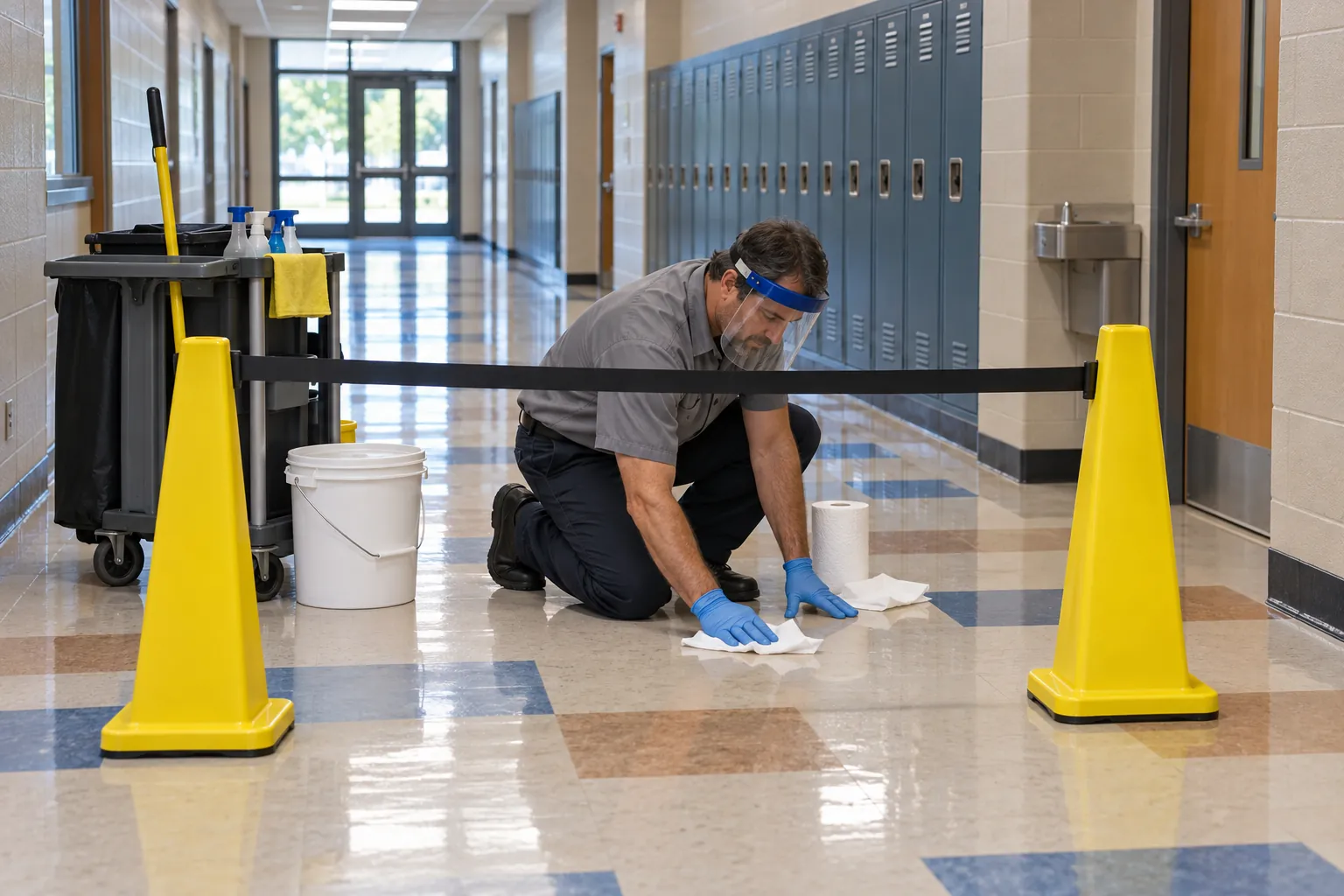 CleaningNorovirus cleanup: how to deal with vomit and diarrhea without spreading the virusHow to clean up vomit and diarrhea so norovirus does not spread: the CDC steps, bleach strength, EPA List G, the Food Code plan, OSHA duties and the record.
 CleaningCleaning, sanitizing and disinfecting: what each one does, and when a building needs itCleaning, sanitizing and disinfecting defined by the CDC, EPA and FDA Food Code: when each is needed, how to do it right, and what the record should show.
 CleaningJanitorial PPE: the hazard assessment, the kit and the daily checkJanitorial PPE under OSHA 29 CFR 1910.132: the hazard assessment, gloves, eye protection, footwear, bloodborne pathogens, training, payment and the daily check.
 CleaningRestroom cleaning log: what to record, and how to make it believableWhat a restroom cleaning log should record, how often to check, the OSHA and Food Code rules behind it, and how to keep a log a client or inspector will believe.