Cleaning
Janitorial PPE: the hazard assessment, the kit and the daily check
Janitorial PPE is the personal protective equipment cleaning staff wear to work safely: chemical-resistant gloves, splash goggles, face shields, aprons and slip-resistant shoes that protect them from chemicals, sharps in the trash, blood on a restroom floor and the wet floor itself.
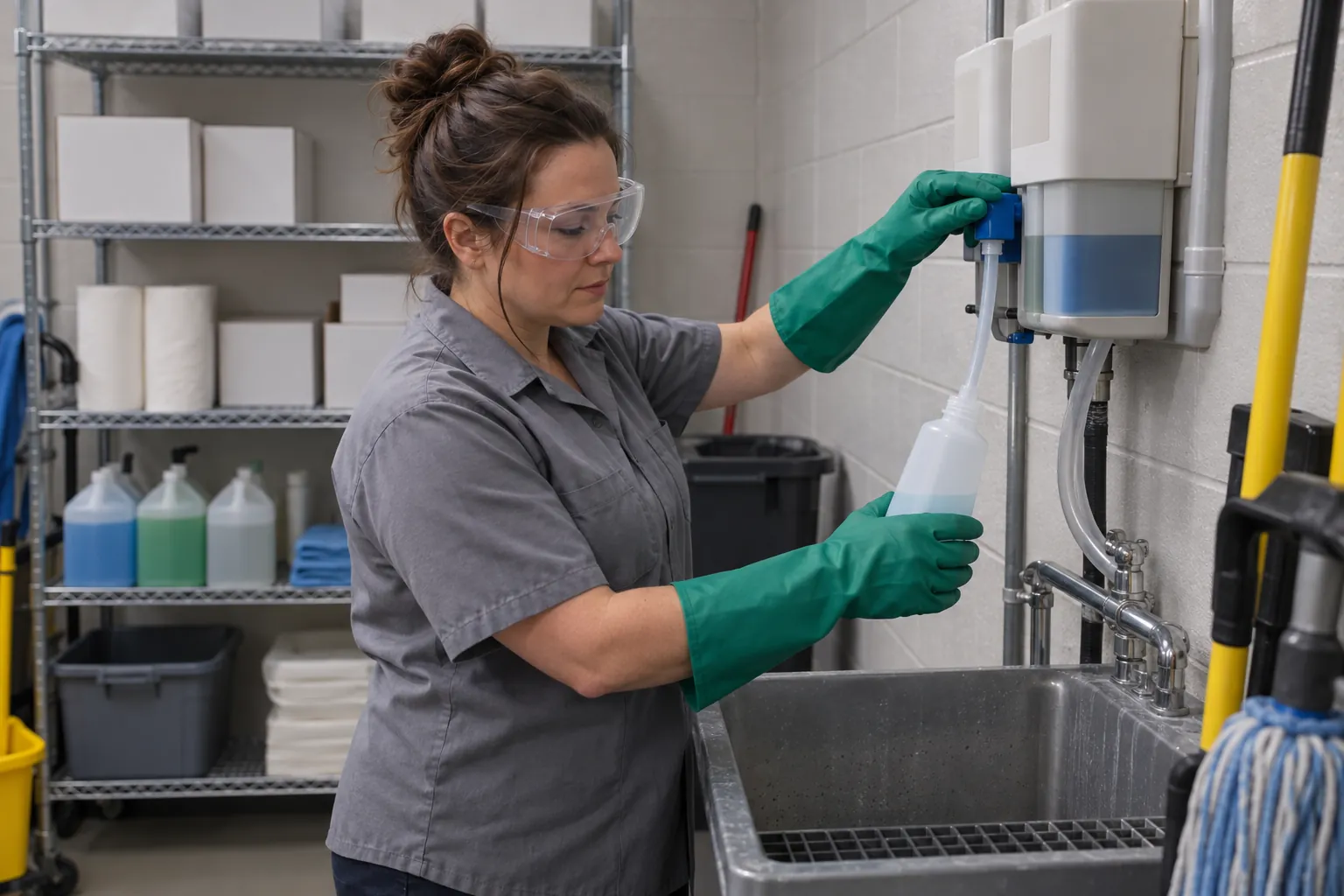
Federal OSHA does not publish a janitorial PPE list. It requires the employer to assess the hazards, choose the equipment, pay for it, train people in it and keep it in good condition. This guide sets out what the standards say, what a custodial crew usually needs, and how to check that the kit is actually there.
01
What OSHA requires: the general PPE standard and the ones beside it
Personal protective equipment (PPE) for janitorial and custodial work falls under the same federal rule as PPE in any general industry workplace: 29 CFR 1910.132, Personal protective equipment, general requirements. Protective equipment "shall be provided, used, and maintained in a sanitary and reliable condition wherever it is necessary by reason of hazards", and paragraph (e) adds that "Defective or damaged personal protective equipment shall not be used."
The heart of the standard is the hazard assessment in paragraph (d): "The employer shall assess the workplace to determine if hazards are present, or are likely to be present, which necessitate the use of personal protective equipment (PPE)." Where they are, the employer must select the PPE and have each affected employee use it, "Communicate selection decisions to each affected employee", and "Select PPE that properly fits each affected employee." The assessment must be written down: the employer "shall verify that the required workplace hazard assessment has been performed through a written certification that identifies the workplace evaluated; the person certifying that the evaluation has been performed; the date(s) of the hazard assessment; and, which identifies the document as a certification of hazard assessment."
Paragraph (f) requires training before the work starts, and paragraph (h) settles who pays: the equipment "shall be provided by the employer at no cost to employees", with narrow exceptions such as non-specialty safety-toe footwear and prescription safety eyewear the employer allows to be worn off the job.
Beside it sit the standards a custodial crew meets every day:
- 29 CFR 1910.133, Eye and face protection, for hazards including "liquid chemicals, acids or caustic liquids, chemical gases or vapors", with devices meeting ANSI/ISEA Z87.1.
- 29 CFR 1910.138, Hand protection, for hazards "such as those from skin absorption of harmful substances; severe cuts or lacerations; severe abrasions; punctures; chemical burns".
- 29 CFR 1910.136, Foot protection, for "falling or rolling objects, or objects piercing the sole" and some electrical hazards.
- 29 CFR 1910.1030, Bloodborne pathogens, wherever cleaning up blood is part of the job.
- 29 CFR 1910.151, Medical services and first aid, whose paragraph (c) requires flushing facilities "Where the eyes or body of any person may be exposed to injurious corrosive materials".
Check the state first. OSHA's State Plans page says there are "currently 22 State Plans covering both private sector and state and local government workers, and seven State Plans covering only state and local government workers." A state plan must be at least as effective as federal OSHA. California's rule is Title 8, section 3380, Personal Protective Devices, which carries the same hazard assessment and written certification wording. School and city custodial staff are covered only where a state plan reaches public employees.
02
What janitorial PPE covers in practice
OSHA's guide Personal Protective Equipment (OSHA 3151, revised 2023) puts PPE last: "Controlling a hazard at its source is the best way to protect employees." A dilution dispenser and a sharps container in the restroom reduce what the gloves have to do. The hazards a custodial assessment usually finds, and the usual answer, are these:
- Chemical splash to the eyes from dispensing concentrate, cleaning overhead, descaling fixtures and stripping floors: safety glasses with side protection for general work, chemical splash goggles for pouring and splashing work, and a face shield with them where the SDS calls for one.
- Chemical contact with the skin from disinfectants, degreasers, bowl cleaners and strippers: chemical-resistant gloves chosen for the product, with a long cuff or an apron for pouring.
- Cuts and punctures from needles and glass in trash: puncture-resistant gloves, and a rule that nobody compacts trash by hand.
- Blood and body fluids in restrooms, lobbies and classrooms: disposable gloves, a mask with goggles or a face shield where splashes are likely, a spill kit, and contaminated gloves replaced as soon as practical and never washed for reuse.
- Wet and slippery floors: slip-resistant work shoes, with wet floor signs and good mopping practice.
- Falling and rolling objects from carts, cases and floor machines: protective footwear where the assessment finds the hazard.
- Dust and aerosols: usually better methods first, such as microfiber, HEPA vacuums and dispensing rather than spraying, with masks or respirators only where the assessment calls for them.
Two things are often missing. The eyewash under 1910.151(c) is not PPE, but it is the other half of the goggle rule: flushing facilities belong "within the work area for immediate emergency use" wherever corrosive concentrate is poured. And the glove for the job, not the one that happens to be in the box: a thin disposable glove is fine for wiping desks and wrong for handling a floor stripper.
03
Choosing the kit: gloves, eye protection, footwear and respirators
Start with the safety data sheet. The Hazard Communication standard, 29 CFR 1910.1200, requires one for every hazardous product, and Section 8, Exposure Controls/Personal Protection, states the PPE. OSHA's brief on Hazard Communication safety data sheets (OSHA 3514) says it includes "Any special requirements for PPE, protective clothing or respirators (e.g., type of glove material, such as PVC or nitrile rubber gloves; and breakthrough time of the glove material)." Disinfectants are antimicrobial pesticides registered with the EPA (see What are Antimicrobial Pesticides?), and the EPA's Introduction to Pesticide Labels gives the rule for all of them: "It is a violation of Federal law to use this product in a manner inconsistent with its labeling." If the label says to wear eye protection, that is the minimum.
Gloves. Under 1910.138(b), selection rests on "an evaluation of the performance characteristics of the hand protection relative to the task(s) to be performed, conditions present, duration of use, and the hazards". OSHA 3151 notes there is no ANSI standard for gloves, describes nitrile as protecting "when working with oils, greases, acids, caustics and alcohols" but "generally not recommended for use with strong oxidizing agents, aromatic solvents, ketones and acetates", and warns that "Latex gloves have caused allergic reactions in some individuals". Most custodial crews need two or three glove types, not one: disposable nitrile for general cleaning and body fluids, a heavier chemical-resistant glove with a long cuff for concentrates and stripping, and a puncture-resistant glove for trash. Check the heavier glove against each product's SDS.
Eye and face protection. OSHA 3151 says "ordinary prescription corrective lenses will not provide adequate protection against most occupational eye and face hazards". Look for the Z87 marking. Safety glasses suit dry work; goggles are for pouring, overhead cleaning and anything that can splash.
Footwear. Slip resistance is not written into 1910.136, but OSHA 3151 lists "Working on or around hot, wet or slippery surfaces" among the situations where foot protection should be worn, and wet floors are a custodian's normal workplace. Many janitorial employers set a slip-resistant shoe policy through the hazard assessment. Read the payment exceptions in 1910.132(h) against that policy rather than assuming who pays.
Respirators. Ordinary custodial work seldom needs one; ventilation, dispensing and a less hazardous product are the better answers to vapors. Where one is required, the full program in 29 CFR 1910.134, Respiratory protection applies. Voluntary use is allowed "if the employer determines that such respirator use will not in itself create a hazard", with the information in the standard's Appendix D.
04
Who does what: the employer, the supervisor, the custodian and the client
OSHA 3151 says employers are responsible for the hazard assessment, for "Identifying and providing appropriate and adequate PPE for employees", "Training employees in the use and care of the PPE" and "Maintaining PPE, including replacing worn or damaged PPE". Employees should "Properly wear PPE", "Care for, clean and maintain PPE", and "Inform a supervisor of the need to repair or replace PPE." On a janitorial contract that splits naturally:
- The janitorial company, as the employer, owns the hazard assessment and its certification, the selection, the training, the budget and the replacement stock.
- The janitorial supervisor makes it real: the right gloves and goggles in the right sizes in each closet, a working eyewash, new hires trained before they touch the stripper, nobody working in a torn glove. See janitorial supervisor duties.
- The custodian wears the equipment, inspects it before use, and reports what is worn, missing or does not fit.
- The client's facility manager tells the contractor about hazards in the building, such as a clinic area or a known sharps problem, and should ask to see the hazard assessment at the start of the contract. Where the building supplies the chemicals, it owns the product list and the safety data sheets.
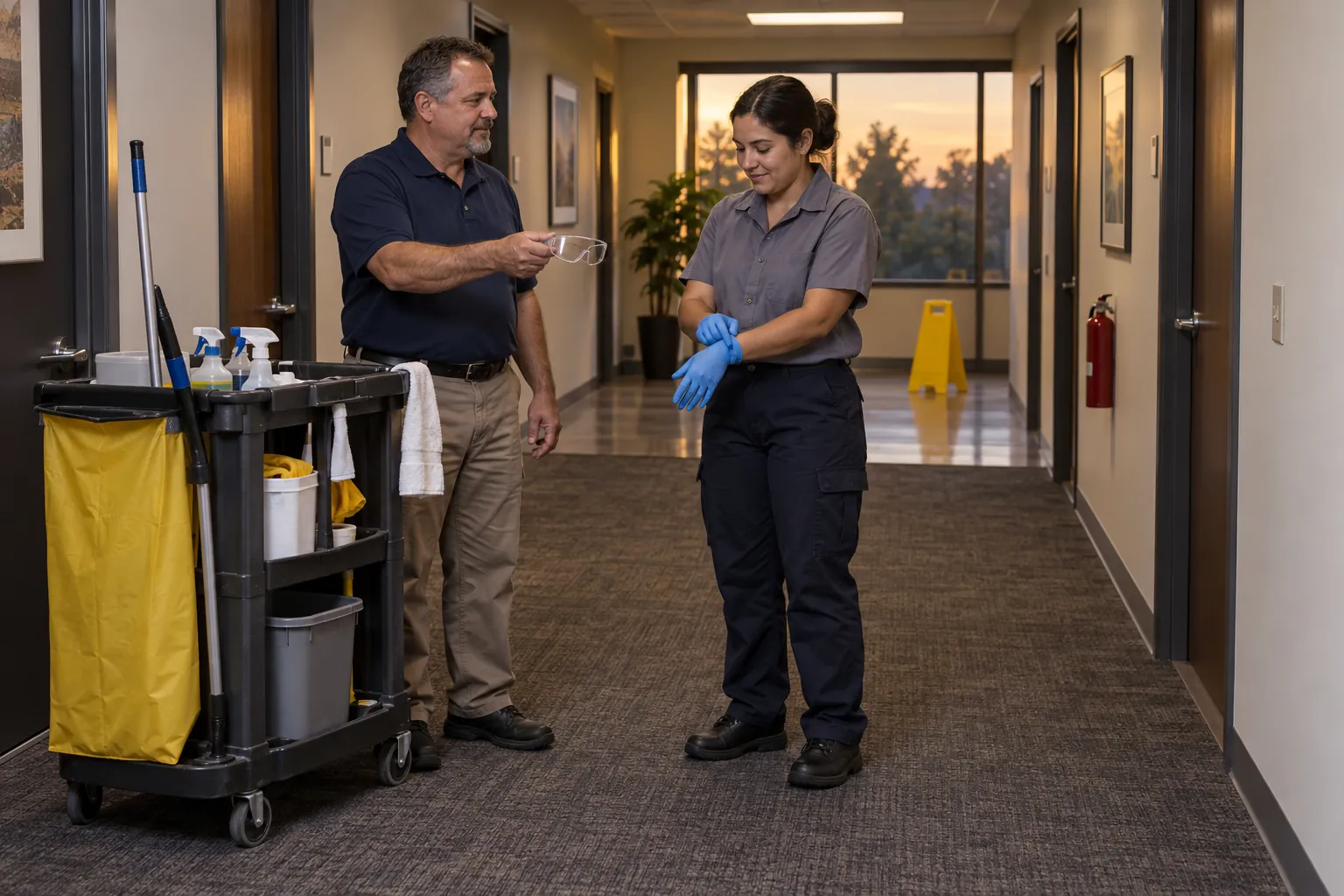
Training. Under 1910.132(f), each affected employee is trained in "When PPE is necessary;", "What PPE is necessary;", "How to properly don, doff, adjust, and wear PPE;", "The limitations of the PPE; and," "The proper care, maintenance, useful life and disposal of the PPE." They must show they understand it before doing the work, and are retrained when the workplace or the equipment changes. OSHA 3151 says the demonstration is "in a language they understand", and the OSHA and NIOSH InfoSheet Protecting Workers Who Use Cleaning Chemicals says the same: "Employers must provide training to workers at a level and in a language and vocabulary that they can understand."
05
The PPE check: how often, what to look at, and what good evidence looks like
A hazard assessment signed once and filed is where most PPE programs stop. OSHA 3151 asks for more: "Inspect protective gloves before each use to ensure that they are not torn, punctured or made ineffective in any way", treat gloves that are "discolored or stiff" as suspect, and "Discard and replace any gloves with impaired protective ability." It advises periodic reassessment, including "a review of injury and illness records" and "The suitability of existing PPE, including an evaluation of its condition and age". A practical rhythm:
- Before each use, the custodian checks their own gloves, goggles and face shield. Torn or stiff gloves go in the trash.
- Each shift, at the closet, someone checks the stock: disposable gloves in every size the crew wears, chemical gloves, goggles, face shields, aprons, the spill kit. It is the same visit as the closet check in our guide to janitor closet requirements.
- On a set schedule, the eyewash is activated and checked as its manufacturer directs, and reusable goggles and face shields are cleaned and inspected.
- When anything changes (a new product, floor finish, building or task), the hazard assessment is revisited and the certification updated. A new product also means reading its SDS and checking its dilution; see chemical dilution control.
- At least once a year, the supervisor or safety lead reviews the assessment, the injury records, the training and whether people actually wear what was chosen.
Good evidence answers five questions: where (which closet), when (the time the check happened, not the day it was filled in), who (a named person, not initials), what was found (stock present or short, eyewash working or not) and what happened next (who was told, when it was fixed).
The records OSHA requires are few: the certification of the hazard assessment, the Exposure Control Plan and training records where the bloodborne pathogens standard applies, the hazard communication program, and, for employers not exempt from them, the injury and illness records.
06
Where the PPE record fails, and what SiteClara does about it
The usual PPE record is a hazard assessment in a binder at the office, a training sign-in sheet, and nothing in the closet. Stock runs out on a Friday night and the crew works in whatever gloves are left. The basement eyewash has not been run in months because nobody was named to run it. A custodian mentions scratched goggles to whoever is passing, and the supervisor hears about it after the splash.
SiteClara puts a tag at the closet door: a printed QR code poster, with an NFC tag behind it if staff would rather tap than scan. A custodian scans or taps on their own phone, with no app to install, sees the checks due in that closet, such as PPE stock and the eyewash, and marks each one done or says what stopped them. The time and the named person are recorded as it happens, with a photo when one is asked for. A problem found there, no large gloves, a cracked face shield, an eyewash with no flow, is recorded at the closet and goes onto the team's list of jobs until someone closes it.
The janitorial supervisor sees which closets were checked and which were missed, and records the reason a check was missed. At the end of the day they review it, add a note and approve a report that goes to the facility manager or the client at 8 a.m. the next morning, showing what was checked, what was reported and what is still open.
07
Questions people ask
What PPE should be used during cleaning?
PPE for cleaning is whatever the product's safety data sheet and the employer's hazard assessment call for, which for most cleaning chemicals means gloves and eye protection. The OSHA and NIOSH InfoSheet Protecting Workers Who Use Cleaning Chemicals says a safety data sheet gives the "Recommended personal protective equipment, such as gloves, safety goggles or respirators" and the "Proper procedures for cleaning up spills", and that employers should review "the proper protective equipment needed, such as gloves and goggles" and provide it to the workers using the product.
What PPE is needed for housekeeping?
Federal OSHA sets no fixed list for housekeeping or custodial work; the employer decides through a hazard assessment. Under 29 CFR 1910.132, Personal protective equipment, general requirements, the employer must "assess the workplace to determine if hazards are present, or are likely to be present, which necessitate the use of personal protective equipment (PPE)", then select the PPE, tell each affected employee, and choose equipment that "properly fits each affected employee." For housekeepers and custodians, the assessment usually finds chemicals, sharps in the trash, body fluids and wet floors.
What do janitors wear to work?
Beyond ordinary work clothes, janitors wear the PPE their employer's hazard assessment selects, most often gloves, safety glasses or goggles, and slip-resistant shoes. OSHA's guide Personal Protective Equipment (OSHA 3151) lists "Working on or around hot, wet or slippery surfaces" among the situations that call for foot protection. Under paragraph (h) of 29 CFR 1910.132, protective equipment "shall be provided by the employer at no cost to employees", with narrow exceptions such as non-specialty safety-toe footwear.
What are 5 PPE items?
OSHA does not set a numbered list. Its guide Personal Protective Equipment (OSHA 3151) says "Examples of PPE include such items as gloves, foot and eye protection, protective hearing devices (earplugs, muffs) hard hats, respirators and full body suits," and has sections on eye and face, head, foot and leg, hand and arm, body, and hearing protection. A custodial crew most often needs hand, eye and face, and foot protection.
08
Where to read the rules, and a list to take away
Start with 29 CFR 1910.132 and Personal Protective Equipment (OSHA 3151), which includes a glove chart by chemical, then the InfoSheet Protecting Workers Who Use Cleaning Chemicals and the SDS for every product your crew uses. If your state runs its own plan, read its standard; in California, Title 8, section 3380.
Before you sign off janitorial PPE for a building, check that:
- a written hazard assessment names the workplace, the person certifying it and its date, and was revisited after the last new product or task;
- each product's SDS Section 8 has been read and the gloves and eye protection match it;
- disposable, chemical-resistant and puncture-resistant gloves are on hand in every size the crew wears;
- goggles are available wherever concentrate is poured;
- flushing facilities are within the work area wherever corrosives are handled, and someone named checks them;
- the slip-resistant footwear policy is written, and it is clear who pays;
- custodians who may clean up blood are covered by the Exposure Control Plan;
- every custodian was trained in a language they understand before doing the work;
- closet stock is checked every shift, and the record shows who, when and what was found;
- worn or missing PPE is replaced at no cost to the custodian, and reported as a job, not a remark in passing.
Sources
Every document this guide quotes or links to, in the order it first cites them.
- 29 CFR 1910.132, Personal protective equipment, general requirements osha.gov
- 29 CFR 1910.133, Eye and face protection osha.gov
- 29 CFR 1910.138, Hand protection osha.gov
- 29 CFR 1910.136, Foot protection osha.gov
- 29 CFR 1910.1030, Bloodborne pathogens osha.gov
- 29 CFR 1910.151, Medical services and first aid osha.gov
- State Plans page osha.gov
- Title 8, section 3380, Personal Protective Devices dir.ca.gov
- Personal Protective Equipment (OSHA 3151, revised 2023) osha.gov
- Hazard Communication standard, 29 CFR 1910.1200 osha.gov
- Hazard Communication safety data sheets (OSHA 3514) osha.gov
- What are Antimicrobial Pesticides? epa.gov
- Introduction to Pesticide Labels epa.gov
- 29 CFR 1910.134, Respiratory protection osha.gov
- Protecting Workers Who Use Cleaning Chemicals osha.gov
Related guides
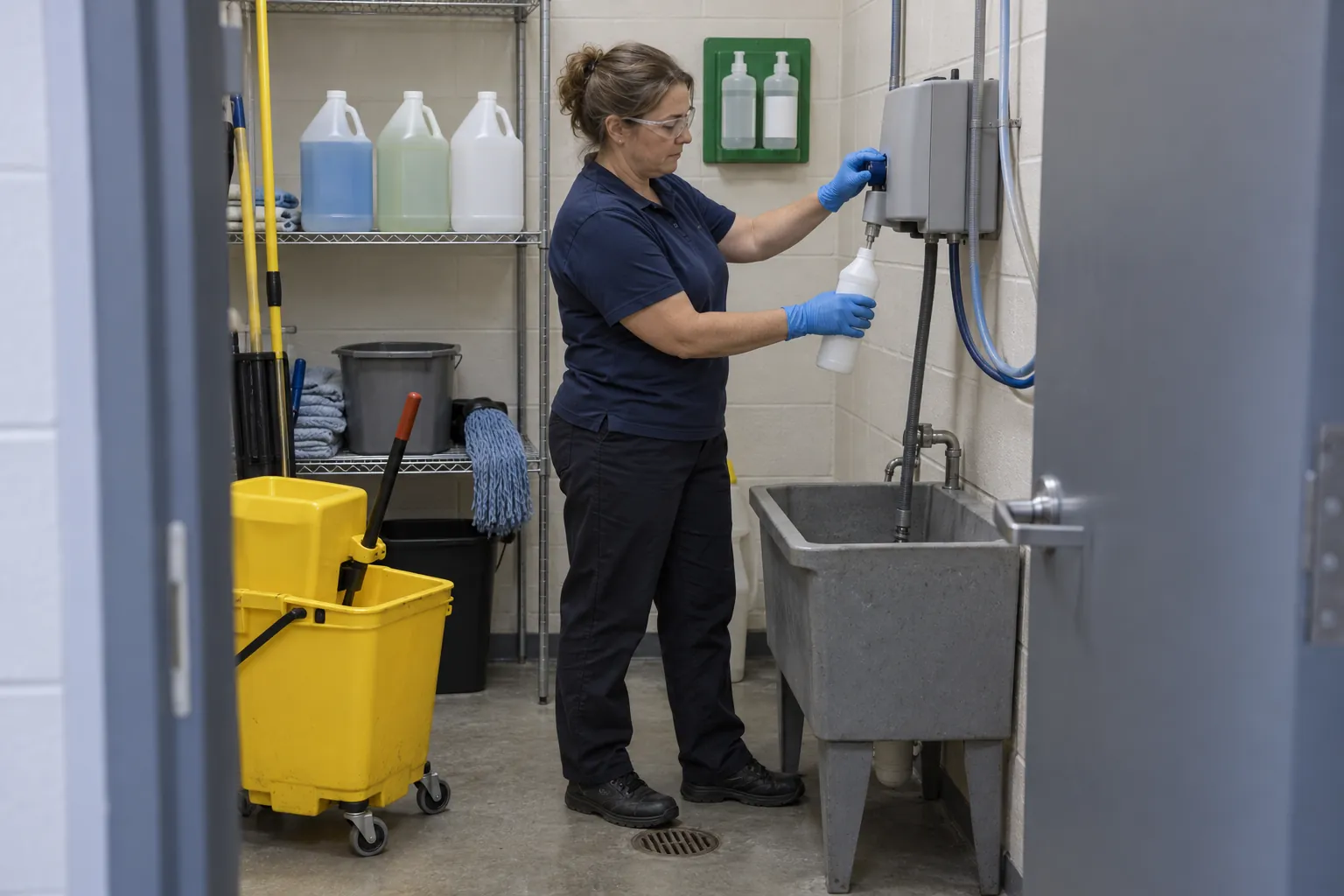 CleaningChemical dilution control: getting the mix right, every bottle, every shiftHow a chemical dilution control system works, what OSHA HazCom and EPA labels require, how to check dispensers and bottles, and what the record should show.
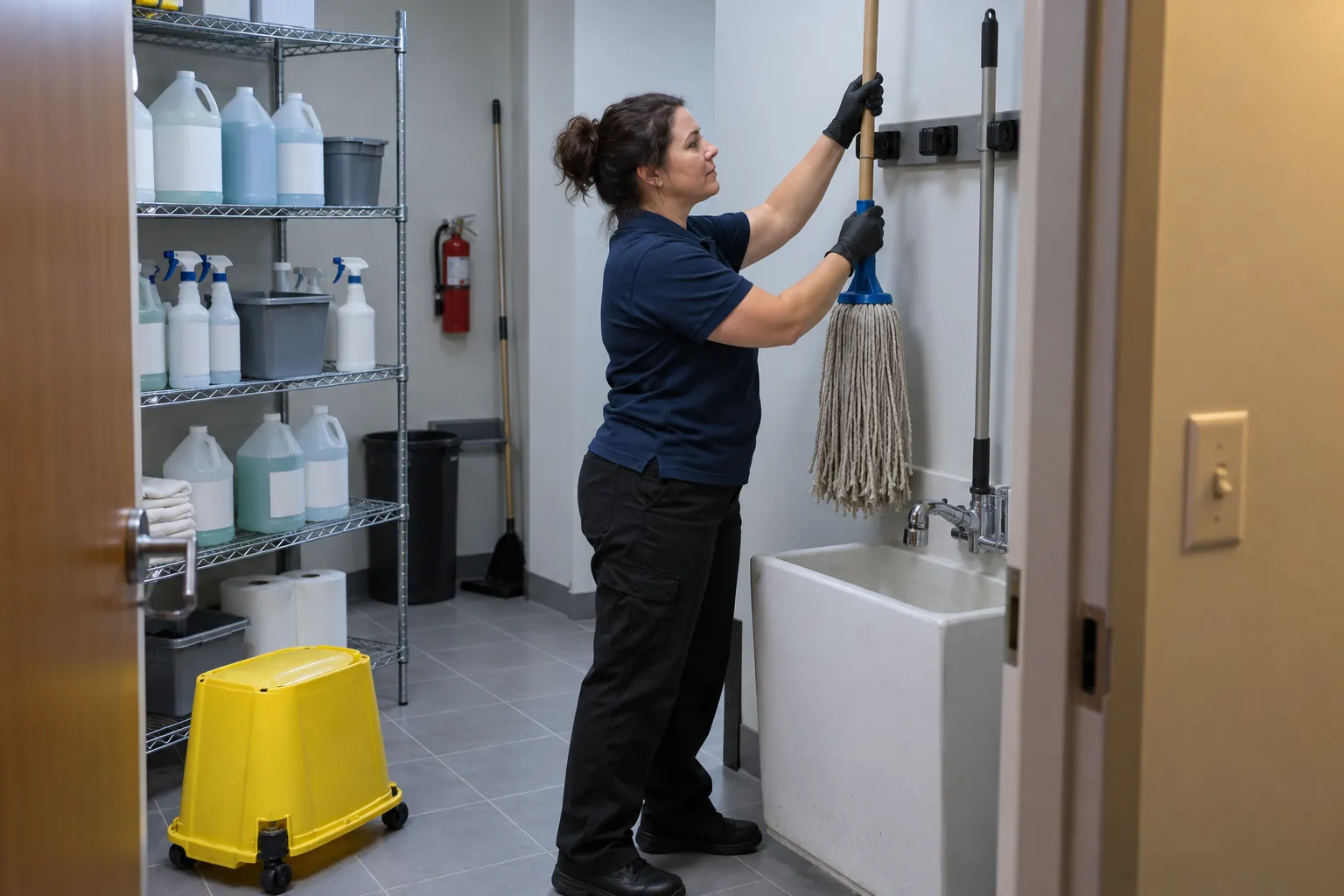 CleaningJanitorial closet requirements: the sink, the chemicals and the daily checkWhat US codes and OSHA require of a janitorial closet: the service sink, chemical storage, SDS, eyewash, clear panels and housekeeping, and a routine closet check.
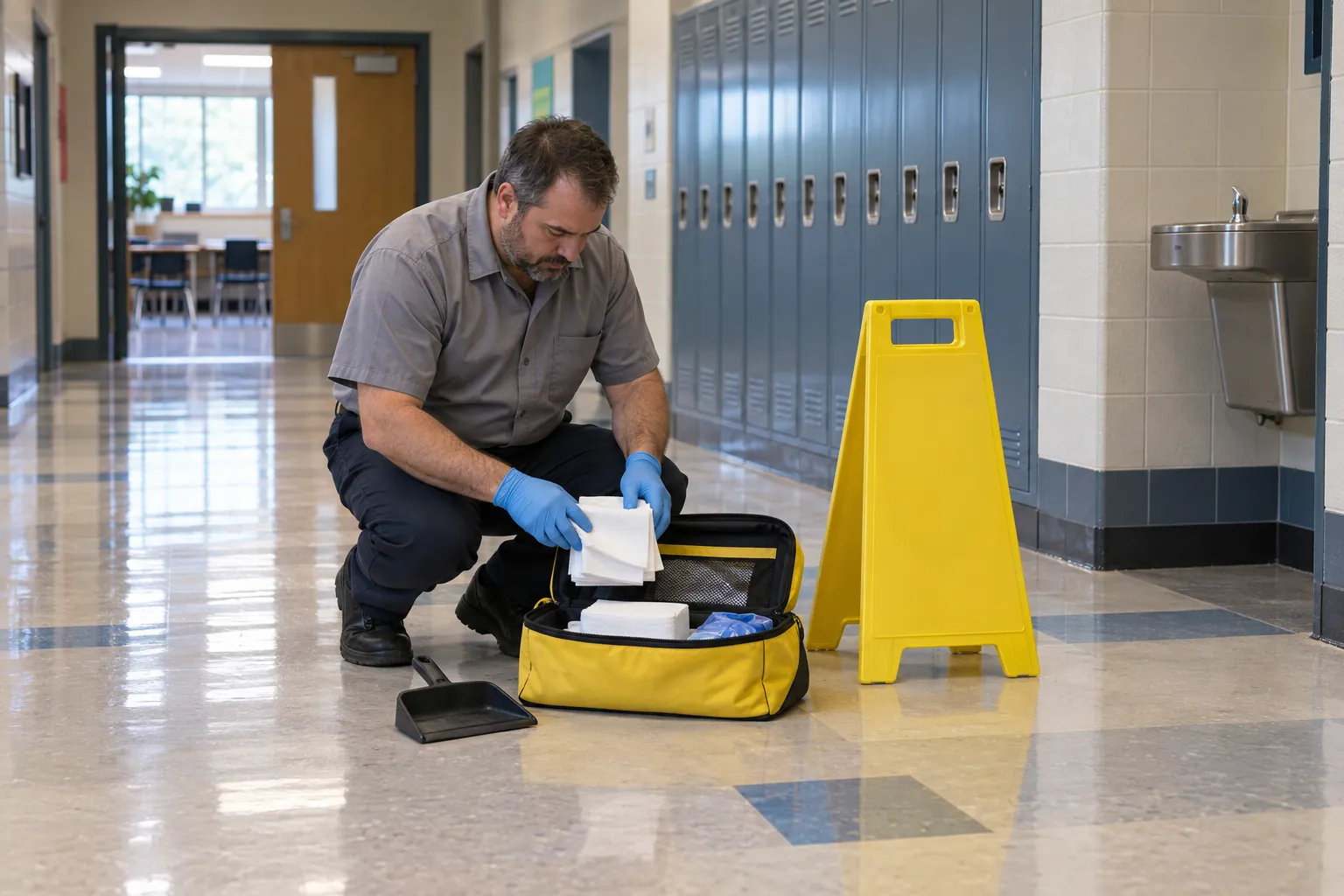 CleaningBlood spill cleanup: doing it safely, and showing it was doneHow to clean up a blood spill at work under OSHA's bloodborne pathogens standard: PPE, sharps, disinfectants, waste, training and the record to keep.
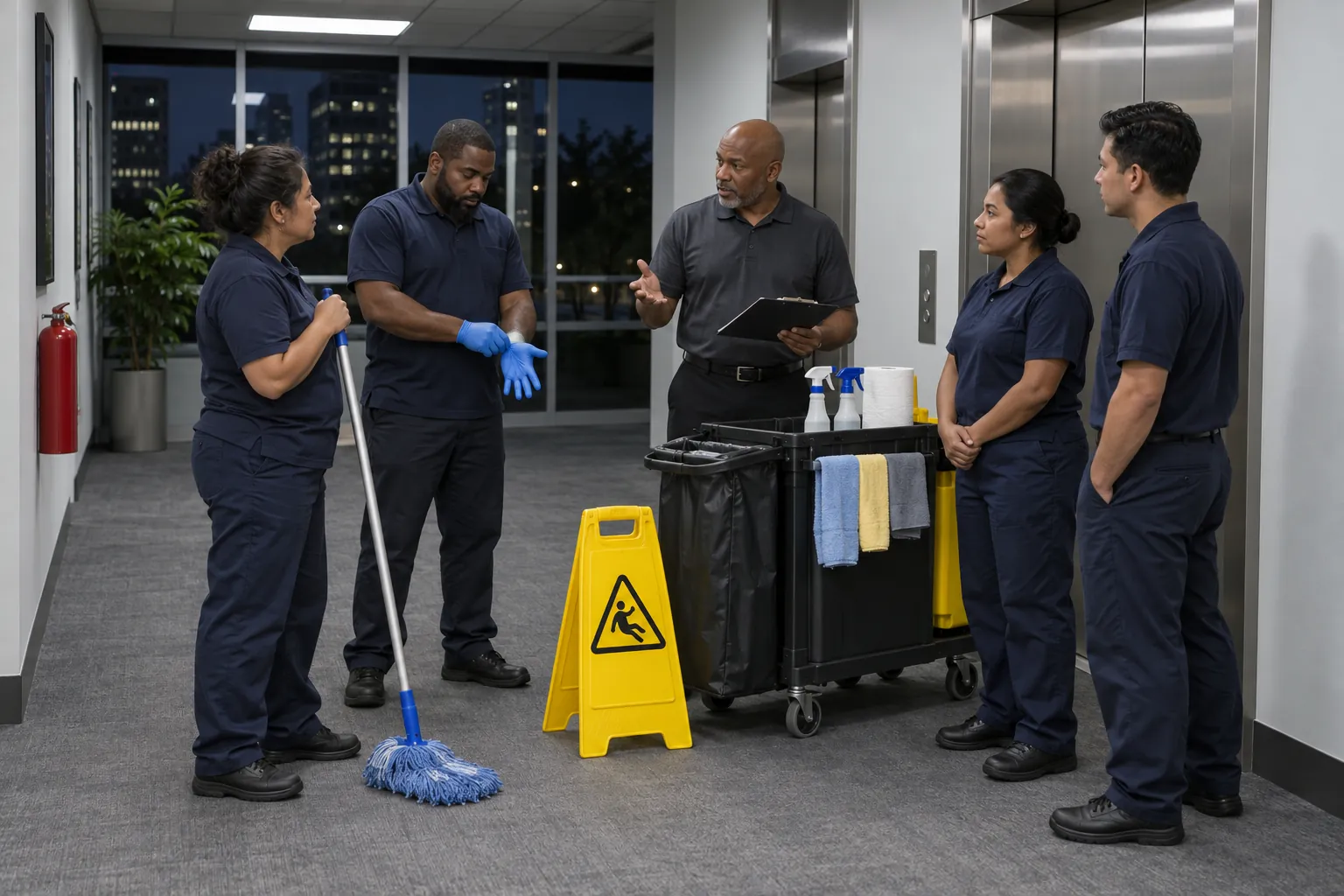 CleaningJanitorial supervisor duties: what the job involves, and what good looks likeWhat a janitorial supervisor does: the core duties, a typical night shift, the OSHA rules behind the work, inspecting the cleaning and reporting to the client.