Cleaning
Norovirus cleanup: how to deal with vomit and diarrhea without spreading the virus
Norovirus cleanup means wiping up the vomit or diarrhea with paper towels while wearing gloves, disinfecting the whole area with a 1,000 to 5,000 ppm bleach solution or an EPA-registered norovirus disinfectant, and then cleaning it again with soap and hot water.
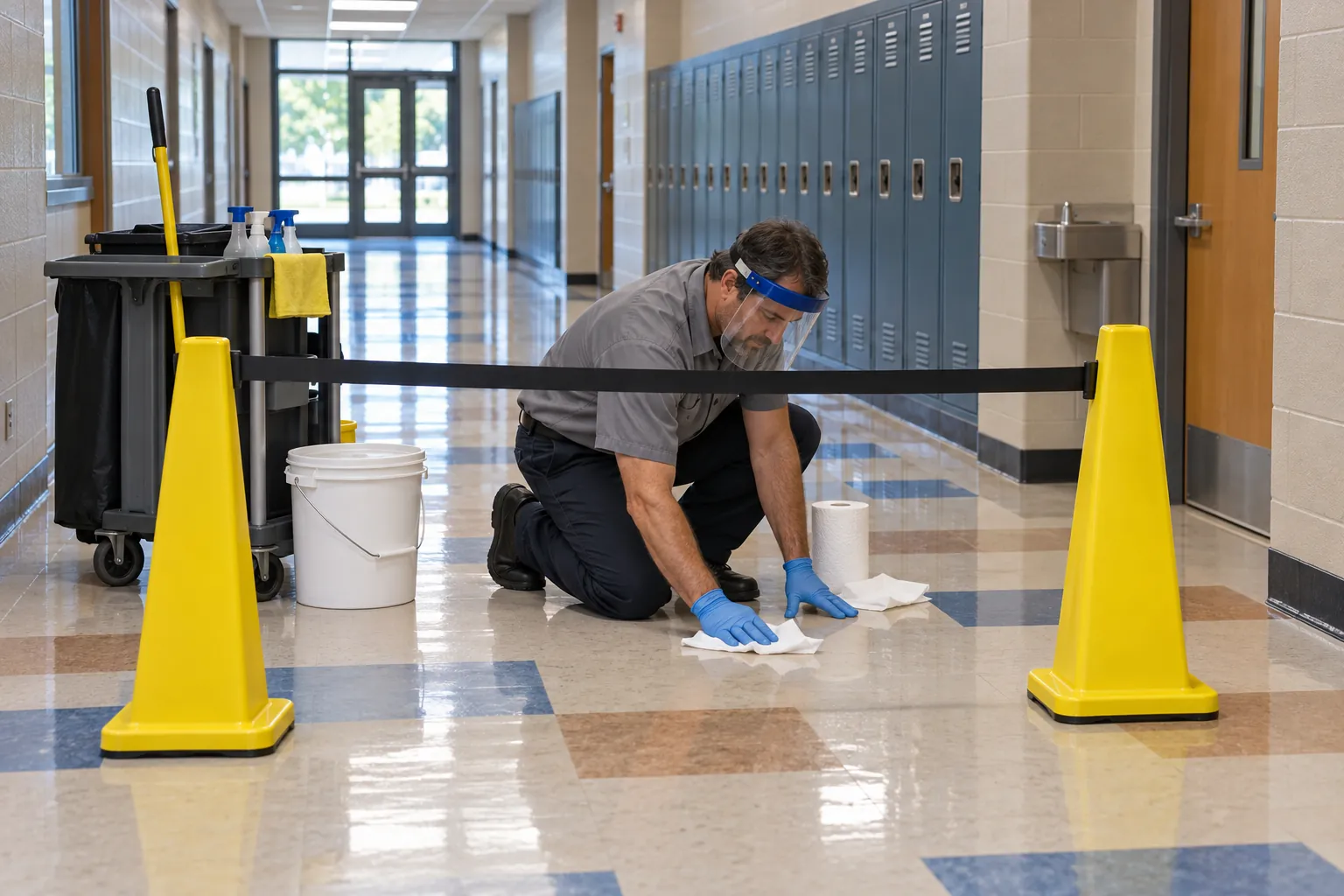
A vomiting incident in a school hallway, a restaurant dining room or a nursing home corridor is a cleaning job with a short fuse. Norovirus spreads from a few particles, rides on droplets and survives the routine wipe-down, so the way the spill is cleaned decides whether one sick person becomes twenty. This guide sets out what the CDC, EPA, the FDA Food Code and OSHA say, the cleanup step by step, who should do it, and what a record of it should show.
01
Why norovirus cleanup is different, and what the rules say
The CDC's About Norovirus page calls norovirus "the leading cause of vomiting and diarrhea, and foodborne illness in the United States." Its page on how norovirus spreads adds that "it only takes a few norovirus particles" to make someone sick, that people can spread the virus for two weeks or more after they feel better, and that tiny drops of vomit spray through the air. The visible puddle is the smallest part of the contamination.
Routine cleaning falls short, for two reasons. First, the virus lasts: the CDC's norovirus outbreak basics page says it "can persist on surfaces for days or weeks and is resistant to many common disinfectants." Second, the FDA's explanation of its food-service rule notes that "certain quaternary ammonium compounds" used for sanitizing and for disinfecting counters and floors "may not be effective against Norovirus."
There is no single federal norovirus cleanup rule for every building. Four sources set the standard between them:
- The CDC's How to Prevent Norovirus gives the cleanup steps and the bleach strength.
- The Environmental Protection Agency's List G: EPA's Registered Antimicrobial Products Effective Against Norovirus names the registered disinfectants with a norovirus claim, each with its own contact time.
- The FDA Food Code 2022, section 2-501.11, requires every food establishment to have written procedures for vomiting and diarrheal events. It is a model code, binding once the state or local health authority adopts it; check which edition yours uses.
- OSHA's general duties for the people doing the cleanup: the hazard assessment and PPE under 29 CFR 1910.132, hazard communication for the chemicals under 29 CFR 1910.1200, and, where there is blood in the spill, the Bloodborne Pathogens standard, 29 CFR 1910.1030. In the 21 states and Puerto Rico whose own OSHA-approved State Plans cover private employers, the State Plan's version of these rules applies instead.
Hospitals and nursing homes also have the CDC's Guideline for the Prevention and Control of Norovirus Gastroenteritis Outbreaks in Healthcare Settings (2011), last updated in February 2017, for cleaning during an outbreak.
02
Where vomit cleanup happens, and who ends up doing it
Norovirus is seasonal and it clusters. The CDC says outbreaks "occur throughout the year but are most common from November to April," that healthcare facilities are the most commonly reported setting, and that over half of reported U.S. outbreaks are in long-term care facilities. Most foodborne outbreaks start in food service settings such as restaurants, and outbreaks also frequently occur in schools, childcare centers, colleges and universities; cruise ships account for only about 1% of reported outbreaks. In practice a custodian or day porter can meet a vomit spill almost anywhere:
- Schools and colleges: classrooms, buses, cafeterias and residence hall restrooms, often with a class waiting to come back in.
- Offices and public buildings: restrooms, elevators, lobbies and stairwells.
- Food service: dining rooms, counters and kitchens, where the Food Code procedure also has to deal with any food that may have been exposed.
- Healthcare and senior living: patient rooms, bathrooms and common areas, where a spill may be the first sign of an outbreak.
- Retail, venues and transit: aisles, seating, carpet and restrooms, where the public keeps walking through unless someone closes the area off.
The job is almost always the custodial or EVS team's, but the first person on the scene rarely is. A teacher, a server or a front-desk officer needs to know two things: keep people away, and call the right person.
Diarrhea in a restroom is the same hazard. The FDA's note on section 2-501.11 records that "the bathroom environment was identified as a major reservoir of human Norovirus, even in the absence of an ill individual on site," so treat a soiled stall like a vomit spill.
03
Norovirus cleanup, step by step
This sequence follows the CDC's steps and the Food Code's plan. Follow the product label wherever the two differ.
- Close off the area. Move people away, including anyone eating nearby, and put up a barrier or cones. The Food Code's public health note asks a plan to cover "the segregation of areas that may have been contaminated" and the prompt removal of the ill person from food areas.
- Get the spill kit and put on PPE. The CDC says to "wear rubber or disposable gloves." A disposable gown or apron protects clothing, and a mask and eye protection make sense where splashing is likely; the CDC's healthcare guideline recommends a surgical or procedure mask and eye protection or a full face shield where splashes to the face are anticipated during patient care, particularly around patients who are vomiting.
- Remove the bulk. Cover the spill with absorbent powder or paper towels, then scoop or wipe it up without spreading it. The CDC's instruction is to "wipe the entire area with paper towels and throw them in a plastic trash bag."
- Clean before you disinfect. The CDC's healthcare guideline says to clean surfaces before applying a disinfectant; organic soil left behind shields the virus.
- Disinfect the whole area. Use a chlorine bleach solution of 1,000 to 5,000 ppm, which the CDC gives as "5 to 25 tablespoons of household bleach [5% to 8%] per gallon of water," or an EPA-registered product with a norovirus claim. The CDC says to "leave bleach disinfectant on the affected area for at least 5 minutes"; for any other product, the contact time is the one on its label.
- Clean again. The CDC's last surface step is to "clean the entire area again with soap and hot water."
- Deal with soft surfaces and laundry. Handle soiled linens "carefully without shaking them," then, as the CDC advises, "wash the items with detergent and hot water at the maximum available cycle length" and machine dry them at the highest heat setting. For upholstery its healthcare guideline suggests immediate cleaning with a manufacturer-approved agent, and considering steam cleaning.
- Clean the tools and bag the waste. Change or launder mop heads and cloths, and clean and disinfect the bucket, scoop and any reusable equipment. The CDC's healthcare guideline says to change mop heads after large spills of emesis or fecal material.
- Take off PPE and wash your hands. Take off gloves first, or peel them off with the gown, then remove the eye protection and any gown still on, take off the mask last, and wash your hands with soap and water for at least 20 seconds. The CDC is plain that "hand sanitizer does not work well against norovirus."
- Reopen, then follow up. Reopen when the surface is clean and dry, restock the kit, and step up cleaning of nearby high-touch surfaces.
04
Choosing the disinfectant and stocking the spill kit
The product on the janitorial cart for daily restroom cleaning may have no norovirus claim, or one only at a stronger dilution or longer contact time than the crew uses. EPA's List G is the check: it lists registered products whose testing EPA has reviewed and found to kill norovirus, with contact times that range on the list from half a minute to 15 minutes. EPA's instruction is to "check that the product's label includes directions for use as a disinfectant product against norovirus." Because the human virus is hard to grow in a lab, List G products are tested against a surrogate, feline calicivirus, as the list's full title says.
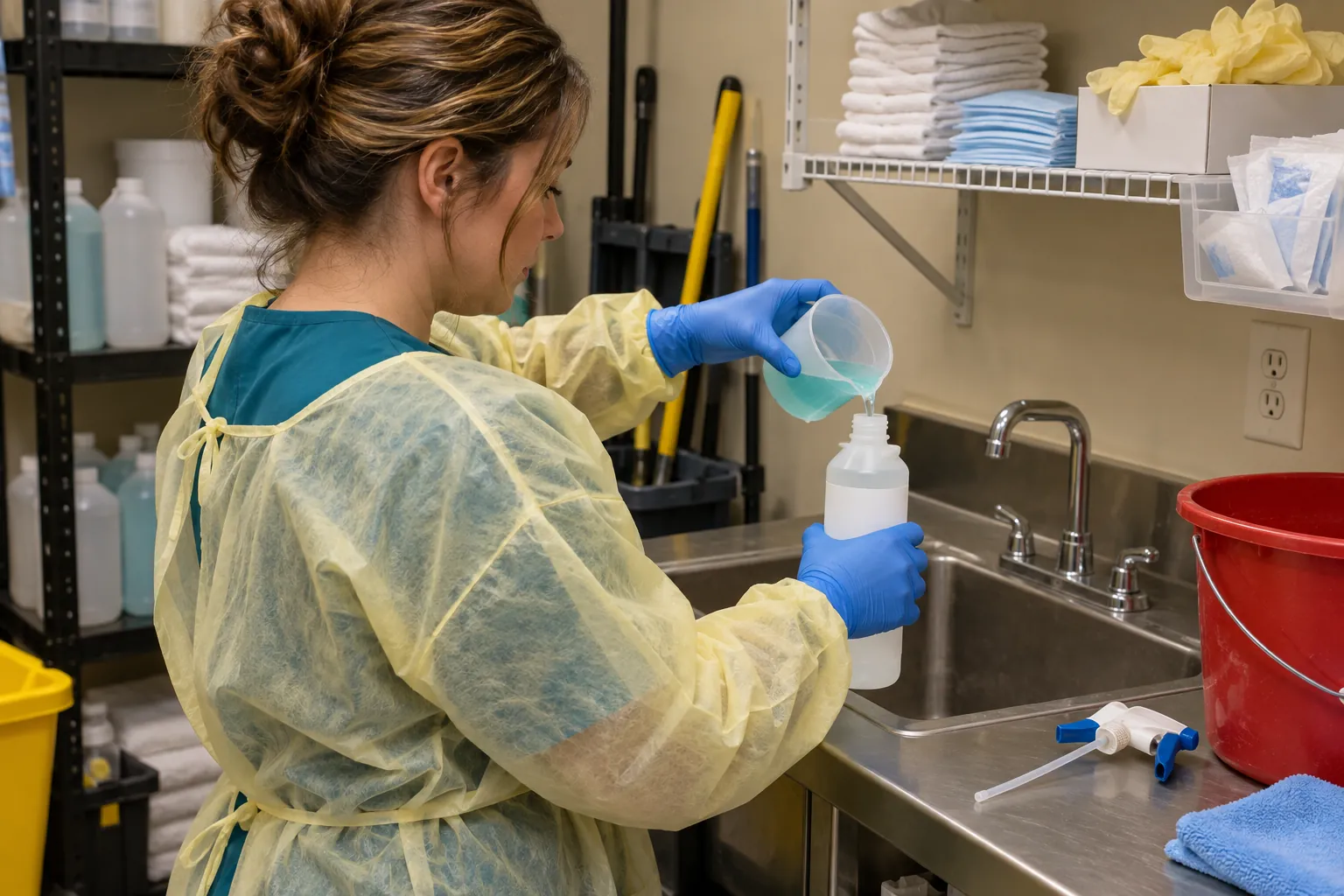
Bleach remains the default in many buildings because the CDC gives a strength for it. Measure it, mix it on the day, follow the label, and mark the container with what it is and when it was mixed.
Whichever product you choose, the chemicals come with OSHA duties. The Hazard Communication standard, 29 CFR 1910.1200, requires a written hazard communication program, safety data sheets readily accessible to employees during each shift, and training when a worker is first assigned and when a new hazard is introduced. Its consumer product exemption applies only where exposure is no greater than a consumer's, which a custodian using disinfectant every shift is unlikely to meet.
A spill kit should be ready before it is needed and within reach in minutes. A workable kit holds:
- disposable gloves in several sizes, disposable aprons or gowns, surgical masks and eye protection or face shields;
- absorbent powder or granules, a scoop and scraper, and plenty of paper towels;
- a List G disinfectant with its contact time written on the kit, or bleach with a measuring cup and a labeled spray bottle;
- heavy plastic trash bags and ties, and a bag for soiled laundry;
- a wet floor sign or cones and a barrier to close off the area;
- a laminated copy of the procedure, and a way to record the cleanup.
Check the kit on a schedule and after every use for expired product, missing gloves and a dirty scoop.
05
The written plan, the training and what changes in an outbreak
For a food establishment the written procedure is not optional where the Food Code is adopted. Section 2-501.11 says a food establishment "shall have written procedures for EMPLOYEES to follow when responding to vomiting or diarrheal events that involve the discharge of vomitus or fecal matter onto surfaces," and the inspection guidance in the Food Code's annex marks the item out of compliance when the establishment cannot show them. The annex lists what the plan should consider, a sound template for any building: containing and removing the discharge, including airborne particles; cleaning and disinfecting surfaces; dealing with exposed food; having the right disinfectants, PPE and equipment; cleaning the tools; when PPE is worn; closing off the area; and keeping ill employees and customers away from food.
Outside food service, OSHA's PPE standard, 29 CFR 1910.132, still asks the employer to "assess the workplace to determine if hazards are present, or are likely to be present, which necessitate the use of personal protective equipment," to certify that assessment in writing, and to train each worker in when and what PPE is necessary and how to put it on, take it off and dispose of it. Spill cleanup belongs in that assessment for custodial, EVS and porter roles.
Blood changes the rules. Under the Bloodborne Pathogens standard, 29 CFR 1910.1030, other potentially infectious materials include "any body fluid that is visibly contaminated with blood, and all body fluids in situations where it is difficult or impossible to differentiate between body fluids." Vomit with blood in it is therefore covered, and surfaces must be "cleaned and decontaminated after contact with blood or other potentially infectious materials" under a written cleaning schedule. Workers with occupational exposure need the training and hepatitis B vaccination the standard sets out; see the blood spill cleanup guide.
When cases start to cluster, a single-spill routine is not enough. The CDC's healthcare guideline recommends increasing cleaning during norovirus outbreaks, for example unit-level cleaning twice daily and frequently touched surfaces three times daily; working from areas less likely to be contaminated, such as tray tables and counters, toward the most contaminated, such as toilets and bathroom fixtures; and changing mop heads with each new bucket of cleaning solution. The same principles suit a school or residence hall with a cluster of cases: more frequent passes, a defined list of high-touch surfaces, and restrooms last.
Two steps sit outside the cleaning team. The CDC tells sick people to wait at least 48 hours after symptoms stop before they prepare or handle food or care for others, and its healthcare guideline excludes ill staff for the same period. It also asks facilities to notify local and state health departments of a suspected outbreak as their rules require.
06
Where the norovirus cleanup record fails, and what SiteClara does about it
Most buildings have a norovirus procedure somewhere, and can say little afterward about what happened. The report of a spill reaches whoever was passing, and nobody writes down when it was reported or when the area reopened. The restroom log on the back of the door is initialed for the whole shift all at once. During an outbreak the extra cleaning passes are agreed in a meeting, with nothing to show which surfaces were done and when.
SiteClara records the routine checks at the location. A printed QR poster, with an optional NFC tag behind it, sits at each place a check is scheduled, such as a restroom, a cafeteria or the closet where the spill kit lives. Staff scan or tap on their own phone, with no app to install, see the checks due there, and mark each one done or say what stopped them. The time and the named person are recorded as it happens, with a photo when the check asks for one, and a problem someone reports, such as a spill in a hallway, goes onto the team's list of jobs until it is closed.
The supervisor sees what is due, done and missed across the day, and records the reason a check was missed. Each day they review it, add a note and approve a report that goes to the building's designated contacts the next morning at 8:00 by default. During an outbreak, that shows which restrooms were checked, by whom and when, and which spills were reported and closed.
07
Questions people ask
How do I clean up after norovirus?
The CDC's How to Prevent Norovirus page says to wear rubber or disposable gloves, wipe the entire area with paper towels and throw them in a plastic trash bag, and disinfect with a bleach solution of 1,000 to 5,000 ppm or an EPA-registered product against norovirus. It says to leave bleach on the area for at least 5 minutes, clean the area again with soap and hot water, and wash soiled laundry on the longest hot cycle.
What kills norovirus besides bleach?
The CDC's How to Prevent Norovirus page accepts an EPA-registered disinfecting product against norovirus in place of bleach. The products are named on List G: EPA's Registered Antimicrobial Products Effective Against Norovirus, each with its own contact time. The same CDC page says hand sanitizer does not work well against norovirus.
Do disinfectant wipes kill norovirus?
Only if the product is registered for it. EPA's List G includes wipes as well as ready-to-use and dilutable liquids, so the check is the EPA Reg. No. on the label. EPA also asks you to confirm the label has directions for use as a disinfectant against norovirus, and to leave the product on the surface for its listed contact time.
How long does norovirus live on surfaces?
The CDC's Norovirus Outbreaks page says norovirus "can persist on surfaces for days or weeks and is resistant to many common disinfectants." That is why a spill area needs a norovirus disinfectant, not only the everyday cleaner.
Can I catch norovirus from being in the same room?
Yes, when someone vomits. The CDC's How Norovirus Spreads page says tiny drops of vomit spray through the air, landing on surfaces or entering another person's mouth, which is why the area is closed off before cleanup starts. It also says people can still spread norovirus for 2 weeks or more after they feel better.
08
Where to read more, and a norovirus cleanup checklist to take away
Start with the CDC's How to Prevent Norovirus page and EPA's List G. Food establishments should read Food Code section 2-501.11 and check which edition their health authority has adopted; hospitals and long-term care facilities should use the CDC's 2011 guideline. OSHA's 29 CFR 1910.132, 1910.1200 and 1910.1030 cover the workers, or the state's own versions in a State Plan state. All are linked above.
Before the next spill, check that:
- there is a written vomit and diarrhea cleanup procedure, and in food service it meets section 2-501.11 as your jurisdiction adopted it;
- the first person on the scene knows to close off the area and who to call;
- every spill kit has gloves, gowns or aprons, masks and eye protection, absorbent, a scoop, bags, a barrier and a norovirus disinfectant, and is checked on a schedule;
- the disinfectant is on List G, or is bleach at 1,000 to 5,000 ppm, and staff know the contact time;
- safety data sheets are reachable on every shift;
- the PPE hazard assessment names spill cleanup, and the people who do it have been trained;
- anyone who may meet blood in a spill is covered by the Exposure Control Plan;
- sick staff stay away until 48 hours after symptoms stop;
- there is an outbreak routine with more frequent passes and a defined list of high-touch surfaces; and
- each spill is recorded when it is reported, cleaned and reopened, by the person who dealt with it, at the time.
See also cleaning versus disinfecting and the restroom cleaning log.
Sources
Every document this guide quotes or links to, in the order it first cites them.
- About Norovirus cdc.gov
- How norovirus spreads cdc.gov
- Norovirus outbreak basics cdc.gov
- How to Prevent Norovirus cdc.gov
- List G: EPA's Registered Antimicrobial Products Effective Against Norovirus epa.gov
- FDA Food Code 2022 fda.gov
- OSHA-approved State Plans osha.gov
- Guideline for the Prevention and Control of Norovirus Gastroenteritis Outbreaks in Healthcare Settings (2011) cdc.gov
- 29 CFR 1910.1200 osha.gov
- 29 CFR 1910.132 osha.gov
- 29 CFR 1910.1030 osha.gov
Related guides
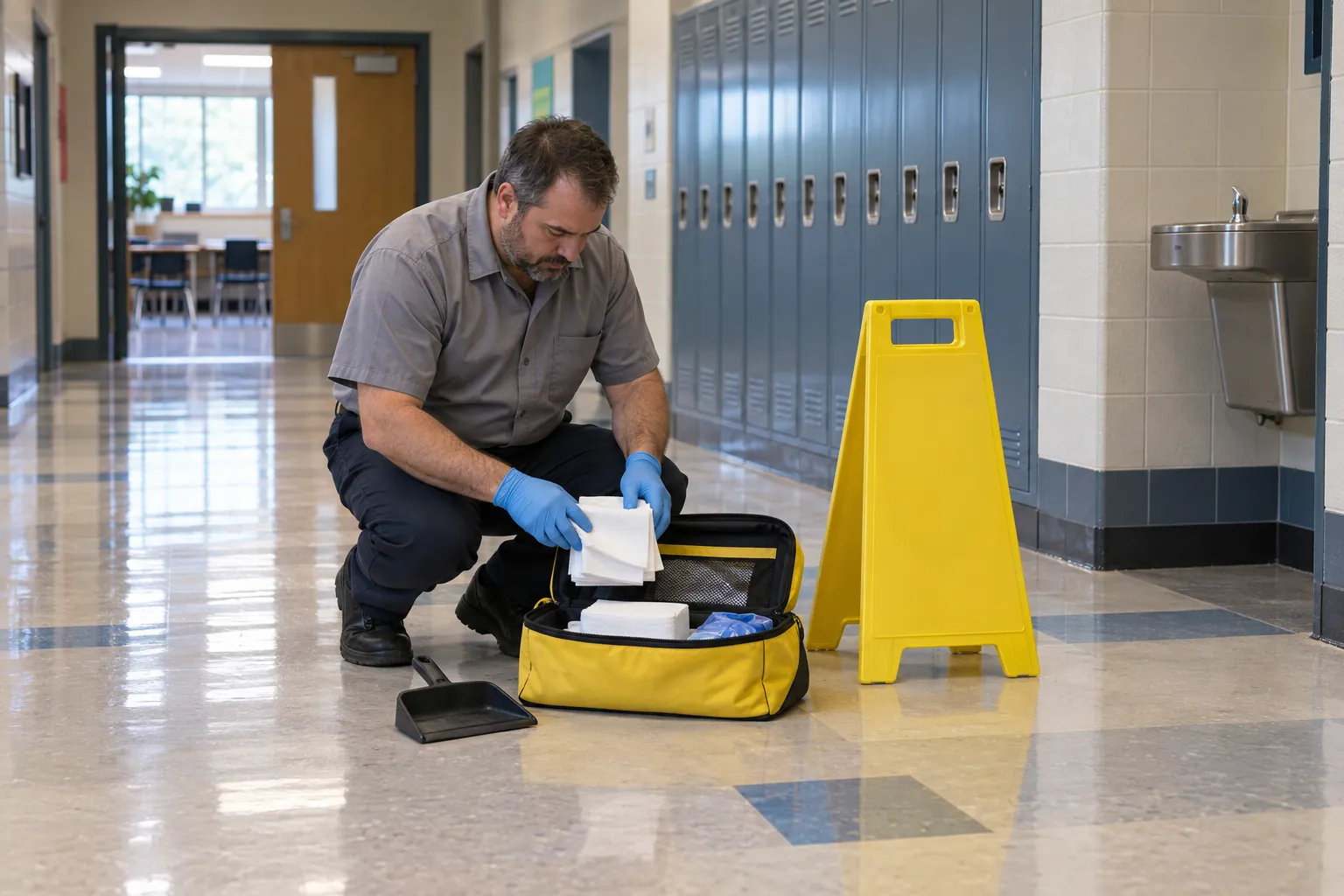 CleaningBlood spill cleanup: doing it safely, and showing it was doneHow to clean up a blood spill at work under OSHA's bloodborne pathogens standard: PPE, sharps, disinfectants, waste, training and the record to keep.
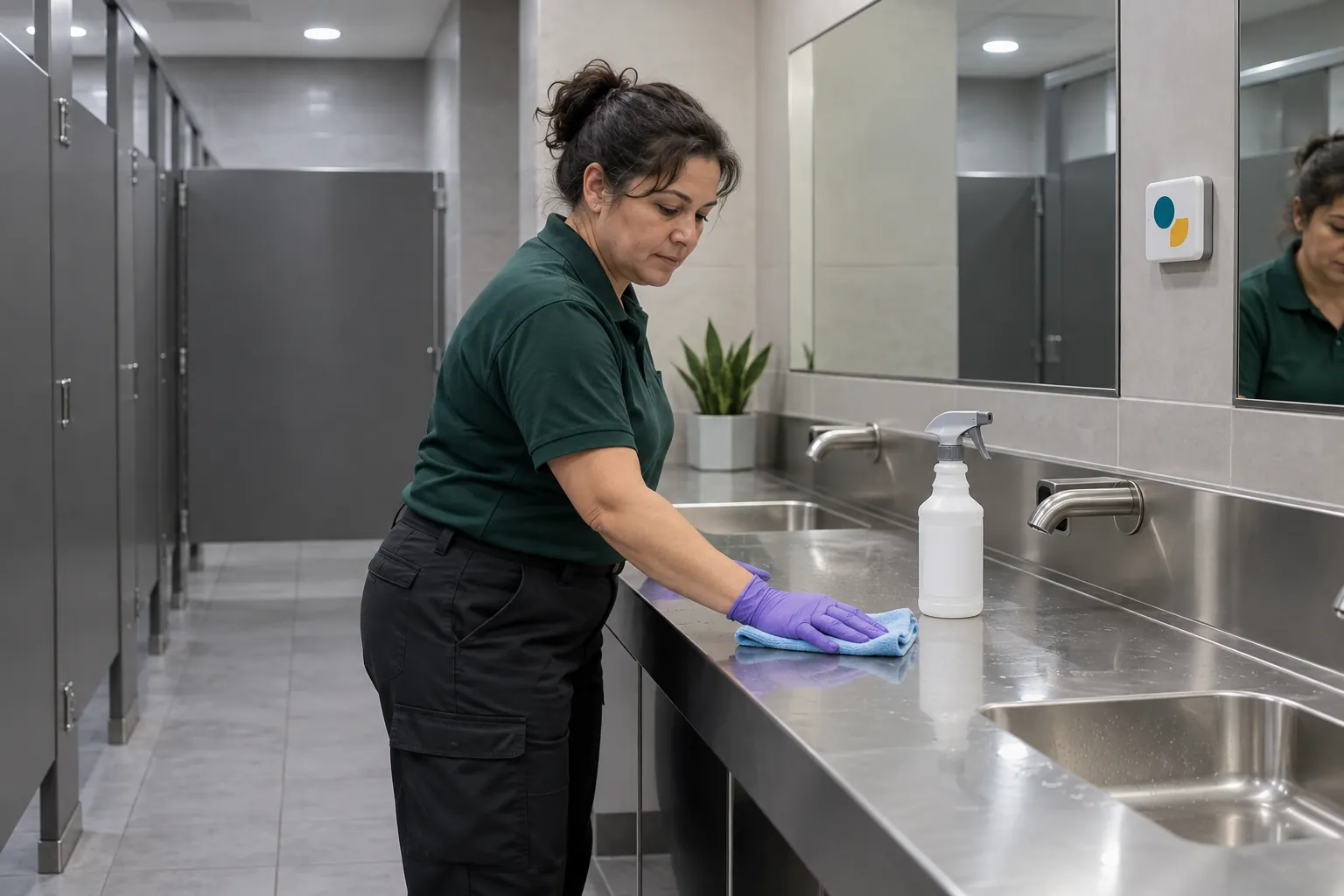 CleaningCleaning, sanitizing and disinfecting: what each one does, and when a building needs itCleaning, sanitizing and disinfecting defined by the CDC, EPA and FDA Food Code: when each is needed, how to do it right, and what the record should show.
 CleaningHigh-touch surfaces: a cleaning routine you can show was doneHigh-touch surfaces as the CDC describes them: which ones to list area by area, how often to clean and disinfect them, the right method, and a record that holds up.
 CleaningRestroom cleaning log: what to record, and how to make it believableWhat a restroom cleaning log should record, how often to check, the OSHA and Food Code rules behind it, and how to keep a log a client or inspector will believe.