Cleaning
Janitorial closet requirements: the sink, the chemicals and the daily check
A janitorial closet in the United States is governed by the plumbing code, which usually requires a service sink, and by OSHA, which requires the room to be kept clean, orderly and sanitary and the safety data sheets for its chemicals to be readily accessible during each work shift.
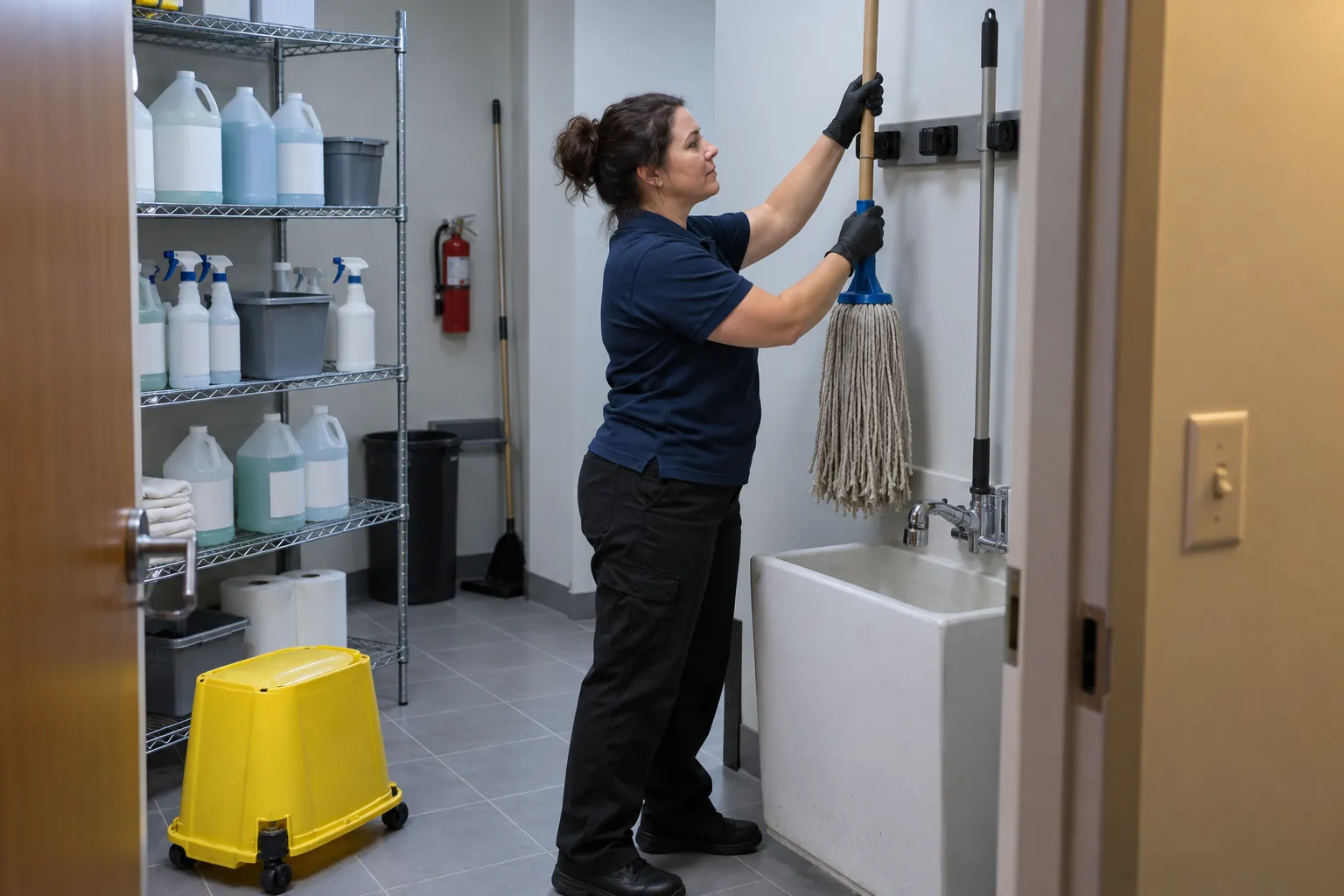
Most are small rooms doing a big job: a service sink, the cleaning chemicals, the mops and carts, the paper stock, and often an electrical panel on the back wall. No single rule is called the janitor closet standard, so the requirements come from the plumbing code, OSHA's general industry standards and the chemical labels themselves. This guide sets out what those say, how a well-run closet is laid out, and how to check it so it stays that way.
01
What the rules actually require of a janitorial closet
A janitorial closet, also called a janitor's closet, custodial closet or mop room, is the room where a building's cleaning is prepared and put away. Federal law does not define it as a room type. What it must contain, and how it must be kept, comes from three places: the plumbing code the building was permitted under, OSHA's general industry standards for the people who work in it, and the labels on the chemicals stored there.
The plumbing code. Plumbing codes in the United States are adopted by states and cities, usually from a model code with local amendments, and the authority having jurisdiction (AHJ) decides what applies to a given building. The fixture table in the adopted code is what usually requires a service sink, the deep, low sink a custodian fills and empties a mop bucket at. New York City publishes its own code free, and it shows how this works: Chapter 4 of the 2022 New York City Plumbing Code requires plumbing fixtures "in the minimum number shown in Table 403.1", and that table lists "1 service sink" in its Other column for most occupancies, from theaters to warehouses. A footnote relaxes it: "For business and mercantile occupancies with an occupant load of 15 or fewer, service sinks shall not be required." Section 422.7 of the same chapter adds that "A service sink shall not be utilized for the disposal of urine, fecal matter or other human waste", and that a clinical sink in a soiled utility room is not a substitute for one. Check your own jurisdiction's edition: the numbers and exceptions differ from place to place.
OSHA. Under 29 CFR 1910.22, the general requirements for walking-working surfaces, "All places of employment, passageways, storerooms, service rooms, and walking-working surfaces are kept in a clean, orderly, and sanitary condition." A janitorial closet is both a storeroom and a service room. The Hazard Communication standard, 29 CFR 1910.1200, governs the chemicals, 29 CFR 1910.151, Medical services and first aid, governs emergency eyewash where corrosives are handled, and 29 CFR 1910.132, the general requirements for personal protective equipment, governs the gloves and goggles on the shelf.
Check the state first. OSHA's State Plans page counts 22 state plans covering private and public employers and seven covering only state and local government workers. A state plan must be at least as effective as federal OSHA and may go further.
The label. Disinfectants and sanitizers are regulated by the EPA as antimicrobial pesticides, and the EPA's Introduction to Pesticide Labels gives the sentence every product carries: "It is a violation of Federal law to use this product in a manner inconsistent with its labeling." The storage, dilution and first aid directions on the jug are part of the closet's rules.
02
What a janitorial closet holds, and what goes wrong in each part
Each part of a closet fails in its own way:
- The service sink and faucet. Failures: a slow drain, a dripping faucet, a hose left in dirty water, a missing vacuum breaker.
- The chemical shelf and dispenser. Failures: unlabeled spray bottles, open jugs, incompatible products side by side, a bypassed dispenser.
- The safety data sheets. Failures: sheets for products no longer used, and none for the one bought last month.
- Emergency eyewash where concentrates are handled. Failures: blocked access, dust caps missing, never flushed.
- Personal protective equipment. Failures: the right gloves in the wrong size, or none left.
- Tools and equipment: mops, buckets, carts, vacuums, auto scrubbers and chargers (see the guide on floor scrubber maintenance). Failures: wet mop heads left in a bucket overnight, a scrubber tank left full.
- Consumables. Failures: stock stacked against a panel, and restrooms that run out because nobody knew stock was low.
- Shared building services: electrical panels, water shutoffs and risers. Failures: the working space in front of the panel used as storage, a valve hidden behind a cart.
- The room itself. Failures: standing water, leaks, poor lighting, no ventilation, pests.
None of these is dramatic. They are why a restroom runs out of soap, a custodian gets a chemical splash, or an electrician cannot reach a breaker.
03
Chemicals in the closet: hazard communication, labels, dilution and mixing
The Hazard Communication standard applies to the hazardous chemicals a janitorial crew uses, with one limited exemption: a consumer product used in the workplace for its intended purpose, where "the use results in a duration and frequency of exposure which is not greater than the range of exposures that could reasonably be experienced by consumers" (1910.1200(b)(6)(ix)). A custodian using a restroom cleaner for hours every shift is not using it the way a householder does, so most commercial cleaning programs treat the exemption narrowly. Where the standard applies, the employer must:
- "develop, implement, and maintain at each workplace, a written hazard communication program" (1910.1200(e)(1));
- keep safety data sheets for each hazardous chemical and "ensure that they are readily accessible during each work shift" (1910.1200(g)(8));
- label workplace containers, which may be done with the "Product identifier and words, pictures, symbols, or combination thereof, which provide at least general information regarding the hazards of the chemicals", provided that, with the other information immediately available under the hazard communication program, employees have the specific hazard information (1910.1200(f)(6)(ii)), and keep labels "legible, in English, and prominently displayed on the container, or readily available in the work area" (1910.1200(f)(10));
- train workers "at the time of their initial assignment, and whenever a new chemical hazard the employees have not previously been trained about is introduced into their work area" (1910.1200(h)(1)).
OSHA updated the standard in 2024, with compliance dates of May 19, 2026 for substances and November 19, 2027 for mixtures. For a closet, that means labels and data sheets changing as suppliers update them; the binder needs to keep up.
The joint OSHA and NIOSH InfoSheet Protecting Workers Who Use Cleaning Chemicals turns this into closet practice. Its safe work practices include "Warning workers not to mix cleaning products that contain bleach and ammonia", making sure workers know how to dilute correctly, labeling every container, running ventilation during cleaning, and giving workers a place to wash up. It advises employers to "choose the least hazardous cleaners", and says training must be given "at a level and in a language and vocabulary that they can understand."
In the closet this means a short list of approved products, a dilution system rather than free pouring where concentrates are used, every secondary bottle labeled before it leaves the room, incompatible products kept apart, and nothing decanted into a drink bottle or an unlabeled bucket; the guide on chemical dilution control covers the dispenser. Concentrates usually arrive in larger containers and are decanted into spray bottles and buckets; under 1910.1200(f)(8) only a portable container "intended only for the immediate use of the employee who performs the transfer" may go unlabeled, so a bottle that stays on the cart for the next shift needs its label. The plumbing code has a part in this too: Chapter 6 of the 2022 New York City Plumbing Code requires that "Where chemical dispensers connect to the potable water distribution system, the water supply system shall be protected against backflow" (608.16.7), and that hose connections "shall be protected by an atmospheric-type or pressure-type vacuum breaker or a permanently attached hose connection vacuum breaker" (608.15.4.2). A dilution dispenser fitted by a supplier should come with its backflow device; if someone has removed it, that is a plumbing matter, not a cleaning one.
04
Layout and housekeeping: sink, storage, eyewash, panels and floor
A well-run janitorial closet is laid out so the right thing is the easy thing. The details depend on the room, but the pattern is the same:
- Sink and drying. The service sink kept clear, with a wall-mounted mop and broom rack above or beside it so heads hang to drain and dry instead of sitting in a bucket. Buckets emptied, rinsed and turned over at the end of the shift.
- Chemicals at or below eye level. Concentrates on low, sturdy shelving with containment trays, ready-to-use bottles above, incompatible products apart, nothing in the sink.
- Information by the chemicals. The SDS binder, or a note of where the electronic sheets are, with the dilution chart and the approved product list.
- Eyewash reachable. Where the eyes or body may be exposed to corrosives, 1910.151(c) requires that "suitable facilities for quick drenching or flushing of the eyes and body shall be provided within the work area for immediate emergency use." The consensus standard for that equipment is ANSI/ISEA Z358.1; read it with the manufacturer's instructions. The route to the station stays clear of carts.
- PPE by the door. Gloves and eye protection chosen for the products after the hazard assessment 1910.132(d) requires, with the employer's written certification that it was done. See the guide on janitorial PPE.
- Panels clear. Where an electrical panel shares the room, 29 CFR 1910.303(g)(1)(ii) is plain: "Working space required by this standard may not be used for storage." For equipment at 0 to 150 volts to ground, Table S-1 in (g)(1)(i) gives a minimum working-space depth of 3 feet whatever the condition. Mark the floor if carts keep drifting into it. The same goes for water shutoffs and risers.
- Stock organized. Consumables on shelving off the floor, oldest in front, with a par level for each so a low shelf is obvious.
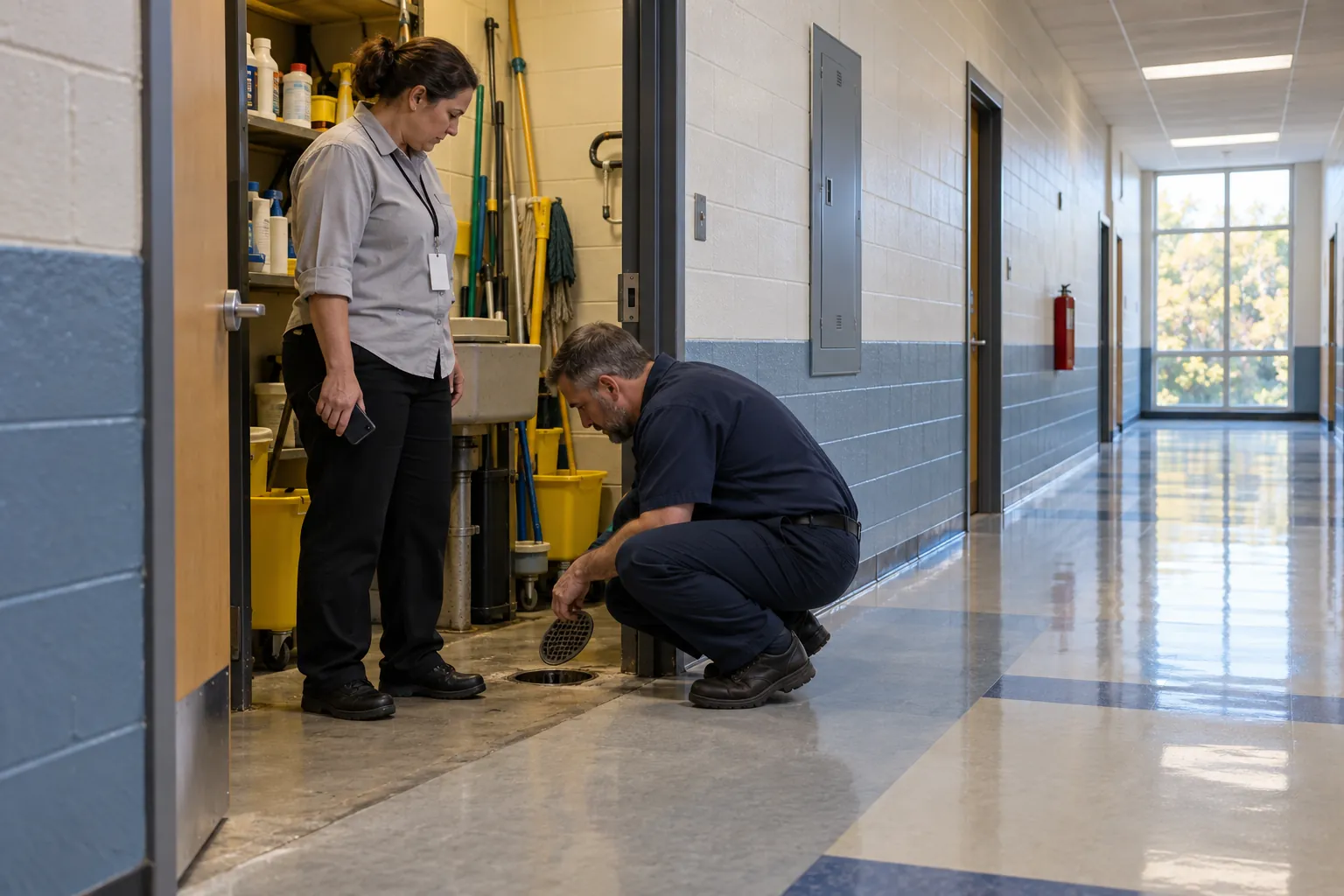
- Floor dry and drains working. 1910.22(a)(2) requires each workroom floor to be "maintained in a clean and, to the extent feasible, in a dry condition", and 29 CFR 1910.141 requires that "All places of employment shall be kept clean to the extent that the nature of the work allows." A closet with a permanent puddle has a leak or a drain to report.
- Waste out. Waste receptacles that do not leak and can be cleaned, which is what 1910.141(a)(4)(i) asks of any receptacle for putrescible waste. Bagged trash belongs in the trash room, not the closet; see the guide on trash room cleaning.
In healthcare, the closet also carries infection control. The Environmental Services section of the CDC's Guidelines for Environmental Infection Control in Health-Care Facilities says that "Laundering of cloths and mop heads after use and allowing them to dry before re-use can help to minimize the degree of contamination", and that making fresh cleaning solution for daily cleaning, discarding what is left and drying out the container helps to minimize bacterial contamination. The same habits suit any building, and a color-coded system keeps restroom mops and cloths apart; see the guide on color-coded cleaning.
05
The closet check: how often, who does it, and what good evidence looks like
None of the rules above sets a frequency for checking a janitorial closet, apart from 1910.22(d)(1), which requires walking-working surfaces to be "inspected, regularly and as necessary". The routine is the facility's own. A pattern that works for most commercial buildings:
- Every shift, by the custodian closing the closet: buckets emptied and turned over, mop heads hung or bagged for laundry, sink clear and faucet off, chemicals capped and on the shelf, nothing in front of the panel or eyewash, floor dry, door closed and locked if it locks.
- Weekly, by the janitorial supervisor or lead: stock against par levels, labels on every bottle, dispenser working and dilution correct, PPE stocked in the right sizes, eyewash checked to the manufacturer's instructions, and any leak, slow drain or broken shelf reported as a work order.
- Monthly or when products change: the SDS collection compared with what is actually on the shelves, retired products removed, and new products added to the approved list and the training.
- At contract start, and after any change to the room: a walkthrough with the facility manager or building engineer to agree what is stored there and who owns the panel and valves.
Good evidence of a closet check says which closet, who checked it, when, what was found and what was done about it. In a large building the supervisor rarely sees every closet, so the record matters. A photo of the shelf and the panel front, taken at the time, settles most arguments.
06
Where the closet record fails, and what SiteClara does about it
Most janitorial closets have no record at all, or a sheet taped inside the door and initialed at the end of the week. It cannot show when the room was last checked, or who left the scrubber full. The leak noticed on Tuesday night is mentioned to whoever is passing, and the building engineer hears about it when the floor below reports a ceiling stain.
SiteClara puts a tag at the closet door: a printed QR code poster, with an NFC tag behind it if staff would rather tap than scan. A custodian scans or taps on their own phone, with no app to install, sees the checks due in that closet, and marks each one done or says what stopped them. The time and the named person are recorded as it happens, with a photo when one is asked for, such as the shelf or the panel front. A problem found there, a slow drain, a broken shelf, a missing eyewash cap, is recorded at the closet and goes onto the team's list of jobs until someone closes it.
The janitorial supervisor sees which closets were checked and which were missed, and records the reason a check was missed. At the end of the day they review it, add a note and approve a report that goes to the facility manager or the client at 8 a.m. the next morning, showing what was checked, what was reported and what is still open.
07
Questions people ask
What are the requirements for a janitor's closet?
No single US rule is written for the room itself. The plumbing code usually requires the service sink: Chapter 4 of the 2022 New York City Plumbing Code, for example, lists "1 service sink" for most occupancies in Table 403.1 and excuses business and mercantile occupancies with an occupant load of 15 or fewer. OSHA's 29 CFR 1910.22, the general requirements for walking-working surfaces, requires storerooms and service rooms to be "kept in a clean, orderly, and sanitary condition", and the Hazard Communication standard, 29 CFR 1910.1200, requires labeled containers and safety data sheets "readily accessible during each work shift". Your own jurisdiction's adopted code decides the plumbing details.
What would be in a janitor's closet?
Usually a service sink, the cleaning chemicals, the protective equipment to use them and the tools and stock. The OSHA and NIOSH InfoSheet Protecting Workers Who Use Cleaning Chemicals says employers "must obtain and maintain SDSs for all hazardous cleaning products and chemicals that they use" and that "SDSs must be readily accessible to workers", and its safe work practices include labeling every container of cleaning product to identify its contents and hazards and providing the gloves and goggles each product needs.
08
Where to read the rules, and a list to take away
The OSHA and NIOSH InfoSheet Protecting Workers Who Use Cleaning Chemicals is the most useful single document for a janitorial closet, read with the Hazard Communication standard. If your state runs its own plan, read its standards on the state's site. For the plumbing, ask your local building department which code and edition applies.
Before you sign off a janitorial closet, check that:
- the service sink drains, the faucet does not drip and the hose connection has its vacuum breaker;
- every product on the shelf is on the approved list, labeled, capped and has a safety data sheet you can reach during the shift;
- concentrates are low, contained and away from incompatible products, and dilution goes through the dispenser;
- eyewash is provided where corrosives are handled, reachable and checked;
- gloves and eye protection match the products and the hazard assessment;
- nothing is stored in the working space in front of an electrical panel, valve or riser;
- mops are hung to dry, buckets emptied, and the floor is dry;
- stock is off the floor with a par level for each item;
- someone checks the closet every shift, and the record shows who, when and what was found;
- leaks, drains and broken fittings go to the building engineer as work orders, not as a remark in passing.
Sources
Every document this guide quotes or links to, in the order it first cites them.
- Chapter 4 of the 2022 New York City Plumbing Code nyc.gov
- 29 CFR 1910.22, the general requirements for walking-working surfaces osha.gov
- Hazard Communication standard, 29 CFR 1910.1200 osha.gov
- 29 CFR 1910.151, Medical services and first aid osha.gov
- 29 CFR 1910.132, the general requirements for personal protective equipment osha.gov
- State Plans page osha.gov
- Introduction to Pesticide Labels epa.gov
- Protecting Workers Who Use Cleaning Chemicals osha.gov
- Chapter 6 of the 2022 New York City Plumbing Code nyc.gov
- 29 CFR 1910.303(g)(1)(ii) osha.gov
- 29 CFR 1910.141 osha.gov
- Environmental Services section of the CDC's Guidelines for Environmental Infection Control in Health-Care Facilities cdc.gov
Related guides
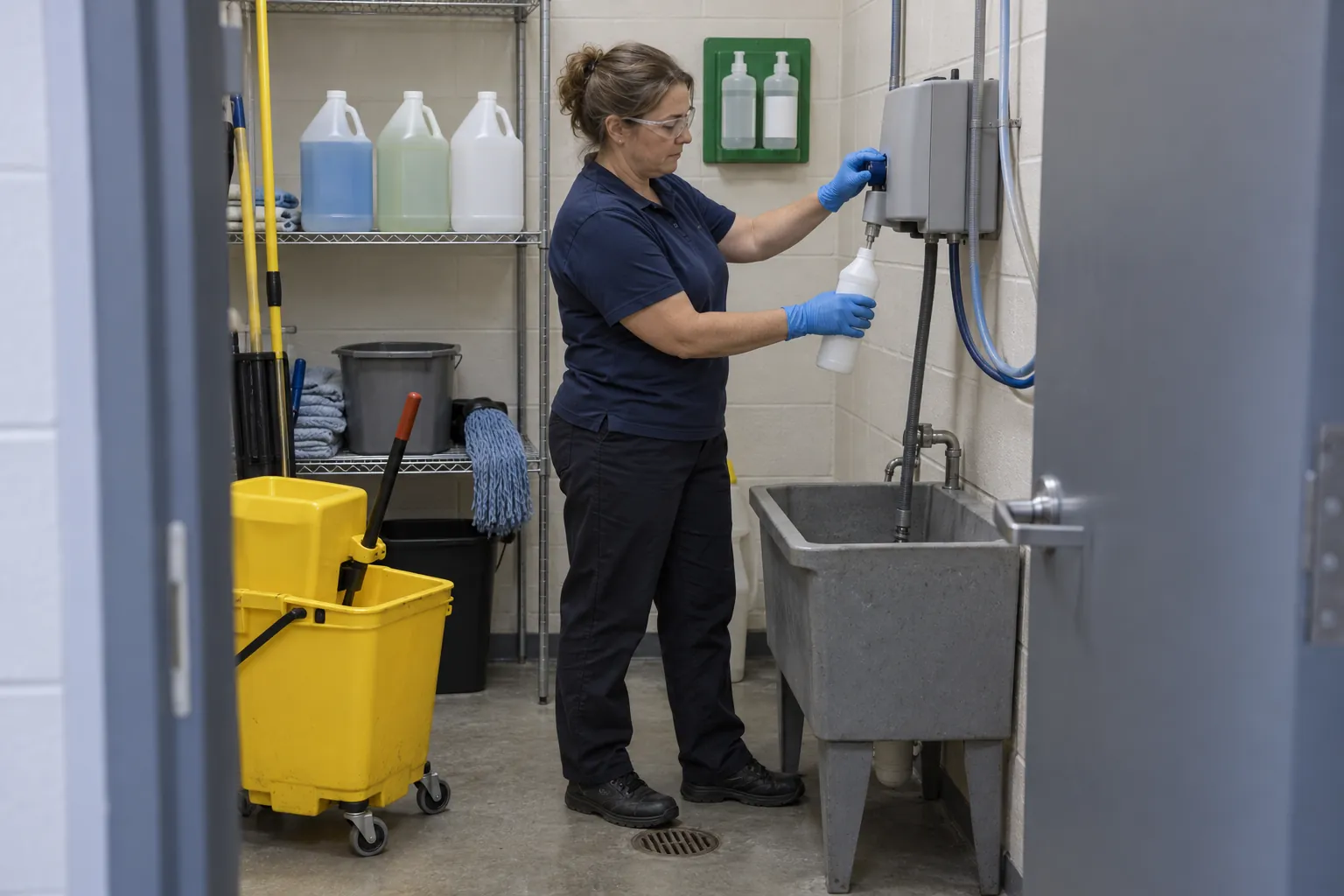 CleaningChemical dilution control: getting the mix right, every bottle, every shiftHow a chemical dilution control system works, what OSHA HazCom and EPA labels require, how to check dispensers and bottles, and what the record should show.
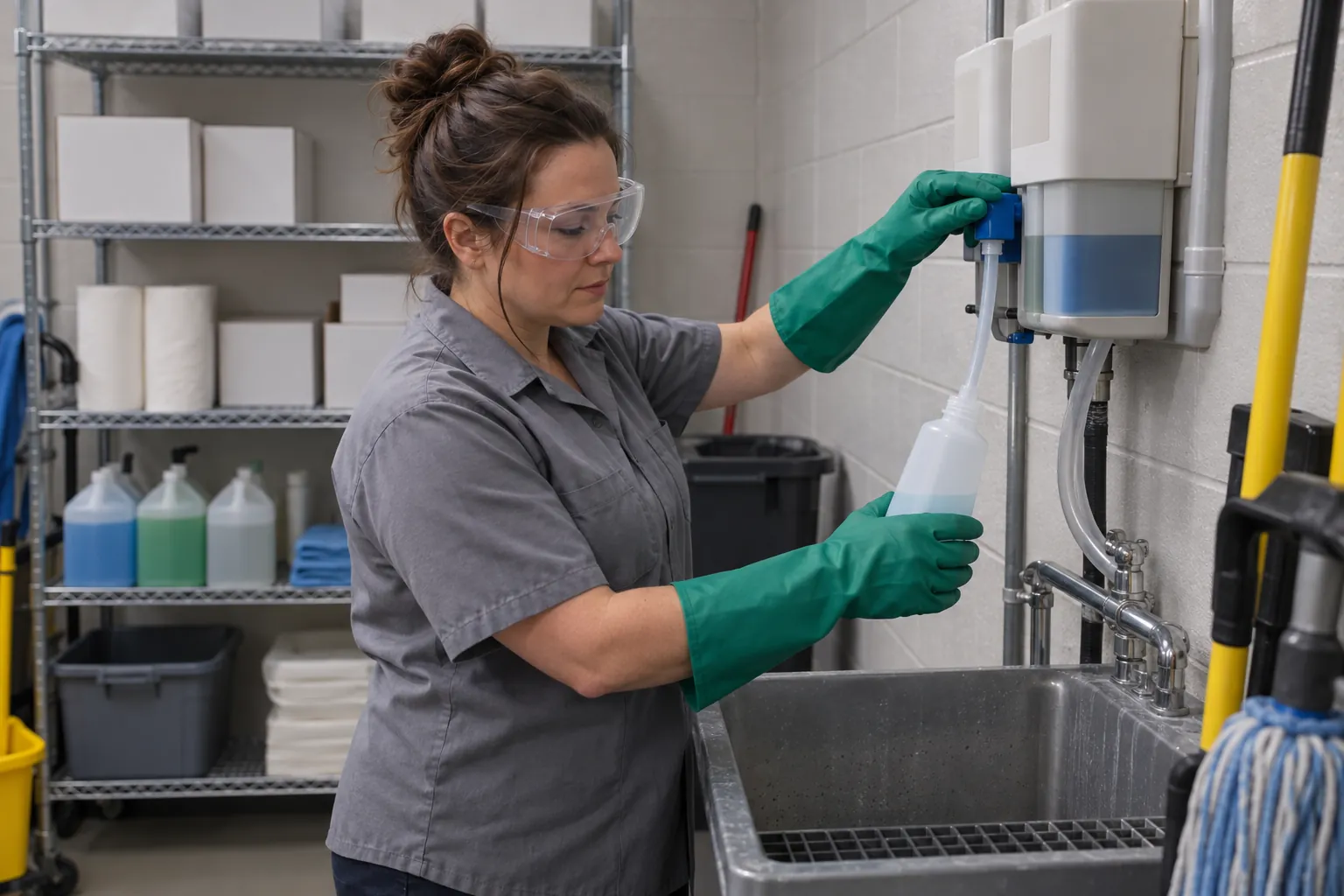 CleaningJanitorial PPE: the hazard assessment, the kit and the daily checkJanitorial PPE under OSHA 29 CFR 1910.132: the hazard assessment, gloves, eye protection, footwear, bloodborne pathogens, training, payment and the daily check.
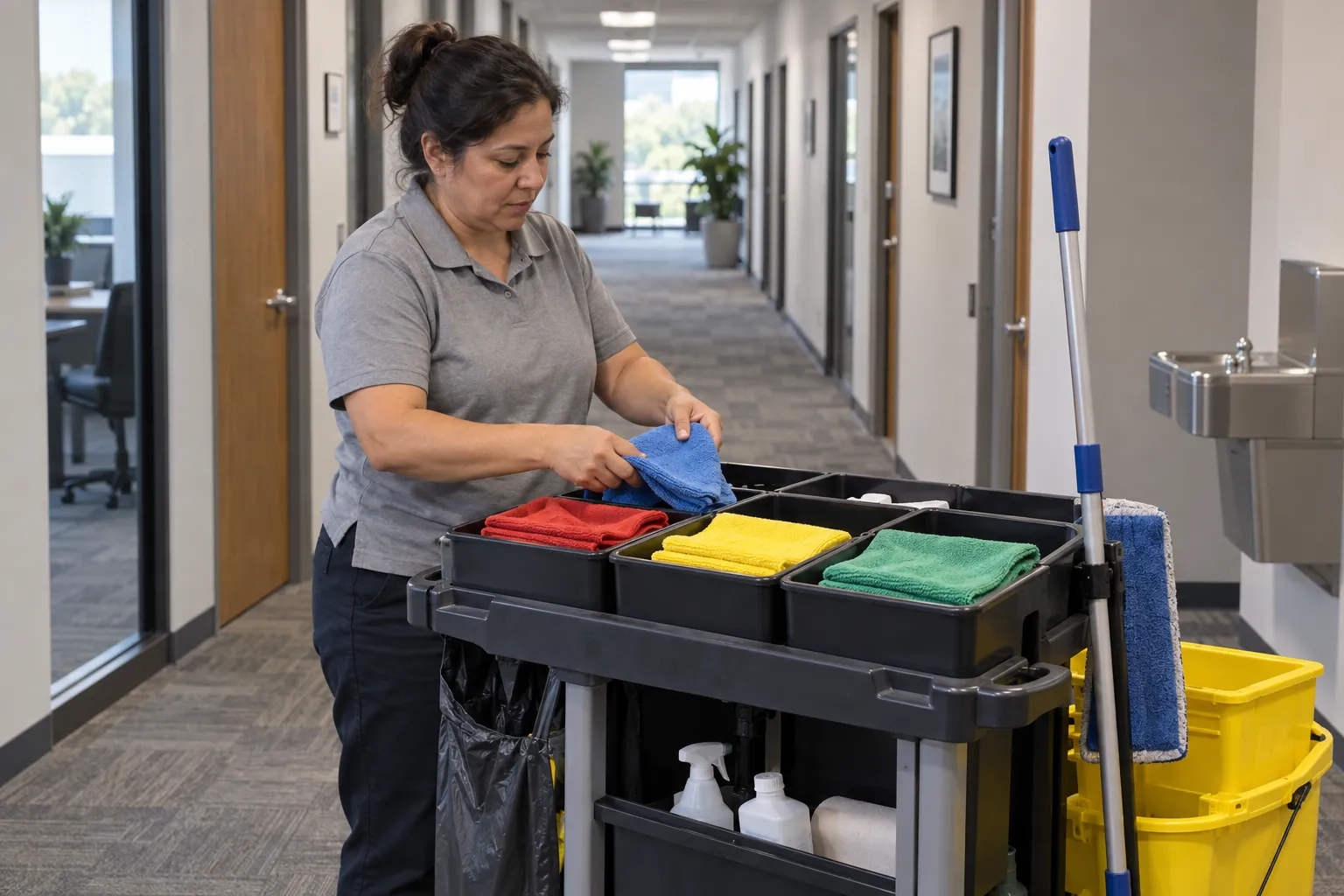 CleaningColor-coded cleaning: keeping the restroom cloth out of the break roomHow a color-coded cleaning system works: choosing zones and colors, writing the chart, keeping cloths and mops apart in practice, and checking the system holds.
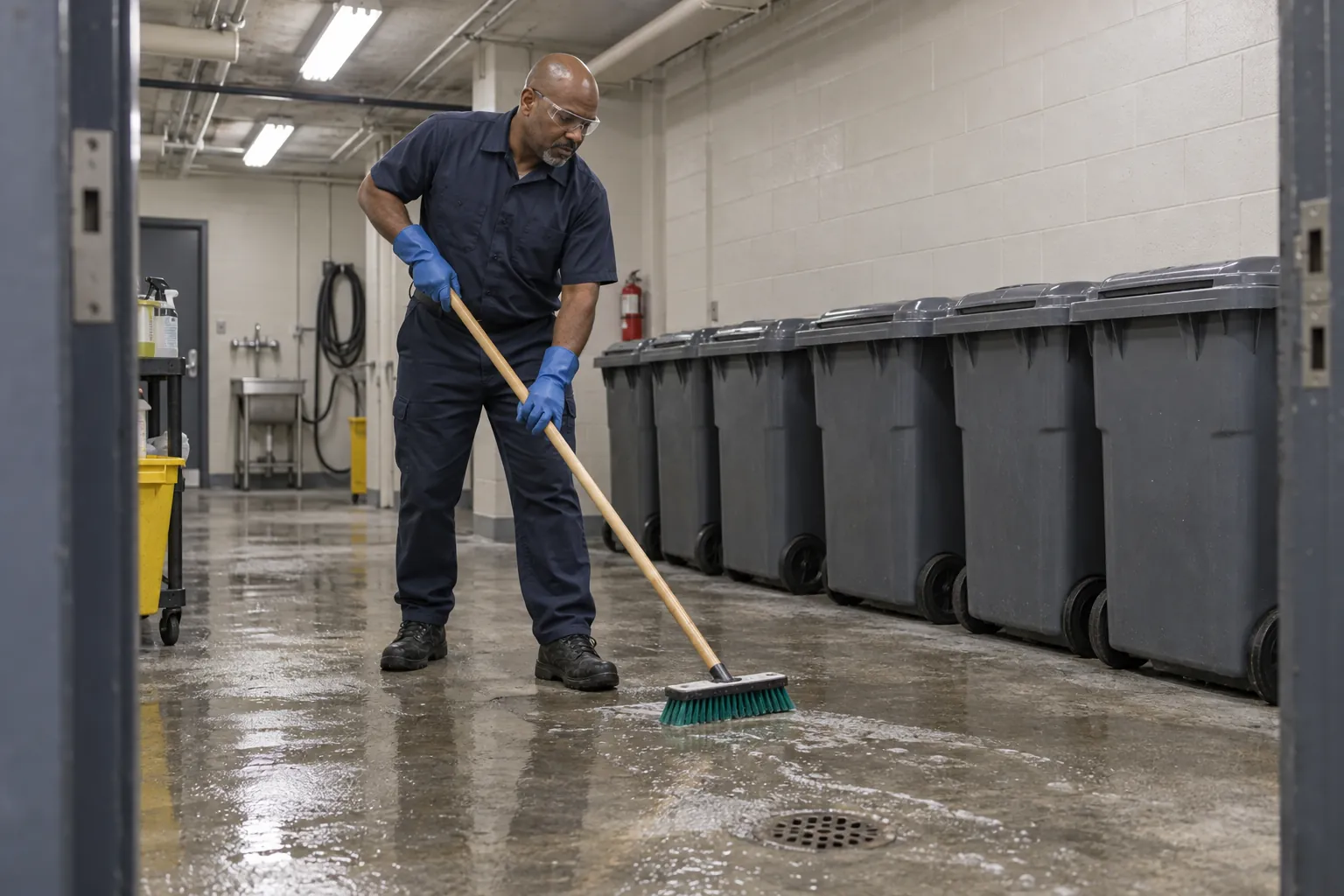 CleaningTrash room cleaning: the codes, the schedule and the recordHow to keep a trash room clean, safe and pest-free: the property maintenance, fire and OSHA rules behind it, a cleaning schedule, and what to record.