Cleaning
Color-coded cleaning: keeping the restroom cloth out of the break room
Color-coded cleaning is a system of assigning each area of a building its own color of cloths, mop heads and buckets, so the tools used on a toilet never reach a kitchen counter or a patient's bedside table.
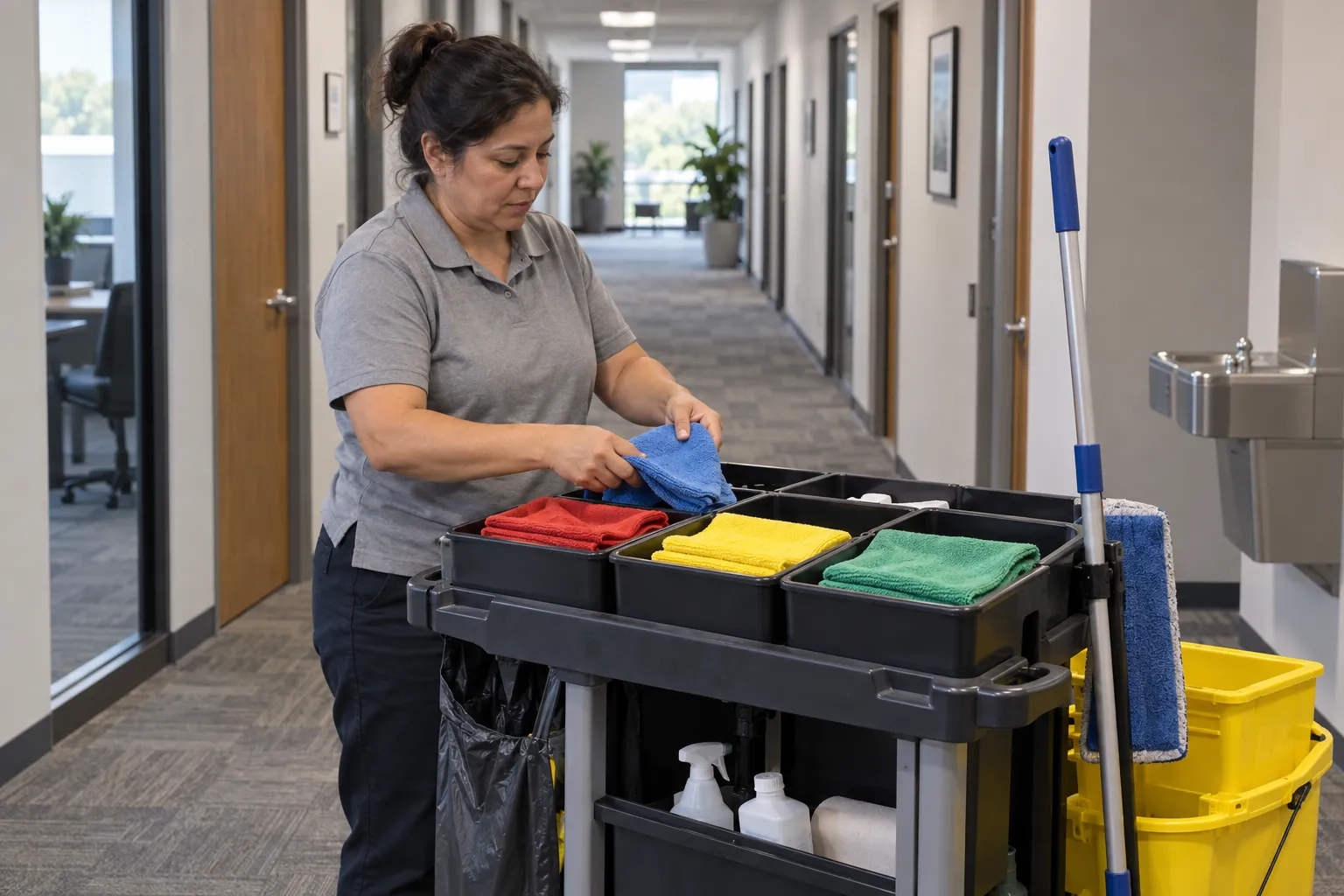
It is one of the cheapest ways a janitorial team can cut cross-contamination, and one of the easiest to let slip. This guide covers what the rules and the CDC actually say, how to choose the zones and write the chart, how the system works on a shift, and how to check that it is still being followed.
01
What color-coded cleaning is, and what the rules say
A color-coded cleaning system assigns a color to each zone of a building, usually by risk, and buys the tools for that zone in that color: microfiber cloths, mop heads, buckets, scrub pads and sometimes handles, gloves and cart compartments. A custodian who picks up a red cloth knows it belongs to the restroom fixtures and nowhere else.
No federal regulation requires a color-coded system for janitorial tools in an ordinary commercial building. The duties are about outcomes. OSHA's sanitation standard, 29 CFR 1910.141, says that "all places of employment shall be kept clean to the extent that the nature of the work allows," and that the floor of every workroom shall be maintained, so far as practicable, in a dry condition. Color coding is one of the practical ways a janitorial program meets that duty without moving contamination around the building.
The OSHA standard that comes closest to cleaning is the Bloodborne Pathogens standard, 29 CFR 1910.1030, and there color coding is about waste and laundry, not cloths. Containers for regulated waste and contaminated sharps must be "labeled or color-coded," contaminated laundry must travel in bags or containers "labeled or color-coded," and "red bags or red containers may be substituted for labels." It also requires an employer whose staff have occupational exposure to set "an appropriate written schedule for cleaning and method of decontamination" based on the location, the type of surface, the type of soil and the tasks performed there. A color chart does not satisfy that on its own, but it belongs in the written method.
The clearest public recommendation comes from the CDC. Its Best Practices for Environmental Cleaning in Healthcare Facilities in Resource-Limited Settings (version 2, CDC and the Infection Control Africa Network, 2019) says: "Have a supply of different colored cloths to allow color-coding: for example, one color for cleaning and a second color for disinfecting. Color-coding also prevents cross-contamination between areas, like from toilets to patient areas, or isolation areas to general patient areas." It was written for hospitals, but the reasoning holds in any building with restrooms and places to eat.
Food areas add a legal edge. The FDA Food Code 2022 says in 3-304.14 that cloths used for wiping surfaces in contact with raw animal foods "shall be kept separate from cloths used for other purposes," and that cloths for wiping counters and equipment are held in sanitizer between uses and laundered daily. The Food Code is a model: it has force only where a state or local health department has adopted it, often with amendments, and FDA has since published a 2026 edition. A separate color for food areas is the simplest way to show an inspector that the cloths are kept apart.
02
The zones, the colors and what gets coded
There is no national color standard for cleaning tools in the United States, and no single industry convention. Suppliers sell cloths and mops in four or five colors, and many janitorial companies use a four-color convention along these lines:
- Red: restroom fixtures, meaning toilets, urinals and the floor and walls immediately around them. The highest-risk zone.
- Yellow: other restroom surfaces, such as sinks, counters, partitions, dispensers and door hardware, or, in healthcare, isolation rooms.
- Blue: general areas, such as offices, classrooms, corridors, lobbies, glass and desks.
- Green: food areas, such as break rooms, kitchens and kitchenettes, cafeterias and restaurant counters.
That convention is common, but it is not universal. The CDC document's own example is different: red cloths for toilet areas, blue for general patient areas and yellow for isolation areas. A custodian who learned another system elsewhere will carry it with them, so the building's own chart matters more than any convention.
Decide which items are coded. At a minimum:
- Cloths, microfiber or cotton, the item that moves between surfaces most often;
- Mop heads, flat microfiber pads or wet mops, since a restroom mop on a cafeteria floor defeats the point;
- Buckets, or colored lids or handles on them;
- Scrub pads and hand brushes;
- Gloves, where restroom fixtures get their own pair;
- Cart compartments or bins, so clean and soiled cloths of each color have their own place.
Toilet brushes and bowl swabs stay in the restroom. Spray bottles are better labeled than color coded: a bottle's color tells a custodian nothing about what is in it, and OSHA's Hazard Communication standard, 29 CFR 1910.1200, requires a workplace container of a hazardous chemical to carry at least the product identifier and general information about its hazards in words, pictures or symbols under paragraph (f)(6), with a narrow exception under (f)(8) for a portable container filled for the immediate use of the person who filled it. A color can sit alongside the label, never instead of it.
03
Setting up the system and writing the chart
A color system is a written procedure, not a purchase. Work through these steps:
- Map the zones by risk, not by room name. Mark every restroom, locker room, break room, kitchen, food counter and clinic room, and note which are high-risk; in healthcare, add isolation rooms and any area your infection preventionist names.
- Choose the colors, and keep to the fewest that cover the risks. Four is usual; a fifth color for isolation, a clinic or a food production area is fine if it is really used.
- Write the chart: each color, the zone it belongs to, the items coded in it, and one line on what never happens ("red never leaves the restroom"). Date it, and name who approved it.
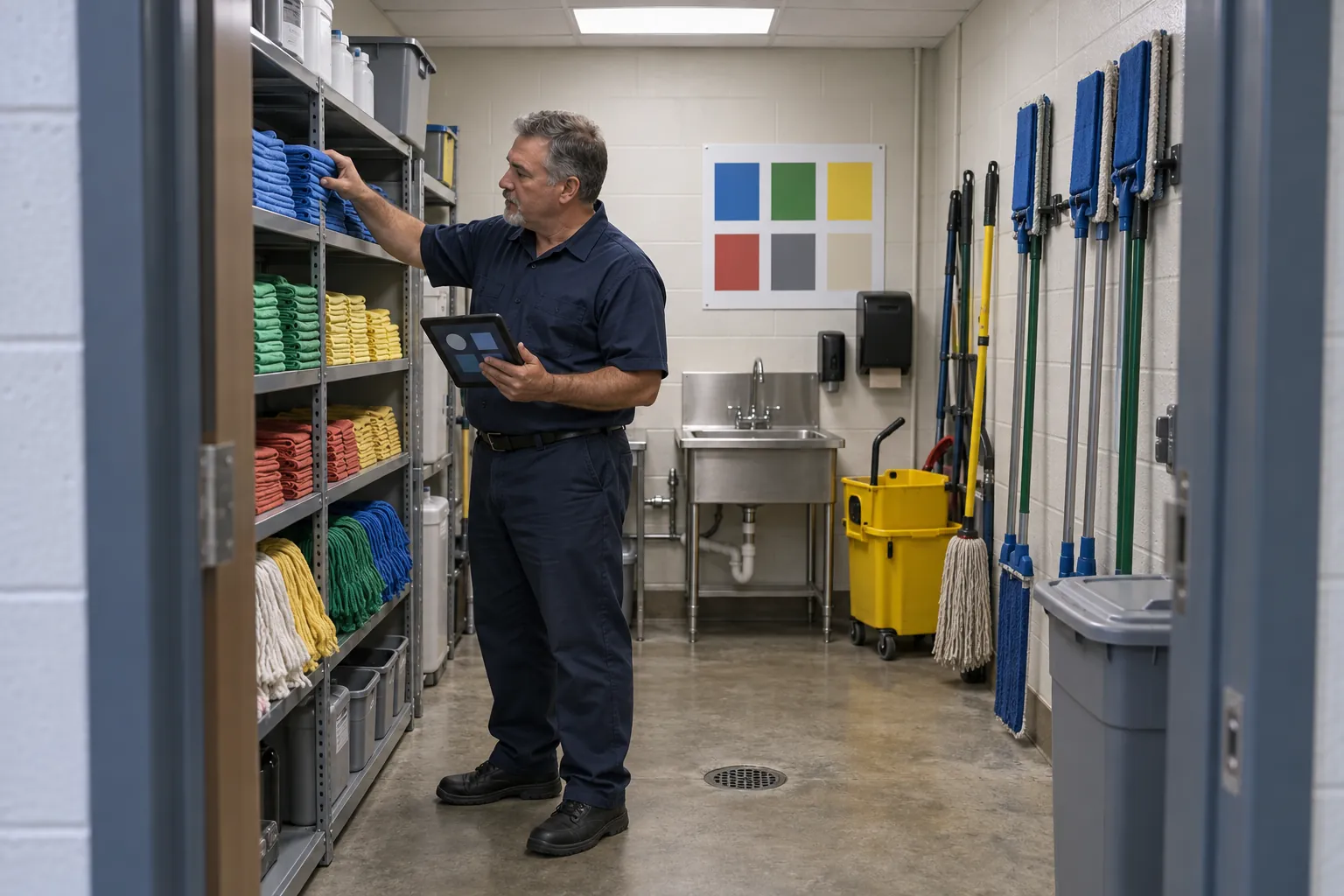
- Post the chart in every janitor closet and on each cart, with the color word printed beside each swatch, so everyone on the crew reads it the same way. Colors alone fail anyone who has trouble telling red from green, and words help a crew that works in more than one language.
- Buy in balance. When the green cloths run out, a blue one goes into the break room. Stock each color to cover a full shift plus the laundry cycle.
- Set up the laundry. Decide who launders cloths and mop heads, how soiled ones are bagged by color, and how clean ones come back. The CDC document says to launder mop heads and cleaning cloths separately from other soiled textiles, not to use chlorine-based disinfectants on microfiber, and to let items fully dry before storage and reuse.
- Train every custodian, including day porters, floaters and anyone covering a shift, before they work alone. Show the chart, walk one restroom and one break room together, and check they can explain it back. Train again when the colors or products change.
Put the colors into the building's other documents too. The cleaning checklist for each area should name its color (the commercial cleaning checklist guide covers writing one), the closet stock check should count by color, and the janitorial scope of work should say whose system applies when a contractor takes over. A new contractor should adopt the building's chart or replace every coded item on day one, never mix the two.
04
How the system works on a shift
Color coding only works alongside the basic order of cleaning. The CDC's environmental cleaning procedures say to "proceed from cleaner to dirtier areas to avoid spreading dirt and microorganisms" and "from high to low to prevent dirt and microorganisms from dripping or falling and contaminating already cleaned areas." In a restroom that means the yellow cloth does the dispensers, mirrors, sinks and partitions first, and the red cloth does the toilets and urinals last.
On each shift, a custodian should:
- Start with fresh cloths and mop heads of each color the route needs. The CDC says to "use fresh cleaning cloths at the start of each cleaning session" and to change a cloth "when they are no longer saturated with solution."
- Fold and turn cloths so each face is used once, and swap a cloth when it is soiled rather than rinsing it in the bucket.
- Keep clean and soiled apart on the cart, by color. The CDC's best practices for carts are to separate clean and soiled items, never to put personal items, food or drinks in them, and never to leave them unattended while in use.
- Never double-dip. A used cloth going back into a bucket of clean solution contaminates the solution. Narrow-necked bottles, which the CDC document prefers to buckets for exactly this reason, make that harder, and it prefers squeeze bottles to spray bottles for putting solution onto the cloth.
- Change mop water and mop heads between zones, and as often as needed. The CDC's 2003 Guidelines for Environmental Infection Control in Health-Care Facilities note that "cleaning solutions should be replaced frequently," because solutions in buckets become contaminated quickly and carry microorganisms to the next surface.
- Never shake a cloth or mop head. The CDC says it "disperses dust or droplets that could contain microorganisms."
- Bag soiled items by color at the end of the shift for the laundry, and leave mop heads and buckets to dry.
The closet matters as much as the cart. The Food Code requires, where it applies, a service sink or curbed cleaning facility with a floor drain for cleaning mops and emptying mop water (5-203.13), says toilets and urinals may not be used to dispose of mop water, and says mops shall be placed after use so they can air-dry without soiling walls, equipment or supplies (6-501.16). Store each color's mops and buckets in their own spot. The janitor closet guide covers the rest of the room.
05
Checking the system holds, and what good evidence looks like
A color system fades: turnover, a short delivery of one color or a floater on an unfamiliar route can undo it in a week. The checks that catch it are simple:
- Cart check at the start of each shift: every color the route needs is on the cart, clean and soiled are apart, and nothing of the wrong color is in the wrong bin.
- Closet stock check, weekly or more often: clean stock of each color against the level set, the chart posted and readable, mops drying head up.
- Laundry count: cloths and mop heads out against those back, by color. A color that keeps coming back short is being thrown away, lost or used somewhere it should not be.
- Observation: a supervisor watches a custodian clean a restroom and then a break room, and checks the order of work and the color in hand.
- Spot checks in the zones: a red cloth in a break room bin or a blue mop head in a locker room is a finding, not a curiosity.
- Retraining after a finding, recorded.
Good evidence of a working system is ordinary: a dated chart that matches what is on the carts; a training record for each custodian; closet and cart checks recorded with the date, the time and the name of the person who did them; supervisor observations with what was found; and every shortage or wrong-color finding followed until it was put right. In hospitals, the CDC's Options for Evaluating Environmental Cleaning describes how to monitor the quality of cleaning itself, which a color system supports but does not replace.
Build these checks into the janitorial quality control program rather than running them on their own.
06
Where the color system record fails, and what SiteClara does about it
Most color systems are documented on the day the chart goes up and rarely after. The closet check is a line on a sheet taped inside the door, initialed for the week in one go. The shortage of green cloths was mentioned to whoever was passing and nobody ordered more. When an infection preventionist, a health inspector or a client asks when the carts were last checked, or who found the red cloth in the break room and what happened next, the answer is a memory rather than a record.
SiteClara records checks at the place they happen. A printed QR code poster, with an optional NFC tag behind it, goes where a check is scheduled, such as a janitor closet or a restroom. A custodian scans the code or taps the tag on their own phone, with no app to install, sees the checks set for that place, and marks each one done, or says what stopped them. The building writes the checks, so a closet check can ask whether every color is stocked, whether the chart is posted and whether mops are drying, and can ask for a photo of the cart. The time and the named person are recorded as it happens. A problem found on the way, such as a color running short or a mop in the wrong closet, goes onto the team's list of jobs until someone closes it.
The janitorial supervisor sees what is due, done and missed, and records the reason when a check was missed. Each day they review the totals and photos and approve a report that goes the next morning to nominated managers, such as the facility manager or the client, showing what was reported, completed and still open, and how the scheduled checks went.
07
Questions people ask
What is color coding in cleaning?
It is assigning a color of cloth, mop head and bucket to each area or task, so tools from one area are never used in another. The CDC and ICAN's Best Practices for Environmental Cleaning in Healthcare Facilities in Resource-Limited Settings suggests one color for cleaning and a second for disinfecting, and says color-coding "prevents cross-contamination between areas, like from toilets to patient areas, or isolation areas to general patient areas."
What are the color codes for cleaning cloths?
There is no national code in the United States, so each building sets its own. The example in the CDC and ICAN's Best Practices for Environmental Cleaning in Healthcare Facilities in Resource-Limited Settings is red cloths for toilet areas, blue for general patient areas and yellow for isolation areas. Many janitorial companies instead use red for toilets and urinals, yellow for other restroom surfaces, blue for general areas and green for food areas.
What is the color code used for housekeeping?
No federal rule sets colors for cleaning cloths or mops. The nearest is OSHA's Bloodborne Pathogens standard, 29 CFR 1910.1030: its housekeeping paragraph requires containers for contaminated sharps and regulated waste to be "labeled or color-coded," and its labeling paragraph says "red bags or red containers may be substituted for labels." The colors of cloths and mops are left to the employer's own written cleaning method.
08
Further reading, and a list to take away
The CDC and ICAN's Best Practices for Environmental Cleaning in Healthcare Facilities in Resource-Limited Settings covers color coding, carts and laundering, and the CDC's environmental cleaning procedures page sets out the order of work. OSHA publishes the sanitation standard, the Bloodborne Pathogens standard and the Hazard Communication standard in full. For food areas, read the FDA Food Code 2022, or the Food Code 2026, and then the edition your state or local health department has actually adopted.
Before you rely on a building's color-coded cleaning system, check that:
- every zone is mapped by risk, including restrooms, locker rooms, food areas and any clinic or isolation rooms;
- the chart is written, dated and approved, with the color word beside each swatch;
- the chart is posted in every closet and on every cart, and matches what is actually there;
- cloths, mop heads, buckets and pads are all coded, and spray bottles are labeled, not just colored;
- stock of each color covers a full shift plus the laundry cycle;
- cloths and mop heads are laundered separately from other textiles and dried before reuse;
- every custodian, floater and day porter is trained before working alone, and again after a change;
- carts and closets are checked on a schedule, by a named person, with the time recorded;
- a supervisor observes the order of work and the colors in use;
- every shortage or wrong-color finding is recorded and followed until it is put right.
Sources
Every document this guide quotes or links to, in the order it first cites them.
- Sanitation standard, 29 CFR 1910.141 osha.gov
- Bloodborne Pathogens standard, 29 CFR 1910.1030 osha.gov
- Best Practices for Environmental Cleaning in Healthcare Facilities in Resource-Limited Settings cdc.gov
- FDA Food Code 2022 fda.gov
- OSHA-approved State Plans osha.gov
- Hazard Communication standard, 29 CFR 1910.1200 osha.gov
- Environmental cleaning procedures cdc.gov
- Guidelines for Environmental Infection Control in Health-Care Facilities cdc.gov
- Options for Evaluating Environmental Cleaning cdc.gov
- Food Code 2026 fda.gov
Related guides
 CleaningChemical dilution control: getting the mix right, every bottle, every shiftHow a chemical dilution control system works, what OSHA HazCom and EPA labels require, how to check dispensers and bottles, and what the record should show.
 CleaningJanitorial closet requirements: the sink, the chemicals and the daily checkWhat US codes and OSHA require of a janitorial closet: the service sink, chemical storage, SDS, eyewash, clear panels and housekeeping, and a routine closet check.
 CleaningHigh-touch surfaces: a cleaning routine you can show was doneHigh-touch surfaces as the CDC describes them: which ones to list area by area, how often to clean and disinfect them, the right method, and a record that holds up.
 CleaningJanitorial quality control: how to inspect, score and fix the cleaningHow janitorial quality control works: QA versus QC, building a cleaning inspection checklist, APPA appearance levels, sampling, scoring and corrective action.