Cleaning
Commercial carpet maintenance: the program, the frequencies and the record behind them
Commercial carpet maintenance is a planned program of soil prevention, routine vacuuming, spot and stain removal, interim cleaning and periodic deep cleaning, with frequencies set by traffic and by the carpet manufacturer's guidelines.
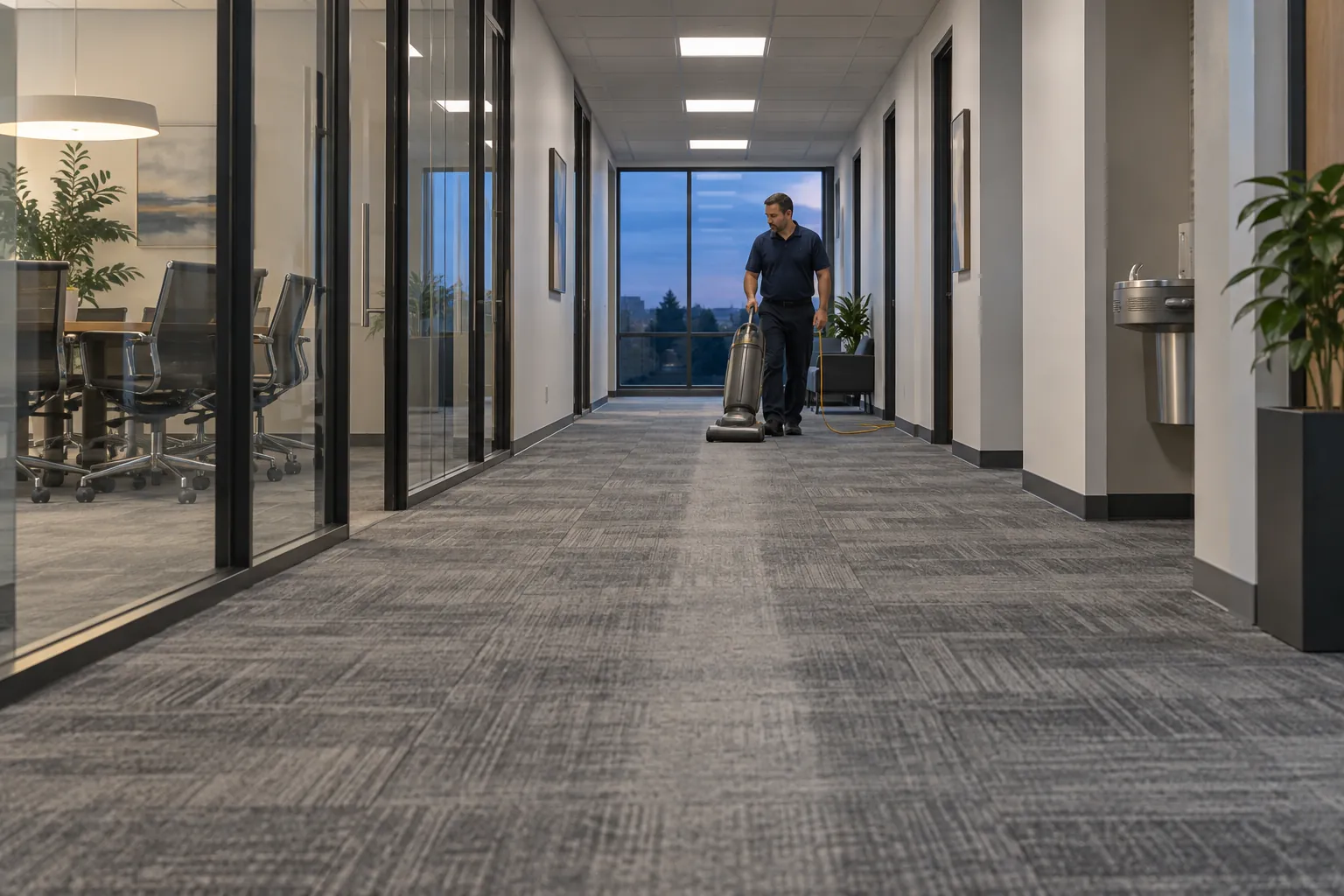
Commercial carpet rarely wears out. It is usually worn down: grit and dirt tracked in from the parking lot, traffic lanes that were never vacuumed properly, spots left to set, and deep cleaning booked only once the carpet already looks gray. A planned maintenance program prevents most of that, protects the manufacturer's warranty, and keeps the floor safe to walk on. This guide covers the industry standards (CRI 204 and IICRC S100), what a program includes, how often each level of cleaning is done by traffic, who does what, and how to keep a record that shows the work was actually done.
01
What commercial carpet maintenance is, and which standards apply
Commercial carpet maintenance is the planned, ongoing care of carpet and carpet tile in offices, schools, hotels, healthcare buildings and other non-domestic facilities. It is different from carpet cleaning done when somebody complains. The Carpet and Rug Institute puts the difference plainly in its commercial standard: "In the minds of many consumers, cleaning takes place 'as needed'", while maintenance "is a planned, ongoing process of soil removal designed to retain carpet appearance at an optimum level every day."
CRI 204 says an effective program maintains the appearance and value of the property, helps manage contaminants and improves indoor air quality, and extends the life of the commercial carpet.
No federal regulation tells a building how often to vacuum or extract its carpet. The detail comes from two industry standards and from the carpet manufacturer:
- CRI 204 Commercial Carpet Standard for Maintenance and Cleaning, published by the Carpet and Rug Institute (CRI), the trade association of US carpet manufacturers. The current version is dated 2023 (originally published in 2019) and is free to download. It sets out a five-part program and recommended frequencies by traffic level, and it is the document most carpet manufacturers point to.
- ANSI/IICRC S100 Standard for Professional Cleaning of Textile Floor Coverings, published by the Institute of Inspection, Cleaning and Restoration Certification. The current edition is the seventh, from 2021. It is the professional cleaner's standard, covering the chemistry of cleaning, fibers and construction, cleaning methods and systems, and spot and stain removal. It is a paid document.
- The carpet manufacturer's maintenance guidelines for the product actually installed. These decide the warranty, and they come first where they differ from the general standards.
The warranty is the reason many facility managers take this seriously. CRI 204 says directly that "failure to follow this standard or the carpet manufacturer's maintenance guidelines may result in the loss of warranty coverage and/or reduction in long-term performance." It also notes that many carpet manufacturers now require products certified under CRI's Seal of Approval program, and CRI-certified cleaning methods, to keep a warranty in force. Read the warranty for your own carpet: it usually says what records the manufacturer will ask for if you make a claim.
Then there is safety law. For private employers, federal OSHA's walking-working surfaces rule, 29 CFR 1910.22, requires that walking-working surfaces are "maintained free of hazards such as sharp or protruding objects, loose boards, corrosion, leaks, spills, snow, and ice", and "inspected, regularly and as necessary, and maintained in a safe condition." A rippled, torn or soaked carpet is that kind of hazard. In states with their own OSHA-approved State Plan, the state's rule applies instead, so check which rule reaches your building.
02
What a commercial carpet maintenance program covers
CRI 204 describes a "customized comprehensive carpet care program" with five elements. Every commercial carpet maintenance plan worth the name covers them:
- Soil prevention. Exterior and interior walk-off mats at every entrance, protective mats where spills and wear concentrate, and clean sidewalks, parking lots and hard floors next to the carpet.
- Routine vacuuming. A scheduled frequency for removing dry soil, set by traffic, with a certified vacuum.
- Spill, spot and stain removal. A spotting procedure, the right products on the cart, and people who know to act the same day.
- Interim maintenance. Low-moisture appearance cleaning of traffic areas on a schedule, so the carpet stays even between deep cleans. CRI 204 defines an interim maintenance system as an encapsulating solution, a counter-rotating brush (CRB) machine and a vacuum.
- Deep cleaning. Scheduled restorative cleaning to remove embedded soil and residues. CRI 204 defines a deep cleaning system as a vacuum, a solution and an extractor, and notes that water extraction systems achieved the highest rankings in its Seal of Approval testing.
CRI 204 groups these into three levels of cleaning: routine (vacuuming and timely spotting), interim (appearance cleaning that "can postpone or limit the need for deep cleaning") and deep. A program with only one level, usually an annual extraction, is not a program.
Two things sit around the five elements. The first is equipment: CRI 204 says rotary machines with a head, pad or bonnet that spins or oscillates horizontally are "NOT recommended for carpet cleaning", and that each machine must be maintained to its owner's manual. The second is review: the standard expects "periodic inspection, assessment, and management review of cleaning programs", so the plan changes as traffic, use and results change.
03
How often: vacuuming, interim and deep cleaning by traffic
Frequency follows traffic and soil, not the calendar. CRI 204 grades carpet by traffic as moderate, heavy or severe, and gives a frequency table for each level. Read it in full before you write a schedule; in outline it says:
- Entrances: vacuum or power pile brush daily at every traffic level, and at severe traffic twice daily in traffic areas.
- Other floors: two or three times a week at moderate traffic; daily at heavy and severe traffic.
- Spill, spot and stain removal: daily or as needed, at every level.
- Interim maintenance: once or twice a year at moderate traffic, six to twelve times a year at heavy traffic, and 12 to 52 times a year at severe traffic, with soil-prone areas done more often.
- Deep cleaning: once or twice a year at moderate traffic (monthly in soil-prone areas), two to six times a year at heavy traffic (every two weeks in soil-prone areas) and 2 to 26 times a year at severe traffic (weekly in soil-prone areas).
CRI 204's routine cleaning section is specific about where the vacuum goes first. Entry foyers are "soil-prone" and need more frequent vacuuming. Reception areas "should be maintained daily or even more frequently". Carpeted elevator cabs, lobbies, restroom entryways and areas next to food service are "high-traffic, frequent-pivot areas" to be vacuumed daily or more. Corridors and common areas are vacuumed daily during the week, because otherwise their soil "can progressively spread" into offices and conference rooms. Private offices, meeting rooms and boardrooms can go to two or three times a week, with periodic attention to corners, edges, and under and behind furniture.
Vacuuming matters most: CRI 204 says "79% or more of the soil can be removed dry by vacuuming", and dry soil left behind abrades the fibers into traffic lanes that no extraction can undo.
Two timing rules follow. Deep cleaning "should be implemented before the soil in the carpet is easily visible", not after. And interim frequency depends on everything upstream: the parking lot, the mats, the vacuuming and the spotting. To write the schedule, map each carpeted area by traffic, mark the soil-prone spots (the coffee station, the elevator landing, the door from the parking garage), set the three levels for each, and check the result against the manufacturer's guidelines.
04
Soil prevention, spotting and drying
Entrance matting is the cheapest carpet maintenance there is. CRI 204 recommends coarse exterior mats that scrape soil from shoes, then absorbent interior mats or walk-off tile, and says that mats extending "9 to 15 feet inside the entrance will trap eighty percent of soil and moisture from the first five or six steps." Mats only work if they are cleaned: the standard says they should be vacuumed or replaced "more frequently than the carpet", because an overloaded mat stops trapping soil. Add protective mats at coffee stations, water coolers, printers, elevators, service entrances and stair thresholds, and chair mats under desks where rollers concentrate wear. Keep the hard flooring next to the carpet clean and dry as well: CRI 204 warns that residues from hard floor care can be tracked onto carpet, that many of the cleaning solutions used on hard floors can damage carpet, and that hard floors should be dried completely after damp maintenance before traffic crosses onto the carpet.
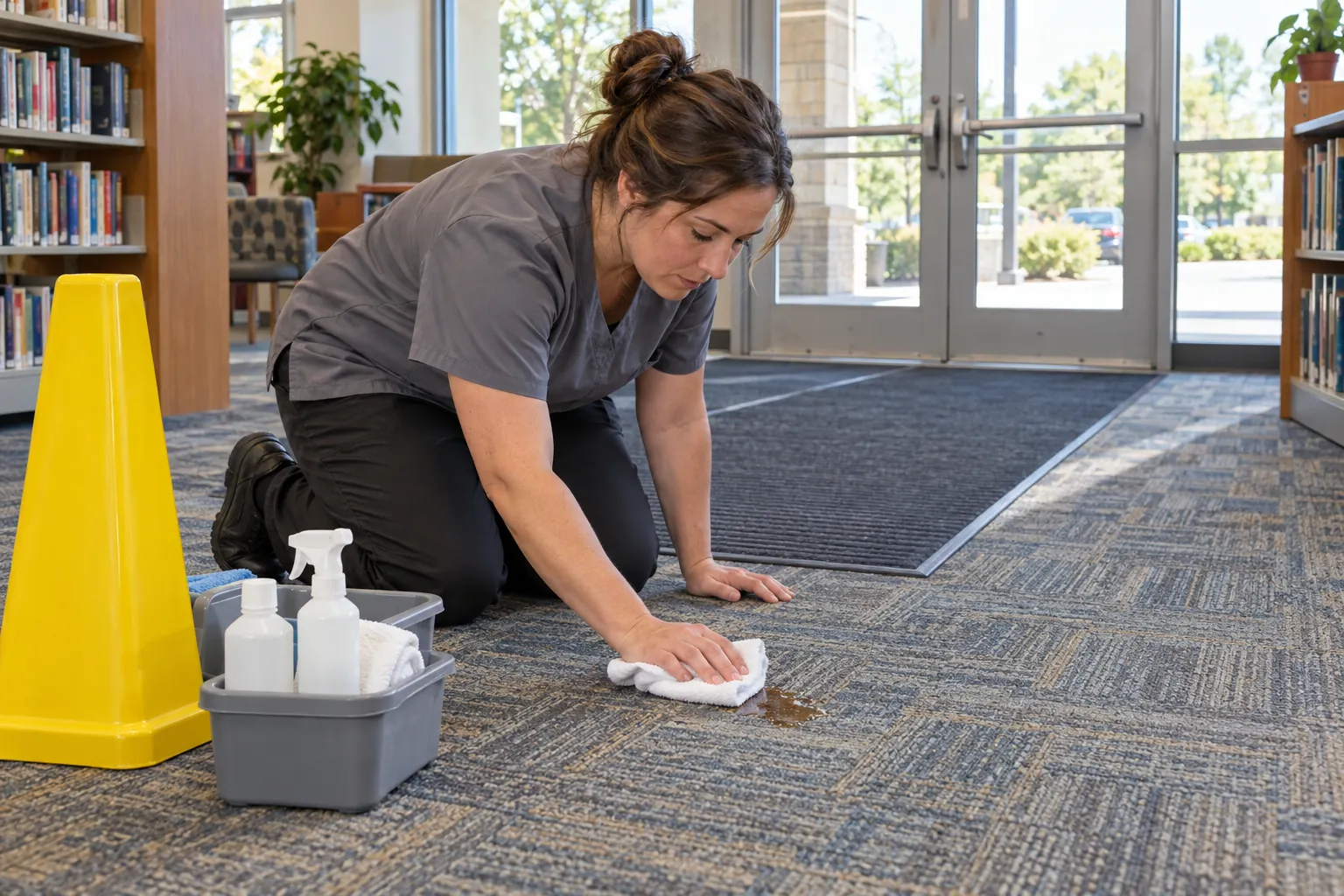
Spotting is usually done by the building's own custodial or janitorial staff, and speed matters more than chemistry. CRI 204 notes that the longer a spot stays on carpet, the greater the chance of a permanent stain, and the longer its residue stays, the more dirt it attracts. CRI 204's procedure, in short:
- Identify the carpet and the spill if you can: wet or dry, water-based or oil-based.
- Remove what you can first: blot liquids with a white absorbent cloth or white paper towels, scrape semi-solids with a spoon or spatula, vacuum dry material.
- Pretest the spotting agent somewhere inconspicuous for color change or damage.
- Apply a small amount, working from the outside of the spot toward the center. Do not scrub, which distorts the pile.
- Rinse out one agent before trying another, and rinse thoroughly at the end, because residue attracts soil.
- Expect wicking as it dries, and repeat if the spot reappears.
The standard warns that "most carpet is stain resistant, not stain proof", that using several or inappropriate products can leave a permanent stain or color loss, and that no solution should be used stronger than recommended, because the residue attracts soil. Keep a spotting kit on the cart with the products the carpet manufacturer approves, and make sure the safety data sheets for each chemical are readily accessible during every shift, as OSHA's Hazard Communication standard (29 CFR 1910.1200) requires.
Drying is part of the clean. CRI 204 says "cleaning is not complete until carpet is dry and ready to be trafficked", asks for ventilation or air movers after deep cleaning, and says access to damp carpet should be limited, with wet floor signs placed.
A leak or flood is a different job. The EPA's Mold Remediation in Schools and Commercial Buildings guide says carpet and backing should be dried within 24 to 48 hours, with a water extraction vacuum, a dehumidifier and fans, and the subfloor cleaned and dried too. Fans should not be used before you know the water is clean.
05
Who does what, and what good evidence looks like
Most buildings split the work. The in-house custodial team or the janitorial contractor does routine vacuuming, mat care and spotting every day. Interim cleaning may be done by the same team if it has CRB equipment and training, or by a specialist. Deep cleaning is usually booked with a carpet cleaning contractor, often one certified by the IICRC or listed as a Seal of Approval service provider. The facility manager or property manager owns the program: the traffic map, the schedule, the budget and the warranty.
The janitorial scope of work should say which of the five elements the contractor delivers, how often, where, and what records it hands over. "Vacuum carpets as needed" cannot be checked.
Good evidence for commercial carpet maintenance looks like this:
- Routine vacuuming: which areas were done, when and by whom, shift by shift, with missed areas recorded as missed and the reason given (a room locked, an event running late).
- Mats: when entrance mats were vacuumed, cleaned or swapped.
- Spots and spills: what was reported, where, when it was treated, and whether it came back.
- Interim and deep cleaning: the date, the areas, the method and products, the contractor, and the contractor's own work ticket or invoice, kept together.
- Hazards: loose seams, ripples, lifted tiles, frayed edges and wet carpet, when they were reported, how they were guarded and when they were repaired.
- Inspections: a periodic supervisor's walk, with photos of areas wearing badly.
Accessibility belongs in the same inspection. Under the 2010 ADA Standards for Accessible Design, section 302.2, carpet or carpet tile on an accessible route "shall be securely attached", pile height is half an inch maximum, and exposed edges must be fastened with trim along their whole length. For businesses open to the public, the Department of Justice's rule at 28 CFR 36.211 requires a public accommodation to "maintain in operable working condition" the features that make the facility accessible, while allowing "isolated or temporary interruptions" for maintenance or repairs. A ripple or a lifted edge on an accessible route is a maintenance job with a deadline, not a cosmetic one.
06
Where the record fails, and what SiteClara does about it
The deep clean is usually documented, because a contractor sends an invoice. The daily work is not. Vacuuming is a column of initials on a sheet in the janitor closet, filled in at the end of the week. A spill is mentioned to whoever was passing, and nobody can say when it was treated. When a warranty claim or a trip on a lifted seam arrives, the building has last spring's invoice and little about the months in between.
SiteClara records routine checks at the place they happen. A printed QR poster, with an optional NFC tag behind it, sits at each location with scheduled checks, such as the main entrance, a floor's elevator lobby or a corridor. Staff scan or tap on their own phone, with no app to install, see the checks due there, such as vacuuming the lobby carpet or cleaning the entrance mats, and mark each one done or say what stopped them. The time and the named person are recorded as it happens, with a photo when the check asks for one. Someone who spots a stain, a lifted tile or a wet patch reports it from the same poster, and it goes onto the team's list of jobs until someone closes it.
The supervisor sees what is due, done and missed across the day, and records the reason a check was missed, for example that a conference suite was in use all evening. Each day they review it, add a note and approve a report that goes to the facility's nominated contacts the next morning at 8:00 by default. That is the missing record between deep cleans.
07
Questions people ask
How often do commercial carpets need to be deep cleaned?
It depends on traffic. The Carpet and Rug Institute's CRI 204 Commercial Carpet Standard for Maintenance and Cleaning recommends deep cleaning once or twice a year at moderate traffic (monthly in soil-prone areas), two to six times a year at heavy traffic (every two weeks in soil-prone areas), and 2 to 26 times a year at severe traffic (weekly in soil-prone areas). It adds that deep cleaning "should be implemented before the soil in the carpet is easily visible", and the carpet manufacturer's own guidelines come first where they differ.
How do you clean commercial grade carpet?
Daily vacuuming and prompt spotting do most of the work, with interim and deep cleaning on a schedule. For the deep clean, CRI 204 Commercial Carpet Standard for Maintenance and Cleaning sets out the steps: always vacuum first, mix solutions carefully, apply a pre-spray following the label, agitate it into the fibers, allow it to dwell, extract with a system certified under CRI's Seal of Approval program, and let the carpet dry, with ventilation or air movers and access limited until it is completely dry. Check the carpet manufacturer's maintenance guidelines before choosing a method, because they decide the warranty.
What do professionals use for carpet cleaning?
The Carpet and Rug Institute's CRI 204 Commercial Carpet Standard for Maintenance and Cleaning defines a deep cleaning system as a vacuum, a cleaning solution and an extractor, which uses pressure, water or solution and suction to remove embedded soil, and notes that, in general, CRI-certified water extraction systems achieved the highest rankings in its Seal of Approval program. For interim cleaning between deep cleans, it defines a system of an encapsulating solution, a counter-rotating brush machine and a vacuum, and it says rotary machines that spin a pad or bonnet horizontally are not recommended for carpet.
Why is my carpet still dirty after professional cleaning?
Often because something was left behind. The Carpet and Rug Institute's CRI 204 Commercial Carpet Standard for Maintenance and Cleaning says a cleaning system must not leave excessive residues, and warns in its advice on spot removal that detergent residue "continues to attract and hold soil even after drying", that using more detergent than recommended does not clean better but makes it harder to remove, and that failing to rinse solutions out completely "may cause accelerated soiling". Spots can also come back through wicking, which the standard describes as liquid, soil or residue moving from the backing to the tip of the fiber as the carpet dries; extra air movement helps, and the spot may need treating again. Walking on damp carpet soils it again too, which is why the standard asks for access to be limited until the carpet is completely dry.
08
Further reading, and a list to take away
Start with the carpet manufacturer's maintenance guidelines and warranty for the product installed. Then read the Carpet and Rug Institute's CRI 204 Commercial Carpet Standard for Maintenance and Cleaning, which is free and short, and its Seal of Approval program, which lists certified vacuums, solutions and systems. Carpet cleaning contractors work to the ANSI/IICRC S100 Standard for Professional Cleaning of Textile Floor Coverings. For safety and accessibility, read OSHA's 29 CFR 1910.22 (checking your state's own rule if you are in a State Plan state) and section 302.2 of the 2010 ADA Standards. For water damage, read the EPA's Mold Remediation in Schools and Commercial Buildings guide.
For a commercial carpet maintenance program that holds up, check that:
- you have the carpet manufacturer's maintenance guidelines and know what the warranty requires;
- every carpeted area is mapped by traffic level (moderate, heavy or severe), with entrances and soil-prone spots marked;
- exterior and interior walk-off mats cover every entrance, and are cleaned more often than the carpet;
- vacuuming frequencies follow the traffic map, with entrances, lobbies and other high-traffic areas daily or more;
- a spotting kit with manufacturer-approved products is on every cart, with safety data sheets accessible each shift;
- interim and deep cleaning are scheduled, not left until the carpet looks dirty;
- vacuums and extractors are maintained, and rotary bonnet machines are kept off the carpet;
- damp carpet is signed and kept clear until dry, and a leak is dried within 24 to 48 hours;
- loose seams, ripples, lifted tiles and frayed edges are reported, guarded and repaired, especially on accessible routes;
- the daily work is recorded when and where it is done, by name, and the program is inspected and reviewed periodically, and changed as traffic and results change.
Sources
Every document this guide quotes or links to, in the order it first cites them.
- CRI 204 Commercial Carpet Standard for Maintenance and Cleaning carpet-rug.org
- ANSI/IICRC S100 Standard for Professional Cleaning of Textile Floor Coverings iicrc.org
- Seal of Approval program carpet-rug.org
- 29 CFR 1910.22 osha.gov
- Hazard Communication standard (29 CFR 1910.1200) osha.gov
- Mold Remediation in Schools and Commercial Buildings guide epa.gov
- 2010 ADA Standards for Accessible Design, section 302.2 ada.gov
- 28 CFR 36.211 ecfr.gov
Related guides
 CleaningFloor scrubber maintenance: the daily routine, the battery room and the record behind themFloor scrubber maintenance for janitorial teams: end-of-shift checks, battery charging, squeegees and pads, what OSHA expects, and a record that shows it was done.
 CleaningJanitorial quality control: how to inspect, score and fix the cleaningHow janitorial quality control works: QA versus QC, building a cleaning inspection checklist, APPA appearance levels, sampling, scoring and corrective action.
 CleaningCommercial cleaning checklist: area by area, and how to use itA commercial cleaning checklist for offices, lobbies, restrooms and shared areas, area by area, with the OSHA rules behind it and how a supervisor checks the work.
 CleaningWet floor sign requirements: what OSHA asks for, and how to use the sign wellWhat OSHA and ANSI Z535 require of a wet floor sign, when one is needed, where to place it, when to take it in, and how to show the wet floor was managed.