Cleaning
Floor scrubber maintenance: the daily routine, the battery room and the record behind them
Floor scrubber maintenance is the routine care that keeps an automatic scrubber cleaning well and running safely: draining and rinsing the tanks after every use, cleaning the filters and squeegee, turning or replacing worn pads and brushes, charging the batteries, and periodic service by the hour meter.
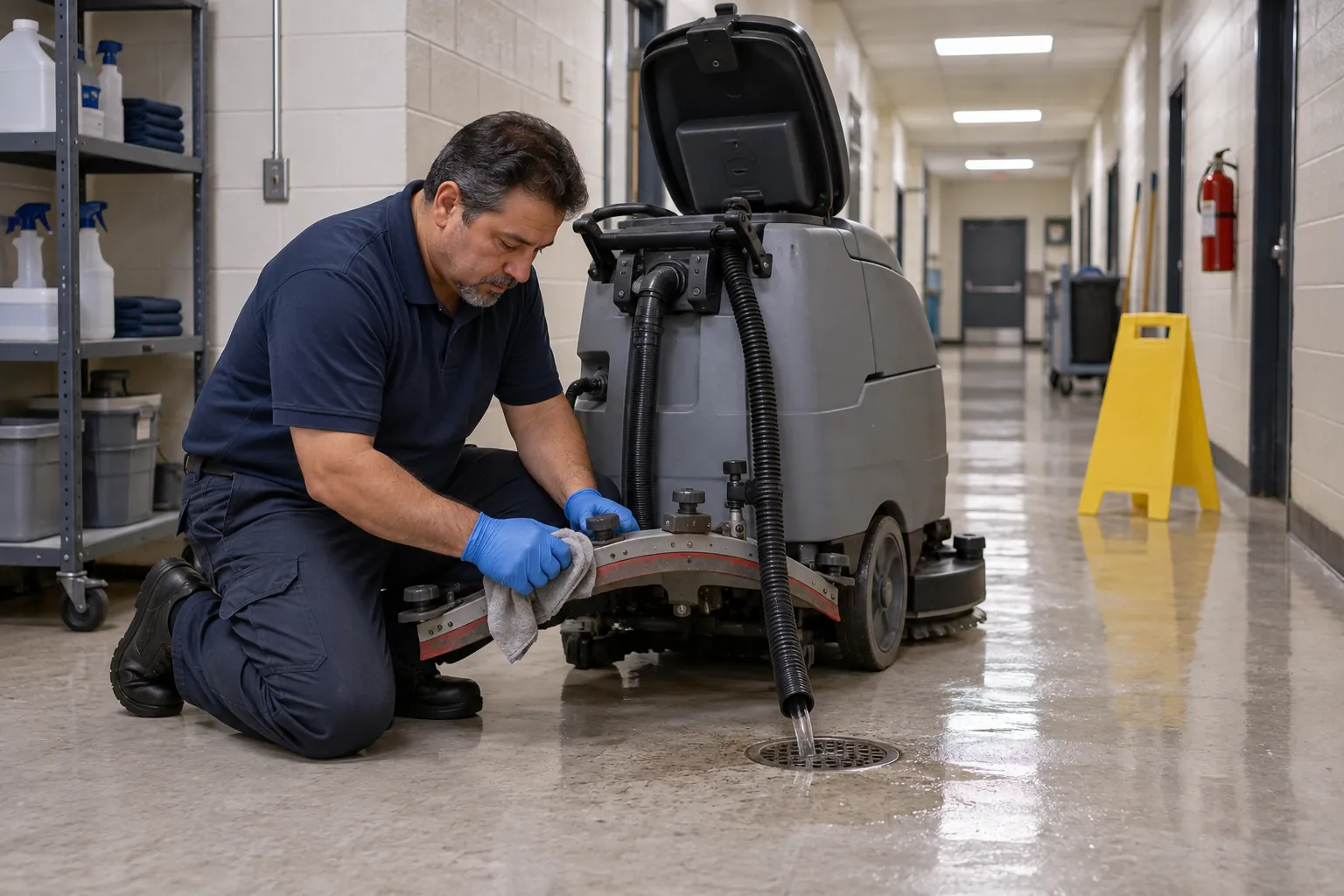
A floor scrubber that streaks, leaves water behind or dies halfway through the lobby is almost always a maintenance problem, not a machine problem. Most of the fixes take five minutes at the end of a shift: empty and rinse the tanks, clean the filter, wipe the squeegee, put the battery on charge. This guide covers what OSHA and the manufacturer expect, the daily, weekly and periodic checks for walk-behind and ride-on commercial floor scrubbers, battery charging safely, who does what, and how to keep a record that shows the work was actually done.
01
What floor scrubber maintenance is, and what the rules say
Floor scrubbers are commercial cleaning equipment with a short list of parts that wear with every shift: squeegee blades, pads and brushes, skirts, filters, hoses and batteries. Regular care of those parts, and taking a faulty machine out of use until it is repaired, is what keeps the machine lifting water and dirt off the floors, and a scrubber waiting for a repair is downtime for the whole floor care schedule. Maintenance applies to walk-behind scrubbers, stand-on and ride-on scrubbers, and the compact micro-scrubbers made for small spaces such as restrooms.
No federal regulation is written for floor scrubbers as such. The duties come from three places.
- The floor itself. OSHA's walking-working surfaces standard, 29 CFR 1910.22, requires that "the floor of each workroom is maintained in a clean and, to the extent feasible, in a dry condition," and that surfaces are kept free of hazards such as "leaks, spills, snow, and ice." A worn squeegee that leaves a wet film creates the very hazard the machine is there to remove.
- The machine as equipment. OSHA's powered industrial truck standard, 29 CFR 1910.178, covers "fork trucks, tractors, platform lift trucks, motorized hand trucks, and other specialized industrial trucks" powered by electric motors or engines. OSHA describes these as vehicles used "primarily to move materials," which a scrubber is not, so whether a particular ride-on scrubber falls within the standard is a question to settle with your safety advisor and the manufacturer rather than assume. Either way, its routine is a sound model: examine before use, take a defective machine out of service, and charge batteries in a properly equipped area.
- The manufacturer's instructions. The operator's manual sets the daily checks, the service intervals by hour meter, the approved chemicals and the battery care for that model.
A word on jurisdiction. Federal OSHA covers most private employers, but OSHA lists 22 approved State Plans covering private and public workers, and seven more that cover only state and local government employees. Cal/OSHA, for example, runs its own program. If you are in a State Plan state, check the state's own rules; they must be at least as effective as the federal ones and are sometimes stricter.
02
What a floor scrubber maintenance program covers
Every automatic scrubber does the same four things: lays down cleaning solution, scrubs with a brush or pad, lifts the dirty water with a squeegee and vacuum, and holds it in a recovery tank. Maintenance follows the same path, and a program for a building's fleet should cover:
- Recovery tank: drained, rinsed and left open to dry after every use; debris tray emptied; the float shut-off cleaned so it cuts the vacuum before water reaches the motor.
- Solution tank and filter: drained if the solution will not be used within the shift, the in-line filter cleaned, and the tank refilled only with the chemical and dilution the manufacturer approves.
- Vacuum motor protection: the vacuum filter or screen cleaned or replaced, and the vacuum hose checked for blockages, kinks and cracks. A blocked hose is a common cause of a scrubber leaving water behind.
- Squeegee: wiped clean, blades checked for nicks and a rounded edge, rotated or flipped when worn, and adjusted for even contact across the floor.
- Brushes and pads: removed after use, rinsed and hung or laid flat to dry; pads flipped or replaced when glazed; brushes replaced when bristles are worn down.
- Batteries and charger: charged after use, watered to the manufacturer's level if they are flooded lead-acid, terminals kept clean and tight, the charger cord and plug checked.
- Controls and safety: key switch, emergency stop, brakes, horn, lights, steering and seat switch on a ride-on, and any guards or covers in place.
03
Daily, weekly and periodic checks
Most manufacturers split care into daily tasks for the operator and periodic tasks, set by the hour meter, for a trained technician. The exact list is in the manual for each model; the pattern below is common to most. The Tennant T300/T300e Operator Manual, for example, lists daily, weekly, 50-hour, 100-hour and 200-hour tasks for the operator, and leaves the rest to trained personnel, including motor carbon brush replacement at 750 hours for the vacuum motor and 1,250 hours for the propel and brush motors.
Before each use, a short pre-use check by the operator. The powered industrial truck standard puts it plainly for the machines it covers: they "shall be examined before being placed in service, and shall not be placed in service if the examination shows any condition adversely affecting the safety of the vehicle." For a scrubber that means:
- Battery charge indicator shows enough charge for the job.
- Recovery tank empty and float shut-off clear.
- Squeegee attached, blades undamaged, hose connected.
- Brush or pad fitted, and the right one for the floor.
- Solution tank filled with correctly diluted chemical.
- Emergency stop, brakes, horn and lights working on a ride-on.
- No leaks, frayed cords or loose covers.
After each use, the end-of-shift routine. This is the part that decides whether the machine works tomorrow: drain and rinse the recovery tank and leave the lid open; drain the solution tank if required; clean the debris tray, float and vacuum filter; wipe the squeegee blades; remove, rinse and hang the pads or brushes; wipe the machine down; and put it on charge in the charging area.
Weekly, typically: check and water flooded batteries after charging, clean battery tops and terminals, inspect the squeegee blades and rotate them to a fresh edge, check the vacuum hose along its length, clean the solution filter and check the skirts and wheels.
Periodic preventive maintenance, usually every few hundred hours on the hour meter or quarterly, by the dealer or a trained technician: vacuum and brush motor carbon brushes, drive system, brakes, electrical connections, battery condition testing, and replacement of worn parts. Record the hour meter reading at each service.
04
Battery charging, chemicals and propane
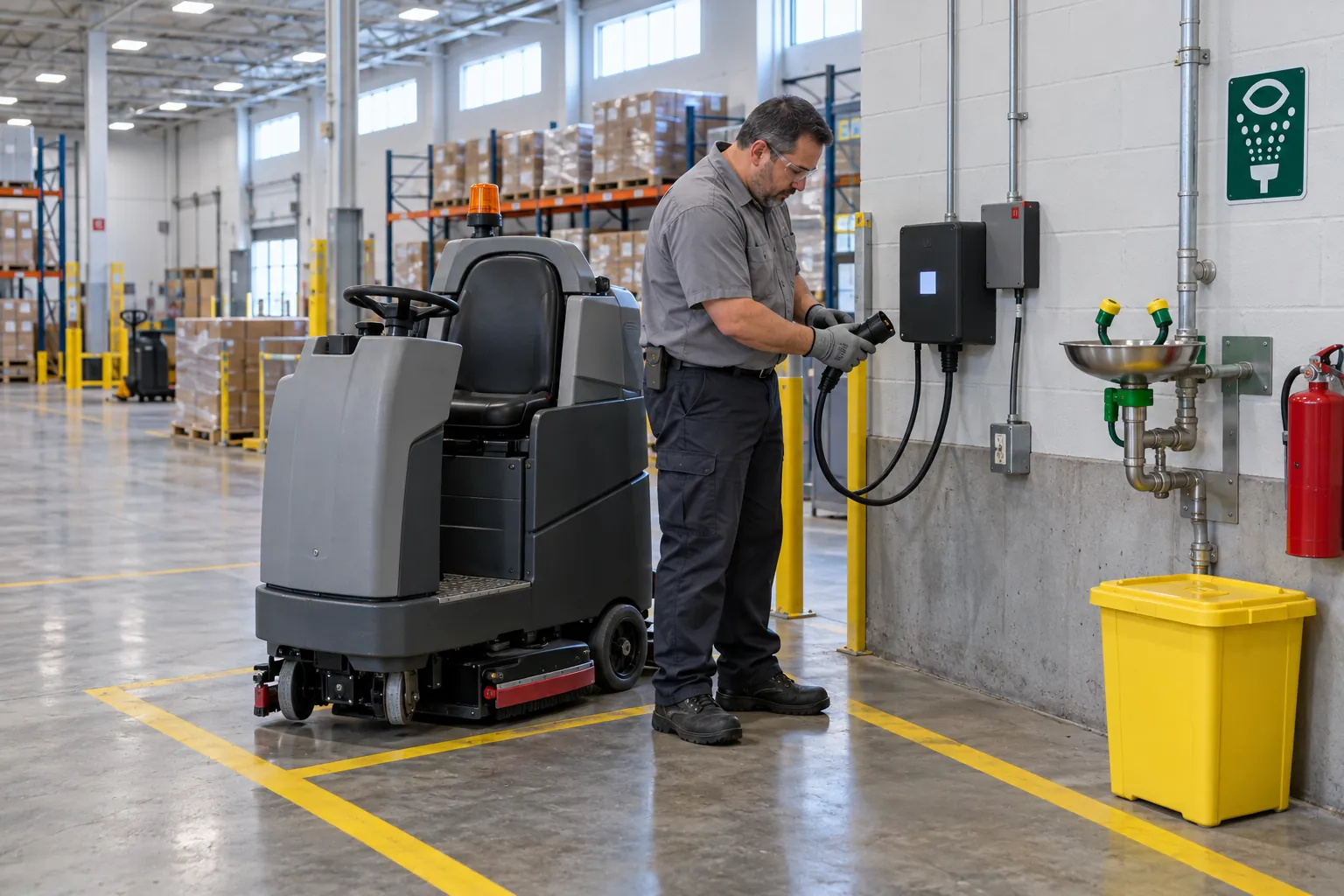
Most scrubbers run on lead-acid batteries, which give off hydrogen while charging and contain sulfuric acid. Where 29 CFR 1910.178 applies, it sets out what a charging area needs, and those rules are a good checklist for any scrubber charging area:
- facilities "for flushing and neutralizing spilled electrolyte, for fire protection, for protecting charging apparatus from damage by trucks, and for adequate ventilation for dispersal of fumes from gassing batteries";
- "Smoking shall be prohibited in the charging area";
- "Precautions shall be taken to prevent open flames, sparks, or electric arcs in battery charging areas";
- "Tools and other metallic objects shall be kept away from the top of uncovered batteries";
- "Reinstalled batteries shall be properly positioned and secured in the truck."
Separately, OSHA's first aid standard, 29 CFR 1910.151(c), applies to any workplace where "the eyes or body of any person may be exposed to injurious corrosive materials": suitable facilities for quick drenching or flushing "shall be provided within the work area for immediate emergency use." A custodian watering flooded batteries is exposed to electrolyte, so the battery room or charging corner needs an eyewash within reach.
Water flooded batteries after charging, not before, unless the plates are exposed, and only to the level the manufacturer gives; overfilling before a charge pushes acid out of the vents. Use the charger that came with the machine or one the manufacturer approves for that battery type, because sealed AGM, gel and lithium batteries need a different charge profile from flooded ones.
Chemicals. Battery electrolyte, and many scrubbing chemicals, are hazardous chemicals under OSHA's Hazard Communication standard, 29 CFR 1910.1200, which requires safety data sheets for them to be "readily accessible during each work shift to employees when they are in their work area(s)." Use the product and dilution the scrubber's manufacturer approves; foaming or solvent-based chemicals can damage the vacuum motor and seals. A dilution control system keeps the mix consistent from shift to shift.
Propane. Propane-powered scrubbers and burnishers produce carbon monoxide. OSHA's Carbon Monoxide Poisoning fact sheet names the internal combustion engine as "one of the most common sources of exposure in the workplace" and tells employers to maintain equipment that can produce CO in good working order, to prohibit gasoline-powered engines in poorly ventilated areas, to consider battery or electric equipment instead where it can be used safely, and to provide personal CO monitors with audible alarms where exposure may exist. For propane machines, engine tune-ups and emissions checks are part of maintenance, not an optional extra.
05
Who does what, and what good evidence looks like
Write the split down, in the janitorial scope of work or the site's equipment procedure:
- The operator (custodian, porter or floor tech) does the pre-use check and the end-of-shift routine, and reports any fault right away rather than working around it.
- The crew lead or janitorial supervisor checks that the routine is being done, deals with reported faults, tags a faulty machine out of service and arranges the repair, and makes sure only trained people operate the machines.
- The building engineer or facility manager, where the client owns the equipment, holds the service contract, the charging area, the eyewash and the ventilation.
- The dealer or a trained technician carries out the periodic service and any repair beyond the operator's daily tasks. 1910.178 puts it this way for the machines it covers: "All repairs shall be made by authorized personnel."
Out of service means out of service. The powered industrial truck rule is that a machine "found to be in need of repair, defective, or in any way unsafe" is "taken out of service until it has been restored to safe operating condition." For a scrubber, remove the key, attach a tag that says why and who took it out of use, and tell the next shift. Before anyone works on the brushes, squeegee or wiring, the key comes out and the battery is disconnected. OSHA's lockout/tagout standard, 29 CFR 1910.147, covers servicing where "unexpected energization or start up" could injure someone; the manufacturer's manual gives the safe isolation steps for each model.
Training. Operators should be trained on each model they use, including the daily checks and what to do when something goes wrong. Where 1910.178 applies, it requires operators to be trained and evaluated, with "an evaluation of each powered industrial truck operator's performance" at least once every three years. The PPE the job needs, such as gloves and eye protection for battery watering and chemical handling, comes from the employer's hazard assessment under 29 CFR 1910.132(d); see janitorial PPE.
Good evidence for a scrubber fleet is simple, and should let anyone answer four questions about any machine: when was it last checked, by whom, what was found, and what happened next. In practice that means:
- each machine identified by an asset number or location, not just "the big scrubber";
- the pre-use and end-of-shift checks recorded when they are done, by the person who did them;
- faults reported with the date, the machine and what is wrong, and followed through to repair;
- out-of-service tags and the date the machine was returned to use;
- the periodic service record with the hour meter reading and the technician's report;
- training records for each operator.
06
Where the record fails, and what SiteClara does about it
The usual scrubber record is a check sheet taped to the machine or hanging in the janitor closet. It gets initialed for the week in one go, or not at all, and the one time it matters, after a slip on a wet corridor or a burned-out vacuum motor, it shows a column of check marks and nothing about what was actually found. Faults are mentioned to whoever was passing, the machine is parked with a full recovery tank, and the next shift discovers it in the morning.
SiteClara records routine checks at the place they happen. A printed QR poster, with an optional NFC tag behind it, sits where the check is done, such as the charging area or the janitor closet where a scrubber is stored. Staff scan or tap on their own phone, with no app to install, see the checks due there, such as the end-of-shift routine, and mark each one done or say what stopped them. The time and the named person are recorded as it happens, with a photo when the check asks for one, such as the rinsed recovery tank left open. A fault someone reports goes onto the team's list of jobs, where it stays until it is closed.
The supervisor sees what is due, done and missed across the day, and records the reason a check was missed, for example that the machine was already tagged out of service. Each day they review it, add a note and approve a report that goes to the facility's designated contacts the next morning at 8:00 by default. When a scrubber fails or a floor is left wet, that record shows when the machine was last checked and by whom.
07
Questions people ask
How do you maintain a floor scrubber?
Follow the operator's manual for the model, which splits the work into tasks the operator does after each use, each week and at set hours, and service by the hour meter for trained personnel. After daily use, the Tennant T300/T300e Operator Manual has the operator drain and rinse the recovery tank, empty the debris tray, clean the float shut-off screen, drain and rinse the solution tank, turn the pad over or replace it when worn, wipe the squeegee blades and rotate them if worn, check the scrub head skirt, clean the outside of the machine and charge the batteries. Weekly tasks include checking the battery electrolyte level and cleaning the squeegee drip trap.
What are the common problems with floor scrubbers?
The troubleshooting table in the Tennant T300/T300e Operator Manual covers three everyday problems among others, with their causes. Trailing water or poor pickup comes from a full recovery tank or foam, a loose drain hose cap or open drain valve, worn squeegee blades, a clogged squeegee, drip trap or float shut-off screen, a loose, clogged or damaged vacuum hose, or a recovery tank lid that is not fully closed or has a bad seal. Little or no solution flow comes from an empty tank, a low flow setting, a clogged solution filter or a plugged supply line. A short run time comes from a low charge, batteries that need maintenance or are at the end of their life, a faulty charger, or brush pressure set too high.
What chemical should you use in a floor scrubber?
Use a commercial floor cleaning detergent the manufacturer approves for the machine, mixed to the detergent's own instructions. The Tennant T300/T300e Operator Manual says to use only "commercially approved cleaning detergents" for conventional scrubbing, warns that "machine damage due to improper detergent usage will void the manufacturer's warranty," and says not to use flammable materials in the tanks. Foam matters too: it will not trip the float shut-off, so the manual warns that vacuum motor damage will result, and it recommends a foam control solution in the recovery tank if excessive foam appears. Machines with a water-conditioning system such as Tennant's ec-H2O run on water alone and signal a fault if detergent is added.
08
Further reading, and a list to take away
Start with the operator's manual for each model you run: it is the authority on daily tasks, service intervals, approved chemicals and battery care. For the federal rules, read OSHA's 29 CFR 1910.22 on floors, 29 CFR 1910.178 for battery charging areas and the examine-before-use rule, 29 CFR 1910.151 for eyewash, and the Hazard Communication standard for chemicals. If you are in a State Plan state, check the state's own rules through OSHA's State Plans page.
For a floor scrubber maintenance program that holds up, check that:
- every machine has an asset number and a home: where it is stored and where it charges;
- operators are trained on each model and know the pre-use check;
- the end-of-shift routine is written down and done every time: tanks drained and rinsed, filters and float cleaned, squeegee wiped, pads off, machine on charge;
- the charging area is ventilated, has no smoking and no open flames, and has an eyewash and spill materials within reach;
- flooded batteries are watered after charging, to the manufacturer's level, with gloves and eye protection;
- only the approved chemical and dilution go in the solution tank, with safety data sheets available;
- a faulty machine is tagged out of service with the key removed until it is repaired;
- periodic service is booked by hour meter or calendar, and the report is kept;
- propane machines have their engines serviced and CO is monitored where they are used indoors;
- the daily checks are recorded when and where they are done, by name, so the record can be believed.
Sources
Every document this guide quotes or links to, in the order it first cites them.
- 29 CFR 1910.22 osha.gov
- 29 CFR 1910.178 osha.gov
- 22 approved State Plans osha.gov
- Tennant T300/T300e Operator Manual tennantco.com
- 29 CFR 1910.151(c) osha.gov
- Hazard Communication standard, 29 CFR 1910.1200 osha.gov
- Carbon Monoxide Poisoning fact sheet osha.gov
- 29 CFR 1910.147 osha.gov
- 29 CFR 1910.132(d) osha.gov
Related guides
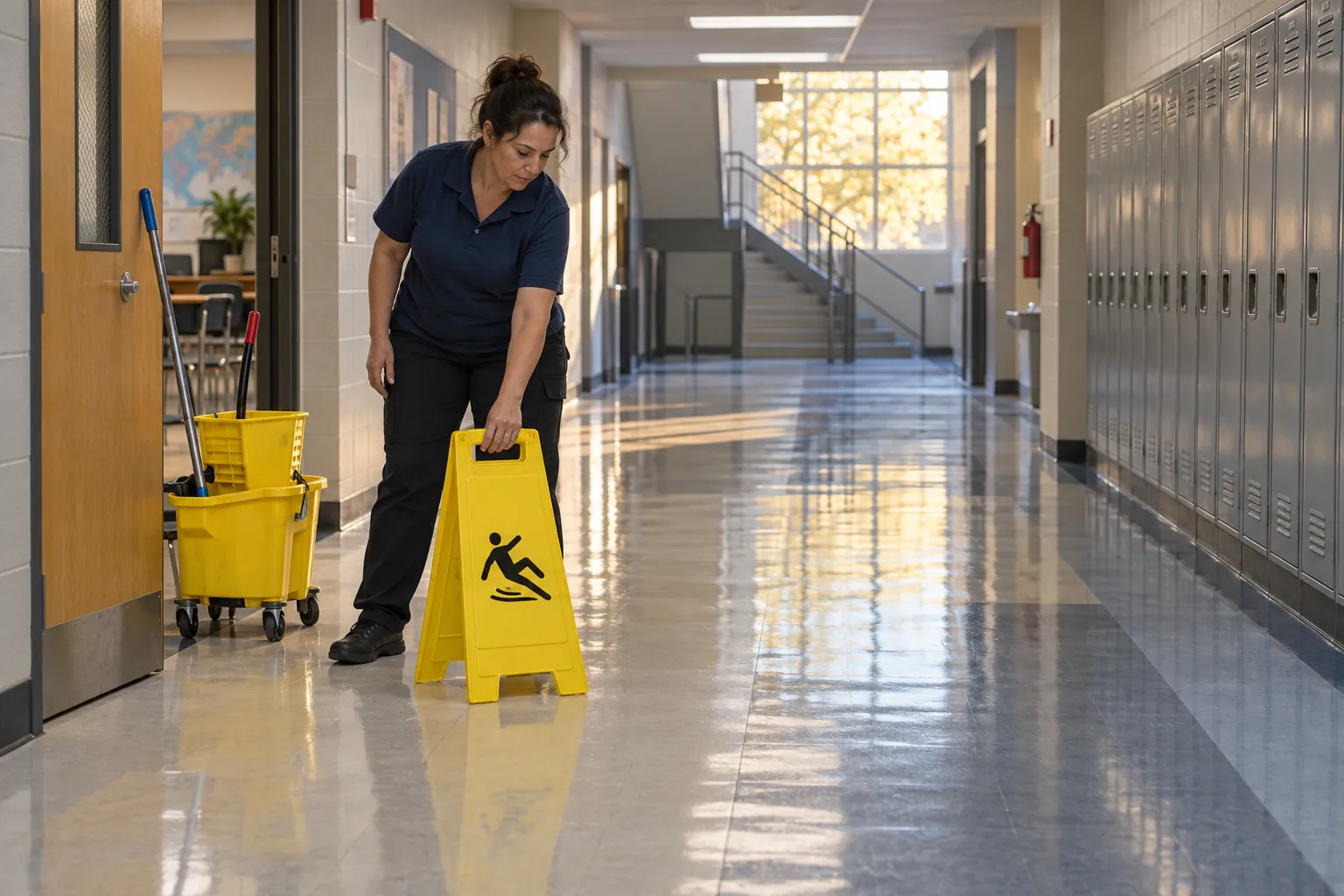 CleaningWet floor sign requirements: what OSHA asks for, and how to use the sign wellWhat OSHA and ANSI Z535 require of a wet floor sign, when one is needed, where to place it, when to take it in, and how to show the wet floor was managed.
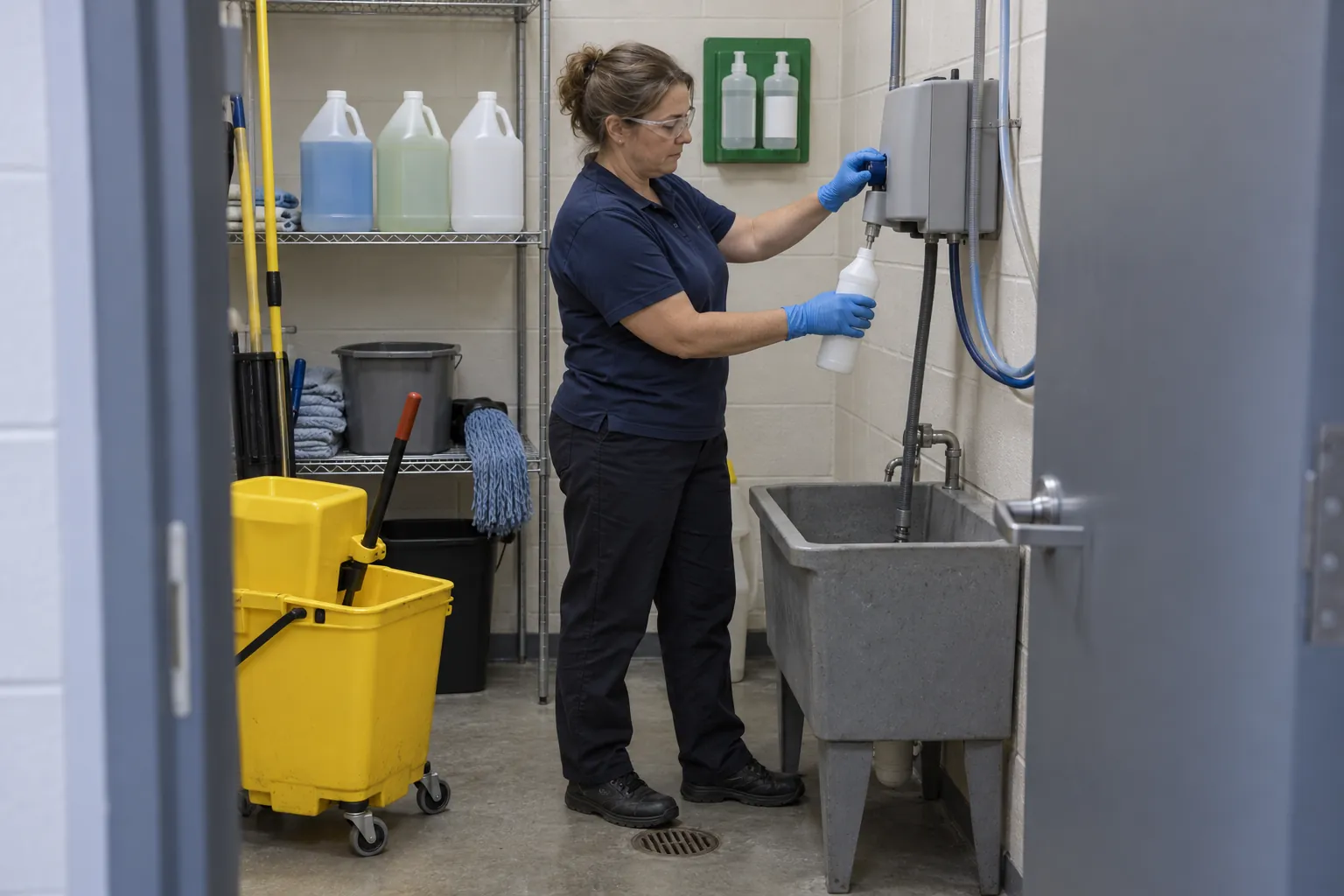 CleaningChemical dilution control: getting the mix right, every bottle, every shiftHow a chemical dilution control system works, what OSHA HazCom and EPA labels require, how to check dispensers and bottles, and what the record should show.
 CleaningCommercial carpet maintenance: the program, the frequencies and the record behind themCommercial carpet maintenance for janitorial teams: CRI 204 and IICRC S100, vacuuming and extraction frequencies by traffic, spotting, and records that hold up.
 CleaningJanitorial PPE: the hazard assessment, the kit and the daily checkJanitorial PPE under OSHA 29 CFR 1910.132: the hazard assessment, gloves, eye protection, footwear, bloodborne pathogens, training, payment and the daily check.