Cleaning
Wet floor sign requirements: what OSHA asks for, and how to use the sign well
Wet floor sign requirements in the United States come from OSHA: a floor must be kept clean and, as far as feasible, dry, a slippery hazard must be guarded until it is fixed, and the sign that warns of it is a caution sign on a yellow background.
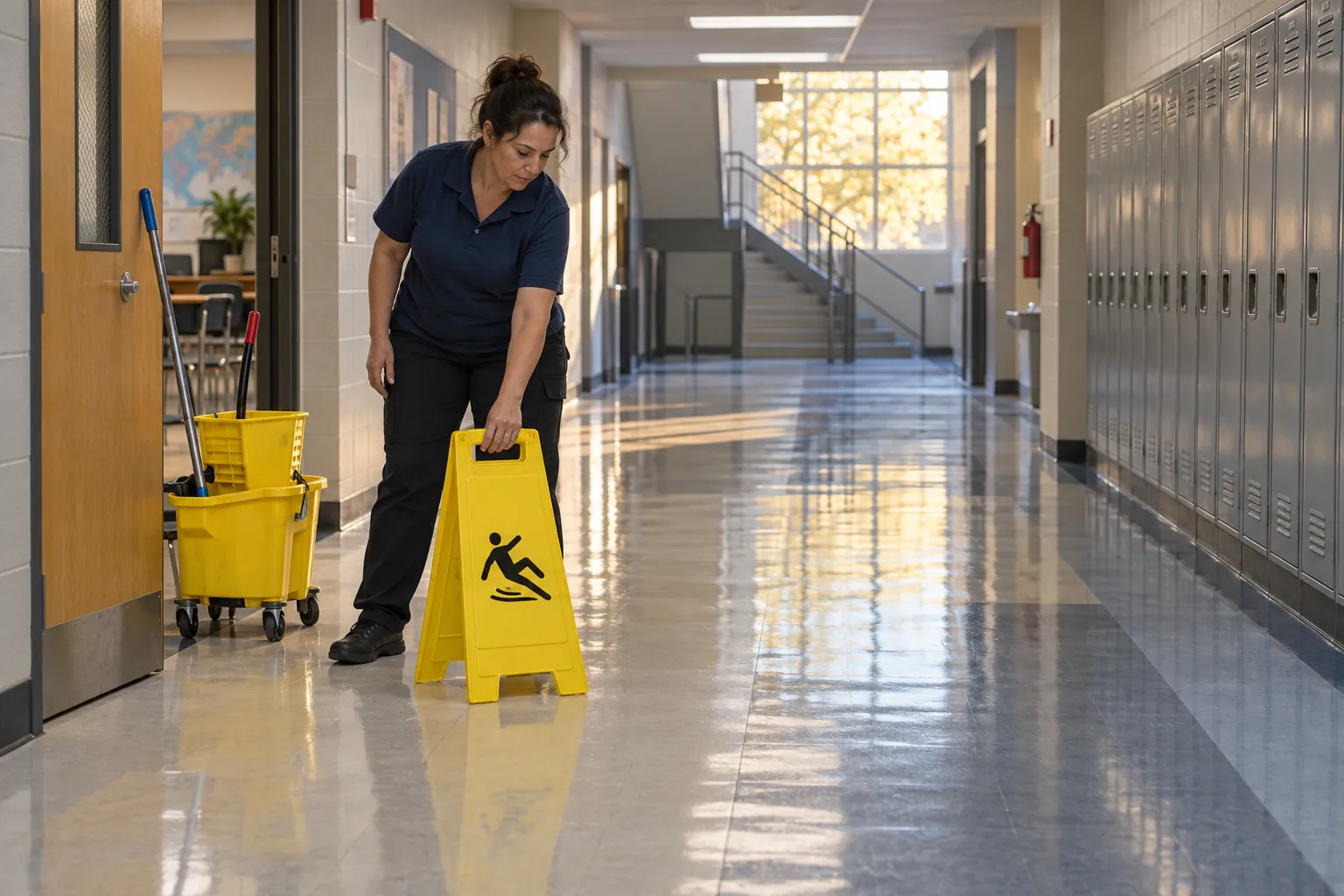
No federal rule names the yellow A-frame itself, but it is where those duties meet in a janitor's cart. This guide covers what the standards say, what a proper sign looks like, where it goes, when it comes in, and how to show the floor was managed.
01
What the rules say about wet floor signs
For most private employers in general industry, the duty starts with 29 CFR 1910.22, General requirements for walking-working surfaces. Under 1910.22(a)(2), "the floor of each workroom is maintained in a clean and, to the extent feasible, in a dry condition." Under 1910.22(a)(3), surfaces are kept free of hazards such as "leaks, spills, snow, and ice." And under 1910.22(d)(2), a hazardous condition is corrected before anyone uses the surface again; if that cannot be done immediately, "the hazard must be guarded to prevent employees from using the walking-working surface until the hazard is corrected or repaired."
That is the logic of the wet floor sign. Mopping, scrubbing, a spill, or rain tracked in through the entrance makes a floor wet for a while. The sign, and the cone or barrier that goes with it, is part of guarding that floor until it is dry. It is not a substitute for drying it.
The sign itself falls under 29 CFR 1910.145, Specifications for accident prevention signs and tags. It applies to signs "intended to indicate and, insofar as possible, to define specific hazards of a nature such that failure to designate them may lead to accidental injury to workers or the public, or both, or to property damage." A wet floor is that kind of hazard, and the sign for it is a caution sign: under 1910.145(c)(2)(i), "caution signs shall be used only to warn against potential hazards or to caution against unsafe practices." OSHA's own Young Worker Safety in Restaurants eTool on clean-up puts it directly: "Provide warning signs for wet floor areas," citing 1910.145(c)(2).
Two further points complete the federal picture. 29 CFR 1910.144, Safety color code for marking physical hazards, makes yellow "the basic color for designating caution and for marking physical hazards such as: Striking against, stumbling, falling, tripping." And OSHA's 2013 final rule, Updating OSHA Standards Based on National Consensus Standards; Signage, effective September 11, 2013, lets employers follow either the older ANSI sign standards named in 1910.145 (Z53.1-1967, Z35.1-1968, and Z35.2-1968) or the updated ANSI Z535.1-2006 (R2011), Z535.2-2011, and Z535.5-2011.
Weather counts too. In a 1994 letter of interpretation, Wet floors due to weather conditions or the entry of vehicles containing melting snow, OSHA confirmed that floors made wet by rain or melting snow are covered by the housekeeping rule, though they are not a "wet process." The letter predates the 2016 rewrite of Subpart D.
02
When a wet floor sign is needed
A sign goes out whenever a walking surface is wet, or about to be, and people other than the person cleaning may walk on it. In an office, school, store, or hospital, that usually means:
- Routine wet cleaning: damp mopping, auto-scrubbing, and restroom floor cleaning, from before the first pass until the floor is dry.
- Spills: a coffee in the lobby, a drink in the cafeteria line, a leaking trash bag at the loading dock. The custodian or day porter who finds it guards it first, then cleans it.
- Entrances in wet weather: rain, snow, and slush tracked in past the walk-off mats, often for hours at a time.
- Leaks and condensation: a roof leak, a sweating chilled-water pipe, a dripping ice machine or drinking fountain. The sign stays until the building engineer has fixed the source, not only until the puddle is mopped.
- Periodic floor care: stripping and refinishing, where the floor is slippery for much longer and a sign alone is not enough; the area is closed with barricade tape or stanchions.
- Carpet extraction: the damp carpet and, more often, the hard floor at its edge where wet shoes leave it.
The sign is the minimum, not the whole control. OSHA's Hospital eTool on slips, trips, and falls recommends "cleaning only one side of a passageway at a time" and ensuring "that spills are reported and cleaned up immediately." Where a dry route cannot be kept, the area is closed rather than signed: under 1910.22(d)(2) the hazard must be guarded to prevent use, and a single cone in the middle of a wet lobby does not do that.
03
What a proper wet floor sign looks like
OSHA does not approve particular products, and there is no official "OSHA wet floor sign." What the standards set is the design of a caution sign and the way it is used. A sign that meets them has:
- The signal word CAUTION. A wet floor is a potential hazard, which is what 1910.145(c)(2) reserves caution signs for. DANGER is for "immediate danger" under 1910.145(c)(1), and using it for a mopped floor dilutes it for the places it is meant for.
- Yellow. Under 1910.145(d)(4), for a caution sign "the standard color of the background shall be yellow; and the panel, black with yellow letters," and any letters on the yellow background are black. Signs made to ANSI Z535.2 use the same safety yellow for CAUTION, in the Z535 format described below.
- Short, plain wording. Under 1910.145(e)(2), "the wording of any sign should be easily read and concise" and "should make a positive, rather than negative suggestion and should be accurate in fact." "Wet floor" or "Caution: wet floor" is accurate; a sign left out on a dry floor is not.
- A picture as well as words. A falling-figure symbol lets someone who does not read the words, or reads another language, understand the sign at a glance. Where many people who use the building read another language, add it to the same sign.
- No sharp edges. Under 1910.145(d)(1), "all signs shall be furnished with rounded or blunt corners and shall be free from sharp edges, burrs, splinters, or other sharp projections." A cracked plastic A-frame with a split edge has stopped meeting that rule.
The ANSI Z535.2-2011 (R2017) contents and scope, published free by NEMA, the secretariat, explains how the series fits together. ANSI Z535.1 covers safety colors, Z535.2 environmental and facility safety signs, Z535.3 safety symbols, and Z535.5 "Safety Tags and Barricade Tapes (for Temporary Hazards)." Z535.2 describes a signal word panel, a message panel, and, where used, a symbol panel, and its foreword notes that the product sign format pairs CAUTION with safety yellow. It also records that, since the 2011 edition, the CAUTION signal word panel without the safety alert symbol is no longer used for matters that are not about physical safety, such as property damage, where NOTICE is the preferred word. A wet floor is a physical hazard, so CAUTION is the right word. The standards themselves are paid documents; OSHA's rule names Z535.1-2006 (R2011), Z535.2-2011, and Z535.5-2011, and later editions have been published since.
04
Where to put the sign, and when to take it in
Most of the value of a wet floor sign is in where and when it stands. A routine that works in most buildings:
- Set it out before the floor gets wet. The sign goes down first, then the mop. A spill is guarded first, then cleaned.
- Cover every approach. A sign faces the direction people come from. A corridor wet across its width needs a sign at each end; a restroom needs one at the door, not only at the sink; an elevator lobby may need one at each bank of doors.
- Place it at the edge of the wet area, where someone will see it before stepping onto the wet surface, not in the middle of the floor where they meet it already on the wet part.
- Keep a dry route. Clean one side of a passageway at a time, as OSHA's hospital eTool recommends, and leave room to pass the sign with a cart, a wheelchair, or a stroller.
- Keep exits clear. Under 29 CFR 1910.37, Maintenance, safeguards, and operational features for exit routes, "exit routes must be free and unobstructed. No materials or equipment may be placed, either permanently or temporarily, within the exit route." A cone and bucket parked across a stair door or exit corridor block it. Plan wet work on exit routes for quiet times and keep the path open.
- Take it in when the floor is dry. A sign on a dry floor teaches everyone to ignore the next one.
That last step is where most sign routines fail. For construction work, OSHA's 29 CFR 1926.200, Accident prevention signs and tags, puts it as a rule: signs "shall be visible at all times when work is being performed, and shall be removed or covered promptly when the hazards no longer exist." California's Section 3340 says the same of temporary construction signs. Neither is written for janitorial work in a finished building, but the principle is the right one for a wet floor sign: up while the hazard is there, gone when it is not.
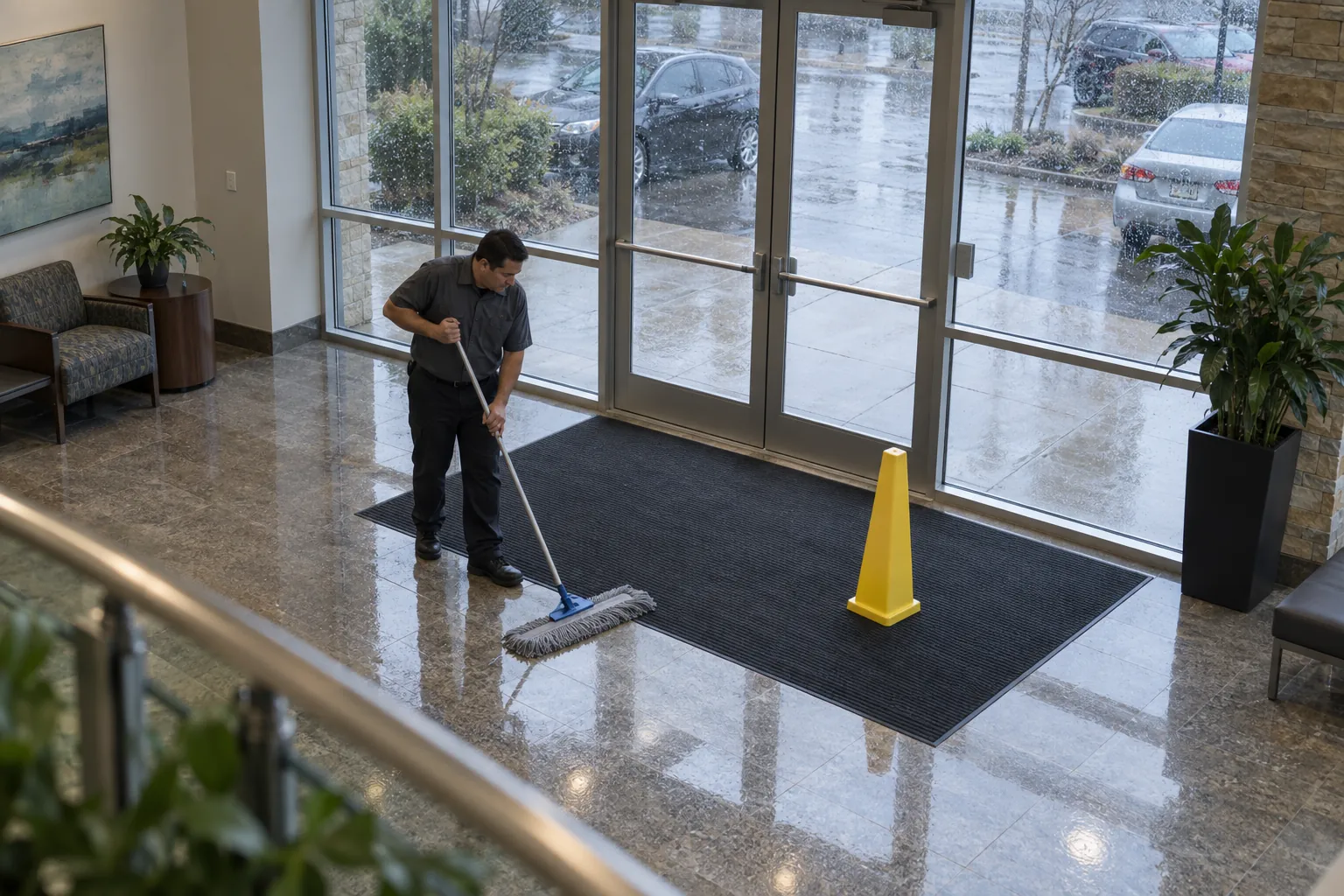
Entrances in wet weather are the exception, because the floor keeps getting wet. There the sign stays out alongside walk-off mats changed when saturated and a set dry-mop round, and comes in when the weather clears and the floor is dry.
05
Who does what, and what good evidence looks like
Wet floor signs are everyone's in principle and nobody's in practice unless the roles are written down. In a typical building:
- Custodians and day porters set out and take in signs for their own work, guard and clean spills they find, and check entrances and restrooms on a set round in wet weather.
- The janitorial supervisor makes sure every cart carries enough signs in good condition, checks during the shift that signs are out where floors are wet and not left on dry floors, and replaces damaged or faded signs.
- Security officers on patrol report spills, leaks, and water at entrances, and guard a spill until a custodian arrives, as the post orders say.
- The building engineer or maintenance team fixes the source of a recurring leak or condensation, so the sign is not the permanent answer to a roof problem.
- The facility manager or property manager sets the routine in the janitorial scope of work, including entrance checks on wet days, and reviews what happened after a slip.
Good evidence is simple and made at the time. For routine checks, a record of the entrance and restroom rounds, with who did each one and when, shows that wet areas were looked at through the day. For a spill or leak, a record of when it was reported, when it was guarded, and when it was cleaned and the sign taken in shows how long the floor was a hazard. A photograph of a guarded spill, or of a sign set out at an entrance, is worth more after an incident than any recollection.
After a slip and fall, the property owner, the cleaning contractor, and their insurers will all ask when the floor was last checked and by whom, and a record made at the time answers that better than anyone's memory.
Keep sign stock on the checklist too: a building that runs out of signs on the first wet day of fall ends up with a trash can doing the job.
06
Where the record fails, and what SiteClara does about it
Wet floor routines fail in ways that leave nothing on paper. The sign goes out for the morning mop and is still there at 4 p.m. The rainy-day entrance checks are in the scope of work, but nobody can say when they happened. The leak under the ice machine is mopped every morning for a month with no one asked to fix it. After a slip, the question is always the same: when was that floor last checked, and by whom?
SiteClara records routine checks at the location. A printed QR poster, with an optional NFC tag behind it, sits at each place a check is scheduled, such as the main entrance or a restroom. Staff scan or tap with their own phone, with no app to install, see the checks due there, such as the entrance dry-mop round on a wet day, and mark each one done or say what stopped them, with a photo when one is asked for. A spill or leak found there can be reported with a photo, and it stays on the team's list of jobs until someone closes it.
The supervisor sees what was due, done, and missed, and records the reason a check was missed. A job the team cannot fix, such as a roof leak that needs the owner's contractor, can be escalated to the building manager to answer. Each day the supervisor reviews and approves a report that goes to nominated management or client contacts at 8 a.m. the next morning: what was reported, what was completed, what is still open, and how the scheduled checks went.
07
Questions people ask
Are wet floor signs legally required?
For employers covered by federal OSHA, in effect yes, though no rule names the sign itself. 29 CFR 1910.22, General requirements, requires workroom floors to be kept clean and, to the extent feasible, dry, and a hazardous condition to be corrected, or guarded, before employees use the surface again. OSHA's Young Worker Safety in Restaurants eTool on clean-up tells employers to "provide warning signs for wet floor areas," citing 1910.145(c)(2), the rule for caution signs.
How close do wet floor signs need to be?
No federal rule sets a distance. 29 CFR 1910.145, Specifications for accident prevention signs and tags, sets the design of a caution sign but not how far it stands from the hazard; its five-foot readability rule, in 1910.145(f)(4)(ii), applies to accident prevention tags, not signs. In practice the sign stands at the edge of the wet area, facing each way people approach, so it is seen before anyone steps onto the wet floor.
Does a wet floor sign have to be yellow?
Yes, if it follows OSHA's caution sign design. Under 1910.145(d)(4) of 29 CFR 1910.145, Specifications for accident prevention signs and tags, "the standard color of the background shall be yellow; and the panel, black with yellow letters." 29 CFR 1910.144, Safety color code for marking physical hazards, makes yellow the basic color for caution and for hazards such as stumbling, falling, and tripping.
08
Where to read more, and a list to take away
The rules are short and free on OSHA's site: 29 CFR 1910.22 for floors, 29 CFR 1910.145 for caution signs, and the 2013 signage final rule for the ANSI Z535 option. In a State Plan state, check its own rules too.
Before the next wet day, check that:
- every cart and janitor closet has enough CAUTION signs, yellow, with a pictogram, and none cracked or faded;
- custodians and day porters know the rule: sign out before the floor gets wet, take it in when it is dry;
- wet cleaning is done in sections, leaving a dry route, with exit routes kept open;
- areas being stripped or refinished are closed, not just signed;
- entrances have walk-off mats and a set check round on wet days, with who did each round and when;
- spills and leaks are recorded from report to cleanup, and a recurring leak is sent to maintenance;
- the supervisor walks the building for signs left on dry floors;
- the routine is written into the scope of work and the post orders, and reviewed after any slip.
Sources
Every document this guide quotes or links to, in the order it first cites them.
- 29 CFR 1910.22, General requirements osha.gov
- 29 CFR 1910.145, Specifications for accident prevention signs and tags osha.gov
- Young Worker Safety in Restaurants eTool on clean-up osha.gov
- 29 CFR 1910.144, Safety color code for marking physical hazards osha.gov
- Final rule, Updating OSHA Standards Based on National Consensus Standards; Signage osha.gov
- State Plans osha.gov
- Title 8, Section 3340, Accident Prevention Signs dir.ca.gov
- Wet floors due to weather conditions or the entry of vehicles containing melting snow osha.gov
- Hospital eTool on slips, trips, and falls osha.gov
- ANSI Z535.2-2011 (R2017) contents and scope nema.org
- 29 CFR 1910.37, Maintenance, safeguards, and operational features for exit routes osha.gov
- 29 CFR 1926.200, Accident prevention signs and tags osha.gov
Related guides
 Premises and facilities managementSlip, trip, and fall prevention: keeping floors, stairs, and walkways safe every daySlip, trip, and fall prevention in a commercial building: what OSHA 1910.22 requires, where people fall, the controls that work, and how to check and record them.
 CleaningDay porter duties: what the job covers, and how to prove the roundsWhat a day porter does in an occupied building, a sample daily route, the OSHA rules behind the work, and how to show a client the rounds really happened.
 CleaningPublic restroom cleaning: frequency, safety and ADA upkeepCleaning public restrooms in parks, transit, venues and public buildings: how often at peak, sharps and bodily fluids under OSHA, and keeping ADA features usable.
 CleaningCommercial cleaning checklist: area by area, and how to use itA commercial cleaning checklist for offices, lobbies, restrooms and shared areas, area by area, with the OSHA rules behind it and how a supervisor checks the work.