Fire and water checks
Cooling tower inspection: the weekly checks, the 90-day inspection, and a record that holds up
A cooling tower inspection is a check of the tower's structural condition, mechanical parts and water treatment for the biofilm, scale, debris, corrosion and faulty equipment that let Legionella grow, Where rules apply, as they do in New York, a qualified person inspects the tower at least every 90 days, and New York City also requires a designated responsible person to check it weekly.
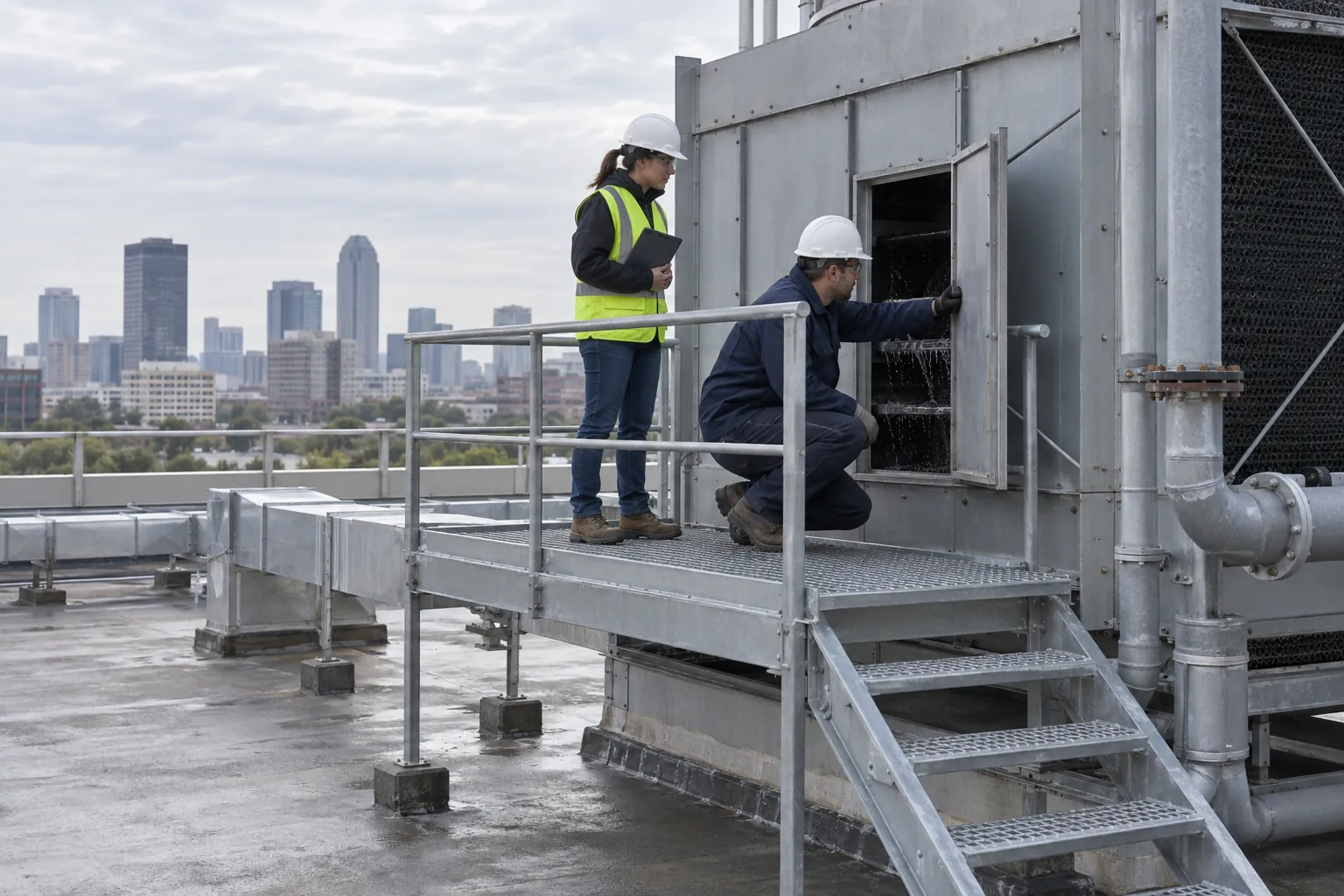
A cooling tower sits on the roof or behind the building doing its job quietly, which is exactly why its checks slip. The tower is also one of the best known sources of Legionnaires' disease, because it throws a fine mist of recirculating water into the air. This guide covers where the rules for cooling tower inspections come from in the United States, what New York City's detailed rules require, what the routine checks and the quarterly inspection look at, and what makes the record believable to an inspector.
01
Where cooling tower inspection rules come from
A cooling tower rejects heat by exposing recirculating water to air. Warm water, sediment, biofilm and a steady spray of droplets are the conditions Legionella bacteria like, and the aerosol can carry them to people nearby or into air intakes. The CDC's module Controlling Legionella in Cooling Towers puts the growth range at 77 to 113°F and advises operating a tower at the lowest water temperature practical. The CMS memo on reducing Legionella risk in healthcare facility water systems (QSO-17-30) names cooling towers among the devices through which transmission can occur.
There is no single federal rule that tells the owner of an ordinary commercial building how often to inspect a cooling tower. What exists is a layer of standards, guidance and, in some places, local law:
- ANSI/ASHRAE Standard 188-2021, Legionellosis: Risk Management for Building Water Systems sets minimum risk management requirements for building water systems. ASHRAE says the 2021 edition "replaces permissive language with enforceable language to facilitate adoption of the standard in codes and regulations". It is a voluntary standard until a jurisdiction, an accreditor or a contract adopts it.
- The CDC's toolkit puts a water management program into practice; its cooling towers module covers control, monitoring and remediation.
- OSHA has no cooling tower standard of its own, but its page on Legionellosis control and prevention recommends cleaning and disinfecting cooling towers at least twice a year and sets out how to protect the workers who do it.
- Healthcare: QSO-17-30 expects hospitals, critical access hospitals and long-term care facilities to have policies and procedures that inhibit microbial growth in building water systems, the cooling tower included.
- State and city law: some jurisdictions regulate cooling towers directly. The most detailed is New York City, where the Health Department's rules in Chapter 8 of Title 24 of the Rules of the City of New York sit alongside section 17-194.1 of the city's Administrative Code and Part 4 of the New York State Sanitary Code.
Even outside New York, the NYC rules are worth reading, because they turn general advice into named checks, frequencies and records. Check with your state and local health department before assuming no local rule applies, and treat your building's plan, not this guide, as the authority on what your tower needs.
02
What a cooling tower inspection covers in practice
Chapter 8 separates the routine monitoring done by the building's own designated person from the compliance inspection done by an outside qualified person. Both are recorded on a written or electronic checklist, and between them they cover the same ground a good engineer would walk on any tower.
At the weekly check, the rules say all wetted surfaces visible while the system runs, the tower basins and the drift eliminators must be observed, and the checklist must note any of these:
- organic material, biofilm and algae;
- scale, sediment, and silt or dust deposits;
- oil and grease, and any other visible contaminants;
- the condition of the chemical dosing and control equipment and the bleed-off system;
- whether there is enough treatment chemical in storage and being delivered.
The quarterly compliance inspection covers visible contaminants; the condition of the tower, basin, packing and drift eliminator; the makeup water connections and control; whether the conductivity control and dosing equipment work; and a review of the routine maintenance records.
The practical walk usually adds a few things the rules imply: the structural condition of the casing, supports and fill, with any corrosion noted; the hot water distribution basin and its nozzles, which clog and spray unevenly; fan guards in place, ladders and platforms sound, the basin free of leaves and bird waste, no dead leg valved off and forgotten, and the registration number still posted on the tower.
03
How often: the NYC frequencies as a working model
New York City's rules give the clearest set of frequencies in the country. Read them as a model if you are elsewhere, and as the law if your building is in the five boroughs:
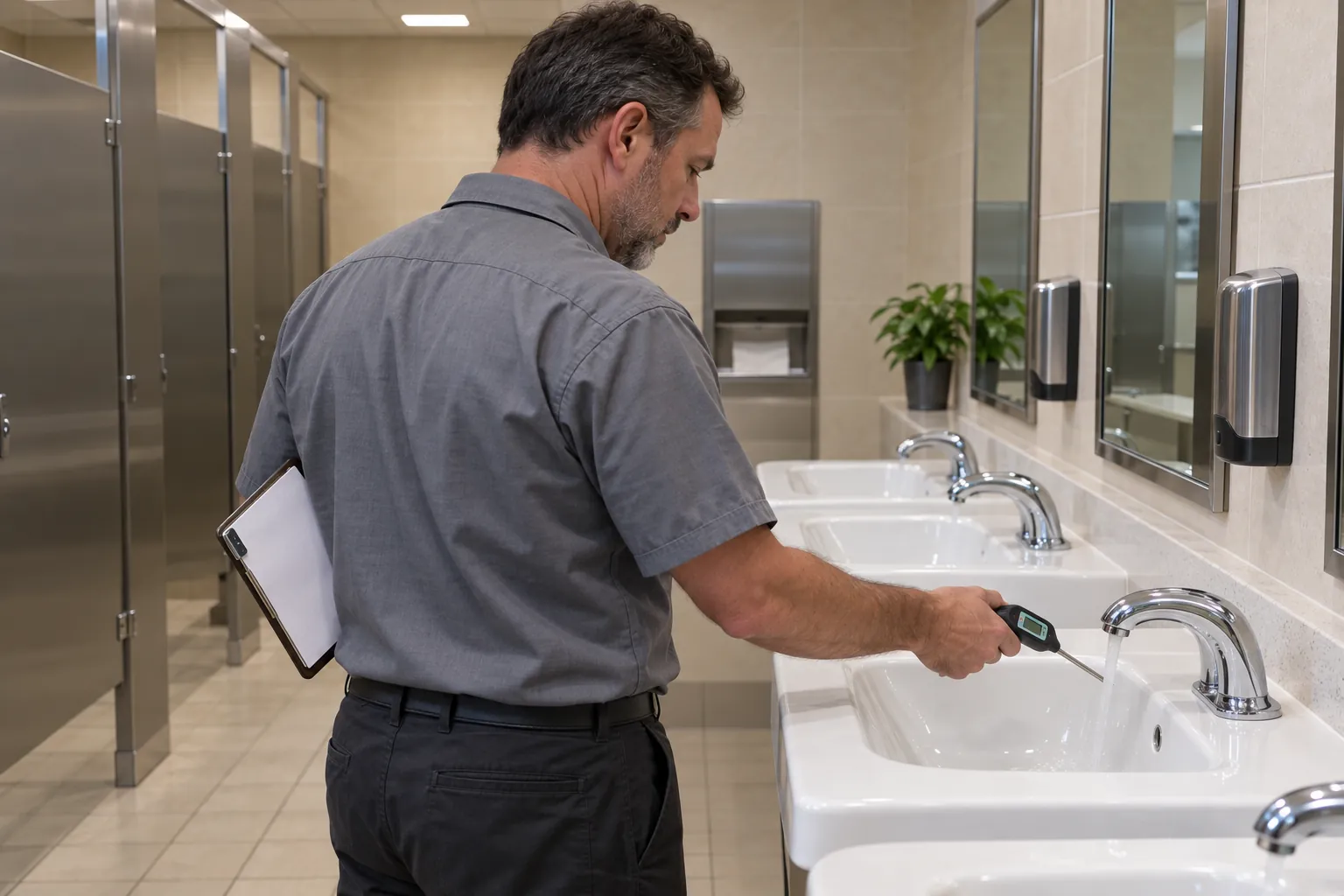
- Water quality readings: pH, temperature, conductivity and the biocidal indicator (free halogen residual or oxidation reduction potential) measured and recorded at least three times each week, with no more than two days passing without a reading while the system is operating, unless the plan shows how continuous or automated monitoring covers it.
- Routine monitoring: a visual check by the designated responsible person at least weekly while the system is in use, with any anomaly reported to the management and maintenance team for corrective action to be completed within 24 hours.
- Bacteriological indicator: a heterotrophic plate count or dip slide at least once each week while operating, interpreted against Table 8-2 of the Chapter; a plate count must go to a laboratory accredited under New York State's Environmental Laboratory Approval Program (ELAP). A result under 10,000 CFU/mL means maintain the water chemistry; a higher one starts more frequent residual checks and a review of the treatment program.
- Legionella culture: the Health Department's page on Cooling Tower Registration and Maintenance says that beginning May 8, 2026, sampling must be monthly, with no more than 31 days between samples, and that sample dates must be reported through the registration portal within five days of collection. Samples go to an ELAP-accredited laboratory, and extra samples are needed after events such as a power failure or a loss of biocide treatment long enough to allow growth.
- Compliance inspection: by a qualified person at least once every 90 days while the system is in operation.
- Cleaning: whenever monitoring shows a need, and no less than twice a year.
- Summertime hyperhalogenation: at least once a year between July 1 and August 31 (a system fully shut down and drained for that whole period is exempt), holding at least 5 ppm free halogen residual for at least six hours, with pH and residuals measured at two independent sampling points, a Legionella sample 3 to 31 days afterward, and a declaration filed within 30 days.
- Annual certification: each registered tower that operated during the year is certified as inspected, tested, cleaned and disinfected in line with the plan. The Health Department's Cooling Tower Annual Certification notice for the 2025 season set the deadline as November 1, 2025.
Shutdown and startup carry their own steps. A system that is shut down must be completely drained, and the Department notified within five days. Before startup it must be cleaned and disinfected within the 15 days before operation, and the Department notified within five days of startup; cleaning and disinfection are also required after any period of no circulation of five days or more, and a Legionella sample must be taken 3 to 14 days after startup. A qualified person supervises both procedures and carries out a pre-startup inspection.
Outside New York, the CDC's module advises cleaning and disinfecting at least annually, flushing low-flow pipe runs and dead legs at least weekly, and keeping measurable disinfectant residuals throughout each day; OSHA recommends cleaning at least twice a year, usually before the seasonal startup and after the fall shutdown. Your plan sets its own frequencies from these sources and the manufacturer's instructions.
04
Who does the checks, and what happens when a reading is wrong
Most towers are looked after by three kinds of people, and the record works only when each knows their part.
- The responsible person is usually the building engineer, the chief engineer or an operating engineer on staff. In the NYC rules this person takes the water quality readings, does the weekly monitoring, checks biocide storage and records chemical additions, under the guidance of a qualified person.
- The qualified person writes or certifies the maintenance program and plan and carries out the 90-day compliance inspection. In New York City that means a New York State licensed and registered professional engineer, a certified industrial hygienist, a certified water technologist with training and experience in developing management plans and performing inspections to standards such as ASHRAE 188, or an environmental consultant with at least two years of operational experience in water management planning and operation.
- The water treatment vendor supplies and doses the chemicals and often takes the samples. In New York anyone who applies biocides must be a certified pesticide applicator or technician, or an apprentice under one.
The owner or property manager makes sure all of it happens and keeps the record, including the chemical record: in New York, every chemical and biocide added, with its purpose, the manufacturer's name, the brand name, the safety data sheet, the date and time of each addition and the amount added each week.
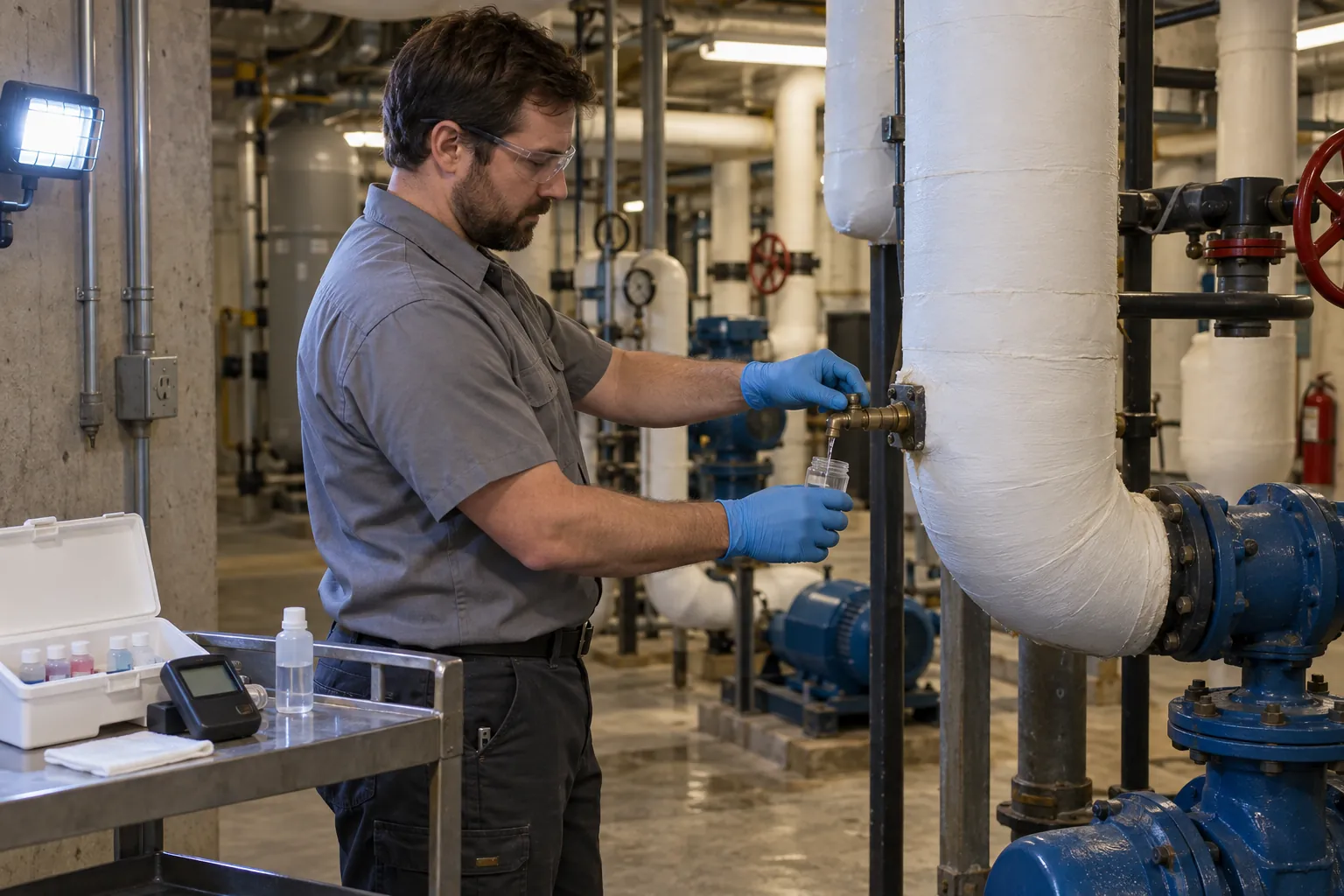
A reading out of range is where a paper system most often fails. The Chapter requires the plan to name the procedure, the responsible parties, the response time and the notification route for each result level. For Legionella culture, Table 8-1 runs from maintaining the treatment when nothing is detected, through disinfection within 24 hours and a retest within 3 to 7 days, to full remediation within 48 hours (hyperhalogenating, draining, cleaning and flushing) at 1,000 CFU/mL or more, with the highest results reported to the Health Department within 24 hours.
The CDC's page on Routine Testing for Legionella gives under 10 CFU/mL as the sign of a well controlled cooling tower, and is clear that test results alone "don't provide a measure of health risk" and that there is "no known safe level or type" of Legionella. A clean result is not permission to skip the next weekly check.
The people doing the work need protecting too. OSHA's guidance advises a NIOSH-approved respirator at least as protective as an N95 for routine maintenance and says workers cleaning a tower must wear, at a minimum, the protective equipment required for the chemicals in use and a half-face air-purifying respirator with an N-100 cartridge. Anyone reaching into a basin or working near the fan is servicing equipment that could start unexpectedly, which brings in OSHA's control of hazardous energy standard, 29 CFR 1910.147, or your state plan's equivalent: lock out the fan and pumps before hands go in.
05
What a good cooling tower record shows
The NYC rules are unusually direct about records. The owner must keep records of every maintenance activity, inspection, deficiency, corrective action, water treatment, test result, cleaning and disinfection for at least three years, and produce them to the Health Department on request. Failing to produce a record "shall be considered prima facie evidence" that the record does not exist and that the requirement was not met. If records are electronic, the owner must show them on a device at the inspection and be able to supply them in a common format such as PDF.
Put simply: the check that was done but not written down counts as not done. A record that stands up has these qualities:
- Readings, not check marks. A pH of 7.9 and a free chlorine residual of 0.8 ppm tell an inspector something; a tick in a box labeled "water OK" does not.
- A named person and a real time. Each entry shows who took it and when, so a week of identical entries written at once looks like what it is.
- The observations the checklist asks for: biofilm, algae, scale, debris in the basin, the drift eliminators, the dosing pumps, the chemical drums.
- The missed check, with its reason. The tower was down for repair, or the roof was closed in a storm. A gap explained on the day beats one discovered in an audit.
- The problem and what happened next. When it was reported, to whom, what was done and when it was closed.
- The documents in one place: the plan and its certification, laboratory reports with chain of custody, vendor service reports, the 90-day checklists, and the shutdown, startup and hyperhalogenation filings.
Photographs help where words are weak: the basin after cleaning, the drift eliminators in place, the chemical tank level. The Health Department carries out its own inspections that review the plan and operational records, so assume someone outside the building will read what you write.
06
Where the record fails, and what SiteClara does about it
Cooling tower records rarely fail because nobody knows the rules; they fail because the tower is out of sight. The weekly walk is skipped when the chief engineer covers two buildings. The water readings go on a clipboard in the mechanical room, three days' worth filled in on Friday afternoon. The vendor's quarterly report arrives by email and sits in someone's inbox. A basin full of leaves is mentioned to whoever was in the elevator, and nobody writes down when it was cleared.
SiteClara puts a printed QR poster, with an optional NFC tag behind it, at the places in the plan where checks happen: the roof door by the tower, the chemical feed station, the condenser water sample point in the mechanical room. The engineer scans or taps with their own phone, with no app to install, and sees the checks due there. They mark each one done, or say what stopped them, with a photo when one is asked for, such as the basin or the drift eliminators. The time and the named person are recorded as it happens, not reconstructed at the end of the week.
A supervisor or chief engineer sees which checks are due, done and missed, and records the reason one was missed. A problem found on a check, such as a dosing pump that has stopped or algae in the basin, is reported on the spot and stays on the team's list of open jobs until someone closes it, and it can be escalated to the building manager. Each day the supervisor reviews and approves a report that goes to nominated managers or clients the next morning, showing how the scheduled checks went.
07
Questions people ask
How often should cooling towers be serviced?
OSHA's page on Legionellosis control and prevention recommends cleaning and disinfecting cooling towers at least twice a year, normally before startup when the cooling season begins and after shutdown in the fall, and more often where there is heavy biofouling or high Legionella results. The CDC's module Controlling Legionella in Cooling Towers sets a floor of removing the tower from service, cleaning and disinfecting it at least annually. Routine checks and water readings happen far more often, at the frequency your plan sets.
What are the regulations for cooling towers in New York State?
Statewide, Subpart 4-1 of the New York State Sanitary Code, Cooling Towers, requires owners to register each tower, keep a maintenance program and plan developed under ASHRAE 188, sample for bacteria at intervals of no more than 30 days and for Legionella within 14 days of seasonal startup and then at least every 90 days while in use, have the tower inspected before seasonal startup and at least every 90 days, obtain a certification by November 1 each year, and keep records for at least three years. New York City's own rules, described above, are stricter.
How do you test a cooling tower for Legionella?
A water sample, typically 250 mL for routine testing according to the CDC's page on Routine Testing for Legionella, goes to a laboratory for culture, which reports colony forming units (CFU) per volume of water and usually takes 7 to 14 days. The CDC reads under 10 CFU/mL as a well controlled cooling tower. In New York, section 4-1.5 of the State Sanitary Code requires the culture to be done by a laboratory approved under the Environmental Laboratory Approval Program (ELAP).
08
Further reading, and a list to take away
Start with the CDC's module Controlling Legionella in Cooling Towers and its page on routine testing. ASHRAE Standard 188 sets the framework and OSHA's page covers the workers. In New York City, read Chapter 8 in full and the Health Department's cooling tower pages, which change with the rules. Healthcare facilities should read QSO-17-30; elsewhere, ask your state and local health department. Our guide to the Legionella water management program covers the rest of the building's water systems.
For the cooling tower in your building, make sure that:
- there is a written maintenance program and plan for each tower, with a flow diagram, a risk assessment and named people;
- one person is designated to do the weekly check and knows what the checklist asks for;
- water quality readings are recorded as numbers, at the frequency the plan sets, with calibrated test kits;
- the bacteriological indicator and Legionella sampling dates are on a calendar, not remembered;
- the 90-day inspection is booked ahead, and its checklist is kept with the record;
- cleaning, shutdown and startup are planned for the season, with the notices and samples that go with them;
- every out-of-range result has a corrective action, a named person and a response time;
- a missed check is recorded with its reason, not left blank;
- the fan and pumps are locked out before anyone works in the basin;
- the records for the last three years can be produced on the day an inspector asks.
Sources
Every document this guide quotes or links to, in the order it first cites them.
- Controlling Legionella in Cooling Towers cdc.gov
- Reducing Legionella risk in healthcare facility water systems (QSO-17-30) cms.gov
- ANSI/ASHRAE Standard 188-2021, Legionellosis: Risk Management for Building Water Systems ashrae.org
- Legionellosis control and prevention osha.gov
- Chapter 8 of Title 24 of the Rules of the City of New York nyc.gov
- Cooling Tower Registration and Maintenance nyc.gov
- Cooling Tower Annual Certification nyc.gov
- Routine Testing for Legionella cdc.gov
- Control of hazardous energy standard, 29 CFR 1910.147 osha.gov
- Subpart 4-1 of the New York State Sanitary Code, Cooling Towers regs.health.ny.gov
- Section 4-1.5 of the State Sanitary Code regs.health.ny.gov
Related guides
 Fire and water checksLegionella water management program: the plan, the routine checks, and the record that proves themWhat a Legionella water management program covers under ASHRAE 188 and the CDC toolkit: control limits, routine monitoring, corrective action and the record.
 Premises and facilities managementBuilding engineer duties: what the job covers, and how to show it is doneBuilding engineer duties in a commercial building: running the plant, rounds and logs, lockout, refrigerant and boiler rules, vendors, and a record that holds up.
 Premises and facilities managementBoiler log: what to record, how often, and what the state expectsWhat a boiler log should record, how often to take readings and test the low-water cutoff, what state boiler rules and ASME CSD-1 expect, and where logs fail.
 Premises and facilities managementHVAC filter change log: what to record, how often, and who signs itWhat an HVAC filter change log should record, how often to check and change filters, which ASHRAE standards and state rules apply, and where filter logs go wrong.