Fire and water checks
Legionella water management program: the plan, the routine checks, and the record that proves them
A Legionella water management plan is the written part of a building's water management program: it describes the water systems, the places where Legionella growth could happen, the control limits and monitoring that reduce the risk, and what to do when a reading falls outside them.
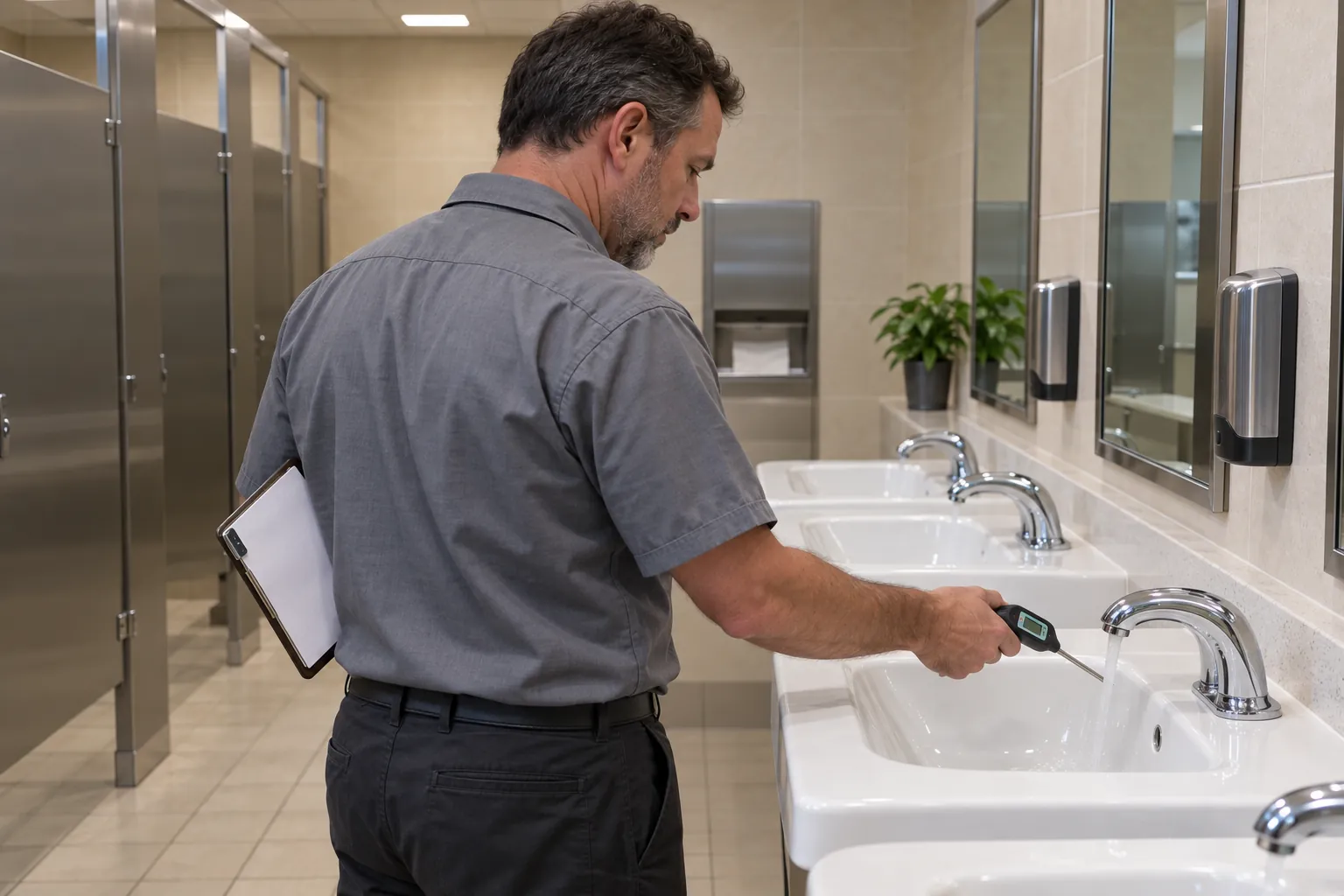
A water management program is only as good as the checks that follow it. The binder with the flow diagram and the control limits matters, but so does the building engineer running the far shower in an empty wing every week and writing down the reading. This guide covers what a water management plan is in the United States, where it comes from, the routine monitoring it calls for, who does it, and what makes the record believable.
01
Where the water management program comes from
Legionella bacteria grow in building water systems that are warm, stagnant or poorly disinfected, and people are infected by breathing in small droplets of contaminated water, from a showerhead, a cooling tower, a hot tub or a decorative fountain. The illness, Legionnaires' disease, is a serious pneumonia. People at higher risk include those aged 50 or older, smokers, and people with chronic lung disease or weakened immune systems.
There are no federal regulations that tell every building owner to have a water management program. The requirement comes from a small set of documents, and which ones apply depends on the building:
- ANSI/ASHRAE Standard 188-2021, Legionellosis: Risk Management for Building Water Systems is the industry standard. OSHA describes it as establishing "minimum risk management requirements for building water systems to prevent Legionellosis." It is a voluntary consensus standard until a code, a regulator or a contract adopts it. ASHRAE lists it, with its companion Guideline 12-2023 on managing the risk, among the standards it lets you read free online.
- The CDC Toolkit: Developing a Legionella Water Management Program (the current page is dated March 2024) is the free, practical guide to putting the standard into practice. CMS notes that CDC and its partners developed it to help facilities implement the ASHRAE standard.
- CMS memo QSO-17-30, Requirement to Reduce Legionella Risk in Healthcare Facility Water Systems (June 2017, revised July 2018) sets out CMS's expectation that hospitals, critical access hospitals and long-term care facilities certified by Medicare and Medicaid have water management policies and procedures. For hospitals and critical access hospitals, the memo says it clarifies existing expectations rather than imposing new ones. Facilities "unable to demonstrate measures to minimize the risk of LD are at risk of citation for non-compliance."
- OSHA has no specific standard. Its Legionnaires' disease standards page says "there currently is no specific OSHA standard for Legionellosis," but that OSHA may use the General Duty Clause, Section 5(a)(1) of the OSH Act, where a workplace has a recognized serious hazard with no specific standard, and it gives occupational exposure to Legionella in water systems as an example. State plan states may go further.
Some states and cities have their own rules on top, most visibly for cooling towers. New York City, for example, requires cooling tower owners to register their towers, keep maintenance records for at least three years and, since May 8, 2026, sample for Legionella monthly, as set out on the NYC Health cooling towers page. Check with your state and local health department before you assume the federal picture is the whole one.
This guide is about the routine monitoring that shows a written program is being followed, not the hazard analysis behind it.
02
Which buildings need one, and what the plan contains
CDC's water management program worksheet is a short set of yes or no questions. If any answer is yes, CDC says the building or device should have a program. The questions ask whether the building:
- is a healthcare facility where patients stay overnight, or houses or treats people with chronic or acute medical problems or weakened immune systems;
- primarily houses people older than 65, such as a retirement home or assisted living facility;
- has multiple housing units and a centralized hot water system, such as a hotel or high-rise apartment building;
- has more than 10 stories, counting basement levels;
- has a cooling tower, a hot tub that is not drained between each use, a decorative fountain, or a centrally installed mister, atomizer, air washer or humidifier.
CDC sets out seven steps for a water management program, which are also a fair outline of what the written plan should contain:
- A program team, with the skills to develop and run the program, trained in house or brought in.
- A description of the building water systems, with flow diagrams and a written description: where water enters, how it is heated and distributed, and where the water heaters, boilers, tanks, cooling towers and hot tubs are.
- The areas where Legionella could grow and spread, such as places where temperatures fall into the growth range or flow is low.
- Where to apply control measures and how to monitor them, each with control limits: the acceptable values, minimums, maximums or ranges.
- Corrective actions for when a measurement falls outside its control limits.
- Verification and validation: checking that the program is being carried out as designed, and that it actually controls the hazard.
- Documentation and communication of all of it, updated when the program changes, with the people who carry it out trained on each update.
For healthcare, CMS says facilities must have water management plans and documentation that, at a minimum, include a facility risk assessment covering Legionella and other opportunistic waterborne pathogens, a program that considers the ASHRAE standard and the CDC toolkit, and testing protocols with acceptable ranges for control measures, with the results and the corrective actions documented.
03
Control limits and the routine monitoring
Most of a building's water management program is about keeping hot water hot, cold water cold, disinfectant present and water moving. The control limits for your building are in your plan, and your plan may be stricter, but CDC's module Controlling Legionella in Potable Water Systems gives the usual reference points:
- Hot water storage above 140°F (60°C).
- Circulating hot water not falling below 120°F (49°C), recirculated continuously where possible.
- Cold water stored and circulated below the favorable range for Legionella, 77–113°F (25–45°C), bearing in mind that growth can occur as low as 68°F (20°C).
- Disinfectant residual, chlorine or monochloramine, detectable throughout the system, as the plan directs.
- Low-flow piping runs and dead legs flushed at least weekly, and infrequently used fixtures, such as eyewash stations and emergency showers, flushed as often as needed to keep water quality within control limits.
OSHA's page on Legionnaires' disease control and prevention gives a similar target for domestic hot water: stored at a minimum of 140°F (60°C) and delivered at a minimum of 122°F (50°C) to all outlets.
In a typical building, the routine monitoring that follows from those limits looks like this:
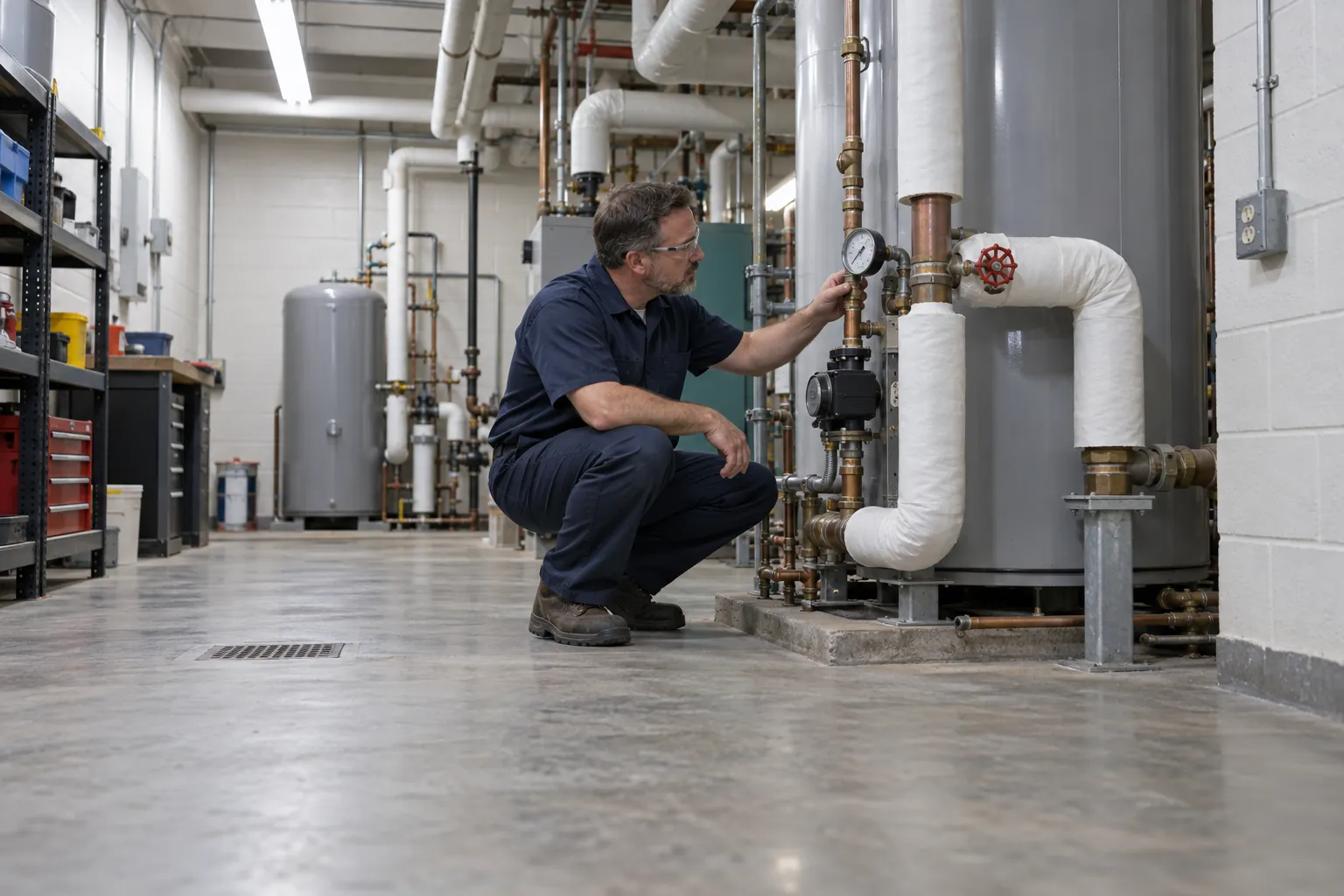
- Water heater and storage temperatures: the outlet and return temperatures at each water heater or storage tank, read from a calibrated gauge or thermometer.
- Point-of-use temperatures: hot and cold readings at the fixtures the plan names, usually those nearest to and farthest from the heater, and a rotation through representative outlets. CDC suggests also noting how long hot water takes to reach its maximum temperature.
- Disinfectant residual: free chlorine or total chlorine for monochloramine, at the point of entry and at fixtures, with pH where the plan asks for it. CDC points out that the difference between the value at the supply and at the fixtures can reveal a problem in the system.
- Flushing: little-used outlets, dead legs and emergency fixtures run through on schedule.
- Maintenance and visual checks: cleaning and descaling showerheads, aerators and hoses, servicing thermostatic mixing valves and filters, inspecting storage tanks.
CDC does not set a single national frequency. It says to monitor temperature, disinfectant residuals and pH "frequently" based on how the program is performing, and to adjust the frequency according to how stable the readings are. So apart from the weekly flush of low-flow runs and dead legs, the frequencies are in your plan: often a set monthly round of temperatures and residuals at named points, and cleaning of showerheads and aerators on a longer cycle, tightened wherever readings drift.
04
Who does the checks, and when the plan says to do more
The program team owns the plan. In a hospital it may bring together facilities, infection prevention and an outside water management consultant; in an office building or an apartment community it may be the facility manager, the chief engineer and the water treatment vendor. Someone on the team should be named as responsible for making sure the monitoring happens and the records are kept.
The routine work is usually shared out:
- Building engineers and maintenance technicians take the heater and fixture temperatures and disinfectant readings on a set route, with calibrated instruments, as part of their building engineer duties, and often keep the boiler log alongside.
- Custodians and housekeeping or EVS staff often flush little-used showers and sinks, because they are in those rooms anyway. It is a simple job, as long as they know which fixtures, for how long, and to avoid creating spray.
- A water treatment vendor or consultant usually handles cooling towers, supplemental disinfection, any Legionella sampling, and the review of the plan.
A technician who writes down 108°F at a shower and moves on has taken a reading; one who knows the limit is 120°F and calls the chief engineer has done the check.
Corrective action is written into the plan for each control limit: who is told, what is done, such as raising a heater set point, flushing a branch or boosting disinfection, and when the reading is taken again. Validation is how the team shows the program actually works. Environmental testing for Legionella is one way to validate, and CDC's Routine Testing for Legionella module recommends using a laboratory accredited to a recognized standard, such as ISO/IEC 17025. CMS does not require water cultures; its memo leaves testing protocols to the provider.
The plan should also say when the program gets extra attention. CDC's guidance on reopening buildings after a prolonged shutdown explains that in stagnant water hot water can cool into the growth range and disinfectant can fall to low or undetectable levels; before reopening, it says to set the water heater to at least 140°F and flush hot and cold water through all points of use. The potable water module adds flushing after an intrusion event, such as a water main break. A school's summer break or a closed office floor is the everyday version.
05
What a good water management record shows
Documentation is the seventh step for a reason. The record is how the program team shows a surveyor, an accrediting organization, a health department, an insurer or a client that the plan is being followed, and it is the first thing asked for after a case of Legionnaires' disease. CMS expects healthcare facilities to document the results of testing and the corrective actions taken when control limits are not maintained. Your plan, your state or your accreditor may also set how long records are kept; follow the longest that applies.
A useful record of the routine monitoring carries:
- The control location, named the same way as in the plan and flow diagram, so that "sentinel hot, 4th floor east restroom" means one fixture.
- The date and time, written when the check was done.
- The name of the person who did it.
- The reading itself, in degrees or parts per million, not a check mark. A column of check marks beside "above 120°F" hides a loop sliding from 128°F to 121°F over a winter.
- For flushing, which fixtures were run and for how long, if the plan sets a time.
- Every reading outside its control limit, with who was told, what was done and the reading after the fix.
- Missed checks, with the reason: a locked suite, a floor closed for renovation, an instrument out for calibration.
CDC's review of its Legionnaires' disease outbreak investigations from 2015 to 2019, summarized in Key Findings: Outbreaks and Water Management Gaps, found that all of the deficiencies associated with the outbreaks could have been prevented by a comprehensive, properly implemented water management program. Among the program deficiencies, 43% were a building with no program at all, and 40% were a program that would have been adequate but was not followed. CDC's example of that implementation gap is "not measuring water heater temperatures as called for in the WMP."
That is the case for the routine record. A plan with no evidence that its monitoring happened looks, after an outbreak, very like a plan that was never followed.
06
Where the record fails, and what SiteClara does about it
Most failures are not a lack of knowledge. They are the weekly flush that stopped when a custodian moved to another building, the monthly temperatures skipped in July because the school was empty, a reading of 104°F written on a clipboard and never passed on. The plan sits in a binder in the engineering office, the readings sit on sheets on the mechanical room door, and nobody sees the gap until the vendor's quarterly visit or the surveyor's.
SiteClara puts a printed QR poster, with an optional NFC tag behind it, at the control locations in the plan: the far shower in the unused locker room, the sentinel fixtures, the water heater room door. Staff scan or tap with their own phone, with no app to install, and see the checks due at that location. They mark each one done, or say what stopped them, with a photo when one is asked for, such as the thermometer in the stream. The time and the named person are recorded as it happens.
A supervisor sees which checks are due, done and missed, and records why one was missed. A problem found on a check, such as a fixture that will not reach temperature, is reported on the spot and stays on the team's list of open jobs until someone closes it, and it can be escalated to the building manager. Each day the supervisor reviews and approves a report that goes to nominated managers or clients the next morning, showing how the scheduled checks went.
07
Questions people ask
What is the first step in a Legionella water management program?
Once CDC's worksheet shows that a building needs a program, the first step is to establish a program team. CDC's Steps to Develop a Water Management Program says the team needs members with the skills to develop and implement the program, and suggests training in-house personnel or hiring professionals with environmental and Legionella experience. Describing the building water systems comes next.
Is there a template or example of a water management plan?
CDC's toolkit is a guide rather than a fill-in plan, though it gives examples at each step. The CDC Toolkit: Developing a Legionella Water Management Program is a free PDF with a yes or no worksheet for whole buildings and certain devices, a review of each element of a program, scenarios for common water quality problems, and special considerations for healthcare facilities.
What kills Legionella in a building's water system?
Day to day, Legionella is controlled rather than killed: CDC's Controlling Legionella in Potable Water Systems says to store hot water above 140°F (60°C), keep circulating hot water at or above 120°F (49°C), and keep a detectable disinfectant residual throughout the system. When remediation is needed, it says a chemical shock with an elevated level of disinfectant for a limited time can control Legionella, but that thermal shock is not recommended because it often fails and the bacteria recolonize quickly.
Can Legionella in tap water or a shower make you sick?
It can if the bacteria have grown in the building's water system. CDC's How Legionella Spreads explains that Legionella occurs naturally in freshwater, generally in amounts that do not lead to disease, and can pose a risk to health when it gets into building water systems and grows. Breathing in mist containing Legionella, from sources such as showerheads and sink faucets, is the most common way people get sick; less commonly, people get sick by aspirating drinking water containing Legionella, when water accidentally goes into the lungs while drinking.
08
Further reading, and a list to take away
Start with CDC's toolkit, worksheet and Controlling Legionella in Common Sources of Exposure modules, all free. ASHRAE lets you read Standard 188 and Guideline 12 online at no charge, CMS memo QSO-17-30 covers healthcare surveys, and your state and local health department will tell you about any rules of their own, particularly for cooling towers.
For the routine checks in your building, make sure that:
- you have run the CDC worksheet and know whether the building, or only a device in it, needs a program;
- there is a written plan with a flow diagram, named control locations and control limits for each;
- a program team exists, and one person is responsible for making sure the monitoring happens;
- every low-use fixture and dead leg is listed, and someone owns the weekly flush for each one;
- temperatures and residuals are recorded as readings, not check marks, with calibrated instruments;
- every reading outside a limit has a written corrective action and a named person to tell;
- missed checks are recorded with a reason, not left blank;
- the plan says what happens after a shutdown, construction or a water main break;
- the plan is reviewed when the building, its water systems or its occupants change, and staff are trained on each update.
Sources
Every document this guide quotes or links to, in the order it first cites them.
- ANSI/ASHRAE Standard 188-2021, Legionellosis: Risk Management for Building Water Systems ashrae.org
- CDC Toolkit: Developing a Legionella Water Management Program cdc.gov
- CMS memo QSO-17-30, Requirement to Reduce Legionella Risk in Healthcare Facility Water Systems cms.gov
- Legionnaires' disease standards page osha.gov
- NYC Health cooling towers page nyc.gov
- Water management program worksheet cdc.gov
- Seven steps for a water management program cdc.gov
- Controlling Legionella in Potable Water Systems cdc.gov
- Legionnaires' disease control and prevention osha.gov
- Routine Testing for Legionella cdc.gov
- Guidance on reopening buildings after a prolonged shutdown cdc.gov
- Key Findings: Outbreaks and Water Management Gaps cdc.gov
- How Legionella Spreads cdc.gov
Related guides
 Fire and water checksCooling tower inspection: the weekly checks, the 90-day inspection, and a record that holds upCooling tower inspection in the US: weekly checks, the 90-day compliance inspection under NYC rules, Legionella sampling, cleaning, and a record that holds up.
 Premises and facilities managementBoiler log: what to record, how often, and what the state expectsWhat a boiler log should record, how often to take readings and test the low-water cutoff, what state boiler rules and ASME CSD-1 expect, and where logs fail.
 Premises and facilities managementBuilding engineer duties: what the job covers, and how to show it is doneBuilding engineer duties in a commercial building: running the plant, rounds and logs, lockout, refrigerant and boiler rules, vendors, and a record that holds up.
 Premises and facilities managementEnvironment of care rounds: walking the building, and proving the findings were fixedHow to run environment of care (EOC) rounds in a hospital in 2026: the CMS and Joint Commission basis, what a round covers, who goes and how findings get closed.