Premises and facilities management
Boiler log: what to record, how often, and what the state expects
A boiler log is the running record of a boiler plant: the readings taken on each round, the tests of the safety controls, the blowdowns, the chemicals added, and every trip, repair and visitor.
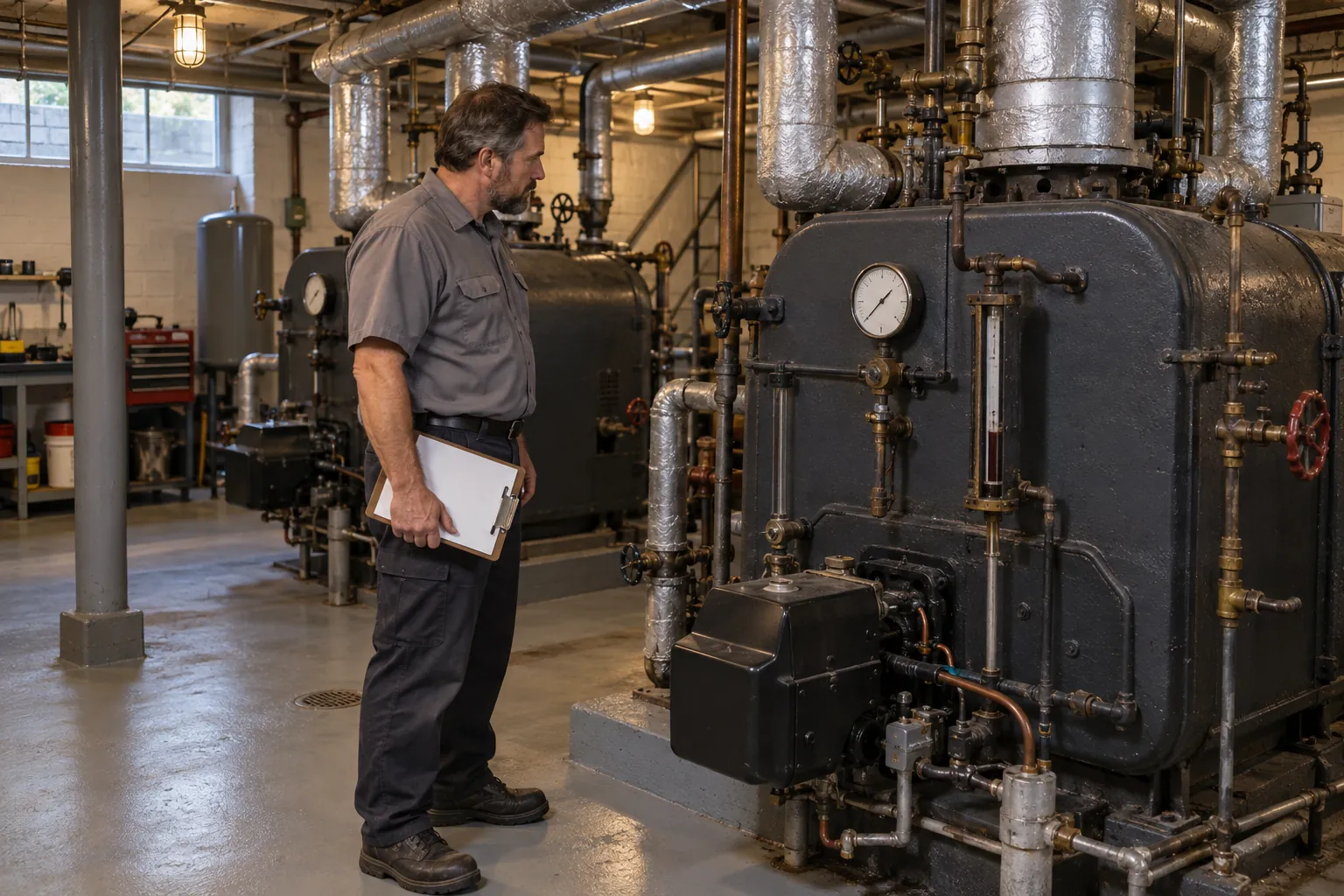
Some states require one in so many words; everywhere, it is how a building engineer spots a problem before it becomes a shutdown and how an owner shows the plant is being looked after. This guide covers what goes in the log, how often, who signs it, and what state boiler rules, ASME CSD-1 and the EPA expect of the records around it.
01
What a boiler log is, and which rules ask for one
A boiler log records how a boiler plant is operating and what has been done to it. In practice there are usually two records. The operating log holds the readings and observations from each round of the boiler room, and the maintenance log holds the scheduled checks and tests, the repairs and the parts replaced. The National Board of Boiler and Pressure Vessel Inspectors describes both in its Suggested Daily Boiler Log Program and Suggested Maintenance Log Program.
There is no federal boiler log rule. Boiler safety is regulated by the states, and by some cities, each with its own boiler law, inspectors and adopted codes. State rules typically adopt codes and standards by reference, such as sections of the ASME Boiler and Pressure Vessel Code, the National Board Inspection Code and ASME CSD-1, Controls and Safety Devices for Automatically Fired Boilers. In ASME's own words, CSD-1 covers "the assembly, installation, maintenance, and operation of controls and safety devices on automatically operated boilers directly fired with gas, oil, gas-oil, or electricity, having fuel input ratings under 12,500,000 Btu/hr." That range includes many of the heating and hot water boilers in offices, schools, apartment buildings, hospitals and churches. CSD-1 is a paid standard, now in its 2024 edition, and it is enforceable where your jurisdiction has adopted it, with any local amendments.
Some states spell the log out. New Jersey is a clear example. Its boiler rules, N.J.A.C. 12:90, as excerpted in the state's Guidelines for Logbooks: Compliance to Boiler Regulations N.J.A.C. 12:90 (Bureau of Boiler and Pressure Vessel Compliance, revised October 2010), say that "a boiler operator's log shall be maintained in each plant containing over 100 horsepower," that every operator on the shift shall review the log and sign it at the end of the shift, and that all logs shall include "the date, name of operator(s) on duty, and time of relief." Other states set operator attendance, licensing and record rules of their own, so the first job is to find out which boiler law applies to your building and what it says, from the state's boiler program or its chief inspector.
02
What goes in a boiler log
The National Board's daily log program lists the readings worth taking, "as appropriate to the specific boiler system." New Jersey's guideline reproduces much the same list, adding fuel and oil consumed. For a typical building plant it comes to:
- General: outdoor air temperature, city water supply pressure, and control air pressure where there is an air compressor.
- Boiler: which boilers are in service, the fuel in use, operating hours and cycles, fuel on hand and fuel used, the water level (normal, low or high), the firing rate, the flame condition as observed, the steam pressure or water temperature, and the net stack temperature.
- Gas: pilot and burner gas pressure, and gas used.
- Oil: which oil pump is in service, oil used, pressures at the pump, burner and regulating valve, and atomizing air or steam pressure.
- Condensate system (steam): the feed pump in service, condensate return temperature, the condensate tank level and the makeup water used.
- Hot water system: the circulating pumps in service, return water temperature and the expansion tank level.
- Water treatment: the level in the chemical tank, the treatment pump in service, and whether a boiler water sample was taken.
New Jersey's guideline also lists the functions that belong in the log: blowdown of the boiler and of the water column, testing of the low-level control, testing of safety valves, water sampling, addition of chemicals, and tests of the modulating or on/off controls. It adds that any malfunction, a trip or shutdown of any equipment or control, "must be documented in the logbook with the time of occurrence, together with the corrective action taken," and that repairs started or completed, visitors to the boiler room and their purpose, and the completion of any instructions from the chief engineer are recorded as well.
Printed boiler log sheets and free templates are easy to find, and New Jersey's guideline says standard forms are available, but it adds that "the log may be more useful if the log form is customized for the particular installation by the owner." It also says the log and readings should be kept in a consistent format "in order for trends to be perceived and followed with preventive or predictive action." A steam boiler log and a hot water boiler log share most columns; the steam log adds the condensate lines and the daily low-water cutoff blowdown, and the hot water log the circulating pumps and the expansion tank.
The guideline's worked example of a day's entries records a round, a smell of gas reported to the supervisor, a low-water fuel cutoff test, a lockout reset and the relief at the end of the shift: a narrative of the plant, not a column of ticks. As the guideline puts it, "the actual operator logbook entry is not just a list of readings."
03
How often to take readings and test the controls
The National Board suggests that instrument readings be taken "daily for low-pressure heating boilers and at least once per eight-hour shift for high-pressure boilers." A state rule may ask for more. New Jersey, for example, requires a low-pressure boiler operator to monitor the plant "at least once every two hours," and its guideline calls that two-hour period a minimum.
Maintenance checks follow a calendar. The National Board's maintenance log program, which New Jersey also reproduces, suggests the following for a typical automatically fired plant, always subject to the manufacturer's instructions:
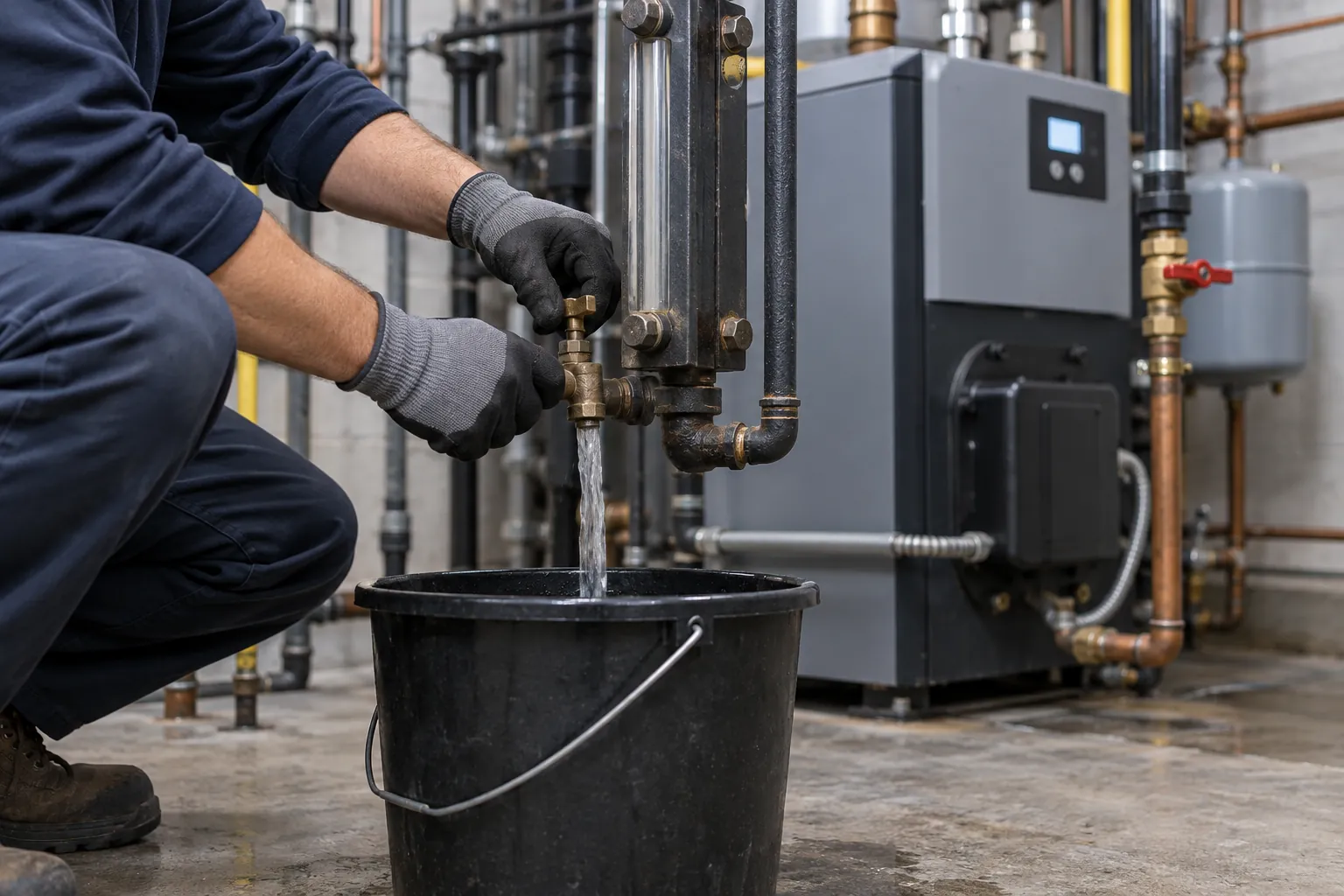
- Daily: blow down and test the low-water cutoffs of steam boilers (once per shift for high pressure); blow down the gage glasses and, on a low-pressure steam boiler, the makeup feeder; blow down the boiler; check the control linkage; check the boiler and system for leaks; check the burner flame.
- Weekly: check and record flame signal strength for pilot and main flame; check the flame failure cutoff and timing; check that the pilot and main fuel shutoff valves close; check igniter and burner operation; check the chemical tank level and compressor oil.
- Monthly: test the fan and air pressure interlocks, the low-fire start interlock, the high pressure or temperature interlocks and, on gas, the high and low gas pressure interlocks; test the low-water cutoffs of hot water boilers; check the main fuel safety shutoff valves for leakage; manually lift the safety or safety relief valves; review the water treatment results.
- Semiannually: perform a slow drain test of the low-water cutoffs on steam boilers; inspect burner components; check the flame failure system, the combustion controls and the interlock wiring; recalibrate gages and instruments.
- Annually: everything in the semiannual list, plus cleaning the firesides and watersides, reconditioning or replacing the low-water cutoff, leak-testing all fuel valves, testing every control and safety device, a combustion adjustment with test instruments, and the inspection by a commissioned inspector.
The low-water cutoff gets the attention it does for a reason. In a 1995 National Board Bulletin article, Boiler Logs Can Reduce Accidents, William H. Axtman cited the National Board Incident Report for 1993: 79 percent of all reported boiler accidents in its three boiler categories were attributable to two causes, low-water cutoffs and operator error or poor maintenance, and low-water-cutoff problems accounted for 62 percent of the incidents. The figures are old, but the lesson holds, and it is why a steam boiler's cutoff is on the daily list. As a matter of general practice rather than anything in Axtman's article, a cutoff that is never blown down can collect sludge and fail to shut the burner off when the water drops.
04
Who keeps the log, who signs it, and how long it is kept
In most buildings the log is kept by whoever runs the plant: a licensed boiler operator or stationary engineer where the state requires one, otherwise the building engineer, chief engineer or maintenance technician. The owner is responsible for making sure it happens. New Jersey's guideline says that owners "must maintain records of equipment maintenance, repair and service calls," including testing, calibration and replacement of the controls and safety devices, and make them available when the state asks.
New Jersey requires every operator on the shift to review the log and sign it at the end of the shift, and the names of the operators on duty and the time of relief to be entered. Its guideline also covers shift change: the relief "must include the operational conditions and any abnormal occurrences," and any valve left out of its normal position must be in both the log and the conversation. It is blunt about honesty too: "Falsification of the logbook is a serious offense that could cause an operator to lose their license if the action is negligent or deliberate."
On format, New Jersey asks for "a hardbound book of the consecutively numbered type" with no pages removed, but allows the log to be "kept on electronic media recording devices" provided it is "accessible for review or printing upon request." The Bureau's example cover page for a hardbound log says it should be kept accessible in the plant for at least three years after the last entry. Your own state may say something different, so check.
05
What the boiler inspector looks for
Many states require a boiler to hold a current certificate of operation, renewed after an inspection by the state's own inspectors or by an authorized inspector working for an insurance company. Texas is one example: its Boiler Safety Frequently Asked Questions from the Texas Department of Licensing and Regulation say that certificate inspections occur every 12, 24 or 36 months depending on the boiler type, carried out by TDLR deputy boiler inspectors or by authorized inspectors of authorized inspection agencies, and that a current certificate of operation must be posted on or near the boiler.
The inspector looks at the boiler, but a good one also reads the log. The questions it answers are simple:
- Are the readings being taken as often as the rules and the manufacturer say, and do they look like readings rather than copies of yesterday's?
- Are the low-water cutoffs being blown down and tested, and when was the last slow drain test on a steam boiler?
- Have the safety valves been tried, and the flame safeguard and interlocks tested, on the schedule?
- Is every trip, lockout and repair recorded with what was done about it, and is there any pattern?
- Is the water treatment being tested and adjusted, and does the log show it?
- Is the certificate current and posted, and was the last inspection's list of corrections addressed?
The log is also the building engineer's own tool. Axtman's example: a stack temperature rising at a steady load points to dirty firesides or scale, which can be cleaned at a planned shutdown rather than found at a failure. A log nobody reads catches nothing.
06
Where the record fails, and what SiteClara does about it
Boiler logs fail in familiar ways. Readings are written up at the end of the shift from memory, or copied from the line above. The daily blowdown and cutoff test are initialed for the week in one sitting. The two-hour round is logged on the hour whether it happened or not. A leak or a lockout is mentioned to whoever was passing and never written down, so the next shift and the chief engineer never hear of it. On a weekend or in a building with no engineer on site, nobody knows whether anyone went into the boiler room at all.
SiteClara records the checks at the location. A printed QR poster, with an optional NFC tag behind it, sits at each place a check is scheduled, such as the boiler room door or the water treatment station. Staff scan the code or tap the tag on their own phone, with no app to install, see the checks due there, and mark each one done or say what stopped them, such as a locked room or a boiler down for service. The time and the named person are recorded as it happens, with a photo when one is asked for, for example of the gage glass or the pressure gage. A problem, such as a leak or a burner in lockout, is reported there with a photo and goes onto the team's list of jobs until someone closes it.
The supervisor sees what is due, done and missed, and can record the reason a check was missed. A job that needs the building manager can be escalated to them to answer. Each day the supervisor reviews and approves a report that goes to designated management or client contacts at 8 a.m. the next morning, showing what was reported, completed and still open, and how the scheduled checks went, for example 3 of 3 boiler room rounds completed.
07
Questions people ask
What is a boiler maintenance log book?
It is the record of the scheduled checks and tests on a boiler, kept separately from the daily readings. The National Board's Suggested Maintenance Log Program says a checklist of the daily, weekly, monthly, semiannual and annual items "should be incorporated into a maintenance log with provisions for checking off the item for the appropriate period," with a separate log sheet for each period, filed in a loose-leaf binder and "retained as a permanent maintenance record."
What is a boiler service record?
It is the owner's record of the work done on the boiler and its controls, beyond the operator's log. New Jersey's Guidelines for Logbooks: Compliance to Boiler Regulations N.J.A.C. 12:90 says owners "must maintain records of equipment maintenance, repair and service calls," covering the installation, setup, testing, calibration, service, repair or replacement of the equipment or its controls and safety devices, including the maintenance history and the documentation of operational checks, maintenance, repair, tests and service logs, and must make them available when the state asks.
08
Further reading, and a list to take away
Start with your state's boiler program or chief inspector for the law that applies to your building, the adopted codes and editions, and any operator licensing or log rules. The National Board's Suggested Daily Boiler Log Program and Suggested Maintenance Log Program are free and practical. New Jersey's Guidelines for Logbooks shows what a good entry looks like, wherever you are. ASME publishes CSD-1 and ASME Section VI, Recommended Rules for the Care and Operation of Heating Boilers; both are paid documents. For oil, coal and biomass boilers, read the EPA's Small Entity Compliance Guide for Area Source Boilers.
Before the heating season, check that:
- you know which state or city boiler law applies, and whether it requires a licensed operator or a log;
- the log has a column for every reading on the National Board list that applies to your plant;
- readings are taken daily on a low-pressure plant and at least once a shift on a high-pressure plant, or more often if your state says so;
- low-water cutoffs on steam boilers are blown down and tested daily, with a slow drain test twice a year;
- safety valves, interlocks and the flame safeguard are tested on a written schedule that follows the manufacturer and CSD-1 where adopted;
- every trip, lockout, repair and visitor is logged with the time and the action taken;
- each operator on the shift signs the log at the end of it, as New Jersey requires, and, as good practice, each entry names the person who did the work;
- the certificate of operation is current and posted on or near the boiler;
- boilers covered by the EPA area source rule have their tune-up and other records;
- someone reads the log every week and acts on what it shows.
Sources
Every document this guide quotes or links to, in the order it first cites them.
- Suggested Daily Boiler Log Program nationalboard.org
- Suggested Maintenance Log Program nationalboard.org
- ASME CSD-1, Controls and Safety Devices for Automatically Fired Boilers asme.org
- Guidelines for Logbooks: Compliance to Boiler Regulations N.J.A.C. 12:90 nj.gov
- 1995 National Board Bulletin article, Boiler Logs Can Reduce Accidents nationalboard.org
- Small Entity Compliance Guide for Area Source Boilers epa.gov
- Boiler Safety Frequently Asked Questions tdlr.texas.gov
Related guides
 Premises and facilities managementBuilding engineer duties: what the job covers, and how to show it is doneBuilding engineer duties in a commercial building: running the plant, rounds and logs, lockout, refrigerant and boiler rules, vendors, and a record that holds up.
 Premises and facilities managementPreventive maintenance checklist: what to check in a commercial building, how often, and how to prove itA preventive maintenance checklist for commercial buildings: HVAC, electrical, fire and life safety, plumbing, how often, and what the record should show.
 Premises and facilities managementWinterization checklist: getting a commercial building ready for freezing weatherA winterization checklist for commercial buildings: freeze protection, sprinklers, heating, roofs, snow and ice, when to check, who does it, and what to record.
 Premises and facilities managementGenerator testing: what NFPA 110 asks, and what to write downEmergency generator testing under NFPA 110: the weekly inspection, the monthly exercise under load, batteries, fuel, the 36-month test, and what the record shows.