Security patrols
CPTED: how crime prevention through environmental design works on a real property
CPTED, short for crime prevention through environmental design, is an approach to preventing crime that uses the design, use and upkeep of the physical environment, from a building and its grounds to a school campus or a city park, to control access, give people the chance to see and be seen, and show that the place is owned and cared for.
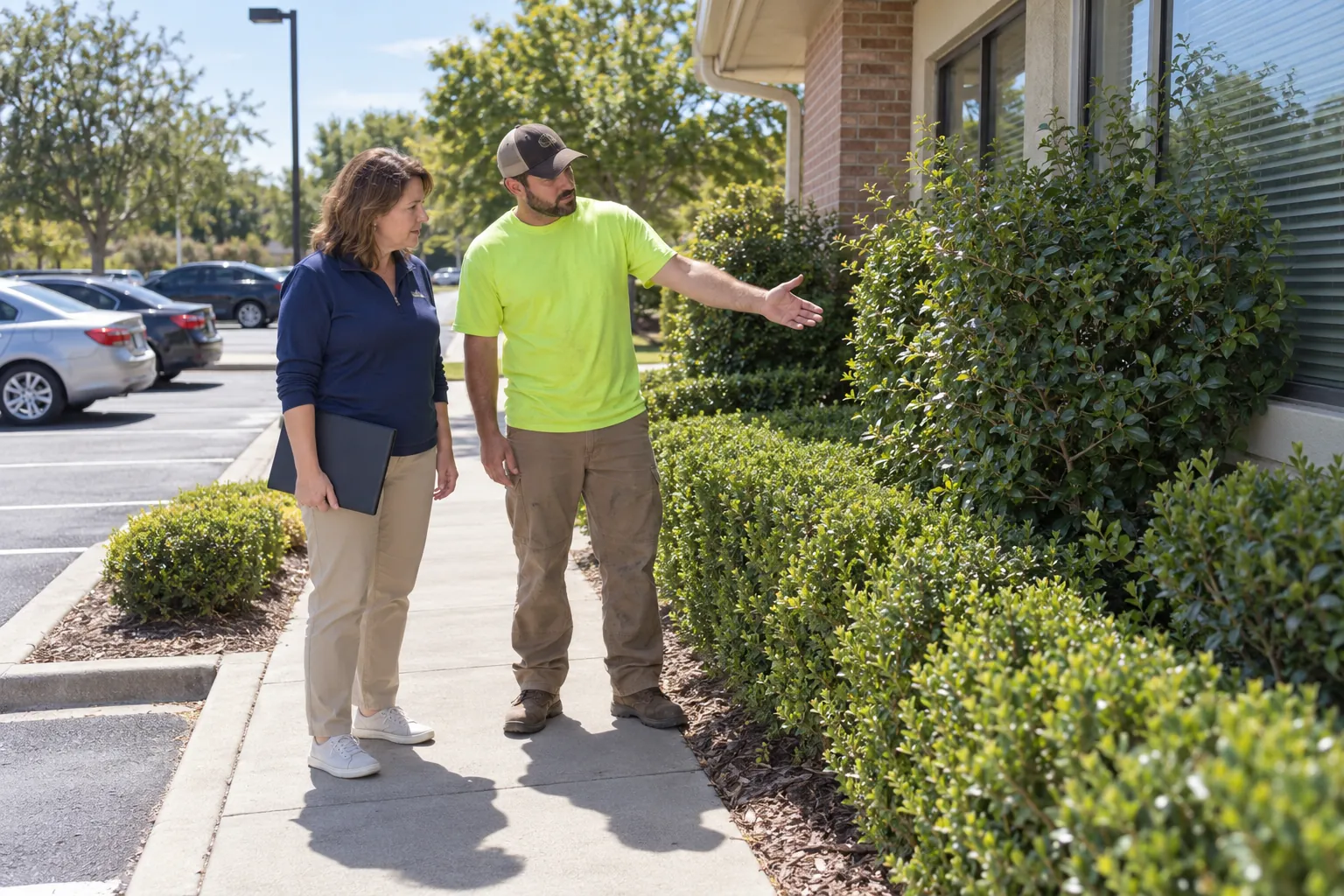
It is a way of working, not a federal rule: a city may build it into site plan review, a police department may offer a free CPTED survey, and an owner may adopt it to cut break-ins, graffiti and loitering. The design gets the attention, but the principle that fails most often is maintenance: the light out, the hedge grown over a window, the broken fence nobody reported. This guide covers what CPTED is, its principles, how a CPTED assessment is run, a checklist for an existing property, and how to keep the upkeep going so the design keeps working.
01
What CPTED is, and where it is written down
The Center for Problem-Oriented Policing's guide Using Crime Prevention Through Environmental Design in Problem-Solving (Problem-Solving Tools Series No. 8, Diane Zahm, August 2007) defines it as "an approach to problem-solving that considers environmental conditions and the opportunities they offer for crime or other unintended and undesirable behaviors." It works by using the environment to "(1) control access; (2) provide opportunities to see and be seen; and (3) define ownership and encourage the maintenance of territory." It places CPTED in research on crime and place, citing among others C. R. Jeffery's Crime Prevention Through Environmental Design (1971) and Oscar Newman's Defensible Space (1972).
The Seattle Police Department's Crime Prevention Through Environmental Design (CPTED) page puts it as "a place-based and multi-disciplinary approach to preventing crime using design and management of the built environment to influence human behavior to deter crime by increasing potential offender's sense of risk." The same page says that "CPTED reduces victimization, increases the perception of safety and recognizes the important role of community in creating and maintaining safe spaces." Both put management beside design.
No federal law requires a property to apply CPTED. Where it is written down, it takes four forms:
- State law. Florida's Safe Neighborhoods Act defines it in Florida Statutes section 163.503 as "the planned use of environmental design concepts such as natural access control, natural surveillance, and territorial reinforcement in a neighborhood or community setting which is designed to reduce criminal opportunity and foster positive social interaction among the legitimate users of that setting."
- City development review. Some cities ask developers to show how a project meets CPTED principles. The City of Federal Way, Washington, asks for its Crime Prevention Through Environmental Design (CPTED) Checklist, whose CPTED Checklist Instructions tie it to the principles in Federal Way Revised Code 19.115.010; responses "will be evaluated by city staff, and will be integrated into the site plan and/or building permit review process." Saint Paul, Minnesota, offers its Site Plan Review: Best Practices and Checklist for CPTED as "a discussion guide for design and development teams during the pre-Site Plan Review stage."
- An international standard. ISO 22341:2021, Security and resilience – Protective security – Guidelines for crime prevention through environmental design, published in January 2021, gives organizations guidelines for "establishing the basic elements, strategies and processes for preventing and reducing crime and the fear of crime at a new or existing built environment." It is a voluntary, paid standard.
- Workplace safety guidance. OSHA's Recommendations for Workplace Violence Prevention Programs in Late-Night Retail Establishments (OSHA 3153, 2009) recommends reducing robbery risk "by improving visibility and surveillance, controlling customers' access, and limiting the availability of cash." It is guidance, not a standard.
For most existing properties, CPTED is the owner's choice, often made after a run of incidents or on the advice of a police crime prevention officer, an insurer or a security provider.
02
The CPTED principles
Sources count the principles differently but describe the same ideas. The National Crime Prevention Council's Best Practices for Using Crime Prevention Through Environmental Design in Weed and Seed Sites (December 2009) works from four: "natural access control, natural surveillance, territorial reinforcement, and maintenance." Seattle's and Saint Paul's lists also include bringing legitimate activity into a space.
- Natural surveillance: arranging the place so people can see and be seen. Windows that overlook parking and walkways, lighting without glare or deep shadow, landscaping that leaves sight lines open, and no blind corners on paths. Saint Paul's checklist asks whether landscaping follows the "2 ft / 6 ft rule (no shrubs higher than 2 ft and no tree branches lower than 6ft)."
- Natural access control: guiding people to the right entrances and away from the places they should not be, with paths, fences, hedges, gates and signs. The POP Center guide says the environment "must offer cues about who belongs in a place."
- Territorial reinforcement: making it plain where public space ends and private space begins, with paving, planters, fences and signs, so a stranger feels noticed.
- Maintenance, which Seattle calls image and maintenance: "Care and maintenance serves as an expression of ownership and supports the use of a space for its intended purpose." The NCPC's list of proper upkeep is "mowing grass, trimming trees and landscaping, picking up trash, repairing broken windows and light fixtures, and painting over graffiti."
- Activity support, which Seattle calls community activation: bringing people with a legitimate reason into a space, through seating, events and active uses, so that their presence makes it a worse place for crime. Seattle's examples include "concerts in the park" and "bike and walking trails, and community gardens."
Locks, alarms, cameras and guards are target hardening. The POP Center guide is clear that in CPTED these support the design rather than lead it: "Design features are 'supported' by locks, guards and alarms. Target hardening and security measures are not the primary means for improvement." Saint Paul's checklist treats target hardening as most relevant "where it's hard to naturally watch or control access through design, or where there might be blind spots."
03
How a CPTED assessment is run
A CPTED assessment, sometimes called a CPTED survey or security survey, asks the question the POP Center guide puts at the center of the method: why here? Its appendix sets out a process for a single building or facility in three phases, which any property team can follow on a smaller scale.
- Before the visit: gather crime and calls-for-service data, the site and floor plans, the maintenance procedures and the relevant ordinances, and work out who needs to be involved.
- The visit: a "tabletop" review of the site plan to mark safe and unsafe places, a tour with the people who use the site, then an independent examination of the site "morning, afternoon, evening, and night" on "multiple weekday and weekend visits," because a parking lot at 2 p.m. on a Tuesday is not the same place at 11 p.m. on a Saturday.
- After the visit: review the photographs, plans and notes, develop recommendations for design, procedures, security and activities, and write a report recording the methods, dates and times, findings and recommendations.
In the guide's vandalism cases, "maintenance reports rather than crime reports are critical." On an existing property, work orders, janitorial logs and officers' daily activity reports often explain a problem corner better than police data does.
You do not have to do it alone. Some police departments offer CPTED assessments through their crime prevention officers or coordinators. The Seattle Police Department says that "to request a free security assessment, based on CPTED principles, please contact the Crime Prevention Coordinator for your area," and the Green Bay Police Department's CPTED page says it "offers CPTED surveys to businesses." Ask yours.
An assessment is only the start. The POP Center guide's final phase is assessment of the response: follow-up surveys "should reveal that critical recommendations have been implemented," and it adds that "one indicator of success might be better record keeping."
04
A CPTED checklist for an existing property
City checklists such as Federal Way's and Saint Paul's are written for new development. For a property that already exists, the questions are about the physical site as it is now and what would improve it. Walk the site in daylight and again after dark; the checklists in OSHA 3153 ask several of the same things, such as whether "the area surrounding the building" is "free of bushes or other hiding places."
- Sight lines: can the entrances be seen from the street, the parking lot from the building, and the cash wrap or reception from outside? Are window signs kept to low or high positions and shelving kept low, as OSHA 3153 suggests, so staff can see who is coming in and police can see in from outside?
- Landscaping: are shrubs kept low and tree canopies raised, so nothing hides a person, a window or a light?
- Lighting: is every fixture working, are entrances, walkways and parking lit without glare or deep shadow, and do photocells and timers switch on at dusk? The lighting survey guide covers the night check and the readings.
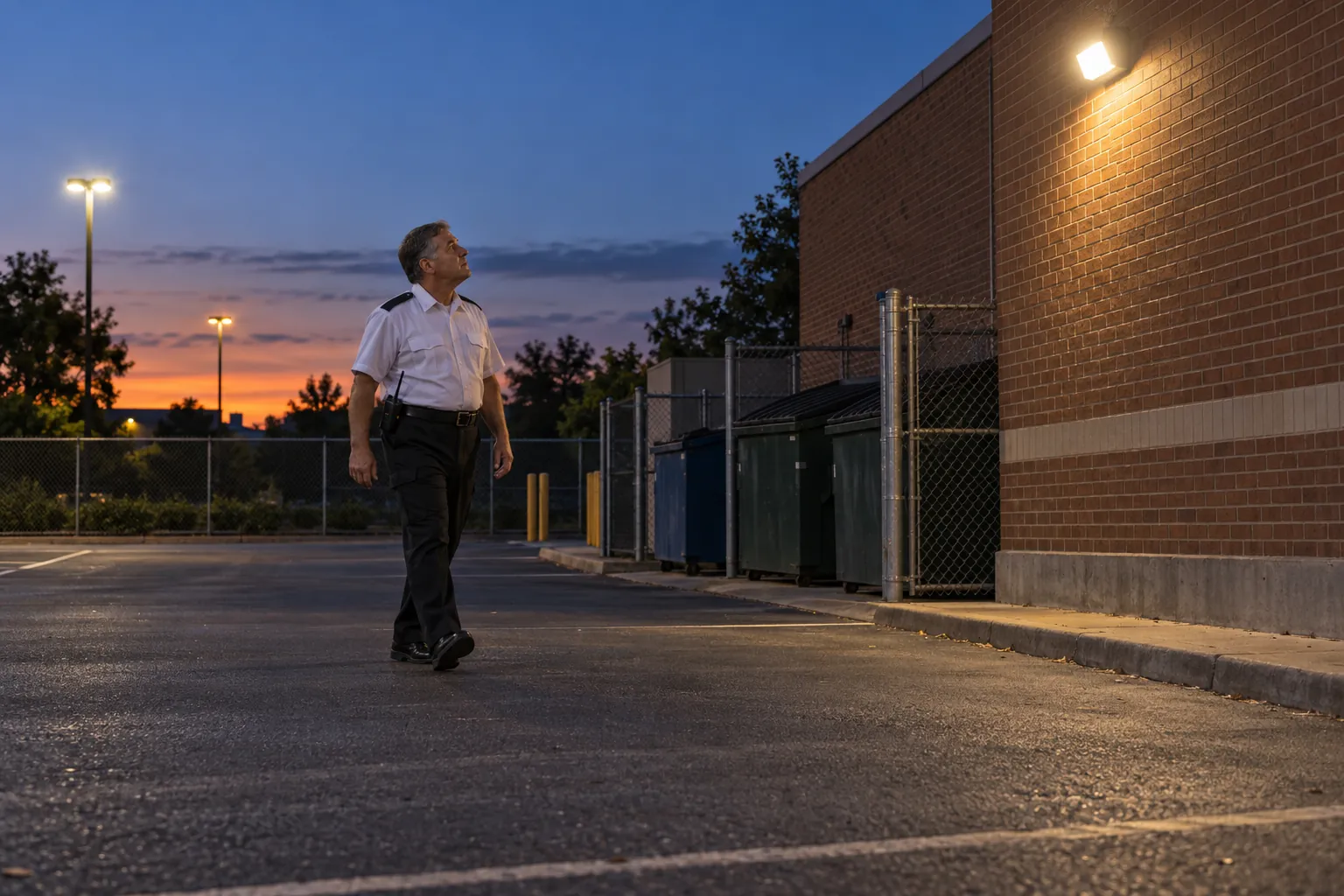
- Blind spots: corners of the building, recessed doorways, dumpster enclosures, loading docks and stairwells. Would a convex mirror, a trimmed hedge or a light remove the hiding place?
- Entrances and routes: is it obvious where the public entrance is, and are staff-only areas signed and kept shut?
- Boundaries: are fences, gates and hedges intact, with no gaps, climbing aids or broken sections? The perimeter security checklist covers the fence line in detail.
- Signs of neglect: litter, graffiti, broken glass, dead plants, overflowing dumpsters.
- Use of space: are there places that stand empty and attract loitering, where seating, a staffed desk or a changed schedule could put legitimate users?
Mark each finding on the site plan with a photograph, and sort it: what the team can fix this week, what needs a contractor or a budget, and what is a design question for the owner. The POP Center guide notes that "many CPTED strategies are relatively cost-free and easy to accomplish in a short time frame."
05
Maintenance: the principle that fails first, and who owns it
A redesign is done once; maintenance has to be done every week, and it is where CPTED usually breaks down. The POP Center guide says design elements "need to be supported by potential observers (they actually need to look for and then report unusual behavior), and by policies and procedures, for example, related to landscape maintenance." A hedge planted to define a boundary becomes a hiding place in a few summers if nobody trims it.
Speed matters as much as upkeep. The POP Center's Twenty Five Techniques of Situational Prevention lists "rapid repair of vandalism" as a way to discourage imitation and "graffiti cleaning" as a way to deny the offender the benefit. OSHA 3153 recommends that employers "integrate violence prevention activities into daily procedures, such as checking lighting, locks, and security cameras to help maintain a secure worksite."
Put the maintenance side of CPTED into routines with a named owner:
- Every patrol or shift: security officers or the day porter look for lights out, damage, graffiti, propped doors, gaps in the fence and new hiding places, and report each one with its location. Write it into the post orders.
- Weekly or monthly: the property manager or facility manager walks the whole site with the checklist above, in daylight and after dark.
- Seasonally: the grounds contractor trims to the agreed heights, written into the landscaping contract, before growth closes sight lines.
- After any incident or change: a new tenant, construction, a new sign or a removed light, walk the area again.
Decide who owns each part. The owner sets the standard and the budget; the property manager or facility manager keeps the site plan and raises work orders; the security provider reports what its officers see; and the grounds, janitorial and electrical contractors fix what is theirs, ideally against a response time in each contract.
06
Where CPTED upkeep fails, and what SiteClara does about it
The record behind CPTED fails in familiar ways. The assessment report sits in a drawer while its recommendations fade. The officer notices the wall pack behind the hedge is out, mentions it at pass-down, and it is still out a month later. When graffiti appears on the back wall, nobody can say when that corner was last checked.
SiteClara works on those gaps. A printed QR poster at a location, with an optional NFC tag behind it, lets staff scan or tap with their own phone, with no app to install. Staff see the checks due there, such as the first round after dark or the monthly CPTED walk, and mark each one done or say what stopped them, with a photo when one is asked for. A problem found on the round, such as a light out, a hedge over a window or fresh graffiti, is reported with a photo and stays on the team's list of jobs until someone closes it. On sites led by the building owner, occupants and visitors can also report a problem at a tag.
The supervisor sees what was due, done and missed, and records the reason a check was missed. A job the team cannot fix itself, such as a fence repair or a new fixture that needs the owner's money, can be escalated to the building manager to answer. Each day the supervisor reviews and approves a report that goes to nominated management or client contacts at 8 a.m. the next morning, showing what was reported, what was completed and what is still open.
07
Questions people ask
What does CPTED stand for?
CPTED stands for crime prevention through environmental design. Section 163.503 of the Florida Statutes defines it as the planned use of environmental design concepts such as natural access control, natural surveillance and territorial reinforcement to reduce criminal opportunity.
What are the five principles of CPTED?
The Seattle Police Department's Crime Prevention Through Environmental Design (CPTED) page lists five: natural surveillance, access control, image and maintenance, territorial definition and community activation. The National Crime Prevention Council's Best Practices for Using Crime Prevention Through Environmental Design in Weed and Seed Sites uses four, leaving out activity.
What are the 25 techniques of situational crime prevention?
They are a table of 25 ways to reduce the opportunity for crime, grouped under five headings: increase the effort, increase the risks, reduce the rewards, reduce provocations and remove excuses. The POP Center's Twenty Five Techniques of Situational Prevention lists them with examples. Several overlap with CPTED, such as controlling access to facilities and assisting natural surveillance, whose examples include improved street lighting and defensible space design, and "rapid repair of vandalism" is its example of discouraging imitation.
How do I get CPTED certification?
The International CPTED Association runs the ICA CPTED Certification Program (ICCP), a competency-based certification for ICA members with training in CPTED and experience in crime prevention and in applying CPTED. Applicants build a competency matrix with evidence from their own work and then take a written take-home or oral examination, at two levels: Certified CPTED Practitioner and Certified CPTED Professional.
08
Where to read more, and a list to take away
The POP Center guide is the clearest free account of the method, with worked cases and a step-by-step process for a building. Federal Way's and Saint Paul's checklists show what a city asks of a new project, and ISO 22341:2021 is sold by ISO and national standards bodies. Your city's planning department will say whether CPTED review applies to a new project, and your police department whether it offers a free CPTED survey.
Before you rely on CPTED at a property, check that:
- the site has been walked with a CPTED checklist in daylight and after dark, on weekdays and on weekends;
- each finding is on the site plan with a photo, an owner and a target date;
- officers and porters report lights out, damage, graffiti and new hiding places on every round, with the location;
- each fault has a work order, a date it was fixed and a check that the fix worked;
- the assessment is repeated after an incident or a change to the site, and its recommendations are followed up.
Sources
Every document this guide quotes or links to, in the order it first cites them.
- Using Crime Prevention Through Environmental Design in Problem-Solving popcenter.asu.edu
- Crime Prevention Through Environmental Design (CPTED) page seattle.gov
- Florida Statutes section 163.503 flsenate.gov
- Crime Prevention Through Environmental Design (CPTED) Checklist docs.cityoffederalway.com
- CPTED Checklist Instructions docs.cityoffederalway.com
- Site Plan Review: Best Practices and Checklist for CPTED stpaul.gov
- ISO 22341:2021, Security and resilience – Protective security – Guidelines for crime prevention through environmental design iso.org
- Recommendations for Workplace Violence Prevention Programs in Late-Night Retail Establishments osha.gov
- Best Practices for Using Crime Prevention Through Environmental Design in Weed and Seed Sites houstontx.gov
- Green Bay Police Department's CPTED page greenbaywi.gov
- Twenty Five Techniques of Situational Prevention popcenter.asu.edu
- ICA CPTED Certification Program (ICCP) cpted.net
Related guides
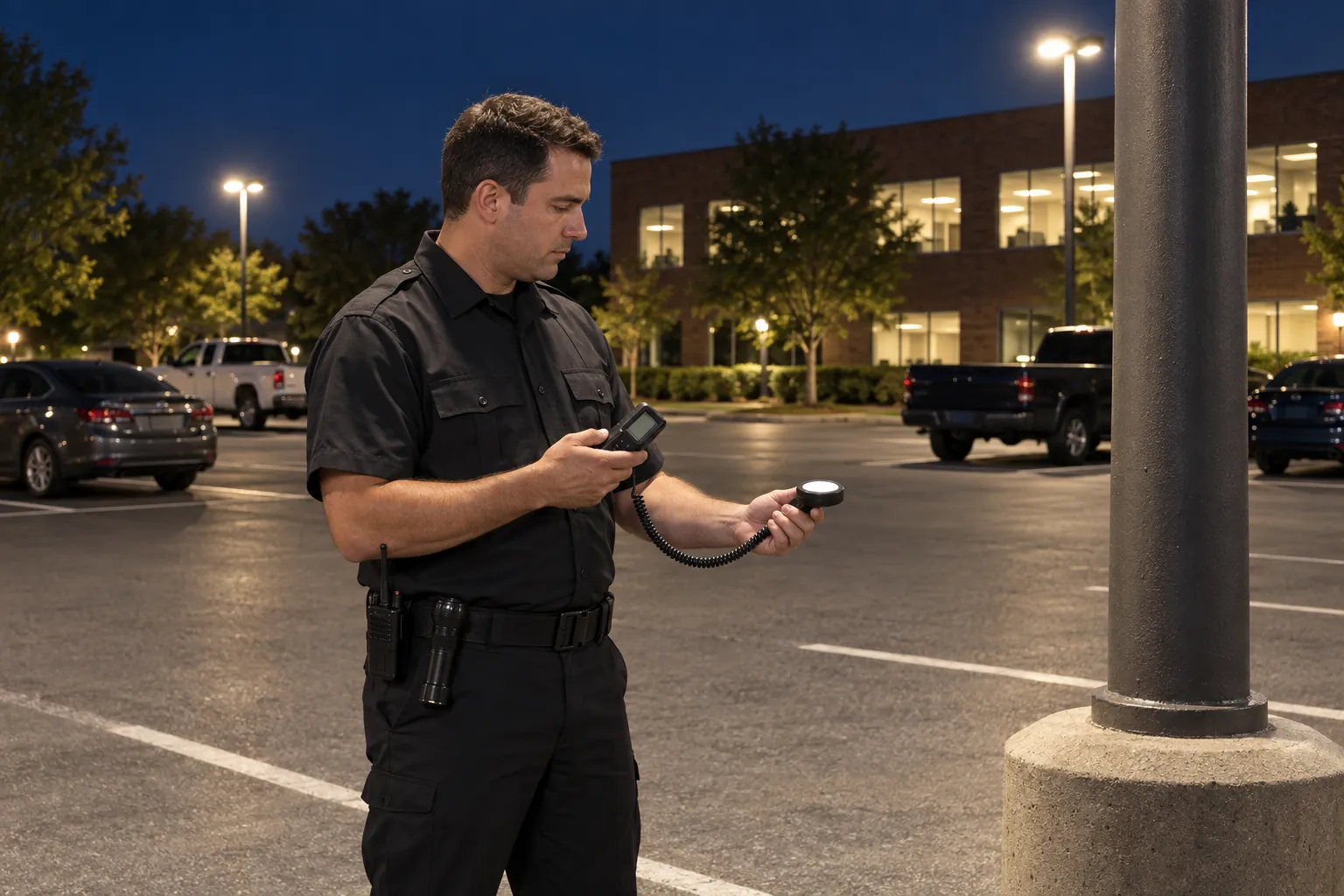 Security patrolsLighting survey: how to check a property's security lighting after darkHow to run a security lighting survey at night: what to check, how to take foot-candle readings, how often, who owns the fixes, and a record that holds up.
 Security patrolsPerimeter security checklist: how to inspect a fence line, its gates and the ground around itA perimeter security checklist for US sites: what a fence inspection covers, gates and barriers, how often to walk the line, and the record that shows it was done.
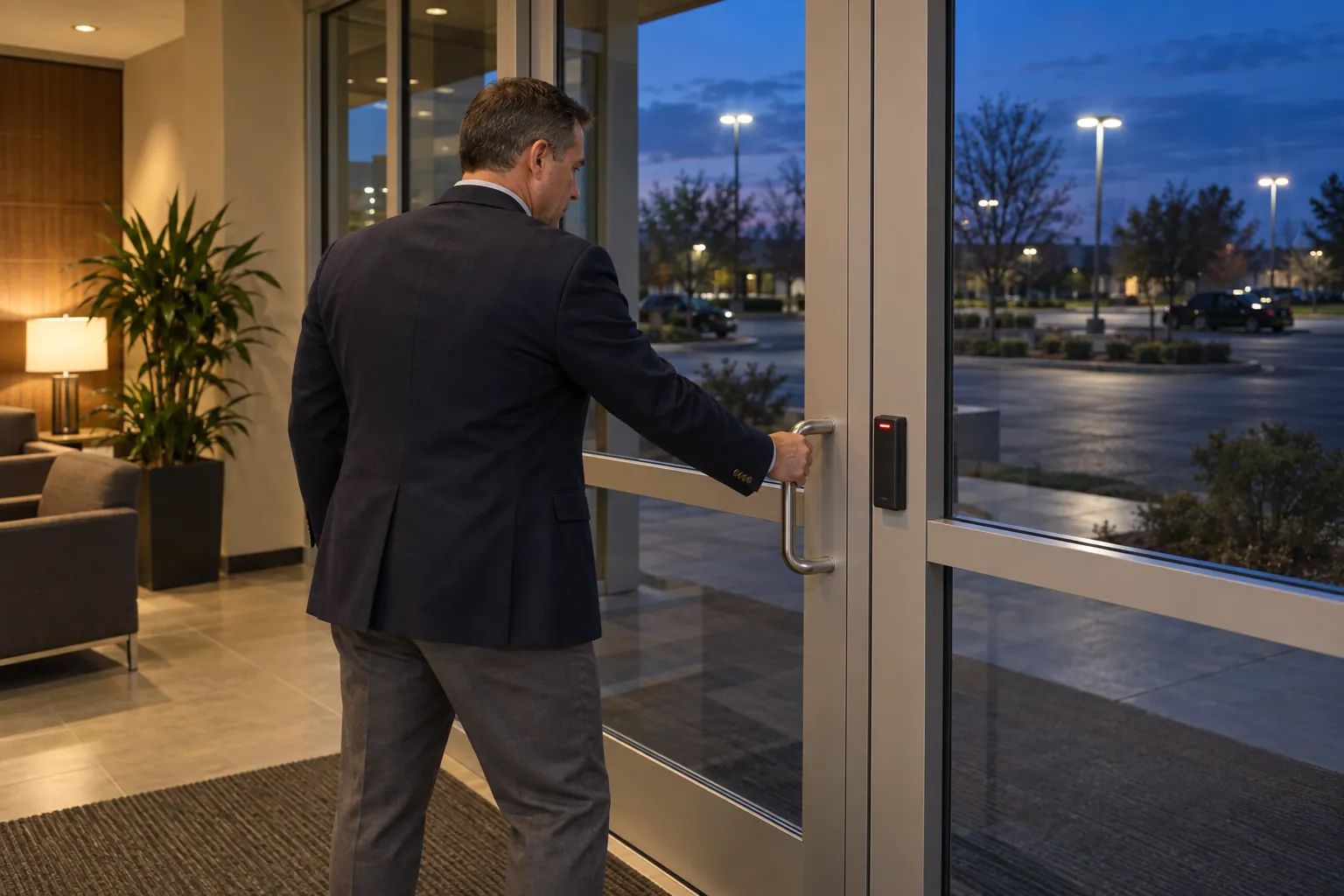 Security patrolsBuilding security checklist: what to check, when to check it, and how to show it was doneA building security checklist for US offices, schools and commercial buildings: doors, locks, lights, cameras, alarms and exits, when to check them and the record.
 CleaningGraffiti removal: who must do it, how to do it safely, and how fastWho is responsible for graffiti removal in U.S. cities, how to remove graffiti from brick and other surfaces safely, anti-graffiti coatings, and a removal policy.