Cleaning
Graffiti removal: who must do it, how to do it safely, and how fast
Graffiti removal is the work of taking spray paint, marker and other unwanted markings off a building without damaging the surface underneath, and in many American cities the property owner must do it within a deadline set by city ordinance once the city sends a notice: 30 days in San Francisco, and 10 days at each stage in Seattle.
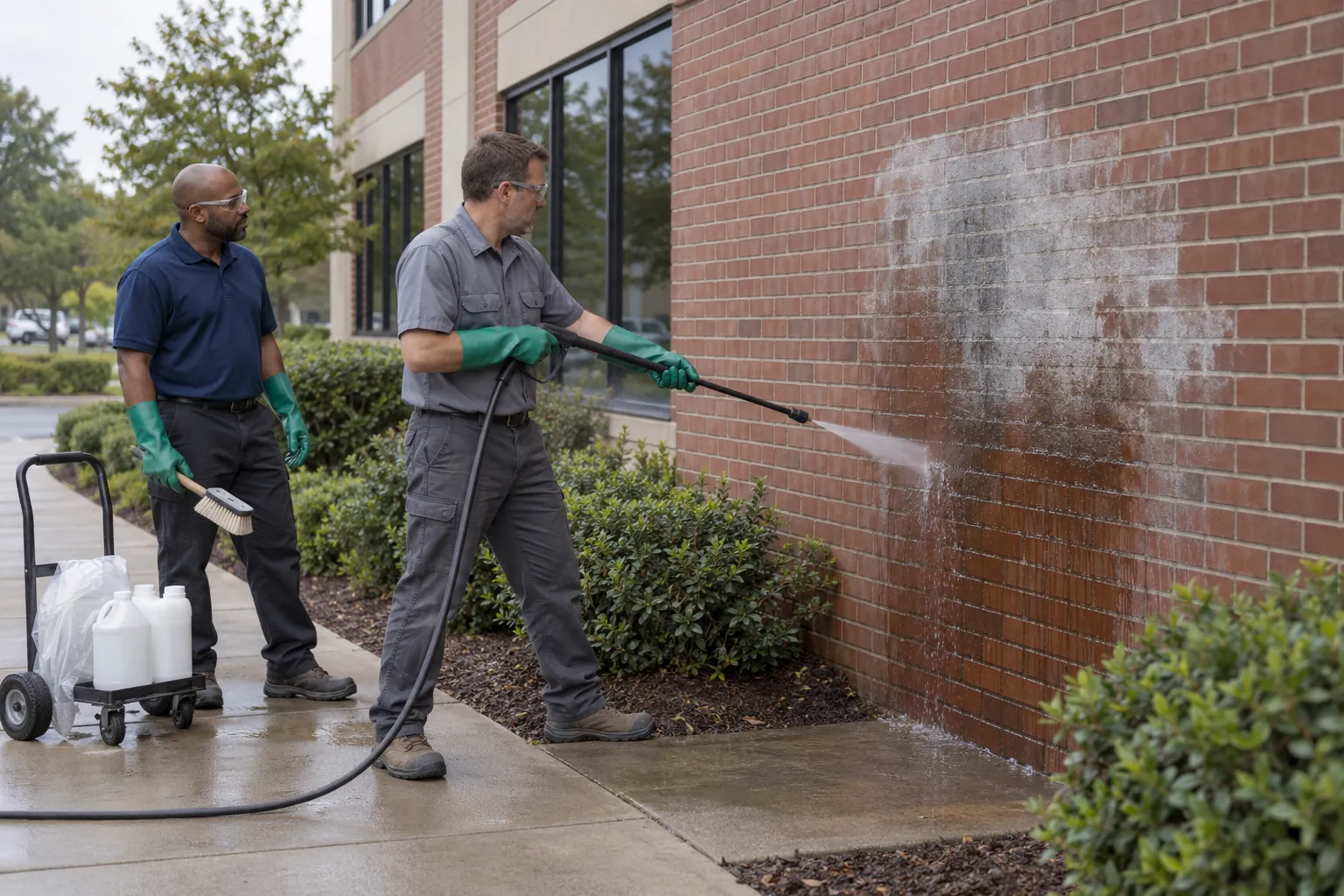
The National Park Service's guidance on masonry puts the practical rule just as plainly: remove graffiti fast, but test first, because a hasty attempt with harsh chemicals or abrasives can leave permanent damage that may be worse than the tag. This guide covers who is responsible, how to remove graffiti from brick and other surfaces, the OSHA rules for the chemicals, anti-graffiti coatings, and what a graffiti removal policy should say.
01
Who is responsible for graffiti removal
No federal law requires anyone to remove graffiti. The duty comes from city and county nuisance or graffiti abatement ordinances, which in most places make the property owner responsible, set a deadline that runs from a city notice, and then let the city fine the owner, recover its costs or remove the graffiti itself. The details vary, so read your own city's code. Three large cities show the range:
- San Francisco. San Francisco Public Works' page on graffiti on private property tells owners: "You must remove the graffiti within 30 days of the receipt of the notice," under Article 23 of the Public Works Code. An owner with "a disproportionate share of graffiti" may request a hardship hearing within the same 30 days. Otherwise "the City will initiate proceedings to abate the graffiti, for a minimum of $500 plus attorney's fees."
- New York City. The NYC Department of Sanitation's graffiti removal page says: "Property owners are required by law to remove or arrange for the removal of graffiti from their property." After a 311 report, DSNY mails a Notice of Intent to Remove Graffiti, and "If the owner does not remove the graffiti and report back within 35 days, DSNY will inspect the property, and if the graffiti is still there, we will have it removed."
- Seattle. The City of Seattle's Graffiti Nuisance Ordinance page says the 1994 ordinance "requires property owners to remove graffiti in a timely manner or risk having the property considered a nuisance." A letter asks for removal within 10 days; if the graffiti stays, a formal notice follows and "The graffiti must be removed within 10 calendar days after receipt of the notice." A Hearing Examiner can then assess "monetary penalties of up to $100 per day, with a maximum of $5,000."
So the owner is responsible, not the city, the police or a tenant, unless a lease or management agreement passes the work on. In a commercial building it usually lands with the property manager, who sends it to the janitorial contractor, the building engineer or a specialist. Write down which, because a tag on a loading dock wall is the job each assumes belongs to another.
The city's deadline is the outer limit, not the target. The National Park Service's Preservation Brief 38, Removing Graffiti from Historic Masonry (Martin E. Weaver, 1995) says: "Removing graffiti as soon as it appears is the key to its elimination–and recurrence," and "Graffiti that is not removed quickly tends to attract more graffiti."
02
Graffiti removal starts with the surface and the paint
Preservation Brief 38 says success means "breaking the bond between the graffiti and the masonry surface without damaging the masonry." It is written for historic buildings, but says "the same guidance may be applied equally to removing graffiti from non-historic masonry." Before anyone opens a can of remover, the crew should know:
- What the graffiti is. "Most graffiti is made with spray paints," but brush-applied paints such as vinyl, acrylic and alkyd paints, felt markers, ballpoint, chalk, crayon and shoe polish turn up too, and a tag is often outlined in marker and filled with spray paint, so one method may not clean all of it.
- How old it is. Paint that has been on a wall "for several weeks or months" has hardened and is harder to dissolve. Fresh water-soluble marker can sometimes come off with water and a neutral detergent.
- How porous the surface is. Brick, stone, concrete and mortar are porous and "sensitive to abrasion"; smooth, newly polished granite is comparatively easy to clean because paint stays on its surface, while weathered marble or limestone can be so porous that pigment lodges in it.
- How it reacts to chemicals. Limestone, marble and glazed brick are acid-sensitive; some granites, Indiana limestone and many sandstones are alkali-sensitive; and "Glazed and polished surfaces tend to be damaged by both strong acids and strong alkalis."
- What sits next to it. Cleaning chemicals "can also damage adjacent metals, glass, and painted surfaces, as well as vegetation," so metal railings, fixtures and planting are covered first.
A wall that is already painted is often the simplest case: repaint the patch in the building's color. On unpainted masonry, the brief warns that paint over graffiti "usually appears as an obvious patch on unpainted masonry and tends to attract more graffiti."
03
How to remove graffiti from brick and masonry, step by step
Preservation Brief 38 says removal "should always begin with the gentlest means possible." Drawn from its testing advice, tips and table of methods, with a first step of our own for the record, a sound routine for brick, stone and concrete is:
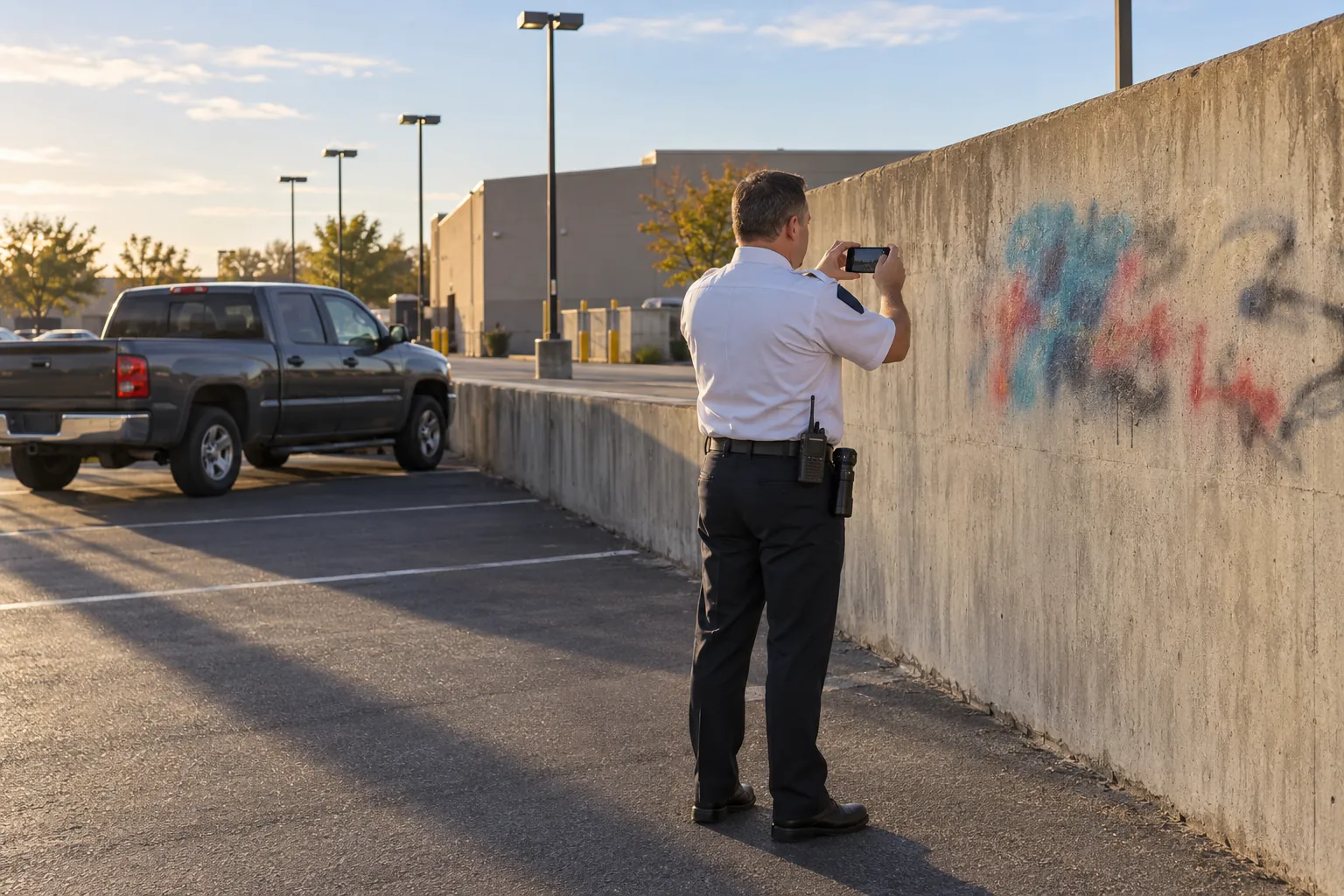
- Record it. Photograph the graffiti with the date, and report it to the police if that is the building's policy; once it is cleaned, the photo is the only record.
- Test on a small, inconspicuous area that is "representative of typical conditions," record the results, and keep the approved sample area for comparison until the end of the job.
- Start gentle. A soft eraser for pencil, a soft brush for chalk, then water and a non-ionic detergent.
- Use a poultice for paint. "The most effective method of removing graffiti from masonry usually involves the use of a poultice": an absorbent such as kaolin clay or cellulose mixed with a cleaning solution such as water, an organic solvent, a paint stripper or bleach, often covered with plastic, which pulls the paint out of the pores instead of driving it in. Test any graffiti remover and follow its manufacturer's instructions.
- Pre-wet only where the product calls for it. Pre-wet before an alkaline remover, but "Do not wet the area to be cleaned if the cleaning agent is solvent-based or incompatible with water."
- Rinse from the bottom up, so run-off does not stain the wall below; neutralize alkaline removers with a weak acid wash and a water rinse.
- Clean whole bricks or stones, "the entire masonry unit that is bounded by mortar joints," and feather out to avoid a clean spot.
- Check for residue with non-staining pH strips.
- Know when to stop. If a faint "ghost" cannot come off without removing masonry, "it may be preferable to leave the masonry alone"; some fade with time.
Two shortcuts cause most of the damage. Off-the-shelf aerosol graffiti removers "generally should not be used" on masonry, because dissolved paint runs down and stains clean wall. And abrasive methods, including sandblasting, grinding and high-pressure water, "will cause damage to masonry," often etching the tag's outline permanently into it; some masonry is damaged by pressure washing even at low or moderate pressures. The brief allows micro-abrasion "at low pressures of 35-40 psi with fine abrasives" only by a professional conservator. On a landmark or in a historic district, check whether the preservation commission must approve the work.
04
Safety: solvents, respirators and runoff
"Most of the chemicals used for graffiti removal are dangerous to workers, as well as to others who may be in the vicinity," Preservation Brief 38 says; organic solvents are "toxic by ingestion, inhalation, and skin contact" and many are flammable. For an employer, three OSHA standards apply:
- 29 CFR 1910.1200, Hazard Communication: a "written hazard communication program," safety data sheets "readily accessible during each work shift," and training "at the time of their initial assignment, and whenever a new chemical hazard the employees have not previously been trained about is introduced." A new remover on the truck is a new chemical hazard.
- 29 CFR 1910.132, Personal Protective Equipment: the employer "shall assess the workplace to determine if hazards are present," and certify that assessment in writing. The brief lists face shields or safety glasses and long chemical-resistant gloves among the usual PPE.
- 29 CFR 1910.134, Respiratory Protection: where respirators are necessary, a "written respiratory protection program with worksite-specific procedures," a medical evaluation before use, and fit testing for tight-fitting facepieces before first use and "at least annually thereafter."
Some states run their own programs: OSHA's State Plans page lists "22 State Plans covering both private sector and state and local government workers, and seven State Plans covering only state and local government workers," which "must be at least as effective as OSHA." Check your state's rules too.
The brief's practical rules: work with good ventilation; no smoking, eating or open flames during cleaning; store solvent-soaked rags safely, "even overnight"; keep water spray away from temporary wiring; and keep passers-by clear. Plan the waste first, because runoff is an environmental problem as well as a safety one: "In many places it is illegal to discharge solvents and/or paint residues into sewers or storm drains."
05
Anti-graffiti coatings, prevention and a graffiti removal policy
Anti-graffiti or barrier coatings make graffiti easier to remove, usually "with low-pressure water and a detergent, or with a solvent." They are most commonly transparent but may be pigmented, and come "in a variety of formulations designed to serve different needs." Preservation Brief 38 describes sacrificial coatings, which come off with the graffiti and must be reapplied; permanent coatings, which stay on but "must usually be reapplied after several cleanings"; and two-part systems of a sealer under a sacrificial wax layer. It warns they "are not the panacea that some advertising might suggest. Some of them simply do not work." Clear coatings can add gloss, trap moisture, yellow or fail in patches. Look for one that is breathable, invisible wet and dry and weathers evenly, ask whether it will pay for itself and can be removed if the wall needs repointing, and test it on an inconspicuous area first.
Prevention starts with upkeep: "Neglect invites vandalism, whereas a well-maintained property encourages civic pride." The brief names lighting, security officers, visible cameras and planting or fences, alongside prompt removal.
A graffiti removal policy, which the brief calls a treatment plan and describes as "essentially a cleaning specification," should cover:
- Who finds it: which rounds or patrols look for graffiti, and how anyone else reports it.
- Who removes it, and how fast: crew, contractor or specialist, with a target time, faster for anything offensive or at a main entrance.
- Methods by surface: what has been tested on each wall, what must never be used, and what is reserved for a specialist.
- Products and safety: approved graffiti remover products with safety data sheets, PPE, and waste handling.
- Records: dated before and after photos, who removed it and when, and any police report or city notice number.
06
Where the graffiti record fails, and what SiteClara does about it
Graffiti usually fails between people, not chemicals. The security officer notes a fresh tag in the 2 a.m. daily activity report; the property manager reads it days later; the janitorial crew was never told; and the next anyone hears is a city notice. Even when it is cleaned, nobody can say when, by whom, or whether the same wall was hit three times last month.
SiteClara records the work where it happens. A printed QR code poster, with an optional NFC tag behind it, sits at each point on a patrol or porter round: an entrance, a loading dock, a parking garage stairwell, a perimeter wall. The officer or porter scans the code or taps the tag on their own phone, with no app to install, and marks the checks due there done. If they find graffiti, they report it there with a photo, and it goes onto the team's list of open jobs until someone closes it, recorded with the person and the time.
A supervisor sees what is open, done and missed, and the daily report they approve goes to the nominated property manager or client contacts the next morning: what was reported, completed and still open. Over weeks, the same wall turning up again is visible in the record, which is useful evidence for a coating, better lighting or a hardship request.
07
Questions people ask
Who is responsible for removing graffiti?
In most American cities, the property owner, under a city ordinance that runs from a city notice. San Francisco Public Works' page on graffiti on private property says owners "must remove the graffiti within 30 days of the receipt of the notice" under Article 23 of the Public Works Code, and the City of Seattle's Graffiti Nuisance Ordinance page says the ordinance "requires property owners to remove graffiti in a timely manner or risk having the property considered a nuisance." A lease or management agreement may pass the work on, but the city's notice goes to the owner.
What is the best thing to remove graffiti?
There is no single best graffiti remover; the right one depends on the graffiti and the surface, and it should be tested first. For spray paint on masonry, the National Park Service's Preservation Brief 38, Removing Graffiti from Historic Masonry lists a poultice with paint remover, organic solvent or a petroleum-based compound, a rinse, a wash with water and non-ionic detergent, and a final water rinse.
How can I get graffiti removed for free in NYC?
Report it to 311 and request free removal under the Graffiti-Free NYC program: the NYC Department of Sanitation's graffiti removal page says the city can remove graffiti from "the front exterior of residential and commercial buildings," in areas that are easily accessible, and from public sidewalks and streets. Owners can also submit a Forever Graffiti Free form so the city removes graffiti "whenever it is reported, without having to receive a Notice of Intent first."
08
Further reading, and a list to take away
Start with your own city's graffiti ordinance, through its public works or sanitation department. For methods, read the National Park Service's Preservation Brief 38, Removing Graffiti from Historic Masonry, which applies to ordinary masonry too. For the chemicals, OSHA's Hazard Communication standard, and the State Plans page if your state runs its own program.
Before the next tag appears, check that:
- you know your city's ordinance, its deadline and who receives its notices;
- leases and contracts say who removes graffiti, and how fast;
- each surface has a tested method, and anything reserved for a specialist is marked;
- patrols and porter rounds include the walls and areas that get hit;
- graffiti is photographed with the date before it is removed;
- removers have safety data sheets on hand and crews are trained on them;
- PPE is assessed in writing, and respirator use has a written program and fit testing;
- runoff and solvent waste are kept out of storm drains;
- any anti-graffiti coating was tested first and has a reapplication plan;
- each removal is recorded with who, when and an after photo, and repeat locations are reviewed.
Sources
Every document this guide quotes or links to, in the order it first cites them.
- San Francisco Public Works' page on graffiti on private property sfpublicworks.org
- NYC Department of Sanitation's graffiti removal page nyc.gov
- City of Seattle's Graffiti Nuisance Ordinance page seattle.gov
- Preservation Brief 38, Removing Graffiti from Historic Masonry nps.gov
- 29 CFR 1910.1200, Hazard Communication osha.gov
- 29 CFR 1910.132, Personal Protective Equipment osha.gov
- 29 CFR 1910.134, Respiratory Protection osha.gov
- State Plans page osha.gov
Related guides
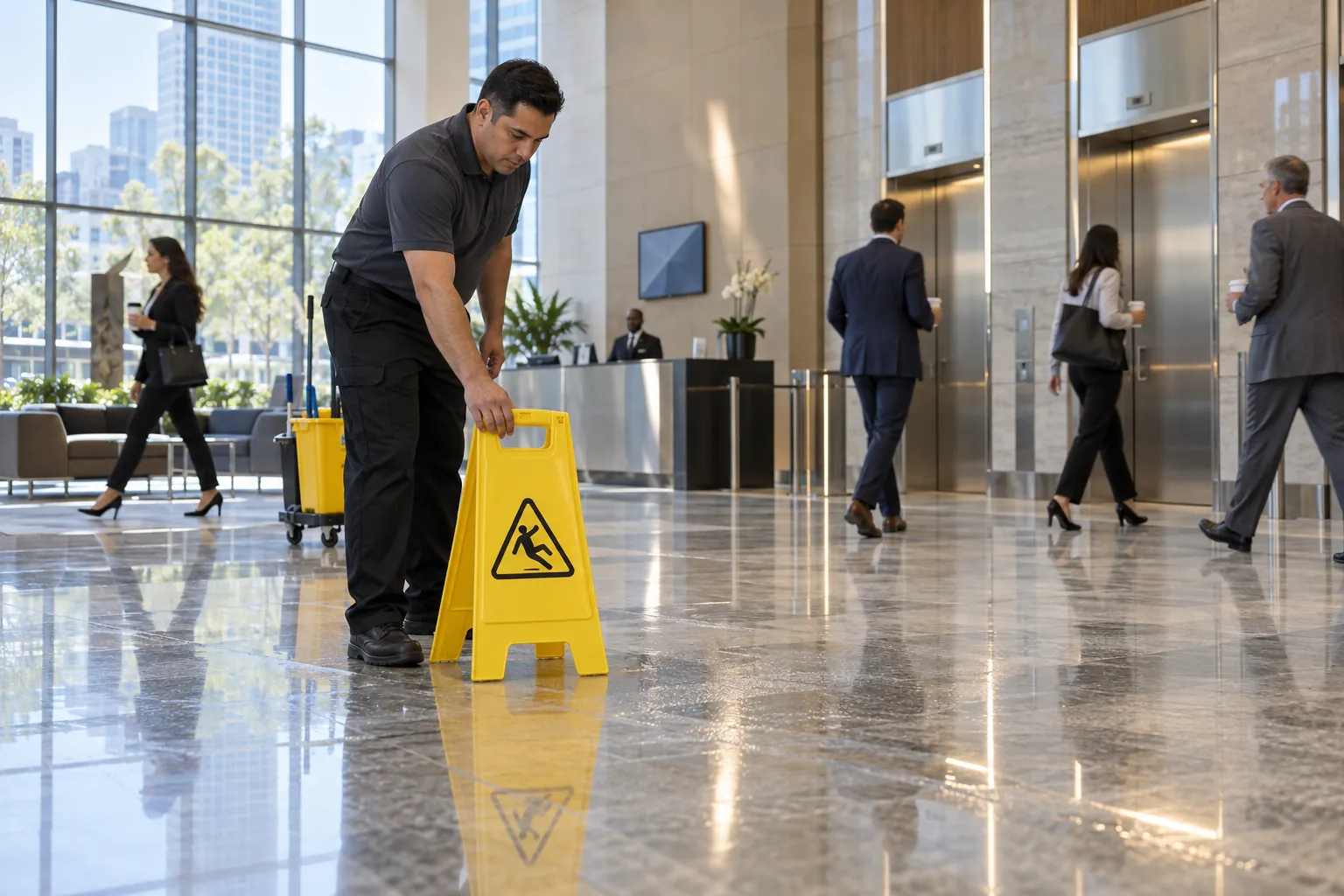 CleaningDay porter duties: what the job covers, and how to prove the roundsWhat a day porter does in an occupied building, a sample daily route, the OSHA rules behind the work, and how to show a client the rounds really happened.
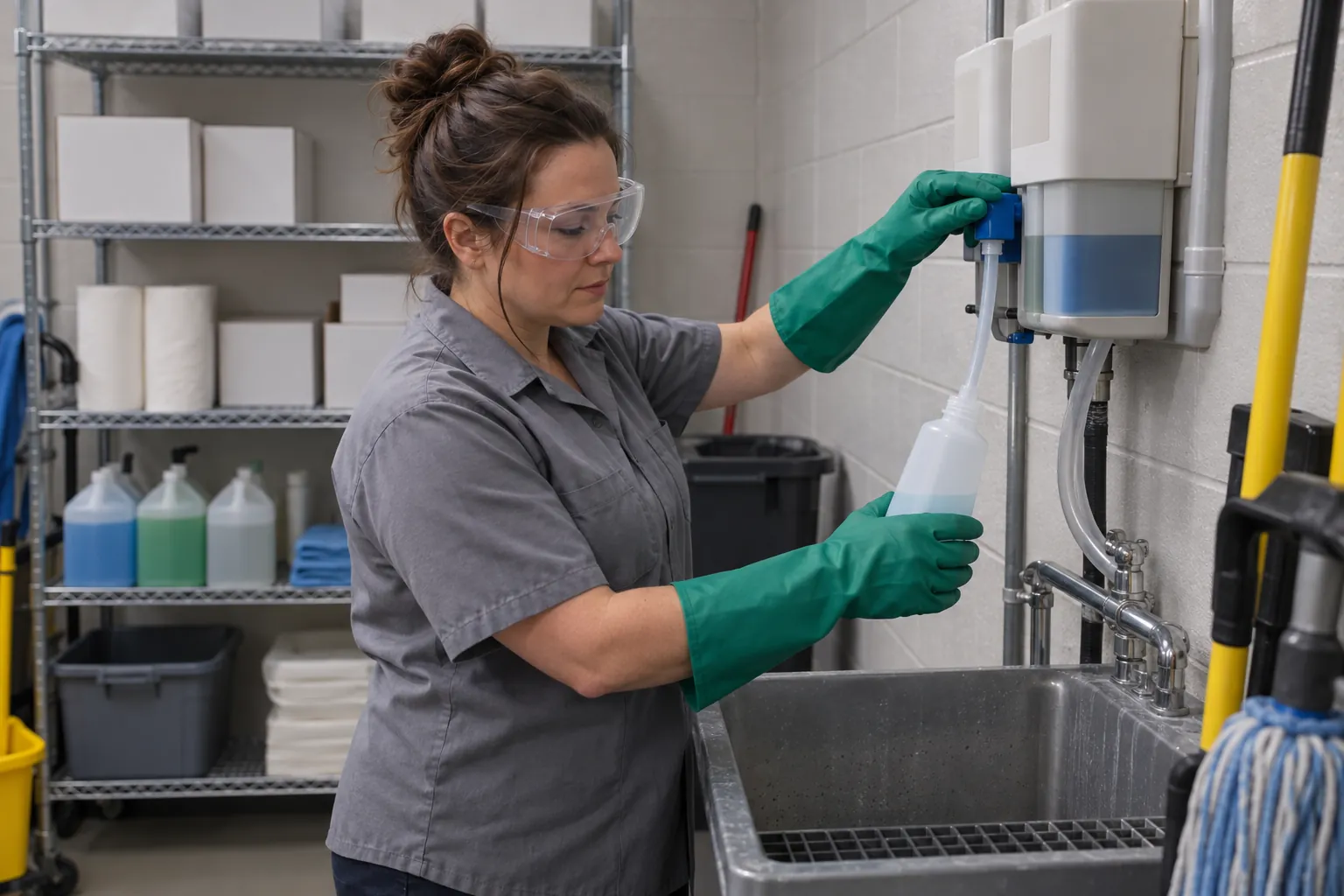 CleaningJanitorial PPE: the hazard assessment, the kit and the daily checkJanitorial PPE under OSHA 29 CFR 1910.132: the hazard assessment, gloves, eye protection, footwear, bloodborne pathogens, training, payment and the daily check.
 CleaningChemical dilution control: getting the mix right, every bottle, every shiftHow a chemical dilution control system works, what OSHA HazCom and EPA labels require, how to check dispensers and bottles, and what the record should show.
 Premises and facilities managementGrounds maintenance checklist: what to check outside the building, how often, and what to recordA grounds and landscape maintenance checklist for US commercial properties: walkways, turf, trees, irrigation and play areas, by season, with OSHA and ADA duties.