Cleaning
Daycare cleaning checklist: what to clean, sanitize and disinfect, and when
A daycare cleaning checklist lists every surface in a child care center and says whether it is cleaned, sanitized or disinfected, and whether that happens before each use, after each use, daily or weekly.
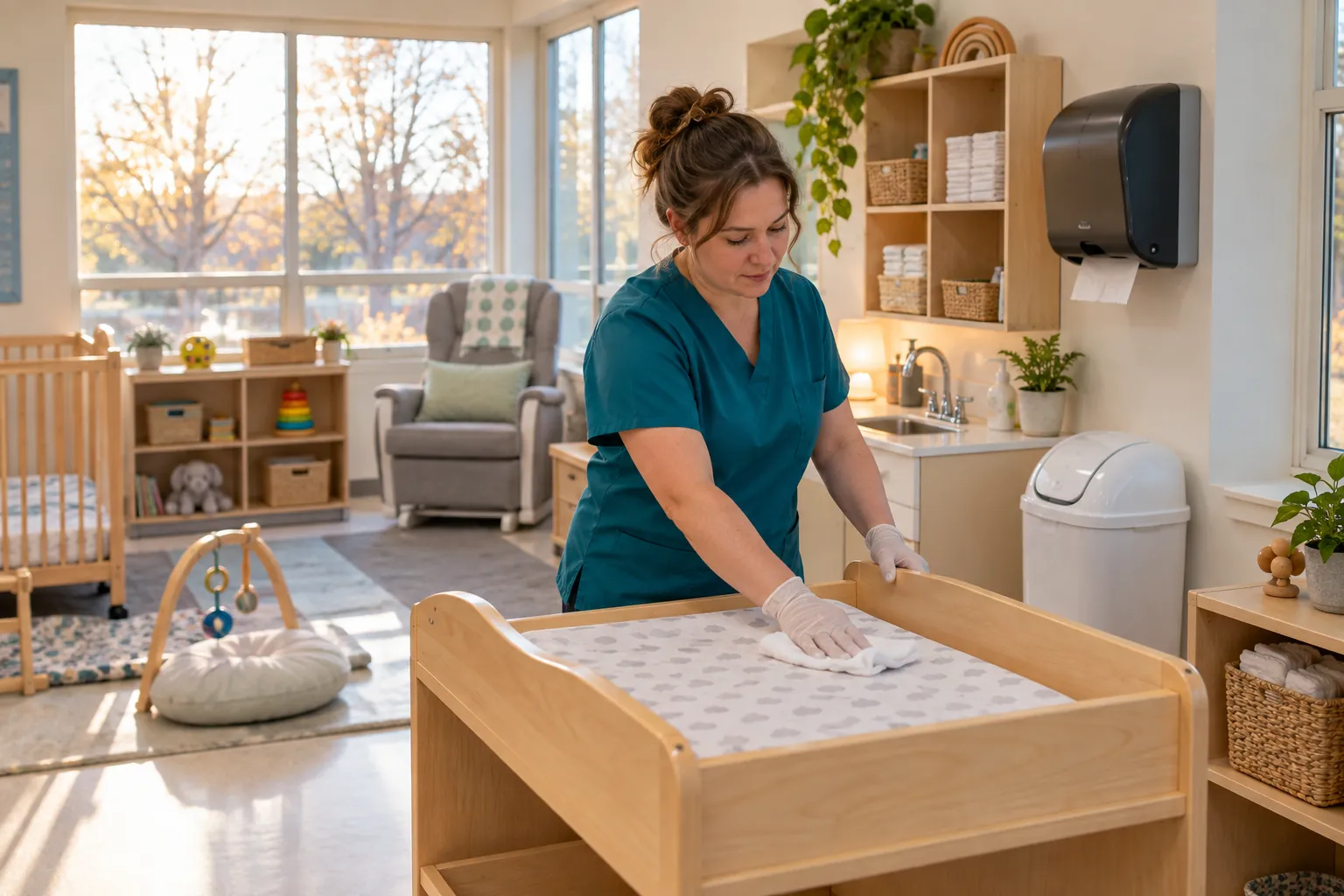
Daycare centers are cleaned while they are in use: toddlers mouth toys, infants need diaper changes and feeds through the day, and the floor is where much of the day happens. This guide sets out the national reference schedule, what state licensing and federal rules add, who does the work, and how to show it was done.
01
What rules apply to cleaning a daycare
There is no single federal daycare cleaning law. The duty comes from three places, and a well-run center checks all of them before it writes its checklist.
State child care licensing. Licensing is a state job, and every state writes its own rules for centers and family child care homes. The rules usually state the outcome and the method rather than a full schedule. Washington's WAC 110-300-0240, Clean and healthy environment, is a typical example: "Early learning program premises and program equipment must be clean and sanitary", and "an early learning provider must clean all surfaces before sanitizing or disinfecting." It also says that "aerosol sprays and air fresheners must not be used during child care hours", sets conditions on bleach solutions, and requires any product other than bleach, including wipes, used to sanitize or disinfect to be approved by the department before use, registered with the EPA and used by trained staff only. Other states differ in the detail, so start from your own state's licensing rules; the licensing regulations database kept by the National Center on Early Childhood Quality Assurance holds every state's.
Federal funding conditions. A state that receives Child Care and Development Fund money must certify under 45 CFR 98.41 that it has health and safety requirements for providers paid through the program, covering at a minimum topics that include "the prevention and control of infectious diseases" and the "handling and storage of hazardous materials and the appropriate disposal of biocontaminants." Head Start and Early Head Start programs are held to the Head Start Program Performance Standards, 45 CFR 1302.47, which require that all areas for "learning, playing, sleeping, toileting, and eating" are "clean and free from pests", that equipment and materials are "clean and safe for children's use and are appropriately disinfected", and that toileting and diapering areas are separated from food preparation and play. The same section tells programs to consult Caring for Our Children Basics when writing their safety policies.
OSHA, where staff are employees. The Hazard Communication Standard (29 CFR 1910.1200) covers the cleaning chemicals themselves: labels, safety data sheets and training. Where staff can reasonably be expected to come into contact with blood as part of their job, for example as the staff member trained in first aid, the Bloodborne Pathogens Standard (29 CFR 1910.1030) applies, and it requires the employer to "determine and implement an appropriate written schedule for cleaning and method of decontamination based upon the location within the facility, type of surface to be cleaned, type of soil present, and tasks or procedures being performed in the area." Twenty-two OSHA-approved State Plans (21 states and Puerto Rico) cover private employers, and seven more cover only state and local government workers, so a daycare run by a public school district or city falls under a state plan or none, so check which applies before relying on the federal text.
The national reference. Behind most state rules sits Caring for Our Children: National Health and Safety Performance Standards; Guidelines for Early Care and Education Programs (CFOC), maintained by the National Resource Center for Health and Safety in Child Care and Early Education, which describes it as "a collection of national standards that represent the best evidence, expertise, and experience in the country on quality health and safety practices." CFOC is guidance, not law, unless your state writes it into its rules. Its Standard 3.3.0.1, Routine Cleaning, Sanitizing, and Disinfecting, is summarized as a table in CFOC Appendix K: Routine Schedule on Cleaning, Sanitizing, and Disinfecting (last updated July 25, 2022), and most daycare cleaning checklists are built from it.
02
Clean, sanitize, disinfect: three different jobs
A daycare checklist uses three verbs, and they are not interchangeable. CFOC Appendix J: Selection and Use of a Cleaning, Sanitizing, or Disinfecting Product sets them out:
- Clean: soap or detergent and water, or an all-purpose cleaner, "to remove germs, dirt, oils, and sticky substances from surfaces or objects." Appendix J notes that "in most situations, routine cleaning with soap and water is enough to remove dirt and some germs from surfaces", and that sanitizing or disinfecting "may be needed after cleaning to further reduce the risk of spreading illness."
- Sanitize: a chemical product "that reduces the number of most germs on non-porous surfaces or objects to a safe level", used on surfaces that touch food and on objects a child might put in their mouth. Choose an EPA-registered product with directions for food-contact surfaces on the label.
- Disinfect: a chemical product "to kill bacteria and viruses on surfaces or objects", used on toileting and diapering equipment and wherever body fluids are cleaned up. The surface has to stay visibly wet for the contact time on the label.
The order matters. Sanitizers and disinfectants "need to be applied to a clean surface to work effectively", so a checklist line that says "disinfect changing table" means clean it first, then disinfect it, then let it air dry. The CDC's facility guidance, When and How to Clean and Disinfect a Facility, uses the same three steps and warns: "Do not mix products or chemicals with each other as this could be hazardous and change the chemical properties."
Appendix J favors products with safer ingredients, because children "play on the floor, put toys in their mouths, and put their hands in their mouths". Where bleach is used, it asks for an EPA-registered bleach, a fresh dilution made daily in a labeled bottle, and never mixing it with anything else.
03
The daycare cleaning checklist, area by area
This is the CFOC Appendix K schedule turned into a working list. Where your state rule is stricter, it wins.
Food preparation and meal service
- Food preparation surfaces and countertops: clean and sanitize before and after each use, with a microfiber cloth or disposable paper towels; no sponges.
- High chair trays and mixed-use tables used for meals: clean and sanitize before and after each use, and clean the legs and frame when soiled.
- Eating utensils, dishes, bottle-feeding equipment and food preparation equipment: clean and sanitize after each use, by hand or in a dishwasher on its sanitize setting.
Classrooms and play areas
- Pacifiers and mouthed toys used by one child: clean before and after each use; sanitize a pacifier if it is dirty or used by another child, and a mouthed toy if used by another child.
- Classroom toys, washable cloth toys and washable dress-up clothes: clean weekly; machine wash cloth items and dry them completely.
- Play activity centers, counters and shelves: clean daily.
- Mixed-use tables used for activities: clean after each use, and sanitize if the table is also used for food or toothbrushing.
- Water tables and water play equipment: clean and disinfect after each use, changing the water before a new group starts or at the end of the day.
- Drinking fountains: clean often through the day and disinfect at the end of the day.
- Animal areas, such as fish tanks and cages: clean, then disinfect.
Floors and carpets
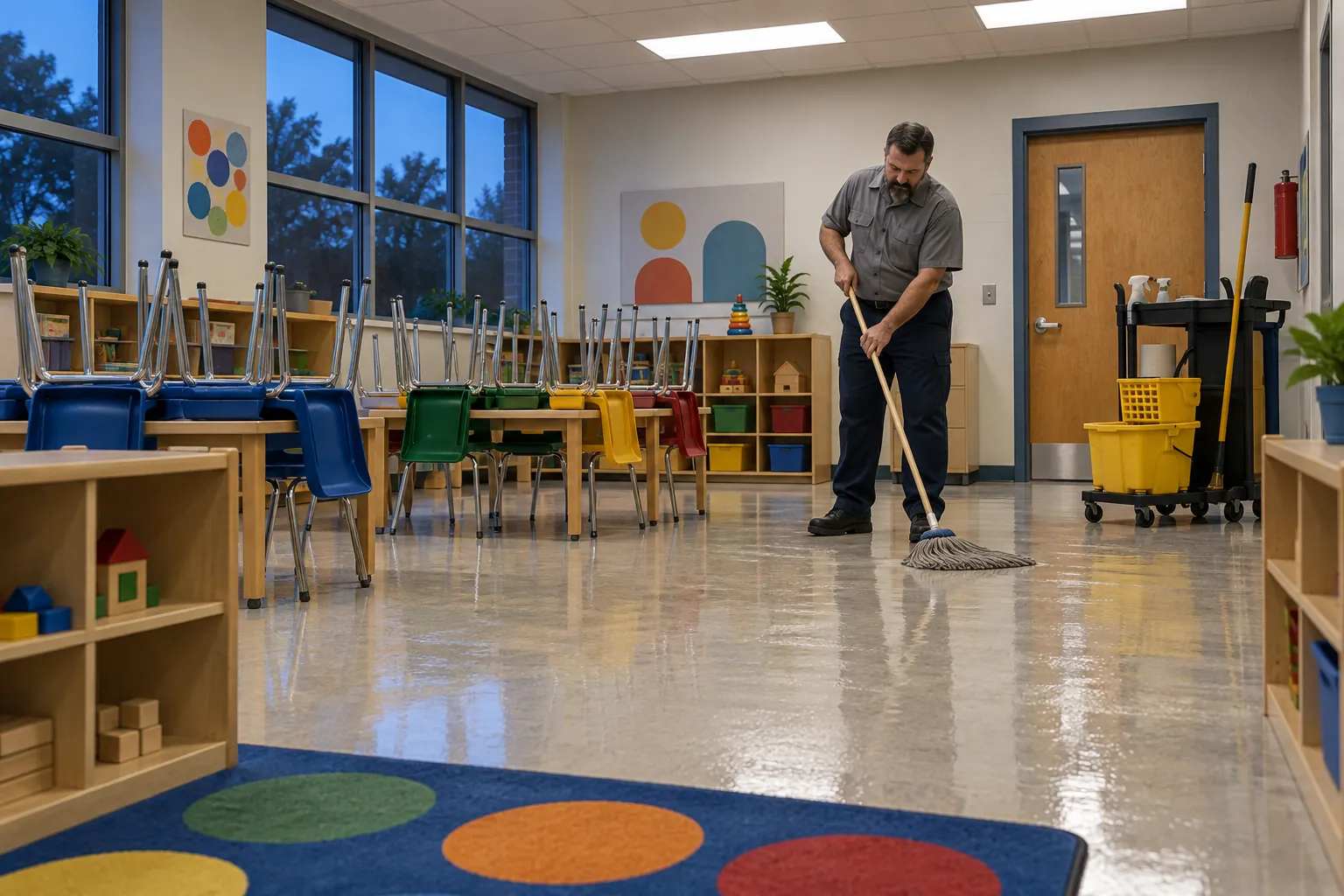
- Hard floors: clean daily by sweeping or vacuuming, then damp mopping; disinfect where soiled with body fluids.
- Carpets and area rugs: vacuum daily with a HEPA filter, clean area rugs weekly, steam clean carpets every three to six months, and spot clean body fluids right away. Appendix K notes that washable area rugs are a safer choice than wall-to-wall carpet.
High-touch surfaces
- Doorknobs, handles, light switches, shared keyboards and phones: clean often through the day and at least daily; during an illness outbreak you may need to sanitize or disinfect more often, so check with your health authority and licensing agency.
Nap and sleeping areas
- Sheets, blankets and pillowcases used by one child: launder weekly, stored separately and labeled for each child; launder with non-chlorine bleach or bleach if soiled with body fluids.
- Cribs, cots and mats: clean the sleep surface regularly, and after each use when a different child uses it; disinfect if soiled with body fluids; use a fitted sheet.
Toilet and diapering areas
- Changing tables: clean and disinfect after each use, and let the surface air dry.
- Diaper pails, toilets, sinks and faucets, countertops and floors: clean and disinfect daily, and disinfect a toilet after use if it is soiled.
- Use separate mops or mop heads for toilet and diapering areas; Appendix K recommends microfiber mops with a split bucket.
04
Who does what, and when in the day
Most of the "before each use" and "after each use" lines are done by teaching staff, because they happen with children in the room: the changing table after every diaper change, the table before and after snack. The end-of-day and weekly lines are usually a custodian's or a janitorial contractor's, done after the children have gone home. A checklist that does not say who owns each line will be done twice in some rooms and not at all in others.
A practical split looks like this:
- Teaching staff, through the day: diapering and toileting surfaces after each use, food surfaces before and after meals, mouthed toys set aside for sanitizing, spills and body fluids as they happen, and hands washed after each task.
- Teaching staff, end of the day: toys that were mouthed, water tables, and any classroom items the state rule assigns to them.
- Custodian or janitorial crew, nightly: restrooms and diapering areas, floors, drinking fountains, high-touch surfaces, trash, and a restock of soap, paper towels and gloves.
- Weekly and periodic: toys and cloth items, bedding, area rugs, and carpet steam cleaning every three to six months.
- Director or site lead: checks the lists are complete, deals with anything reported, and keeps the chemicals list and safety data sheets current.
Chemicals are part of the job. Appendix K says to "keep all chemical products locked up and safely out of the reach of children", and that all containers of cleaning products and chemicals must be labeled. A spray bottle of diluted bleach is a secondary container, and Appendix J lists what its label needs: the name of the product, the health and physical hazards, and the manufacturer's name and address. Staff who use these products need hazard communication training, and a night crew needs to know which cabinets lock and where the safety data sheets are kept.
Illness changes the schedule: Appendix K notes that programs "may need to sanitize, or disinfect surfaces more often during illness outbreaks." Vomit, feces and blood are cleaned up at once, following the written procedure; CFOC's Appendix L covers cleaning up body fluids.
05
What good evidence looks like, and how it is checked
Each state sets how its licensing staff inspect child care centers. A daycare cleaning checklist earns its place when it can answer the question an inspector or a parent will ask: was this done today, and by whom?
A checklist that stands up has:
- one list per room or area, posted where the work is done, so the diapering list is at the changing table and the kitchen list is in the kitchen;
- each task written with its method and frequency, in the words of your state rule where it has one: "clean and disinfect after each use", not "wipe down";
- a space for the time and the person's initials against each completion, filled in when the task is done, not at the end of the shift;
- a way to record a task that could not be done and why, such as out of disinfectant or room still in use;
- a place for problems found: a broken crib slat, a leaking toilet, a pest sighting;
- the product used for sanitizing and disinfecting, since a state may require it to be approved or EPA-registered.
The director should look at the lists every day, not only before a licensing visit. A list completed in one handwriting at 5:55 p.m., or checked off for a room that was closed, says more about the list than the room. Walk the building with the lists in hand and check a few lines against what you can see.
06
Where the checklist fails, and what SiteClara does about it
The daycare cleaning checklist usually lives on a clipboard by the changing table or on a sheet taped inside a cabinet door. It fails in predictable ways. The night crew initials a week of boxes on Friday. The toilet that keeps running is mentioned to whoever is in the hallway, and the director hears about it at the licensing visit. And a paper list cannot show whether the restroom was done at 6 p.m. or signed off in advance.
SiteClara records the check where it happens. A printed QR code poster, with an optional NFC tag behind it, sits at each place a check is scheduled: the restrooms, the diapering area, the kitchen, each classroom. The custodian, the janitorial contractor's cleaner or the teacher scans it or taps it with their own phone, with no app to install, sees the checks due there, and marks each one done or says what stopped them. The time and the named person are recorded as it happens, with a photo when one is asked for. A problem they find, such as a broken cot, a leak or an empty soap dispenser, is reported there and goes onto the team's list of jobs until somebody closes it.
The supervisor, whether that is the center director or the contractor's supervisor, sees what was due, what was done and what was missed, and records why a check was missed. Each day they review it, add a note, and approve a report that goes to the people the center chooses at 8 a.m. the next morning: what was reported, what was completed, what is still open, and how the scheduled checks went.
07
Questions people ask
What should I include on my daily cleaning list for daycare?
Start from CFOC Appendix K: Routine Schedule on Cleaning, Sanitizing, and Disinfecting. Its end-of-day column covers play activity centers, counters and shelves, floors swept or vacuumed and then damp mopped, doorknobs, handles, light switches, shared keyboards and phones, and drinking fountains, which are disinfected at the end of the day; carpets are vacuumed daily with a HEPA filter. In toilet and diapering areas, diaper pails, toilets, sinks and faucets, countertops and floors are cleaned and disinfected daily, and changing tables after each use. Food preparation surfaces, highchair trays and mixed-use tables used for meals are cleaned and sanitized before and after each use. Appendix K adds that programs "may need to sanitize, or disinfect surfaces more often during illness outbreaks".
What are the cleaning requirements for a daycare?
They are set by your state's child care licensing rules, which you can find through the licensing regulations database kept by the National Center on Early Childhood Quality Assurance. Washington's WAC 110-300-0240, Clean and healthy environment, is typical: "Early learning program premises and program equipment must be clean and sanitary", and "an early learning provider must clean all surfaces before sanitizing or disinfecting." Where the state rule does not give a schedule, build from CFOC Appendix K: Routine Schedule on Cleaning, Sanitizing, and Disinfecting.
Is there a daycare cleaning checklist PDF?
The national reference schedule is itself a PDF: CFOC Appendix K: Routine Schedule on Cleaning, Sanitizing, and Disinfecting, last updated July 25, 2022, sets out for each surface whether it is cleaned, sanitized or disinfected and whether before each use, after each use, daily or weekly. It is a reference to build your own list from, not a form to fill in, and your state's licensing rule comes first where it is stricter.
08
Further reading, and a list to take away
Start with your state's child care licensing rules, which are binding where CFOC is not; the NCECQA licensing regulations database links to each state's. For the reference schedule, read CFOC Appendix K alongside CFOC Appendix J on choosing and using products. Head Start programs should read 45 CFR 1302.47 in full. For staff safety, read OSHA's pages on hazard communication and the Bloodborne Pathogens Standard.
Before you post a daycare cleaning checklist, check that:
- it follows your state's licensing rule first, and CFOC Appendix K where the state rule is silent;
- every line says clean, sanitize or disinfect, and before use, after use, daily or weekly;
- each area has its own list, posted where the work is done;
- each line names who owns it: teaching staff, custodian or contractor;
- the sanitizer and disinfectant are EPA-registered, labeled, locked away and on the chemicals list;
- staff know the body fluid procedure and where the supplies are;
- there is room to record the time, the person, anything missed and anything broken;
- someone reviews the lists every day, not only before an inspection.
Sources
Every document this guide quotes or links to, in the order it first cites them.
- WAC 110-300-0240, Clean and healthy environment app.leg.wa.gov
- Licensing regulations database kept by the National Center on Early Childhood Quality Assurance childcareta.acf.hhs.gov
- 45 CFR 98.41 ecfr.gov
- Head Start Program Performance Standards, 45 CFR 1302.47 ecfr.gov
- Hazard Communication Standard (29 CFR 1910.1200) osha.gov
- Bloodborne Pathogens Standard (29 CFR 1910.1030) osha.gov
- National Resource Center for Health and Safety in Child Care and Early Education nrckids.org
- CFOC Appendix K: Routine Schedule on Cleaning, Sanitizing, and Disinfecting nrckids.org
- CFOC Appendix J: Selection and Use of a Cleaning, Sanitizing, or Disinfecting Product nrckids.org
- When and How to Clean and Disinfect a Facility cdc.gov
Related guides
 CleaningCleaning, sanitizing and disinfecting: what each one does, and when a building needs itCleaning, sanitizing and disinfecting defined by the CDC, EPA and FDA Food Code: when each is needed, how to do it right, and what the record should show.
 CleaningHigh-touch surfaces: a cleaning routine you can show was doneHigh-touch surfaces as the CDC describes them: which ones to list area by area, how often to clean and disinfect them, the right method, and a record that holds up.
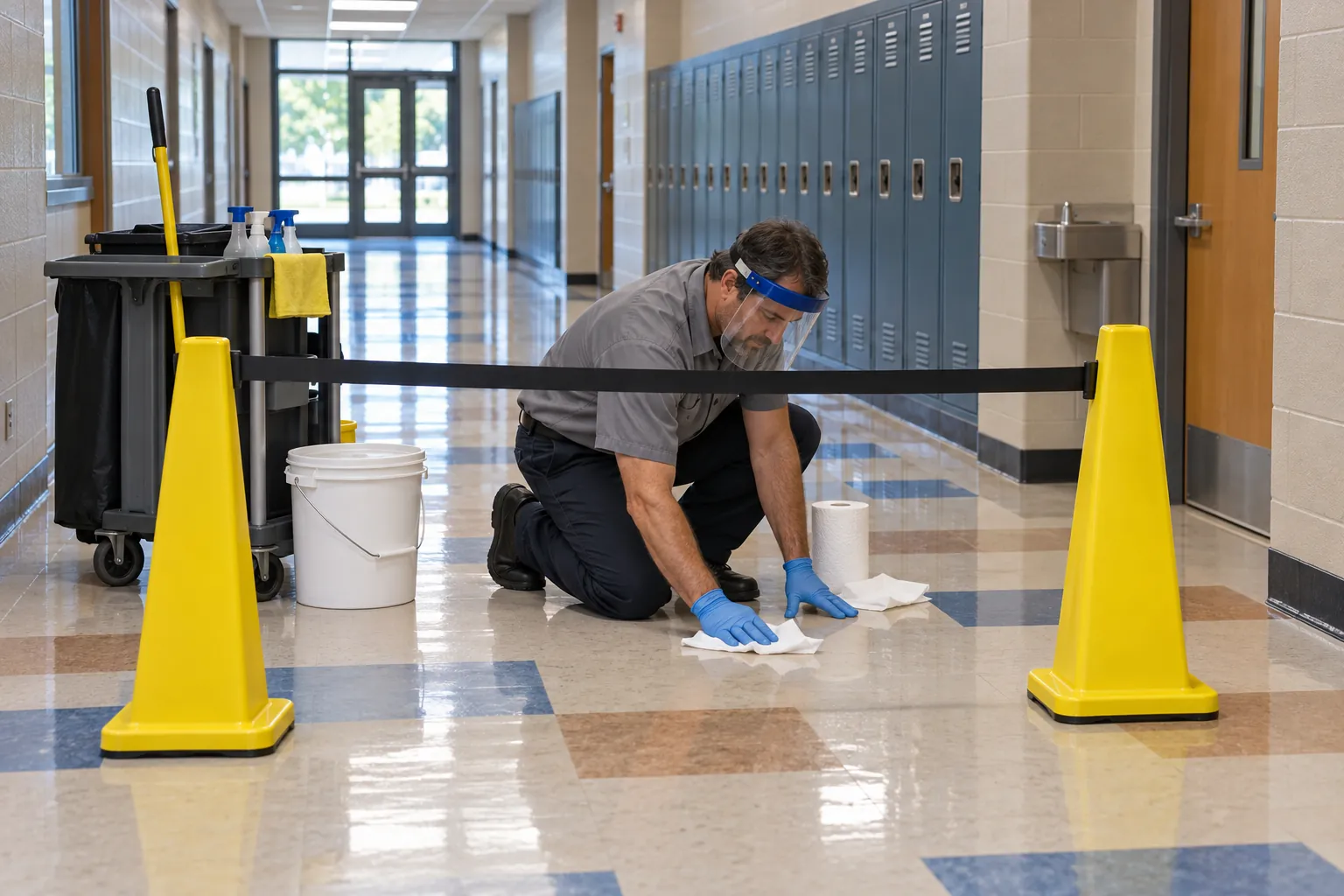 CleaningNorovirus cleanup: how to deal with vomit and diarrhea without spreading the virusHow to clean up vomit and diarrhea so norovirus does not spread: the CDC steps, bleach strength, EPA List G, the Food Code plan, OSHA duties and the record.
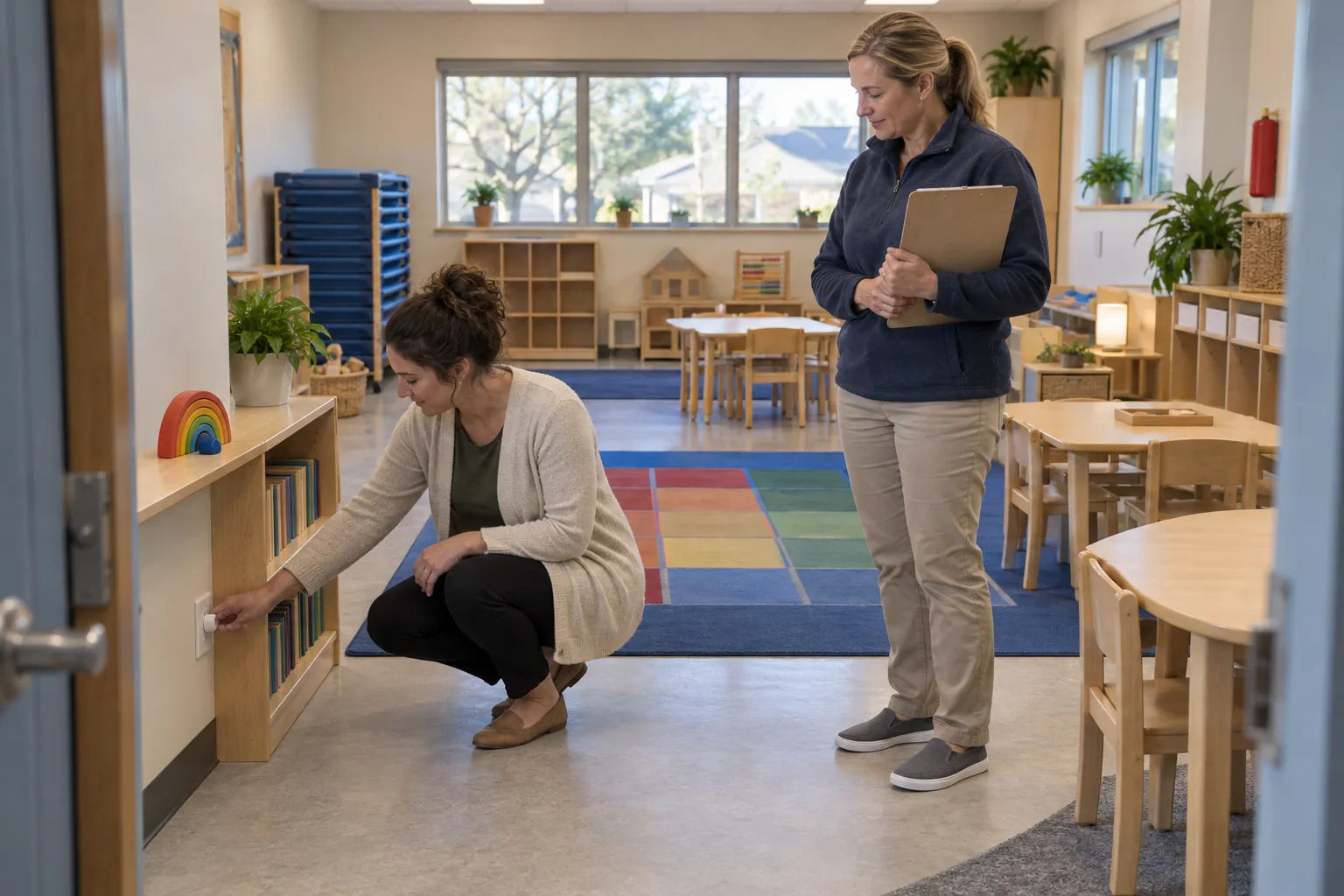 Premises and facilities managementHead Start daily health and safety checklist: what 45 CFR 1302.47 asks for, and how to show it was doneA Head Start daily health and safety checklist built on 45 CFR 1302.47: what to check each morning, what runs weekly or monthly, who does it and what to record.