Premises and facilities management
Head Start daily health and safety checklist: what 45 CFR 1302.47 asks for, and how to show it was done
A Head Start daily health and safety checklist is the short list of checks that staff in Head Start and Early Head Start programs walk every operating day, before children arrive, to confirm that the learning, play, sleeping, toileting and eating areas and their safety supplies meet 45 CFR 1302.47 and the state's child care licensing rules.
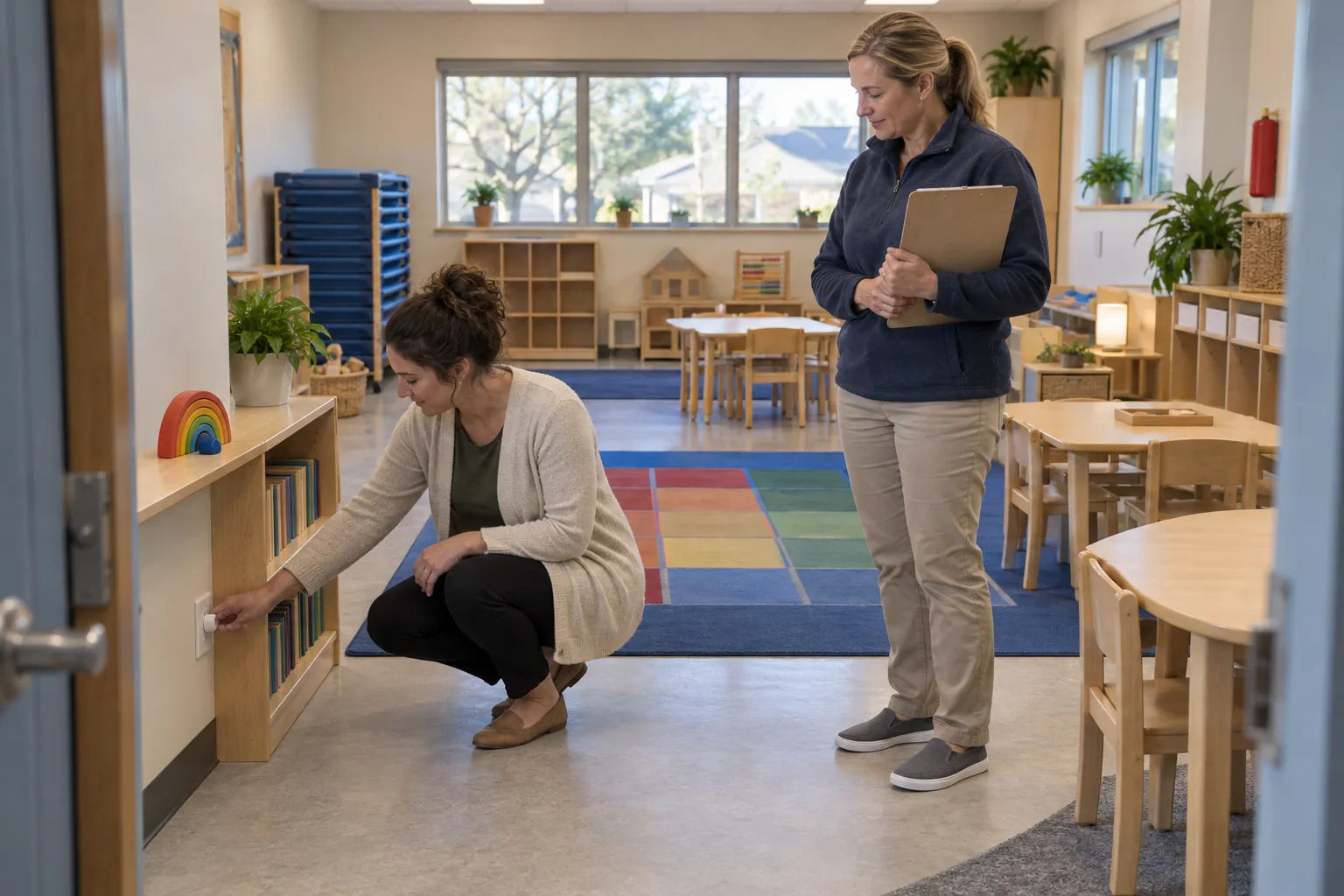
The Program Performance Standards do not print a checklist, but they say what the facilities, equipment and practices must be, and they expect the program to oversee them, correct problems quickly and stop them coming back. This guide sets out what the federal standard requires, what a daily health and safety checklist covers, what runs weekly, monthly and less often, who does each part, and what makes the record worth keeping.
01
What the Head Start Program Performance Standards require
The federal rule is 45 CFR 1302.47, Safety practices, part of the Head Start Program Performance Standards in Title 45 of the Code of Federal Regulations. It applies to every Head Start and Early Head Start program, whether it is run by a school district, a community action agency, a tribe or a nonprofit. Its opening line sets the duty: a program "must establish, train staff on, implement, and enforce a system of health and safety practices that ensure children are kept safe at all times."
Paragraph (b) turns that into a management system, "including ongoing training, oversight, correction and continuous improvement", that covers facilities, equipment and materials, background checks, safety training, safety and hygiene practices and administrative safety procedures. For the building, the standard says that all facilities where children are served, "including areas for learning, playing, sleeping, toileting, and eating", must at a minimum be:
- licensed, in line with the licensing requirements the standards refer to;
- clean and free from pests;
- free from pollutants, hazards and toxins that are accessible to children and could endanger their safety;
- designed to prevent child injury and free from hazards, "including choking, strangulation, electrical, and drowning hazards";
- well lit, "including emergency lighting";
- equipped with safety supplies readily accessible to staff, including "fully-equipped and up-to-date first aid kits and appropriate fire safety supplies";
- free from firearms or other weapons that are accessible to children;
- designed to keep toileting and diapering areas separate from areas for preparing food, cooking, eating or children's activities; and
- "kept safe through an ongoing system of preventative maintenance."
Equipment gets its own paragraph: play equipment, cribs, cots, feeding chairs and strollers must meet CPSC or ASTM International standards, be "clean and safe for children's use" and "appropriately disinfected", and be kept safe through ongoing preventive maintenance.
Two other rules shape the checklist. 45 CFR 1302.21(d)(1) says center facilities "must meet state, tribal, or local licensing requirements, even if exempted by the licensing entity", and that where those requirements differ from Head Start's, "the most stringent provision takes precedence." So a Head Start checklist is the stricter of the federal standard and your state's child care licensing rules, item by item. And 1302.47(a) points programs to Caring for Our Children Basics, the Administration for Children and Families' 2015 set of health and safety foundations, "for additional information to develop and implement adequate safety policies and practices." That document is where most of the daily and monthly frequencies below come from.
02
What a daily health and safety checklist covers
A daily checklist is the part of the system that happens before children are in the room. It is short, it is walked every operating day, and it follows the building rather than the paperwork. It is easiest to organize by area, so the person opening a classroom can finish it in a few minutes. A typical set of items, drawn from 1302.47(b)(1) and (b)(2) and the Caring for Our Children Basics standards, looks like this:
- Entrances and exits: doors open freely from inside, exit routes clear, emergency lighting working where it can be checked, the sign-in and sign-out point set up.
- Classrooms: electrical outlets covered or tamper-resistant, cords out of reach, furniture and shelving stable with no tip-over risk, no loose small parts or broken toys, window blind cords out of reach, no plastic bags, matches or lighters where children can get them.
- Sleeping areas: cribs and cots in good repair, firm mattresses, nothing soft in cribs for infants, cribs away from blinds and drapes.
- Restrooms and diapering areas: clean, stocked with soap and paper towels, handwashing sinks working, diapering surfaces intact, and kept apart from food areas.
- Kitchen and eating areas: clean, free from pests, food allergy information posted where food is served, as 1302.47(b)(7)(vi) requires.
- Chemicals and medications: cleaning products, pesticides and other toxic substances locked away from children in their original labeled containers; medications stored as the program's procedure says.
- Safety supplies: first aid kits present, complete and in date; fire extinguishers in place and unobstructed; the poison control number posted.
- Outdoor play area: fence and gates intact and self-latching, surfacing in place under climbing equipment, no broken or missing parts, no trash, glass, standing water or animal waste.
- Anything new: a leak, a broken window latch, a wasp nest, a gap in the fence. The daily check is how these reach the person who fixes them.
Keep the daily list to what can change overnight or during a day. Items that change slowly, such as smoke and carbon monoxide detector tests or first aid kit inventories, belong on a weekly or monthly list, or the daily sheet grows until nobody reads it.
03
Daily, monthly and less often: what runs when
The Head Start standards set only a few frequencies themselves. The rest come from Caring for Our Children Basics, OSHA where it applies, manufacturers and state licensing:
- Every operating day: the walk above, and the play areas. Caring for Our Children Basics standard 6.2.5.1 says "the indoor and outdoor play areas and equipment should be inspected daily for basic health and safety", including missing or broken parts, protruding nuts and bolts, rust and peeling paint, sharp edges and splinters, the stability of handholds, visible cracks, wear, and vandalism or trash, and that "any problems should be corrected before the playground is used by children."
- After each use: first aid kits. Standard 5.6.0.1 says "first aid kits or supplies should be restocked after each use", and a transportable kit goes on every walk and in every vehicle that carries children.
- Monthly: carbon monoxide detectors. Standard 5.2.9.5 says detectors "should be tested monthly, and testing should be documented", with batteries changed at least yearly. Portable fire extinguishers: where federal OSHA covers the program as an employer, 29 CFR 1910.157(e)(2) requires them to be "visually inspected monthly", with an annual maintenance check under (e)(3). Add smoke alarm and emergency lighting tests on the schedule your fire code and the equipment call for.
- On a set schedule: emergency drills. Standard 9.2.4.3/9.2.4.5 expects "regularly scheduled practice drills", using the daily class roster to account for children and staff, and says "all drills/exercises should be recorded." The number of fire, lockdown and shelter drills a year is set by your state licensing rules and local fire code, so take the figure from them.
- At least every two years: lead. Under 1302.47(b)(9) a program must have a plan to prevent children being exposed to lead in water and paint, and "in facilities where lead may exist" must carry out "testing and inspection at least every two years, with support from trained professionals." The EPA's 3Ts for Reducing Lead in Drinking Water is the federal guidance on testing water in child care facilities.
- Per the manufacturer: playground equipment, cribs, kitchen equipment and building systems. Preventive maintenance is a standing requirement in 1302.47(b)(1)(ix) and (b)(2)(v), and the CPSC's handbook says the manufacturer's maintenance schedules for each piece of play equipment should be the basis of a schedule for the whole playground.
Where these sources disagree, the rule from 1302.21(d)(1) applies: the most stringent one wins. If your state requires a monthly fire drill and a written record of each, that is the schedule, whatever the federal minimum.
04
Who does each part
A Head Start program's safety checks are spread across people who rarely meet. The checklist works when each item has a named owner and a time.
- Teaching staff often walk their own classroom and the play area before children arrive, because they know what the room looked like yesterday and they are the ones who will supervise it.
- The center director or site manager owns the daily walk of shared spaces, reviews what the teams found, and makes sure anything unsafe is closed off until it is fixed.
- Custodians or a janitorial contractor clean, restock restrooms and diapering areas, and are often the first to see a leak, a pest sign or a broken fixture at the end of the day.
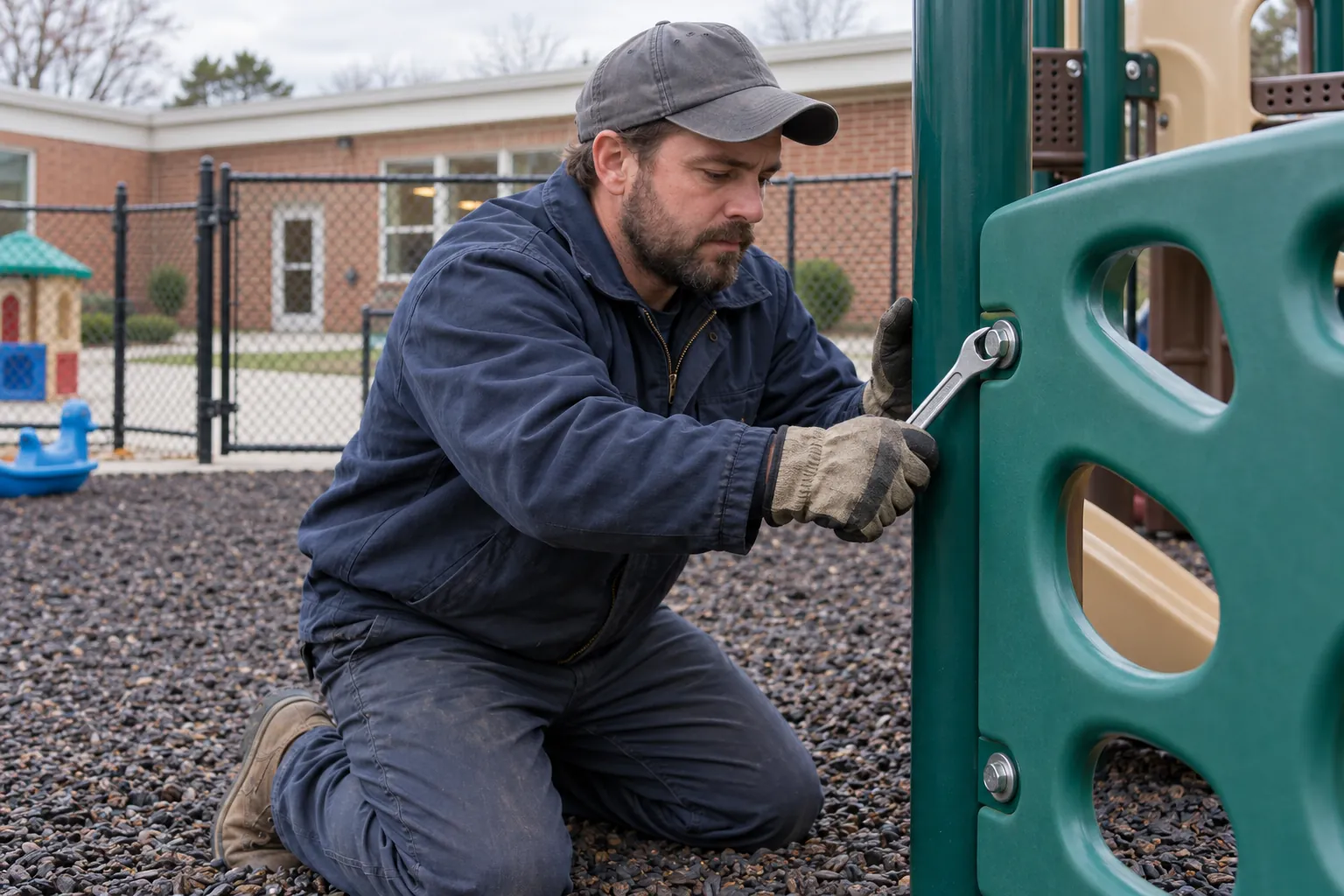
- Facilities or maintenance staff, the program's own or the school district's, run the preventive maintenance schedule, the monthly equipment checks and the repairs.
- The health services manager often owns the first aid, medication, hygiene and exclusion procedures, and the program's contact with its health advisory committee.
The standard reaches all of them. Under 1302.47(b)(5), "all staff, consultants, contractors, and volunteers follow appropriate practices to keep children safe during all activities", so a cleaning contractor's crew is inside the system, not outside it. Under (b)(4)(ii), staff with no regular contact with children, which includes most custodial and maintenance staff, still need orientation within three months of hire, ongoing training in the health and safety requirements that apply to their work, and training in the program's emergency and disaster preparedness procedures.
Blood and body fluids have their own rule. 1302.47(b)(6)(iii) says exposure to them must be handled "consistent with standards of the Occupational Safety Health Administration." For a private employer in a state under federal OSHA, that means OSHA's bloodborne pathogens standard, 29 CFR 1910.1030, which requires the employer to "determine and implement an appropriate written schedule for cleaning and method of decontamination." In a state with its own OSHA-approved State Plan, the state's equivalent standard applies instead, and a program run by a public agency may fall under a state plan or under no OSHA plan at all: the OSHA State Plans page lists 22 plans covering private and public workers and seven covering state and local government workers only. The Head Start standard points to OSHA's standards either way, so follow them.
05
Oversight, correction and what good evidence looks like
The checklist is only the first step of what the standards call a system. 45 CFR 1302.102 sets goals for "effective health and safety practices to ensure children are safe at all times" and requires ongoing oversight in which the program must:
- "collect and use data to inform this process";
- "correct quality and compliance issues immediately, or as quickly as possible";
- work with the governing body and policy council on the issues; and
- "implement procedures that prevent recurrence of previous quality and compliance issues, including previously identified deficiencies, safety incidents, and audit findings."
That is what a daily checklist should feed. The sheet is the data; the fault it finds needs an owner and a fix date; the same fault three weeks running is a recurrence someone has to look at.
Reporting follows from it. Status reports built from ongoing oversight data go to the governing body and policy council at least twice a year, and 1302.102(d)(1)(ii) requires significant incidents to be reported to the responsible HHS official "immediately but no later than 7 calendar days following the incident." The minimum list in (d)(1)(iii) includes "serious harm or injury of a child resulting from lack of preventative maintenance" and serious harm, injury or endangerment resulting from a lack of supervision. When that happens, the maintenance and check records are what show what was known and when.
Good evidence has a few plain features:
- It was made at the time. The CPSC's Public Playground Safety Handbook (2010 edition) says that "when any inspection is performed, the person performing it should sign and date the form used", and that records of inspections and repairs should be kept. The same goes for every check on the list.
- It names a person, not a shift or a room.
- It shows what was wrong, not only ticks. A checklist where every box is always checked tells a reviewer nothing.
- It links the fault to the fix: who was told, when, what was done, and whether the area was closed off in the meantime.
06
Where the checklist fails, and what SiteClara does about it
The daily checklist usually lives on a clipboard by the classroom door or in a binder in the director's office. It fails in familiar ways. The week's boxes are initialed on Friday. The loose fence board is mentioned to whoever is in the hallway, and nobody writes down who was told. The custodian who found the leak at 7 p.m. has no way to put it in front of the director before the children arrive.
SiteClara records the check where it happens. A printed QR code poster, with an optional NFC tag behind it, sits at each place a check is scheduled: each classroom, the restrooms and diapering area, the kitchen, the playground gate. The teacher, custodian or maintenance worker scans or taps it with their own phone, with no app to install, sees the checks due there, and marks each one done or says what stopped them. The time and the named person are recorded as it happens, with a photo when one is asked for. A problem they find, such as a broken latch, a missing outlet cover or an empty soap dispenser, is reported there and goes onto the team's list of jobs until somebody closes it.
The supervisor, whether that is the center director or a contractor's supervisor, sees what was due, what was done and what was missed, and records why a check was missed. Each day they review it, add a note, and approve a report that goes to the people the program chooses at 8 a.m. the next morning by default: what was reported, what was completed, what is still open, and how the scheduled checks went. That gives the oversight 1302.102 asks for a daily source that was recorded at the time.
07
Questions people ask
Is there an official Head Start daily health and safety checklist PDF?
Not a daily one. The Office of Head Start publishes the Health and Safety Screener: Policies and Procedures for Head Start Programs, a yes-or-no form in five parts: facilities, equipment and materials, policies and procedures, active supervision and human resources. It suggests completing "a health and safety screening for each site where children receive services", describing every item marked no, naming the staff responsible for each improvement and following up so improvements are made "in a timely fashion." It reviews policies and conditions rather than walking the building each morning, and it says it "does not include all applicable Head Start Program Performance Standards", so the daily list is still the program's own to write.
What is a culture of safety in Head Start?
The Office of Head Start's 10 Actions to Create a Culture of Safety describes it as a program where "everyone in your program embraces the belief that children deserve the right to be safe and works together to make this happen", from teachers and managers to kitchen staff, maintenance staff, contractors and volunteers. It describes the daily check directly: "Staff do a daily scan of indoor and outdoor spaces to make sure that they are safe for children," they tell maintenance staff right away about a hazard, and children cannot use the area or equipment until it is fixed. The ten actions begin with using data to make decisions and actively supervising, followed by keeping environments safe and secure and making playgrounds safe.
What qualifications does a Head Start health manager need?
Under 45 CFR 1302.91, Staff qualifications and competency requirements, staff responsible for the management and oversight of health services who were hired after November 7, 2016, must have "at a minimum, a baccalaureate degree, preferably related to one or more of the disciplines they oversee." The same section says a program must ensure health procedures are performed "only by a licensed or certified health professional."
How does the Office of Head Start review health and safety?
Through federal monitoring. The FY26 Focus Area 2: Comprehensive Services Review Protocol lists "Safety in staffing, facilities, and equipment" among the health services topics reviewers explore. The review is a 3.5-day event with on-site and virtual activities, including explorations in centers and classrooms and discussions with staff, the governing body and the policy council. The date is normally confirmed 45 days in advance, though "a small number of reviews are unannounced", and all documentation must be received by 12:00 p.m. on the final day to be considered.
08
Where to read the official guidance, and a list to take away
The standard itself is 45 CFR 1302.47 on the eCFR, with the oversight and reporting duties in 45 CFR 1302.102. Caring for Our Children Basics gives the baseline practices the standard points to. The CPSC's Public Playground Safety Handbook covers playground inspection and includes a suggested maintenance checklist in Appendix A. The Office of Head Start's Health and Safety Screener is a resource for reviewing each site's policies and conditions against the standards, and 10 Actions to Create a Culture of Safety sets out the habits that keep a daily check honest. Your state's child care licensing rules decide the rest, and where they are stricter, they win.
Before you rely on your daily health and safety checklist, check that:
- it covers every area 1302.47(b)(1) names: learning, playing, sleeping, toileting and eating;
- each item is the stricter of Head Start and your state licensing rules;
- the daily list holds only what can change in a day, with monthly and less frequent checks on their own schedule;
- every item has a named owner and a time, including contractors;
- each record names the person, the time and what was found, not only a tick;
- every fault has an owner, a fix date and a way to spot it recurring;
- the oversight data reaches the director daily and the governing body and policy council at least twice a year.
Sources
Every document this guide quotes or links to, in the order it first cites them.
- 45 CFR 1302.47, Safety practices ecfr.gov
- 45 CFR 1302.21(d)(1) ecfr.gov
- Caring for Our Children Basics acf.gov
- 29 CFR 1910.157(e)(2) osha.gov
- 3Ts for Reducing Lead in Drinking Water epa.gov
- 29 CFR 1910.1030 osha.gov
- OSHA State Plans osha.gov
- 45 CFR 1302.102 ecfr.gov
- Public Playground Safety Handbook cpsc.gov
- Health and Safety Screener: Policies and Procedures for Head Start Programs headstart.gov
- 10 Actions to Create a Culture of Safety headstart.gov
- 45 CFR 1302.91, Staff qualifications and competency requirements ecfr.gov
- FY26 Focus Area 2: Comprehensive Services Review Protocol headstart.gov
Related guides
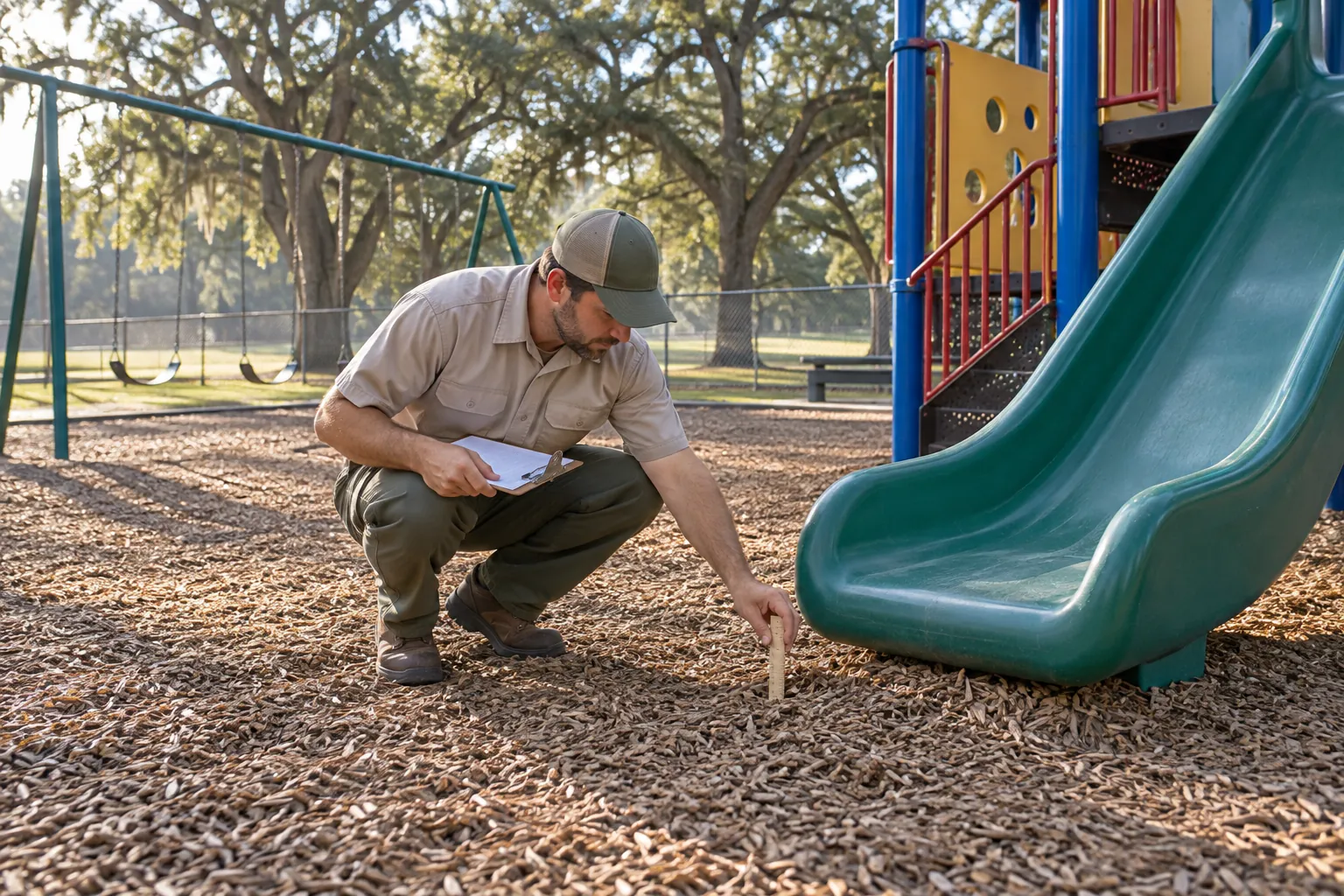 Premises and facilities managementPlayground inspection checklist: keeping public play equipment safe between the big inspectionsA playground inspection checklist for US schools, parks, child care centers and HOAs: the CPSC Handbook, ASTM F1487, surfacing, hazards, frequency and records.
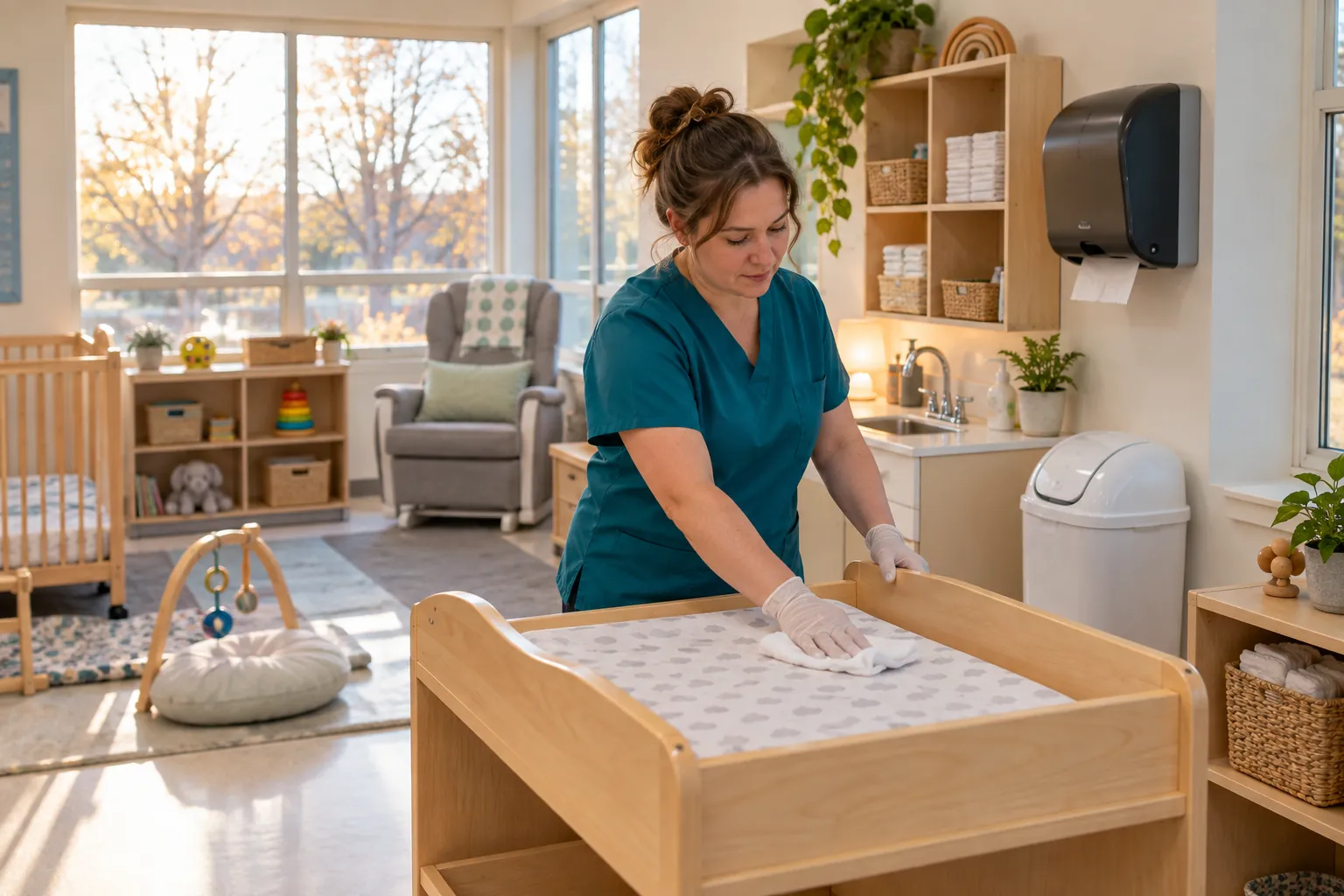 CleaningDaycare cleaning checklist: what to clean, sanitize and disinfect, and whenA daycare cleaning checklist by area and frequency, built on Caring for Our Children's routine schedule, state licensing rules and OSHA's bloodborne pathogens rule.
 Premises and facilities managementSafety walkthroughs: how to walk a building, talk to the crew and fix what you findWhat a safety walk is under OSHA's Recommended Practices, what to look at in a commercial building, how often to walk, how to record findings and close them out.
 Premises and facilities managementPreventive maintenance checklist: what to check in a commercial building, how often, and how to prove itA preventive maintenance checklist for commercial buildings: HVAC, electrical, fire and life safety, plumbing, how often, and what the record should show.