Premises and facilities management
Environment of care rounds: walking the building, and proving the findings were fixed
Environment of care rounds, usually shortened to EOC rounds, are the scheduled walks a hospital or other healthcare facility makes through its own buildings to find hazards before a patient, a staff member or a surveyor does: blocked corridors, propped fire doors, dirty utility rooms, expired supplies, damaged ceilings, unsecured chemicals.
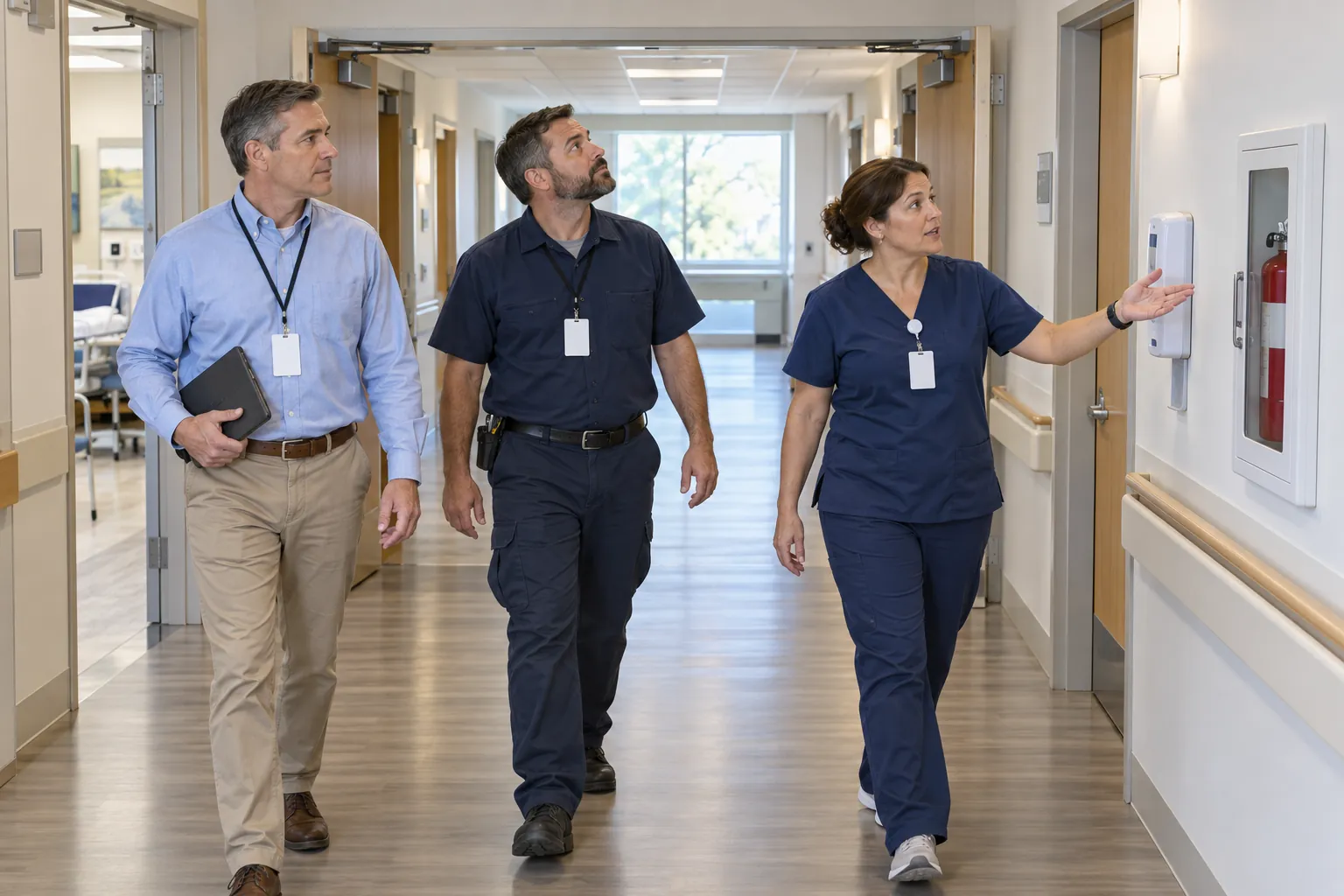
This guide covers where the expectation comes from now that The Joint Commission has rewritten its hospital standards, what a round should cover, who should go and how often, and what a record that stands up to scrutiny looks like.
01
What EOC rounds are, and where the duty comes from
The federal starting point is the Medicare Condition of Participation on the physical environment, 42 CFR 482.41. It says the hospital "must be constructed, arranged, and maintained to ensure the safety of the patient", that "the condition of the physical plant and the overall hospital environment must be developed and maintained in such a manner that the safety and well-being of patients are assured", and that "facilities, supplies, and equipment must be maintained to ensure an acceptable level of safety and quality." It also adopts the 2012 editions of NFPA 101, the Life Safety Code, and NFPA 99, the Health Care Facilities Code, for CMS purposes.
The regulation does not use the word rounds. The expectation that a hospital goes and looks comes from how CMS tells surveyors to test it. The interpretive guidelines in the State Operations Manual, Appendix A apply the Condition to "all locations of the hospital, all campuses, all satellites" and every inpatient and outpatient location (tag A-0700), and say compliance includes "establishing maintenance schedules and conducting ongoing maintenance inspections to identify areas or equipment in need of repair" (tag A-0701). The survey procedures tell the surveyor to check "the condition of ceilings, walls, and floors, presence of patient hazards", and to review the hospital's most recent environmental risk assessment and what it did about the risks found. A regular, recorded walk of every area is the ordinary way to answer all three.
The Joint Commission is where the name comes from. For years its hospital manual had an Environment of Care (EC) chapter, and EC.04.01.01 required the hospital to collect information to monitor conditions in the environment. Under Accreditation 360, the revised hospital and critical access hospital standards effective January 1, 2026, that chapter is gone. The Joint Commission's Disposition Report for Hospitals shows EC.04.01.01, EP 1 "moved and revised" to NPG.11.01.01, EP 3, and deletes the old requirement to evaluate each environment of care management plan every 12 months. The public version of the hospital standards now puts building requirements in a Physical Environment (PE) chapter that tracks the CMS Condition closely.
Neither the CMS Condition nor the current hospital standards we read set a frequency for EOC rounds. That is a choice the hospital makes and has to be able to defend, which is why the rest of this guide is about the routine and the record rather than the rule.
02
What an environment of care round covers
A good EOC round looks at the space the way a patient, a visitor, a firefighter and a surveyor would. Most hospitals build their EOC rounds checklist around the same families of risk the old EC chapter used, because they still map neatly onto the CMS Condition and the Life Safety Code survey:
- Life safety and egress: corridors clear of carts and equipment beyond what policy allows, exits unlocked and marked, exit signs lit, fire doors closing and latching with nothing wedged under them, fire extinguishers mounted and with a current inspection tag, sprinkler heads unobstructed, no penetrations left open in fire and smoke barriers above the ceiling.
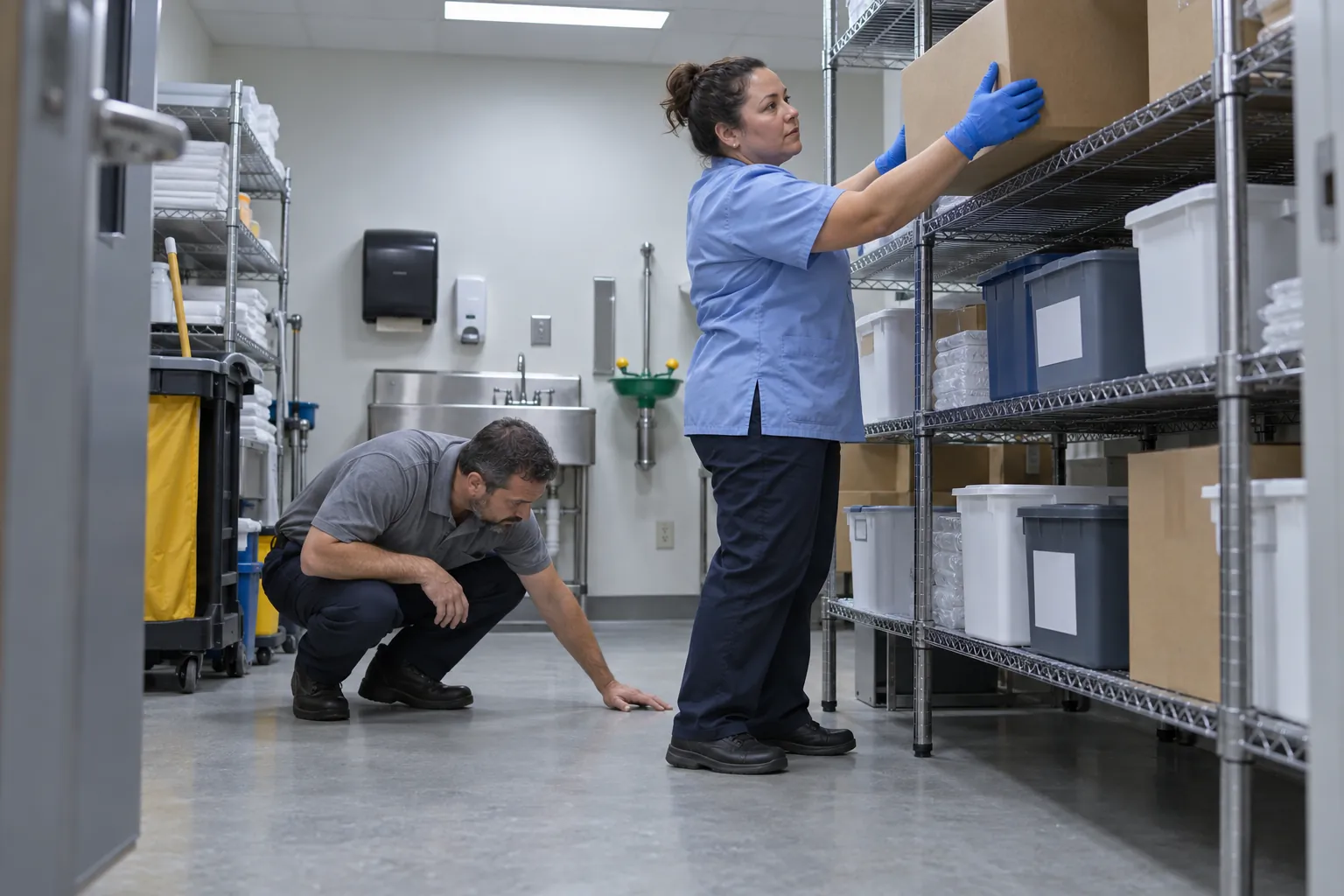
- Storage and housekeeping: storage kept below sprinkler heads by the clearance your code requires, clean and soiled items kept apart, no supplies on the floor, no boxes in patient corridors, oxygen cylinders secured and stored as policy requires.
- Cleanliness and infection prevention: high-touch surfaces clean, no dust on vents and ledges, intact ceiling tiles with no water stains, sharps containers below the fill line, hand hygiene stations stocked, clean utility and soiled utility rooms in the state policy expects.
- Hazardous materials: chemicals labeled and stored as the safety data sheet says, eyewash stations accessible and flushed on schedule, waste segregated, spill kits where they should be.
- Security: doors to security-sensitive areas secured, access to electrical and HVAC rooms locked, badge and visitor controls in use, behavioral health areas checked for ligature and contraband risks under the hospital's own assessment.
- Medical equipment and utilities: equipment carrying a current inspection tag, damaged cords and plugs pulled from use, power strips used only where allowed, medical gas zone valves labeled and unobstructed, electrical panels with clear access.
- The building fabric: floors, walls and ceilings in good repair, trip hazards, lighting out, leaks, temperature and humidity where they are logged, and the exterior: walkways, entrances and parking areas, including weather hazards.
Two areas deserve their own attention. Construction and renovation sites need a closer look at barriers, negative pressure, dust control and egress. CDC's Guidelines for Environmental Infection Control in Health-Care Facilities, section C (Air), recommends an infection control risk assessment before any repair, demolition, construction or renovation, and "a mechanism to monitor worker adherence to infection-control guidelines on a daily basis in and around the construction site." And where a Life Safety Code deficiency cannot be fixed at once, the hospital's interim life safety measures policy may call for daily exit inspections (PE.03.02.01, EP 4) and for the hospital to increase "surveillance of buildings, grounds, and equipment, giving special attention to construction areas" (PE.03.02.01, EP 8), which is a round in all but name.
Tailor the checklist to the area. An operating suite, a behavioral health unit, a kitchen and an off-campus medical office building fall under the same Condition, but one generic sheet walked through all of them produces ticks, not information.
03
Who goes on the round, and how often
EOC rounds, which some hospitals call EOC rounding or environmental rounds, work best as a small multidisciplinary team rather than one person with a clipboard and a paper form. The usual members are:
- the safety officer or environment of care manager, who owns the program and the schedule;
- facilities or plant operations, often a building engineer, who can judge the fabric, the utilities and the life safety features;
- environmental services (EVS), who own cleanliness and waste and can fix many findings on the spot;
- infection prevention, especially in procedural areas and near construction;
- the unit or department manager, who knows how the space is really used and owns the housekeeping and storage findings;
- and, depending on the area, security, clinical engineering (biomedical), pharmacy or food and nutrition services.
Bringing the unit manager matters more than it seems. Most EOC findings are not engineering problems. They are a cart parked in a corridor, a door propped for convenience, linen stored under a sink. The person who can change those habits needs to see them and agree on the fix.
Frequency is the hospital's decision. A common approach is to set it by risk: patient care and procedural areas more often than business offices, and higher-risk areas (emergency departments, operating rooms, behavioral health, kitchens) more often again. Whatever the schedule, write it into the safety management policy with the reasoning, keep to it, and keep a separate, more frequent routine for anything that needs one: daily construction checks while work is under way, daily exit inspections under ILSM, and the unit's own daily checks of crash carts, refrigerators and eyewash stations.
Announced rounds show how a unit looks when it expects you. Many teams add short unannounced, night and weekend visits, and some invite a member of hospital leadership along from time to time, so the findings reach the people who can fund the fixes.
04
What a good EOC rounds record looks like
The record of a round has two jobs: to show the round happened, and to make sure each thing found gets fixed. The second is the one that usually fails. A useful record for each round includes:
- the area walked, at a level someone else could find again (building, floor, unit, room numbers where it matters);
- the date and time, and the names of the people who walked it;
- each finding, described specifically: "fire door 3-114 held open by a wedge", not "fire door issue";
- a photograph where it helps, taken at the time;
- the category, so findings can be trended later (life safety, infection prevention, security, hazardous materials, equipment, utilities, housekeeping);
- the owner and a due date, and the work order number if one was raised;
- how and when it was closed, and by whom.
Keep the round record separate from the documentation that other standards require. For fire and smoke detection, alarm and extinguishing systems, the current hospital manual (PE.04.01.01, EP 2) expects inspection, testing and maintenance records to show the activity, date, inventory, required frequency, the person who did it, the NFPA standard and the result. A round that notices a missing extinguisher tag is not the monthly extinguisher inspection. It is a finding that the inspection record may be wrong.
A finding fixed on the spot still goes on the record, marked as corrected at the time. Otherwise the trend data understates how often the same problem appears, and the unit that clears its corridor only when the team arrives looks perfect.
05
Closing findings, trending them and reporting up
Rounds only earn their time if findings close. Work that needs trades goes into the work order system with the round's reference. Work that belongs to the unit (storage, housekeeping, doors propped for convenience) goes to the unit manager with a due date. Anything that cannot be fixed quickly and affects life safety goes through the ILSM assessment. Someone then checks that each item was actually done, preferably by looking at it, not by reading that the ticket was closed.
Trending turns a pile of findings into decisions. Count findings by category, by area and by repeat: the same corridor clutter on the same unit for the third round running is a process problem, not a housekeeping one. The current hospital standards expect a continual process for monitoring, internally reporting and investigating environmental problems (NPG.11.01.01, EP 3), and CMS's interpretive guidelines expect facility maintenance and the departments responsible for buildings and equipment to be part of the hospital's QAPI program (A-0700). Most hospitals take the EOC rounds summary to their safety or environment of care committee each month or quarter, with open findings, overdue items and the repeats.
A useful summary says how many areas were due and walked, how many findings were raised and closed, what is overdue and why, and which problems keep coming back. Kept up all year, it is also the plainest evidence of survey readiness.
06
Where the record fails, and what SiteClara does about it
EOC round records fail in familiar ways. The schedule says every area was walked, but nobody can say who walked the medical office building across the road. The checklist has every box ticked and no room numbers, so the same propped door is "fixed" three rounds running. A finding is mentioned to the charge nurse, never written down, and a surveyor finds it first. The work order closes, but nobody went back to look. And the round of the loading dock, the parking structure and the stairwells slips because it is nobody's unit.
SiteClara records checks at the location. A printed QR poster, with an optional NFC tag behind it, sits at each point on a route, such as a unit entrance, a clean utility room, a stair tower, a barrier door or a construction entrance. Staff scan or tap on their own phone, with no app to install, and mark the location checked or say what stopped them. The time and the named person are recorded as it happens, with a photo when one is asked for. A problem found on a round, such as a wedged fire door or boxes in a corridor, is reported there with a photo and goes onto the team's list of jobs until someone closes it.
The supervisor sees what is due, done and missed, and can record the reason a check was missed. A job that needs the building manager can be escalated to them to answer. Each day the supervisor reviews and approves a report that goes to nominated management or client contacts at 8 a.m. the next morning, showing what was reported, completed and still open, and how the scheduled checks went.
07
Questions people ask
What is EOC at a hospital?
EOC stands for environment of care, the name of the chapter in which The Joint Commission's hospital manual used to set its requirements for the building, its equipment and its utilities. The public version of the Joint Commission hospital standards no longer has an Environment of Care chapter: building requirements now sit in the Physical Environment (PE) chapter. The name has stuck for the rounds, the committee and the job titles.
Which Joint Commission standard covers environment of care rounds?
No hospital standard calls for environment of care rounds by name. The Disposition Report for Hospitals shows the old monitoring requirement, EC.04.01.01, EP 1, "moved and revised" to NPG.11.01.01, EP 3, under which the hospital "develops and implements a process(es) for continually monitoring, internally reporting, and investigating" injuries, property damage, security incidents, hazardous materials spills, fire safety deficiencies, equipment problems and utility failures. The report is marked "Effective January 1, 2026", and the Accreditation 360 FAQs say the new approach is "being rolled out first to the critical access hospital and hospital accreditation programs in 2026." EOC rounds are one of the ways a hospital meets that monitoring duty.
What are some examples of infection control measures to check on a round?
CDC's Standard Precautions for All Patient Care lists the basics used in all patient care: hand hygiene, personal protective equipment where exposure is expected, respiratory hygiene and cough etiquette, appropriate patient placement, cleaning and disinfecting patient care equipment and the environment, careful handling of textiles and laundry, and safe injection practices. A round can see the evidence of most of them: stocked hand hygiene stations, PPE within reach, clean surfaces and equipment, and clean and soiled linen kept apart.
08
Where to read more, and a list to take away
Start with the regulation itself, 42 CFR 482.41, and how surveyors test it in the State Operations Manual, Appendix A, starting at tag A-0700. For accredited hospitals, read the Physical Environment and National Performance Goals chapters in the public version of the Joint Commission hospital standards, the Disposition Report for Hospitals to see where each old EC requirement went, and the Accreditation 360 FAQs. For infection prevention on the round, CDC's Environmental Services recommendations say high-touch surfaces in patient care areas "should be cleaned and/or disinfected more frequently than surfaces with minimal hand contact", and section C (Air) covers construction. The Life Safety Code is NFPA 101, 2012 edition for CMS purposes, alongside whatever your state or city enforces.
- Check which manual and chapter apply to you: a hospital's EC.04.01.01 is now NPG.11.01.01 and the PE chapter.
- Write down which areas are walked, how often and why, with patient care and high-risk areas more often, and every off-campus location included.
- Walk as a small team that includes the unit manager, EVS and facilities, and add unannounced, night and weekend rounds.
- Use a checklist tailored to the type of area, not one generic sheet.
- Record the area, the time, the names, each finding in specific words and a photo where it helps.
- Give every finding an owner and a due date, and record findings fixed on the spot too.
- Go back and look before you close a finding.
- Trend findings by category, area and repeat, and report the open, overdue and recurring items to your safety committee.
Sources
Every document this guide quotes or links to, in the order it first cites them.
- 42 CFR 482.41 ecfr.gov
- State Operations Manual, Appendix A cms.gov
- Disposition Report for Hospitals digitalassets.jointcommission.org
- Public version of the hospital standards publicstandards.tools.jointcommission.org
- Guidelines for Environmental Infection Control in Health-Care Facilities, section C (Air) cdc.gov
- Worker Safety in Hospitals osha.gov
- Accreditation 360 FAQs jointcommission.org
- Standard Precautions for All Patient Care cdc.gov
- Environmental Services recommendations cdc.gov
- NFPA 101 nfpa.org
Related guides
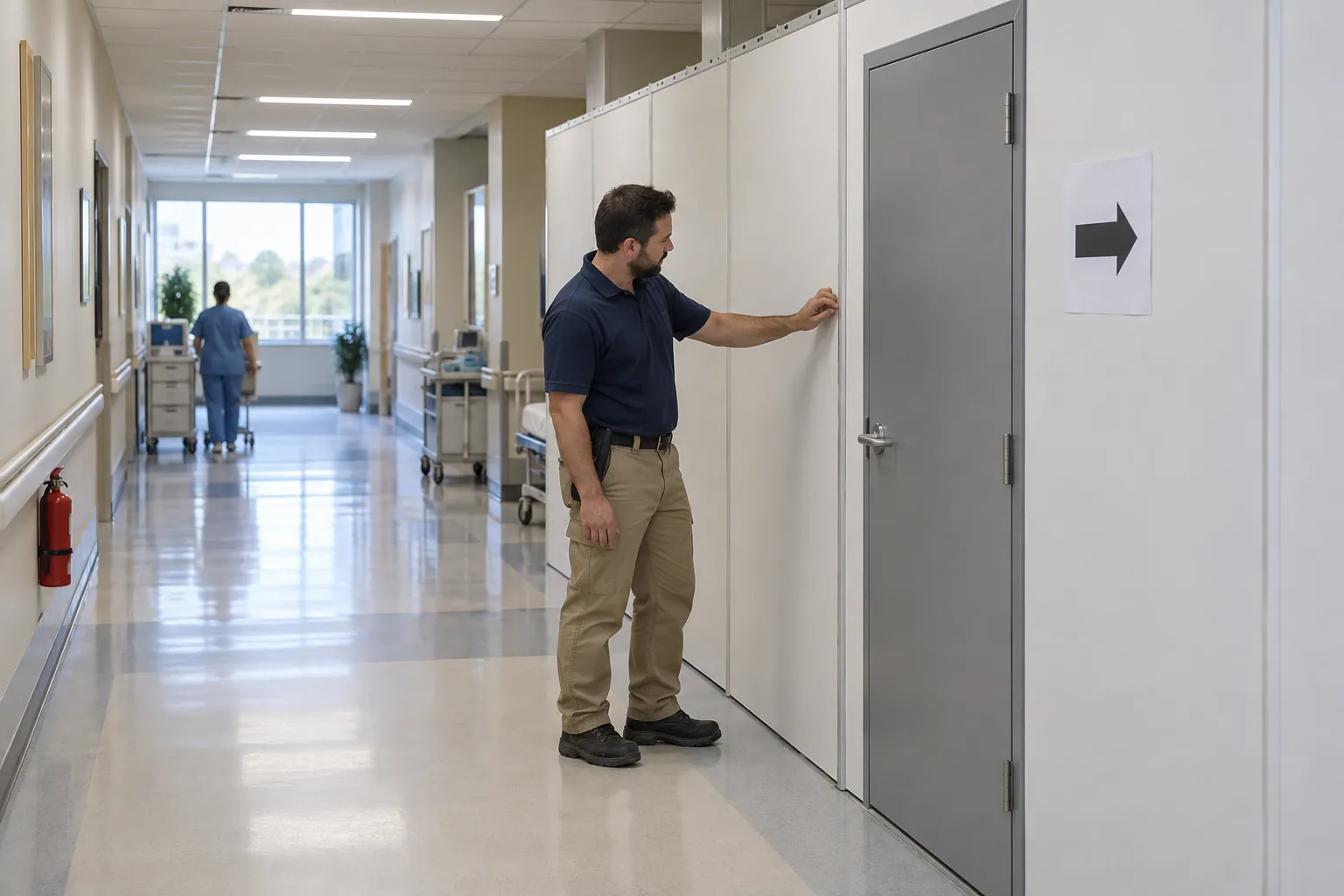 Fire and water checksInterim life safety measures: keeping a healthcare building safe while its fire protection is compromisedWhat The Joint Commission's LS.01.02.01 asks of an ILSM policy, when a fire watch is required, and how to run and record the daily rounds behind the measures.
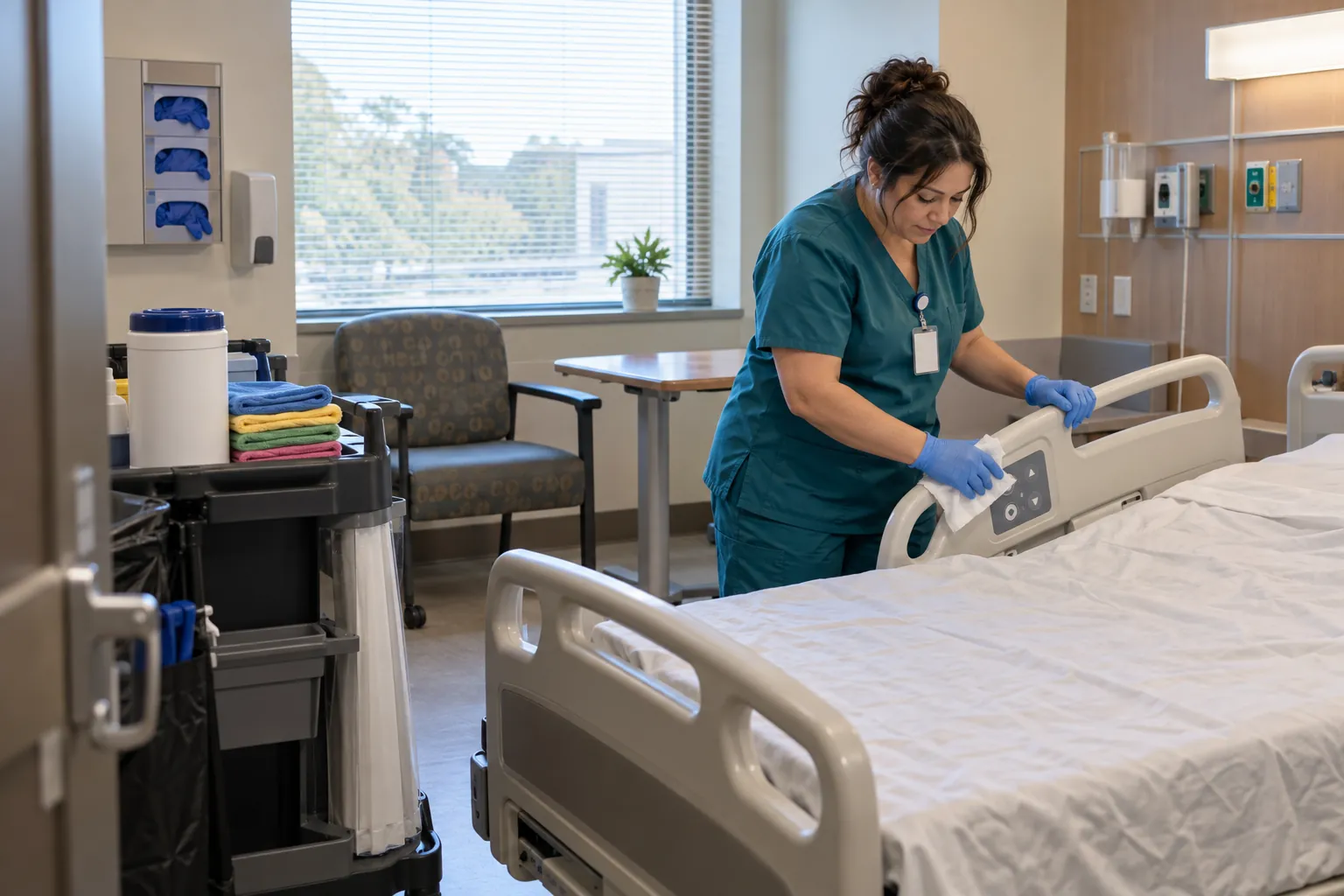 CleaningHospital environmental services: what EVS does, and how to show it was doneWhat hospital environmental services (EVS) does, the CDC, CMS and OSHA rules behind it, cleaning frequencies, who cleans what, and how cleaning is checked.
 Premises and facilities managementSafety walkthroughs: how to walk a building, talk to the crew and fix what you findWhat a safety walk is under OSHA's Recommended Practices, what to look at in a commercial building, how often to walk, how to record findings and close them out.
 Premises and facilities managementEngineering rounds: how to walk the plant, and how to show it was walkedEngineering rounds in a commercial building: what to walk, the readings to take, how often, the rules behind them, and a round log that shows the plant was checked.