Fire and water checks
Interim life safety measures: keeping a healthcare building safe while its fire protection is compromised
ILSM stands for interim life safety measures, the temporary actions a hospital or other healthcare facility takes under The Joint Commission's standard LS.01.02.01 to keep people safe while a Life Safety Code deficiency cannot be corrected at once or a construction project is under way.
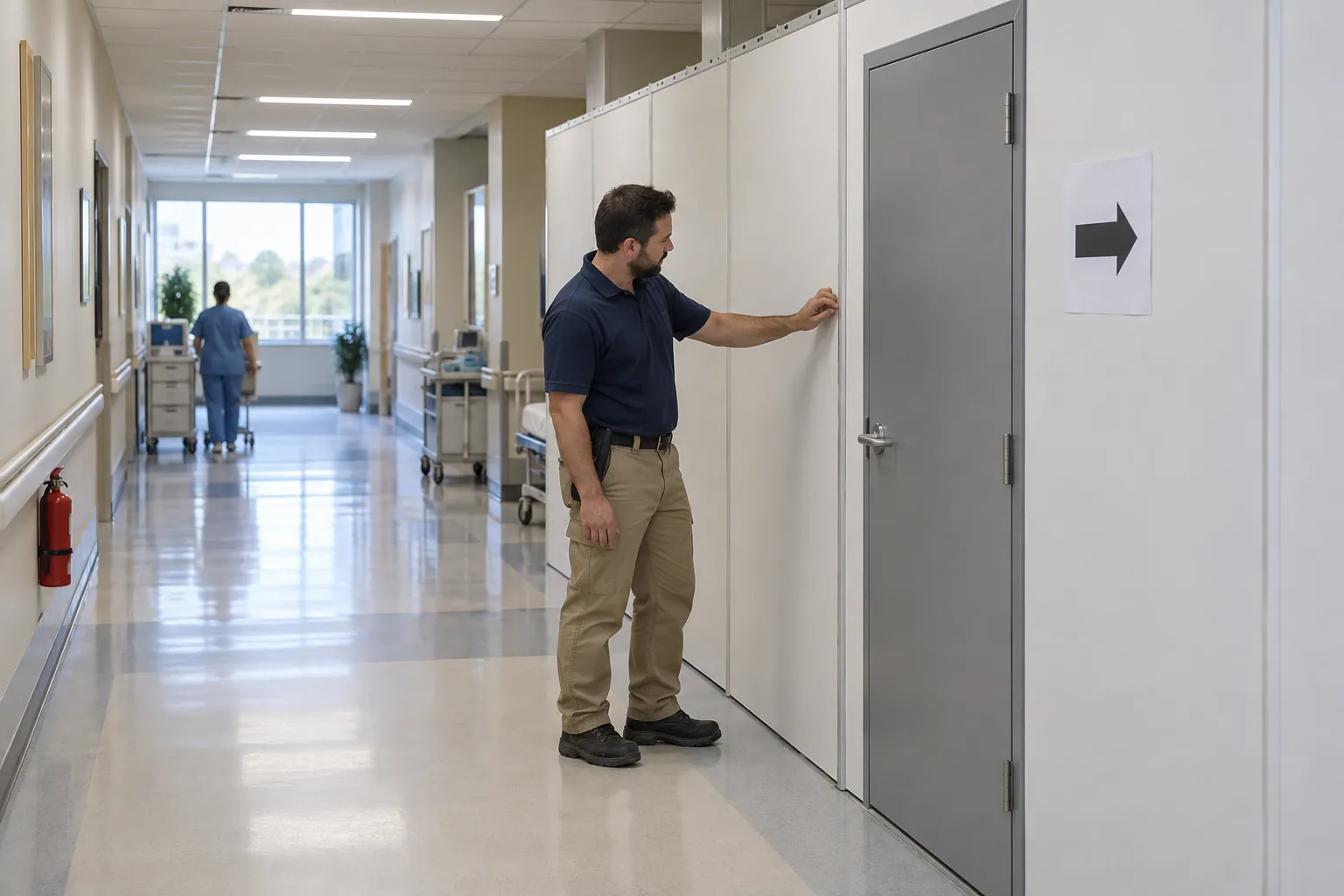
That might be a sprinkler zone shut down for a renovation, a fire alarm panel out of service, a smoke barrier opened for a cable run or a fire door that will not latch while it waits for parts. This guide covers where the ILSM requirement comes from, what an ILSM policy and assessment must contain, the measures on the menu, who does what, and what the daily rounds and records should show a surveyor.
01
What interim life safety measures are, and where the requirement comes from
Interim life safety measures are temporary administrative and physical actions that compensate for a gap in a building's fire and life safety features until the gap is closed. The term belongs to The Joint Commission, whose Life Safety (LS) chapter carries it as standard LS.01.02.01. In The Joint Commission's own words in Environment of Care News, June 2022, an organization "must have a written ILSM policy that addresses safety precautions that must be undertaken during periods of construction and other situations in which compliance deficiencies with the National Fire Protection Association (NFPA) Life Safety Code (NFPA 101-2012) cannot be immediately corrected."
The Life Safety Code matters because the federal government enforces it. Under 42 CFR 482.41, the Medicare Condition of Participation for a hospital's physical environment, "the hospital must meet the applicable provisions and must proceed in accordance with the Life Safety Code", which the same section incorporates by reference as NFPA 101, Life Safety Code, 2012 edition, together with four tentative interim amendments. CMS's page on Life Safety Code and Health Care Facilities Code requirements lists the provider types surveyed against it, from hospitals and critical access hospitals to skilled nursing facilities, ambulatory surgical centers and inpatient hospice facilities.
So the 2012 edition of NFPA 101 is the one a Medicare-certified facility is surveyed against, even though NFPA has published later editions and your state or city may have adopted a newer code for its own inspections. Where the two differ, the facility meets both. The Joint Commission's LS chapter follows the CMS edition, which is why its ILSM standard refers to NFPA 101-2012.
ILSM is not a hospital idea only. The EC News article applies the requirement to an organization "including a hospital or critical access hospital", and the sample ILSM policy it reprints was published for assisted living communities and nursing care centers.
02
What an ILSM policy must contain
The Joint Commission does not dictate the format of an ILSM policy, but it does say what the policy must cover. Summarizing the list The Joint Commission gives in its June 2022 EC News article, the policy must include:
- Scope: a statement that the ILSM process applies both to construction and to situations of noncompliance with the Life Safety Code.
- Triggers: the circumstances that require an ILSM assessment, such as any LS deficiency found during a Joint Commission survey and carried in the Survey-related Plan for Improvement (SPFI), or any deficiency the organization finds itself during a building assessment or a preconstruction risk assessment.
- Response: how the organization will respond to the situations described in LS.01.02.01.
- Protection: how occupants will be protected, using the menu of measures in LS.01.02.01 as they apply.
- Assessment: the assessment process, including a tool for deciding and documenting whether measures are needed and, if so, which ones.
- Implementation: how the chosen measures will stay in effect for as long as the deficiency lasts, and the tool that documents each measure for the whole of that time.
The same article records that a Life Safety Code surveyor will ask to see the ILSM policy early in the survey, usually on the morning of day one. The Joint Commission's Hospital Life Safety and Environment of Care Document List and Review Tool (effective March 1, 2024) lists the ILSM policy under LS.01.02.01, element of performance (EP) 1, with columns for whether each measure is addressed in the policy and whether it was implemented as required.
Two points follow. The assessment is due when the deficiency becomes known, not when a project is scheduled: a fire door that will not latch, found on a round at 2 p.m., needs an ILSM decision that afternoon. And the assessment is written down even when no measures are needed, because that is a decision a surveyor will ask to see.
On a construction project, the ILSM assessment works alongside the preconstruction risk assessment and the infection control risk assessment (ICRA). The EC News article names the preconstruction risk assessment as one place a deficiency that calls for an ILSM assessment can come to light; the ICRA covers dust, air quality and infection prevention; the ILSM assessment covers what the work does to fire safety and egress. Make sure all of them are complete before the first barrier goes up.
03
The menu of measures, and the two that are not optional
LS.01.02.01 sets out fifteen elements of performance. The first is the policy itself. The second is mandatory whenever its trigger is met: The Joint Commission's EC News article describes it as a choice between evacuating an occupied building or notifying the fire department (or another emergency response group) and starting a fire watch, when a fire alarm system is out of service for more than 4 hours in a 24-hour period, or a sprinkler system is out of service for more than 10 hours in a 24-hour period. The Joint Commission's review tool ties that element to NFPA 101-2012 section 9.6.1.6, on fire alarm systems out of service, and to section 9.7.6 and NFPA 25-2011 section 15.5.2, on sprinkler impairments. For the watch itself, see the fire watch log guide.
The federal rule says the same for sprinklers in its own words. 42 CFR 482.41(b)(8) provides that when a sprinkler system is shut down for more than 10 hours, the hospital must "evacuate the building or portion of the building affected by the system outage until the system is back in service", or "establish a fire watch until the system is back in service." Long-term care facilities have the same requirement at 42 CFR 483.90(a)(8).
The remaining measures are chosen by the organization, case by case, from the assessment. As The Joint Commission lists them, they are:
- Post signs identifying the locations of alternative exits for everyone affected.
- Inspect exits in affected areas every day.
- Provide temporary but equivalent fire alarm and detection systems while a fire system is impaired.
- Provide additional firefighting equipment.
- Use temporary construction partitions that are smoke-tight, or made of noncombustible or limited-combustible material that will not contribute to the development or spread of fire.
- Increase surveillance of buildings, grounds and equipment, with special attention to construction areas and storage, excavation and field offices.
- Enforce storage, housekeeping and debris-removal practices that keep the flammable and combustible fire load as low as feasible.
- Give staff additional training on using firefighting equipment.
- Conduct additional fire drills.
- Inspect and test temporary systems monthly, and document the date the tests were completed.
- Educate staff about building deficiencies, construction hazards and the temporary measures in place.
- Train staff to compensate for impaired structural or compartmental fire safety features.
- Use other measures the policy allows that are not on this list.
One wording differs: the 2022 EC News article says "one additional fire drill per quarter", the 2024 review tool "additional fire drill per shift per quarter". Follow your current manual; the hospital fire drills guide covers the regular program.
04
Who does what: facilities, EVS, security and contractors
An ILSM program usually belongs to the facilities or plant operations director and the safety officer, reporting through the environment of care committee. They make the assessment, choose the measures and sign them off. But the measures themselves are carried out by the people who are already in the building around the clock, and the policy should name them by role:
- Facilities and engineering: identifies and reports deficiencies, tags impaired systems, arranges temporary detection and extra extinguishers, installs and repairs barriers, and tests temporary systems monthly.
- Construction managers and contractors: build and maintain the barriers, keep egress routes through and around the work clear, remove debris daily, and follow the hospital's hot work and impairment procedures. Their contract and pre-construction meeting should say so.
- Security officers: often stand the fire watch and carry out the increased surveillance rounds, especially at night and on weekends, working from post orders that name the affected areas.
- Environmental services (EVS): removes waste and packaging so combustibles do not build up near the work, and reports blocked exits, open barriers or missing signs on their normal rounds.
- The fire department or other emergency response group: is notified when the mandatory measure applies, and the notification is recorded with the time and who was told.
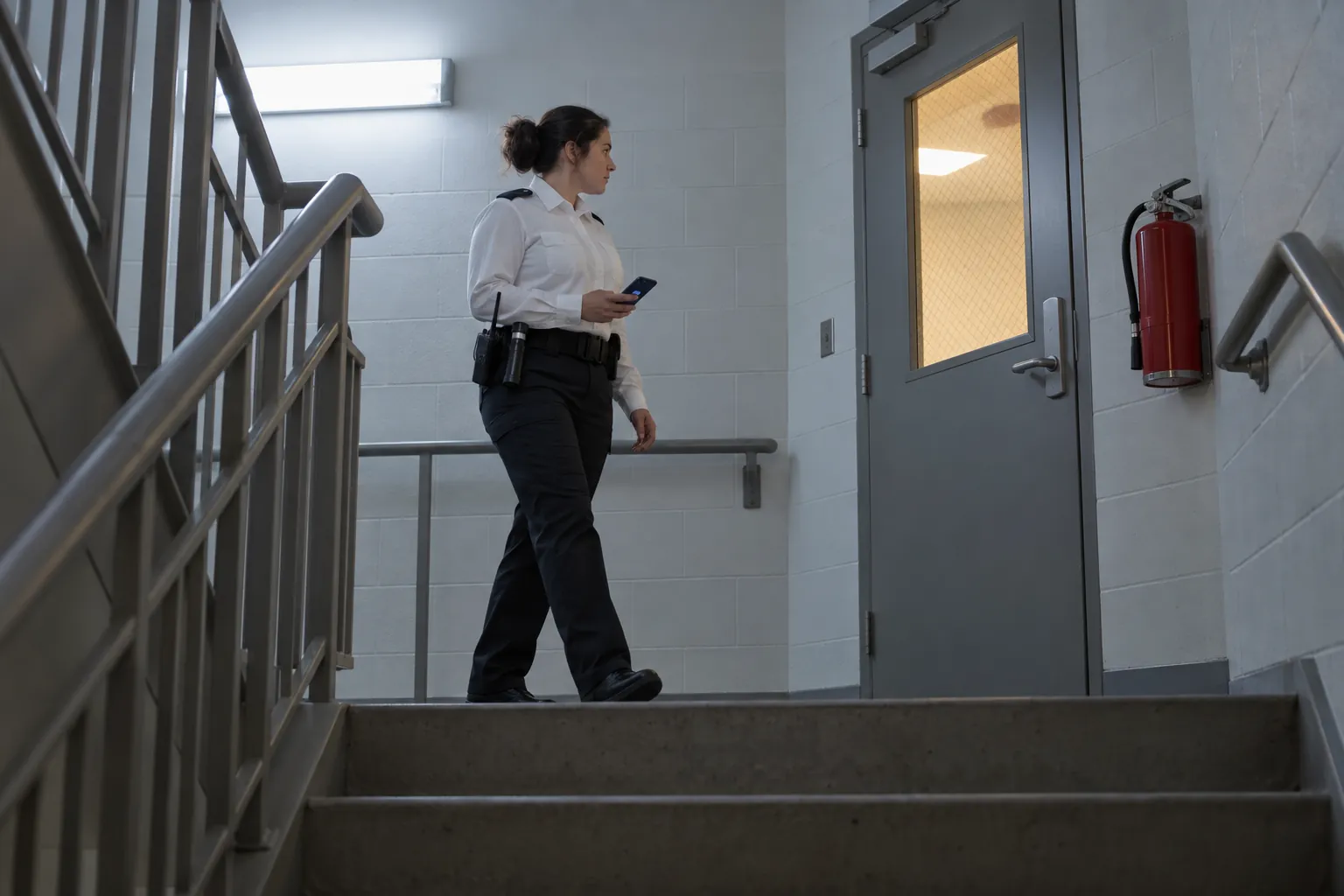
A common gap is nights and weekends. The assessment is made on Tuesday morning; by Saturday night the only people in the area are a security officer and an EVS technician who were never told the stairwell sign matters. Name who carries each measure on every shift, and say so in the post orders and EVS assignments.
Reassess as the work moves on. As The Joint Commission's field director is quoted in the EC News article, the need for particular measures "can change over time, such as during a renovation or construction project or as a Life Safety Code deficiency is addressed". A new phase, barrier line or impaired zone is a new assessment.
05
The rounds, and what the record should show
Several of the measures need someone to go and look: daily exit inspections, barrier checks, increased surveillance and fire watch rounds. A workable routine for an affected area looks like this:
- Every day: walk the exit routes in the affected area to the public way; confirm alternative exit signs are up and legible; confirm barriers are intact, closed and sealed at the top and at penetrations; check that construction debris and combustibles have been removed; and check that extra extinguishers are present, charged and unobstructed.
- Every shift, where increased surveillance applies: a round of the construction area, storage, laydown areas and field offices, with attention to smoking, hot work, open doors in barriers and unauthorized access.
- At the interval your policy and authority having jurisdiction (AHJ) set, during a fire watch: a timed round of every area affected by the impaired system, logged as it happens.
- Monthly: inspection and testing of temporary systems, with the completion date documented.
- When anything changes: a new phase, a new barrier line or a new impaired zone, a fresh assessment and a briefing for the staff affected.
Good evidence is specific. The Joint Commission's review tool asks, for each measure, whether it was addressed in the policy and whether it was implemented as required, and the policy must name a tool that documents each measure for as long as it applies. Make each entry show which area, who checked, the date and time, what was found, and what was done about it. A daily exit log that reads "OK" for thirty days with no area named does not show that the east stair was walked. An ILSM checklist for each affected area, with a line per check, keeps that evidence in one place.
Problems found on a round need their own trail. A propped barrier door, a stair blocked by a pallet or a missing sign should be reported at once to whoever can fix it, recorded with the time, and closed with the time and the name of the person who fixed it. If the problem changes the risk, for example a barrier that can no longer be made smoke-tight, it goes back to the facilities director for a fresh assessment.
Record the end as carefully as the start: the date the deficiency was corrected, who confirmed it and how, and the date each measure was lifted. That gives an unbroken record from the day the deficiency was found to the day it was corrected.
06
Where the record fails, and what SiteClara does about it
ILSM records fail in familiar ways. The daily exit inspection sheet is filled in for the week on Friday afternoon. The increased surveillance round reads "all secure" with no area named. The barrier checked on Monday was cut open on Wednesday for a duct run, and nobody on nights knew. A problem was mentioned to someone in the corridor and never written down, so the surveyor finds it first.
SiteClara records checks at the location. A printed QR poster, with an optional NFC tag behind it, sits at each checkpoint on a route, such as a barrier door, an alternative exit, a stair tower or a construction entrance. Staff scan or tap on their own phone, with no app to install, and mark the location checked or say what stopped them. The time and the named person are recorded as it happens, with a photo when one is asked for, for example of a closed barrier door or a clear exit. A problem found on a round, such as a propped door or debris in an egress corridor, is reported there with a photo and goes onto the team's list of jobs until someone closes it.
The supervisor sees what is due, done and missed, and can record the reason a check was missed. A job that needs the building manager can be escalated to them to answer. Each day the supervisor reviews and approves a report that goes to nominated management or client contacts at 8 a.m. the next morning, showing what was reported, completed and still open, and how the scheduled checks went.
07
Questions people ask
What does ILSM stand for?
ILSM stands for interim life safety measures. The Joint Commission's Environment of Care News, June 2022 explains that, under standard LS.01.02.01, it "requires the use of one or more interim life safety measures (ILSMs) during periods of construction or when life safety (LS) deficiencies are identified", and that the standard lists fifteen of them. When a fire alarm or sprinkler system is out of service beyond set limits, one of the first two is mandatory: evacuate, or notify the fire department and start a fire watch.
What is an ILSM assessment?
It is the documented decision on whether a deficiency needs interim measures and, if so, which ones. The Environment of Care News, June 2022 says the ILSM policy must describe the assessment process, "which must include a tool for determining and documenting whether measures need to be implemented and, if so, which ones", and that the circumstances calling for one include any LS deficiencies found during a Joint Commission survey, or found by the organization itself during a building assessment or preconstruction risk assessment.
Is there a required ILSM form?
No. According to the Environment of Care News, June 2022, The Joint Commission "does not dictate the format of an organization's ILSM policy", but the policy must name a tool that documents each measure for as long as it applies, and "the tool itself is usually attached to the policy." The same issue reprints a sample policy, whose ILSM documentation records the deficiency, the corrective action needed, its time frame and the date and time the measures started, and on completion the date and time they ended.
Does ILSM apply to construction?
Yes, and not only to construction. The Environment of Care News, June 2022 says the policy must include "a statement clarifying that the ILSM process is applicable to construction-related situations and situations of noncompliance with the Life Safety Code", so a fire door that will not latch needs an ILSM decision just as a renovation does.
08
Where to read more, and a list to take away
Start with your own manual's LS.01.02.01 and the Joint Commission material that is free to read: the June 2022 Environment of Care News, whose Life Safety Q&A covers ILSM policy and includes a sample policy, and the Hospital Life Safety and Environment of Care Document List and Review Tool. For the federal requirement, read 42 CFR 482.41 for hospitals and 42 CFR 483.90 for long-term care, and CMS's page on Life Safety Code and Health Care Facilities Code requirements. The code itself is NFPA 101, 2012 edition for CMS purposes, alongside whatever edition your state or city enforces. Your local authority having jurisdiction, often the fire department or a local or state fire marshal, sets its own rules for fire watches and impairment notices.
- Keep a written ILSM policy that covers construction and Life Safety Code deficiencies alike, with an assessment tool attached.
- Assess every deficiency when it becomes known, and write the assessment down even when no measures are needed.
- Evacuate, or notify the fire department and start a fire watch, when a fire alarm system is out of service for more than 4 hours in 24 or a sprinkler system for more than 10 hours in 24.
- Choose the other measures case by case, and name who carries each one on every shift, including nights and weekends.
- Inspect exits and barriers in affected areas every day, and log each check with the area, the name and the time.
- Report problems found on a round at once, and record who fixed them and when.
- Test temporary systems monthly and record the completion date.
- Reassess at every new phase of work, and record the date each deficiency was corrected and each measure lifted.
Sources
Every document this guide quotes or links to, in the order it first cites them.
- Environment of Care News, June 2022 digitalassets.jointcommission.org
- 42 CFR 482.41 ecfr.gov
- Life Safety Code and Health Care Facilities Code requirements cms.gov
- NFPA 101 nfpa.org
- Hospital Life Safety and Environment of Care Document List and Review Tool digitalassets.jointcommission.org
- 42 CFR 483.90(a)(8) ecfr.gov
Related guides
 Fire and water checksFire watch logs: patrolling a building while its fire protection is out of serviceWhen a fire watch is required under IFC 901.7 and NFPA 25, who can stand it, how often to patrol, and what a fire watch log should show the fire marshal.
 Fire and water checksHospital fire drills: every shift, every quarter, and a record that shows itWhat CMS and the Life Safety Code require of hospital fire drills, quarterly on each shift with the alarm and night drills, and how to critique and record each one.
 Premises and facilities managementEnvironment of care rounds: walking the building, and proving the findings were fixedHow to run environment of care (EOC) rounds in a hospital in 2026: the CMS and Joint Commission basis, what a round covers, who goes and how findings get closed.
 Fire and water checksFire sprinkler inspection: what NFPA 25 asks of the buildingWhat a sprinkler system inspection involves under NFPA 25, who does the weekly, monthly and annual checks, how impairments work, and what the record should show.