Fire and water checks
Fire suppression system inspection: the monthly check, the six-month service and the record
A fire suppression system inspection confirms that a fixed extinguishing system, such as the wet chemical system over a commercial kitchen's cooking line or the clean agent system in a server room, is charged, unobstructed and ready to discharge, in two layers: a monthly visual check by trained people on site, and an inspection, test and service by a qualified technician, which the International Fire Code requires at least every six months for a kitchen system.
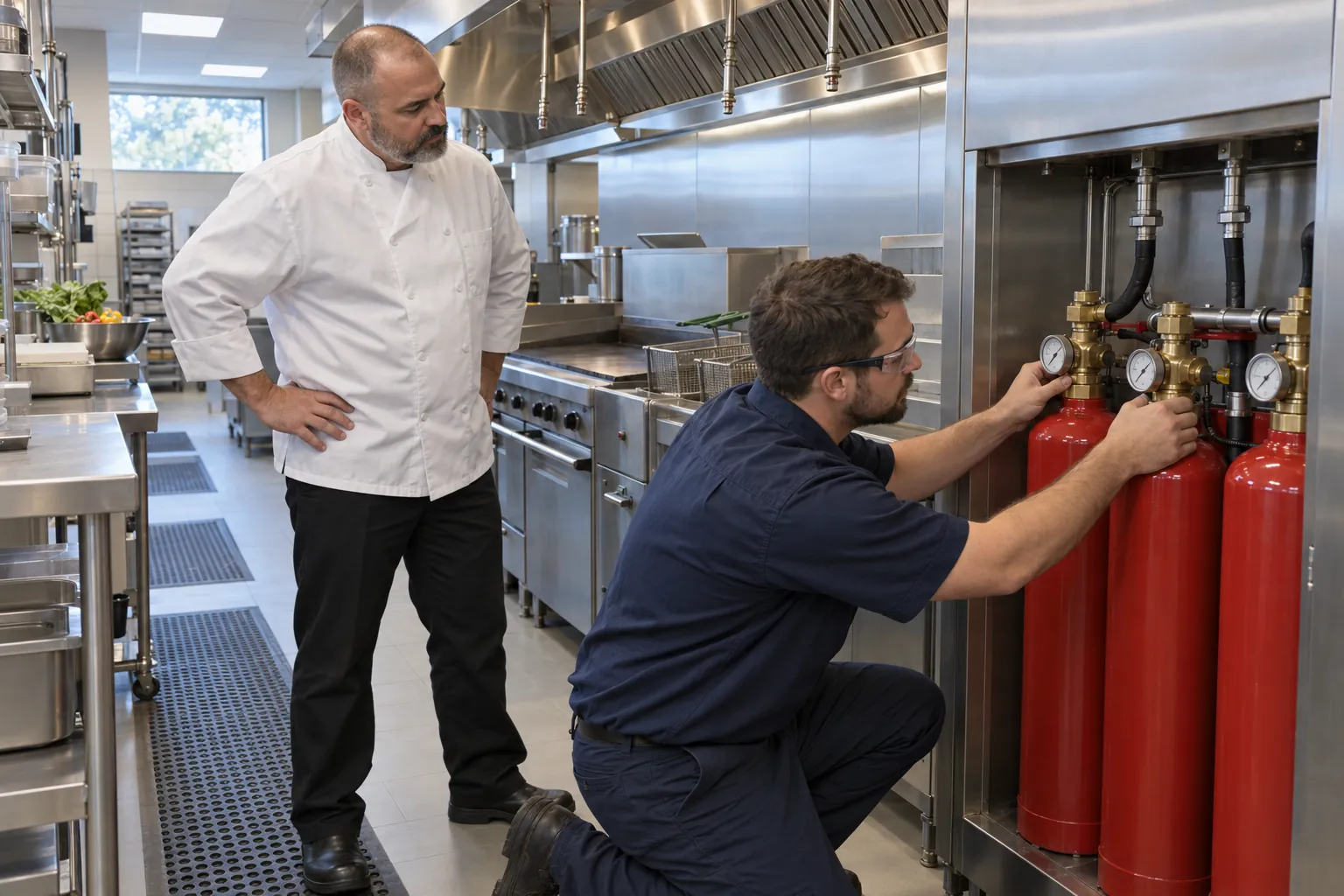
The details depend on the kind of system, the NFPA standards it was built to and the fire code your city or state has adopted. This guide covers where the requirements come from, what each layer looks at, how often, who does what, and what a record worth keeping shows.
01
What a fire suppression system is, and which rules call for inspection
In fire codes, a fire suppression system usually means a fixed extinguishing system other than sprinklers: agent in cylinders, piping and nozzles aimed at one hazard, and a way to set it off automatically and by hand. The commonest is the wet chemical system over a commercial kitchen's cooking line. Others protect rooms where water would be ineffective or do more harm than the fire, such as a server room, an archive or a switchgear room. Sprinklers have their own standard: see fire sprinkler inspection.
Each kind of system has its own standard from the National Fire Protection Association (NFPA), with its own chapter on inspection, testing and maintenance: NFPA 17A, Standard for Wet Chemical Extinguishing Systems, NFPA 17, Standard for Dry Chemical Extinguishing Systems, NFPA 2001, Standard on Clean Agent Fire Extinguishing Systems and NFPA 12, Standard on Carbon Dioxide Extinguishing Systems. NFPA's website lists the latest edition of each, with free read-only access. Water mist systems follow NFPA 750, and the halon systems still in service NFPA 12A.
An NFPA standard is a standard until a jurisdiction adopts it, usually through the International Fire Code (IFC) or NFPA 1, and the authority having jurisdiction (AHJ), usually the local fire marshal, decides which editions apply. The 2015 IFC, as the City of Lawrence, Kansas publishes its section 904.12, says of commercial cooking systems in 904.12.6.2: "Automatic fire-extinguishing systems shall be serviced at least every six months and after activation of the system. Inspection shall be by qualified individuals, and a certificate of inspection shall be forwarded to the fire code official upon completion." In 904.12.6.3 it also requires fusible links to be replaced at least annually. Your AHJ may enforce a later edition, whose wording and section numbers can differ, or its own amendments, so read the text it enforces.
Some cities write their own code. New York City's, in FDNY Fire Code Chapter 9 (2022), section FC 904, sets out the monthly inspection, the semiannual service and a schedule for each type of system so plainly that this guide quotes it as an example. Outside New York City, your own code governs.
Federal OSHA comes in more narrowly. OSHA 29 CFR 1910.160, Fixed extinguishing systems, general applies to systems "installed to meet a particular OSHA standard", sprinklers excepted, and its warning, inspection and container-check paragraphs also apply to other fixed systems whose agent could injure employees, unless no employee is exposed where they are installed. There, "the employer shall assure that fixed systems are inspected annually by a person knowledgeable in the design and function of the system", and refillable containers' weight and pressure are checked at least semiannually. Where your state runs an OSHA-approved State Plan, its rule applies instead.
02
What gets inspected: the monthly look and the six-month service
For a wet chemical kitchen fire suppression system, NFPA 17A's monthly owner's inspection covers the points below, as the Uintah Fire Suppression Special Service District's wet chemical checklist, in Vernal, Utah, quotes them from the standard. The checklist cites NFPA 17A by section number but does not name the edition, so check each point against the edition your AHJ enforces:
- The system is in its proper location, and the hood, duct and protected appliances have not been replaced, modified or relocated.
- The manual actuators are unobstructed.
- Tamper indicators and seals are intact.
- The maintenance tag or certification is in place.
- No obvious physical damage might prevent operation.
- The pressure gauge, if there is one, is in its operable range.
- The nozzle blow-off caps are intact and undamaged; NFPA 17A requires caps or other suitable devices on every discharge nozzle to keep grease vapors, moisture and other foreign materials out of the piping.
New York City's monthly visual inspection, FC 904.5.1, made by "a trained and knowledgeable person", covers every type of system: the extinguishing agent container, piping, nozzles and nozzle caps are intact and undamaged. It also checks that fusible links and other detection devices are clean, that the pressure gauge or control panel shows the system operational with no supervisory or trouble signals, and that "the maintenance tag for the fire extinguishing system is in place and has not expired."
The semiannual service goes further, to every one of the system's components. FC 904.5.2 has the technician:
- Verify that the hazard has not changed and the system has not been altered.
- Examine the detection, alarms, manual stations, agent containers, releasing devices, piping, hoses and nozzles.
- Verify that the agent has not been discharged and the piping is not obstructed.
- Check that the containers have been inspected, retested and marked as the US Department of Transportation requires.
- Test the automatic and manual releases, and the gas and electric shutoff interlocks.
- Give the owner a written report of defects and, once they are corrected, a compliance tag.
The first item is the one most often missed between visits. A kitchen system is designed for the appliances under the hood when it was approved; NFPA's Restaurant Fire Protection Basics warns that changing them "without analyzing the system could result in a failure to extinguish a fire." A clean agent system is designed for one room, so new openings or equipment are a change the technician needs to hear about.
03
How often: the schedule by type of system
The frequency depends on the system and the code. New York City's FC Table 904.5.2 sets this schedule:
- Wet chemical (kitchen hood) and dry chemical systems: inspection monthly, testing and other maintenance semiannually; on a cooking system, fusible links replaced at least annually (FC 904.6.9.1).
- Clean agent and carbon dioxide systems: inspection monthly, testing semiannually, other maintenance annually.
- Halon 1301 systems: inspection monthly, testing and other maintenance semiannually.
- Aerosol and expansion foam systems: inspection monthly, testing and other maintenance annually.
- Water mist systems: by NFPA 25, the sprinkler standard.
Some checks have their own clock. Clean agent containers are checked every six months, and one that has lost more than 5 percent of its weight or 10 percent of its pressure, adjusted for temperature, is refilled or replaced (FC 904.6.3.1; OSHA 1910.160(b)(7) uses the same limits). Hoses are examined every 12 months and tested every five years. NFPA 17A, in the checklist above, has wet chemical containers and hoses hydrostatically tested at intervals not exceeding 12 years. For dry chemical, OSHA 29 CFR 1910.161 requires all but stored-pressure systems to be sampled at least annually so the supply is "free of moisture which may cause the supply to cake or form lumps."
Cities add their own reporting rhythm. The Seattle Fire Department's Systems Testing page asks for range hood and dry chemical reports every six months, and gaseous (aerosol, carbon dioxide and clean agent) and water mist reports annually. New York City adds a five-year retest of every system except cooking systems (FC 904.5.3).
After any discharge the clock resets: the IFC requires a kitchen system to be serviced "after activation of the system", and until then it protects nothing.
04
Who does what: the owner, the people on site and the contractor
Seattle's page puts the owner's duty in one line: "Building owners are required to have the systems inspected, tested and maintained in good working condition." In practice the work is shared, and the gaps open at the handoffs.
- The facility manager or building engineer owns the schedule, the service contract and the record. With restaurant tenants or a contract caterer, write down who books the service and keeps the paperwork.
- The kitchen manager makes the monthly look at a kitchen hood fire suppression system, or makes sure someone does, and knows when the appliances change.
- The IT or data center manager knows when a protected room changes: new racks, a new opening, a change of use.
- The fire suppression contractor's technicians service the system, replace the links, leave the tag and write the report. Who may perform the service is set locally: "qualified individuals" in the 2015 IFC; a trained person with the manufacturer's manual under NFPA 17A; in New York City a licensed master fire suppression piping contractor and certificate of fitness holder; in Seattle, someone the fire department has certified.
- The monitoring company confirms the system's signal reaches the fire alarm panel and the central station. See fire alarm testing.
Where OSHA's rule applies, 1910.160(b)(10) says "the employer shall train employees designated to inspect, maintain, operate, or repair fixed extinguishing systems and annually review their training." NFPA's overview says kitchen staff are instructed on the extinguishers and the manual release on hiring and annually.
Total flooding systems need care around people. OSHA 1910.160(b)(4) requires safeguards to warn employees against entering a discharge area while its atmosphere stays hazardous, and OSHA 29 CFR 1910.162 requires a pre-discharge alarm for carbon dioxide and Halon 1211 systems with a design concentration of 4 percent or more, and Halon 1301 systems at 10 percent or more. New York City forbids new halon systems, and the EPA's Phaseout of Class I Ozone-Depleting Substances notes that "the ban on production and import of halons took effect on January 1, 1994."

05
What good evidence looks like, and how to check it
When the fire marshal visits, or after a discharge, the question is whether anyone can show the system was looked at, serviced on time, and that every problem found was put right. A useful record has four layers.
- The service tag. NFPA 17A requires a tag showing the month and year of maintenance and who performed it, with only the current tag left in place. In New York City, the weight and pressure of a clean agent or halon container are recorded on a tag on the container too (FC 904.6.3.1 and 904.6.6.1).
- The contractor's report. The date, the technician, what was tested, the links replaced, the containers weighed, and a written list of defects. Where your city requires filing, the date it went in: in Seattle, within seven calendar days of the work.
- The monthly checks. NFPA 17A requires "at least monthly, the date the inspection is performed and the initials of the person performing the inspection" to be recorded, and kept for the period between the semiannual maintenance inspections.
- The deficiency list. Every defect, from a missing nozzle cap to a trouble light, with when it was found, who it went to and when it was fixed.
Check the paperwork against the system. Is the tag current, and dated within the last six months? Do the appliances on the report match those under the hood, and the room on the report the room in front of you? Look at the gauge, the caps, the seal on the pull station and the path to it, and for a trouble light on the panel.
Then look across the year. Two services and no monthly inspections leave months unobserved. Initials all in one pen, written on one day, are not checks. A defect with no repair after it is a deficiency left on file.
06
Where the record fails, and what SiteClara does about it
Fire suppression records fail in familiar ways. The only proof of the last service is the tag, and nobody can say whether the report's defects were fixed. The monthly check is a grid on the back of a door, initialed for the quarter in one sitting. A cook moved the fryer, or IT added a rack, and nobody told the contractor. A trouble light on the panel was mentioned to whoever was passing.
SiteClara records checks at the location. A printed QR poster, with an optional NFC tag behind it, sits where the check happens, such as beside the hood's pull station or at the door of the protected room. Staff scan or tap on their own phone, with no app to install, and mark the location checked or say what stopped them. The time and the named person are recorded as it happens, with a photo when one is asked for, for example of the gauge or the nozzle caps. A problem found on a check, such as a missing cap, a blocked pull station or a trouble light, is reported there with a photo and goes onto the team's list of jobs until someone closes it.
The supervisor sees what is due, done and missed, and can record the reason a check was missed. A job that needs the building manager, such as a defect waiting on the contractor, can be escalated to them to answer. Each day the supervisor reviews and approves a report that goes to nominated management or client contacts at 8 a.m. the next morning, showing what was reported, completed and still open, and how the scheduled checks went.
07
Questions people ask
How often do fire suppression systems need to be inspected?
A kitchen fire suppression system needs a monthly visual inspection on site and a service by a trained technician at least every six months; other types follow their own NFPA standard and your local code. For a commercial kitchen, 2015 IFC Section 904.12.6.2, as the City of Lawrence, Kansas publishes it, says the systems "shall be serviced at least every six months and after activation of the system", and NFPA 17A, as the Uintah Fire Suppression Special Service District's wet chemical checklist quotes it, requires the owner's inspection "on a monthly basis".
What are the NFPA standards for fire suppression systems?
Each type of system has its own: NFPA 17A for wet chemical, NFPA 17 for dry chemical, NFPA 2001 for clean agent, NFPA 12 for carbon dioxide, NFPA 12A for halon 1301, NFPA 750 for water mist and NFPA 2010 for aerosol systems, as FDNY Fire Code Chapter 9 lists them in FC Table 904.1. Sprinkler systems are not among them; New York City's code governs them under FC 903.
What is a hood suppression system inspection?
It is the inspection of the wet chemical system that protects a commercial kitchen's cooking equipment, hood and duct. Under NFPA 17A, as the Uintah wet chemical checklist sets it out, the monthly owner's inspection verifies that the manual actuators are unobstructed, the tamper indicators are intact, the maintenance tag is in place, the pressure gauge is in its operable range, the nozzle blow-off caps are intact, and the hood, duct and cooking appliances have not been replaced, modified or relocated. The semiannual maintenance adds an examination of the detectors, containers, releasing devices, piping and nozzles, and a test of the releasing devices and manual stations.
What are the inspection requirements for a fire suppression system?
For a wet chemical system, NFPA 17A requires a monthly inspection, with "the date the inspection is performed and the initials of the person performing the inspection" recorded, and maintenance at least semiannually by a trained person, who leaves a tag showing the month and year and who did the work, as the Uintah wet chemical checklist quotes the standard. Where a fixed system was installed to meet an OSHA standard, or its agent could injure employees who work near it, OSHA 29 CFR 1910.160 also requires an annual inspection "by a person knowledgeable in the design and function of the system" and a check of refillable containers' weight and pressure at least semiannually.
08
Where to read more, and a list to take away
Start with your fire marshal's office, which decides which editions apply, who may service the system and whether reports must be filed. NFPA's free access covers NFPA 17A and NFPA 2001. FDNY Fire Code Chapter 9, section FC 904, is a clear schedule by system type. Employers should read OSHA 1910.160 to 1910.162. For the hood itself, see kitchen hood inspection and cleaning.
- List every fixed extinguishing system, its type, its NFPA standard and what it protects.
- Confirm with the fire marshal which editions apply and who may service each system.
- Book the semiannual service for each kitchen system, and the service your code sets for the others.
- Make the monthly inspection, and record the date and the initials of whoever made it.
- Tell the contractor before the appliances, the room or its use change.
- Have the system serviced after any discharge before relying on it again.
- Put every defect on a list with a named owner and the date it was fixed.
Sources
Every document this guide quotes or links to, in the order it first cites them.
- NFPA 17A, Standard for Wet Chemical Extinguishing Systems nfpa.org
- NFPA 17, Standard for Dry Chemical Extinguishing Systems nfpa.org
- NFPA 2001, Standard on Clean Agent Fire Extinguishing Systems nfpa.org
- NFPA 12, Standard on Carbon Dioxide Extinguishing Systems nfpa.org
- City of Lawrence, Kansas publishes its section 904.12 assets.lawrenceks.org
- FDNY Fire Code Chapter 9 (2022) nyc.gov
- OSHA 29 CFR 1910.160, Fixed extinguishing systems, general osha.gov
- OSHA-approved State Plan osha.gov
- Uintah Fire Suppression Special Service District's wet chemical checklist uintahfiredistrict.gov
- Restaurant Fire Protection Basics nfpa.org
- OSHA 29 CFR 1910.161 osha.gov
- Systems Testing seattle.gov
- OSHA 29 CFR 1910.162 osha.gov
- Phaseout of Class I Ozone-Depleting Substances epa.gov
Related guides
 Fire and water checksKitchen hood inspection: grease, cleaning and the fire suppression systemHow commercial kitchen hood inspection works under NFPA 96: grease buildup, cleaning, the six-month suppression service, daily checks and the records to keep.
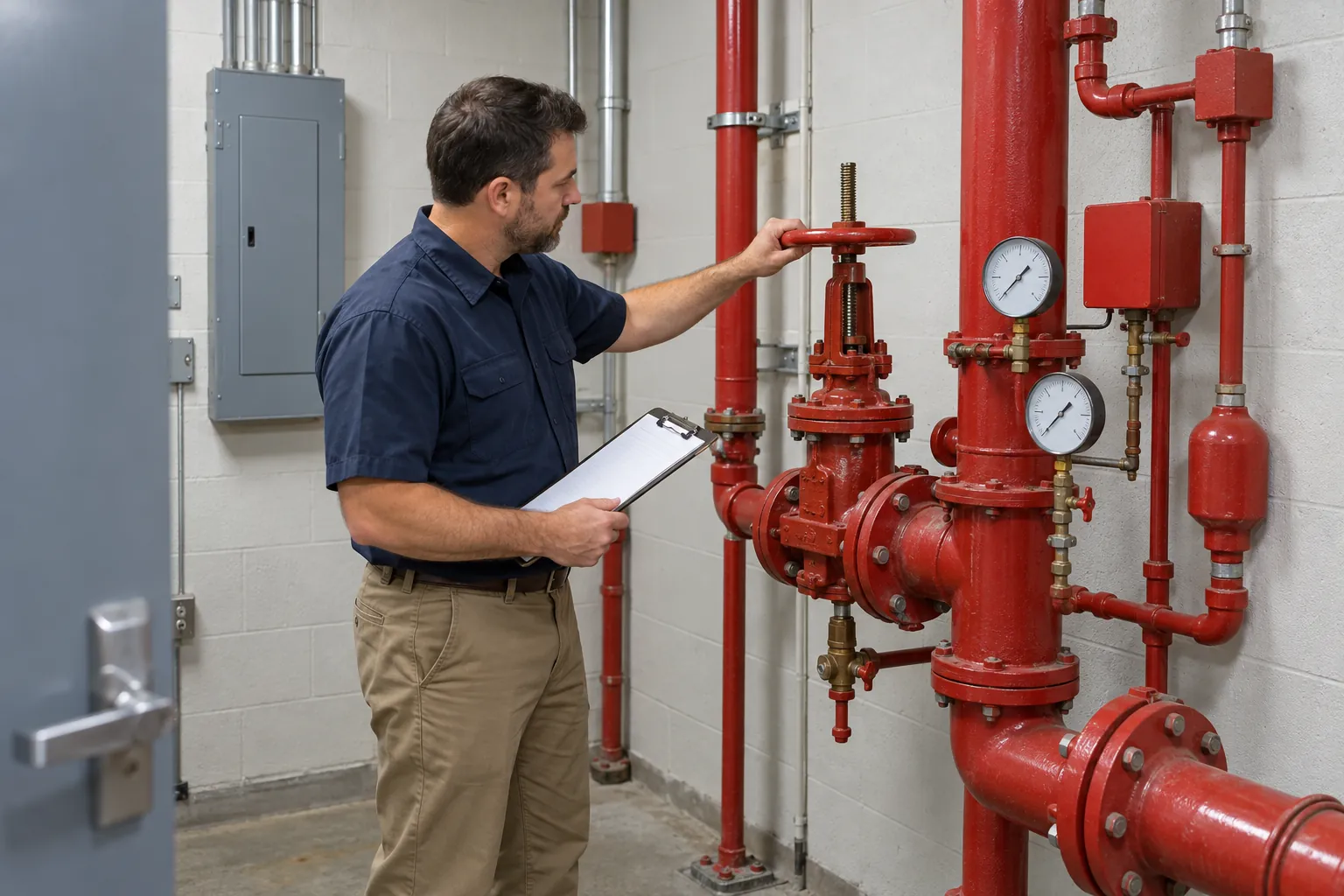 Fire and water checksFire sprinkler inspection: what NFPA 25 asks of the buildingWhat a sprinkler system inspection involves under NFPA 25, who does the weekly, monthly and annual checks, how impairments work, and what the record should show.
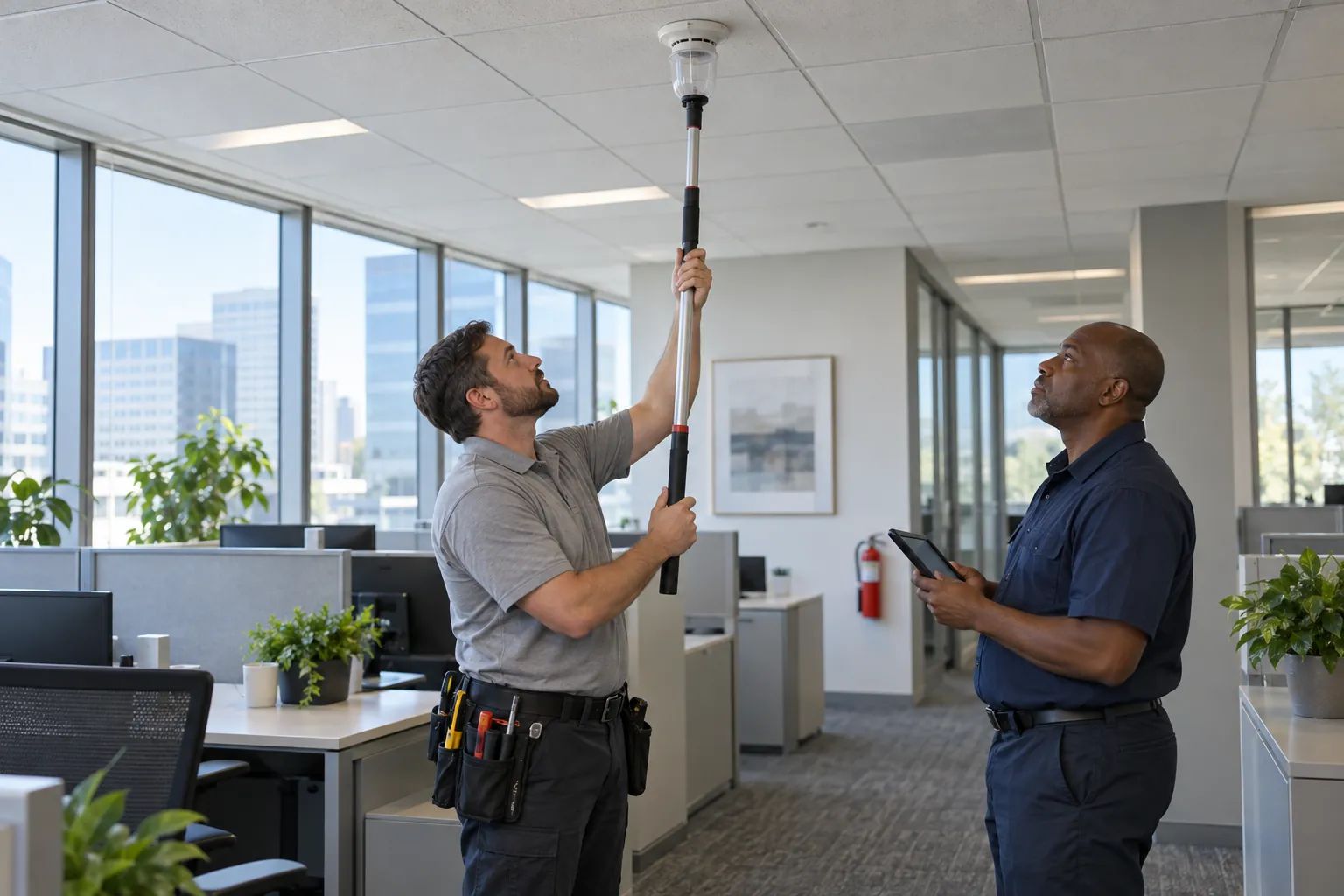 Fire and water checksFire alarm testing: who does what, and what the record should showFire alarm testing in the US: what NFPA 72 and OSHA ask of the owner, what gets tested, how to run a test day, and what the building's own record should show.
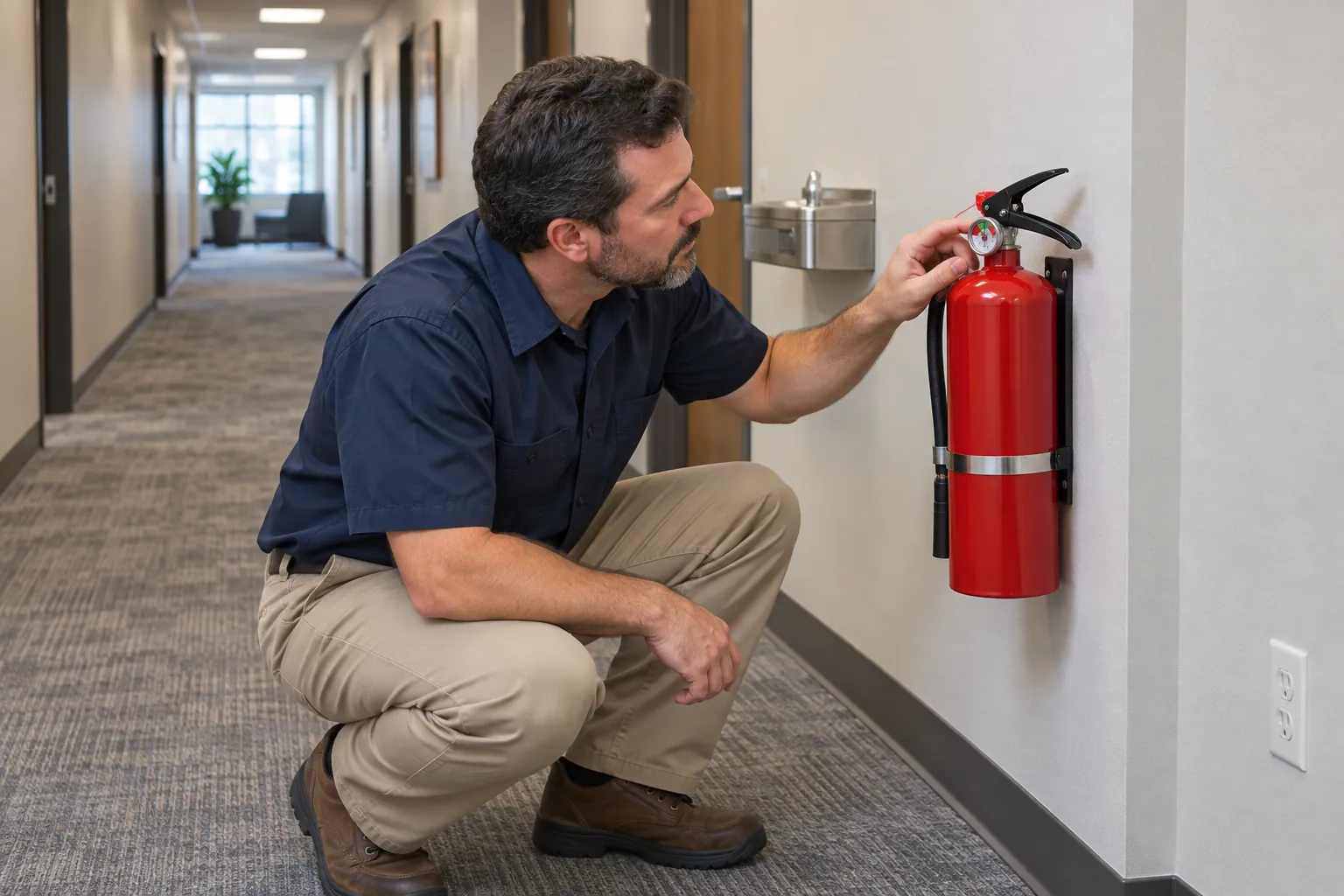 Fire and water checksFire extinguisher inspection: the monthly check and the annual maintenanceWhat a monthly fire extinguisher inspection covers under OSHA 1910.157 and NFPA 10, how it differs from annual maintenance, and what the record should show.