Fire and water checks
Fire sprinkler inspection: what NFPA 25 asks of the building
A sprinkler system inspection is a visual check, under NFPA 25, that the valves, gauges, alarm devices and sprinkler heads of a fire sprinkler system are in the right condition, repeated at set intervals from weekly to every five years, alongside the tests and maintenance the standard also requires.
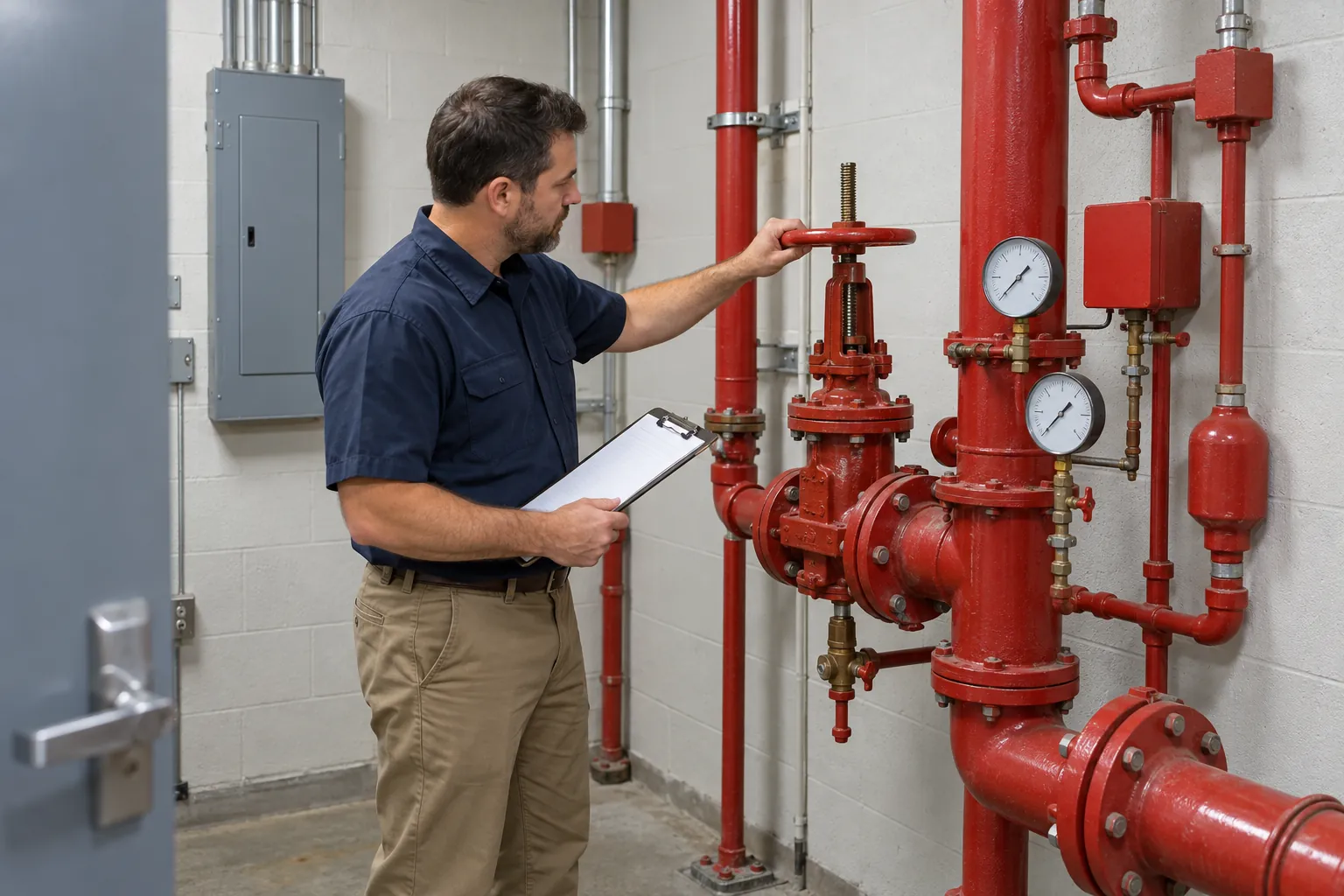
NFPA 25 sets schedules like this for all water-based fire protection systems, from a look at a control valve every week to an assessment of the inside of the piping every five years, and it puts the responsibility on the building owner or the owner's designated representative. This guide covers where the rule comes from, what gets inspected and how often, who can do which part, what happens when the system is out of service, and what the record should show.
01
The rule: NFPA 25, the local fire code and OSHA
In the United States the technical rulebook for a sprinkler system inspection is NFPA 25, Standard for the Inspection, Testing, and Maintenance of Water-Based Fire Protection Systems, published by the National Fire Protection Association. The current edition is 2026, and the next is scheduled for 2029. NFPA 25 covers sprinkler systems, standpipes, private fire service mains, fire pumps, water storage tanks, fixed water spray, foam and water mist systems. It sets what must be inspected, tested and maintained, and how often.
NFPA 25 is a standard, not a law, until a jurisdiction adopts it. Most do so through their fire code, usually the International Fire Code or NFPA 1, often with local amendments. The fire marshal or fire code official who enforces it is the authority having jurisdiction (AHJ), and the edition of NFPA 25 that applies to your building is the one your AHJ enforces, which may be older than the current one. NFPA's own guidance names an insurer, as well as the fire department, as a possible AHJ, so ask your carrier what it expects too.
Local codes can add to the standard. In the 2022 New York City Fire Code, Chapter 9, Fire Protection Systems, as published by the FDNY, FC Table 901.6.1 lists NFPA 25 for water-based systems, and FC 901.6.2.1 requires a visual inspection of standpipe and sprinkler systems every month by a certificate of fitness holder, in accordance with NFPA 25, with all defects noted on the inspection report. Check the edition your city enforces.
Whatever the source, NFPA puts the duty in one place. In its words, from Responsibilities of the Building Owner for Fire Sprinkler System Inspection, Testing, and Maintenance: "While often the performance of these activities are contracted with a service provider, the ultimate responsibility for ITM falls on the building owner." A designated representative, such as a tenant, a property management company or a facility manager named in a lease or management contract, can carry that duty on the owner's behalf.
02
What a sprinkler system inspection covers, and how often
NFPA 25 separates three kinds of work. An inspection is a visual check that a component looks right and is in the right state. A test operates something, such as flowing water through the main drain or tripping an alarm. Maintenance is the work that keeps the system operable, such as replacing a sprinkler or servicing a valve. A "sprinkler inspection" in everyday use usually means all three.
In NFPA 25 and Properly Maintaining a Sprinkler System (August 2024), NFPA summarizes the major sprinkler components and their frequencies. For inspections:
- Weekly: reduced pressure backflow preventers, and control valves (monthly if locked, quarterly if electrically supervised).
- Monthly: gauges, and the exterior of dry pipe valves.
- Quarterly: alarm valve exteriors, the fire department connection, valve and other supervisory devices, and waterflow alarms.
- Annually: dry pipe valve internals, the sprinklers themselves (from floor level), hangers and braces (from floor level), and the hydraulic information sign.
- Every five years: alarm valve and check valve internals, and backflow preventer interiors.
And for tests:
- Semiannually: control valve supervisory devices and waterflow alarms.
- Annually: control valves, backflow preventers, the main drain test (quarterly where the system is supplied through a backflow or pressure reducing valve), the dry valve trip test, and other supervisory devices.
- Every three years: a dry valve full flow test.
- Every five years: gauges.
- Every 5 to 75 years: sprinkler testing, depending on the sprinkler type and environment.
Fire pumps, standpipes and tanks have their own schedules. NFPA's summary is a starting point, not a substitute: read the tables in the edition your AHJ enforces, because they change between editions.
03
Who does which part: the owner, the building staff and the contractor
Much of the annual and five-year work, and every test that flows water or trips a valve, is done by a fire protection contractor whose technicians hold the licenses or certifications your state or city requires. But NFPA 25 does not assume a contractor does everything. NFPA's 2024 article says the intent is that "the owner or the owner's designated representative(s) perform many of the required inspections": an owner's representative trained to a level acceptable to the AHJ could be qualified to do the monthly check that control valves are open, and "A facility maintenance person could be trained to inspect pressure gauges, exterior conditions of water storage tanks, accessibility of fire hydrants, and so forth."
In practice the weekly and monthly rounds often fall to the building engineer or the maintenance team, and the longer-interval work to the contractor. Whoever does it must be qualified in NFPA's sense: competent, and trained to a standard the AHJ accepts.
The owner also carries duties no contractor can do for them. NFPA lists them in its article on owner responsibilities, drawn from Chapter 4 of NFPA 25:
- Keep the program running: make sure each activity is done within its frequency, even where the work is contracted out.
- Provide ready access: NFPA calls out "the all-too-common practice of placing objects – such as file cabinets or stock – in front of sprinkler risers and other control equipment," and says exterior components must be kept accessible as well.
- Protect against freezing: areas with water-filled piping and no other freeze protection must be kept at a minimum of 40°F (4°C).
- Notify before testing or shutting down: the AHJ, the fire department if required, and the alarm-receiving facility, so a test does not become a false alarm.
- Correct deficiencies and impairments, in line with the applicable design and installation standard.
- Manage change: have the system evaluated when the building changes, for example office space converted to storage or a change in storage height.
- Keep the records, on paper or electronically, and make them available to the AHJ on request.
04
The annual look at the sprinklers, and how findings are graded
The annual visual inspection of the sprinkler heads themselves is the part most people picture. NFPA's post Visual Inspection of Sprinklers explains that it is done from floor level, without ladders or lifts, and that sprinklers in concealed spaces such as above suspended ceilings do not need inspection. It is not a sample: apart from concealed spaces and areas inaccessible for safety reasons during process operations, which are inspected at each scheduled shutdown, every sprinkler is included. The owner must provide access, and where some cannot be reached, that is noted on the report. NFPA lists what the inspector looks for:
- leakage;
- corrosion detrimental to sprinkler performance;
- physical damage, including bent deflectors;
- loss of fluid in the glass bulb heat-responsive element;
- loading detrimental to sprinkler performance;
- paint other than that applied by the sprinkler manufacturer;
- sprinklers installed in the incorrect orientation;
- minimum clearance to storage, the 18 inches below the deflector.
Several of these are the building's doing: a painter's overspray, boxes stacked too high in a stock room, a sprinkler knocked by a ladder. NFPA notes that obstructions to sprinkler distribution patterns, such as storage that is too close to the deflectors, can hamper the effectiveness of sprinklers. That is why the walks by building staff between visits matter. A leaking or damaged sprinkler, NFPA says, is replaced, and a painted one is never cleaned and reinstalled.
When something is wrong, NFPA 25 grades it. NFPA's post Deficiencies and Impairments of Sprinkler Systems quotes the 2020 edition's three definitions: a noncritical deficiency does not have a material effect on the system's ability to function in a fire but still needs correcting; a critical deficiency "if not corrected, can have a material effect on the ability of the fire protection system or unit to function as intended in a fire event"; and an impairment is a condition where the system or part of it "is out of order, and the condition can result in the fire protection system or unit not functioning in a fire event." Many states use color-coded tags built on this, and an annex to NFPA 25 (Annex G in the 2020 edition) gives AHJs guidance for green, yellow, orange and red tags. Check what your state requires.

05
When the system is out of service: impairments and fire watch
Sprinkler systems are shut down for repairs, for tenant build-outs, after a frozen pipe, or because a test finds a failed valve. NFPA 25 treats all of these as impairments, planned or not, and Chapter 15 sets out what to do. NFPA's post Impairment Procedures for Sprinkler Systems That Are Out of Order summarizes it:
- the owner assigns an impairment coordinator, who authorizes any planned impairment before the system is taken out of service;
- a tag is posted at each fire department connection and system control valve, and wherever else the AHJ requires, showing which system or part is out of service;
- the extent and expected duration are determined, the affected area inspected, and the increased risks assessed;
- the fire department, the insurance carrier, the alarm company, the property owner, other AHJs and supervisors in the affected areas are notified;
- when the system is out of service for more than 10 hours in a 24-hour period, one or more of these follow: evacuating the affected area, an approved fire watch, a temporary water supply, or an approved program to eliminate ignition sources and limit fuel;
- on restoration, the necessary inspections and tests are done, everyone notified is told protection is restored, and the tags are removed.
Local codes may be stricter. The FDNY's Chapter 9 text, in the 2022 New York City Fire Code, requires evacuation or a fire watch whenever a sprinkler system is out of service, with each affected floor or area "patrolled at least once an hour," and a record of the fire watch kept on the premises "for a minimum of 48 hours after the fire watch has concluded."
06
Where the record fails, and what SiteClara does about it
The contractor's report is usually thorough. The weak part is the in-house routine between visits: the weekly valve round initialed for the whole month in one sitting, gauge readings copied from last month, boxes that crept up to the deflectors in March and were found at the annual inspection in November. A fire watch during an impairment is often worse: patrolled every hour, with nothing to show for it.
SiteClara records the checks at the location. A printed QR poster, with an optional NFC tag behind it, sits at each place a check is scheduled, such as the riser room, the fire pump room or a storage area. Staff scan the code or tap the tag on their own phone, with no app to install, see the checks due there, and mark each one done or say what stopped them, such as a locked room. The time and the named person are recorded as it happens, with a photo when one is asked for, for example of the gauges. A problem, such as a valve found closed, a leaking sprinkler or storage too close to the heads, is reported there with a photo and goes onto the team's list of jobs until someone closes it.
The supervisor sees what is due, done and missed, and can record the reason a check was missed. A job that needs the building manager can be escalated to them to answer. Each day the supervisor reviews and approves a report that goes to nominated management or client contacts at 8 a.m. the next morning, showing what was reported, completed and still open, and how the scheduled checks went, for example 12 of 12 completed.
07
Questions people ask
How often should a sprinkler system be checked?
At several intervals at once. NFPA's summary in NFPA 25 and Properly Maintaining a Sprinkler System lists weekly, monthly and quarterly inspections of valves, gauges, the fire department connection and alarm devices, annual inspections of the sprinklers, hangers and braces from floor level, and five-year inspections of valve internals. Its post Sprinkler System Inspections Testing and Maintenance Frequencies Explained says the more frequent activities "need to happen within the calendar day, week, or month," and NFPA's Visual Inspection of Sprinklers defines annual as once a year, at least 9 and at most 15 months apart.
What does a 5 year sprinkler inspection consist of?
In NFPA's summary, NFPA 25 and Properly Maintaining a Sprinkler System, the five-year items are an inspection of the alarm valve and check valve internals and the backflow preventer interior, and a test of the gauges. NFPA's post Sprinkler System Corrosion and Steps to Help Minimize It adds that because internal corrosion is hard to see at the annual inspection, "an assessment of the internal condition of piping is required to be conducted every five years."
Does NYC require monthly sprinkler inspections?
Yes. FC 901.6.2.1 of the 2022 New York City Fire Code, Chapter 9, Fire Protection Systems says: "A visual inspection shall be completed monthly by the certificate of fitness holder in accordance with the requirements of NFPA 25." Periodic testing and other maintenance must also be done by a certificate of fitness holder with the requisite qualifications, and all defects or violations noted on the inspection report.
08
Where to read more, and a list to take away
NFPA offers free read-only access to its codes and standards, including NFPA 25, from the standard's own page; read the edition your AHJ enforces. The NFPA articles cited above are a plain-language way in. Read 29 CFR 1910.159 if a system was installed to meet an OSHA standard, and your state's version in a State Plan state. Your fire marshal can tell you which fire code and which edition of NFPA 25 apply, and what local amendments add.
Before the next contractor visit, check that:
- you know which systems the building has, and which edition of NFPA 25 and which fire code apply;
- someone is named as the owner's representative, and someone as impairment coordinator;
- the weekly, monthly and quarterly inspections are scheduled, assigned to qualified people and recorded as they happen;
- risers, valves, the fire department connection and other components are accessible, and storage is at least 18 inches below the sprinklers;
- heated areas with wet piping stay at 40°F or above through the winter;
- every deficiency on the last report has a date it was corrected, or a plan;
- the impairment procedure, tags and fire watch arrangements are ready before they are needed;
- the AHJ, the fire department and the alarm company are notified before tests and shutdowns;
- the records are kept together and can be shown to the AHJ on request.
Sources
Every document this guide quotes or links to, in the order it first cites them.
- NFPA 25, Standard for the Inspection, Testing, and Maintenance of Water-Based Fire Protection Systems nfpa.org
- 2022 New York City Fire Code, Chapter 9, Fire Protection Systems nyc.gov
- 29 CFR 1910.159, Automatic sprinkler systems osha.gov
- State Plans osha.gov
- Responsibilities of the Building Owner for Fire Sprinkler System Inspection, Testing, and Maintenance nfpa.org
- NFPA 25 and Properly Maintaining a Sprinkler System nfpa.org
- Sprinkler System Inspections Testing and Maintenance Frequencies Explained nfpa.org
- Visual Inspection of Sprinklers nfpa.org
- Deficiencies and Impairments of Sprinkler Systems nfpa.org
- Impairment Procedures for Sprinkler Systems That Are Out of Order nfpa.org
- Sprinkler System Corrosion and Steps to Help Minimize It nfpa.org
Related guides
 Fire and water checksSprinkler head clearance: keeping storage 18 inches below the sprinklersSprinkler head clearance explained: the 18-inch rule for storage below sprinkler deflectors, where it comes from, and how to keep it and check it week by week.
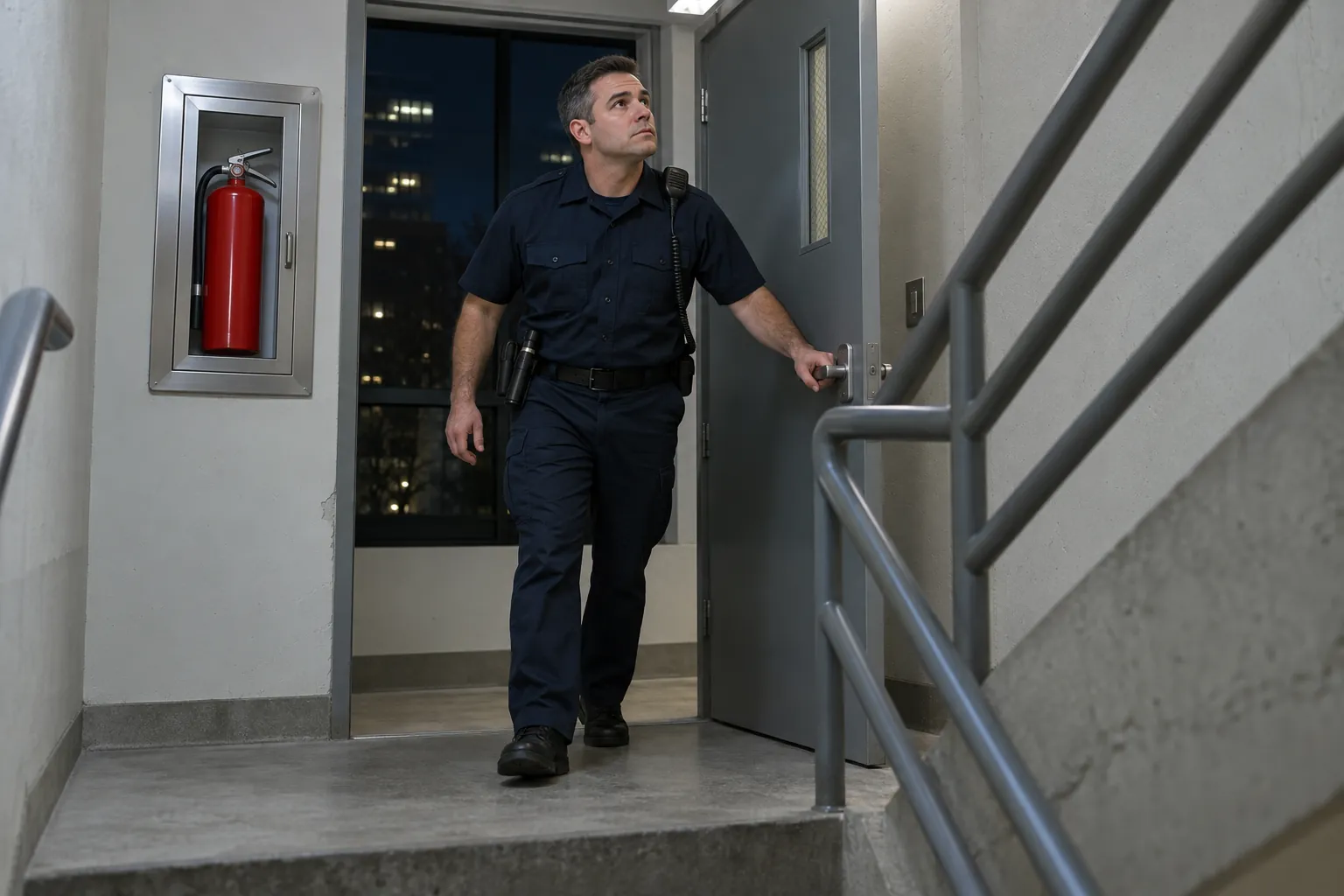 Fire and water checksFire watch logs: patrolling a building while its fire protection is out of serviceWhen a fire watch is required under IFC 901.7 and NFPA 25, who can stand it, how often to patrol, and what a fire watch log should show the fire marshal.
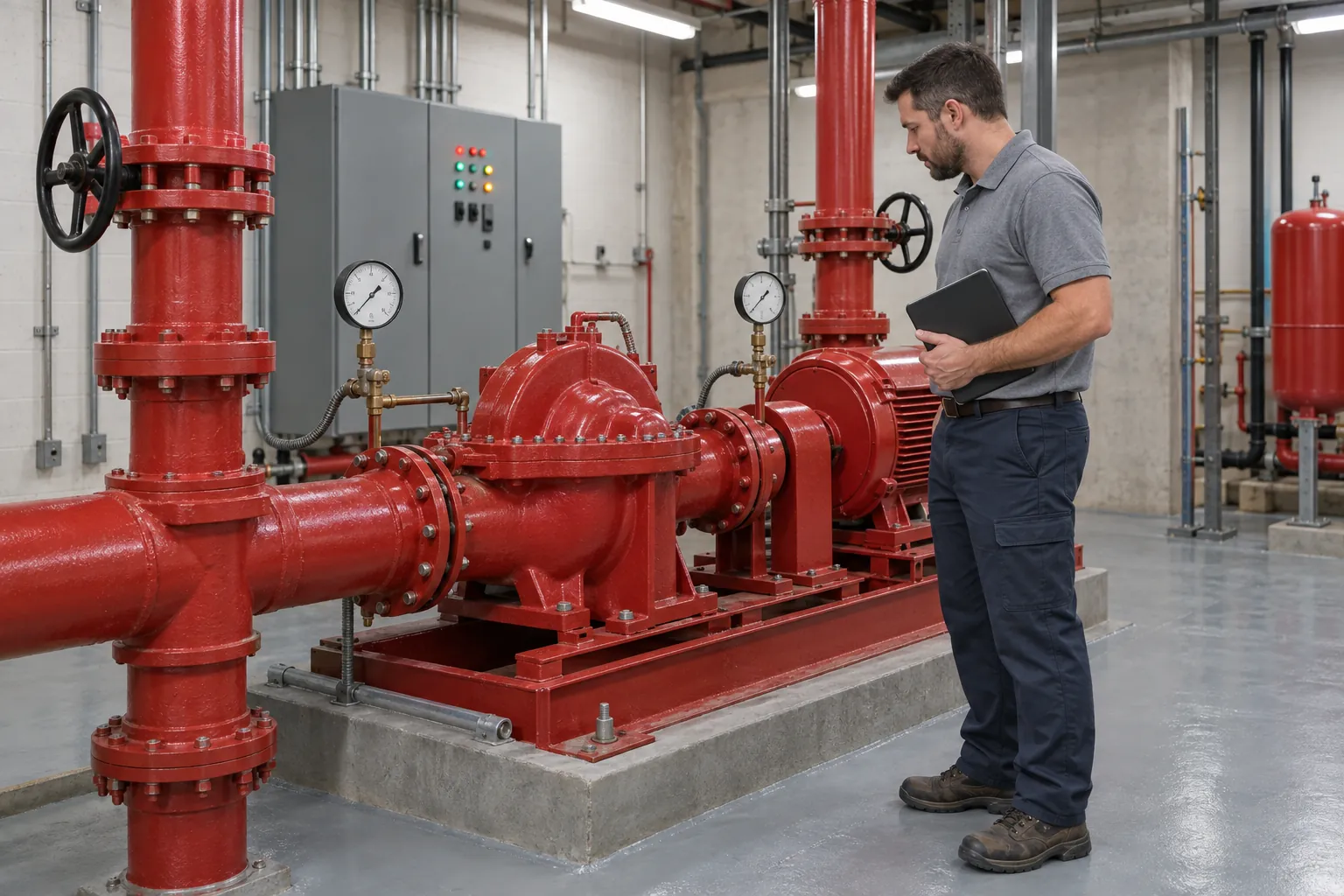 Fire and water checksFire pump testing: what NFPA 25 asks, week by weekWhat fire pump testing involves under NFPA 25: the weekly inspection, the weekly or monthly churn test, the annual flow test, who does each, and what to record.
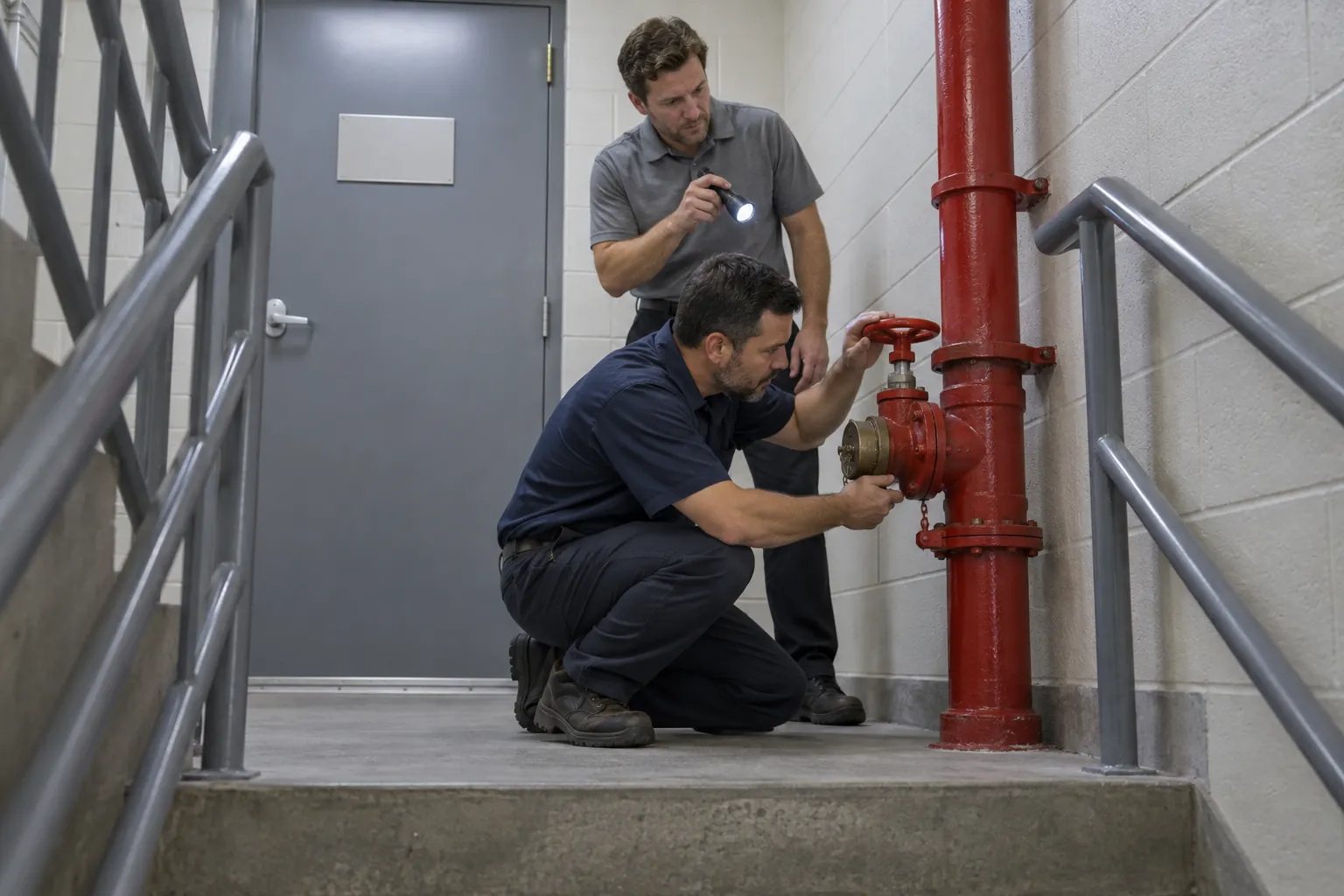 Fire and water checksStandpipe inspection and testing: keeping the fire department's water readyWhat standpipe inspection and testing involve under NFPA 25 and the fire code, what building staff check between contractor visits, and what the record shows.