Fire and water checks
Kitchen hood inspection: grease, cleaning and the fire suppression system
A kitchen hood inspection checks a commercial kitchen's hood system, the hood, grease filters, exhaust duct and fan, for grease buildup and tests the fire suppression system above the cooking line, as NFPA 96 and your local fire code require.
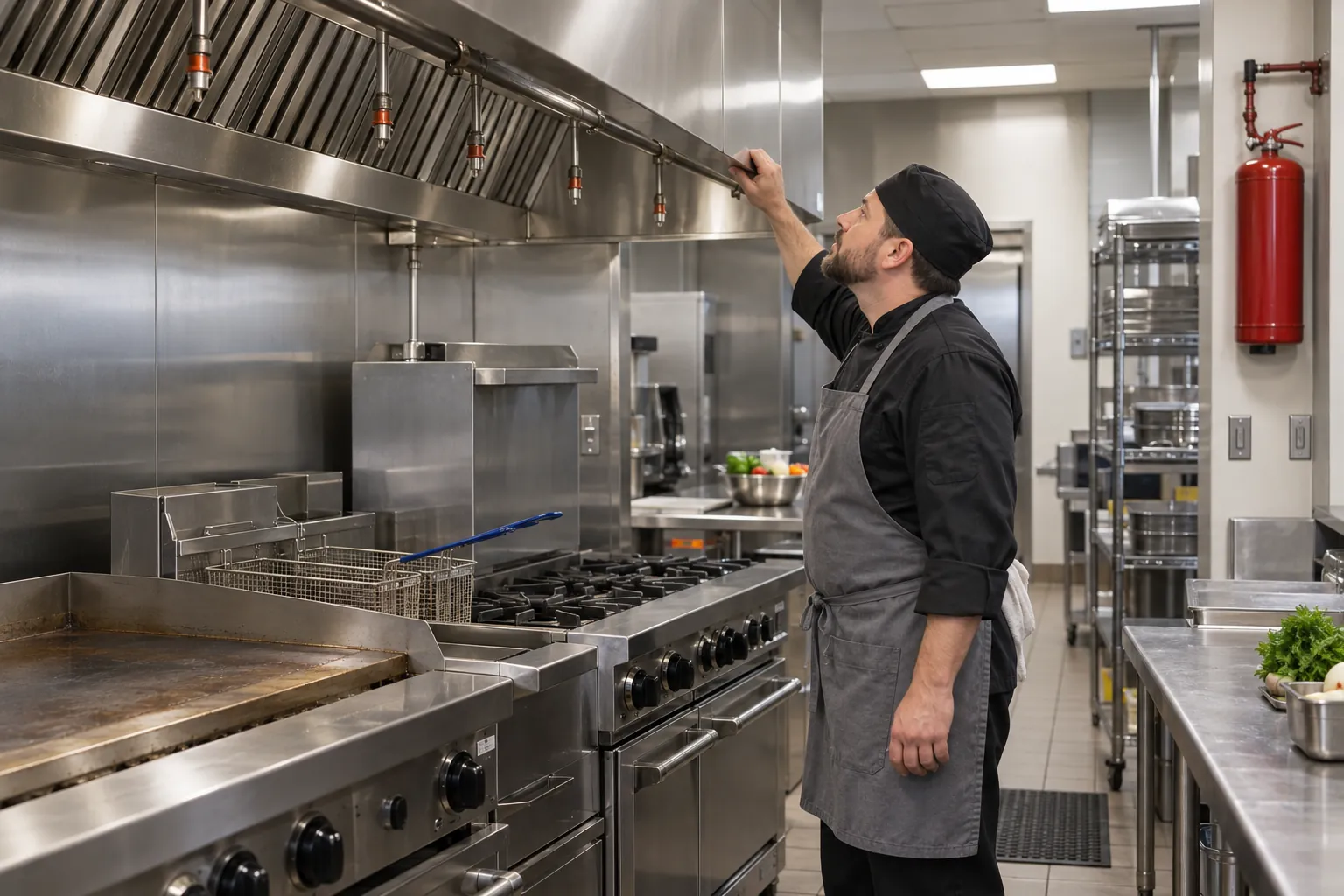
Most fires in restaurants and other commercial kitchens start at the cooking line, and the hood above it is where grease collects out of sight. In practice it is three jobs: checking the hood, filters, ducts and fan for grease and cleaning them when they need it, servicing the fire suppression system every six months, and the everyday checks the kitchen makes itself. This guide covers where the requirements come from, what gets looked at, how often, who does what, and what a record worth keeping shows.
01
What a kitchen hood inspection is, and which rules call for it
A commercial kitchen exhaust system is the hood, the grease filters, the plenum behind them, the exhaust duct, the exhaust fan on the roof or an outside wall, and a fire extinguishing system piped to nozzles above the appliances. Grease-laden vapor from frying and grilling condenses on every one of those surfaces and becomes fuel where a fire can travel fast and staff cannot reach. Regular inspection and cleaning reduce that fuel, and the fire suppression systems above the appliances are the safety net when a fire starts anyway.
The standard that governs all of it is NFPA 96, Standard for Ventilation Control and Fire Protection of Commercial Cooking Operations, published by the National Fire Protection Association. The current edition is 2027, and NFPA offers free read-only access to the standard on its website. Like every NFPA document, it is a standard until a jurisdiction adopts it. The International Fire Code and NFPA 1 point to it, and your authority having jurisdiction (AHJ), usually the local fire marshal, decides which edition applies and what local amendments sit on top. The inspection, testing and maintenance procedures were Chapter 11 in the 2017 and earlier editions and Chapter 12 in the 2021 edition. Seattle's current inspection form, written for the city's 2021 Fire Code, cites them by their Chapter 12 numbers, such as NFPA 96 12.2.4 for the fusible links.
NFPA's own overview, Restaurant Fire Protection Basics, puts the core duty plainly: "Hoods need to be inspected for grease buildup at a frequency that is typically semi-annually for most restaurants but can be more or less frequent, depending on the type and volume of cooking." And: "When that inspection finds grease buildup the hood and exhaust system must be cleaned." The same overview says the fire extinguishing systems "must be maintained at least every 6 months", with all actuation and control components tested.
The health code looks at the same hood from the food safety side. The FDA Food Code 2022, the model most states and counties adopt, says in section 6-501.14 that "intake and exhaust air ducts shall be cleaned and filters changed so they are not a source of contamination by dust, dirt, and other materials." Section 4-301.14 requires hood systems "sufficient in number and capacity to prevent grease or condensation from collecting on walls and ceilings".
Then there is your city. The Seattle Fire Department's Systems Testing page, for example, lists range hoods under Seattle Fire Code 904.13.5 with reports every six months, filed with the fire department within seven calendar days by a technician it has certified. Check what your own fire marshal requires.
02
What gets inspected: hood, filters, duct, fan and the suppression system
Seattle publishes the questions its certified technicians answer at every six-month service in its Kitchen Hood ITM form, with the NFPA 96, NFPA 17A and fire code reference beside each one. It is a useful picture of what a full inspection covers anywhere, even where your AHJ uses its own paperwork:
- Appliance coverage: every appliance that can produce grease-laden vapor sits completely under the hood, with the required nozzles, properly positioned.
- The appliances have not moved: the system still protects what it was approved to protect, and signage on the hood shows the protected appliances from left to right.
- Fusible links: not impaired by grease, the system operates from the terminal link, and the links are replaced on schedule.
- The manual pull station: working, and in the path of egress, NFPA's overview adds, so staff can use it on the way out.
- Shutoffs: the switch controlling gas or electrical power to the appliances works, all cooking heat shuts down on activation, and makeup air too where there is any.
- UL 300 compliance: the suppression system meets the UL 300 standard. A system that does not must be replaced where the appliances cook with vegetable oil, parts are no longer available or its coverage is not adequate.
- Agent cylinders: the right agent and quantity, gauges in range, hydrostatic testing up to date.
- Fire alarm connection: where there is a fire alarm system, the panel and the monitoring company receive the signal.
- Grease buildup: the system recorded as clean, or dirty with cleaning required.
- The Class K extinguisher: within 30 feet of travel from the cooking equipment, along the path of egress, with a current inspection tag.
- The tag: red (impaired), yellow (deficient) or white (normal), left on the agent cylinder or pull device.
The grease inspection runs from the hood to the fan: the filters and hood interior, the plenum and duct through access panels, and the exhaust fan, where grease often shows first. Where grease has built up, the system is cleaned, and a good contractor tells you in writing which parts it could not reach.
NFPA's overview names two faults inspectors keep finding: nozzle caps taken off in day-to-day use, although they keep grease out and are designed to blow off on discharge, and cooking equipment rearranged or replaced without checking the system, which was designed for the original layout.
03
How often: the schedule, and who sets it
NFPA 96 sets the interval for the grease inspection by the type and volume of cooking, not by the calendar alone. The NFPA overview's "typically semi-annually for most restaurants" is the middle: heavier cooking needs more frequent inspection, lighter cooking less. Read the schedule in the edition your AHJ has adopted. A school cafeteria that reheats trays and a 24-hour diner with a charbroiler do not share one.
A workable year for a typical commercial kitchen looks like this, with your AHJ's rules taking precedence:
- Every shift or every day: the kitchen's own check that filters are in place and not dripping, grease cups are emptied, nozzle caps are on, the pull station and the Class K extinguisher are clear, and nothing is stored on or under the hood.
- Weekly, or as often as the grease demands: filters removed and washed. The Food Code's standard is the result, filters that are not a source of contamination, so set the frequency from what you see.
- Monthly: a visual inspection of every portable fire extinguisher, including the Class K, which OSHA 29 CFR 1910.157 requires where extinguishers are provided for employees' use: "Portable extinguishers ... shall be visually inspected monthly."
- Every six months: the fire suppression system is inspected, tested and serviced by a qualified technician, and in cities like Seattle the report is filed with the fire department.
- At the interval your cooking calls for: the hood, duct and fan inspected for grease and cleaned when buildup is found, which NFPA's overview puts at typically every six months for most restaurants.
- Annually: the extinguishers' maintenance check, with the date recorded, and extinguisher training for staff.
Fusible links are a place where the edition matters. NFPA's 2021 overview says metal alloy fusible links are replaced at the six-month interval; Seattle's current form lists fusible link replacement as annual, citing NFPA 96 12.2.4. Your service contractor should know which edition your AHJ enforces, and your records should show the links being replaced on that schedule.
Training has its own clock. NFPA's overview says staff are instructed on the extinguishers and the manual actuation of the suppression system on hiring and annually. OSHA 1910.157(g)(2) sets the same rhythm: "upon initial employment and at least annually thereafter." With high turnover, the onboarding half slips first.
Change the schedule when the kitchen changes: a new fryer, longer hours or more grilling can move a kitchen into a heavier cooking category.
04
Who does what: the kitchen, the facility team and the contractors
Seattle's systems testing page puts it simply: "Building owners are required to have the systems inspected, tested and maintained in good working condition." In practice the work is spread across several people, and most failures happen at the handoffs between them.
- The kitchen manager or chef owns the daily checks: filters, grease cups, nozzle caps, a clear pull station and extinguisher, and reporting anything that looks wrong. They also know when the cooking changes.
- The facility manager or building engineer owns the schedule, the contractors and the record, and usually the roof access to the exhaust fan. In a hospital, a school district or a corporate campus with a contract caterer, this is the person the fire marshal will ask for the reports.
- The fire suppression contractor inspects, tests and services the system every six months, replaces the links, leaves the tag and, where the city requires it, files the report. In Seattle the work must be done by a technician the fire department has certified.
- The hood cleaning contractor inspects the hood, duct and fan for grease and cleans them. Some jurisdictions set their own rules on who may do this work; check yours.
- The landlord and the tenant in a building with restaurant tenants split the duties by lease. The duct may run through floors the tenant never sees, and the fan sits on a roof the landlord controls. Write down who schedules the cleaning, who gives access and who keeps the report.
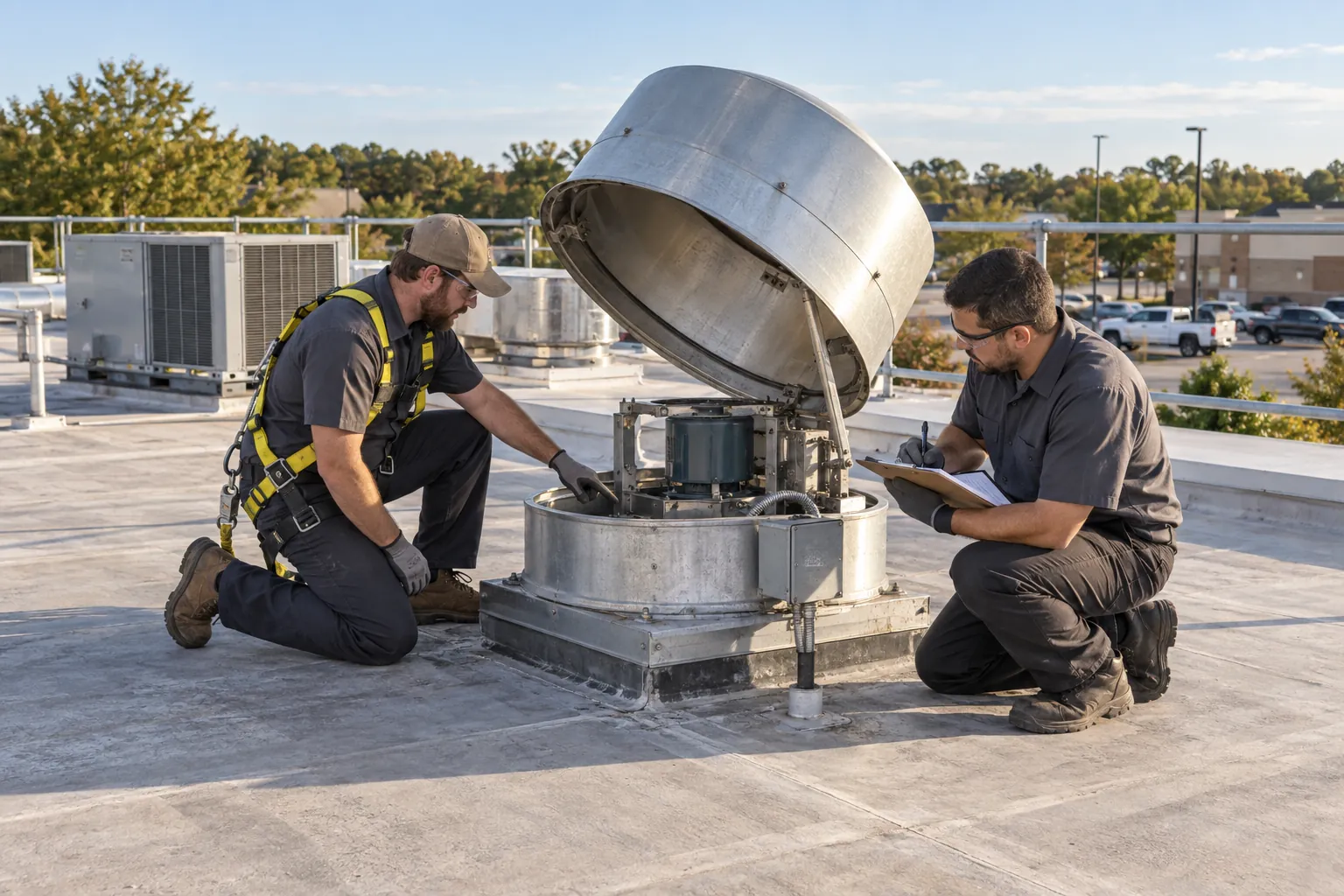
The exhaust fan is often near a roof edge. OSHA 29 CFR 1910.28 requires fall protection on surfaces with an unprotected edge 4 feet or more above a lower level, and on low-slope roofs requires guardrails, safety nets, travel restraint or personal fall arrest within 6 feet of the edge. Where your state runs its own OSHA plan, its rule applies instead. Settle how contractors reach the fan safely before the first visit.
Contractors usually work while the kitchen is closed. Agree who checks the suppression system has not been disturbed and who confirms the appliances are back in service before the morning crew arrives.
05
What good evidence looks like, and how to check it
After a fire, or at the next inspection, the question is not whether the kitchen meant to keep the hood clean. It is whether anyone can show when it was last inspected, what was found, what was cleaned, and what was done about each problem. A useful record has four layers:
- The contractors' reports. For the suppression system: the date, the technician, what was tested, the links replaced, the deficiencies found and the tag left. For the grease inspection and cleaning: the date, the company, the person who did the work, what was cleaned, and any areas that could not be reached or cleaned. Ask for photos of the duct and fan before and after.
- What the fire department holds. Where your city requires reports to be filed, a copy of the filed report and the date it went in. In Seattle, that is within seven calendar days of the work.
- The kitchen's own checks, shift by shift or day by day: filters in place, grease cups emptied, nozzle caps on, pull station and Class K extinguisher clear. A named person and a real time for each one.
- The deficiency list: every deficiency, from a yellow tag to a dripping filter, with when it was found, who it went to and when it was fixed.
Check the paperwork against the kitchen. Look up at the hood yourself: filters seated and not dripping, no film of grease on the hood interior, nozzle caps on, signage showing which appliances are protected, and the tag color matching what the report says. Compare the appliances under the hood with the list on the report; if the kitchen has added a fryer or moved the charbroiler since, the system may no longer cover them. Walk to the pull station and the Class K extinguisher and make sure the placard is there. NFPA's overview says it tells staff the fire protection system must be activated before the extinguisher is used.
Then look at the dates. A cleaning report every six months for a kitchen whose cooking calls for more is a record of the wrong schedule. A yellow tag with no follow-up is a deficiency left on file. Daily checks all checked off in the same pen are not checks.
06
Where the record fails, and what SiteClara does about it
Kitchen hood records fail in familiar ways. The only evidence of the last cleaning is a sticker on the hood, and nobody can find the report. The cleaning was done, but the report's note that the horizontal duct run could not be reached was never read. The daily sheet on the wall is filled in for the week on Monday morning. A cook mentioned that the nozzle caps were missing, to whoever happened to be passing, and it was never written down. The rooftop fan has not been looked at since the last contractor visit, because the roof is the facility team's and the hood is the kitchen's.
SiteClara records checks at the location. A printed QR poster, with an optional NFC tag behind it, sits where the check happens, such as beside the hood, at the pull station or at the roof access door. Staff scan or tap on their own phone, with no app to install, and mark the location checked or say what stopped them. The time and the named person are recorded as it happens, with a photo when one is asked for, for example of the filters in place or the nozzle caps on. A problem found on a check, such as a dripping filter, a missing cap or a blocked extinguisher, is reported there with a photo and goes onto the team's list of jobs until someone closes it.
The supervisor sees what is due, done and missed, and can record the reason a check was missed. A job that needs the building manager, such as a yellow tag waiting on the contractor, can be escalated to them to answer. Each day the supervisor reviews and approves a report that goes to nominated management or client contacts at 8 a.m. the next morning, showing what was reported, completed and still open, and how the scheduled checks went.
07
Questions people ask
What does a kitchen hood inspection consist of?
Two inspections usually go by the name. One looks at the hood, filters, plenum, duct and exhaust fan for grease buildup, and leads to cleaning when buildup is found. The other inspects and tests the fire suppression system: appliance coverage and nozzles, fusible links, the manual pull, the gas and electrical shutoffs, the agent cylinders and the fire alarm connection. Seattle's Kitchen Hood ITM form sets out 31 questions a certified technician answers, from appliance coverage to whether the system appears clean or dirty, and the red, yellow or white tag left on the agent cylinder or pull device.
How often should a hood system be inspected?
For grease, as often as the type and volume of cooking demands. NFPA's Restaurant Fire Protection Basics says hoods are inspected "typically semi-annually for most restaurants but can be more or less frequent", and that the fire extinguishing systems "must be maintained at least every 6 months". Your fire marshal decides which edition of NFPA 96 applies.
Who inspects kitchen hoods?
A fire protection contractor's technician, and in some cities one the fire department has certified. The Seattle Fire Department's Systems Testing page says "Building owners are required to have the systems inspected, tested and maintained in good working condition", with range hoods tested every six months by a technician the Seattle Fire Department has certified and the report filed online. Ask your fire marshal who may do the work where you are.
08
Where to read more, and a list to take away
Start with your fire marshal's office, which decides which edition of NFPA 96 applies and whether reports must be filed. NFPA's Restaurant Fire Protection Basics is a clear introduction, and What Is a Class K Fire Extinguisher? explains why only a Class K belongs by the fryers. Seattle's Kitchen Hood ITM form is a good checklist for a six-month service anywhere. For the health side, read the FDA Food Code 2022, sections 4-204.11, 4-301.14 and 6-501.14.
- Confirm with the fire marshal which edition of NFPA 96 applies and whether reports must be filed with the department.
- Set the grease inspection interval from the type and volume of cooking, and review it whenever the appliances, menu or hours change.
- Schedule the fire suppression service every six months, and keep every report with its tag color and deficiencies.
- Keep each hood cleaning report, and read the areas the contractor could not reach.
- Check every shift that filters are in place, grease cups are emptied, nozzle caps are on, and the pull station and Class K extinguisher are clear.
- Visually inspect the Class K and other extinguishers monthly, and record their annual maintenance.
- Train new kitchen staff on hiring, and everyone annually, on the extinguisher and the manual pull.
- Agree roof access and fall protection for the exhaust fan before the contractor arrives.
- Put every deficiency on a list with a named owner and a date it was fixed.
Sources
Every document this guide quotes or links to, in the order it first cites them.
- NFPA 96, Standard for Ventilation Control and Fire Protection of Commercial Cooking Operations nfpa.org
- Restaurant Fire Protection Basics nfpa.org
- FDA Food Code 2022 fda.gov
- Systems Testing seattle.gov
- Kitchen Hood ITM form seattle.gov
- OSHA 29 CFR 1910.157 osha.gov
- OSHA 29 CFR 1910.28 osha.gov
- What Is a Class K Fire Extinguisher? nfpa.org
Related guides
 Fire and water checksFire inspection checklist: what the fire marshal looks at, and how to be readyA fire inspection checklist for US businesses: what the fire marshal checks, the records to have ready, who prepares what, and how to stay ready between visits.
 Fire and water checksFire extinguisher inspection: the monthly check and the annual maintenanceWhat a monthly fire extinguisher inspection covers under OSHA 1910.157 and NFPA 10, how it differs from annual maintenance, and what the record should show.
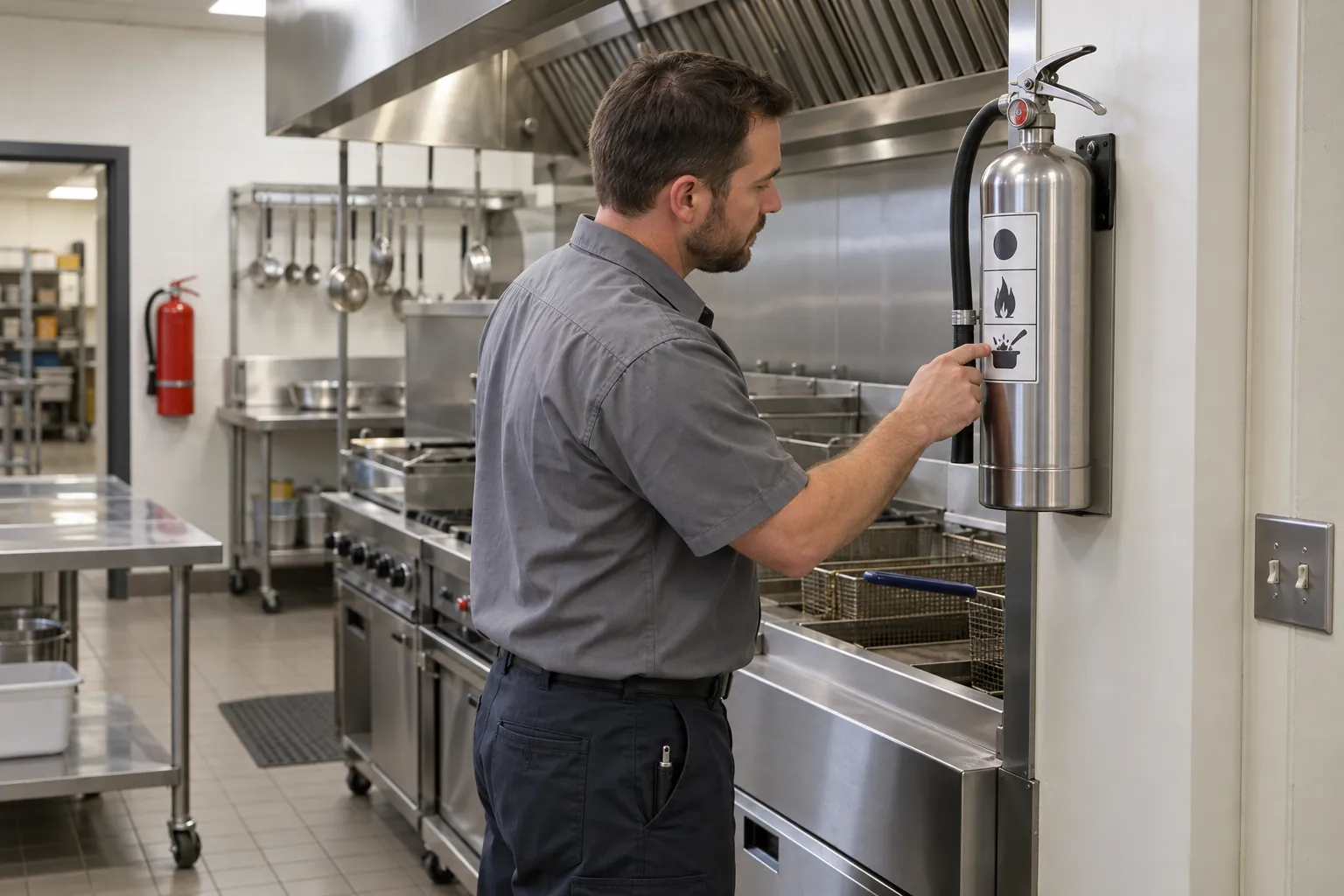 Fire and water checksFire extinguisher types: the classes, the labels and which one belongs whereThe fire extinguisher types used in US workplaces, the classes of fire they are for, how to read the rating label, and how to match each type to the space.
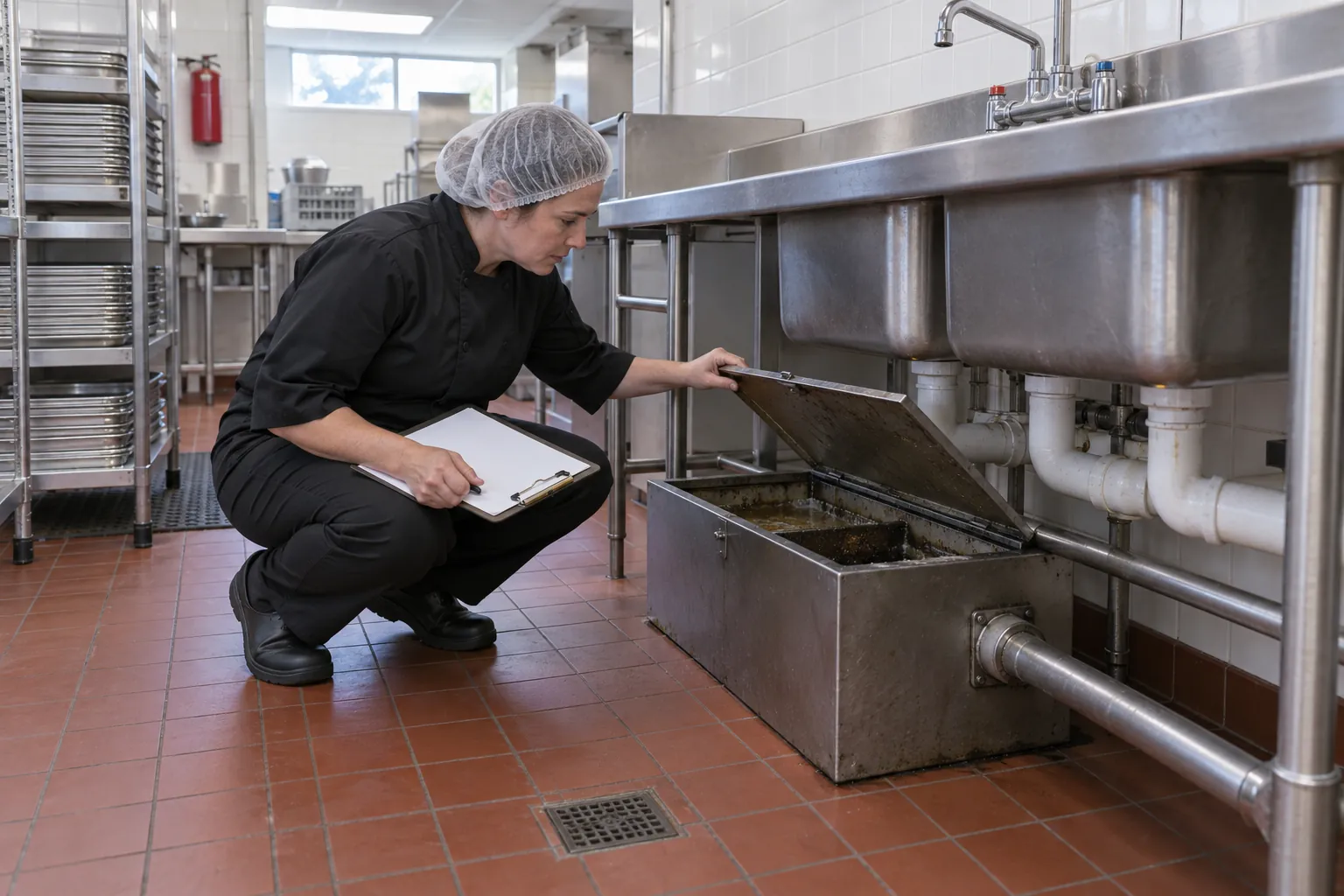 Premises and facilities managementGrease trap cleaning log: what to record, how often, and what the FOG inspector expectsWhat a grease trap cleaning log should record, how often interceptors are pumped, what local FOG programs and inspectors expect, and where the log usually fails.