Fire and water checks
Hot work permits: what OSHA and NFPA 51B expect before the torch is lit
A hot work permit is a written authorization, issued before anyone welds, cuts, brazes, grinds or uses an open flame outside a designated shop, that records that the work area has been inspected and made fire safe, who is doing the work, and who will watch for fire during it and afterward.
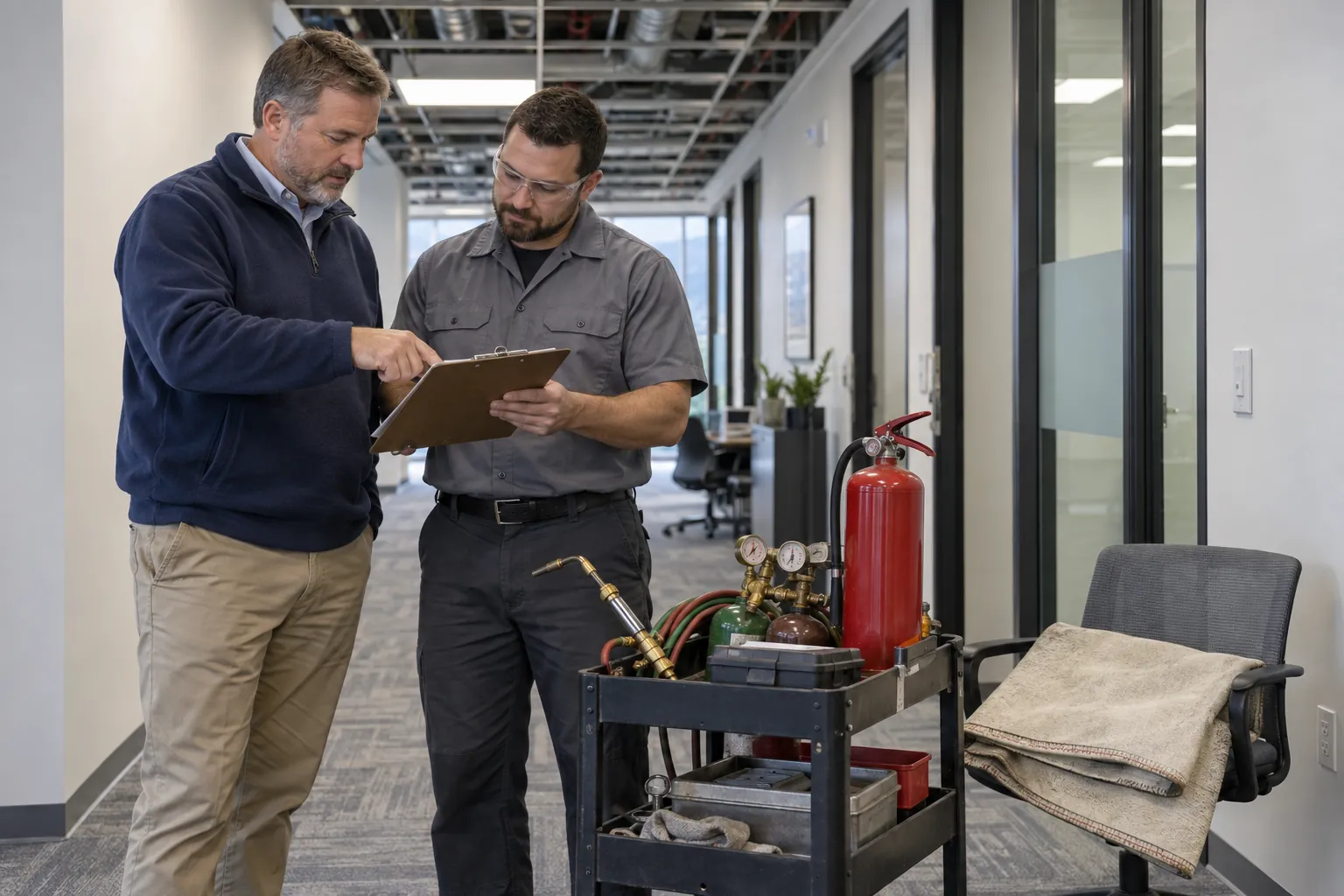
Hot work brings an ignition source into places that were not set up for one, so the permit is how a facility decides, before the work starts, that the risk is under control. This guide covers where the rules come from, what counts as hot work, what a permit should contain, who does what, how the fire watch and closeout work, and where the paperwork usually lets the building down.
01
The rules: OSHA 1910.252, NFPA 51B and your fire code
For general industry in the United States, the federal rule is 29 CFR 1910.252, General requirements (Welding, Cutting, and Brazing). Its fire prevention paragraphs, 1910.252(a), set out what has to happen before and after welding or cutting: movable fire hazards taken to a safe place, guards where they cannot be moved, and, if neither is possible, no work at all. In the standard's own words at 1910.252(a)(1)(iii), "If the requirements stated in paragraphs (a)(1)(i) and (a)(1)(ii) of this section cannot be followed then welding and cutting shall not be performed."
The permit itself comes from 1910.252(a)(2)(iv): "Before cutting or welding is permitted, the area shall be inspected by the individual responsible for authorizing cutting and welding operations. He shall designate precautions to be followed in granting authorization to proceed preferably in the form of a written permit." OSHA requires the inspection and the authorization, and prefers that it be written; in practice, a written permit is the only way to show afterward that the inspection happened.
There is one place where OSHA makes the written permit mandatory. Under 29 CFR 1910.119, Process safety management of highly hazardous chemicals, paragraph (k)(1), "The employer shall issue a hot work permit for hot work operations conducted on or near a covered process." Construction work has its own rule, 29 CFR 1926.352, Fire prevention.
The consensus standard behind all of this is NFPA 51B, Standard for Fire Prevention During Welding, Cutting, and Other Hot Work. OSHA incorporates a very old edition of it by reference: 29 CFR 1910.6, Incorporation by reference, lists "NFPA 51B-1962 Standard for Fire Protection in Use of Cutting and Welding Processes, IBR approved for §1910.252(a)(1) introductory text." NFPA 1, Fire Code, carries it forward: NFPA's own Hot Work Safety fact sheet (April 2021, written for the 2019 edition of NFPA 51B) notes that NFPA 1 requires compliance with NFPA 51B in Chapter 41. Jurisdictions that use the International Fire Code follow its own International Fire Code Chapter 35, Welding and Other Hot Work, instead, with their own amendments, so ask your fire code official which code applies and whether hot work needs a fire department permit as well as your own.
02
What counts as hot work, and where a permit is needed
NFPA's fact sheet defines hot work as "Work involving burning, welding, or a similar operation that is capable of initiating fires or explosions," and lists arc welding, oxy-fuel gas welding, open-flame soldering, brazing, thermal spraying, oxygen cutting and arc cutting. In a commercial building, the jobs that most often need a permit are:
- Welding and cutting on structural steel, handrails, brackets, pipe supports and equipment frames.
- Brazing and soldering on copper piping by plumbers and HVAC technicians, often in ceilings, shafts and mechanical rooms.
- Grinding and abrasive cutting, which throw sparks a long way and are easy to forget as hot work.
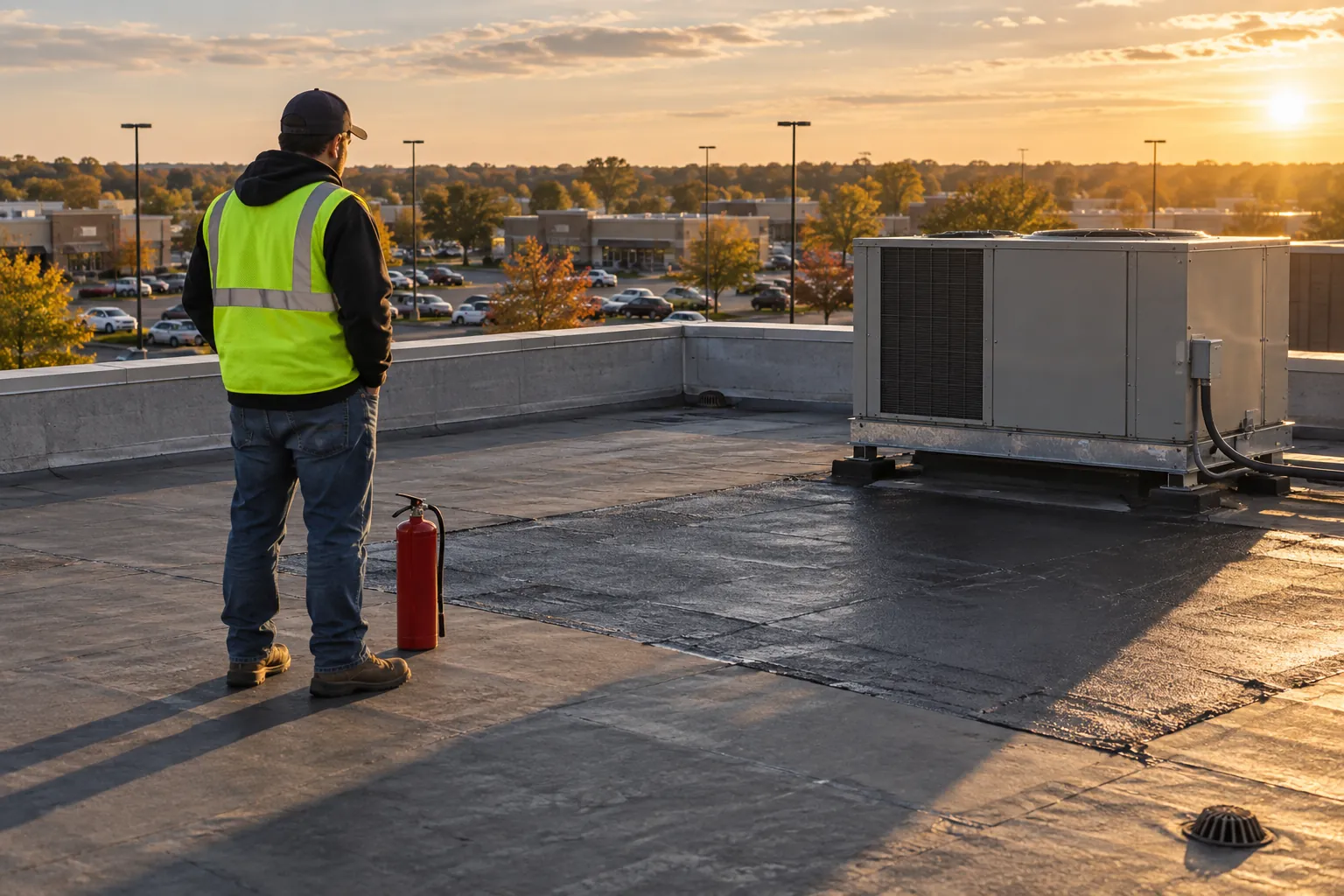
- Torch-applied roofing and other open-flame work on roofs, where the combustibles are the roof itself.
- Torches used to thaw frozen pipes close to insulation or framing.
OSHA splits the building into two kinds of place. Under 1910.252(a)(2)(xiii)(A), management must, "Based on fire potentials of plant facilities, establish areas for cutting and welding, and establish procedures for cutting and welding, in other areas." A maintenance shop or welding bay built for the purpose is a designated area. Everywhere else, the office floor, the above-ceiling space, the roof, the parking garage and the mechanical room, needs a permit each time.
Some places are off limits whatever the paperwork says. Under 1910.252(a)(2)(vi), welding and cutting are not permitted in areas not authorized by management, "In sprinklered buildings while such protection is impaired," in explosive atmospheres, including uncleaned tanks and built-up combustible dust, or near large quantities of exposed, readily ignitable materials.
The first question on any permit is whether hot work is needed at all. The U.S. Chemical Safety Board's bulletin Seven Key Lessons to Prevent Worker Deaths During Hot Work In and Around Tanks (March 2010) puts it first: "Use Alternatives – Whenever possible, avoid hot work and consider alternative methods." NFPA's fact sheet suggests some: screwed, flanged or clamped pipe, manual hydraulic shears, and mechanical bolting or pipe cutting.
03
What a hot work permit should contain
OSHA prescribes no single form, and NFPA publishes a sample permit alongside NFPA 51B. A good permit is short enough to be filled out honestly at the work site, and complete enough that someone reading it a year later can tell what was checked. It should record:
- The job: what is being done, on what object, and by which method, for example brazing copper pipe in the fourth-floor ceiling above room 412.
- The exact location, and the areas above, below and on the other side of walls that the work could reach.
- The date and the time window the permit is valid for; a job that runs into another shift or day gets a fresh look and a new permit.
- Who authorized it, by name, and who is doing the work, including the contractor's company where it is not your own staff.
- Who is the fire watch, by name, and confirmation that they have an extinguisher and know how to raise the alarm.
- The precautions checklist, checked off at the site, not in the office (see below).
- Fire protection status: sprinklers in service, and whether any smoke or heat detectors have been isolated to avoid false alarms, with the name of whoever will restore them.
- The closeout: when the work stopped, when the fire watch ended, when the area was last checked, and the signature of the person who closed the permit.
The precautions checklist follows 1910.252(a)(2) closely. The usual items are:
- combustibles moved at least 35 feet away, or covered with flameproofed covers where that is impracticable (1910.252(a)(2)(vii));
- floors swept clean for 35 feet, and combustible floors wetted or shielded (1910.252(a)(2)(v));
- openings and cracks covered so sparks cannot drop to the floor below (1910.252(a)(2)(i));
- ducts and conveyors that might carry sparks protected or shut down (1910.252(a)(2)(viii));
- combustibles behind a metal wall, ceiling or roof moved, or a fire watch posted on that side (1910.252(a)(2)(x));
- an extinguisher "maintained in a state of readiness for instant use" (1910.252(a)(2)(ii));
- used drums and tanks cleaned, blanked and vented first (1910.252(a)(3)), and, where vapors could be present, the air tested with a calibrated combustible gas detector, as the CSB bulletin urges.
04
Who does what: management, the authorizer, the operator and the fire watch
OSHA divides the duty between management and the supervisor, and NFPA's fact sheet on NFPA 51B names three working roles: "the permit authorizing individual, hot work operator, and fire watch."
Management must, under 1910.252(a)(2)(xiii), establish designated areas and procedures, "Designate an individual responsible for authorizing cutting and welding operations in areas not specifically designed for such processes," make sure operators and their supervisors are suitably trained, and "Advise all contractors about flammable materials or hazardous conditions of which they may not be aware." That last duty is the one most often forgotten when an outside plumber or steel fabricator arrives with their own torch.
The permit authorizing individual (PAI) is the individual management designates under 1910.252(a)(2)(xiii)(B), for example the facility manager, the property manager, the building engineer or chief engineer, or a trained supervisor on the maintenance team. They inspect the site, decide the precautions and sign the permit, so they should know the building: where the concealed combustibles are, which detectors cover the area, and whether the sprinklers are in service today.
The hot work operator is the welder, plumber, roofer or technician doing the job. Under 1910.252(a)(2)(xiv), the supervisor of the work is responsible for the safe handling of the equipment, must "determine the combustible materials and hazardous areas present or likely to be present in the work location," must protect combustibles by moving the work, moving the combustibles or shielding them, and "Shall secure authorization for the cutting or welding operations from the designated management representative."
The fire watch is a person whose only job is to look for fire. Under 1910.252(a)(2)(iii)(B), "Fire watchers shall have fire extinguishing equipment readily available and be trained in its use," know how to sound the alarm, and fight a fire only "when obviously within the capacity of the equipment available." The fire watch should not be the operator; a welder behind a mask cannot see smoke rising from the floor below.
05
The fire watch, the closeout, and keeping the permit
Under 1910.252(a)(2)(iii)(A), OSHA requires fire watchers whenever welding or cutting is done where other than a minor fire might develop, or where any of four conditions applies: appreciable combustible material "closer than 35 feet (10.7 m) to the point of operation"; combustibles more than 35 feet away "but are easily ignited by sparks"; wall or floor openings within 35 feet that expose combustibles in adjacent areas, "including concealed spaces in walls or floors"; or combustibles next to the far side of metal partitions, walls, ceilings or roofs likely to be ignited by conduction or radiation. Under 1910.252(a)(2)(iii)(B), "A fire watch shall be maintained for at least a half hour after completion of welding or cutting operations to detect and extinguish possible smoldering fires."
NFPA 51B asks for longer. NFPA's fact sheet says: "The fire watch must remain on site for a minimum of 60 minutes to monitor for smoldering fires, per NFPA 51B. The permit authorizing individual could require the fire watch to remain on site longer depending on the conditions of the work site." NFPA 1's 2024 edition, as Professional Roofing's article Fire drill (July 2024) summarizes section 41.3.6, keeps the one-hour default, lets the permit authorizing individual reduce it to no less than 30 minutes where the absence of fire hazards warrants it, and adds fire monitoring for up to three more hours as the PAI decides. The International Fire Code (section 3504.2.1) asks for not less than 30 minutes. Where your fire code adopts NFPA 51B, or your insurer's conditions follow it, the 60-minute watch is the one to plan for. For construction, 1926.352(e) requires additional personnel to guard against fire during the work "and for a sufficient period of time after completion of the work to ensure that no possibility of fire exists."
A permit is closed, not just filed. A sound closeout routine is:
- The operator stops work and the time goes on the permit.
- The fire watch stays the full period, checking the work area, the floor below, the far side of walls and any openings sparks could reach.
- A final check of the area is made and recorded with a time and a name.
- Isolated detectors are restored, and whoever restored them signs for it.
- The permit is signed off as closed and filed.
How long to keep permits is for your procedure and your insurer; 1910.119(k)(2) says only that "The permit shall be kept on file until completion of the hot work operations." Many facilities keep them much longer, because a permit is the evidence that a precaution was taken if a fire, a claim or an inspection asks later.
06
Where the record fails, and what SiteClara does about it
The permit form is rarely the weak point; the checks around it are. The precautions are checked off in the office before anyone has looked at the above-ceiling space. The fire watch is written as "60 min" when the watcher left with the welder. The detector isolated at 2 p.m. is still isolated the next morning because nobody wrote down who would restore it.
SiteClara records checks at the location. A printed QR poster, with an optional NFC tag behind it, sits at each place a check is scheduled, such as a mechanical room, a roof hatch or a riser. Staff scan or tap on their own phone, with no app to install, and mark each check due there done or say what stopped them. The time and the named person are recorded as it happens, with a photo when one is asked for, for example of the cleared work area before the job or the restored detector after it. A problem, such as scorching found on the final check or a detector still isolated, is reported there with a photo and goes onto the team's list of jobs until someone closes it.
The supervisor sees what is due, done and missed, and can record the reason a check was missed. A job that needs the building manager can be escalated to them to answer. Each day the supervisor reviews and approves a report that goes to nominated management or client contacts at 8 a.m. the next morning, showing what was reported, completed and still open, and how the scheduled checks went.
07
Questions people ask
Is a hot work permit required by OSHA?
In general industry, OSHA requires the inspection and the authorization but only prefers a written permit: under 29 CFR 1910.252, General requirements (Welding, Cutting, and Brazing), paragraph (a)(2)(iv), the area must be inspected by the individual responsible for authorizing the work, who designates the precautions "preferably in the form of a written permit." The written permit is mandatory for hot work on or near a process covered by 29 CFR 1910.119, Process safety management of highly hazardous chemicals, paragraph (k)(1).
Who fills out a hot work permit?
The person management has designated to authorize hot work inspects the area and sets the precautions, under paragraph (a)(2)(iv) of 29 CFR 1910.252, and the supervisor of the job "Shall secure authorization for the cutting or welding operations from the designated management representative" under (a)(2)(xiv)(D). NFPA's Hot Work Safety fact sheet says the permit helps "the permit authorizing individual, hot work operator, and fire watch recognize potential hazards," so all three work from the permit, and the authorizer's signature grants it.
When would I need a hot work permit?
Whenever workers perform welding, cutting, brazing or other hot work outside an area set aside for it. Under paragraph (a)(2)(xiii)(A) of 29 CFR 1910.252, management must "establish areas for cutting and welding, and establish procedures for cutting and welding, in other areas," so a purpose-built shop can work under standing rules while a ceiling, roof or mechanical room needs a permit each time.
How long does a hot work permit last?
OSHA sets no fixed period. Where a permit is mandatory, 29 CFR 1910.119, paragraph (k)(2), says it "shall indicate the date(s) authorized for hot work" and "shall be kept on file until completion of the hot work operations." So the length is set by your own procedure: write the time window on the permit, and give a job that runs into another shift or day a fresh inspection and a new permit.
What is the 35 foot rule for hot work?
It is the distance in 29 CFR 1910.252: "Where practicable, all combustibles shall be relocated at least 35 feet (10.7 m) from the work site" (paragraph (a)(2)(vii)), floors with combustible debris are swept clean for a radius of 35 feet (paragraph (a)(2)(v)), and a fire watch is required where appreciable combustible material is "closer than 35 feet (10.7 m) to the point of operation" (paragraph (a)(2)(iii)(A)). NFPA's Hot Work Safety fact sheet gives the same distance as a 35-ft (11-m) radius.
08
Where to read more, and a list to take away
Read 29 CFR 1910.252 in full; the fire prevention paragraphs are short and plainly written. For construction, read 29 CFR 1926.352, and in a State Plan state, your state's version. NFPA offers free read-only access to NFPA 51B from the standard's own page; read the edition your AHJ enforces. NFPA's Hot Work Safety fact sheet is a two-page summary, and the CSB bulletin is worth reading wherever a building has fuel tanks or flammable storage. Your fire marshal can tell you whether hot work needs a fire department permit where you are.
Before the next contractor arrives with a torch, check that:
- your hot work program names the designated areas, and everywhere else needs a permit;
- permit authorizers are named, trained and know the building;
- contractors hear the site's hazards first, and cannot start without a signed permit;
- the permit is filled out at the work site, including sprinkler status and isolated detectors;
- a named fire watch, not the operator, has an extinguisher and knows how to raise the alarm;
- the watch period is the longest that OSHA, NFPA 51B, your fire code and your insurer require;
- the final check and detector restoration are recorded with a time and a name, and closed permits filed.
Sources
Every document this guide quotes or links to, in the order it first cites them.
- 29 CFR 1910.252, General requirements (Welding, Cutting, and Brazing) osha.gov
- 29 CFR 1910.119, Process safety management of highly hazardous chemicals osha.gov
- 29 CFR 1926.352, Fire prevention osha.gov
- NFPA 51B, Standard for Fire Prevention During Welding, Cutting, and Other Hot Work nfpa.org
- 29 CFR 1910.6, Incorporation by reference osha.gov
- Hot Work Safety fact sheet content.nfpa.org
- International Fire Code Chapter 35, Welding and Other Hot Work up.codes
- State Plans osha.gov
- Seven Key Lessons to Prevent Worker Deaths During Hot Work In and Around Tanks csb.gov
- Professional Roofing's article Fire drill (July 2024) professionalroofing.net
Related guides
 Fire and water checksFire watch logs: patrolling a building while its fire protection is out of serviceWhen a fire watch is required under IFC 901.7 and NFPA 25, who can stand it, how often to patrol, and what a fire watch log should show the fire marshal.
 Fire and water checksFire sprinkler inspection: what NFPA 25 asks of the buildingWhat a sprinkler system inspection involves under NFPA 25, who does the weekly, monthly and annual checks, how impairments work, and what the record should show.
 Fire and water checksFire alarm testing: who does what, and what the record should showFire alarm testing in the US: what NFPA 72 and OSHA ask of the owner, what gets tested, how to run a test day, and what the building's own record should show.
 Fire and water checksWorkplace fire safety checklist: what to check, how often, and who does itA fire safety checklist for a US workplace: the daily, monthly and annual checks behind OSHA Subparts E and L and the local fire code, who does each, and the record.