Fire and water checks
Fire watch logs: patrolling a building while its fire protection is out of service
A fire watch log is the written record of a fire watch: who patrolled, when each round was made, which areas were checked and what was found while a building's sprinkler system, fire alarm or other fire protection was out of service.
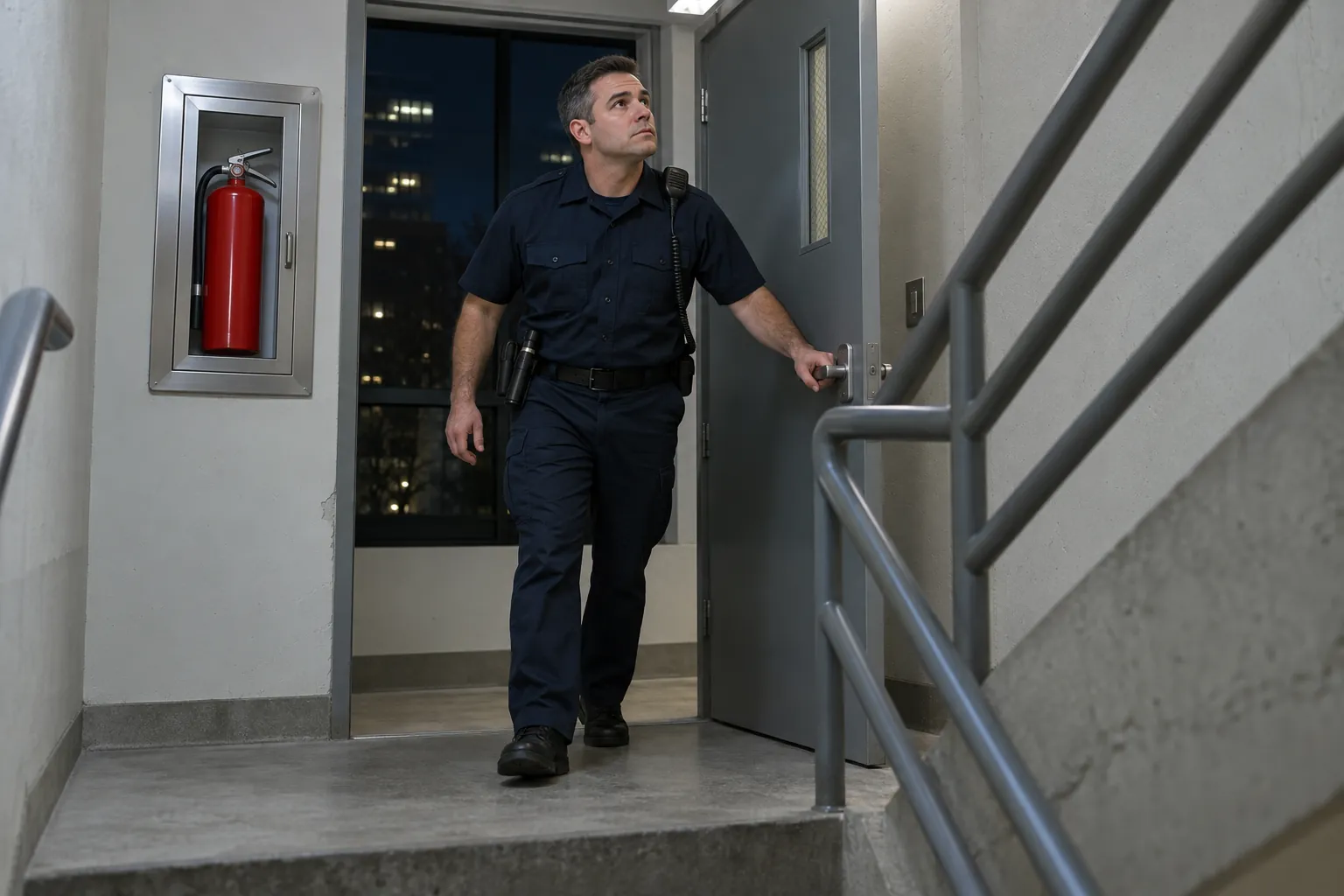
When a sprinkler system, fire alarm or fire pump is out of service, the building has lost the thing that was meant to find a fire and raise the alarm. A fire watch puts people in its place: trained patrols walking the affected areas on a set route until the system is restored. This guide covers where the requirement comes from, what triggers it, who can stand the watch, how often to patrol, what the fire watch log should record, and where those logs usually let the building down.
01
What a fire watch is, and the codes that call for one
The International Fire Code defines a fire watch in Section 202 as "A temporary measure intended to ensure continuous and systematic surveillance of a building or portion thereof by one or more qualified individuals for the purposes of identifying and controlling fire hazards, detecting early signs of unwanted fire, raising an alarm of fire and notifying the fire department."
The requirement is International Fire Code Section 901.7, Systems out of service, which the Flower Mound Fire Marshal's Office Fire Watch Requirements quote in full: "Where a required fire protection system is out of service, the fire department and the fire code official shall be notified immediately and, where required by the fire code official, the building shall be either evacuated or an approved fire watch shall be provided for all occupants left unprotected by the shutdown until the fire protection system has been returned to service. Where utilized, fire watches shall be provided with at least one approved means for notification of the fire department. Their only duty shall be to patrol the protected premises constantly and watch for fires." The wording varies by edition: later editions end "their only duty shall be to perform constant patrols of the protected premises and keep watch for fires."
Three things in that paragraph shape everything that follows: the fire department is told immediately, the fire code official decides whether a watch is required, and the watch has one job. California's hospital building regulator, HCAI, applies the same section of the 2022 California Fire Code in its Code Application Notice CAN 9-901.7, Fire Watch.
NFPA standards reach the same place from the maintenance side. NFPA 25, Standard for the Inspection, Testing, and Maintenance of Water-Based Fire Protection Systems, deals with impairments in Chapter 15. The Iowa State Fire Marshal Division's Fire Watch Plan Guidance memorandum (October 2016) quotes the 2011 edition: where an impairment occurs, "the procedures outlined in Chapter 15 of this standard shall be followed, including the attachment of a tag to the impaired system." It also quotes the 2012 Life Safety Code, NFPA 101, which it applies alongside the requirements of CMS: a fire alarm out of service "for more than 4 hours in a 24-hour period" means notifying the authority having jurisdiction and either evacuating or providing "an approved fire watch."
None of these codes applies until a state, county or city adopts it, usually with amendments. The authority having jurisdiction (AHJ), normally the local fire marshal, decides what your building must do.
02
When a fire watch is triggered
HCAI puts the scope plainly: "Fire watch shall be implemented where a fire sprinkler system, fire alarm system, standpipe, fire pump, water supply, or any other fire and life safety system becomes inoperable for an extended period." In an ordinary commercial or residential building, the usual triggers are:
- A sprinkler impairment: a control valve closed for a tenant fit-out, a system drained for a pipe repair, a frozen or broken main.
- A fire alarm system out of service: a failed panel, a lost communicator, or detection disabled across a floor during work.
- A fire pump or water supply failure, leaving sprinklers and standpipes without the pressure they were designed for.
- Repeated nuisance alarms: Seattle may require a fire watch "until the system is repaired" where an alarm system has an excessive number of accidental activations.
- Construction, demolition and assembly events, which HCAI lists as other routes to a fire watch when the fire official requires one.
The time limits vary. The Iowa memo sets out the NFPA position in the editions CMS uses: four hours in 24 for a fire alarm, and, for sprinklers under NFPA 25, more than 10 hours in a 24-hour period before the impairment coordinator must arrange evacuation, "an approved fire watch," a temporary water supply, or a program "to eliminate potential ignition sources and limit the amount of fuel available." The Louisiana Office of State Buildings' Fire Watch Procedures use the same four- and ten-hour figures.
Local rules are often tighter. The Seattle Fire Department's Client Assistance Memo 5991, Fire Watch and Out of Service Fire Protection Systems (updated June 2022) says "A fire watch is required whenever a fire protection system is out of service," planned or emergency, unless an exemption applies. Flower Mound, Texas, requires one when the sprinkler and alarm systems are out for eight or more hours, and asks for contact "a minimum of 72 hours before a planned impairment." The safe working rule is to call the fire marshal's office at the start of any impairment, ask what they require, and write down who said what and when.
03
Who can stand a fire watch, and what they do
The owner is responsible for the building's fire protection and so for the watch. NFPA 25 has the owner assign an impairment coordinator, and the Iowa memo lists that coordinator's first tasks: tag the system "at each FD connection, system control valve, and any other locations deemed by the AHJ," and notify the fire department, insurance carrier, alarm company, property owner and the supervisors of affected areas. Seattle adds telling tenants "how long the systems are likely to be out of service."
Who may patrol depends on the occupancy and the jurisdiction:
- Seattle: "A professional security company is not required." But in assembly occupancies with a posted occupant load over 50, and in residential, institutional and educational occupancies, the watch is dedicated, day and night, and "building occupants performing their regular duties cannot serve as a fire watch." In offices, stores and industrial buildings, informed occupants may stand in while the building is occupied.
- Flower Mound, Texas: a licensed and bonded security company where people sleep, with one fire watch officer for every three floors; qualified paid staff elsewhere, "provided that is their sole responsibility."
- New York City: the FDNY calls the role a fire guard, and its Certificate of Fitness F-01, Citywide Fire Guard for Impairment applies. After the first four hours (for an affected area up to 50,000 square feet) the patrol must be done by certificate holders.
- California hospitals: HCAI requires personnel "Responsible solely for Fire Watch, without any other duties assigned."
The duties are much the same everywhere. Seattle's list is typical: patrol the impaired areas (the whole building if the alarm is out), identify hazards, call 9-1-1 with the exact address if a fire is found, get occupants out, keep a direct means of reaching the fire department, keep the log, and know where the extinguishers are. Flower Mound adds that the watch needs "any keys necessary to check all affected areas of the building and admit the emergency responders."
A security officer already on post is not automatically a fire watch. An officer also running the lobby desk or escorting contractors is not a dedicated watch, and where a guard company provides one, its post orders should say so explicitly.
04
Patrol rounds: how often, where, and what to look at
The interval between rounds is set by the AHJ, and the published figures range widely:
- Every 15 minutes: Seattle, where "All applicable areas of the building shall be visited at least once every 15 minutes."
- Every 30 minutes: the Iowa memo, where "the person conducting the fire watch must be in each room once every 30 minutes."
- Every hour: HCAI, the Louisiana Office of State Buildings, and Flower Mound, whose rounds run at "intervals not exceeding sixty (60) minutes from completion of the previous time."
Note Flower Mound's wording: the clock runs from the end of the last round, not its start. Time the route, and add people if one person cannot get around in time.
Build the route before the first round. HCAI's patrol covers "all rooms (offices, spaces, areas) including basements, penthouses." In residential buildings Seattle limits the patrol to common areas and facilities such as laundry, maintenance and storage rooms. A good route lists each checkpoint in order: stair towers, corridors, mechanical and electrical rooms, trash rooms, storage, loading docks, the fire alarm panel and the riser whose valve is closed.
At each checkpoint the watch looks for what a fire needs and what people need to escape one. The Louisiana procedures name ignition sources, extinguishers, combustible materials, exits, illuminated signs and self-closing doors, and the Iowa memo adds "No propping open of the fire doors." In practice:
- smoke, heat, burning smells or anything smoldering;
- unauthorized hot work, smoking or space heaters;
- trash and stored goods building up in corridors and stairs;
- exits clear and unlocked from the inside, exit signs lit;
- fire doors closed and latching;
- extinguishers in place, and the impaired system still tagged.
Shift changes are where rounds go missing. HCAI tells the watch to "Relay any special orders or pertinent information to relief personnel and management" and to "Remain on duty until properly relieved." A handover in person, written on the log with both names and the time, closes that gap; on a guarded site the pass-down log should carry it too.
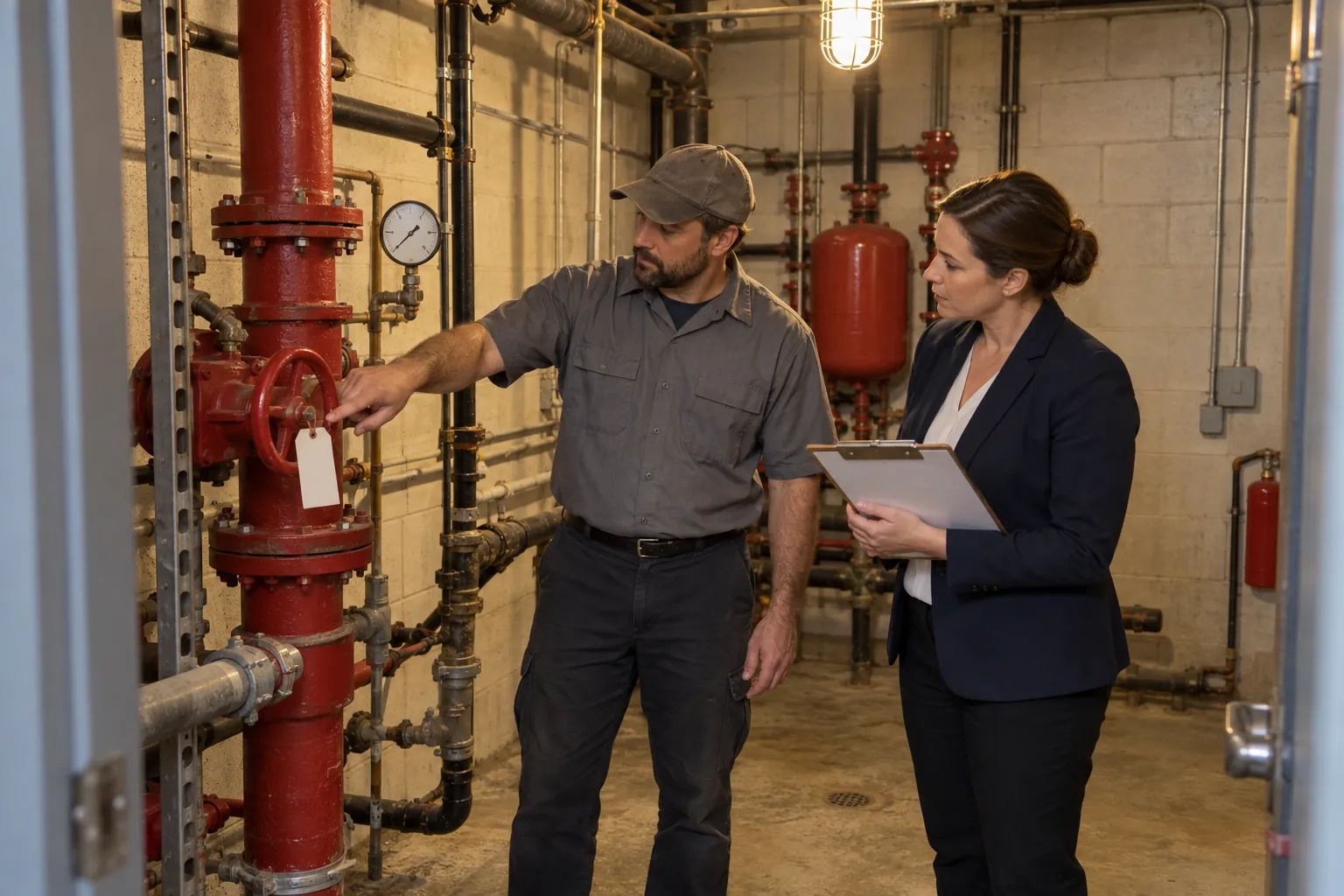
05
What a fire watch log should record, and how the watch ends
The fire watch log is the evidence that the watch happened. Seattle requires it to be kept at the facility and "available to the Seattle Fire Department at all times during the fire watch," with a "Running list of persons conducting patrol, including name, starting and ending time of patrol shift, and signature," and a record of communications to the fire department and the monitoring company. HCAI requires a logbook of emergency contacts that also records "the history of Fire Watch patrol rounds."
Use your fire department's own form or log sheet where one exists. The City of Fayetteville's Fire Watch Log is a good model. Across the published forms, a complete log records:
- The building and the impairment: address, which system is out, why, and the areas affected.
- Who ordered it: the impairment coordinator and the code official, with the start date and time.
- Every person on the watch, including overlapping shifts and changes of area.
- Each round: date, time, area patrolled and its status, one line per round, not one line per shift.
- What was found and done: Fayetteville's example reads "1st floor near lobby, welding found," corrected by "stopped welding."
- Notifications: fire department, monitoring company, insurer, owner, tenants, and when.
- The end: when the watch stopped, who authorized it, and the evidence the system was restored.
Ending the watch is a step in itself, not the moment the contractor leaves. Seattle treats a system as restored "when a test conducted by an SFD-certified technician confirms that the system functions as designed," when the red tag comes off and a white tag goes on. HCAI requires written termination: "Verbal Termination Authorizations are not permitted." Flower Mound wants the whole log and proof of restoration sent to the Fire Marshal's Office, and the Iowa memo has the impairment coordinator confirm testing, tell occupants and the parties notified at the start, and remove the tag.
Keep the log afterward. The Iowa memo says documentation is to be maintained for one year; your AHJ, insurer or accreditor may want longer. File it with the tag and restoration test records, so the whole impairment can be read in one place at the next sprinkler inspection or fire alarm test.
06
Where the record fails, and what SiteClara does about it
Fire watch logs fail in familiar ways. A neat line every 15 minutes in the same handwriting, filled in at the end of the shift. The overnight rounds read "all OK" with no area named, so nobody can tell whether the basement was walked. The officer who also ran the front desk signed as the fire watch. The 6 a.m. handover was a nod in the lobby.
SiteClara records checks at the location. A printed QR poster, with an optional NFC tag behind it, sits at each checkpoint on a route, such as a stair tower, a riser room, a trash room or a loading dock. Staff scan or tap on their own phone, with no app to install, and mark the location checked or say what stopped them. The time and the named person are recorded as it happens, with a photo when one is asked for, for example of a closed fire door or a clear exit. A problem found on a round, such as a propped door or packaging stored in a stair, is reported there with a photo and goes onto the team's list of jobs until someone closes it.
The supervisor sees what is due, done and missed, and can record the reason a check was missed. A job that needs the building manager can be escalated to them to answer. Each day the supervisor reviews and approves a report that goes to nominated management or client contacts at 8 a.m. the next morning, showing what was reported, completed and still open, and how the scheduled checks went.
07
Questions people ask
What is a fire watch log?
It is the record that shows a fire watch was actually carried out. The Seattle Fire Department's Client Assistance Memo 5991, Fire Watch and Out of Service Fire Protection Systems says "A fire watch log should be maintained at the facility" and "must be available to the Seattle Fire Department at all times during the fire watch." It should show the address, a description of the fire watch duties such as the patrol route and the hazards to check, a running list of the people on patrol with their shift times and signatures, and a record of communications to the fire department and the monitoring company.
How do you fill out a fire watch log?
Fill in the header once, then add one line for every round. The City of Fayetteville's Fire Watch Log asks for the business, the address, the activation and deactivation dates and times, the reason for the fire watch, and the impairment coordinator and code official who issued it. Its personnel section "should include the names of all personnel conducting fire watch from beginning to end." Each round then takes a date, a patrol time, a last name, the area patrolled and its status, and any corrections, as in its example: "1st floor near lobby, welding found," corrected by "stopped welding."
What are the OSHA fire watch requirements?
OSHA's fire watch is for hot work, not for an impaired sprinkler or alarm system, which falls under the fire code your AHJ has adopted. Under 29 CFR 1910.252, General requirements (Welding, Cutting, and Brazing), fire watchers are required whenever welding or cutting is performed in locations "where other than a minor fire might develop," and under certain other conditions the standard lists. They "shall have fire extinguishing equipment readily available and be trained in its use," and "A fire watch shall be maintained for at least a half hour after completion of welding or cutting operations to detect and extinguish possible smoldering fires."
Where can I get a fire watch log template?
Ask your own fire marshal's office first, because some publish the form they expect. The Denver Fire Department's Fire Watch Log is a single printable sheet with the building name, date and address, and columns for the time, the initials of the person on watch, and "Issues &/or Concerns"; Denver asks for the sheet to be faxed to its Fire Prevention Bureau by 10:00 a.m. daily. Fayetteville's Fire Watch Log adds the impairment details and a corrections column.
08
Where to read more, and a list to take away
Start with your own fire marshal's office, whose policy and form are the ones that count. Seattle's CAM 5991 and HCAI's CAN 9-901.7 are two of the clearest published examples. For sprinkler impairments, read Chapter 15 of NFPA 25, free to read online, in the edition your AHJ has adopted. Healthcare facilities should pair it with the interim life safety measures their policy requires.
- Call the fire marshal's office at the start of every impairment, and note who you spoke to, what they required, and when.
- Name the impairment coordinator and tag the impaired system.
- Tell the monitoring company, the insurer, the owner and the tenants, and write down when.
- Put people on the watch whose only duty is the watch, unless your AHJ says otherwise.
- Walk and time the route, and staff it so each round finishes inside the required interval.
- Log every round with the time, the area and what was found.
- Hand over in person, with both names and the time on the log.
- End the watch only when the system is tested and restored and the AHJ has agreed, and record who agreed.
- Keep the log with the tag and test records for as long as your AHJ requires.
Sources
Every document this guide quotes or links to, in the order it first cites them.
- Flower Mound Fire Marshal's Office Fire Watch Requirements flowermound.gov
- Code Application Notice CAN 9-901.7, Fire Watch hcai.ca.gov
- NFPA 25, Standard for the Inspection, Testing, and Maintenance of Water-Based Fire Protection Systems nfpa.org
- Fire Watch Plan Guidance memorandum (October 2016) dial.iowa.gov
- 29 CFR 1910.252, General requirements (Welding, Cutting, and Brazing) osha.gov
- Fire Watch Procedures doa.la.gov
- Client Assistance Memo 5991, Fire Watch and Out of Service Fire Protection Systems (updated June 2022) seattle.gov
- Certificate of Fitness F-01, Citywide Fire Guard for Impairment nyc.gov
- Fire Watch Log fayettevillenc.gov
- Fire Watch Log denvergov.org
Related guides
 Fire and water checksFire sprinkler inspection: what NFPA 25 asks of the buildingWhat a sprinkler system inspection involves under NFPA 25, who does the weekly, monthly and annual checks, how impairments work, and what the record should show.
 Fire and water checksFire alarm testing: who does what, and what the record should showFire alarm testing in the US: what NFPA 72 and OSHA ask of the owner, what gets tested, how to run a test day, and what the building's own record should show.
 Fire and water checksHot work permits: what OSHA and NFPA 51B expect before the torch is litWhat a hot work permit is, what OSHA 1910.252 and NFPA 51B require, what the permit should cover, who signs it, and how the fire watch and closeout are recorded.
 Fire and water checksInterim life safety measures: keeping a healthcare building safe while its fire protection is compromisedWhat The Joint Commission's LS.01.02.01 asks of an ILSM policy, when a fire watch is required, and how to run and record the daily rounds behind the measures.