Premises and facilities management
Pest control in hotels: how housekeeping, engineering and the pest company work together
Pest control in hotels is an integrated pest management program that keeps guest rooms, kitchens, laundry, trash areas and grounds free of bed bugs, cockroaches, rodents and other pests, with treatment done by a licensed pest management professional and early detection done every day by the housekeeping, engineering and food and beverage staff who see the building first.
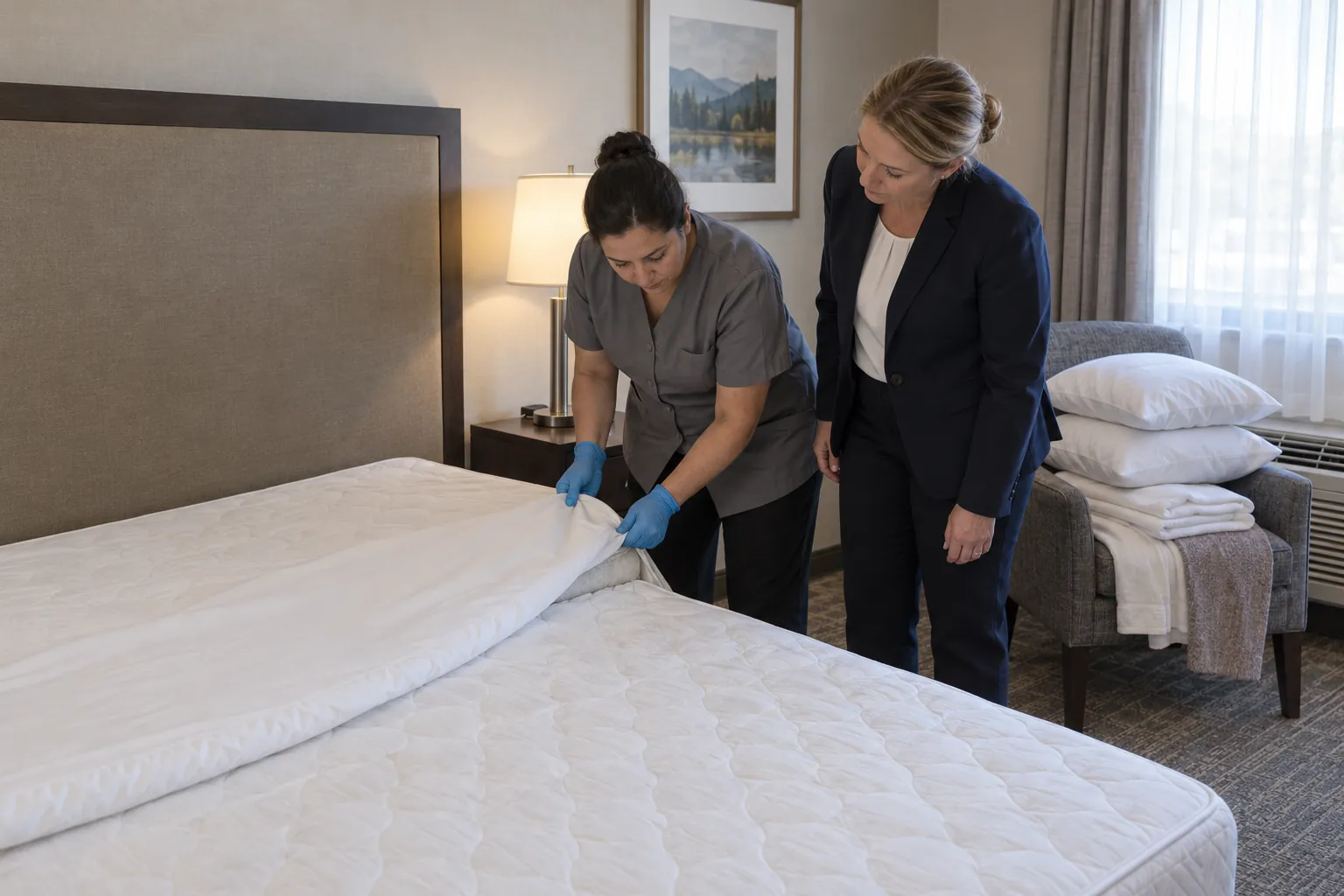
No single federal law covers it: state and county lodging rules, the FDA Food Code as your state adopted it, and OSHA's sanitation standard each require the result, and a health inspector checks it room by room. This guide covers those rules, where pests turn up in a hotel, how housekeepers spot bed bugs at room turnover, what to do when one is found, and what the record should show.
01
The rules behind pest control in hotels
No US rule is called "hotel pest control". Several apply at once, each requiring the building to be kept free of pests and leaving the method to the operator. Which apply depends on the state, the county and whether the property runs a restaurant, banquet kitchen or bar.
- State and county lodging rules. Hotels are usually permitted and inspected by the state or county environmental health department. Florida's rule for every public lodging and public food service establishment, Florida Administrative Code Rule 61C-1.004, General Sanitation and Safety Requirements, paragraph (3), says "Effective control measures shall be taken to protect against the entrance into the establishment, and the breeding or presence on the premises of rodents, flies, roaches and other vermin." In California, San Bernardino County's Division of Environmental Health Services inspects hotels and motels in its contract cities and unincorporated areas every year, and its Self-Inspection List for Hotel and Motel Operators (January 2015) says the inspector "will ask to see at least 10% of your rooms", with the items "Verify no vermin infestation exists (rodents, roaches)" and "Inspect mattress, bedding, headboard, and surrounding area for presence of bed bugs."
- Bed bug laws. The EPA's page on bed bug laws and regulations says "There are 21 states that have some level of law or regulation that applies to bed bugs", and that the "Requirements focus on hotels and landlords or other property managers for the most part."
- Hotel kitchens and bars. The FDA Food Code 2026, section 6-501.111, says "The PREMISES shall be maintained free of insects, rodents, and other pests", controlled by inspecting incoming shipments, "Routinely inspecting the PREMISES for evidence of pests", trapping or other control if pests are found, and "Eliminating harborage conditions." The Food Code binds a hotel kitchen only as your state or local health department adopted it, often from an earlier edition.
- Every workplace. OSHA's sanitation standard, 29 CFR 1910.141, paragraph (a)(5), requires enclosed workplaces to be maintained, "so far as reasonably practicable", so "as to prevent the entrance or harborage of rodents, insects, and other vermin", and says "A continuing and effective extermination program shall be instituted where their presence is detected." In states with their own OSHA-approved State Plan, the plan's equivalent rule applies.
Franchise and management company brand standards usually add their own pest and bed bug requirements. The upshot is the same everywhere: a written program, a licensed contractor, staff who know what to look for, and a record showing each sighting was dealt with.
02
Where pests turn up in a hotel, and who sees them first
A hotel has food, water, warmth, laundry and a steady flow of luggage, and pests follow those. In hospitality, one guest's photo of a bed bug or a mouse can damage a property's reputation, so prevention starts with knowing where to look. Map the places that matter and name the team that passes each one every day:
- Guest rooms. Bed bugs, carried in on luggage; ants and cockroaches around coffee stations, minibars and kitchenettes. Room attendants see every checkout room in full.
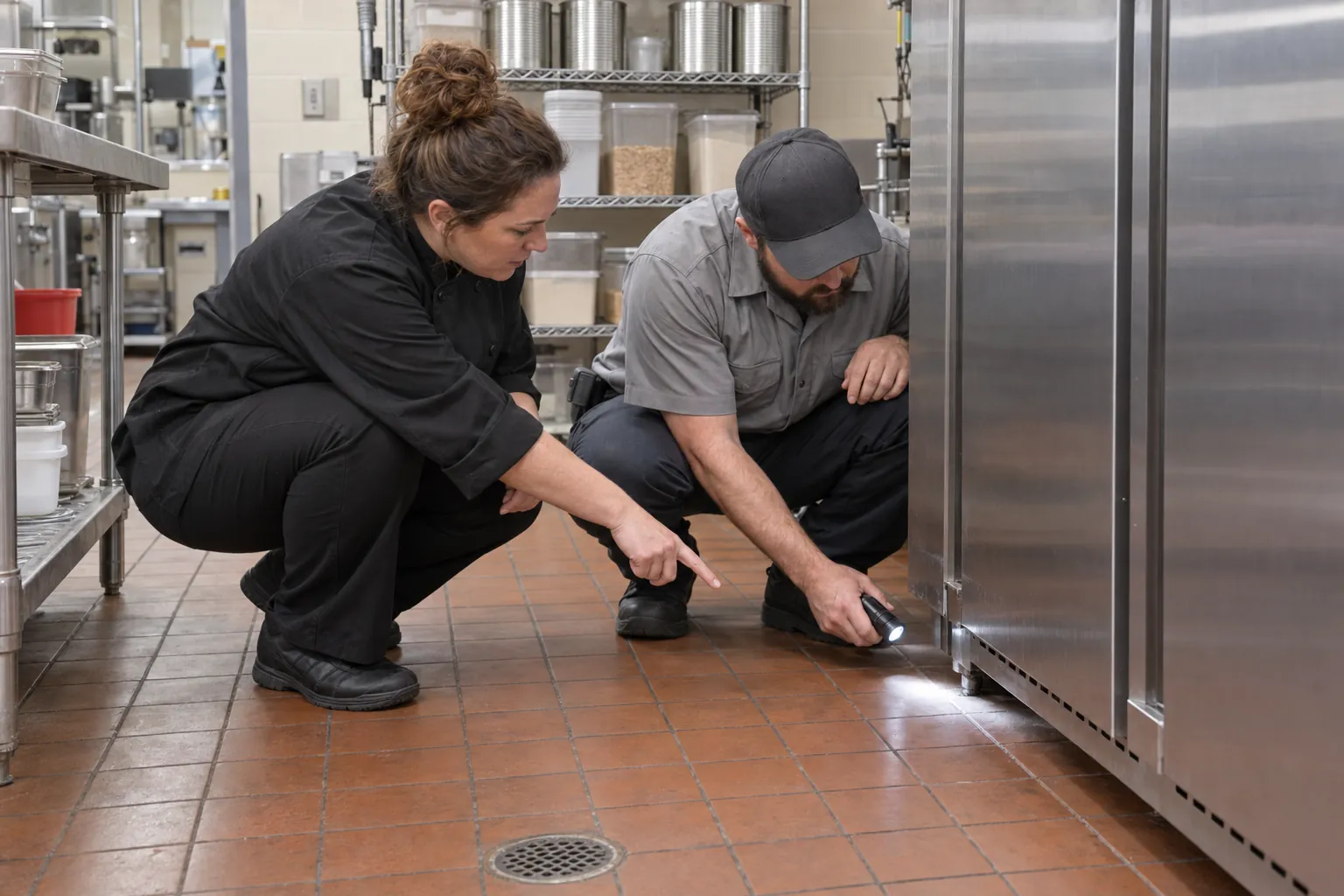
- Kitchens, banquet prep, room service and bars. Cockroaches, small flies and rodents. Stewards and cooks see the floor drains, the dish machine and the space under equipment.
- Laundry and linen rooms. Soiled linen from an infested room can carry bed bugs to a cart, a chute and the next floor.
- Trash rooms, loading docks and receiving. Rats, mice and flies at the compactor and dock door, especially where poor cleaning leaves spills overnight; cockroaches in delivery cardboard.
- Employee areas. The Bed Bug Action Plan for Hotels, by Dini M. Miller of Virginia Tech's Department of Entomology and hosted by the Virginia Department of Agriculture and Consumer Services, warns that "Employee locker rooms, rest rooms, break rooms and other locations where employees might store their personal belonging are vulnerable to bed bug infestations."
- Grounds and the building shell. San Bernardino County's How to Manage Vermin in Hotels and Motels (December 2014) notes that "Rats only need a 1/2 inch space to enter buildings", and that trimming plants away from buildings, removing fallen fruit and garbage spills, and "keeping door weather stripping in good repair" deter them. Engineering and the grounds crew own these.
The pest management professional visits on a schedule, often monthly; everyone else is in the building every day. The EPA, on protecting yourself from bed bugs in public places, tells building managers to "Educate the staff so that they know what to do if a bug is found that appears to be a bed bug" and to "Establish a monitoring program so that if a bed bug is found in an area the status of that area will be formally tracked." The staff watch, the contractor treats, and someone owns the list in between, usually the director of engineering or the executive housekeeper.
03
Bed bugs: early detection at room turnover
A hotel cannot stop bed bugs arriving. The CDC's About Bed Bugs says they have been found in "five-star hotels and resorts", and that cleanliness does not decide whether they are present. The Virginia action plan puts it plainly: "prevention, in the lodging industry, is really early detection." The goal is to find them before a guest does.
Housekeeping staff are best placed, because room attendants strip and make the bed in every checkout room. The EPA's How to Find Bed Bugs lists the signs:
- "Rusty or reddish stains on bed sheets or mattresses caused by bed bugs being crushed."
- "Dark spots", about the size of a printed dot, "which are bed bug excrement".
- "Eggs and eggshells, which are tiny (about 1mm)", and the "pale yellow skins that nymphs shed as they grow larger."
- "Live bed bugs", which the CDC describes as reddish-brown, wingless and 1 to 7 millimeters long.
Look "near the piping, seams and tags of the mattress and box spring" and "in cracks on the bed frame and headboard", then, in heavier infestations, in the seams of chairs, the folds of curtains and drawer joints. Build that into the checkout clean: lift the sheet and mattress pad at the head, check the piping and tag, look along the headboard and frame, and glance at the chair seams. It takes under a minute.
San Bernardino County's list expects a "waterproof mattress cover" on every bed, and many hotels fit encasements; the EPA's page on controlling bed bugs using integrated pest management says encasements "trap bed bugs and help detect infestations".
The Virginia plan says "all hotel employees should receive some bed bug identification training", from reception and housekeeping to engineering, catering and bell staff, "because your employees are located all over the hotel". It suggests the pest management company train them, and help selected staff "draft a monthly inspection plan for the facility, so that your employees actively scout guest rooms for bed bugs on a regular basis."
04
When a guest reports bed bugs, or a housekeeper finds them
Write the response down before the first report. San Bernardino County's Suggested Procedures for Owners/Operators in Case of Bed Bug Infestation (August 2015) says the procedure "should include a plan for rapid response and provide for immediate referral to a licensed pest control company." Drawing on it and the Virginia plan, the response usually runs:
- Take the room out of order at once. The Virginia plan says "do not move anything in or out of the room until it can be inspected by your contract pest management company." The attendant leaves the cart outside, keeps the linen in the room and tells the supervisor.
- Inspect. A trained in-house inspector checks straight away; the pest management company confirms and finds where the bugs are harboring. The headboard often has to come off the wall, a job for engineering.
- Look after the guest. The county says to relocate guests where possible to a room "not located immediately adjacent to the infested room", inspected before the move and again after they leave, and to "assist guests in seeking medical attention if requested."
- Check the rooms around it. The Virginia plan says rooms "on either side, above and below" should be inspected, because bed bugs move through walls.
- Contain belongings and linen. The county says infested items "should remain in the room until after the room has been treated", and anything discarded "should be double bagged and sealed." The EPA says bedding put "in the dryer at high temperatures for 30 minutes" kills bed bugs.
- Treat, then follow up. Treatment is for the licensed company; the EPA notes that heat of "at least 120 ºF (approx. 49 ºC) for 90 minutes" kills eggs. The Virginia plan describes re-inspecting after 48 hours and inspecting and treating again after 14 and 28 days.
- Record each step. The Virginia plan says to "Document the guest's complaint, your response to the complaint, and your inspection results". The room goes back on sale when the pest management company's follow-up inspections find no activity.
05
Kitchens, cockroaches, rodents and the IPM program
The EPA's Integrated Pest Management (IPM) Principles set four steps: set action thresholds, monitor and identify, prevent, and control. An action threshold is "a point at which pest populations or environmental conditions indicate that pest control action must be taken." In a guest room or kitchen it is usually one sighting of bed bugs, cockroaches or rodents; ants on an outside wall may only need watching. Write the thresholds down so a steward or night auditor knows which sightings mean calling the contractor today.
Cockroaches. San Bernardino County's vermin guidance says they "are most active at night", that "Just one live roach seen during the day could mean at least 50-100 more" hiding in the walls, and that "Good housekeeping and repairs are the keys to keeping roaches under control." In a hotel kitchen that means degreasing behind the cook line, clean floor drains, fixed leaks and no stored cardboard.
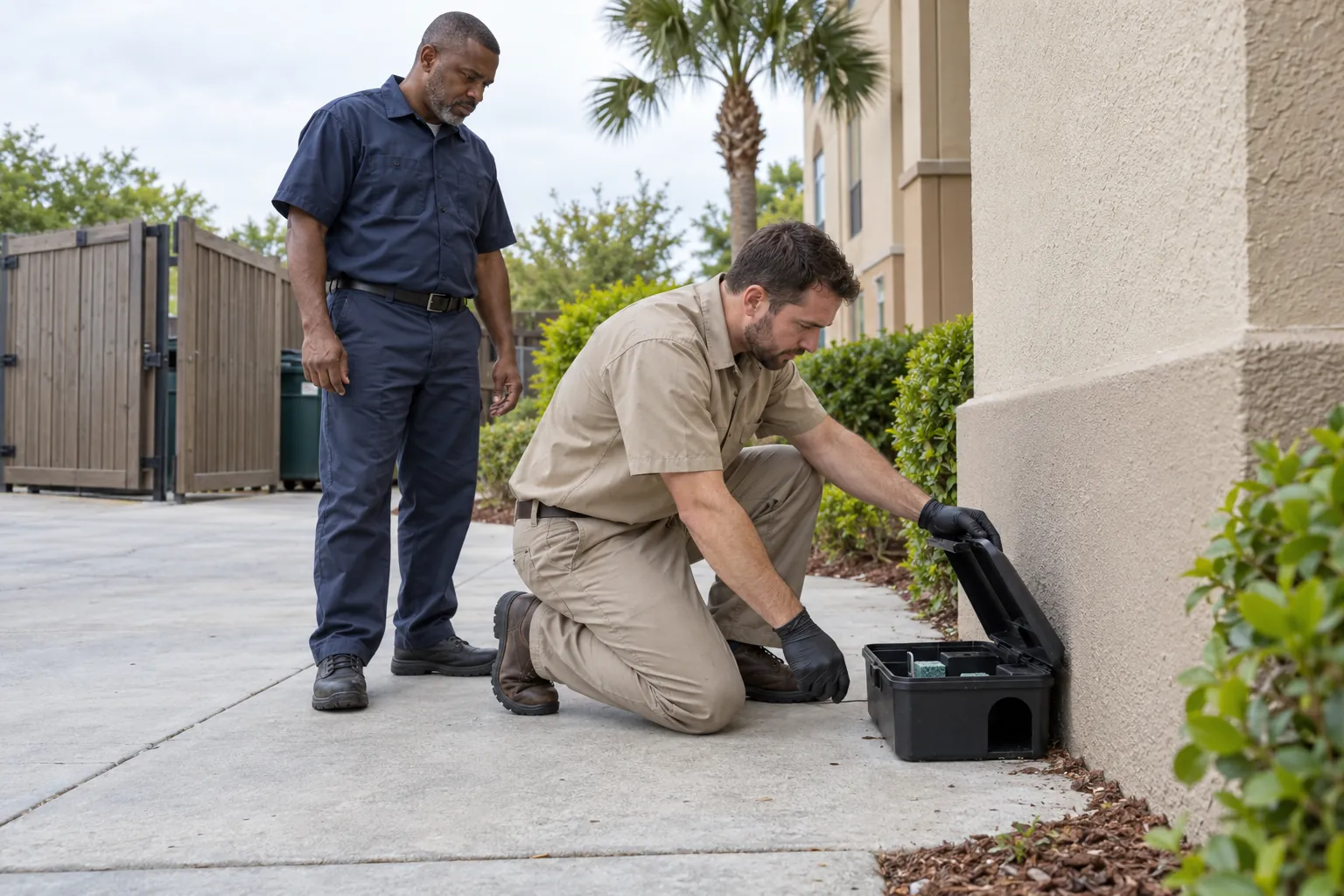
Rodents. Food Code section 6-202.15 requires outer openings to be protected by "Filling or closing holes and other gaps along floors, walls, and ceilings", "Closed, tight-fitting windows" and "Solid, self-closing, tight-fitting doors". Section 7-206.12 says "Rodent bait shall be contained in a covered, tamper-resistant bait station", and 6-501.112 requires dead or trapped pests to be removed "at a frequency that prevents their accumulation, decomposition, or the attraction of pests." In practice engineering checks regularly for gaps, cracks and crevices, especially around pipes and conduits, and someone is named to seal each one so mice and rats cannot get in. A propped dock door or worn sweep is an engineering job, and the sighting stays open until it is fixed.
The contract. San Bernardino County "strongly recommends the use of a licensed pest control operator" for a hotel. The contract should name the areas covered, the visit frequency, the response time for a bed bug or rodent call, each side's contact, and the service report left after every visit: what was inspected, found and applied, and what the hotel must fix.
Good evidence, for an inspector, a brand audit or a guest's lawyer:
- A written program and bed bug procedure, with dated staff training.
- Every sighting with the room or area, the exact spot, the time, who saw it and a photo.
- For each bed bug report: when the room went out of order, who inspected, what was found, which adjacent rooms were checked, the treatment, the follow-ups and the release.
- The contractor's service reports and pesticide application records, matched to the sightings.
- Repair work orders raised from sightings, with the date engineering closed them.
- Proof the routine checks happened when due: room inspections, the look behind kitchen equipment, the dock and trash room walk.
06
Where the record fails, and what SiteClara does about it
Hotel pest records fail in familiar ways. A room attendant sees dark spots on a mattress seam, mentions it in the service elevator, and the room is sold again that night. The night steward sees a mouse in the banquet kitchen and tells a morning shift who never saw where it went. The sighting book is in the engineering office, six floors away. The technician writes "no activity noted" because nobody showed them last week's reports. The dock door sweep is mentioned at three morning meetings and fixed at none. And when a complaint becomes a claim, the hotel can show it has a bed bug procedure, but not that anyone followed it for that room that day.
SiteClara records checks and reports at the location. A printed QR poster, with an optional NFC tag behind it, goes at each place that matters: each floor's linen room, the kitchens, the laundry, the dock, the trash room, the locker rooms. Staff scan or tap with their own phone, with no app to install, and report what they found with a photo, such as "Room 412, spots on the mattress seam". The report carries the place, the time and the named person, and goes onto the team's list of jobs until someone closes it. Scheduled checks, such as a monthly bed bug inspection of a floor or a nightly look behind the cook line, are marked done at the location, or the person says what stopped them.
If the pest company's technicians are enrolled too, each visit to a location can be recorded the same way, with a photo. The supervisor sees what is due, done and missed, and can record why a check was missed. Each day the supervisor reviews and approves a report that goes to nominated managers or client contacts at 8 a.m. the next morning, showing what was reported, completed and still open.
07
Questions people ask
Are hotels required to have pest control?
Yes, in effect: state and county lodging rules require hotels to be kept free of vermin, though few name a contract. Florida's Rule 61C-1.004, General Sanitation and Safety Requirements, requires "Effective control measures" against vermin, OSHA's 29 CFR 1910.141 sanitation standard requires "A continuing and effective extermination program" where vermin are detected, and many states require certification to apply any pesticide commercially, so most hotels contract a licensed company.
What are the 5 steps of IPM?
The EPA's Integrated Pest Management (IPM) Principles set out four, not five: set action thresholds, monitor and identify pests, prevention, and control. Control comes last, once monitoring shows a pest has passed the action threshold, with the less risky methods tried first.
What are the most common methods of control used in IPM?
The University of California's What Is Integrated Pest Management (IPM)? groups them as biological control, cultural controls, mechanical and physical controls, and chemical control, and says pesticides are used "only after monitoring indicates they are needed". In a hotel, cultural and physical controls, such as proper cleaning, sealed gaps and tight doors, do most of the work.
How do you prevent bed bugs from going from a hotel to home?
The EPA's Protecting Your Home from Bed Bugs says to "Inspect the luggage rack in your hotel room for bed bugs", because they travel on "furniture, bedding, luggage, boxes and clothing", and notes that "A dryer on high heat can kill bed bugs." Its How to Find Bed Bugs lists the signs to look for when staying away from home.
Do bed bugs spread disease?
No. The CDC's About Bed Bugs says "Bed bugs are not known to spread diseases to people", though bites cause itching and lost sleep. The EPA's page Bed Bugs: A Public Health Issue still calls them "a public health pest" for their physical, mental health and economic effects.
How often should hotel rooms be inspected for bed bugs?
No federal rule sets a frequency. Housekeepers look every time they strip a bed, and the Virginia Bed Bug Action Plan for Hotels suggests a monthly inspection plan drafted with the pest management company, with canine inspections of a set number of rooms weekly or monthly as an option.
08
Where to read more, and a list to take away
Start with your state or county environmental health department, which will say which rules and which Food Code edition apply; Florida's is Rule 61C-1.004. For bed bugs, read the EPA's How to Find Bed Bugs, the CDC's About Bed Bugs and the Bed Bug Action Plan for Hotels; San Bernardino County's self-inspection list shows what one inspector looks at. For kitchens, read Chapters 6 and 7 of the FDA Food Code 2026 beside your state's version, and for the workplace duty 29 CFR 1910.141.
- Write a pest program and a bed bug procedure, and name who owns each.
- Train every department to recognize bed bug signs.
- Build a one-minute bed check into every checkout clean.
- Take a room out of order at the first sign, move nothing out, and call the licensed company the same day.
- Inspect the rooms on either side, above and below.
- Keep kitchens, docks and trash rooms on the same program: sealed gaps, tight doors, clean drains.
- Leave treatment to the licensed professional.
- Keep each sighting, service report and repair together.
Sources
Every document this guide quotes or links to, in the order it first cites them.
- Florida Administrative Code Rule 61C-1.004, General Sanitation and Safety Requirements flrules.org
- Self-Inspection List for Hotel and Motel Operators sbcounty.gov
- Bed bug laws and regulations epa.gov
- FDA Food Code 2026 fda.gov
- 29 CFR 1910.141 osha.gov
- Bed Bug Action Plan for Hotels vdacs.virginia.gov
- How to Manage Vermin in Hotels and Motels sbcounty.gov
- Protecting yourself from bed bugs in public places epa.gov
- About Bed Bugs cdc.gov
- How to Find Bed Bugs epa.gov
- Controlling bed bugs using integrated pest management epa.gov
- Suggested Procedures for Owners/Operators in Case of Bed Bug Infestation sbcounty.gov
- Certification standards for pesticide applicators epa.gov
- Integrated Pest Management (IPM) Principles epa.gov
- What Is Integrated Pest Management (IPM)? ipm.ucanr.edu
- Protecting Your Home from Bed Bugs epa.gov
- Bed Bugs: A Public Health Issue epa.gov
Related guides
 Premises and facilities managementPest sighting log: recording pest activity so it gets dealt withWhat a pest sighting log should record, who fills it in, how sightings reach your pest control provider, and the US rules behind it: FDA Food Code, OSHA and CMS.
 CleaningHotel housekeeping checklist: what to check, and how to know it was doneA hotel housekeeping checklist for guest rooms, bathrooms and public areas, the OSHA and Cal/OSHA rules behind it, and how to show each check was really done.
 Premises and facilities managementHotel preventive maintenance checklist: guest rooms, public areas and the systems behind themA hotel preventive maintenance checklist: guest room PM, public areas, pools, life safety and plant, how often, who does it, and what the record should show.
 Premises and facilities managementPest control in hospitals: running an IPM program that protects patientsHow pest control in hospitals works in the US: the CMS and CDC basis, integrated pest management, high-risk areas, who does what and the records to keep.