Cleaning
Hotel housekeeping checklist: what to check, and how to know it was done
A hotel housekeeping checklist is the list of tasks a room attendant completes, in a set order, to clean, sanitize, restock and check each guest room, bathroom and public area to the same standard before guests use it.
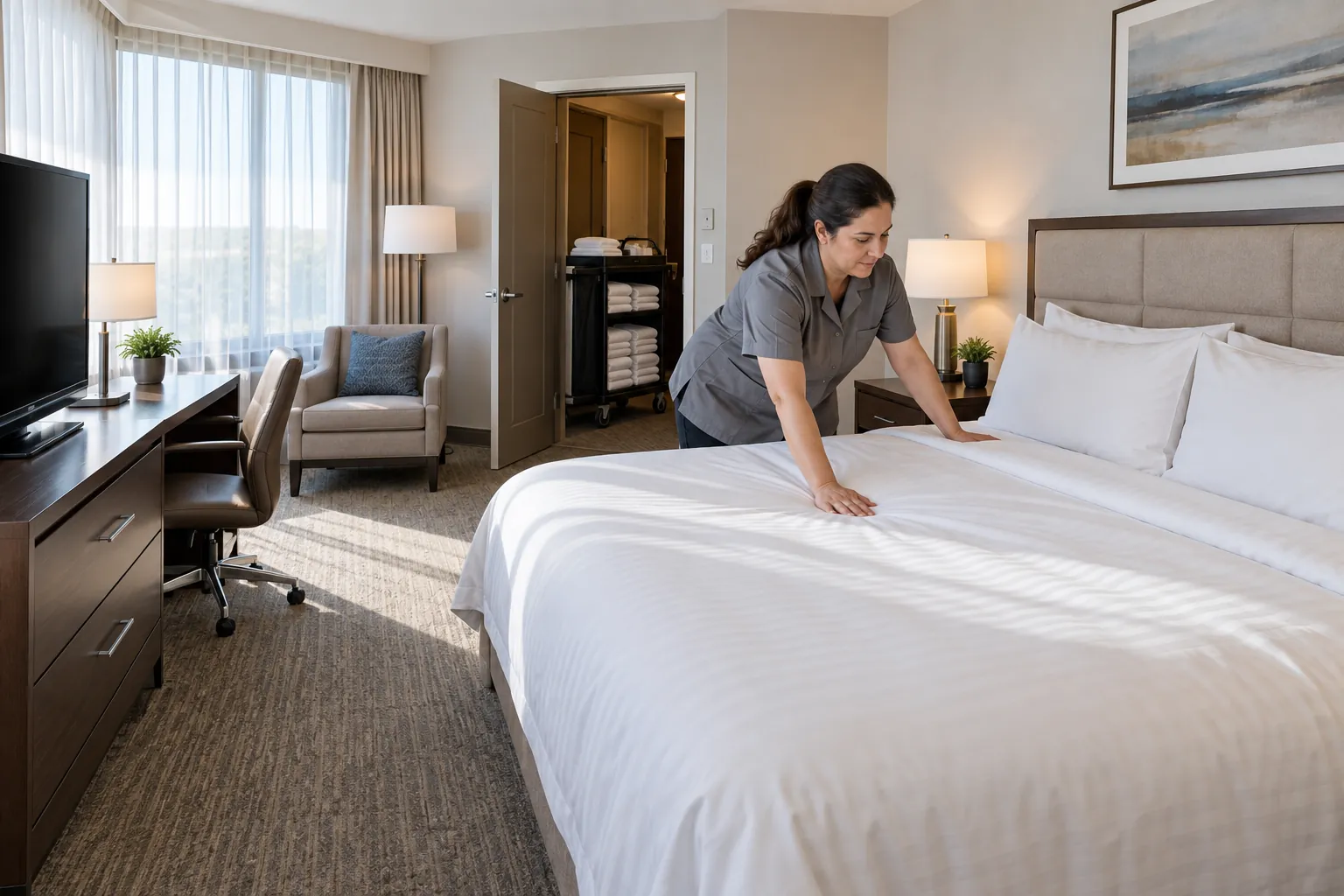
It is how an executive housekeeper turns a brand standard into the same result in every room, on every floor, on every shift. It tells a room attendant what a finished checkout looks like, tells an inspector what to look for before a room is released, and tells the public area attendant which restrooms and corridors to walk and when. This guide covers the rules behind hotel housekeeping in the United States, a working checklist for guest rooms, bathrooms and public areas, how rooms are inspected, how to keep housekeepers safe, and how a manager can tell the checks were done.
01
The rules behind hotel housekeeping
No federal regulation sets out what a clean hotel room looks like. That standard comes from the brand standards of a franchise or management company, the owner’s own standards at an independent property, and the lodging and sanitation rules that some state and local health departments apply to hotels. What federal law does regulate is the workplace, and a hotel’s guest floors, corridors, laundry and back-of-house are a workplace for the people who clean them.
Four OSHA general industry standards shape the job. The walking-working surfaces standard, 29 CFR 1910.22 requires that "all places of employment, passageways, storerooms, service rooms, and walking-working surfaces are kept in a clean, orderly, and sanitary condition," that floors are kept clean and, "to the extent feasible, in a dry condition," and that surfaces are "inspected, regularly and as necessary, and maintained in a safe condition." The sanitation standard, 29 CFR 1910.141 says that "all places of employment shall be kept clean to the extent that the nature of the work allows," and that where rodents, insects or other vermin are detected, "a continuing and effective extermination program shall be instituted."
The Hazard Communication Standard, 29 CFR 1910.1200 covers the chemicals on the cart. In OSHA’s own summary, "all employers with hazardous chemicals in their workplaces must have labels and safety data sheets for their exposed workers, and train them to handle the chemicals appropriately." And the Bloodborne Pathogens standard, 29 CFR 1910.1030 applies wherever an employee has occupational exposure, meaning reasonably anticipated contact with blood or other potentially infectious materials as part of the job. A room attendant who may find a used needle in a trash can or clean a blood-soiled bathroom may fall within it. It is the employer’s call, made in a written exposure determination, and where the answer is yes the hotel needs a written exposure control plan, and its housekeeping paragraph applies: "Employers shall ensure that the worksite is maintained in a clean and sanitary condition," with a written schedule for cleaning and decontamination set by location, surface, soil and task.
Check which OSHA you are under before you cite any of this. There are 22 OSHA-approved State Plans that cover private employers instead of federal OSHA, and their rules can go further. California is the clearest example for hotels. California Code of Regulations, Title 8, Section 3345, Hotel Housekeeping Musculoskeletal Injury Prevention, operative since July 1, 2018, requires every lodging establishment in the state to have a written musculoskeletal injury prevention program for its housekeepers, covered in section 04 below.
02
The hotel housekeeping checklist, room by room
A checklist works best in the order the attendant works: strip, clean top to bottom and dry to wet, make up, restock, check. Adapt these lists to your brand standards.
Guest room, checkout (vacant dirty to vacant clean):
- Open drapes, turn on every light and check each bulb works; note any that do not for engineering.
- Remove trash, used glassware and trays; check drawers, closet and under the bed, and log anything left behind through lost and found.
- Strip the beds; check the mattress, box spring seams and headboard for signs of bed bugs before making up with fresh linen.
- Dust top to bottom: headboard, lamps, frames, desk, nightstands, TV, closet shelf, windowsills and HVAC grille, and clean the windows and mirrors; restock the coffee station.
- Clean and disinfect the high-touch points: door handles and the deadbolt, light switches, remote control, phone, thermostat, desk chair arms, safe keypad, hair dryer, iron and ironing board, coffee maker and microwave.
- Vacuum the carpet including edges, corners and under the bed where it can be reached; spot-clean stains.
- Check the room works: TV, safe open and empty, HVAC, door closer and latch, and nothing hung from the sprinkler head.
- Set amenities and thermostat to standard and take a final look from the doorway.
Bathroom:
- Remove used towels, bath mat and amenities; empty trash.
- Apply the disinfectant to the toilet, sink, vanity, tub or shower and fixtures, and leave it wet for the contact time on its label.
- Clean the toilet inside and out, including the base and behind the seat hinges; clean the tub or shower, walls, grout, door or curtain and drain; polish fixtures and mirror.
- Report dripping faucets, a running toilet, slow drains and loose grab bars to engineering.
- Mop the floor last, working out of the room; replace towels and restock toilet paper, tissues and amenities.
Stayover (occupied room): the same room tidied to the guest’s preference and your program: bed made or linen changed on the agreed cycle, trash out, bathroom cleaned and towels replaced, supplies restocked. Respect the do-not-disturb sign, and follow the hotel’s procedure for a room that has shown do-not-disturb for too long, which usually means a manager, not the attendant, checks on the guest.
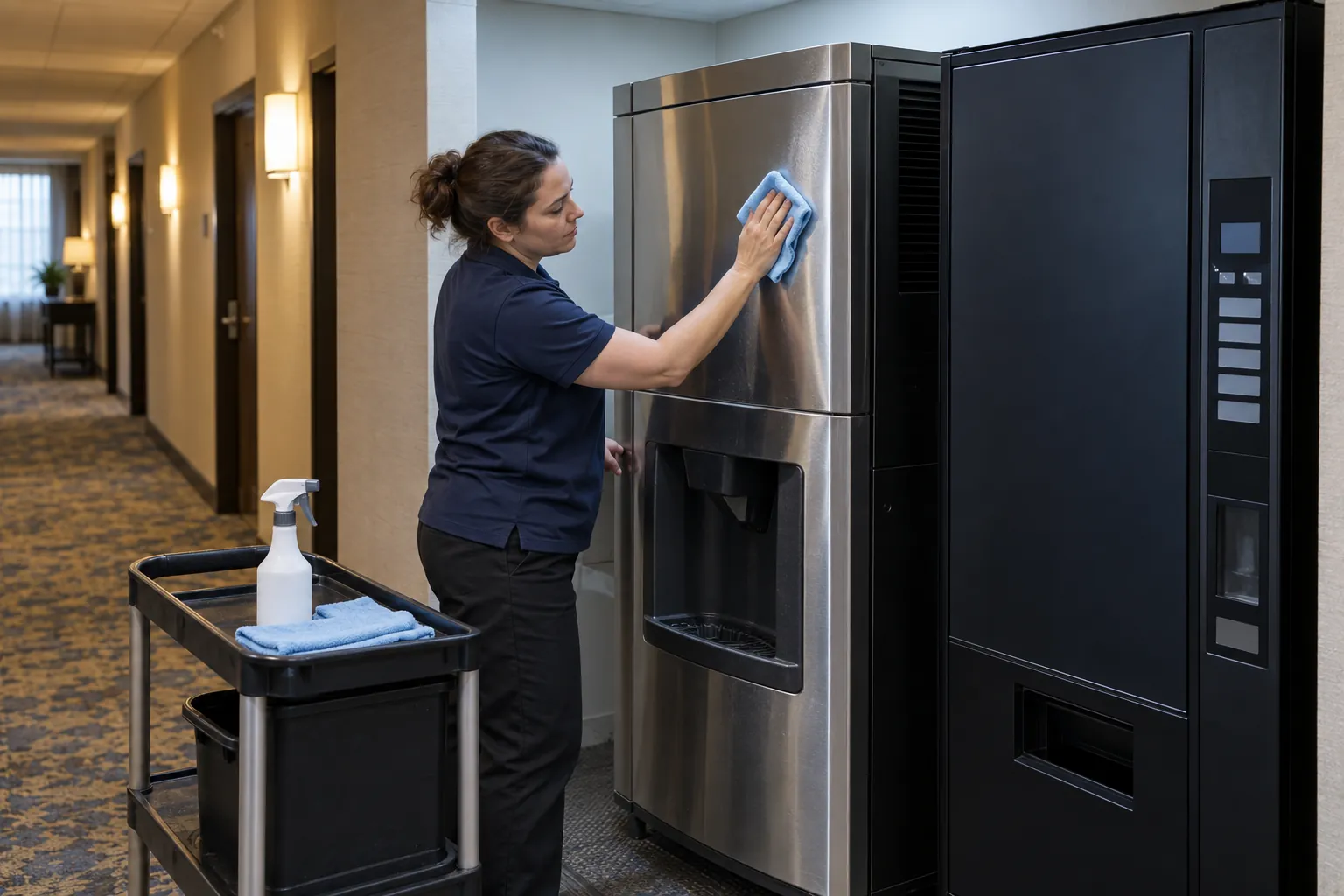
Public areas: the lobby, lobby and meeting-room restrooms (see public restroom cleaning), elevator cabs and landings, guest corridors and stairwells, ice and vending alcoves, the fitness center, the pool deck, the breakfast area and back-of-house break and locker rooms. Each needs its own short list and a set number of rounds a day, and they are the areas most often left off the record.
03
Room status, frequencies and inspection
Guest rooms run on status. The front desk and housekeeping share a room status in the property management system (PMS): occupied, vacant dirty, vacant clean, inspected, out of order and so on. The executive housekeeper or housekeeping manager builds the morning board from the night’s occupancy and expected departures, assigns sections and responsibilities to the housekeeping staff, and sets a quota, usually counted in rooms or in credits where a checkout counts for more than a stayover.
The frequencies in a hotel housekeeping checklist fall into three bands:
- Every departed room, and occupied rooms on the stayover cycle your brand sets: the checkout or stayover list above.
- Public areas, several times a day: lobby restrooms, entrance and elevators checked on a set round, more often at peak check-in and checkout and during events.
- Deep cleaning on a rotation: a set number of rooms a week or month for the tasks a daily clean does not reach, such as high dusting, drapes, mattresses, vents and carpet extraction, logged by room number.
Inspection is where the checklist becomes a result. An inspector or floor supervisor walks a completed room before it is released to the front desk, checks it against the same list the attendant used, and either marks it inspected or sends it back with what was missed. Record the result: what failed, who fixed it and when the room was released. A repeated miss is a training point, not a reason to blame one person. For audit methods, see janitorial quality control.
Engineering items found on the round go to a work order at once, and the room goes out of order if it cannot be sold safely. An inspection sheet with "shower head leaking" written in the margin is not a work order. The same applies to pests: under 1910.141(a)(5), pest control in the workplace is continuing, and a sighting only helps if it reaches whoever manages the pest control contract.
04
Keeping housekeepers safe on the job
Room attendants lift mattresses to tuck sheets, push heavy carts, bend over tubs and reach above their shoulders, many times a shift. California’s Section 3345 is written for exactly that. It defines housekeeping tasks as cleaning and maintaining sleeping room accommodations, including making beds, vacuuming, handling linen carts, supplying linens, removing trash and moving furniture, and it requires the written program to cover responsibility, compliance, communication that encourages housekeepers to report hazards without retaliation, a worksite evaluation, investigation of injuries, correction of hazards, and an annual review.
The worksite evaluation must look at, among other things, slips, trips and falls; awkward postures; reaches above shoulder height; lifting and forceful exertions; bending, twisting, kneeling and squatting; pushing and pulling; excessive work-rate; and inadequate recovery time. Section 3345 requires "an effective means of involving housekeepers and their union representative" in the evaluation and in choosing corrections, and training when the program starts, for new housekeepers and supervisors, at least once a year, and when new equipment or hazards arrive. Records follow the California IIPP rules in 8 CCR 3203(b), must be available at the worksite for housekeepers to review, and must reach Cal/OSHA within 72 hours if it asks. Elsewhere there is no federal equivalent, but the evaluation is a good model.
The rest of the safety program is the familiar list:
- Sharps and blood. Never reach into a trash can or push trash down by hand. Under 1910.1030, broken glass that may be contaminated is picked up with a brush and dustpan, tongs or forceps, never by hand, and sharps go straight into a closable, puncture-resistant, labeled container. See blood spill cleanup for the procedure.
- Chemicals. Labels on every bottle, including the ones filled from a dispenser, safety data sheets that attendants can reach, and training on each product. The EPA list of selected registered disinfectants reminds users that "the surface should be visibly wet for the entire contact time," which may mean applying the product again; a spray and an immediate wipe does not disinfect.
- Working alone in a guest room. A written procedure for entering an occupied room, a door propped open while cleaning where your policy allows it, a way to call for help, and a clear rule that an attendant leaves and reports if anything feels wrong.
Housekeepers are also the staff most likely to notice signs of human trafficking or other harm: a room that refuses service for days, many people coming and going, someone who seems unable to leave. The AHLA Foundation’s "No Room For Trafficking" program is listed among the Safe Stay resources, and the Department of Homeland Security’s Blue Campaign page on how to identify and report human trafficking gives the National Human Trafficking Hotline, 1-888-373-7888, and warns: "Do not at any time attempt to confront a suspected trafficker directly."
05
Bed bugs, lost and found, and what good evidence looks like
Bed bugs are a housekeeping matter first, because a room attendant sees the bed every day. The EPA’s How to Find Bed Bugs lists the signs: "rusty or reddish stains on bed sheets or mattresses caused by bed bugs being crushed," dark spots of excrement, tiny pale eggs and shed skins, and live bugs, found "near the piping, seams and tags of the mattress and box spring, and in cracks on the bed frame and headboard." Put a quick look at those places on the checkout checklist, and give attendants one route for a sighting: the room goes out of order, the supervisor confirms, and the pest control provider is called.
Good evidence for a hotel housekeeping program is specific and made at the time:
- The daily board and each attendant’s section, with rooms completed and released.
- Inspection results by room: pass or sent back, what was missed, and when it was fixed.
- Public area rounds with the time each area was checked and by whom, not a column of initials filled in at the end of the shift.
- The deep cleaning rotation by room, showing which rooms were done and which are due.
- Work orders raised from housekeeping and when engineering closed them.
- Pest sightings and the follow-up.
06
Where the housekeeping record fails, and what SiteClara does about it
Guest rooms are usually well tracked: the PMS knows which rooms were cleaned and inspected. The record thins out everywhere else. The lobby restroom, the fitness center, the pool deck and the ice alcove on each floor are often checked against a sheet on the back of a door, initialed in a column, sometimes filled in for a whole shift at once. Nobody can tell when each check was done, a missed round is rarely written down as missed, and a leaking toilet noted on the sheet waits until someone reads it.
SiteClara records those checks at the location. A printed QR code poster, with an optional NFC tag behind it, goes at each place a check is scheduled. A public area attendant scans the code or taps the tag on their own phone, with no app to install, sees the checks due there, and marks each one done or says what stopped them, for example a restroom closed for a leak. The time and the named person are recorded as it happens, with a photo when one is asked for. A problem found on the round, such as a broken hand dryer or a spill by the elevators, goes onto the team’s list of jobs until someone closes it.
The housekeeping supervisor sees what is due, done and missed, and records the reason when a check was missed. Each day they review the totals and photos, add a note and approve a report that goes the next morning to nominated managers, such as the general manager or, where public areas are contracted to a janitorial company, the hotel’s contact. It shows what was reported, completed and still open, and how the scheduled checks went, for example 30 of 32 rounds completed, with the reasons for the two that were not.
07
Questions people ask
What are the typical daily checklists for housekeeping?
In a hotel there are usually four: the checkout list for each departed room, the stayover list for occupied rooms, the bathroom list, and a short list for each public area with a set number of rounds a day. The CDC’s When and How to Clean and Disinfect a Facility gives the principle behind the frequencies: "Clean high-touch surfaces regularly," and "Clean other surfaces when they are visibly dirty." It adds that in a high-traffic area "you may choose to clean more frequently or disinfect in addition to cleaning," which is why lobby restrooms and elevators get more rounds than a quiet corridor.
What are the 5 S’s of housekeeping?
Sort, set in order, shine, standardize and sustain, a workplace organization method from lean manufacturing rather than a hotel rule. The EPA’s Lean Thinking and Methods – 5S describes 5S as "a system to reduce waste and optimize productivity through maintaining an orderly workplace and using visual cues to achieve more consistent operational results." In a hotel it suits the housekeeping closet, the linen room and the cart better than the guest room, and on shine the EPA notes that "Daily follow-up cleaning is necessary to sustain this improvement."
08
Further reading, and a list to take away
Start with OSHA’s 29 CFR 1910.22, 29 CFR 1910.141, the Hazard Communication Standard and the Bloodborne Pathogens standard, then check whether your state runs its own OSHA-approved State Plan. In California, read 8 CCR 3345 in full. Your brand standards, and any state or county lodging rules, complete the picture. For touch points in public areas, see high-touch surface cleaning.
Before your next brand or owner inspection, check that:
- there is a written checklist for checkouts, stayovers, bathrooms and each public area, matching your brand standards;
- every public area has a set number of rounds a day, and each round records the time and the person;
- inspections record what failed and when it was fixed, not just a pass;
- engineering items and pest sightings reach a work order or the pest control provider the same day;
- chemicals are labeled, safety data sheets are at hand, and attendants know the contact time of each disinfectant;
- you have made an exposure determination under the Bloodborne Pathogens standard, and attendants know what to do with sharps and blood;
- in California, the Section 3345 program, worksite evaluation and training records are current and available to housekeepers.
Sources
Every document this guide quotes or links to, in the order it first cites them.
- Walking-working surfaces standard, 29 CFR 1910.22 osha.gov
- Sanitation standard, 29 CFR 1910.141 osha.gov
- Hazard Communication Standard, 29 CFR 1910.1200 osha.gov
- Bloodborne Pathogens standard, 29 CFR 1910.1030 osha.gov
- OSHA-approved State Plans osha.gov
- California Code of Regulations, Title 8, Section 3345, Hotel Housekeeping Musculoskeletal Injury Prevention dir.ca.gov
- EPA list of selected registered disinfectants epa.gov
- Safe Stay ahla.com
- Blue Campaign page on how to identify and report human trafficking dhs.gov
- How to Find Bed Bugs epa.gov
- When and How to Clean and Disinfect a Facility cdc.gov
- Lean Thinking and Methods – 5S epa.gov
Related guides
 CleaningPublic restroom cleaning: frequency, safety and ADA upkeepCleaning public restrooms in parks, transit, venues and public buildings: how often at peak, sharps and bodily fluids under OSHA, and keeping ADA features usable.
 CleaningHigh-touch surfaces: a cleaning routine you can show was doneHigh-touch surfaces as the CDC describes them: which ones to list area by area, how often to clean and disinfect them, the right method, and a record that holds up.
 CleaningJanitorial quality control: how to inspect, score and fix the cleaningHow janitorial quality control works: QA versus QC, building a cleaning inspection checklist, APPA appearance levels, sampling, scoring and corrective action.
 CleaningBlood spill cleanup: doing it safely, and showing it was doneHow to clean up a blood spill at work under OSHA's bloodborne pathogens standard: PPE, sharps, disinfectants, waste, training and the record to keep.