Cleaning
Lactation room requirements: what the law asks, and how to keep the room usable
Under federal law, a workplace lactation room must be a place other than a bathroom, shielded from view and free from intrusion from coworkers and the public, that a nursing employee can use to pump breast milk each time she needs to.
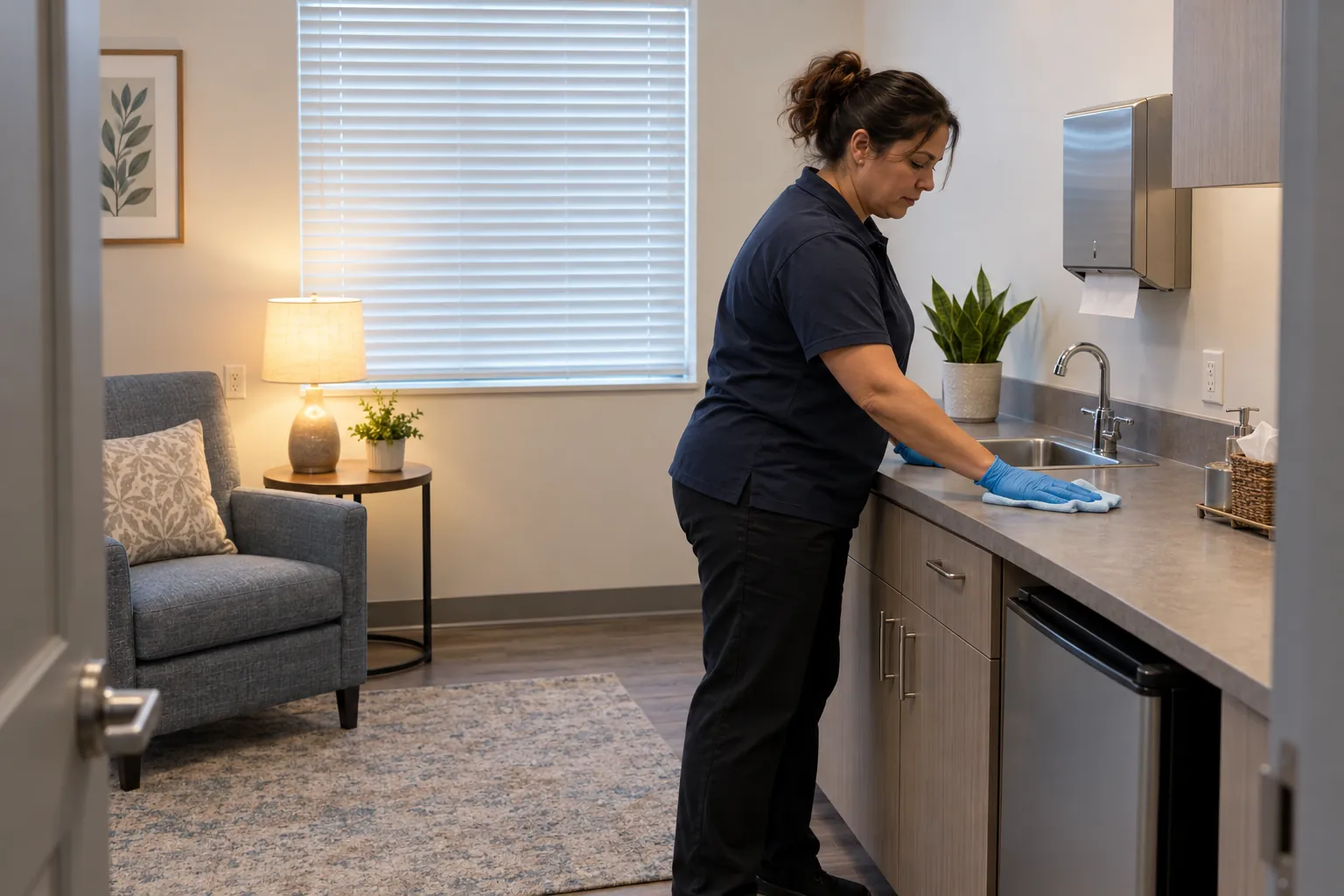
Deciding where that designated lactation space is located falls to HR and the facility manager; keeping it clean, stocked, lockable and actually free when someone needs it falls to the janitorial crew and the building team, every day. This guide covers the federal and state requirements, what the space needs, and the routine that keeps a lactation room fit to use.
01
What federal law requires
The federal rule is in the Fair Labor Standards Act, as expanded by the PUMP for Nursing Mothers Act, which became law on December 29, 2022. The requirement itself is 29 U.S.C. 218d, Breastfeeding accommodations in the workplace. Subsection (a) says an employer shall provide:
- "a reasonable break time for an employee to express breast milk for such employee's nursing child for 1 year after the child's birth each time such employee has need to express the milk"; and
- "a place, other than a bathroom, that is shielded from view and free from intrusion from coworkers and the public, which may be used by an employee to express breast milk."
The statute does not require a room with that name, a sign or a particular size. It sets three tests: not a bathroom, shielded from view, and free from intrusion. The Department of Labor's Fact Sheet #73: FLSA Protections for Employees to Pump Breast Milk at Work adds that a bathroom is not permitted "even if private," and that a space not dedicated to the purpose must be available when needed.
- Who is covered: nearly all employees covered by the FLSA. The Wage and Hour Division lists exceptions for airline flight crewmembers and some rail and motorcoach workers.
- Small employers: under 218d(c), an employer with fewer than 50 employees is not subject to the requirements if they "would impose an undue hardship by causing the employer significant difficulty or expense." That is a narrow defense to be shown, not a blanket exemption.
- Pay: the break need not be paid unless another federal, state or local law says so, but it counts as hours worked if the employee is not completely relieved from duty.
- Remote workers: Fact Sheet #73 says a teleworking employee must be free from observation by any employer-provided or required video system while pumping.
The expanded remedies took effect on April 28, 2023. The Department of Labor's Fact Sheet #73A: Space Requirements for Employees to Pump Breast Milk at Work under the FLSA explains that before suing, an employee may be required to give the employer 10 days to come into compliance, but not where she complains to the Wage and Hour Division, where the claim is about break time rather than space, where she was fired for asking for break time or space or for opposing the employer's conduct, or where the employer has said it has no intention of providing a place.
02
What the space needs to be usable
The Department of Labor's FLSA Protections to Pump at Work page sums the space up as one that is "functional for pumping milk, shielded from view, free from intrusion, available as needed and not a bathroom." Fact Sheet #73A turns "functional" into things a facility team can check:
- A place to sit, and a flat surface, other than the floor, on which to place the pump.
- Electricity, ideally, so an employee can use an electric pump.
- A sink nearby: the fact sheet says access to a sink near the space, so an employee can wash her hands and clean attachments, "improves the functionality of the space."
- Privacy: it suggests "a space with a locking door or use of a sign that designates when the space is in use and off limits to others." Window blinds, a door that closes fully and no glass panel in view of a corridor all belong here.
- Storage: employers need not provide a refrigerator under federal law, but must allow an employee to bring a pump and an insulated container or cooler and make sure there is a place to store them while she works.
A dedicated room is the simplest answer in an office building, but not the only one. Fact Sheet #73A accepts a space "temporarily created or converted" or "made available when needed," such as a manager's office or a conference room with a lock, provided it is available each time an employee needs to pump. That is where most trouble starts: a conference room that is booked for a meeting, or an office whose occupant is on a call, is not available.
Where more than one nursing employee uses the space, the number of users must not prevent anyone from taking a pump break or lead to prolonged waiting; Fact Sheet #73A suggests a dedicated room on each floor, or a shared room with privacy screens.
Beyond the legal minimum, a comfortable chair rather than a stool, and a room that is neither cold nor stuffy, make the difference between a space that meets the law and one that lactating employees are glad to use.
03
State and city rules that go further
The PUMP Act is a floor. Several states and cities set more detailed requirements for the space itself, and an employer has to meet whichever rule is stricter. Two large examples show how far they go.
California. California Labor Code section 1031, as amended with effect from January 1, 2020, says a lactation room or location "shall not be a bathroom and shall be in close proximity to the employee's work area, shielded from view, and free from intrusion while the employee is expressing milk." It must:
- "Be safe, clean, and free of hazardous materials";
- "Contain a surface to place a breast pump and personal items";
- "Contain a place to sit"; and
- "Have access to electricity or alternative devices, including, but not limited to, extension cords or charging stations, needed to operate an electric or battery-powered breast pump."
Section 1031(d) adds that the employer shall provide access to "a sink with running water and a refrigerator suitable for storing milk in close proximity to the employee's workspace," or, if a refrigerator cannot be provided, another cooling device such as an employer-provided cooler. Where a multipurpose room is used, lactation takes precedence over the other uses "but only for the time it is in use for lactation purposes," and an employer in a multitenant building may share a space with other employers if it cannot provide one in its own workspace. California writes cleanliness into the requirement in so many words.
New York State. New York Labor Law section 206-c, as amended with effect from June 19, 2024, requires 30 minutes of paid break time each time an employee has reasonable need to express breast milk, for up to three years following childbirth. On request, the employer must designate a room or location that is "in close proximity to the work area," "well lit," "shielded from view" and "free from intrusion," providing at minimum "a chair, a working surface, nearby access to clean running water and, if the workplace is supplied with electricity, an electrical outlet." It may not be a restroom or toilet stall. If the workplace has refrigeration, the employer must extend access to it for storing expressed milk, and employers must give employees a written policy on how to request the space.
Other states and some cities have their own rules, and they change. Write your building standard to the strictest rule that applies to anyone working in the building.
04
Cleaning a lactation room: what, how often and with what
A lactation room is a small room with a lot of hand contact. Treat it as a high-touch area, and name it in the janitorial scope of work as its own line with a frequency, rather than folding it into "offices" or "common areas."
- High-touch surfaces, daily as a minimum: the door handle, the lock or occupancy indicator, light switches, the chair arms and seat, the table or counter, the sink faucet and the refrigerator handle.
- The sink, daily: basin, faucet and counter cleaned; hand soap and paper towels refilled; trash emptied.
- The floor, daily: vacuumed or mopped, with any spill cleaned the same day.
- The refrigerator, weekly: shelves and door seals wiped, and anything spilled cleaned up. Agree in writing what happens to milk left in it; a custodian should never be the person who decides to throw it away.
- Supplies: disinfectant wipes, paper towels, hand soap and trash liners stocked, with a par level written down.
The CDC's guidance for shared equipment, How to Clean and Sanitize Breast Pumps, tells users to "wash your hands well with soap and water for 20 seconds" and, if the pump is shared, to "clean pump dials, power switch, and countertop with disinfectant wipe." That is why the wipes should never run out. If the building provides a hospital-grade pump for shared use, the manufacturer's instructions govern how it is cleaned, and the cleaning of the pump's own parts is for the user, not the janitorial crew.
Time the cleaning around use: an early visit by the day porter and the full clean after hours usually avoid the busiest times. Knock, check the occupancy sign, and never enter an occupied room to clean it.
05
The daily check: availability, privacy and faults
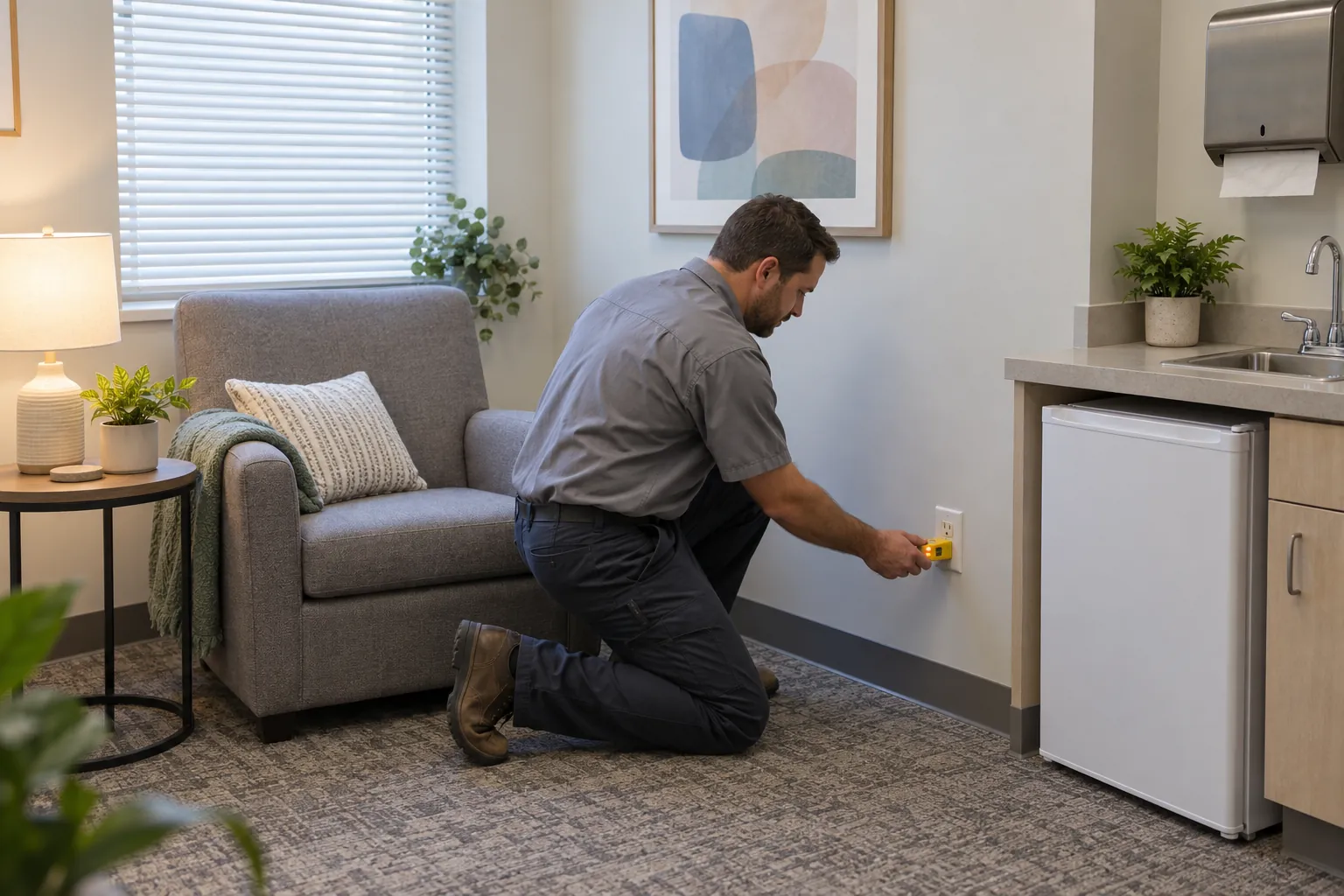
A clean room that cannot be locked, or that is booked for a meeting, fails the federal test just as surely as a dirty one. A daily check by the porter or building engineer should confirm the things that make the space legally usable, not only the things a cleaner sees:
- The lock or occupancy sign works: the door locks from inside, the in-use indicator changes, and a spare key or override exists for emergencies.
- Privacy holds: the door closes fully, blinds work, and no new glass panel, camera or open ceiling has appeared. A camera must never cover the inside of the room.
- The furniture is there and sound: the chair, the table or counter, and any screens between spaces.
- Power works: the outlet near the chair has power; a dead outlet is a fault, not an inconvenience.
- The light works, and the room is not dim enough to be a problem. New York names "well lit" in its law.
- The refrigerator is running and cold, where there is one.
- The room is still a lactation room: no boxes, no spare chairs, no furniture waiting for disposal, and no meeting booked into it in the room calendar.
Treat a broken lock or a dead outlet as urgent, because it takes the space out of use for everyone who relies on it: fix it the same day or open an alternative. Record the work order number and when the fault was fixed, so the record shows the room was out of service for hours, not weeks.
06
Where the record fails, and what SiteClara does about it
The usual record for a lactation room is nothing at all, or a sheet taped inside the door with a column of initials, filled in ahead of time or not at all. The broken lock gets mentioned to whoever is at the front desk, and a week later nobody can say when it was reported or whether it was fixed. When an employee says the room was not usable, the facility manager cannot show when it was last checked, by whom, or what was done.
SiteClara replaces the sheet with a tag at the room: a printed QR code poster, with an NFC tag behind it if the crew prefer to tap, placed on the outside of the door so nobody has to go in to use it. A custodian or porter scans the code or taps the tag on their own phone, with no app to install, and marks the scheduled check done. The time and the person are recorded as it happens. If something is wrong, such as a lock that will not catch, a dead outlet or a warm refrigerator, they record it there, with a photo of the fault taken while the room is empty, and it goes onto the team's list of jobs until someone closes it.
Checks are scheduled per location, so the lactation room can be set for a morning check and an evening clean. The crew see what is due and mark it done, or say what stopped them, for example "room in use, came back at 11:40." The supervisor sees what was done and what was missed and can record why, and the approved report goes to the facility manager at 8 a.m. the next morning.
07
Questions people ask
What are the federal requirements for lactation rooms?
Under 29 U.S.C. 218d, Breastfeeding accommodations in the workplace, an employer must give an employee reasonable break time to express breast milk for one year after her child's birth, each time she needs to, and "a place, other than a bathroom, that is shielded from view and free from intrusion from coworkers and the public." The section does not preempt a state law or city ordinance that gives employees greater protections, so where both apply the stricter rule governs.
What should be included in a lactation room?
The Department of Labor's Fact Sheet #73A: Space Requirements for Employees to Pump Breast Milk at Work under the FLSA says the space "must contain a place for the nursing employee to sit, and a flat surface, other than the floor, on which to place the pump." It adds that access to electricity for an electric pump, and a sink nearby to wash hands and clean attachments, make the space more functional, and that "it is not required that employers create permanent, dedicated spaces." Some states ask for more: California Labor Code section 1031 also requires access to a sink with running water and a refrigerator suitable for storing milk.
When did lactation rooms become mandatory?
The federal requirement began on March 23, 2010, when the Affordable Care Act amended section 7 of the Fair Labor Standards Act. The Department of Labor's notice Reasonable Break Time for Nursing Mothers says "The break time requirement became effective when the Affordable Care Act was signed into law on March 23, 2010." The PUMP for Nursing Mothers Act, signed on December 29, 2022, moved the rule to 29 U.S.C. 218d and, as the Department of Labor's FLSA Protections to Pump at Work page explains, extended it to more employees, including agricultural workers, nurses, teachers, truck and taxi drivers, home care workers and managers.
Are lactation rooms required by law in Texas?
Yes. The federal requirement in 29 U.S.C. 218d applies to covered employers in Texas as in every other state. Texas adds its own rule for public employers: Texas Government Code chapter 619, Right to Express Breast Milk in the Workplace, requires counties, cities, school districts and other political subdivisions, state agencies and public colleges and universities to adopt a written policy, to provide reasonable break time, and to provide "a place, other than a multiple user bathroom, that is shielded from view and free from intrusion from other employees and the public." Federal law rules out any bathroom, so a public employer covered by both has to meet the federal test.
08
Where to read more, and a list to take away
Start with the Department of Labor's FLSA Protections to Pump at Work page, which links to Fact Sheets #73 and #73A and to industry FAQs. The statute, 29 U.S.C. 218d, is short and worth reading in full. Then read your state's law, and your city's if it has one: California and New York are examples, not a complete list.
Before you sign off the room, check that:
- it is not a bathroom, is shielded from view and can be kept free from intrusion by a lock or an in-use sign;
- it has a chair, a flat surface other than the floor, a working outlet and a sink nearby, and meets your state's list if it is longer;
- it is available every time someone needs it, with a second space or a clear plan when more than one person uses it;
- the janitorial scope of work names it, with a daily clean of high-touch surfaces and a weekly refrigerator clean;
- disinfectant wipes, paper towels and hand soap have a par level and are restocked;
- a daily check covers the lock, privacy, power, light and refrigerator, and faults are fixed the same day or an alternative is opened;
- the record describes the room and the team's checks, never who used it.
Sources
Every document this guide quotes or links to, in the order it first cites them.
- 29 U.S.C. 218d, Breastfeeding accommodations in the workplace govinfo.gov
- Fact Sheet #73: FLSA Protections for Employees to Pump Breast Milk at Work dol.gov
- Fact Sheet #73A: Space Requirements for Employees to Pump Breast Milk at Work under the FLSA dol.gov
- What You Should Know About the Pregnant Workers Fairness Act eeoc.gov
- FLSA Protections to Pump at Work dol.gov
- California Labor Code section 1031 leginfo.legislature.ca.gov
- New York Labor Law section 206-c nysenate.gov
- How to Clean and Sanitize Breast Pumps cdc.gov
- Reasonable Break Time for Nursing Mothers govinfo.gov
- Texas Government Code chapter 619, Right to Express Breast Milk in the Workplace statutes.capitol.texas.gov
Related guides
 CleaningBreakroom cleaning checklist: what to clean, how often, and who owns the refrigeratorA breakroom cleaning checklist by surface and frequency, the OSHA sanitation rules behind it, who cleans the refrigerator, and how to show the work was done.
 CleaningHigh-touch surfaces: a cleaning routine you can show was doneHigh-touch surfaces as the CDC describes them: which ones to list area by area, how often to clean and disinfect them, the right method, and a record that holds up.
 CleaningCommon area cleaning: what it covers, how often, and how to show it was doneWhat common area cleaning covers in apartment, condo and commercial buildings, how often, the OSHA and code rules behind it, and how to show each visit happened.
 CleaningJanitorial scope of work: what it should say, and how to show it is metWhat a janitorial scope of work should cover, how to set cleaning frequencies by room type, output versus input standards, and how to show the work is being done.