Cleaning
Breakroom cleaning checklist: what to clean, how often, and who owns the refrigerator
A breakroom cleaning checklist lists every surface and appliance in the breakroom with how often each is cleaned: trash emptied and counters, tables, the sink, the microwave and the floors cleaned every working day, the refrigerator cleaned out weekly, and deep cleaning of cabinets, vents and the space behind appliances monthly.
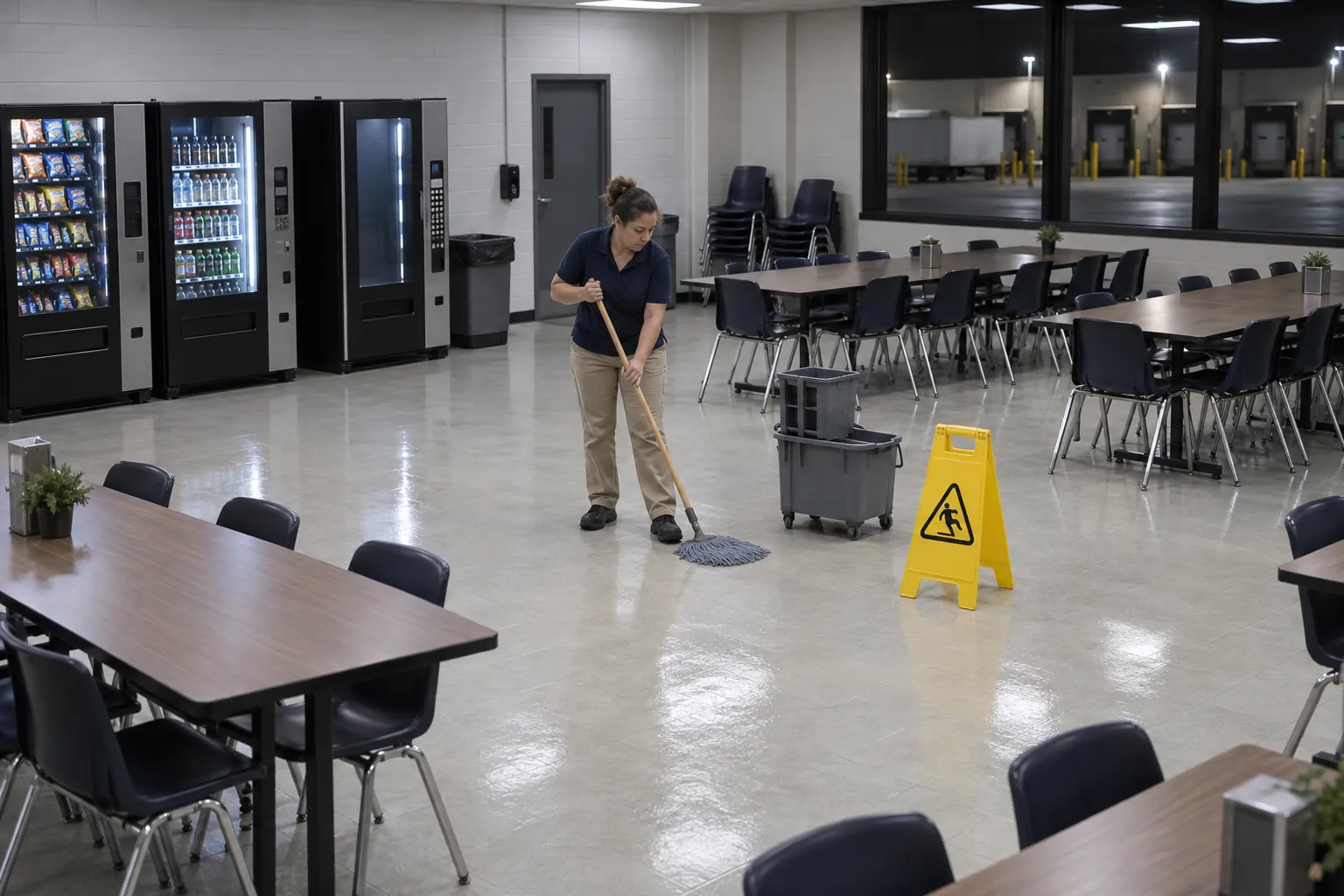
The breakroom is the one room in most workplaces where people eat, drink, wash dishes and throw away food, often all in the same ten minutes at noon. A breakroom cleaning checklist turns that into tasks a custodian or day porter can do and a supervisor can check, with a frequency for each and a clear answer to the question every office argues about: who cleans out the refrigerator. This guide covers the federal rules behind it, the checklist surface by surface, what belongs daily, weekly and monthly, and how to keep a record a facility manager will believe.
01
The rules behind a breakroom cleaning checklist
No federal rule hands you a breakroom cleaning checklist, but the outcome it must deliver is set out in OSHA's sanitation standard, 29 CFR 1910.141, Sanitation, which applies to general industry workplaces such as offices, warehouses, stores and plants. Paragraph (g) covers eating and drinking areas. It applies "only where employees are permitted to consume food or beverages, or both, on the premises", which in practice means almost every employer with a breakroom, lunchroom or kitchenette.
Paragraph (g) sets three working rules, and paragraph (h) adds a fourth where the employer provides food service:
- Employees may not eat or drink "in a toilet room nor in any area exposed to a toxic material" (g)(2), and food and drinks may not be stored there either (g)(4). A breakroom is the place people eat instead.
- Waste food receptacles must be made of "smooth, corrosion resistant, easily cleanable, or disposable materials", placed and sized so they are used and do not overfill, and "emptied not less frequently than once each working day, unless unused" and "maintained in a clean and sanitary condition" (g)(3).
- Those receptacles need "a solid tight-fitting cover unless sanitary conditions can be maintained without use of a cover" (g)(3).
- Where the employer runs food service for employees, paragraph (h) requires that it be carried out "in accordance with sound hygienic principles".
The rest of 1910.141 applies here as everywhere: "all places of employment shall be kept clean to the extent that the nature of the work allows" (a)(3); receptacles for putrescible waste must not leak and must be able to be "thoroughly cleaned and maintained in a sanitary condition" (a)(4); and every enclosed workplace must be maintained, so far as reasonably practicable, to prevent "the entrance or harborage of rodents, insects, and other vermin", with "a continuing and effective extermination program" where they are found (a)(5). Crumbs under the refrigerator are where that last rule is usually tested first.
OSHA's walking-working surfaces standard, 29 CFR 1910.22, adds the floor: each workroom floor must be "maintained in a clean and, to the extent feasible, in a dry condition", and walking-working surfaces must be kept free of hazards including "leaks, spills, snow, and ice". Spilled coffee in front of the sink is a slip hazard under that rule, not only a mess.
02
The breakroom cleaning checklist, surface by surface
A breakroom checklist works best written by surface and appliance, because that is how a custodian moves around the room and how a supervisor inspects it. Adjust the list to what is actually in the room; a warehouse lunchroom and a law firm's coffee bar share most of it. The rest of the building is covered by the office cleaning checklist, from desks and restrooms to lobbies.
- Countertops and backsplash: cleared of dishes and packaging, wiped, then sanitized with a product labeled for food contact surfaces. Grout lines and the gap behind the coffee maker collect the most.
- Tables, chairs and other furniture: tabletops cleaned and sanitized; chair seats and backs wiped, along with any sofa or bench; broken chairs reported.
- Sink, faucet and drain: dishes left in the sink dealt with according to the office's rule, the basin scrubbed, the faucet handles and spout wiped, the drain cleared of food, and any drip or leak under the sink reported.
- Microwave: inside walls, ceiling and turntable cleaned of splatter; door seal, handle and keypad wiped.
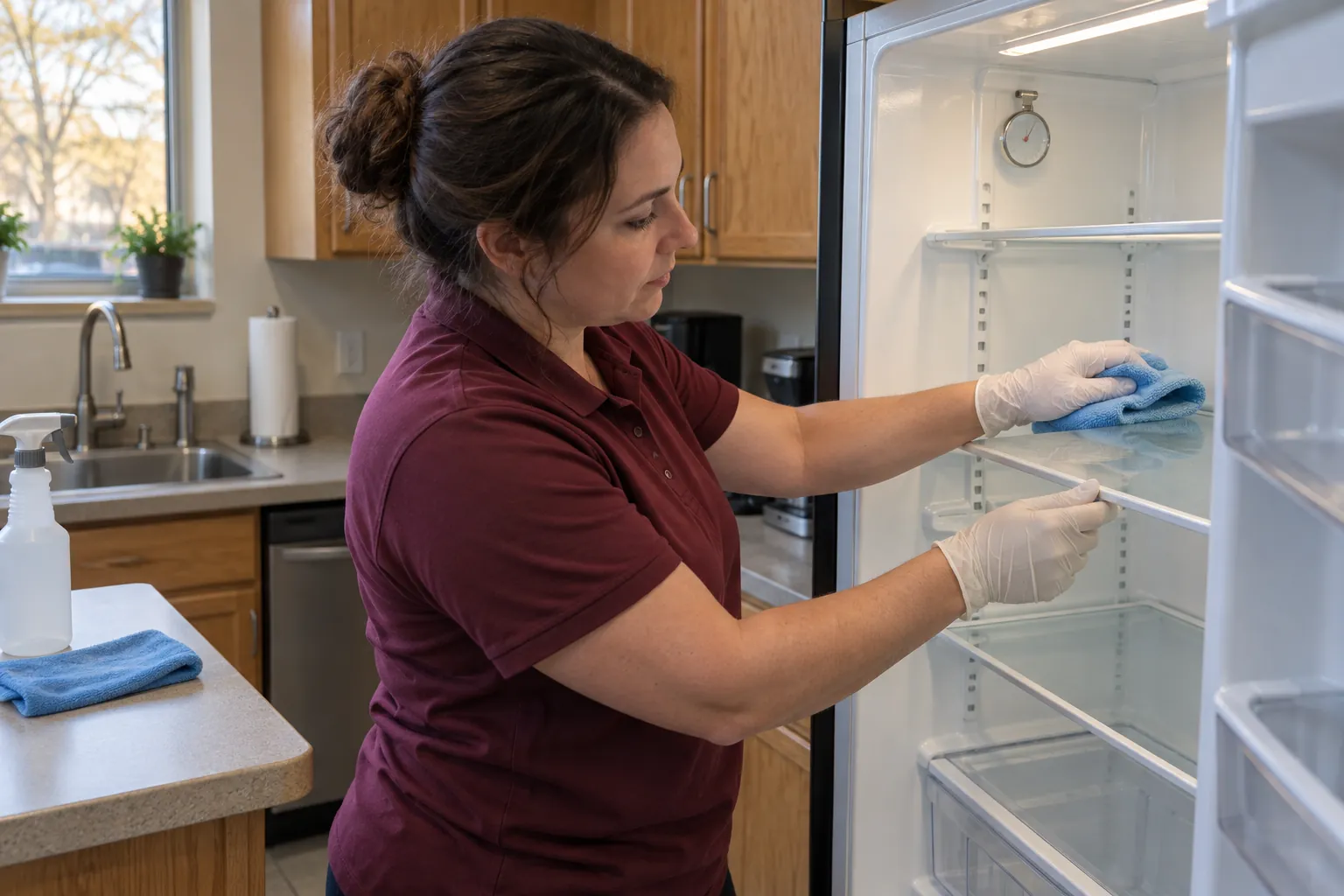
- Refrigerator: handles and door wiped daily; spills inside wiped as found; shelves and drawers cleaned on the set cleanout day; the temperature read on an appliance thermometer.
- Coffee maker, kettle and water dispenser: drip trays emptied and washed, exteriors and buttons wiped, and descaling done to the manufacturer's instructions.
- Ice machine: the exterior and dispensing area wiped; the internal cleaning and sanitizing done on the manufacturer's schedule, usually by a vendor or the building engineer (see the ice machine cleaning guide).
- Trash, recycling and compost: emptied and relined, soiled cans washed, and lids checked for fit.
- High-touch points: door handles and push plates, light switches, cabinet and drawer pulls, vending machine buttons, the dishwasher handle and any shared touchscreen (see high-touch surface cleaning).
- Dispensers and supplies: paper towels, hand soap, dish soap and sanitizer refilled, and broken dispensers reported rather than worked around.
- Floors: swept, then damp-mopped, especially under tables and in front of the sink, refrigerator and trash cans, with a wet floor sign out until it is dry.
- Signs of pests: droppings, gnawed packaging, fruit flies or cockroaches, reported the same day to whoever manages pest control.
Two things belong on the checklist even though a custodian will not do them: what is not janitorial's job, such as washing personal dishes, and who to call for faults found during the clean, such as a leaking faucet or a tripping outlet by the sink.
03
Daily, weekly and monthly breakroom cleaning tasks
Frequency follows use: a room used by 300 people across three shifts needs more than one used by 12, and a room busy at noon may need a midday pass as well as the night clean. As a starting point:
The refrigerator needs its own rule because it is shared and nobody owns it. The FDA's consumer guidance, Refrigerator Thermometers: Cold Facts about Food Safety, says to keep a refrigerator "at 40 °F or below; the freezer should be at 0 °F", and recommends a freestanding appliance thermometer because most refrigerator controls do not show the actual temperature. It also advises wiping up spills immediately and cleaning the refrigerator out frequently: "When in doubt, throw it out."
Many workplaces settle it with a posted policy: any unlabeled items, or items past a set date, are removed and thrown out at a fixed time each week, and employees are told in advance. Management sets and announces the rule; the custodian carries it out. Without one, the refrigerator is either never cleaned out or someone's lunch goes in the trash and the contractor takes the complaint.
04
Who does what, and the right products
A breakroom usually has more owners than any other room in the building, and most complaints come from the gaps between them. Write the split down:
- Janitorial or custodial staff, in-house or from a contracted cleaning services company: the daily clean, trash, floors, surfaces, appliance exteriors and restocking, on the schedule in the janitorial scope of work.
- Day porter: the midday check, spills and restocking during business hours.
- Employees: their own dishes, their own food, and wiping up what they spill in the microwave. A short, polite sign does more than a long one.
- Vendors: coffee service, water cooler and vending machine contractors often clean and service their own equipment inside; confirm what they do and how often, so janitorial does not assume it is covered.
- Facility manager or building engineer: repairs, plumbing, appliance faults, the ice machine's internal service if it is not with a vendor, and the pest control contract.
Get the products right. Cleaning removes dirt and most germs; the CDC's When and How to Clean and Disinfect a Facility says "cleaning alone removes most types of harmful germs" from surfaces and recommends cleaning high-touch surfaces regularly, with disinfection where people have obviously been ill. That guidance is written for community settings such as offices and expressly excludes "food preparation and food service areas", so for countertops and tables where food sits, use a product whose label covers food contact surfaces, and follow the label on dilution, contact time and whether the surface must be rinsed afterward.
EPA registers sanitizers and disinfectants as pesticides, and the label is binding. The EPA's Introduction to Pesticide Labels quotes the statement that "it is a violation of Federal law to use this product in a manner inconsistent with its labeling." To identify a product, EPA's Selected EPA-Registered Disinfectants page notes that "the only way to accurately identify a product is by the EPA registration number", which is on the label.
Janitorial chemicals also bring OSHA's Hazard Communication Standard (29 CFR 1910.1200): employers with hazardous chemicals must have labels and safety data sheets for exposed workers and train them. Consumer products used as the manufacturer intends, at no more than a consumer's duration and frequency of exposure, are exempt, which may cover the dish soap by the sink but rarely covers a custodian working with concentrates every night. Keep the safety data sheets where the crew can reach them, never mix products, keep chemicals out of the breakroom cabinets where food is stored, and store them in the janitor closet instead.
05
How to check the breakroom checklist is being worked
A checklist on its own proves nothing. A facility manager needs to know the work happens at the scheduled frequency and that problems found get fixed. Good evidence for a breakroom looks like this:
- A record per breakroom, per clean, showing the time and the named person, not initials added at the end of the week.
- The midday check recorded separately from the night clean, since they are different tasks with different people.
- The refrigerator cleanout recorded on the day it happened, with the thermometer reading if the building checks it.
- Faults and pest sightings reported with a time and a location, and tracked until someone closes them. A leak under the sink that three custodians noticed and nobody reported is a record failure, not a cleaning one.
- Supervisor inspections at a set frequency, scored against the checklist, with janitorial quality control findings followed up.
- Complaints logged with the date and what was done, so a pattern (the microwave every Monday, the trash on Thursday afternoons) shows up.
Look for the failures a paper sheet hides. Every box ticked at the same time of night means the sheet was filled in, not worked. A midday check never marked missed is probably not being recorded. The same refrigerator complaint every week means the cleanout rule is not followed, or was never announced.
06
Where the breakroom record fails, and what SiteClara does about it
The breakroom is cleaned at night and judged at noon. The record is usually a sheet taped inside a cabinet door, initialed in a batch, or a line in the contractor's monthly report. A missed trash run shows up as a complaint the next afternoon, the midday check leaves no trace at all, and the dripping faucet a custodian noticed at 10 p.m. is still dripping days later because the note never reached maintenance.
SiteClara puts a printed QR code poster in each breakroom, with an optional NFC tag behind it. The custodian or day porter scans the code or taps the tag on their own phone, with no app to install, and sees the scheduled checks due there, such as the night clean, the midday pass and the weekly refrigerator cleanout. They mark each one done, or explain what stopped them, and can add a photo when one is asked for. If something needs fixing, such as a leak under the sink, a broken microwave or signs of pests, they report it at the spot and it goes onto the team's list of jobs until someone closes it.
The janitorial supervisor sees what is due, done and missed, and records the reason a check was missed. At the end of the day they review the totals and photos, add a note and approve the report, which goes to the facility manager or client at 8 a.m. the next morning, showing what was completed, what is still open and how the scheduled checks went, for example 9 of 9 completed.
07
Further reading, and a list to take away
OSHA publishes its sanitation standard, 29 CFR 1910.141, and the walking-working surfaces standard free on its site; if your state runs its own OSHA program, read its version as well. The CDC's facility cleaning guidance explains when cleaning is enough and when to disinfect, the EPA explains how to read a disinfectant label, and the FDA's refrigerator guidance covers safe temperatures and cleanouts.
Before you sign off on the next version of your breakroom cleaning checklist, check that:
- every appliance in the room is listed, including the ice machine, water dispenser and vending machines;
- each task is specific enough for a supervisor to inspect;
- each task has a frequency: daily, midday, weekly, monthly or periodic;
- trash and food waste are emptied at least once each working day and the cans have covers that fit;
- there is a written refrigerator cleanout rule, with a day, a time and who announces it;
- the checklist says what employees and vendors do, as well as janitorial;
- products for food contact surfaces are named, with dilution and contact time from the label;
- safety data sheets are available and chemicals are not stored with food;
- leaks, faults and pests have someone to report them to, the same day;
- you know how completed work will be recorded, who will see the record and how soon;
- there is a date to review the checklist against how the room is actually used now.
Sources
Every document this guide quotes or links to, in the order it first cites them.
- 29 CFR 1910.141, Sanitation osha.gov
- 29 CFR 1910.22 osha.gov
- OSHA-approved State Plans osha.gov
- Food Code 2026 fda.gov
- Refrigerator Thermometers: Cold Facts about Food Safety fda.gov
- When and How to Clean and Disinfect a Facility cdc.gov
- Introduction to Pesticide Labels epa.gov
- Selected EPA-Registered Disinfectants epa.gov
- Hazard Communication Standard osha.gov
Related guides
 CleaningOffice cleaning checklist: what to clean, how often, and how to show it was doneAn office cleaning checklist by area and frequency, the OSHA rules behind it, who does each task, and how to show the night crew's checklist was really worked.
 CleaningCafeteria cleaning checklist: what to clean, when, by whom, and how to show it was doneA cafeteria cleaning checklist built on the FDA Food Code: what to clean during service, between meals and at close, who does it, and the record that proves it.
 CleaningHigh-touch surfaces: a cleaning routine you can show was doneHigh-touch surfaces as the CDC describes them: which ones to list area by area, how often to clean and disinfect them, the right method, and a record that holds up.
 CleaningIce machine cleaning schedule: how often, who does it, and proving it was doneHow often to clean an ice machine under FDA Food Code 4-602.11 and the manufacturer's manual, who does each task, CDC guidance for hospitals, and keeping the log.