Security patrols
Front desk security officer: what the lobby post does, and how to show it was done
A front desk security officer is a security officer posted at a building's main entrance who controls who goes beyond the lobby, signs visitors in, handles deliveries and acts first in an emergency.
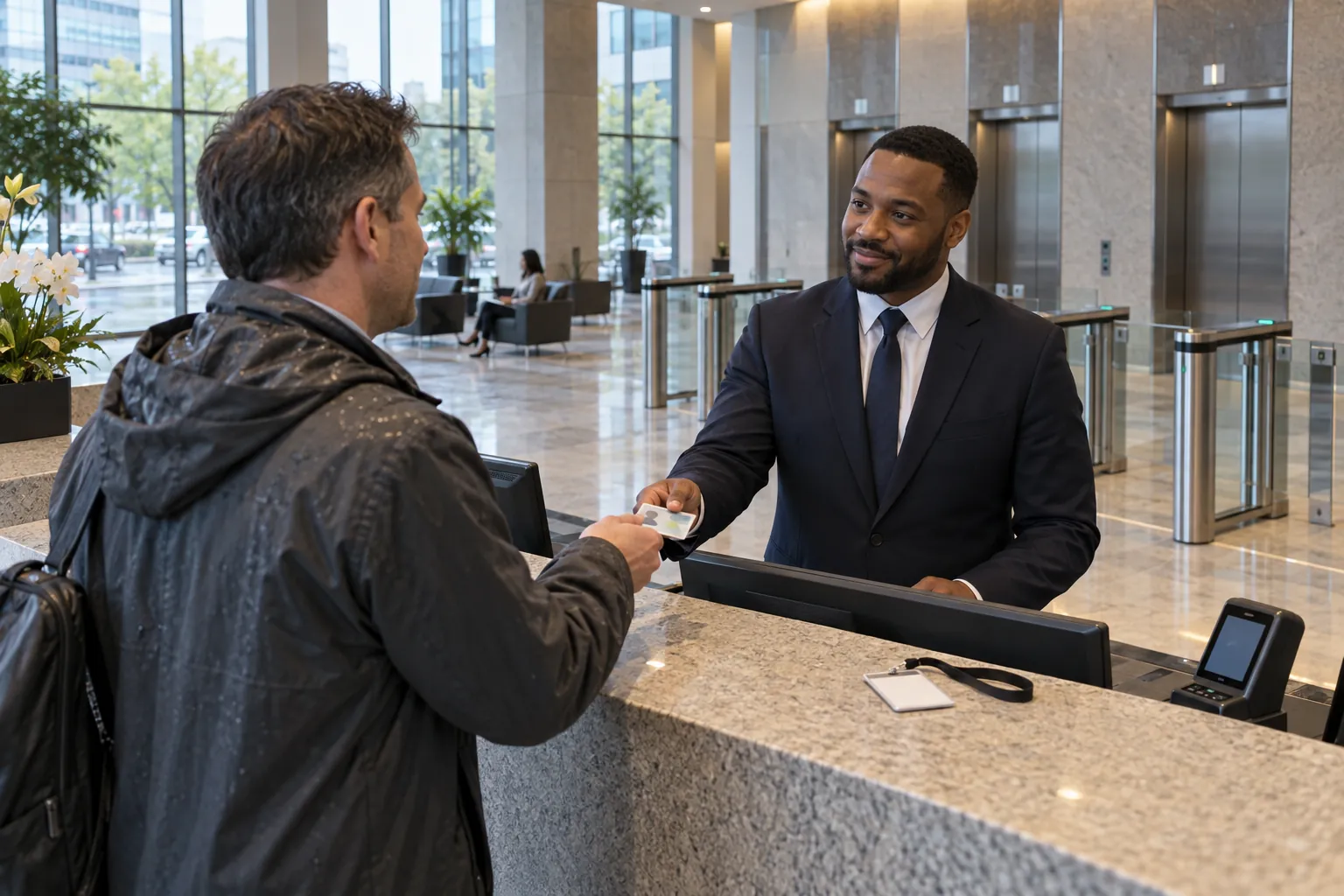
The officer is the first person most visitors meet and the last line between the street and the elevators. The post looks simple: a desk, a screen, a sign-in book. In practice it carries access control, visitors, deliveries, keys, alarms, emergencies and a stream of questions, often with nobody else on the floor. This guide covers the license behind the job, what the lobby post covers, the rules that apply at the desk, how a shift runs and how a supervisor or client can tell the work was done.
01
What a front desk security officer is, and the license behind the post
A front desk security officer, also called a lobby security officer, lobby ambassador or concierge security officer, staffs the main entrance of an office tower, a hospital, a residential building, a campus building or a corporate headquarters. The officer controls who goes beyond the lobby, receives visitors and contractors, handles deliveries, watches the cameras and alarm panel where the desk has them, and is the first to act when something goes wrong in the building. On many properties the same person also opens and locks up, walks short rounds of the ground floor and keeps the post's records.
There is no federal license for security officers. Licensing is state law, and it differs widely. Some examples, from each state's own regulator:
- California. A security guard must be registered with the Bureau of Security and Investigative Services. Under the BSIS security guard training requirements, the Power to Arrest and Appropriate Use of Force courses come before assignment, two mandatory courses within 30 days, the remaining two within six months, and eight hours of annual training. The electives include Post Orders & Assignments, Access Control, Handling Difficult People, Workplace Violence and Evacuation Procedures, which between them describe most of a lobby shift.
- New York. The Department of State's security guard training requirements call for an 8 hour pre-assignment course, 16 hours of on-the-job training within 90 days of employment, described as a course relevant to the duties of guards, the requirements of the work site and the needs of the employer, and 8 hours of annual in-service training.
- Florida. A Class D security officer license requires 40 hours of professional training at a licensed school or facility under Florida Statutes section 493.6303.
Check the state, and sometimes the city, before staffing a post; rules on who needs a license, and whether in-house officers are covered, vary. Whatever the state requires, the front desk also needs site training, because the license says nothing about this building's visitors, doors or alarm panel. ASIS International's Private Security Officer Selection and Training Guideline (ASIS PSO-2019), a paid document, sets out a model approach; it is guidance, not law, unless a contract adopts it.
02
What the lobby post covers in practice
The post orders for a front desk set out the work for this particular building. Across most lobbies, they cover the same ground:
- Access control. Checking that people going beyond the lobby are allowed to, and watching for tailgating, where a second person follows a badge holder through.
- Visitor management. Signing visitors in, checking identification where the building requires it, calling up to the host, issuing and recovering visitor badges, and signing visitors out.
- Contractors and vendors. Confirming they are expected, and issuing and recovering keys or access cards.
- Deliveries and mail. Receiving packages and couriers, holding or routing them, and spotting anything suspicious.
- Key and badge control. Keeping the key box, the key log and the stock of blank or temporary badges, and reporting anything missing.
- Monitoring. Watching CCTV monitors, the intercom, door alarms and the fire alarm annunciator where the desk has them, and responding or calling out as the post orders say.
- Customer service. Answering questions and handling complaints calmly.
- Emergencies. The desk's role in the building's emergency action plan: raising the alarm, calling 911, directing people out, meeting the fire department or police and handing over what they need.
- Rounds and building checks. On many posts, short rounds of the ground floor, restrooms, stairwell doors, the parking garage entrance and the loading dock, plus opening and lockup checks.
- Reports. Logging found property and incidents, and keeping the daily activity report and the pass-down log.
Not every lobby carries every item: a residential front desk leans toward packages and guests, a hospital's toward wayfinding and visiting rules. The post orders say which apply here, and who the officer calls.
03
Visitors, deliveries and calls: the desk procedures
Most of a front desk shift is routine, and routine is where the rules slip. The procedures worth writing down, and training every officer who covers the post, relief officers included, are these.
Signing a visitor in. A typical sequence, adapted to the building's policy:
- Greet the visitor and ask who they are here to see.
- Check that the visit is expected, from the host's pre-registration or by calling the host.
- Check identification if the building's policy requires it, and record only what the policy says to record.
- Issue a visitor badge that shows the date, and explain where to go or wait for an escort.
- Record the time in, and on the way out the time out and the badge returned.
- At the end of the shift, reconcile the badges: any not returned are followed up or deactivated.
Before copying IDs or photographing visitors, the owner should take advice on its state's privacy law.
Contractors. A contractor who needs a roof or mechanical room should be expected and named on a work order, and signed out with any keys returned. An unannounced one asking for the roof key gets a call to the building engineer, not a key.
Deliveries and suspicious mail. The United States Postal Inspection Service's guidance on suspicious mail lists signs such as no return address, excessive tape and postage, and misspelled or badly written words. Its advice if one arrives is to isolate the item, keep a safe distance, wash your hands and call the Postal Inspectors, and to contact local authorities if medical attention is needed. The desk's procedure should add the building's own steps: who to tell, and whether the area is cleared.
Threatening calls. The front desk often answers the building's main number. CISA's Bomb Threat Checklist gives instructions for responding to a bomb threat and the details that help law enforcement. A copy belongs beside the desk phone.
Tailgating and refusals. The post orders should say what the officer does when someone follows a badge holder through, refuses to sign in or will not leave. Generally, a private security officer has only the powers of a private person, which is why California requires its Power to Arrest course before assignment. The usual answer at a lobby is to challenge politely, record, and call the supervisor or police; the limits on what a security guard can do apply at the desk as anywhere else.
04
Exits, emergencies and workplace violence: the rules that reach the desk
There is no OSHA standard for front desk security. But the lobby officer controls doors and is often the first to act in an emergency, so several general rules land on the post.
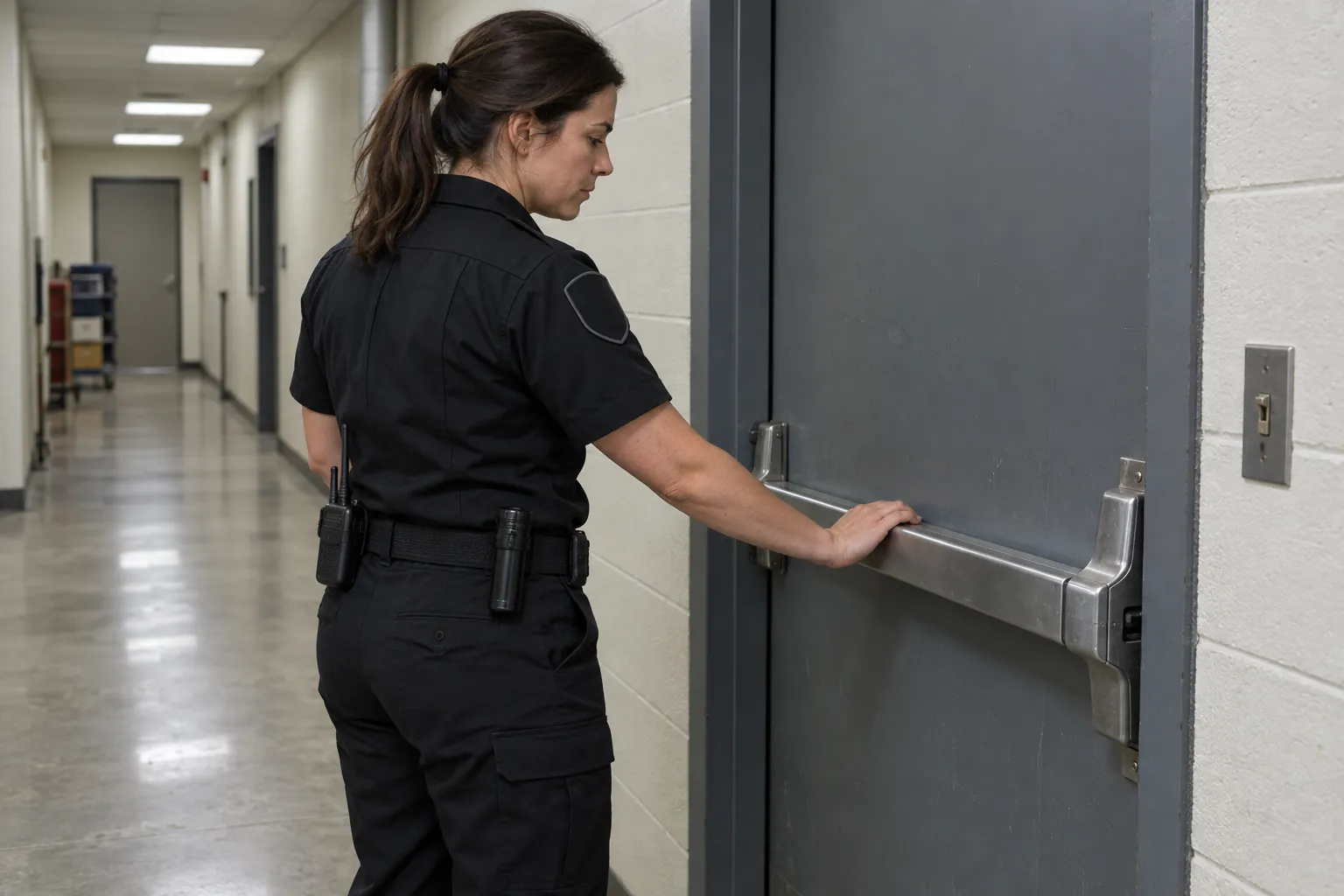
Exit doors stay usable. Under OSHA's exit route standard, 29 CFR 1910.36, employees must be able to open an exit route door from the inside at all times without keys, tools or special knowledge, and exit route doors must be free of any device or alarm that could restrict emergency use of the exit route if the device or alarm fails. Securing a building from the outside is the officer's job; locking or chaining an exit to stop people leaving is never part of it, and post orders should say so plainly. Local fire codes add their own rules on locking arrangements, so the building's fire safety plan says how each door is meant to work.
The emergency action plan. Where an OSHA standard requires one, 29 CFR 1910.38, emergency action plans, requires, among other things, procedures for reporting a fire or other emergency, for evacuation, and for accounting for all employees afterward. The front desk usually has a named part: raising the alarm, calling 911, bringing the visitor list to the assembly point so visitors are accounted for too, and meeting the fire department. The post orders should repeat that part word for word.
Workplace violence. OSHA's workplace violence page defines workplace violence as any act or threat of physical violence, harassment, intimidation or other threatening behavior that occurs at the work site. It says there are currently no specific OSHA standards for workplace violence; OSHA's workplace violence enforcement page explains that the general duty clause, Section 5(a)(1) of the OSH Act, still requires a workplace free from recognized hazards. The main page lists customer service agents and others who may work alone or in small groups among the workers at increased risk, and names working late at night as a further risk factor. A lobby officer on a night shift can be all three.
California. Since July 1, 2024, most California employers must have a workplace violence prevention plan and keep a violent incident log under Labor Code section 6401.9. The law defines four types of workplace violence. Two of them start at the front door: Type 1, by a person with no legitimate business at the worksite, and Type 2, by customers, clients or visitors. The log records each incident's date, time, location and circumstances, with personal identifying information left out, and records are kept for at least five years. The front desk officer is often the one who sees the incident first, so the officer's report is where the employer's log entry starts; the log itself is the employer's.
Active assailants. CISA's active shooter preparedness resources include training and an emergency action plan product suite. The lobby officer's part, including how to warn the building, belongs in the post orders and in drills.
05
How a front desk shift runs, and how the post is checked
A lobby post works best when every shift follows the same routine, so that any trained officer can take it over and a supervisor can see at a glance what was done.
- Start of shift. Read the pass-down log and any new instructions. Count the keys and visitor badges against the log. Test the radio and phone. Check that the CCTV monitors, intercom and door alarms show as working, and report any fault.
- Opening. Where the desk opens the building: unlock the entrances in the agreed order, check the lobby, restrooms and elevator lobbies, and confirm that exit doors are clear and unobstructed.
- Through the day. Visitors, contractors and deliveries as above. Short rounds at set times where the post orders call for them, for example the ground floor stair doors, the loading dock and the garage entrance, with the desk covered while the officer is away or the round timed for a quiet period.
- Incidents. Record each one as it happens in the daily activity report, with the time, the place, what was seen, what was done and who was told. Anything serious gets its own incident report.
- Lockup. Check the building is clear as the post orders describe, lock the entrances, set the alarm where the desk does that, and check the doors that should be secure are secure.
- End of shift. Count keys and badges again, reconcile visitor badges, write up the pass-down log for the next officer and hand over the post in person where possible.
Supervision. A security supervisor checks a lobby post with an unannounced visit, a test visitor who was not pre-registered, a look at the badge count and a question about the emergency plan, and reads the daily activity reports for patterns: the same door alarm every night, rounds always written up at the same minute.
The client's view. The property manager should ask for the concrete: rounds due and done, with times; incidents and what happened next; faults and whether they were fixed. All secure, no incidents every night for a month says little.
06
Where the record fails, and where SiteClara fits
The post orders say the lobby officer checks the stair doors, the loading dock and the garage entrance at 10 p.m., midnight and 2 a.m. The daily activity report says rounds completed, all secure, three times, in the same handwriting, written at the end of the shift. Nobody can tell from that whether the garage door was checked, when, or whether the officer ever left the desk. A fault spotted at the dock goes into a binder, and the door is still broken a week later.
SiteClara turns the rounds and checks in the post orders into a record. A printed QR poster, with an optional NFC tag behind it, goes at each point the orders name: the stair doors, the dock, the garage entrance, the desk itself for the start-of-shift and lockup checks. The officer scans the code or taps the tag on their own phone, with no app to install, sees the checks due at that point and marks them done, or says what stopped them, such as a door that will not latch. The time and the named officer are recorded as it happens, with a photo when one helps. A problem found on the round is reported there and goes onto the team's list of jobs until someone closes it.
The security supervisor sees what was due, done and missed, with the reason where one was given, and a job that needs the building manager can be escalated to them to answer. Each day the supervisor reviews the totals and photos, adds a note and approves a report that goes to the nominated client or management contacts at 8 a.m. the next morning, showing how the scheduled checks went and what is still open.
07
Questions people ask
What are the responsibilities of a front desk security officer?
Controlling who goes beyond the lobby, receiving visitors, contractors and deliveries, watching the alarms and cameras, responding to emergencies and writing up what happened on the shift. The Bureau of Labor Statistics' Occupational Outlook Handbook: Security Guards and Gambling Surveillance Officers lists the duties of security guards generally, including to control building access by employees and visitors, monitor alarms and video-surveillance systems, respond to emergencies and write reports on what they observed while on duty. The post orders say which of these apply at a particular front desk.
What is front desk salary?
For security officers, the Bureau of Labor Statistics' Occupational Outlook Handbook: Security Guards and Gambling Surveillance Officers gives a median annual wage for security guards of $38,020, or $18.29 an hour, in May 2025. Of the industries it lists, the median was highest in healthcare and social assistance, at $44,920, and educational services, at $44,250, against $37,350 in investigation, guard and armored car services, where contract security companies sit.
What disqualifies you from being a security guard?
It depends on the state. The Bureau of Labor Statistics' Occupational Outlook Handbook: Security Guards and Gambling Surveillance Officers says most states require security guards to be licensed, and that the usual qualifications are being at least 18, passing a background check and completing training. In New York, the Department of State's Become a Security Guard page requires an applicant to be 18, to have completed fingerprinting and not to have been convicted of a serious criminal offense. Check with the regulator in the state where the post is.
08
Further reading, and a list to take away
Start with your state's licensing regulator, then OSHA's exit route, emergency action plan and workplace violence pages, California's Labor Code section 6401.9 where it applies, CISA's Bomb Threat Checklist and the Postal Inspection Service's advice on suspicious mail.
Before an officer's next shift on the front desk, check that:
- the officer holds whatever license or registration the state requires, and has had site training for this lobby;
- the post orders say which duties apply here: access, visitors, contractors, deliveries, keys, monitoring and rounds;
- the visitor procedure says what is checked, what is recorded and how badges are recovered;
- the Bomb Threat Checklist and the suspicious mail steps are at the desk;
- the post orders repeat the desk's part in the emergency action plan, including the visitor list at the assembly point;
- no instruction tells the officer to lock or block an exit route;
- in California, the officer knows how to report an incident into the employer's workplace violence prevention plan;
- the rounds in the post orders have set times and a record made at the point, not at the end of the shift;
- faults found on rounds reach someone who will fix them, and someone checks they were fixed;
- the pass-down log is written up and read at every change of shift.
Sources
Every document this guide quotes or links to, in the order it first cites them.
- Security guard training requirements bsis.ca.gov
- Security guard training requirements dos.ny.gov
- Florida Statutes section 493.6303 leg.state.fl.us
- Guidance on suspicious mail uspis.gov
- Bomb Threat Checklist cisa.gov
- Exit route standard, 29 CFR 1910.36 osha.gov
- 29 CFR 1910.38, emergency action plans osha.gov
- Workplace violence page osha.gov
- Workplace violence enforcement page osha.gov
- Labor Code section 6401.9 leginfo.legislature.ca.gov
- Active shooter preparedness resources cisa.gov
- Occupational Outlook Handbook: Security Guards and Gambling Surveillance Officers bls.gov
- Become a Security Guard dos.ny.gov
Related guides
 Security patrolsSecurity post orders: what they should say, and how to know they are followedSecurity post orders in the US: what they are, what state rules say, what to include, how to write, sign and review them, and how to check they are followed.
 Security patrolsSecurity guard duties and responsibilities: what the job involves, and how it is checkedSecurity guard duties in the US: state licensing and training, patrols, access control, reports, the limits of the role, and how post duties are set and checked.
 Security patrolsSecurity daily activity report: what to include, and how to write one that holds upThe security daily activity report (DAR): what to record, how to write entries that hold up, how it differs from an incident report, and how to review and keep it.
 Security patrolsSecurity pass-down log: what to hand over, and how to make the shift change stickThe security pass-down log: what the outgoing officer hands over, how to run the shift change, how to write entries that stay useful, and how to review and keep it.